
The Trier Christmas Market is one of Germany’s lesser-known markets. Located in western Germany, not far from Luxembourg, this ancient city is home to a small Christmas market and several churches and historical sites well worth visiting.
We visited the Trier Christmas Market as part of a bigger trip to northern Germany. Cologne was our home base for exploring the area. In the morning, we started in Traben-Trarbach, which is home to the underground Mosel Wine and Christmas Market, and spent the afternoon in Trier.
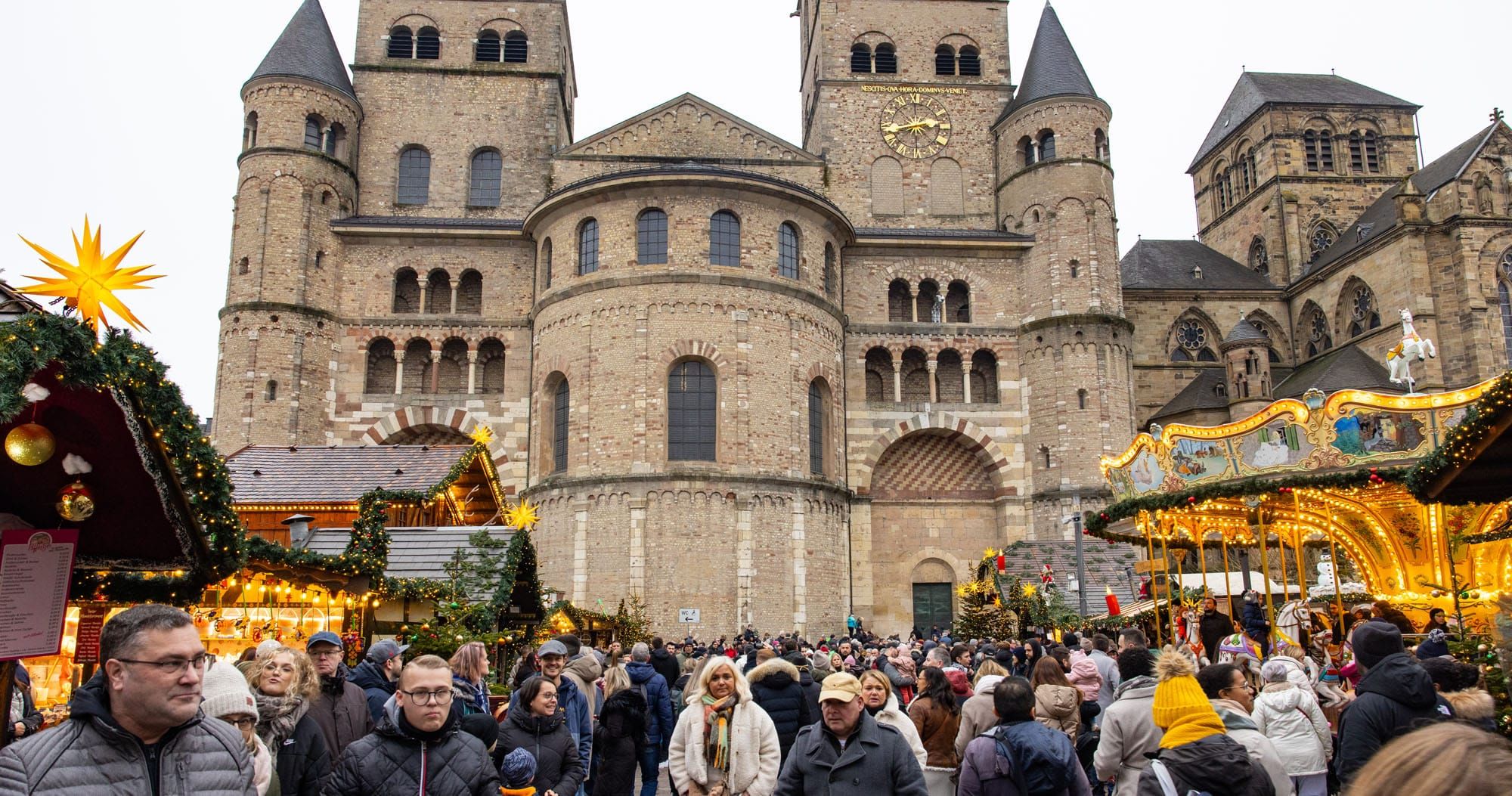
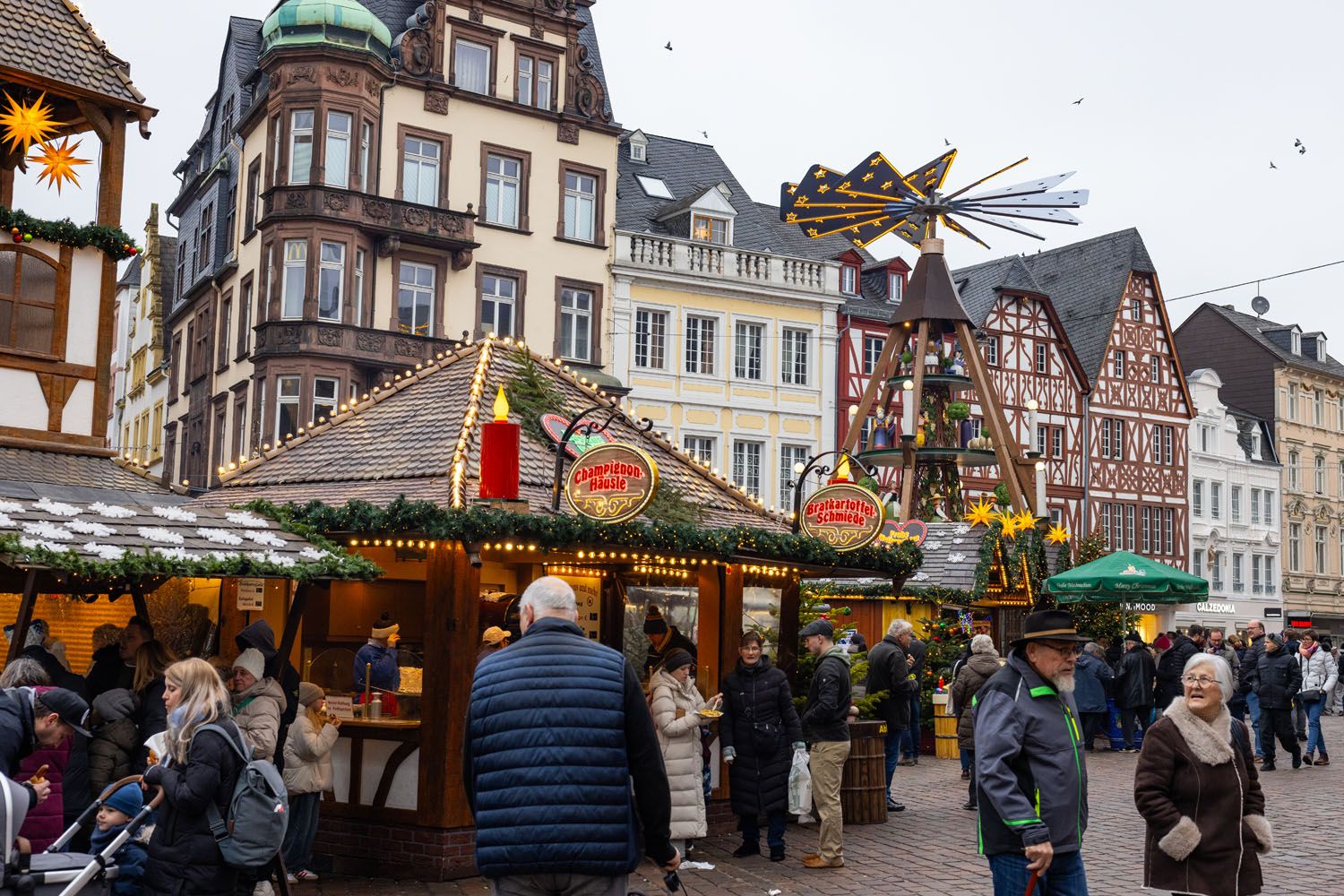
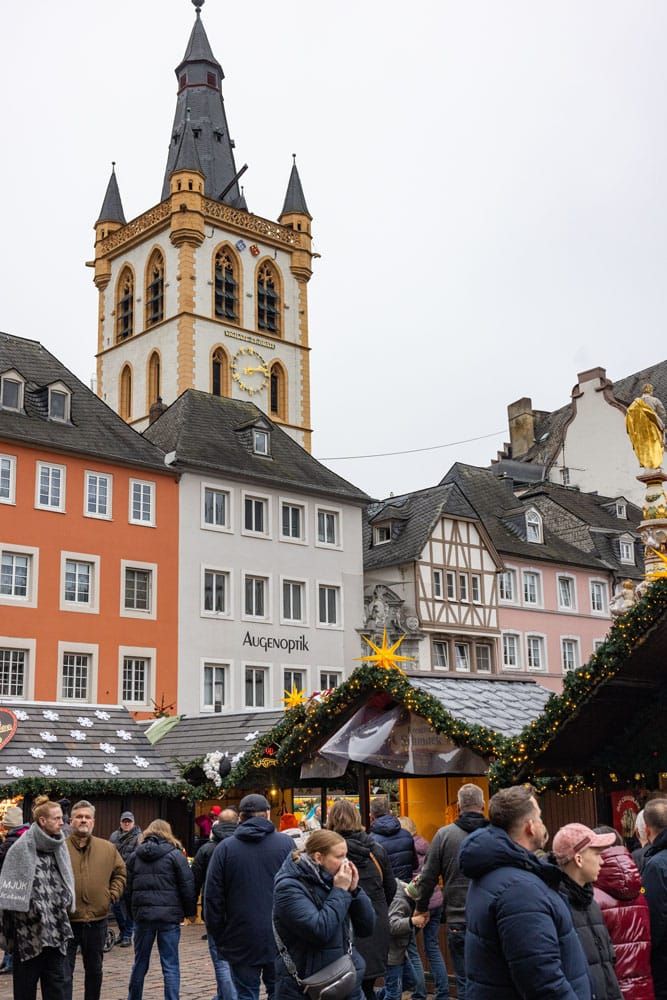
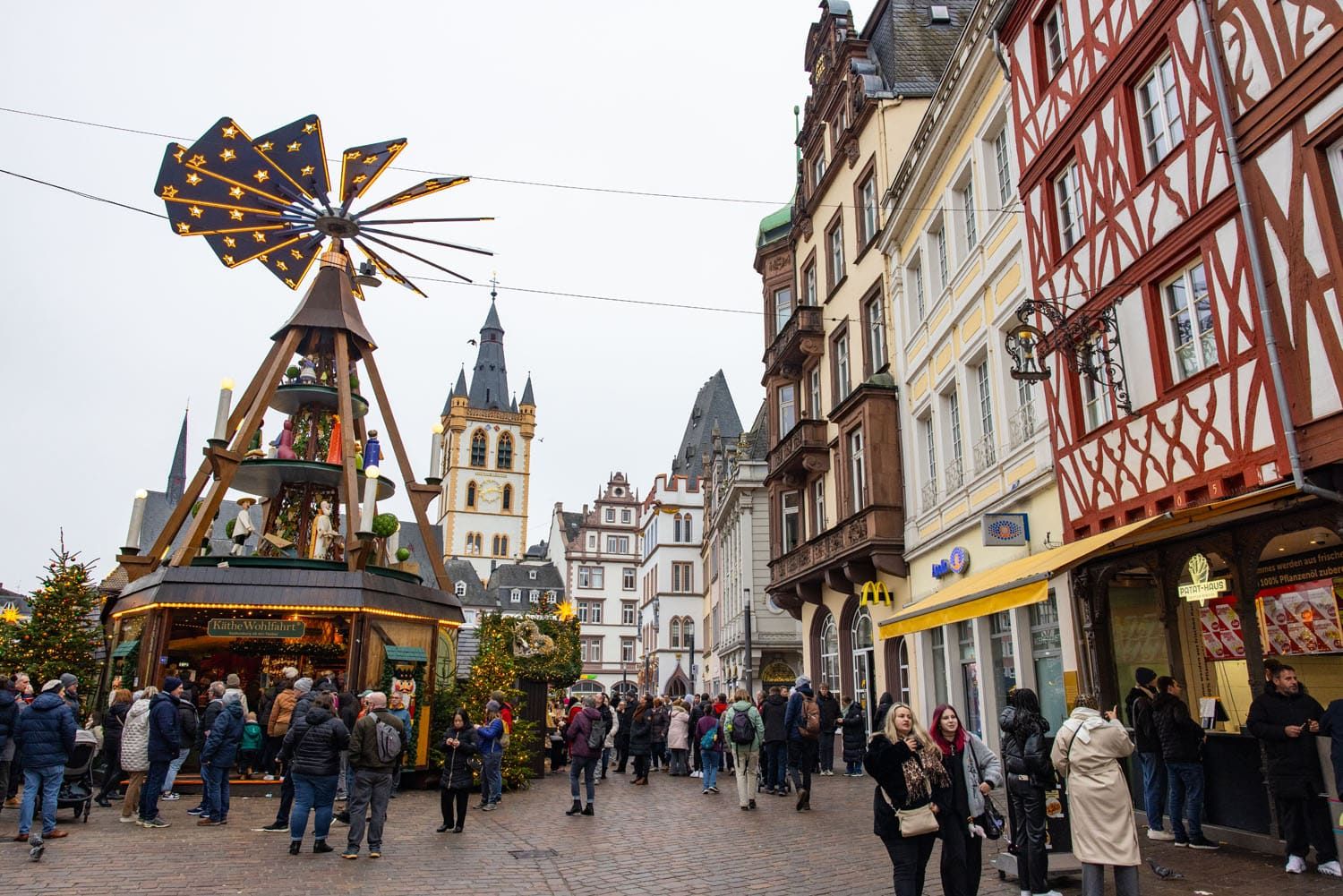
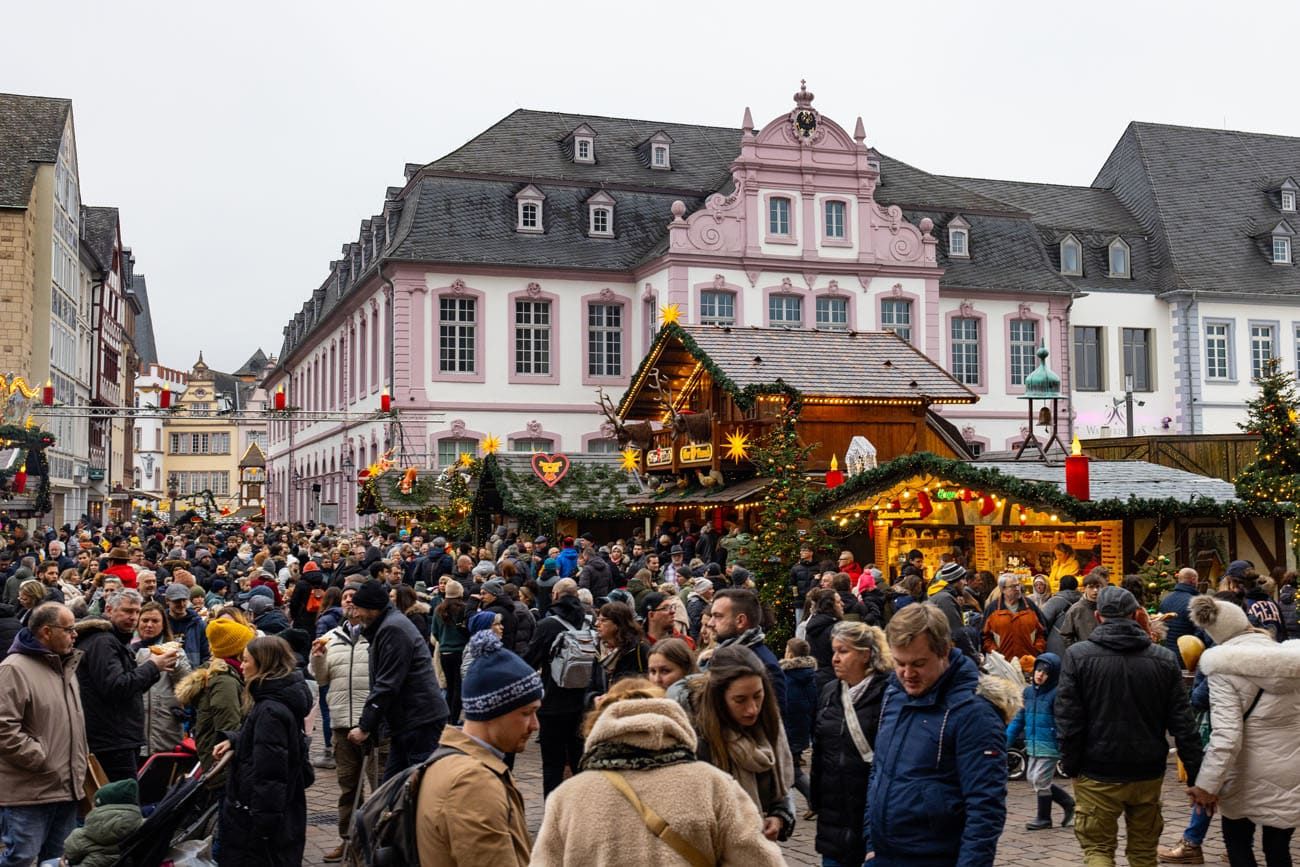
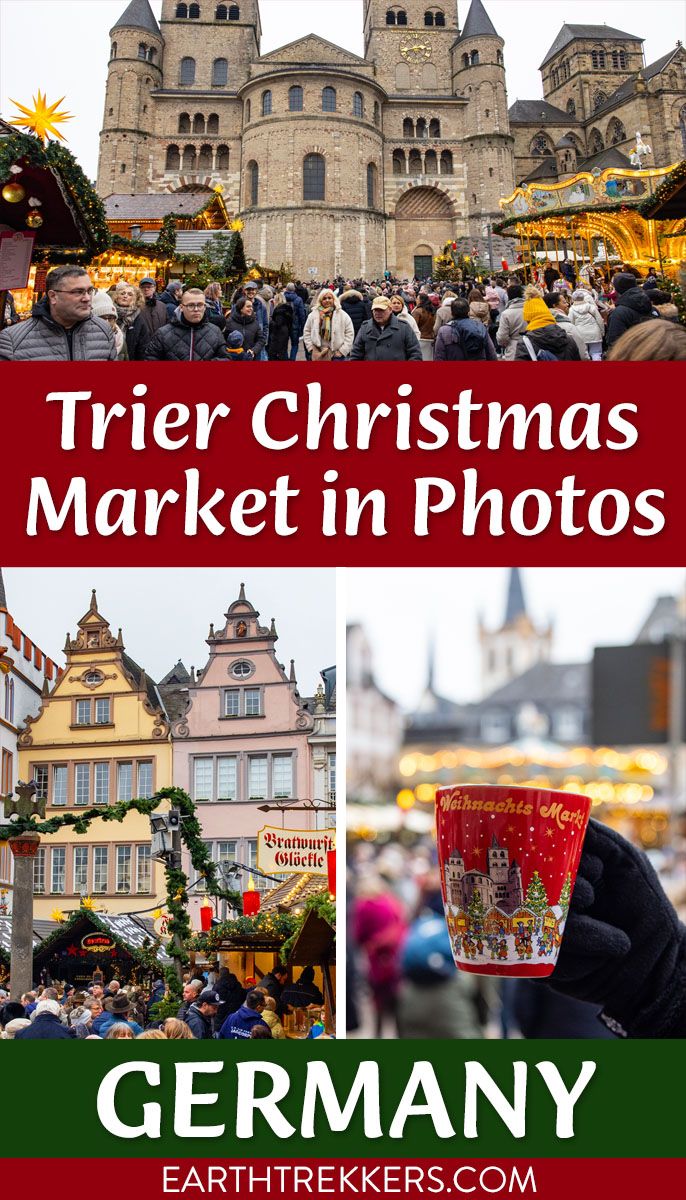
The Trier Christmas Market is mostly set in Hauptmarkt, the main square of this small town. It is a lovely setting for a Christmas market, with colorful buildings and the cathedral as the backdrop.
In this guide, we’ll take you through the Trier Christmas Market in photos, let you know if we thought it was worth it, plus list a few worthwhile sights to see while in Trier.
What is Trier?
Trier is Germany’s oldest city and one of the most important Roman settlements north of the Alps. Founded by the Romans in 16 BC, Trier later became the capital of the Western Roman Empire, leaving behind some of the best-preserved Roman monuments in Europe. These include the monumental Porta Nigra, the Roman Amphitheater, and several impressive bath complexes.
After the Roman era, Trier passed through the hands of the Franks, the French, and the Prussians, adding layers of medieval and Baroque architecture to the cityscape.
Today, medieval highlights include St. Peter’s Cathedral, one of Germany’s oldest churches, and the Hauptmarkt, Trier’s lively historic center. Compact and walkable, Trier offers a fascinating mix of Roman ruins and medieval charm.
The Trier Christmas Market
Open: November 21 to December 22, 2025
Hours: Monday through Thursday 11 am to 8:30 pm; Friday and Saturday 11 am to 10 pm; Sundays 11 am to 8 pm
Location: Hauptmarkt (the main market square)
Cost: Free
Website: trier-weihnachtsmarkt.de
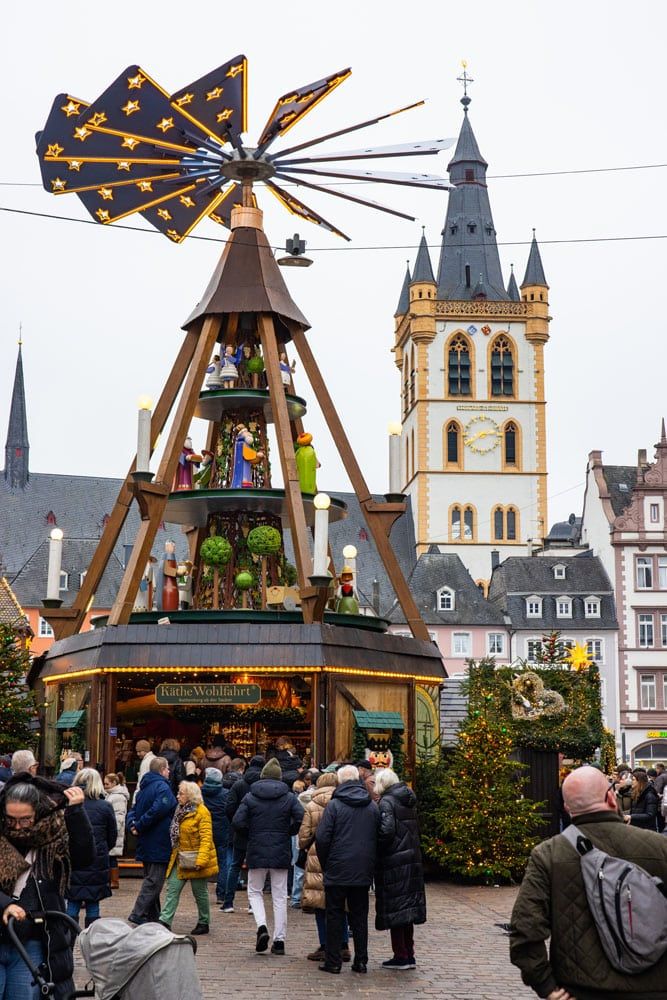
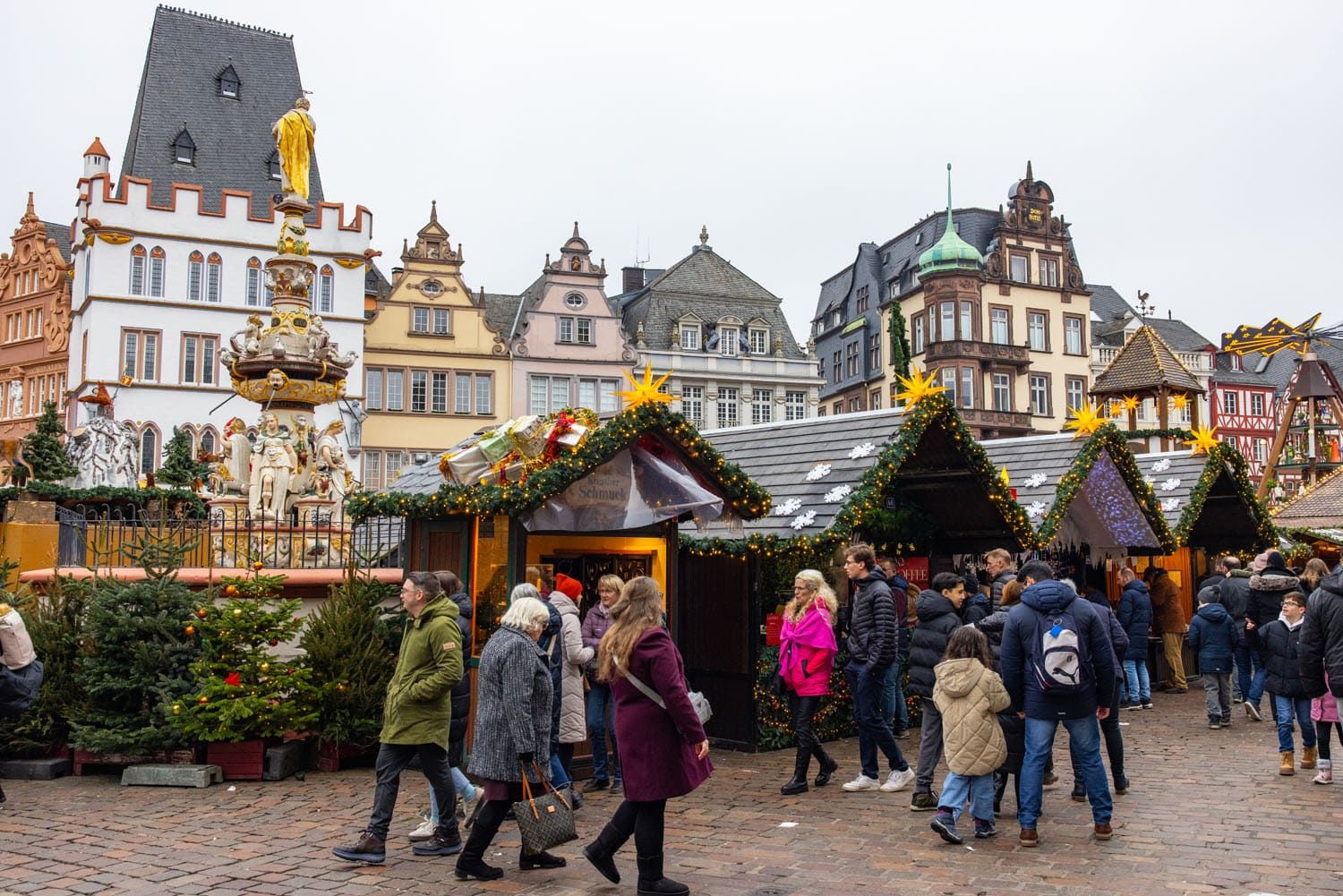
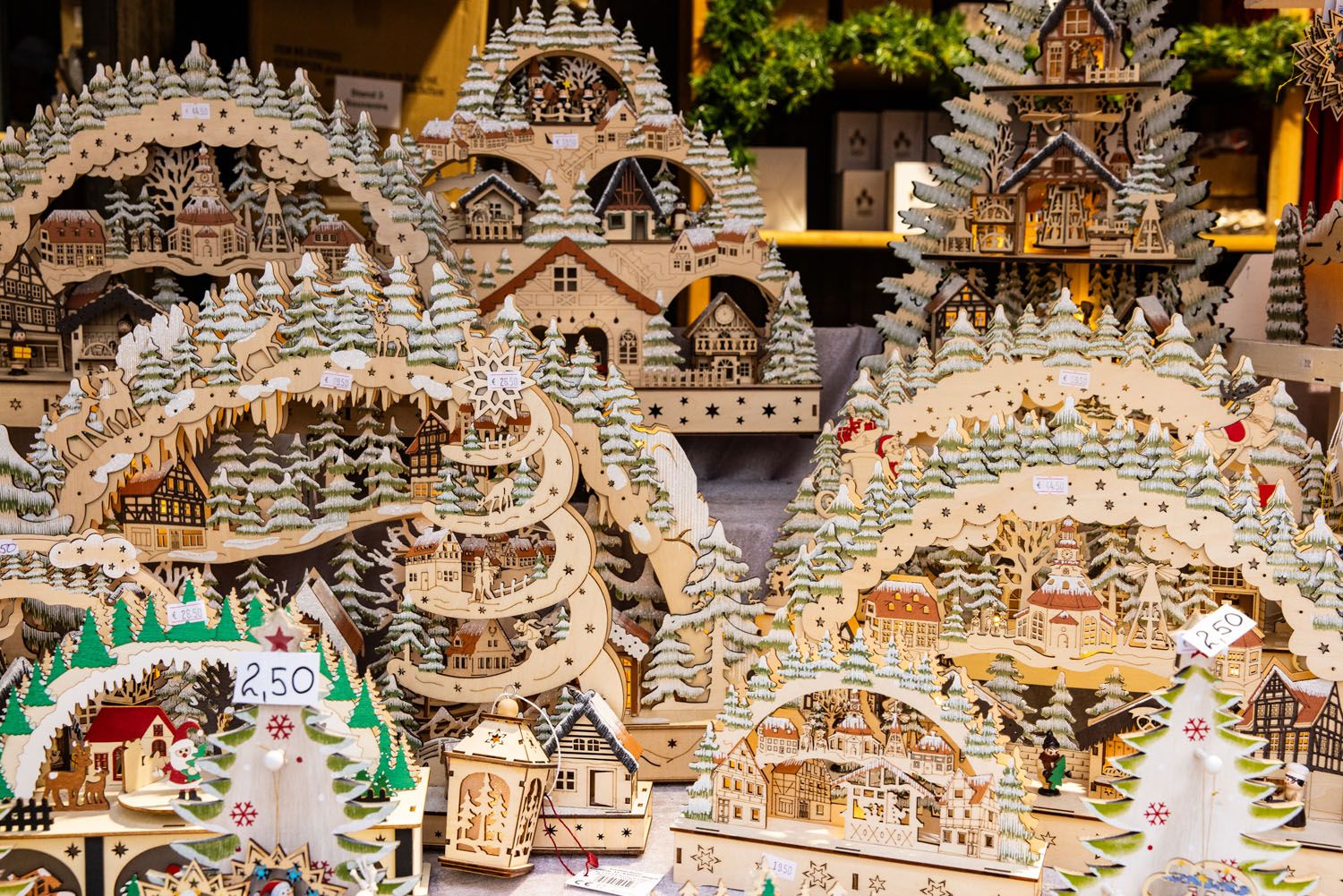
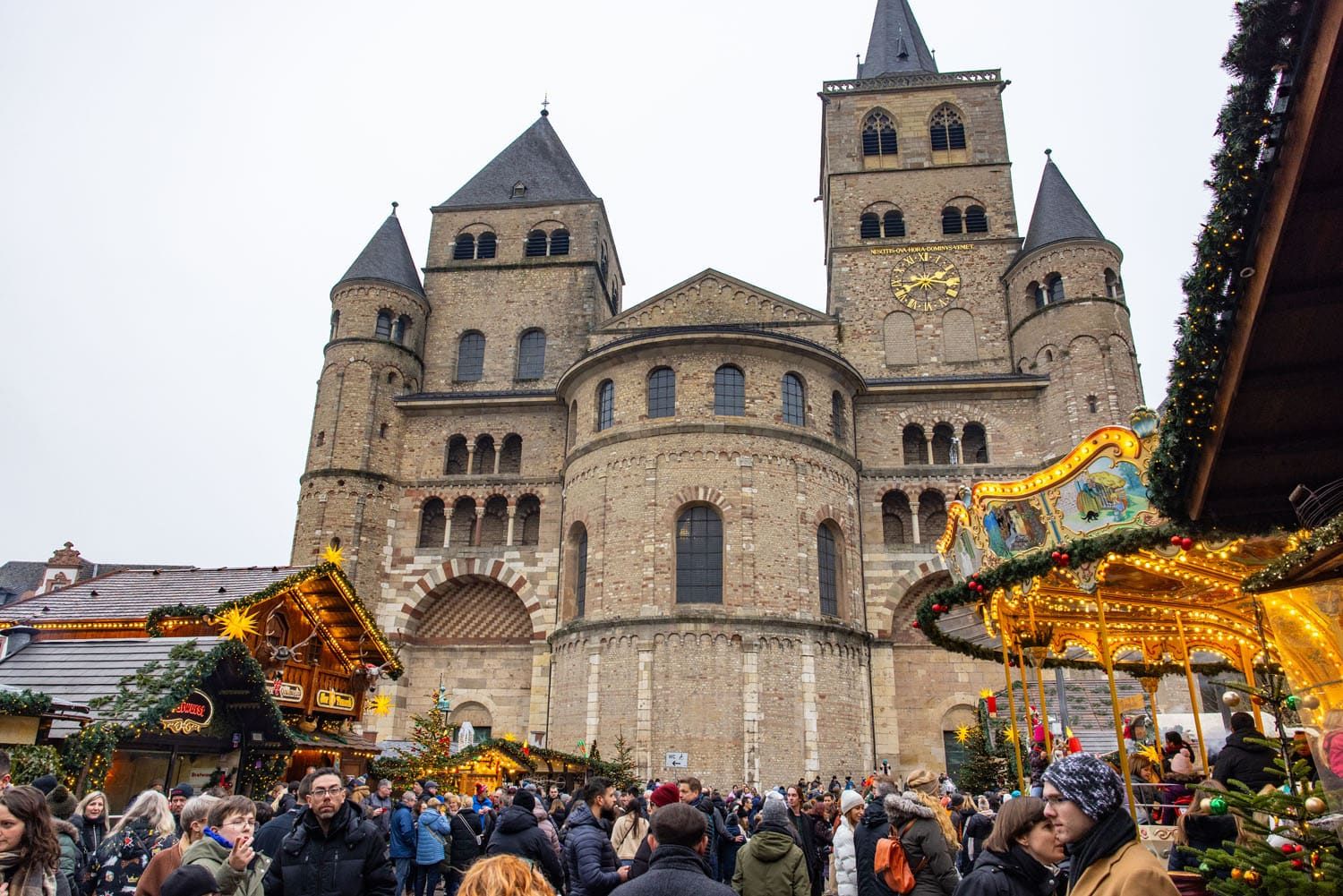
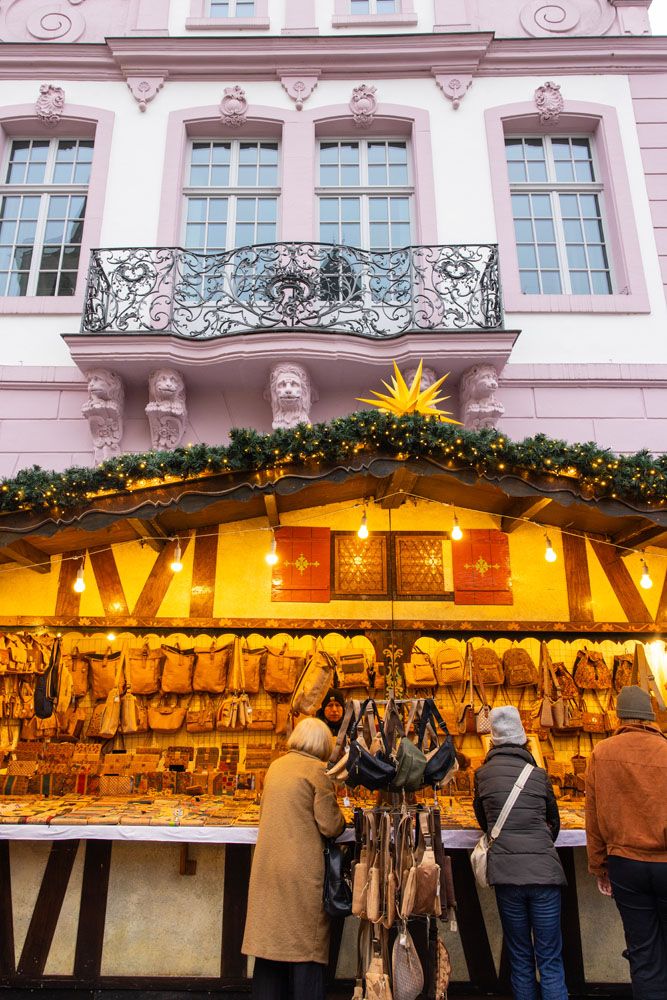
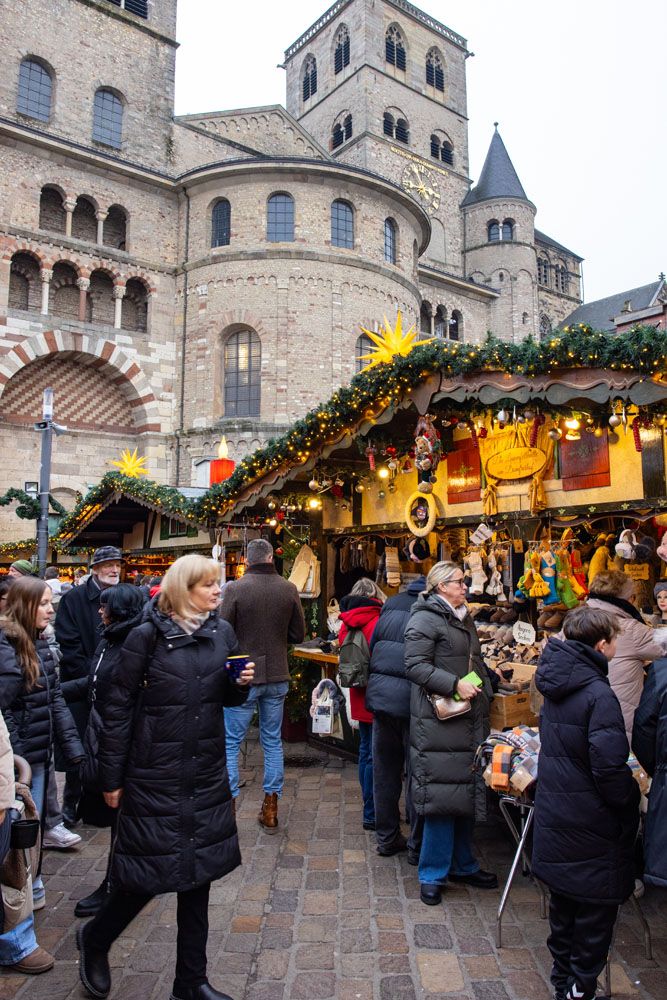
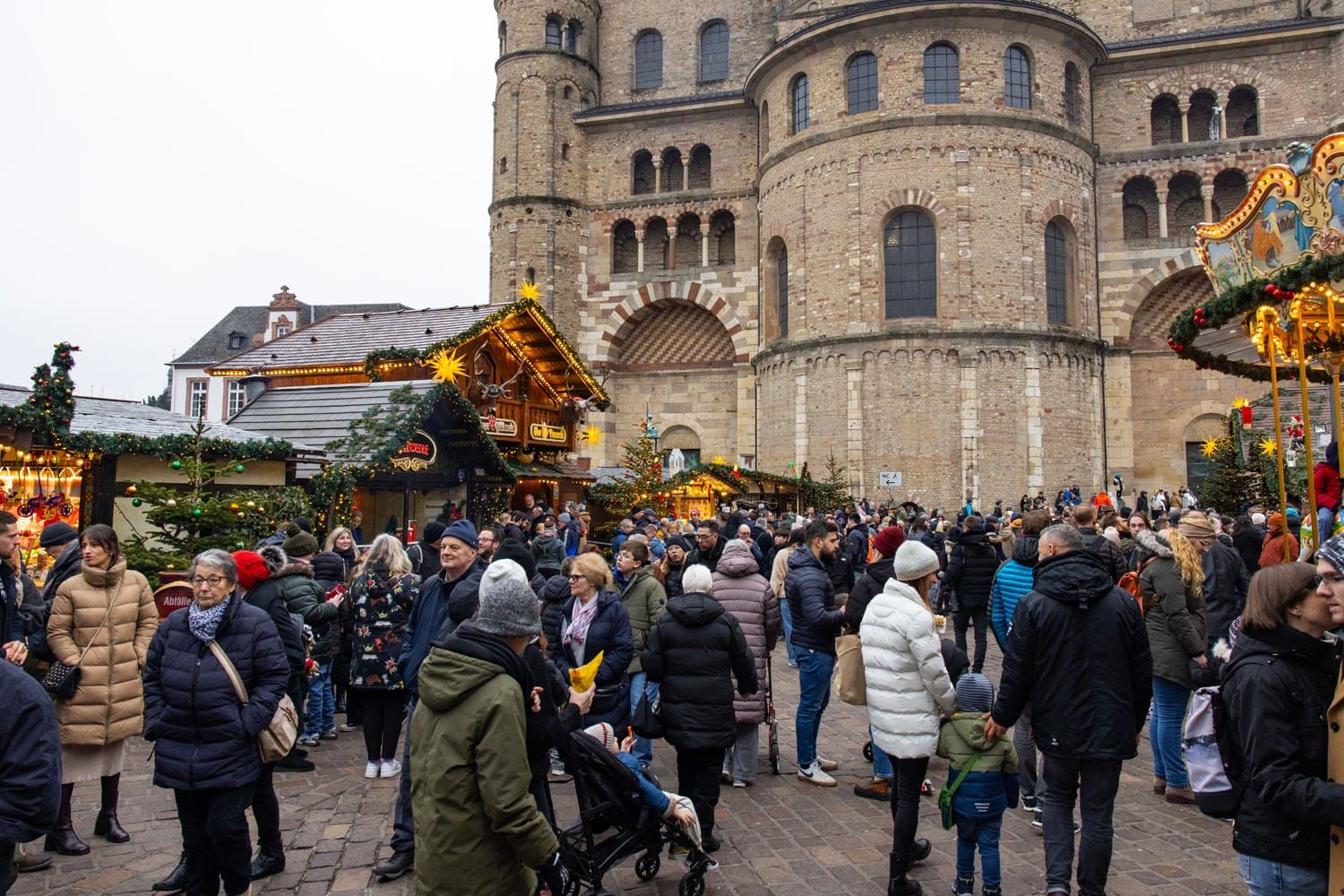
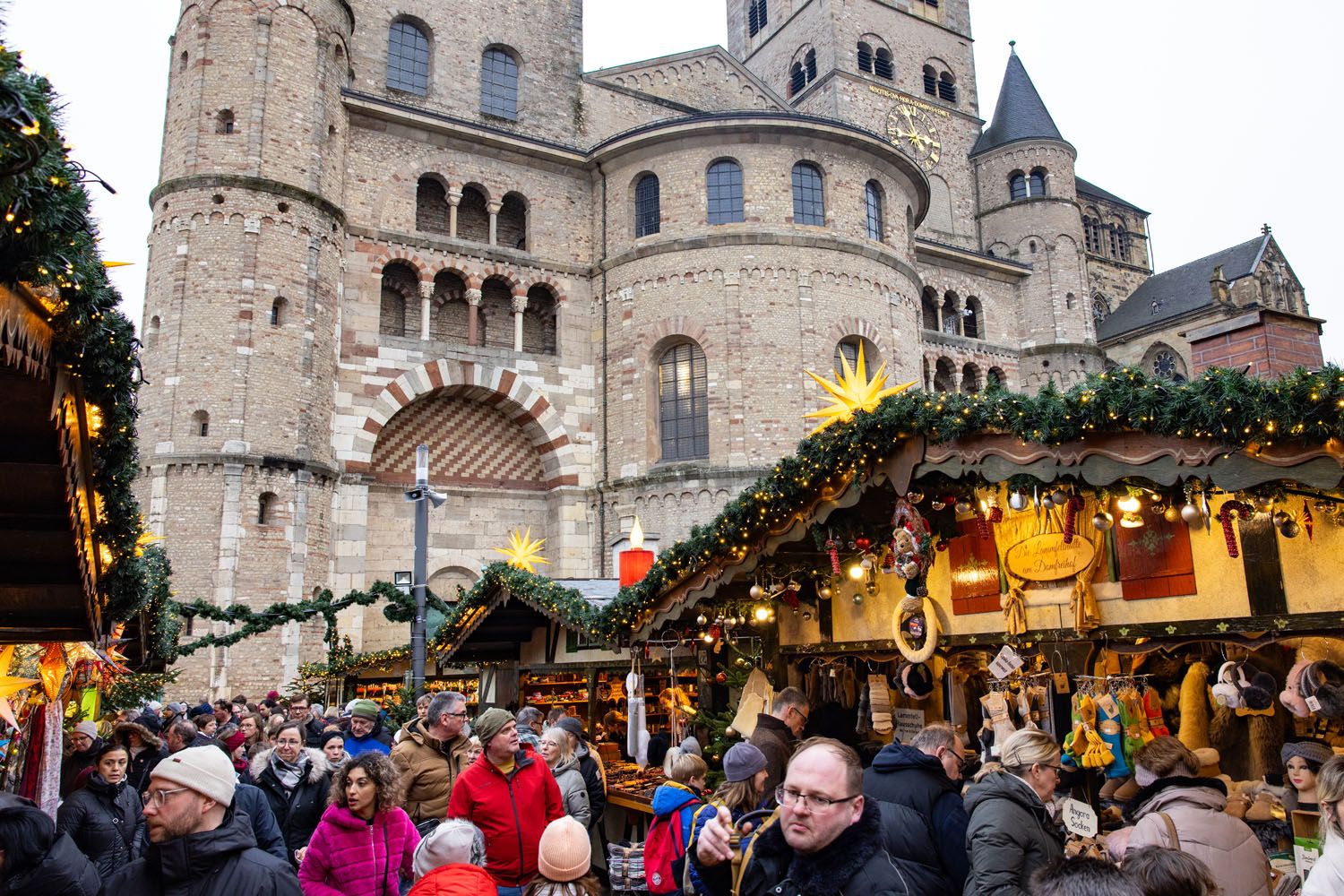
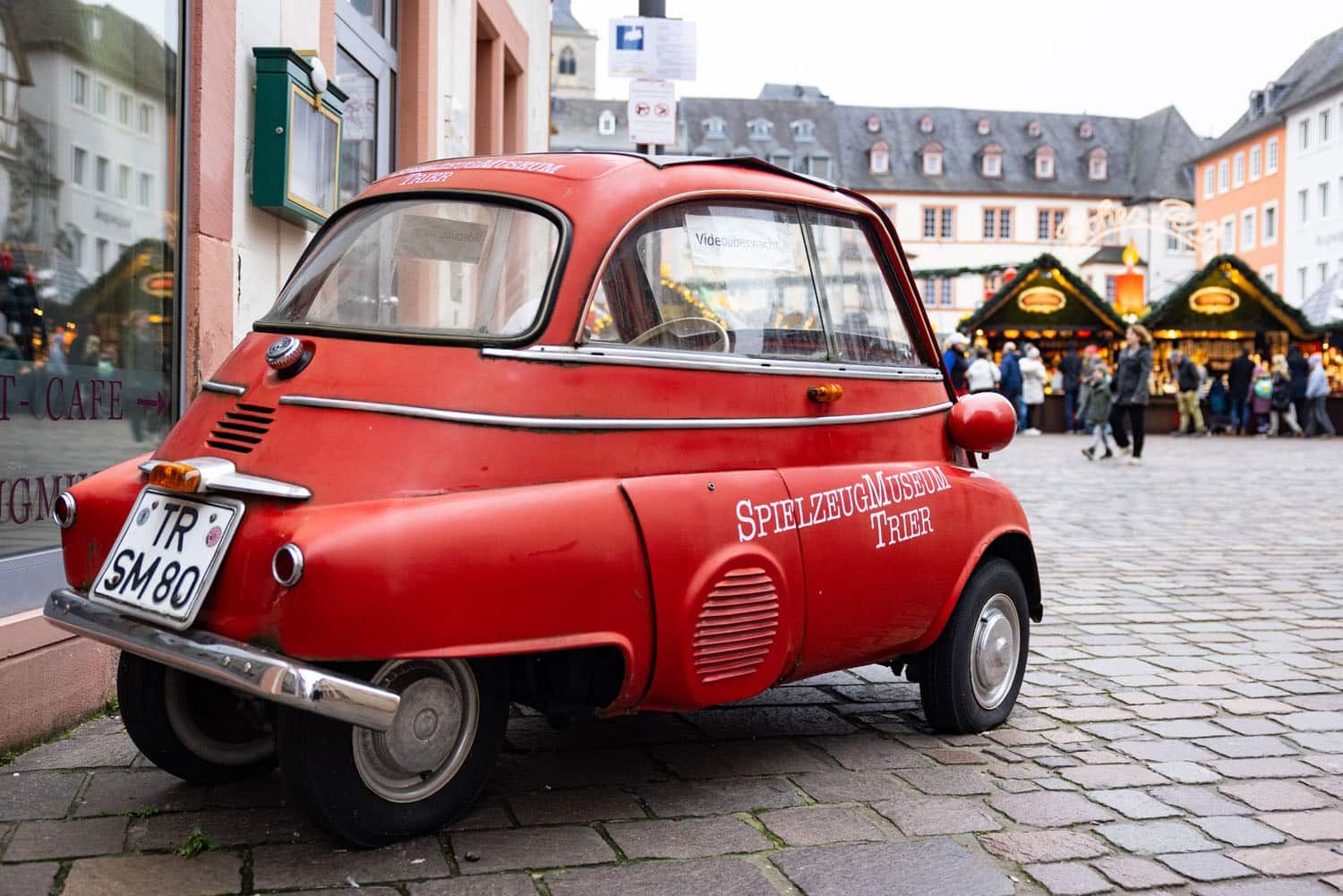
During the Christmas season, the Trier Christmas Market fills the Hauptmarkt and extends toward the front of St. Peter’s Cathedral. The stalls are decorated with garlands, lights, and figurines, creating a cozy and festive atmosphere. Vendors sell traditional Christmas market foods, regional wines, handmade gifts, and decorations, matching the atmospheric holiday markets throughout Germany.
While researching which Christmas markets to visit, several other travel websites highlighted the Trier Christmas Market as a cozy Christmas market with a more local feel. So, Trier was added to our trip.
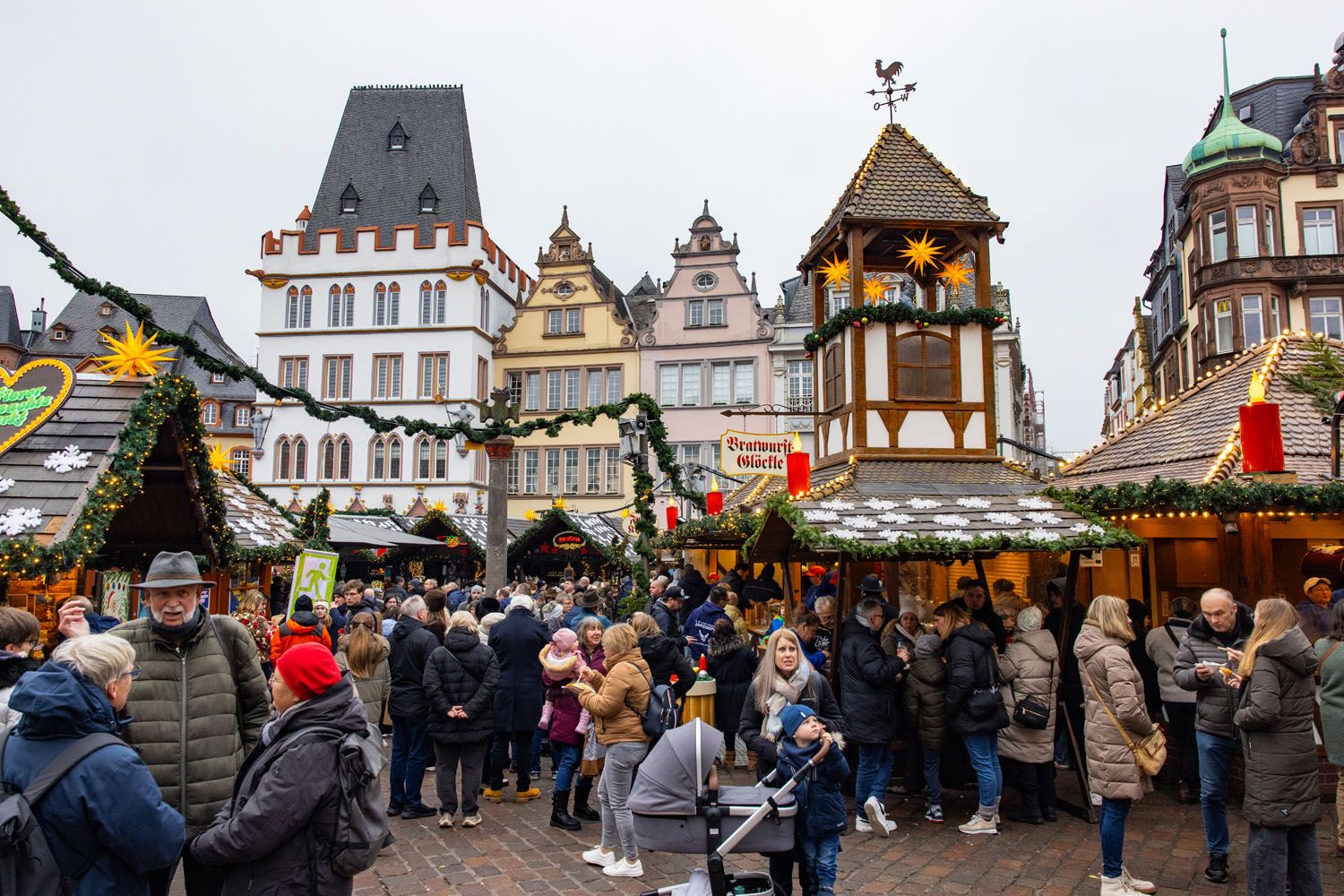
We spent several hours in Trier, both in its market and visiting the sites in town, which we’ll list next in this guide.
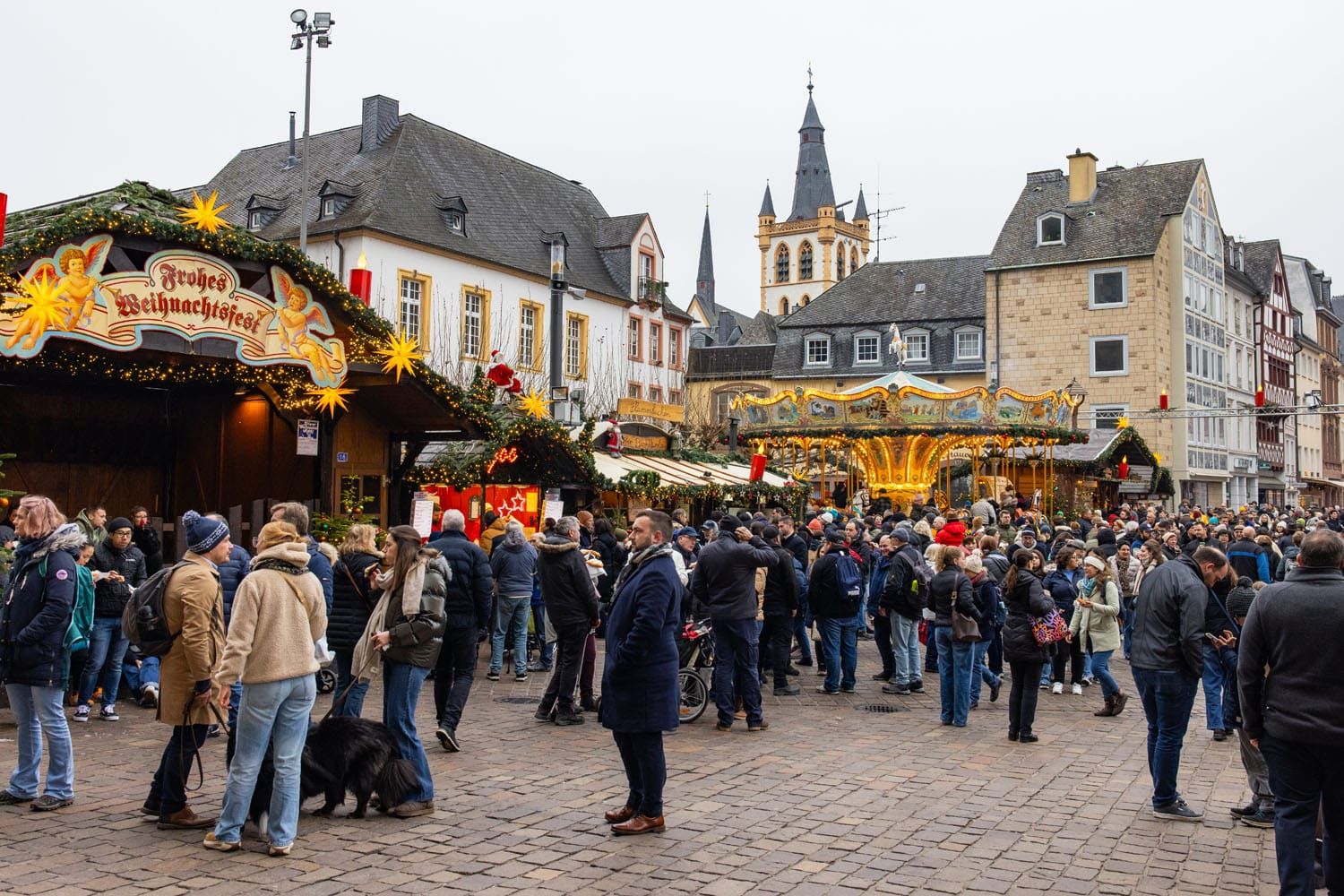
Our visit was on a Monday, and in our experience, one of the least crowded times to visit Christmas markets. We were surprised by the large number of people at this market. For a small town, it was one of the most crowded markets we visited in Germany, which really took away from its appeal.
However, the setting is stunning, with the Trier Cathedral forming a picture-perfect backdrop for the market, plus the colorful buildings in the main square.
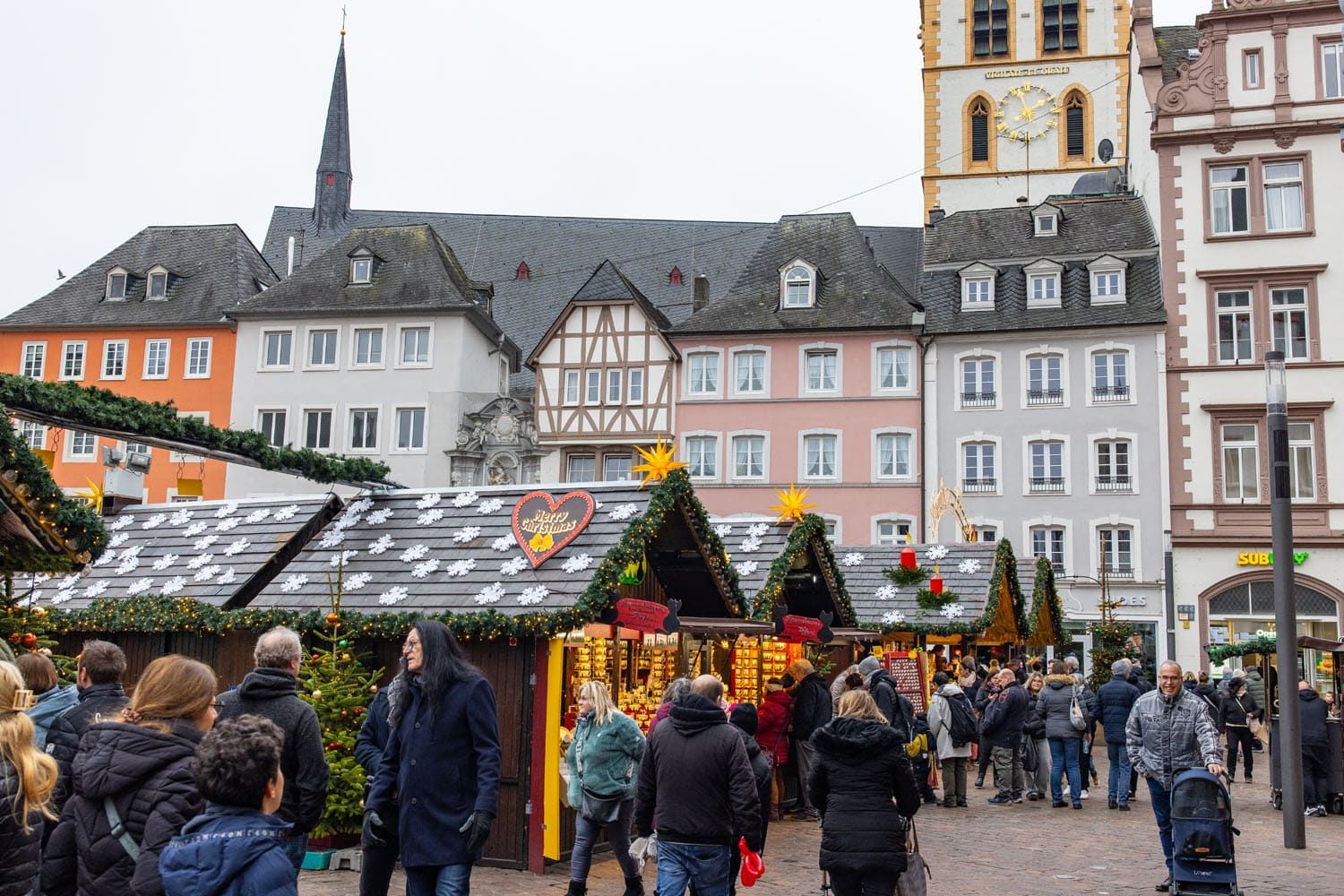
This market is very small, with food and drinks being the main items for sale and a small number of stalls selling crafts and gifts.
Trier Christmas Market in Photos
Journey through the Trier Christmas Market in photos.
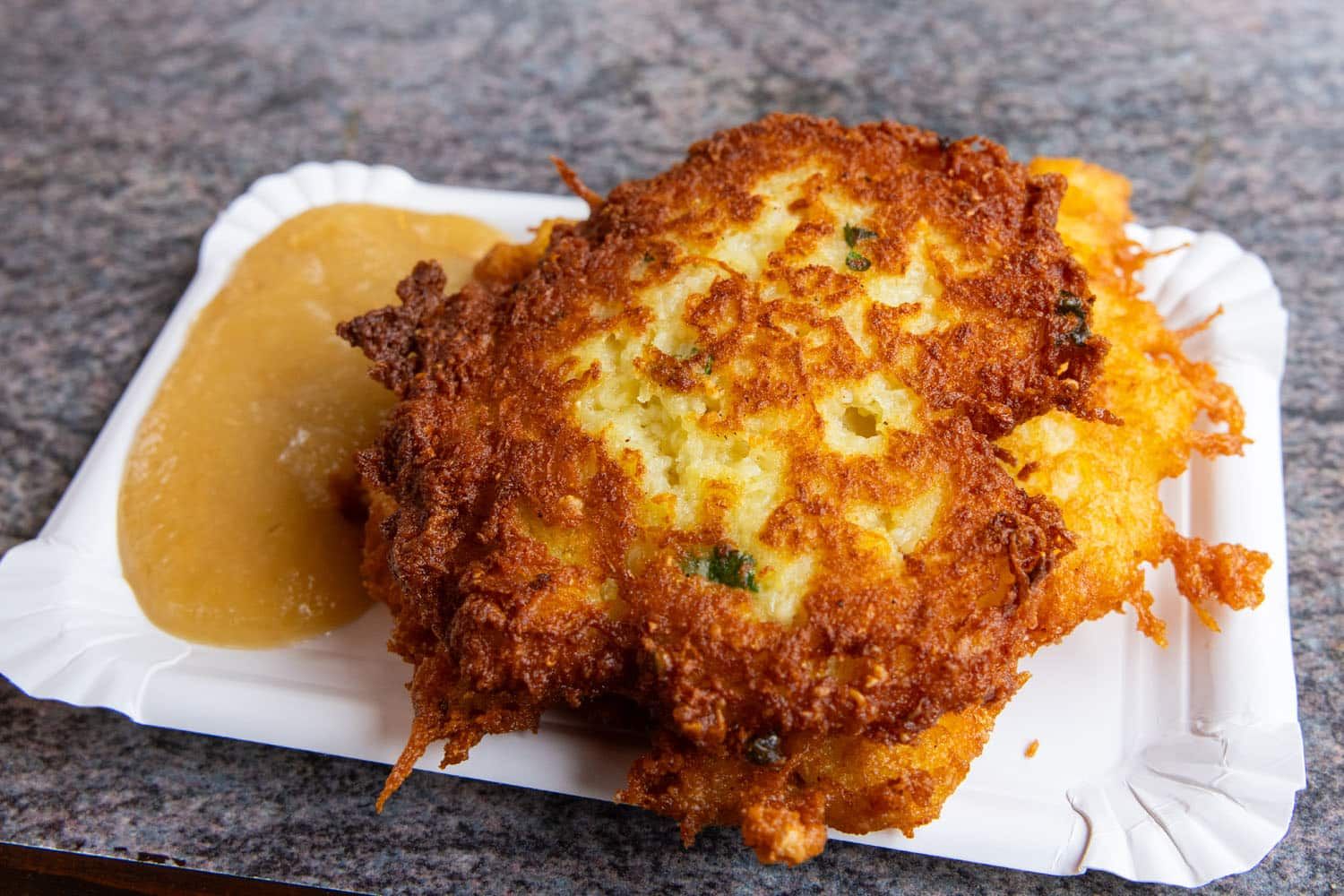
Kartoffelpuffer
So, is the Trier Christmas Market Worth It?
We have visited a lot of Christmas markets in Germany and throughout Europe, and this was one of our least favorites. That’s not to say that we didn’t enjoy this one, but there were many more we liked a lot more.
The Trier Christmas Market is a beautiful market, with its decorated stalls and old-town backdrop, but the crowd size, especially given it was a Monday, really took away from the overall experience for us.
We don’t think it is worth going out of your way to visit this Christmas market. However, it is worth it if you will already be in the area (such as pairing it with the Mosel Wine and Christmas Market in Traben-Trarbach, like we did) or if you like the idea of visiting the other sites in Trier (keep reading!).
Not far from Trier is Aachen, another ancient German city, home to a lovely Christmas market that all four of us liked more than Trier or the Mosel Wine and Christmas Market.
A bit farther away, Heidelberg is a charming German city on the Moselle River, a delight to explore. Its Christmas market isn’t particularly remarkable, but the town itself is well worth a few hours of exploration.
You can see all of our Christmas market write-ups in our guide to the European Christmas Markets ↓
Things to Do in Trier
Hauptmarkt
As mentioned earlier, the Hauptmarkt is the setting for Trier’s Christmas Market and is Trier’s main square and the heart of the old town. It is surrounded by beautifully preserved medieval and Renaissance buildings, many with colorful facades and ornate details.
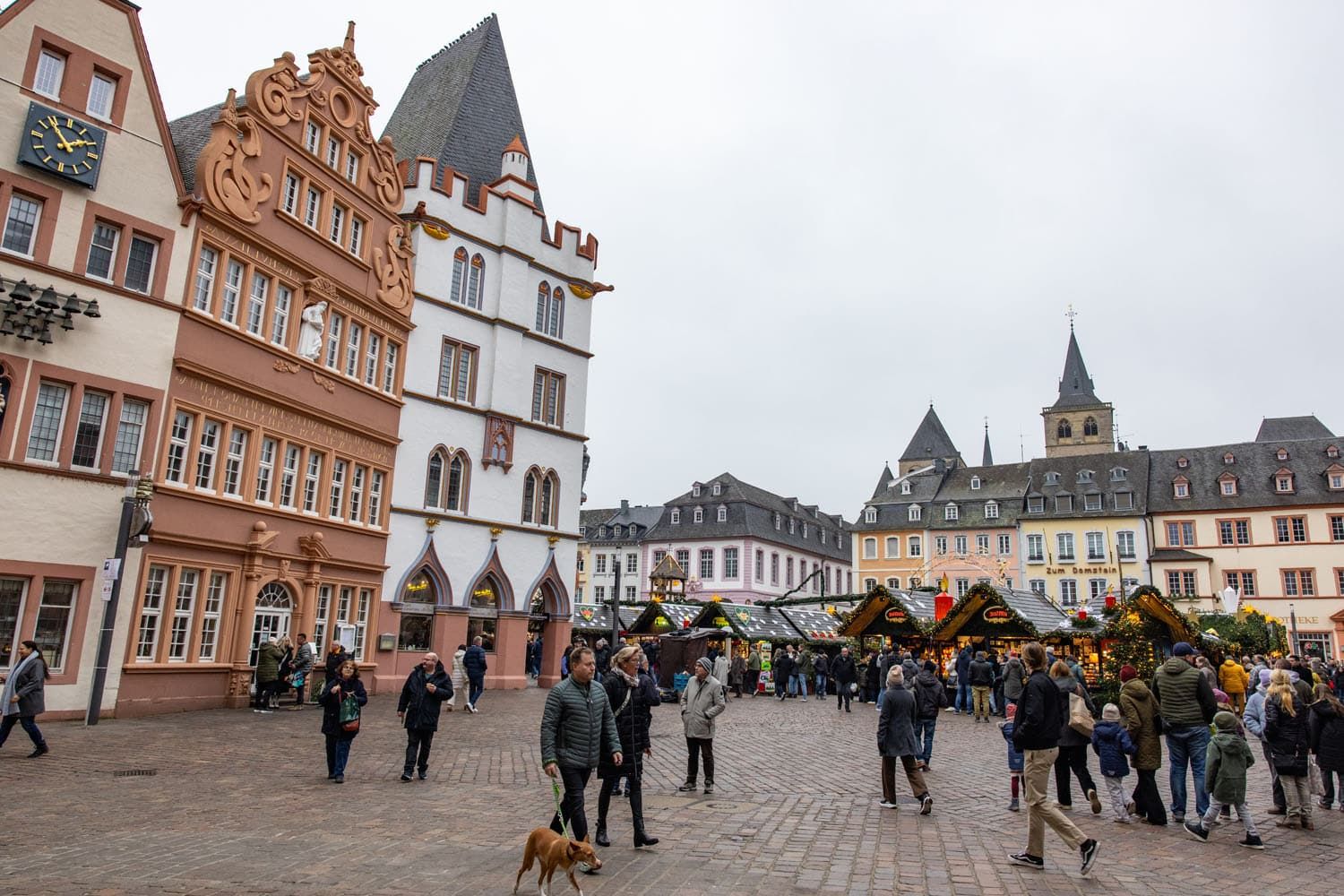
Rising above the square is the St. Gangolf Clock Tower, built in the 15th century, and at the center stands a fountain depicting the city’s patron saint, St. Peter, alongside the Four Virtues.
Outside of the Christmas season, the Hauptmarkt often hosts flower stalls and vendors selling fresh fruits and vegetables, giving the square a lively, local feel.
St. Peter’s Cathedral
Located just off the Hauptmarkt, St. Peter’s Cathedral has served as a bishop’s church for over seventeen centuries. Its origins date back to the fourth century, making it one of the oldest cathedrals in Europe. Over time, Roman, Romanesque, Gothic, Renaissance, and Baroque elements were added, allowing visitors to trace nearly every major artistic period in European history within a single structure.
The cathedral is free to visit during open hours when services are not taking place. Guided tours are also available and provide deeper insight into the cathedral’s history and relics.
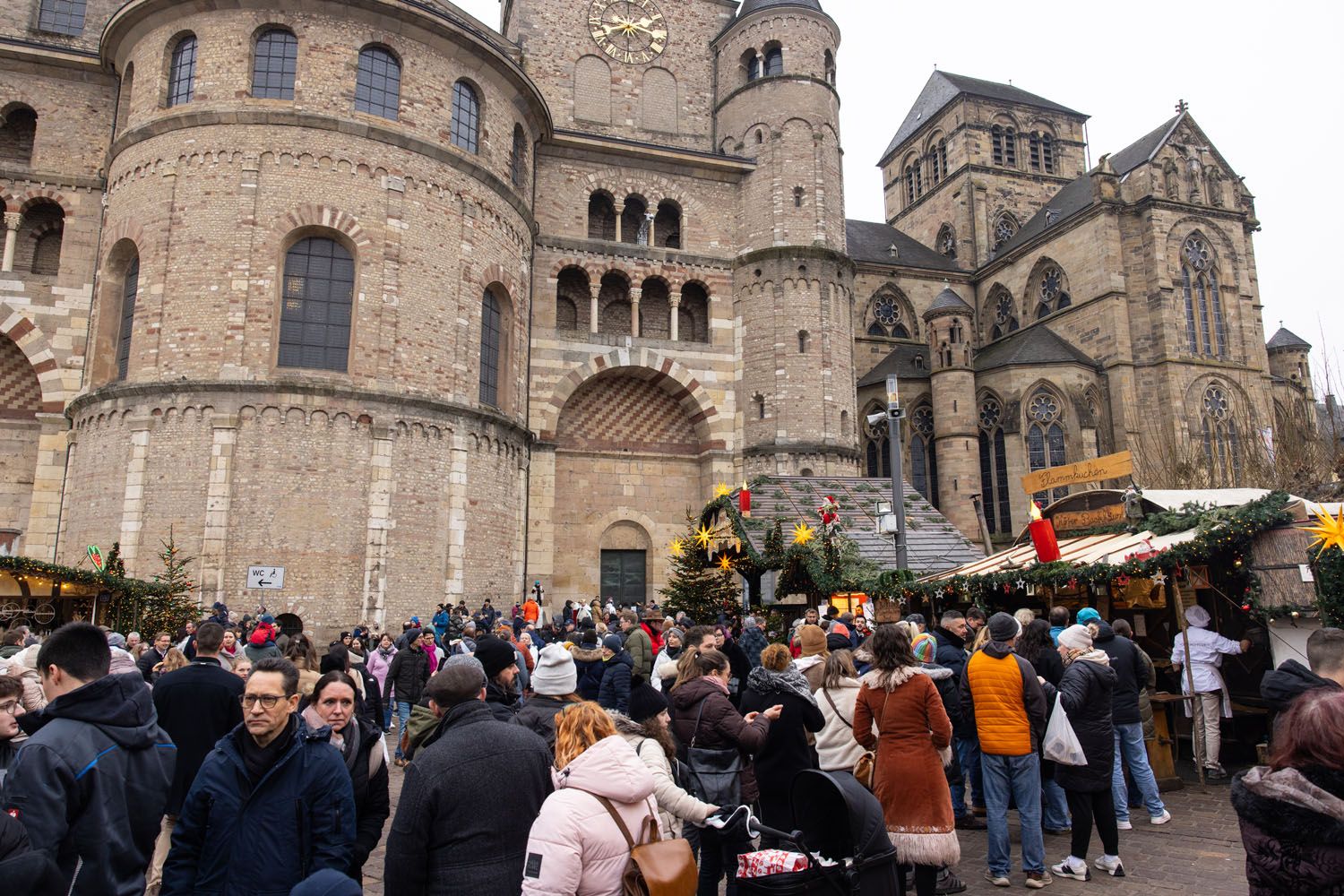
St. Peter’s Cathedral and the Church of Our Lady
Church of Our Lady
Built directly next to the cathedral, the Church of Our Lady is one of the earliest Gothic churches in Germany. Designed by French architects, its floor plan forms a twelve-petaled rose symbolizing the Virgin Mary’s purity.
The church is free to enter during visiting hours. Stand on the star marker near the entrance to see the medieval frescoes of the apostles arranged perfectly around the interior.
House of the Three Magi (Dreikönigenhaus)
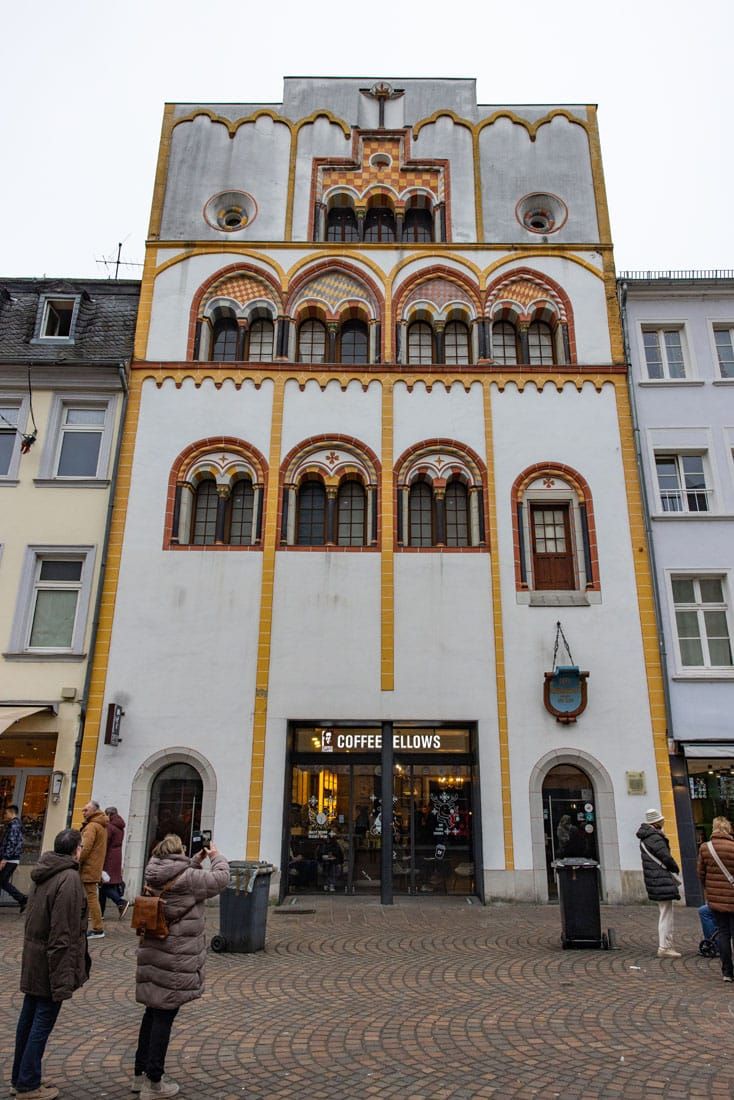
Located along Simeonstraße between the Hauptmarkt and the Porta Nigra, the House of the Three Magi dates back to around 1230. It is easily recognized by its elevated doorway, which was once accessed by a removable wooden ladder to protect residents from invaders.
The colorful facade and decorative friezes were inspired by Byzantine treasures brought back from the Crusades, reflecting the family’s medieval prosperity and artistic influences.
Porta Nigra
At the northern end of Simeonstraße stands the Porta Nigra, Trier’s most iconic landmark.
Built around 180 AD, this massive Roman city gate is constructed from enormous sandstone blocks and remains one of the best-preserved Roman gates north of the Alps.
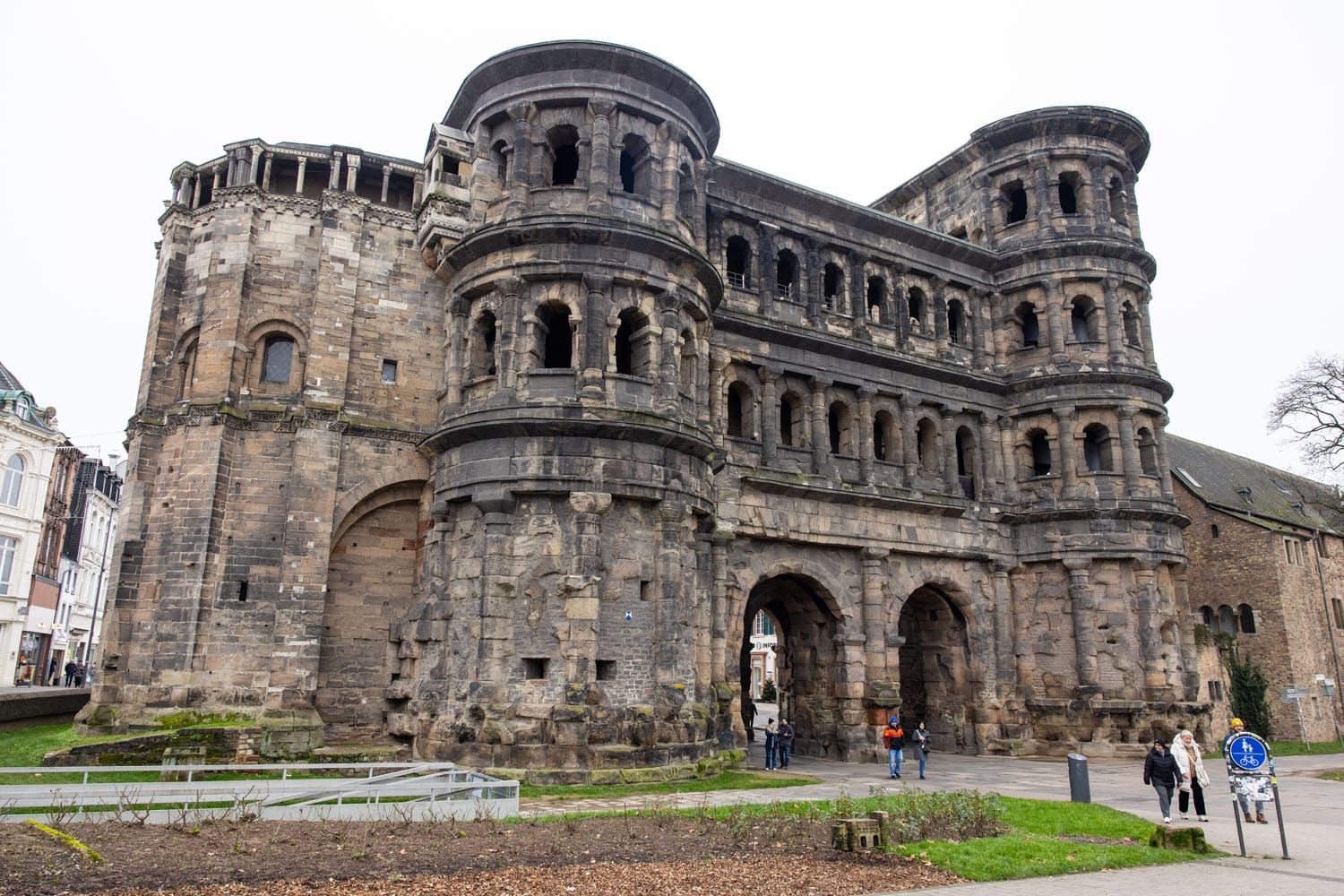
The Porta Nigra stands as a powerful reminder of Trier’s importance as a Roman capital. Visitors can walk around the exterior for free, and tickets are available to explore the interior levels for elevated views of the city.
Palace Garden, Imperial Baths, and Roman Monuments
A short walk from the old town leads to the elegant Palace Garden (Palastgarten), designed in the style of eighteenth century French formal gardens. The garden features fountains, sculptures, manicured flower beds, and a café, making it a pleasant place for a break.
At one end of the garden stands the Electoral Palace (Kurfürstliches Palais), a grand Rococo residence once used by the archbishops of Trier. Adjacent to it is the Konstantin Basilica, originally the imperial throne room of Emperor Constantine and now used as a Protestant church.
Walking through the gardens brings you to the Rhineland State Museum, which houses extensive archaeological collections from Trier’s Roman and medieval periods.
At the far end of the gardens are the Imperial Baths (Kaiserthermen), a sixteen-hundred-year-old Roman bath complex. Planned to be one of the largest bath facilities north of the Alps, the project was never completed. Over the centuries, the structure served as military barracks, a castle, and a monastery. Today, visitors can explore the ruins and walk through the impressive underground tunnel system.
Trier Amphitheater
About a fifteen-minute walk from the Imperial Baths lies the Trier Amphitheater, once the site of gladiatorial combats and public spectacles. The arena could hold thousands of spectators, and visitors can explore the underground corridors where animals and prisoners were held before entering the arena.
Roman Baths at Viehmarkt (Thermen am Viehmarkt)
Trier was home to multiple Roman bath complexes. At Viehmarkt, the ruins of an 80 AD thermal bath are preserved beneath a modern glass pavilion. The contrast between the sleek contemporary structure and the ancient ruins makes this a particularly interesting stop.
Karl Marx House
Trier is also the birthplace of Karl Marx, born here in 1818. His childhood home is now a museum dedicated to the history of the workers’ movement and Marx’s life. Exhibits include letters, personal belongings, and the historical context surrounding his ideas.
How Much Time Do You Need in Trier?
If you are primarily visiting Trier to see its Christmas Market, 1 to 2 hours is sufficient. This is a small market and it doesn’t take long to walk through its two sections of market stalls.
If you also want to visit Trier’s churches, historical sites, and palace, you could spend a full day in town.
WHAT WE DID: We stayed in Cologne. In the morning, we drove to and visited the Mosel Wine and Christmas Market in Traben-Trarbach. This is one of Germany’s most unique Christmas Markets, set underground in historic wine cellars. Again, this was not one of our favorite markets, but it is worth it for foodies, wine aficionados, and those who like the idea of visiting a more unique market.
It takes an hour to drive between Traben-Trarbach and Trier. We arrived in Trier in the early afternoon, around 2 pm, and spent several hours here, both in the market and strolling through town. Around 4 pm we drove back to Cologne.
This was part of a larger trip that also included Berlin, Dresden, Erfurt, Aachen, Frankfurt, and Heidelberg, as well as Wrocław, Poland. Our favorites were Wrocław, Dresden, and Cologne.
How to Get to Trier
Trier is easily accessible by train via Trier Hauptbahnhof (Trier Hbf). Regional trains connect the city to Luxembourg, Cologne, Metz, Koblenz, and Saarbrücken, making it a convenient stop for travelers passing through western Germany or neighboring countries.
Parking in Trier
If you are visiting Trier by car, these parking garages are conveniently located near the old town:
- City Parkhaus Trier (this is where we parked)
- Parkhaus Viehmarkt
- Parkhaus Hauptmarkt Trier
If you have any questions about the Trier Christmas Market, or if you want to share your experience, let us know in the comment section below.
Plan Your Trip to Germany
Below are our guides on more places to visit in Germany, plus our favorite Christmas markets in Europe.
Germany Travel Guide | How to Plan a Trip to Germany
Travel advice for Germany. Visit Bavaria, Munich, Berlin, Berchtesgaden, and Neuschwanstein Castle. Get travel itineraries and learn where to stay and where to eat.
Mosel Wine Christmas Market: Traben-Trarbach’s Underground Market
Traben-Trarbach is a small town set along the Moselle River in western Germany, best known for its wine heritage and distinctive underground architecture. In the late nineteenth and early twentieth centuries, Traben-Trarbach became one of Europe’s most important wine trading centers, second only to Bordeaux. To support this booming industry, vast wine cellars were built […]
Ravenna Gorge Christmas Market: Is It Really Worth It?
The Ravenna Gorge Christmas Market is one of Germany’s most unique markets. Brightly lit, decorated stalls sit around the base of a train viaduct, which is illuminated in a rainbow of colors throughout the night. It’s a beautiful sight to see. But is it worth it? This market is only held on a few weekends […]
Nuremberg Christmas Markets & Festive Things to Do (2026 Guide)
The Nuremberg Christmas Market (Nuremberg Christkindlesmarkt) is widely regarded as one of Germany’s best Christmas markets. It’s often a favorite among those who tour the country’s holiday markets – a remarkable feat in a country renowned for its spectacular number of unique, festive markets. You only need a few hours to visit the Nuremberg Christmas […]
Würzburg in a Day: Top Things to Do + Christmas Market Guide
Würzburg, a small city nestled in Bavaria’s picturesque wine region, is a historic gem that makes for an unforgettable day trip on any southern Germany itinerary. This charming city is packed with stunning landmarks. Highlights include the imposing Marienberg Fortress perched above the city, the iconic Old Main Bridge adorned with statues of saints, the […]
Erfurt Christmas Market in Germany: Why It’s One of the Best
For us, the Erfurt Christmas Market exceeded our expectations. And to think we almost skipped it. While researching which Christmas markets to visit in Germany, we put Erfurt high on our list, but we couldn’t quite work it into our itinerary. That changed when we had some extra time on the drive from Dresden to […]
Our 5 Favorite Berlin Christmas Markets
In this guide, we will narrow down the long list of Berlin Christmas markets to a few must-see’s, complete with photos, a map, and what makes them special. The city of Berlin is home to an incredibly long list of Christmas markets. In our research, we read that this city hosts 70 to 80+ markets! […]
Best Things to Do in Berlin: From the Berlin Wall to Hidden Gems
Discover the best things to do in Berlin, from the Berlin Wall to its world-class museums, iconic landmarks, and quirky spots like Teufelsberg and Flughafen Tempelhof. We’ll also cover when to go, how much time you’ll need, plus a great day trip to several interesting places near Berlin. Before traveling to Berlin, a fellow traveler […]
Regensburg Christmas Markets 2025 | The Ultimate Guide
Regensburg is a historic city in Bavaria, Germany. During the Christmas season, Regensburg hosts four Christmas markets, and one of them, the Romantic Christmas Market at Thurn and Taxis Palace, is often sited to be the most beautiful in Germany. We loved visiting Regensburg. It is listed as a UNESCO World Heritage Site, making the […]
Munich Christmas Markets 2025 | The Ultimate Guide
As November draws to a close, Munich comes alive with the magic of Christmas markets, transforming the city into one of Europe’s most enchanting destinations. From iconic Marienplatz to smaller markets brimming with local charm, there are quite a few festive places to visit in Munich. The Munich Christmas markets are located in and around […]
Christmas Markets in Stuttgart, Ludwigsburg, and Esslingen am Neckar, Germany
If you are planning a Christmas market trip to Germany, there is a trio of cities not to be missed. Stuttgart is home to one of Europe’s largest and oldest Christmas markets. This historic market features some of the best decorated stalls in all of Germany. From Stuttgart, travel Ludwigsburg by train, to visit the […]
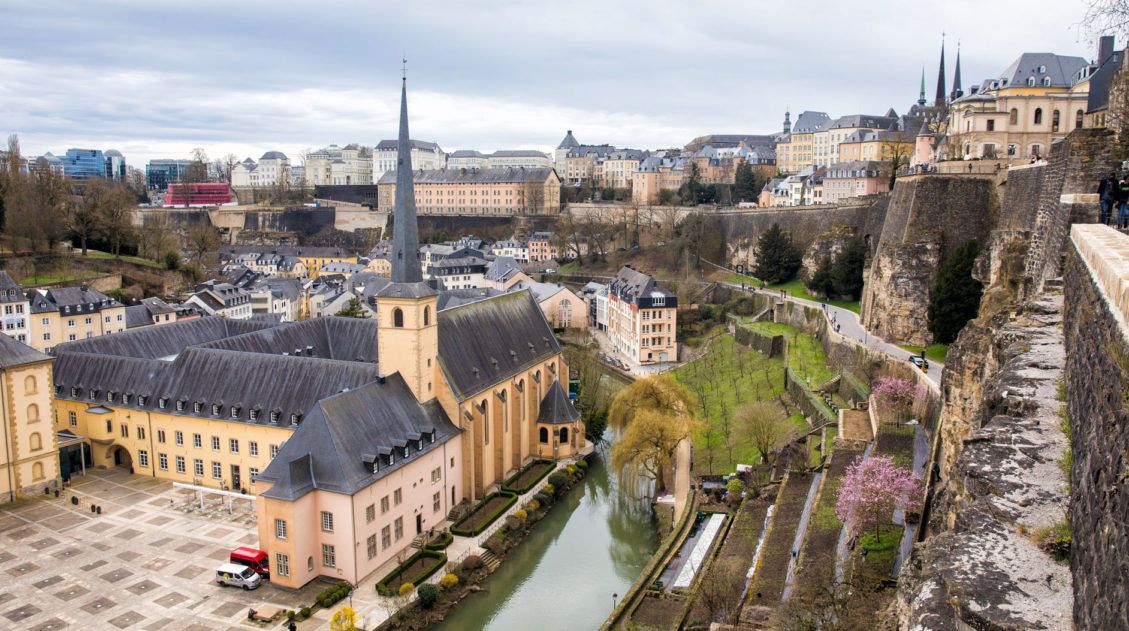
One Perfect Day in Luxembourg City, Luxembourg
Luxembourg City is easy to visit if you only have one day, since it is a compact city with just a few big sites. With one day in Luxembourg, visit the old town, tour the old fortifications of the city, walk the Chemin de la Corniche, and explore the Grund. We visited Luxembourg City while […]


Leave a Comment