
The Louvre is the largest art museum in the world and one of the top things to do in Paris. Planning a visit can sound complicated. With its massive size, long list of art exhibits, and tales of long lines, you may be wondering how to visit the Louvre and actually enjoy your time there, rather than getting lost or overwhelmed.
In this guide, we show you how to visit the Louvre quickly and efficiently, with a self-guided walking route that connects many of its must-see masterpieces. If you only have 1 to 1.5 hours, you can follow the first part of our route to see highlights such as Venus de Milo, the Winged Victory of Samothrace, and the Mona Lisa. With more time, continue into the Medieval Louvre, Egyptian antiquities, and other galleries.
We also cover tickets and entrances, the best time to visit, current gallery closures, and how to plan your visit so you spend less time waiting in lines and figuring out where to go.
On this Louvre treasure hunt, you’ll see famous sculptures by Michelangelo, ancient artifacts from Egypt and Mesopotamia, paintings by famous artists, and of course, the Mona Lisa.
Our Louvre Experiences: We’ve visited the Louvre three times. Our first two visits were quick stops, just enough time to see a few icons, but not much else. On our most recent trip, we did it differently. Tim and I mapped out a route connecting the Louvre’s major masterpieces, then followed it through the museum ourselves. The route in this guide is based on that experience and is designed to minimize backtracking while still giving you time to enjoy what you’re seeing.
Visiting the Louvre: At a Glance
LOCATION | 1st arrondissement, Paris
HOURS | 9 am to 6 pm most days; open until 9 pm Wednesday and Friday
CLOSED | Tuesday, January 1, May 1, December 25
TICKETS | Timed-entry tickets are strongly recommended; reservations are required July 1–August 31, 2026
HOW LONG TO SPEND | 1–1.5 hours for the masterpieces; 2.5–3 hours for a more complete first visit; 5 hours for a deeper dive
BEST TIME TO VISIT | First time slot of the day
BEST FOR FIRST TIME VISITORS | Follow our self-guided masterpieces route first, then add additional galleries if you have time
DON’T MISS | Venus de Milo, Winged Victory of Samothrace, Mona Lisa, and the Grande Galerie
IMPORTANT | Gallery closures are common during the Louvre’s ongoing renovations, so check the room-opening schedule before your visit
September 2026 Update: Updated the Apollo Gallery section. The room reopened in July 2026 after last year’s jewel heist, but the crown jewels are no longer displayed there. We have updated this guide with the latest ticketing, entrance, opening-hour, and gallery information. The Louvre is undergoing ongoing renovations, so gallery openings and walking routes can change.
How We Recommend Planning Your Visit to the Louvre
For a first visit to the Louvre, we recommend booking the first time slot of the day and starting with the museum’s must-see masterpieces. This gives you the best chance of seeing famous works such as Venus de Milo, Winged Victory of Samothrace, and the Mona Lisa before the museum reaches its busiest point.
If you have 1 to 1.5 hours, follow Part 1 of our self-guided route. It connects many of the Louvre’s most famous masterpieces while minimizing unnecessary backtracking.
With 2.5 to 3 hours, continue into the Medieval Louvre and Egyptian Antiquities after completing the masterpieces route. This is the amount of time we recommend for most first-time visitors: you will see the Louvre’s biggest highlights plus several of its most interesting galleries without museum fatigue setting in.
If you have 4 hours or more, you can explore additional galleries in the Richelieu Wing or spend more time in the collections that interest you most. Because gallery closures are common during the Louvre’s ongoing renovations, check the museum’s room-opening schedule before deciding which additional sections to visit.
Our recommendation: Don’t try to see everything. The Louvre is enormous, and attempting to cover the entire museum usually means rushing past the very things you came to see. Start with the masterpieces that matter most to you, then use any remaining time to explore.
Louvre Tickets, Reservations & How to Avoid the Lines
The best way to minimize your wait at the Louvre is to purchase your ticket online in advance and reserve a timed entry. You will still have to go through security, so there is no ticket that allows you to completely skip the line.
For the best experience, we recommend booking the first time slot of the day. This not only reduces your wait to enter the museum but also gives you a head start inside, before the most popular galleries become crowded.
Louvre Tickets
General admission costs €22 for residents and citizens of the European Economic Area (EEA) and €32 for non-EEA visitors. Admission is free for visitors under 18 and for EEA residents and citizens under 26.
Purchase tickets on the official Louvre website and choose a timed entry when you book. During busy travel periods, reserve your tickets as soon as you know your dates, particularly if you want the first entry of the day.
2026 reservation requirement: From July 1 through August 31, 2026, advance reservations are required for almost all visitors. At other times of the year, timed reservations are strongly recommended and give you the best chance of entering at your preferred time.
Paris Museum Pass
The Louvre is included with the Paris Museum Pass, but having the pass does not guarantee entry to the museum. You will need to reserve a Louvre time slot in advance. The reservation itself is free for Paris Museum Pass holders.
If your Paris itinerary includes several museums and monuments, the pass can save money, but we would not buy it solely for the Louvre.
Guided Tours
Another option is to book a guided Louvre tour that includes museum admission. A tour costs considerably more than visiting independently, but it can be worthwhile if you want an expert to explain the artwork and help you navigate this enormous museum. This small group tour gets excellent reviews.
If you prefer to explore on your own, our self-guided Louvre route later in this guide connects many of the museum’s most famous masterpieces without the additional cost of a guide.
Our advice: Whichever option you choose, reserve your Louvre entry in advance and aim for the first time slot of the day. You cannot bypass the security screening, but these two steps will minimize the time you spend waiting and maximize your time inside the museum. And remember, the Louvre is CLOSED on Tuesday.
Best Time to Visit the Louvre
The best time of the day to visit the Louvre is first thing in the morning, two to three hours before closing, and on Friday nights, when the Louvre does not close until 9:00 pm.
The Louvre is closed on Tuesdays. Monday and Wednesday can be busy, since these fall before and after the Tuesday closure. Weekends and holidays can also be very busy. Thursday tends to be the least crowded day of the week.
Louvre Entrances: Which One Should You Use?
The Louvre has four entrances: the Pyramid, Carrousel, Porte des Lions, and Passage Richelieu. For most first-time visitors, we recommend using the Pyramid, particularly if you have the first time slot of the day.
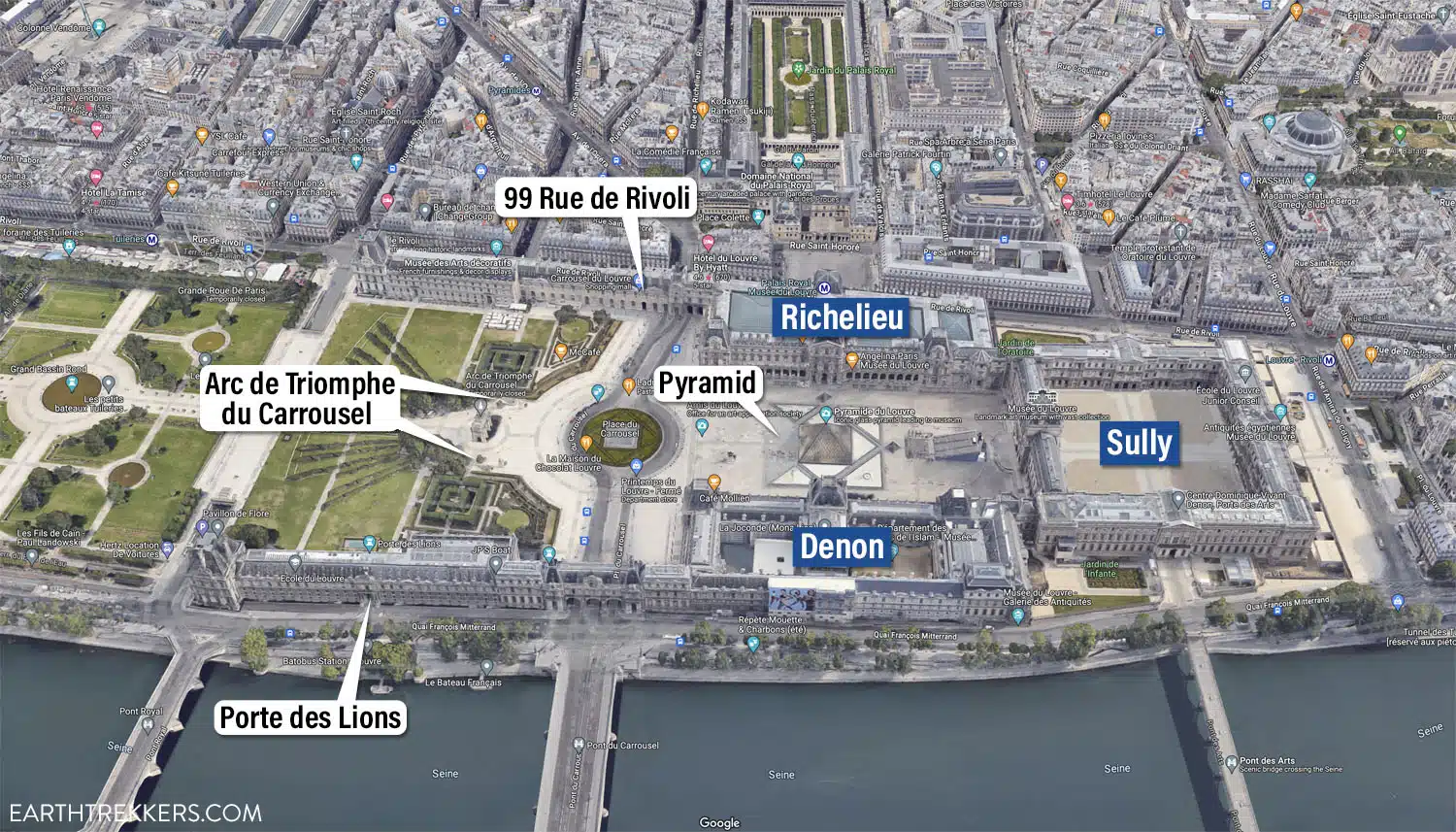
Map of the Louvre entrances (in black and white) and the three wings of the Louvre museum (in blue and white). Map adapted from Google.
Entrance availability and access rules can change, so check the Louvre’s official entrance map shortly before your visit.
The Pyramid: Best for Most First-Time Visitors
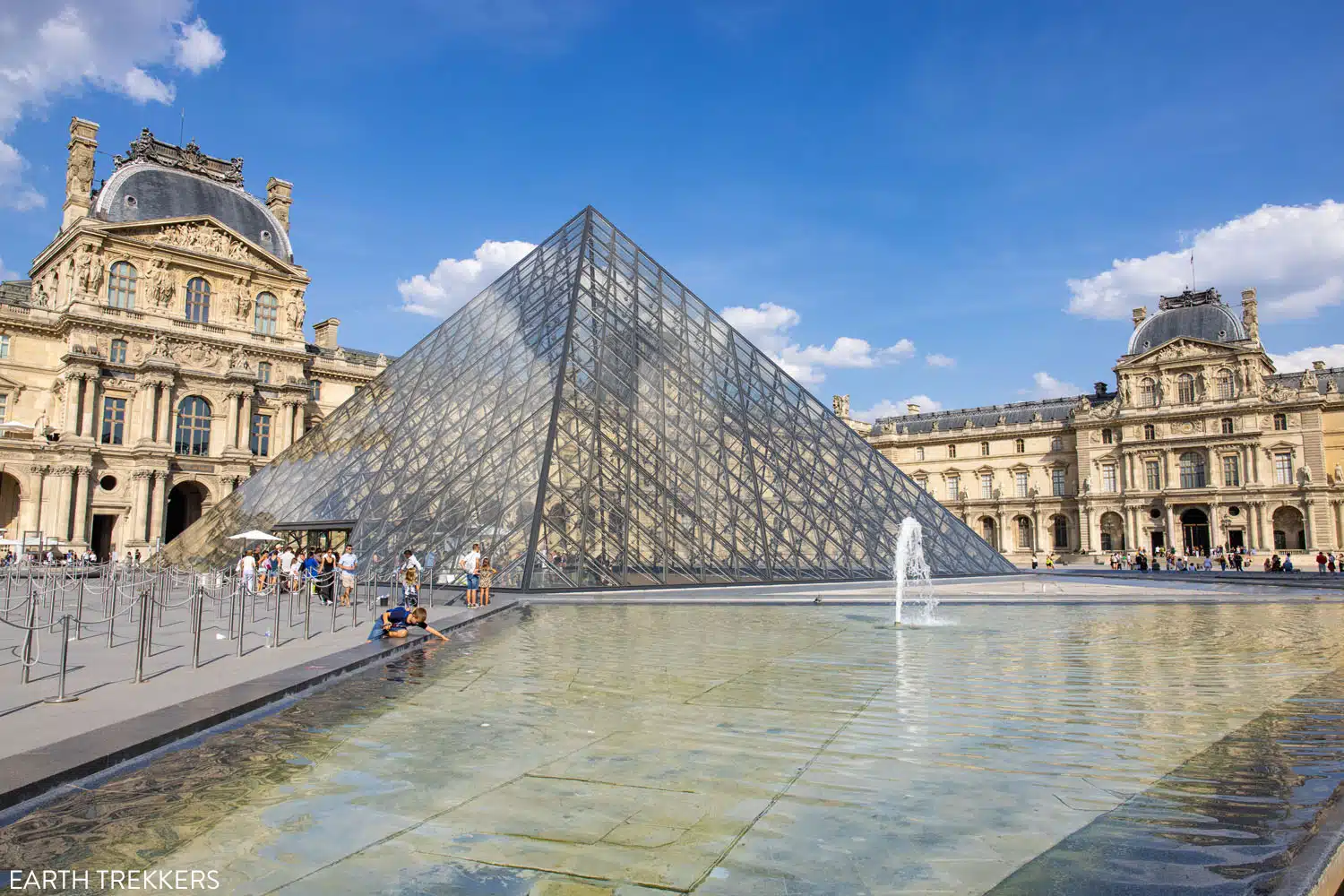
The Pyramid is the Louvre’s main entrance and the one we recommend for most visitors. Not only is it the classic way to enter the museum, but once inside, you arrive in the central reception hall with access to the Denon, Sully, and Richelieu wings.
There are currently three lines at the Pyramid:
Blue: Priority access for visitors with disabilities and staff members
Green: Visitors with a ticket or Paris Museum Pass
Orange: Visitors without a ticket
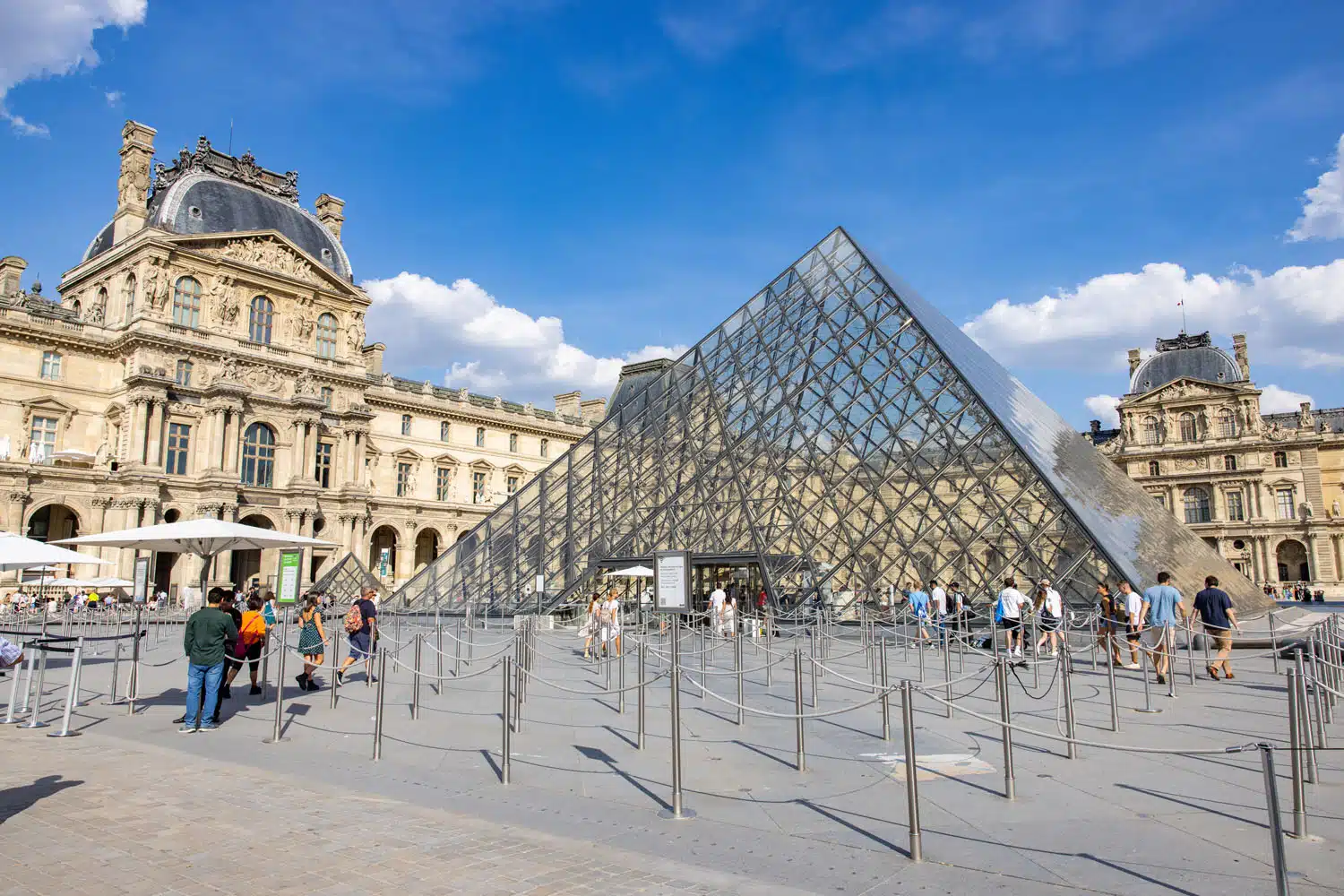
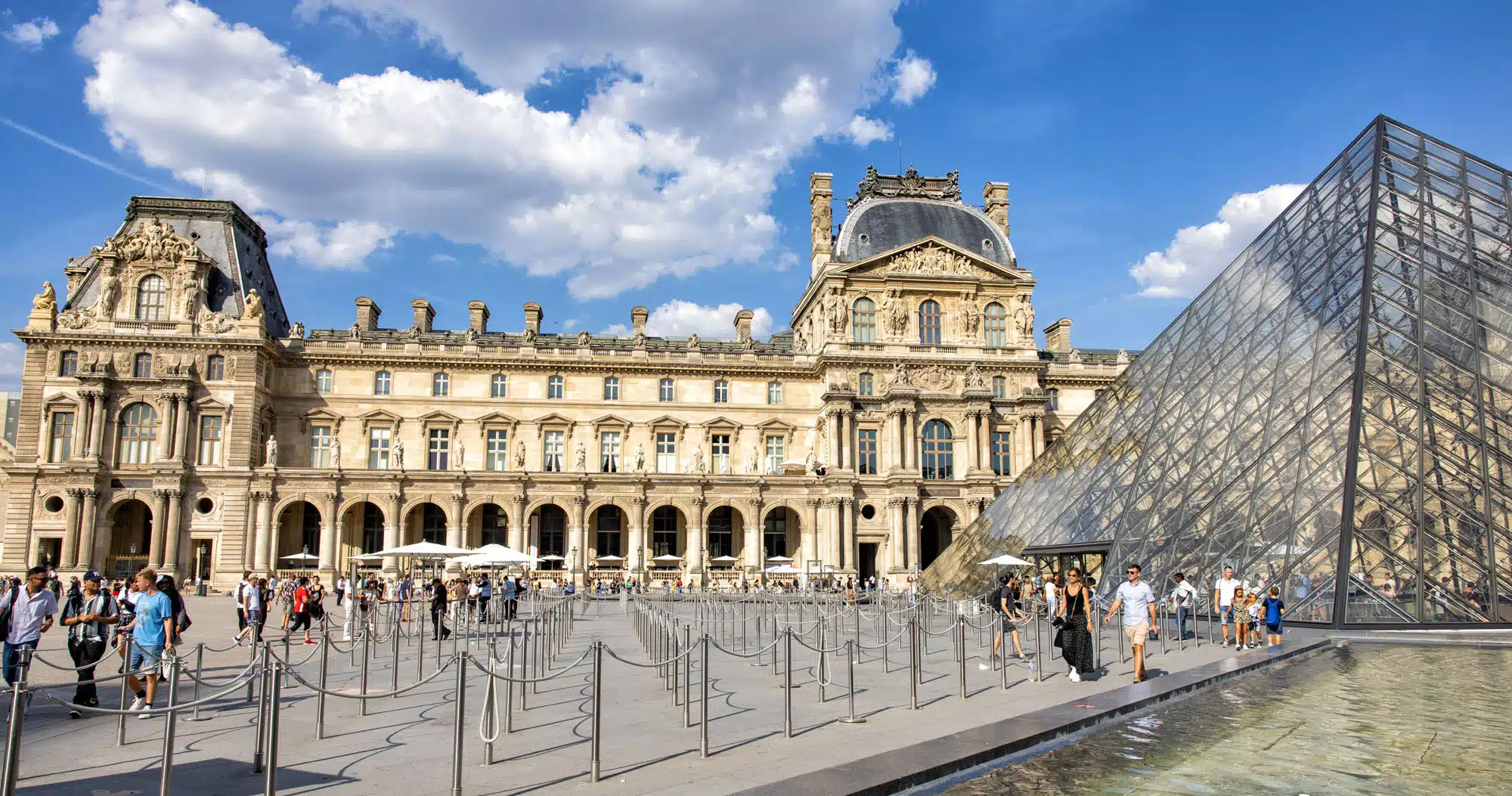
The Pyramid entrance
On our most recent visit, we had a 9 am entry time and used the Pyramid entrance. We got in line at 8:40 am, and once the museum opened, we waited about five minutes to enter. This was in September 2023.
Once you enter the Pyramid, you will go through airport style security and then descend into the Louvre on an escalator or steps. From this lower level, you will choose to enter the museum at either the Sully Wing, Denon Wing, or Richelieu Wing (more on this later). Your ticket will be scanned at one of these three entrances.
Our recommendation: If you have the first entry of the day, use the Pyramid. You get the iconic experience of entering beneath the glass pyramid, and it puts you in a convenient starting point for our self-guided Louvre route.
Carrousel Entrance: Convenient from the Metro & Rue de Rivoli
The Carrousel entrance is located underground at 99 Rue de Rivoli, near the inverted pyramid in the Carrousel du Louvre shopping center. It is particularly convenient if you arrive via the Palais Royal–Musée du Louvre Metro station or want to remain indoors on a rainy or very hot day.
This entrance can be used by visitors who already have a ticket, Louvre membership card, or are visiting as part of a group. After passing through security, you will enter the same central area beneath the Pyramid.
We wouldn’t go out of our way to use this entrance simply to avoid the Pyramid. If this is your first visit, we think walking through the courtyard and entering through the Pyramid is part of the Louvre experience.
All of these entrances take you underground to the inverted pyramid and an entrance into the Louvre.
Once you reach the inverted pyramid, you can enter the Louvre through the airport style security line and it is a 5-minute walk to the main floor of the museum, the room below the pyramid. You must have a ticket as there is no ticket window at the Galerie du Carrousel entrance into the Louvre.
Porte des Lions: An Alternative for Ticket Holders
Porte des Lions is located along Quai François Mitterrand and can only be used by visitors who already have an admission ticket. It closes at 6 pm, with last entry at 5 pm, and is closed on Tuesdays. Equipment loans are not available here, and the locker room is only accessible until 3 pm.
This can be a useful alternative to the Pyramid when it is open, but check its status before relying on it. Entrance availability can change.
Richelieu Passage
Most independent visitors will not use the Passage Richelieu entrance. It is reserved primarily for groups, visitors participating in museum activities or auditorium events, Louvre members, and several other special categories of visitors.
Navigating the Louvre
The Louvre can be confusing at first, but its basic layout is fairly simple. The museum is divided into three interconnected wing, Denon, Sully, and Richelieu, with collections spread across five levels.
If you enter through the Pyramid, you will descend into the large reception area beneath it. From here, you can access each of the three wings. Information desks beneath the Pyramid provide free museum maps, and we recommend picking one up even if you also have the map on your phone.
You can also download the current Louvre map before your visit or use the museum’s interactive map. Since rooms and galleries sometimes close, don’t rely solely on room numbers when navigating; follow the museum signs and check the current room-opening schedule as well.
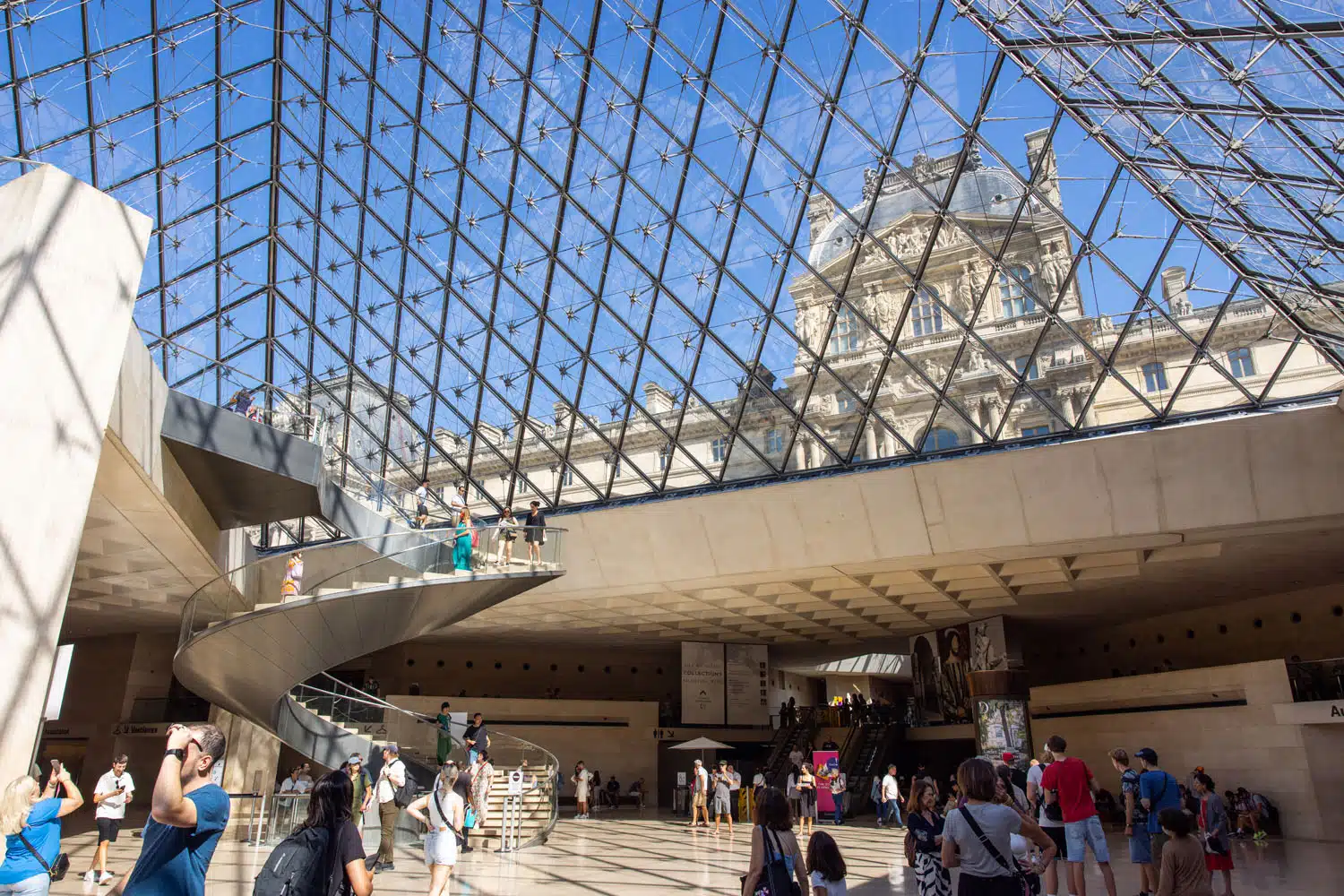
The main floor (reception hall) of the Louvre
Sully Wing
Our self-guided Louvre route begins in the Sully Wing. From the reception area beneath the Pyramid, follow the signs for Sully.
This wing contains several major sights, including Venus de Milo, the Medieval Louvre, and much of the Egyptian Antiquities collection. Starting here also lets you see several highlights before joining the larger flow of visitors heading toward the Mona Lisa. The Louvre’s own 90-minute masterpieces trail also begins in the Sully Wing.
Denon Wing
The Denon Wing contains many of the Louvre’s most famous works of art, including the Mona Lisa, Winged Victory of Samothrace, Italian paintings, and large-scale French paintings.
If you only have a short amount of time at the Louvre, you will spend much of your visit in the Denon Wing. Our route moves from Sully into Denon, connecting many of these masterpieces without having to repeatedly retrace your steps.
Richelieu Wing
The Richelieu Wing contains French sculpture, decorative arts, Northern European paintings, and some of the Louvre’s spectacular historic interiors, including the Napoleon III Apartments when they are open.
We consider this wing an optional addition for a first visit. If you have only 1 to 3 hours, prioritize Sully and Denon. If you have more time, continue into Richelieu, but check the Louvre’s current gallery-opening schedule first because closures in this wing can affect the route.
Navigation tip: Don’t try to navigate the Louvre by memorizing dozens of room numbers. Know the wing and level of your next major stop, follow the museum signs, and use the map for the smaller transitions between galleries. Our self-guided route below gives you turn-by-turn directions between the major masterpieces.
Best Things to See in the Louvre
With over 35,000 works of art on display, spread out across the largest museum in the world, how do you narrow down what to see?
Before our most recent visit to the Louvre, we spent a lot of time researching the top art pieces and historical artifacts in the Louvre. We came up with a list of 20 things to see in the Louvre. This list is perfect for those who want to see the highlights of the Louvre, located throughout its wings and multiple floors, without spending all day in the Louvre.
Below is a list of the top things to see in the Louvre and their location. All of these are included in our walking tour below.
- Venus de Milo – Room 346 – Sully Wing
- Mona Lisa – Room 711 – Denon Wing
- Winged Victory of Samothrace – Room 703 – Denon Wing
- The Grande Galerie – Room 710 – Denon Wing
- Apollo Galerie – Room 705 – Denon Wing
- Wedding Feast of Cana – Room 711 – Denon Wing
- The Caryatids – Room 348 – Sully wing
- The Raft of Medusa – Room 700 – Denon Wing
- The Rebellious Slave and the Dying Slave by Michelangelo – Room 403 – Denon Wing
- Psyche Revived by Cupid’s Kiss – Room 403 – Denon Wing
- Sleeping Hermaphrodite – Room 348 – Sully Wing
- Liberty Leading the People – Room 702 – Denon Wing
- The Consecration of the Emperor Napoleon – Room 702 – Denon Wing
- Medieval Louvre – lower level of the Sully Wing
- The Great Sphinx of Tanis – Room 338 – Sully Wing
- Egyptian Antiquities – Multiple rooms in the Sully Wing
- The Code of Hammurabi – Room 227 – Richelieu Wing
- Lamassus of Khorsabad Palace – Room 229 – Richelieu Wing
- Napoleon III’s Apartments – Level 1 – Richelieu Wing
- The Cour Puget – Room 105 – Richelieu Wing
Self-Guided Louvre Masterpieces Route
This walking tour connects many of the Louvre’s most famous masterpieces in an efficient route through the museum. Tim and I followed this route ourselves on our most recent visit, starting in the Sully Wing and working our way through Denon before continuing to additional collections.
The tour is divided into three parts:
- Part 1: Louvre Masterpieces: Allow about 1 to 1.5 hours. This is the route we recommend for first-time visitors with limited time and includes Venus de Milo, Winged Victory of Samothrace, the Mona Lisa, and several other must-see works.
- Part 2: Medieval Louvre & Egyptian Antiquities: Add roughly 1 to 1.5 hours. Continue here if you have about 2.5 to 3 hours total at the museum.
- Part 3: Richelieu Wing & Additional Highlights: Add this if you have more time and the galleries you want to visit are open.
We provide step-by-step directions between each stop, but we recommend keeping a Louvre map handy as you go. Room closures and temporary rerouting can affect the exact path, so follow museum signage if it differs from our directions.
If you only do one part of this tour, make it Part 1. It gives you the best combination of the Louvre’s iconic masterpieces while keeping walking and backtracking to a minimum.
PRO TRAVEL TIP: I recommend checking which rooms will be open on the day of your visit, because there could be some closures. On the day we did this, Napoleon III’s apartments and the North European paintings were closed.
If you follow the entire walking tour, it will take between 3 hours and 5 hours. To do it in 3 hours, you have to start at 9 am, when crowds are very light, and move very fast. Most people will do this in 4 to 5 hours.
This tour starts with the essential artworks and then goes deeper into the Louvre. Since it is a half day tour, you still are only visiting the highlights. You can further extend this tour, by spending more time in various rooms and taking detours along the way.
Get a Digital Download of this Louvre Walking Tour
Do you want a printer friendly version of this walking tour? How about an eBook version that can be downloaded onto your computer or mobile device?
Our Louvre Walking Tour eBook is a self-guided walking tour of the Louvre that will take you to the museum’s most important masterpieces. This guide covers how to purchase tickets, the different entrances, helps you navigate through the Louvre’s maze of rooms, and provides helpful tips for having the best experience. It is a 15-page document that you can download to take with you or print at home.
Click here to purchase the eBook on Etsy.com.
Part 1: Louvre Masterpieces
Time: 1 to 1.5 hours
If you are short on time or only want to see the Louvre’s essential masterpieces, follow Part 1 of our walking tour. This route starts in the Sully Wing and finishes with several highlights in the Denon Wing.
Things you will see include:
- The Caryatids
- Venus de Milo
- Winged Victory of Samothrace
- Grande Galerie
- Mona Lisa
- Apollo Gallery
Stop 1: The Caryatids
From the main reception floor (the large room under the pyramid), take the escalator/steps up to the Sully Wing. This entrance is the middle of the three entrances into the wings of the Louvre. It looks like this (look for the word “Expositions”):
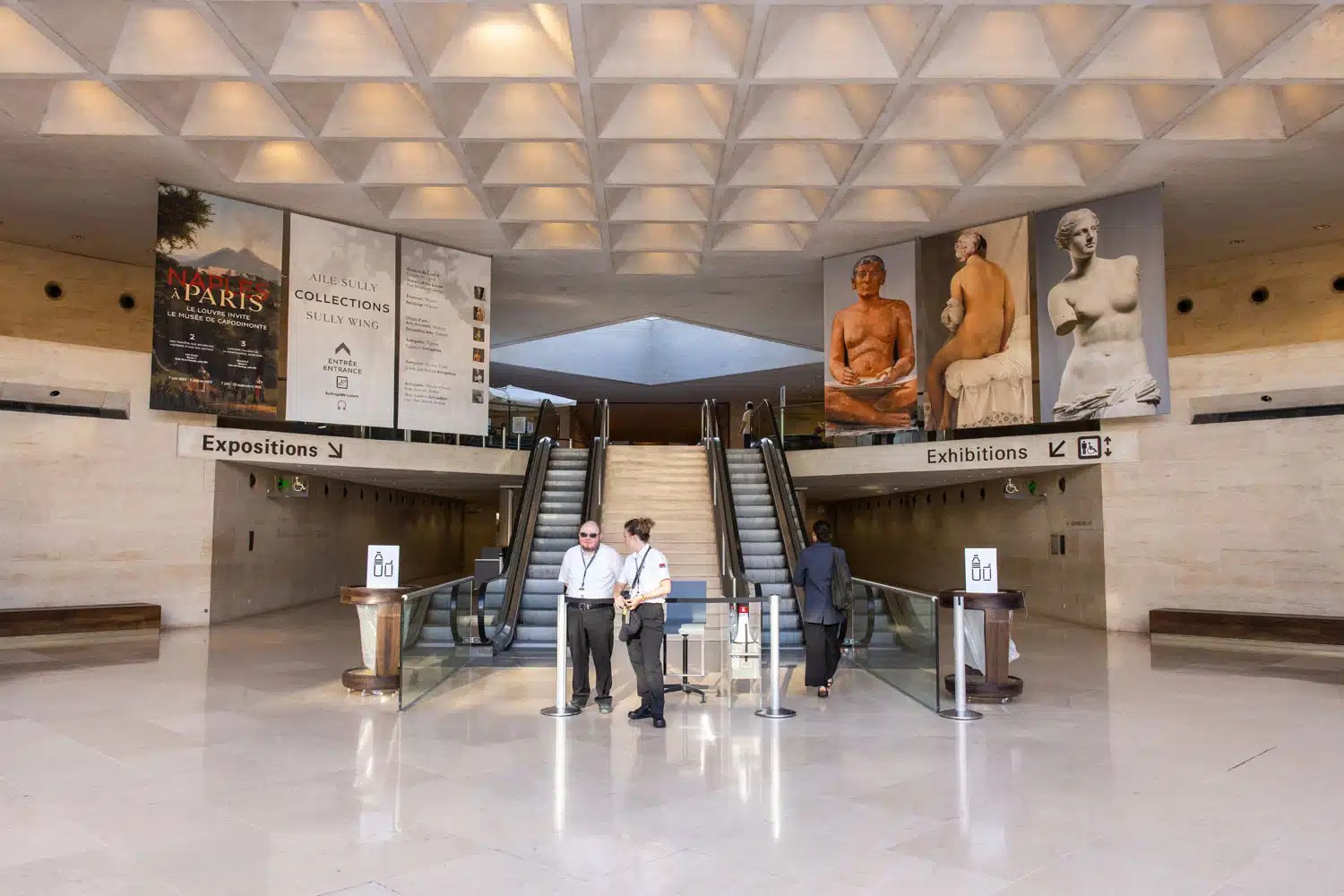
If you are here right at opening time, you’ll probably notice many visitors heading directly toward the Denon Wing and the Mona Lisa. We recommend resisting the urge to follow them.
When we did this route, starting in Sully gave us several beautiful rooms almost to ourselves, and we still reached the Mona Lisa before the biggest crowds arrived.
After you show your ticket, walk straight down the long hallway. Once you reach the entrance to the Pavilion de l’Horloge, take the stairs up to level 1 (this is a series of several staircases; follow signs for 1et etage, Antiquities grecques et romaines). At the top of these stairs, turn right into the double wooden doors.
You are now standing in room 348 of the Sully Wing, the Salle des Cariatides. Turn around to see the Caryatids, which are four female sculptures that serve as columns and support the musician’s gallery. These were created in 1550 by Jean Goujon. They were inspired by the Caryatids on the Erechtheion on the Acropolis in Athens.
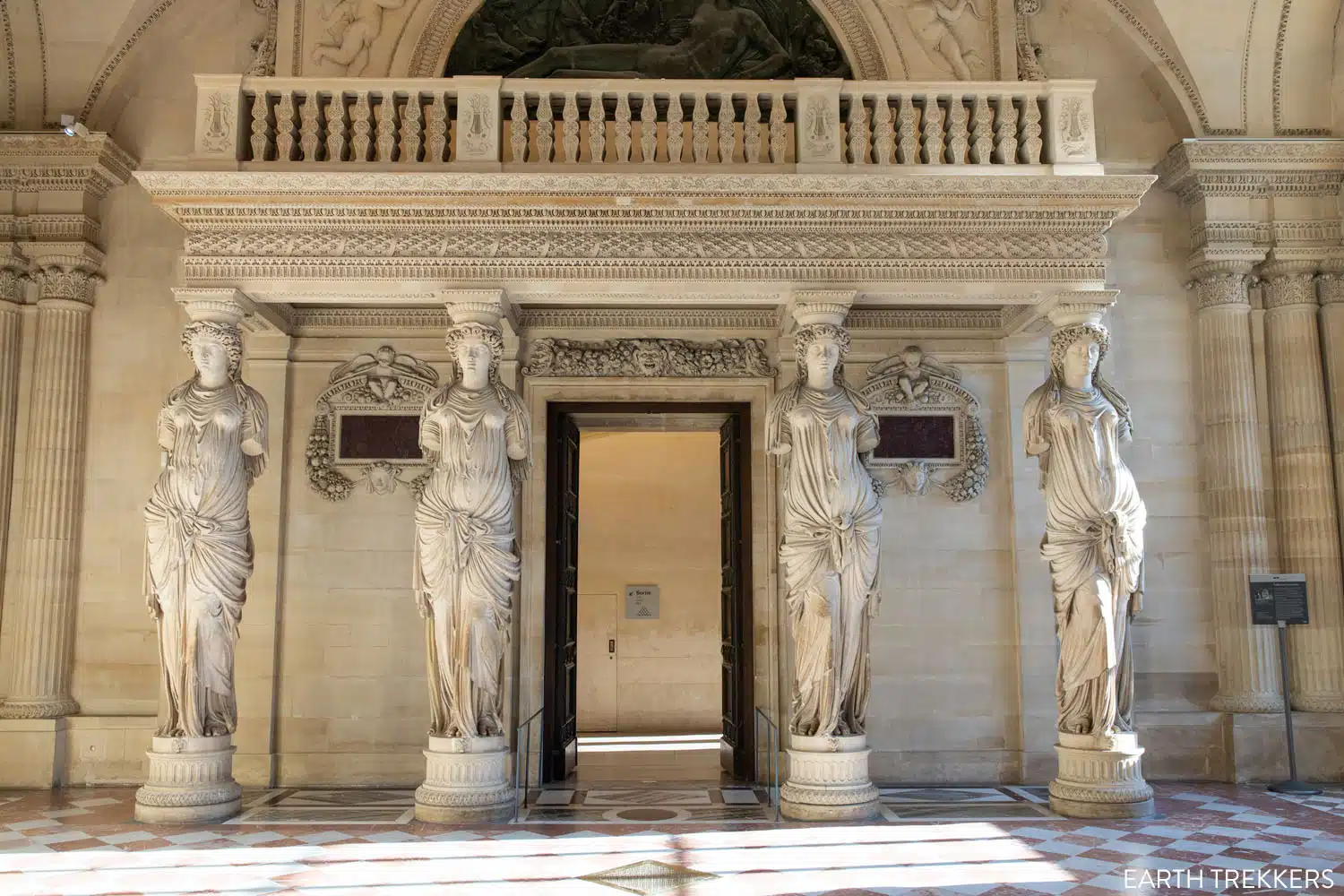
The Caryatids
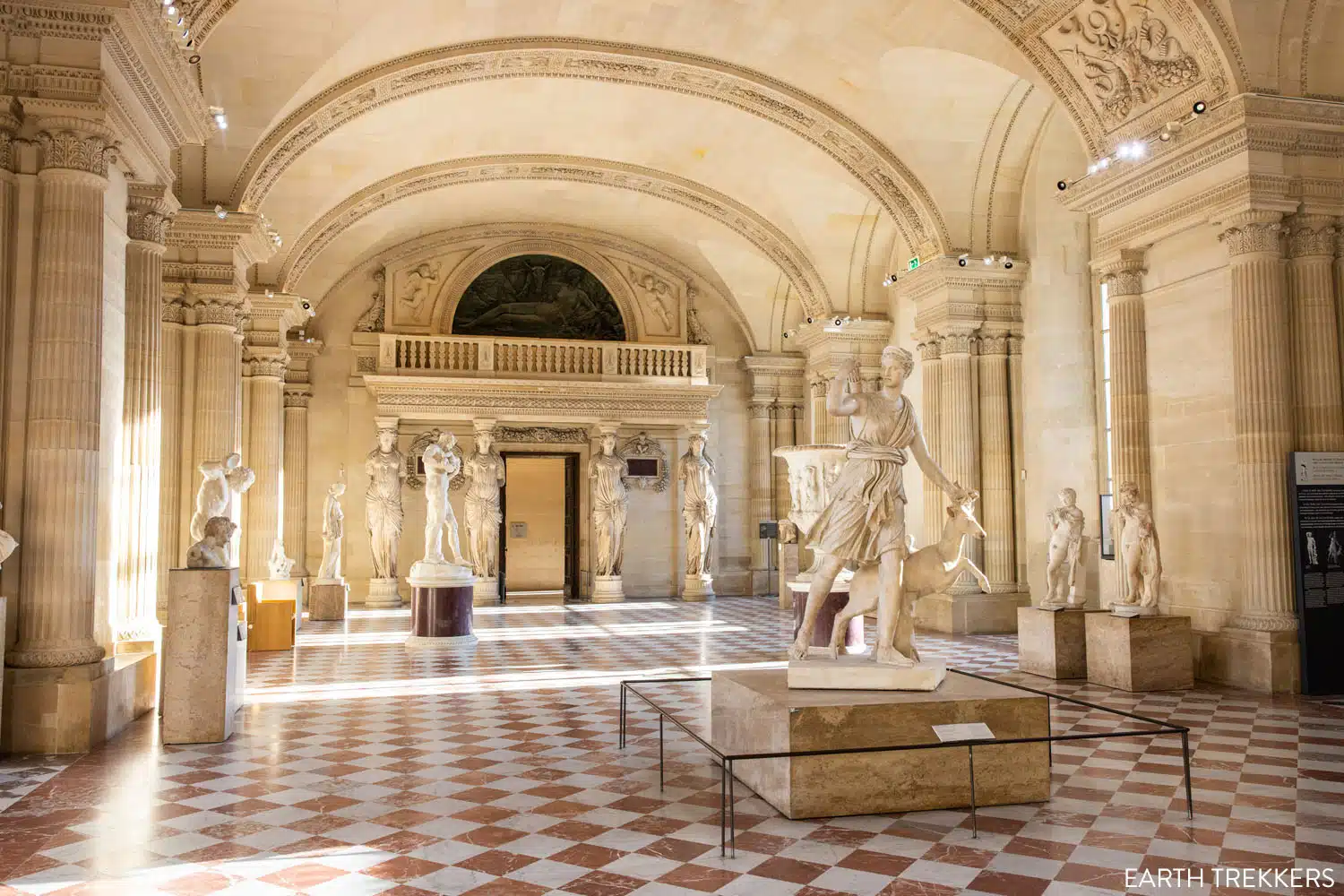
Salle des Cariatides
Walk through the room to the far end. In the corner to the left is Sleeping Hermaphrodite. This ancient Roman sculpture was discovered in the Baths of Diocletian. Gian Lorenzo Bernini sculpted the mattress. The sculpture was first on display in the Borghese Gallery in Rome and later moved to the Louvre when it was sold to the French.
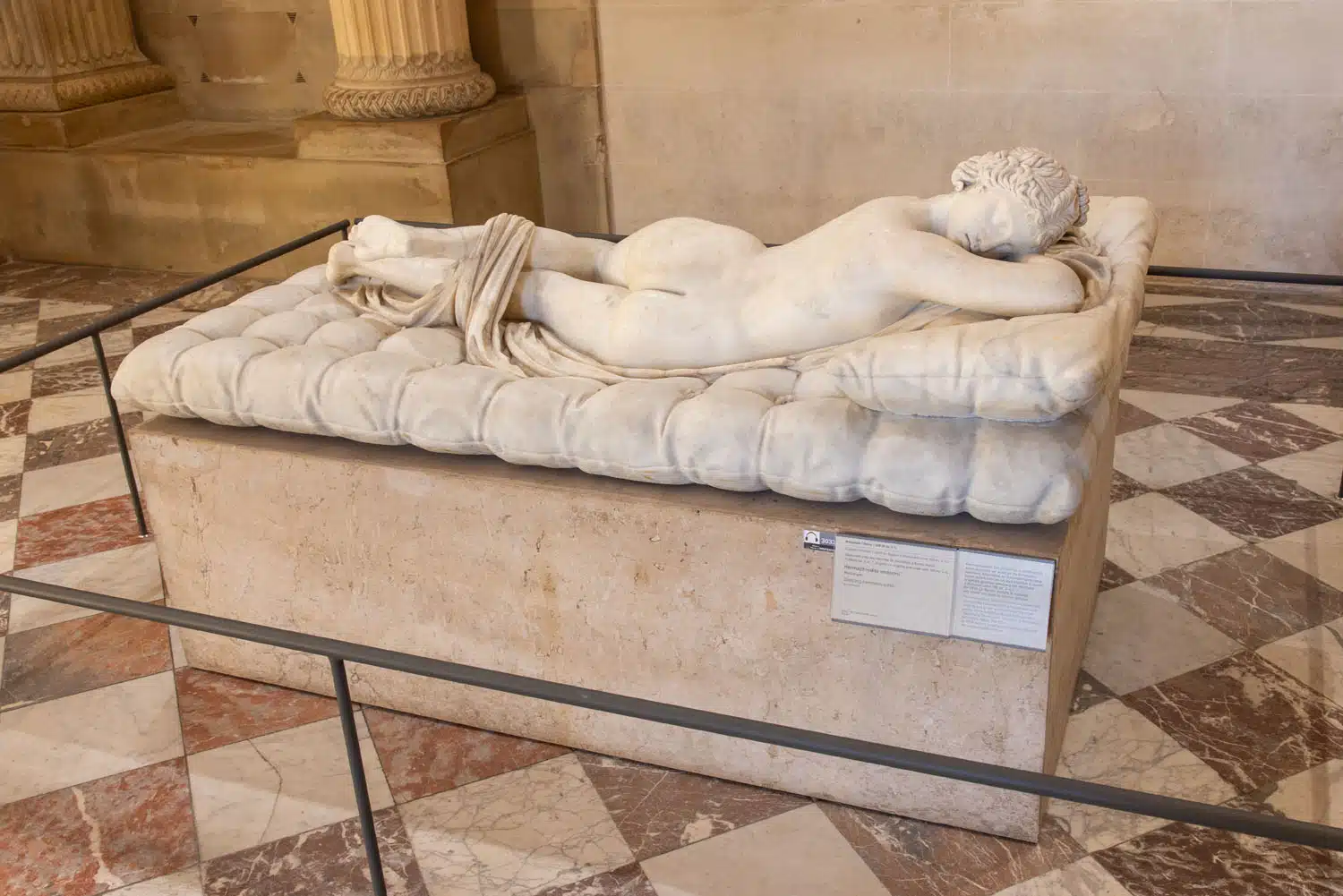
Sleeping Hermaphrodite
Stop 2: Venus de Milo
Walk around the right side of the fireplace and exit the room. Walk between the red pillars for a view of Venus de Milo.
This famous ancient Greek sculpture was carved during the Hellenistic period. It depicts Aphrodite, the Greek goddess of love. It was discovered on the island of Milos, Greece, in 1820, bought by Louis XVIII, and installed in the Louvre.
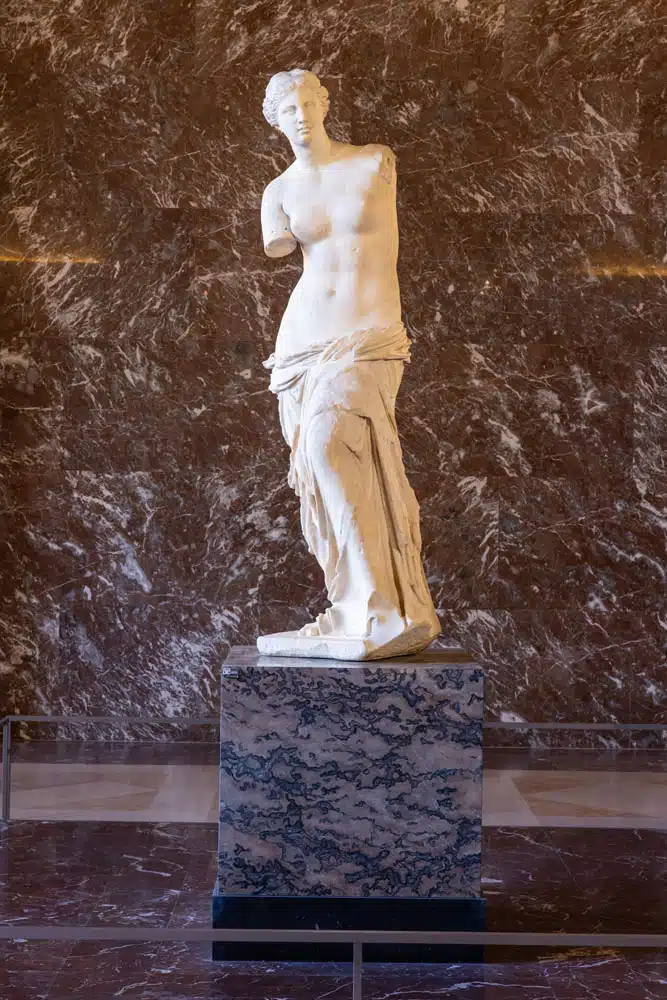
Venus de Milo
Stop 3: The Winged Victory of Samothrace
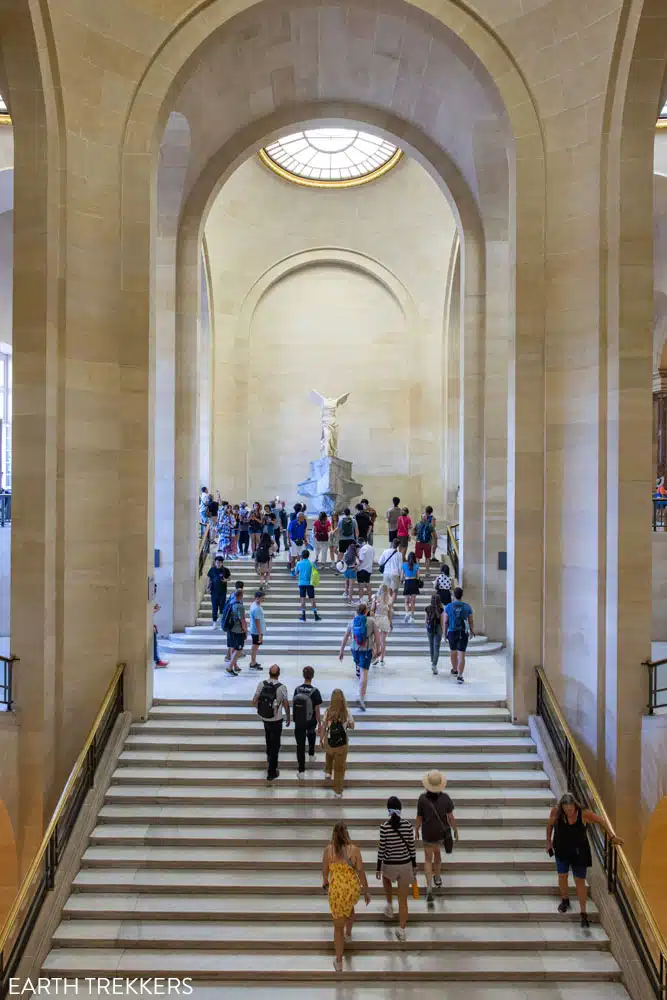
Turn around and walk through the red pillars. Turn left just past the red pillars, walk straight through the rotunda, and walk up the stairs. In front of you is the Winged Victory of Samothrace.
Like Venus de Milo, the Winged Victory of Samothrace is another Greek sculpture from the Hellenstic period. This statue represents the goddess Nike standing on a ship’s bow.
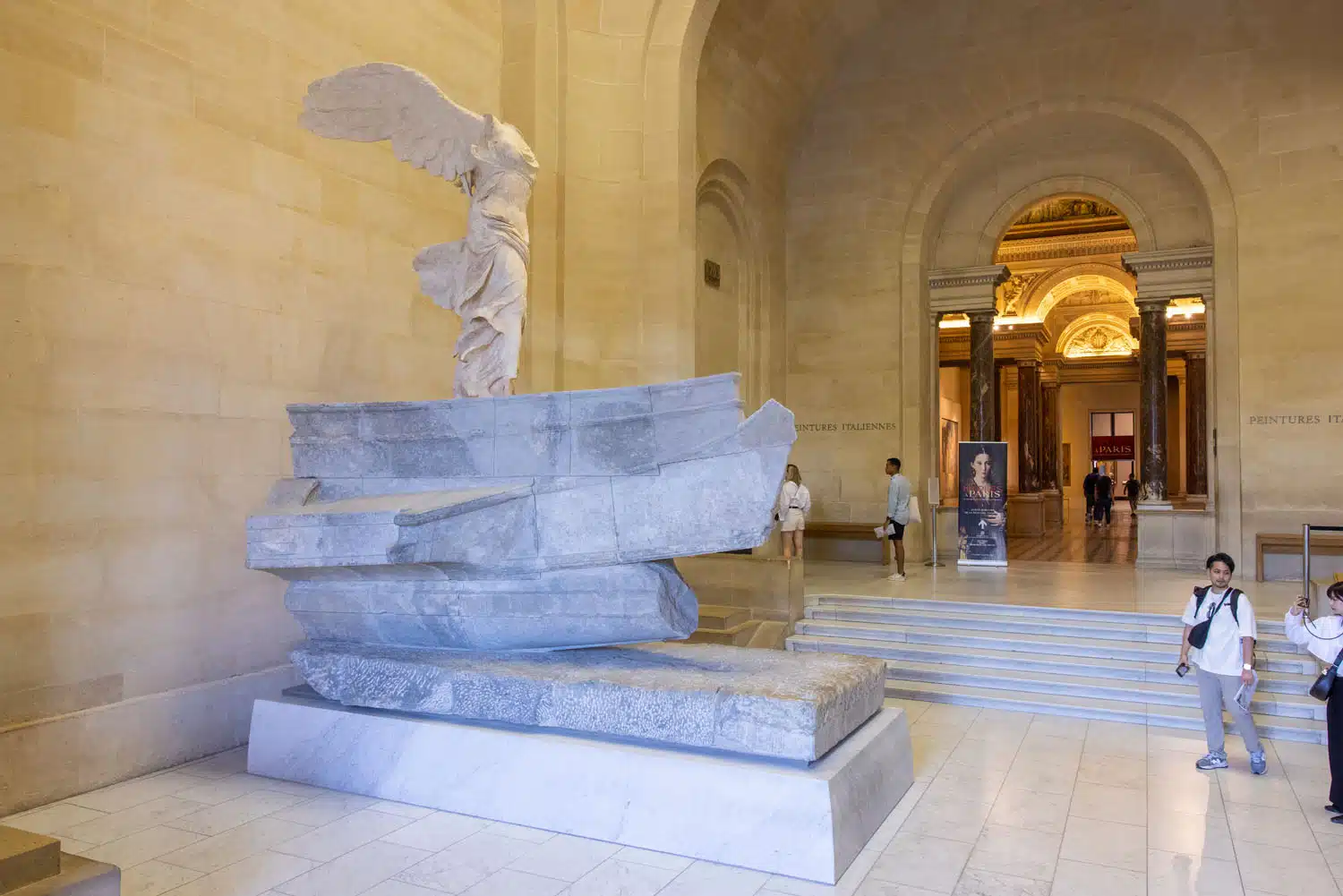
Winged Victory of Samothrace
Stop 4: Apollo Gallery (The Galerie d’Apollon)
Facing the front of Winged Victory, turn left and walk up a few more stairs and enter a round room (room 704). As a bonus, take a look out of the window for a beautiful view outside of the Pyramid.
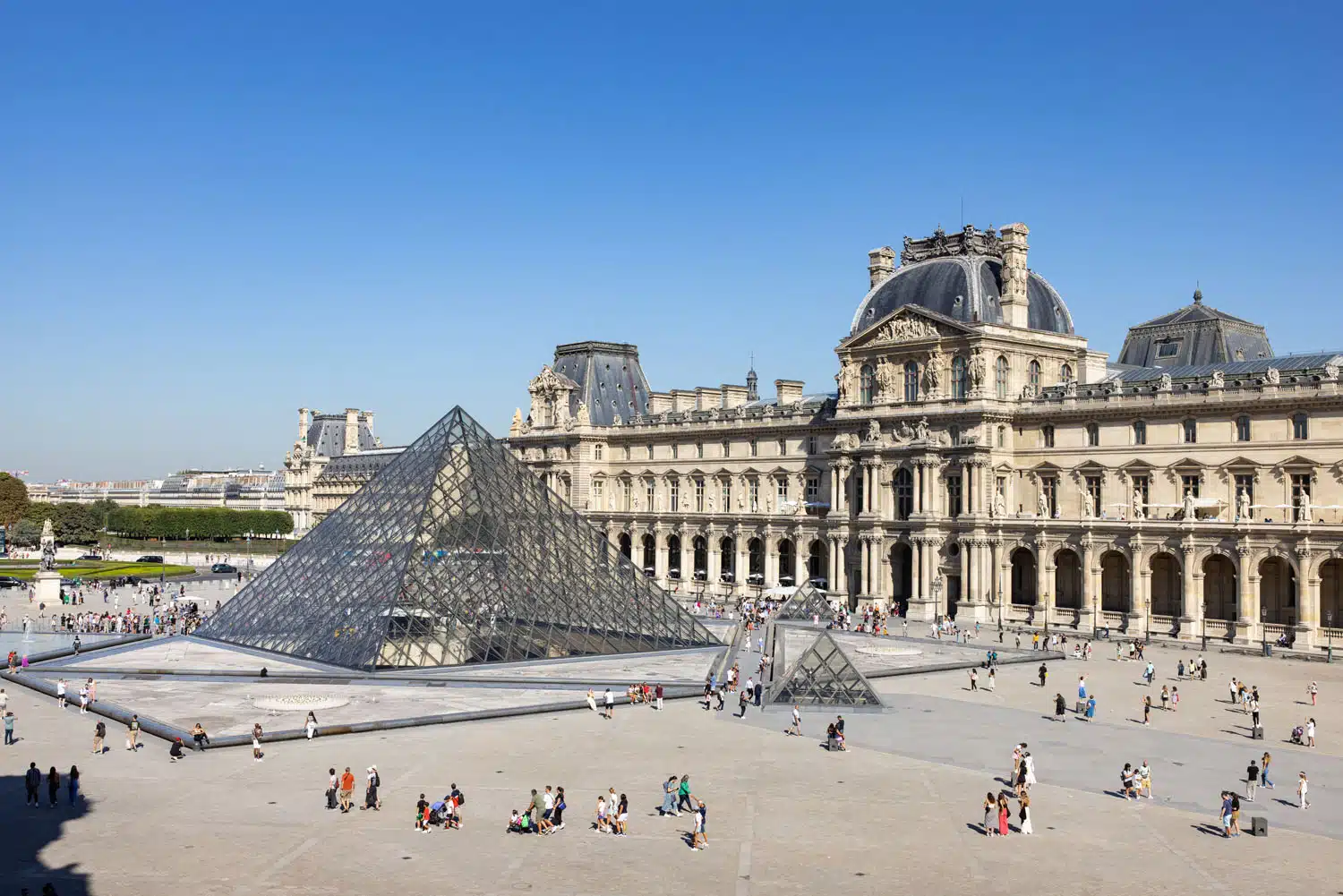
Then, enter the Apollo Gallery (room 705, Denon Wing). To be in this ornate room with little to no people is an underrated experience in the Louvre. We’ve also been here with a huge crowd and it is a much different experience.
The Apollo Gallery is decorated with paintings, stuccos, and tapestries. This part of the Louvre was rebuilt by Louis XIV after a fire burned the Petite Galerie. In the center of the room are display cases containing gems and some of the Crown Diamonds.
2026 Update: The Galerie d’Apollon reopened in July 2026 following the October 2025 robbery. The historic gallery can once again be visited, but the precious objects and Crown Jewels formerly displayed in its cases are no longer on exhibit here. Because temporary closures can still occur, check the Louvre’s room-opening schedule before your visit.
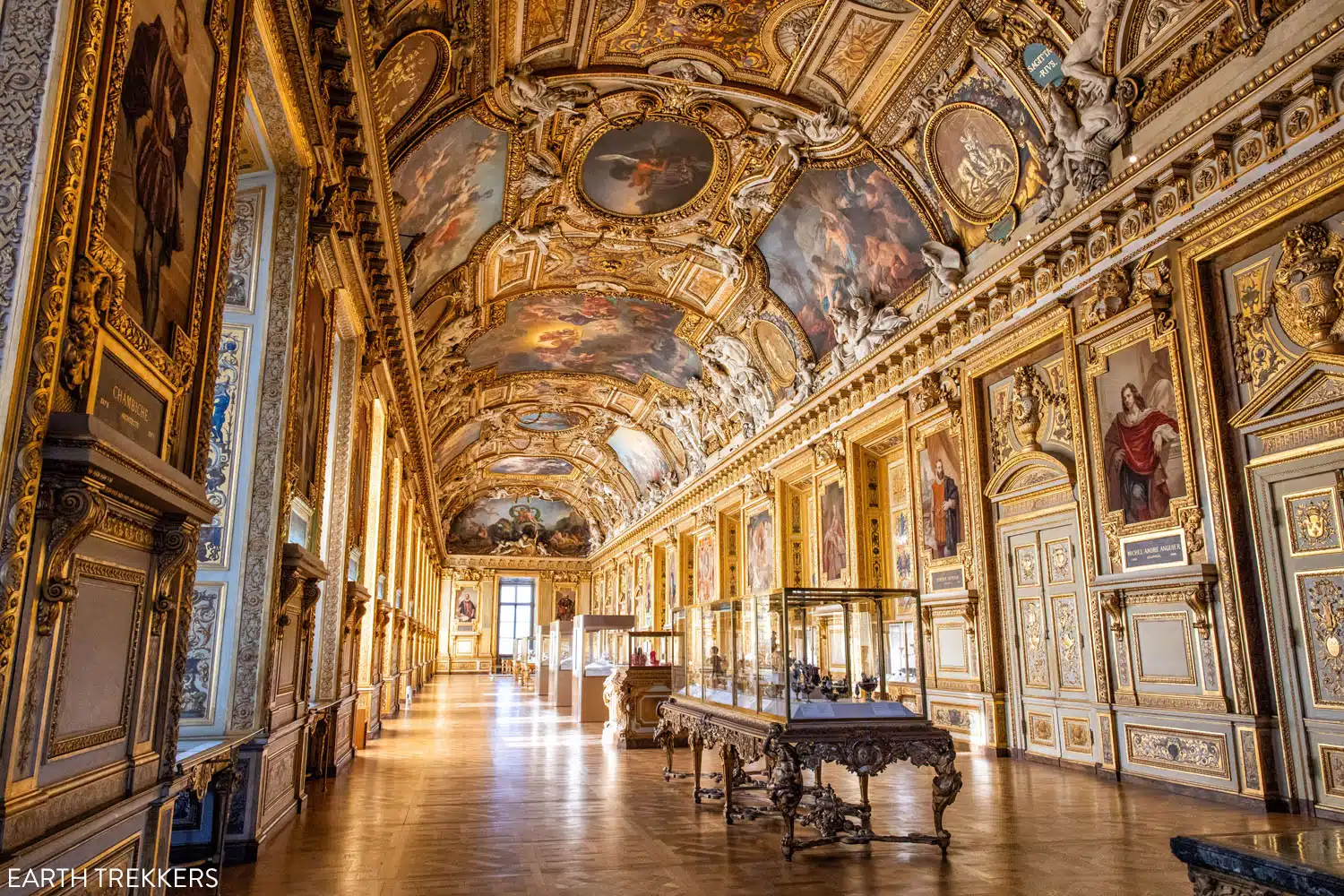
Apollo Gallery
Stop 5: The Grande Galerie
Walk to the far end of Apollo Gallery turn right to enter the Salon Carré (room 708). Look up at the ceiling and then continue straight into a long hallway. This is the Grande Galerie.
Adorning the walls is a large collection of paintings, some of them by Da Vinci and other famous Italian Renaissance artists. In the interest of time, we did not spend a lot of time here, but one of the most famous paintings in this room is Saint Anne, the Virgin and the Infant Jesus Playing with a Lamb by Leonardo Da Vinci.
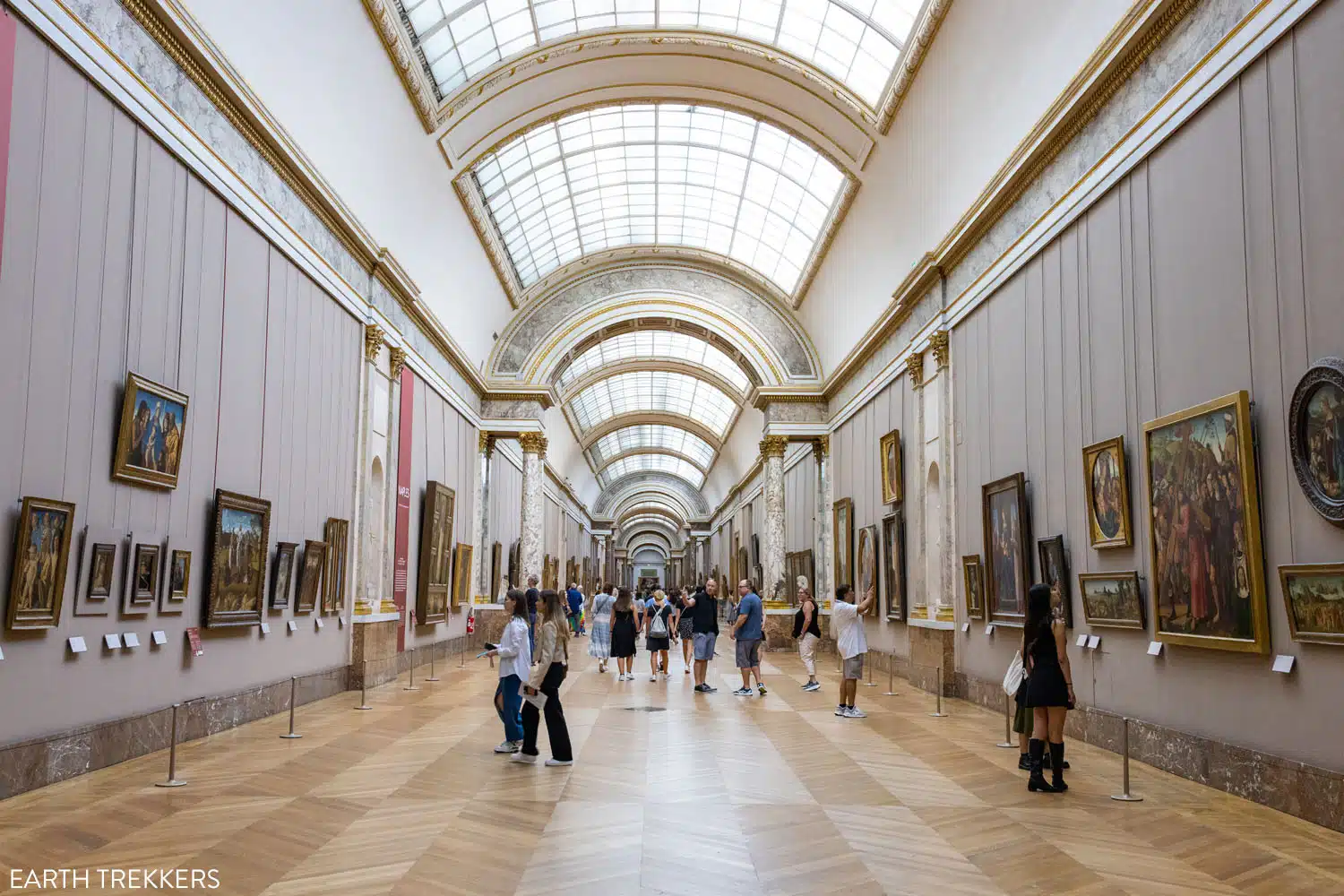
Grande Galerie
Stop 6: Mona Lisa & The Wedding Feast at Cana
You have seen quite a few works of art in a short period of time. By this point, you are about 15 to 20 minutes into this tour, a little longer or shorter, depending on how long you linger at each artwork.
Now it is time to see the Louvre’s most famous masterpiece, the Mona Lisa.
Continue walking through the Grande Galerie. Pass the white marble columns and then make the next right into the room with Mona Lisa (room 711). There will be a sign in the Grande Galerie indicating the turn for the Mona Lisa. When you walk into the room the Mona Lisa will be straight ahead in the middle of the room.
If you are here in the morning, the crowd should be small and it only takes a minute or so to work your way to the front for a photo or selfie with the Mona Lisa. In my opinion, it’s worth having the small crowd here, rather than backtracking to the Apollo Gallery and Salle des Cariatides.
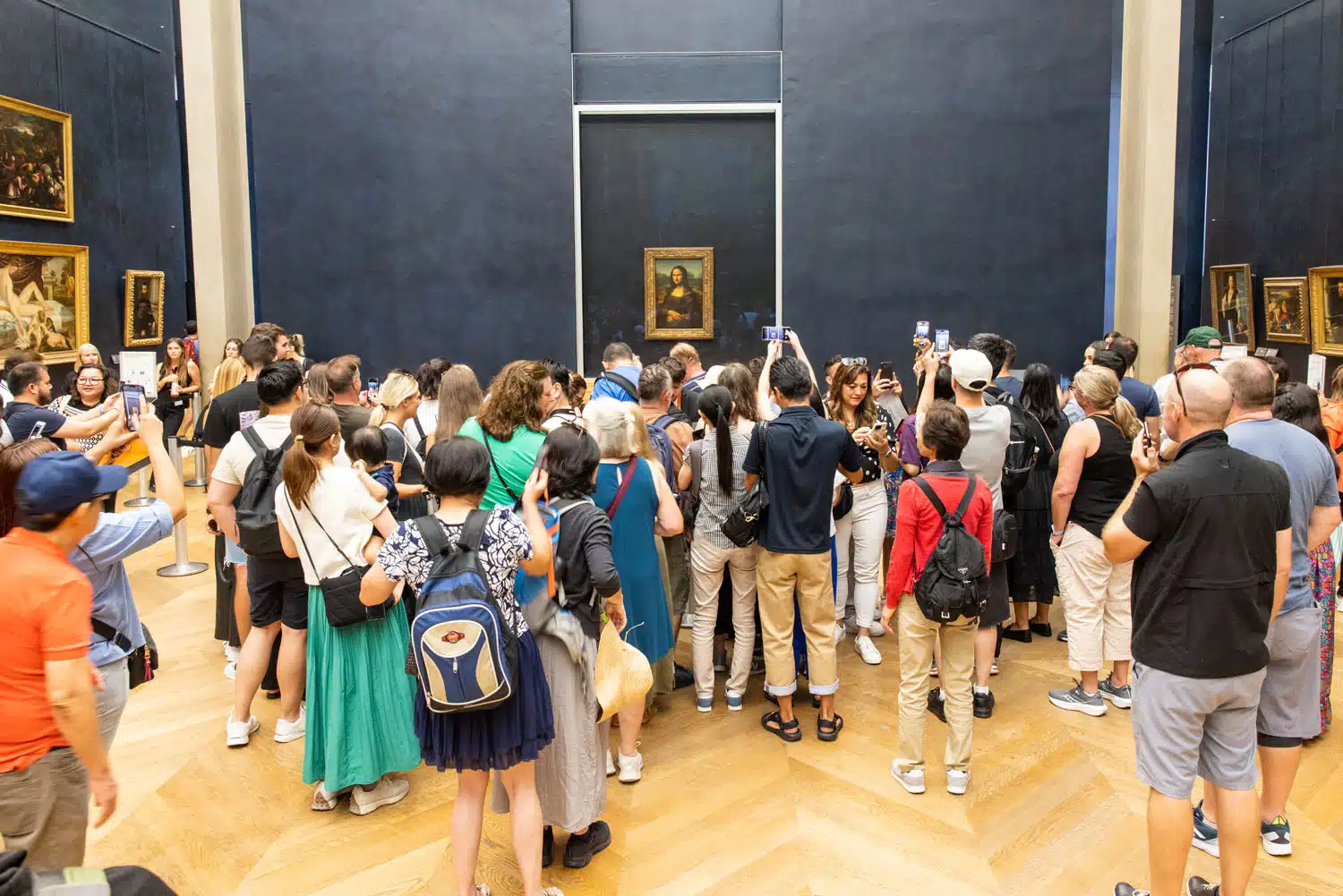
The Mona Lisa is facing a giant painting called The Wedding Feast at Cana. So, after seeing the Mona Lisa turn around to see this other masterpiece. This massive painting was created by Paolo Veronese in 1563. It depicts the story where Jesus converted water into wine during the Wedding at Cana.
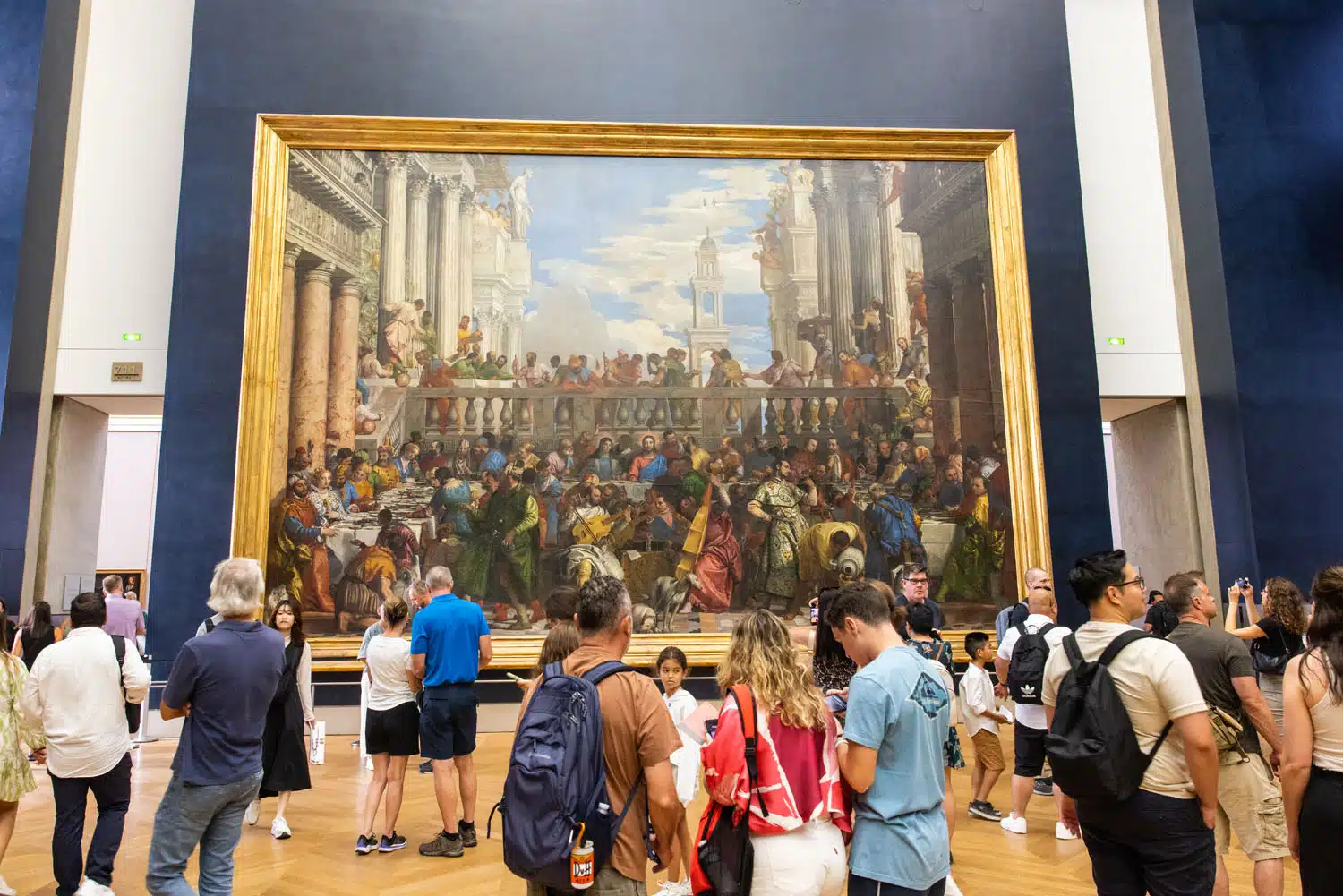
Wedding Feast at Cana
Traffic through 711 is one-way. To exit the room, walk past the Mona Lisa and enter room 701.
This large room contains a souvenir shop and a beautifully painted ceiling. It’s worth a quick photo.
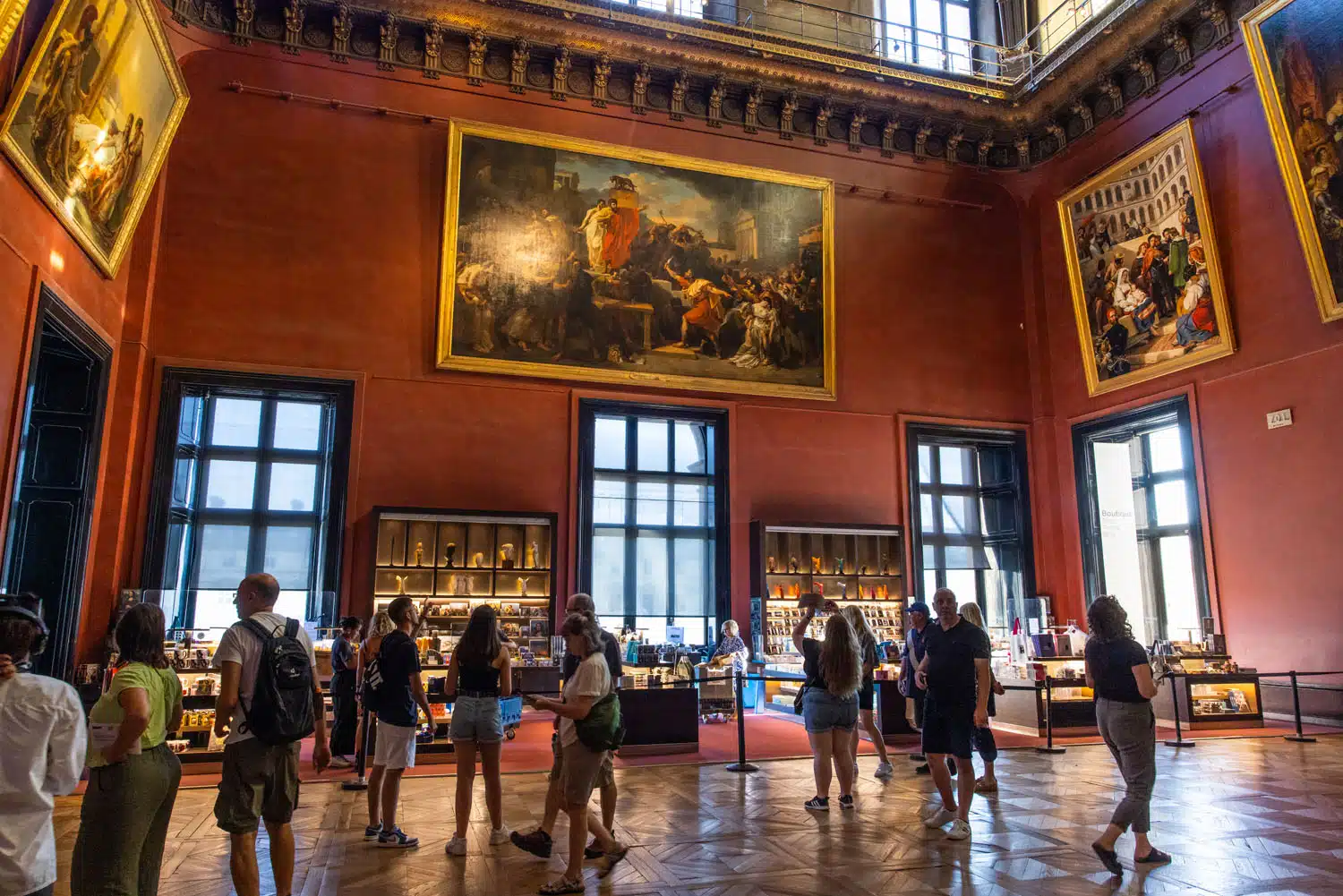
Room 701
Stop 7: The Consecration of Napoleon
From room 701, turn right and enter room 702. You know you are in the correct room if you can see Winged Victory through the doorway on the far end of this room.
Halfway down the wall on the left is the largest painting in the room. This painting, which has the very long official name of the Consecration of the Emperor Napoleon I and Coronation of the Empress Josephine in the Cathedral of Notre-Dame de Paris on 2 Dec 1804, was painted by Jacques-Louis David.
Historically, Napoleon crowned himself. In this painting, David portrays Napoleon crowning Josephine with the Pope blessing the Empress.
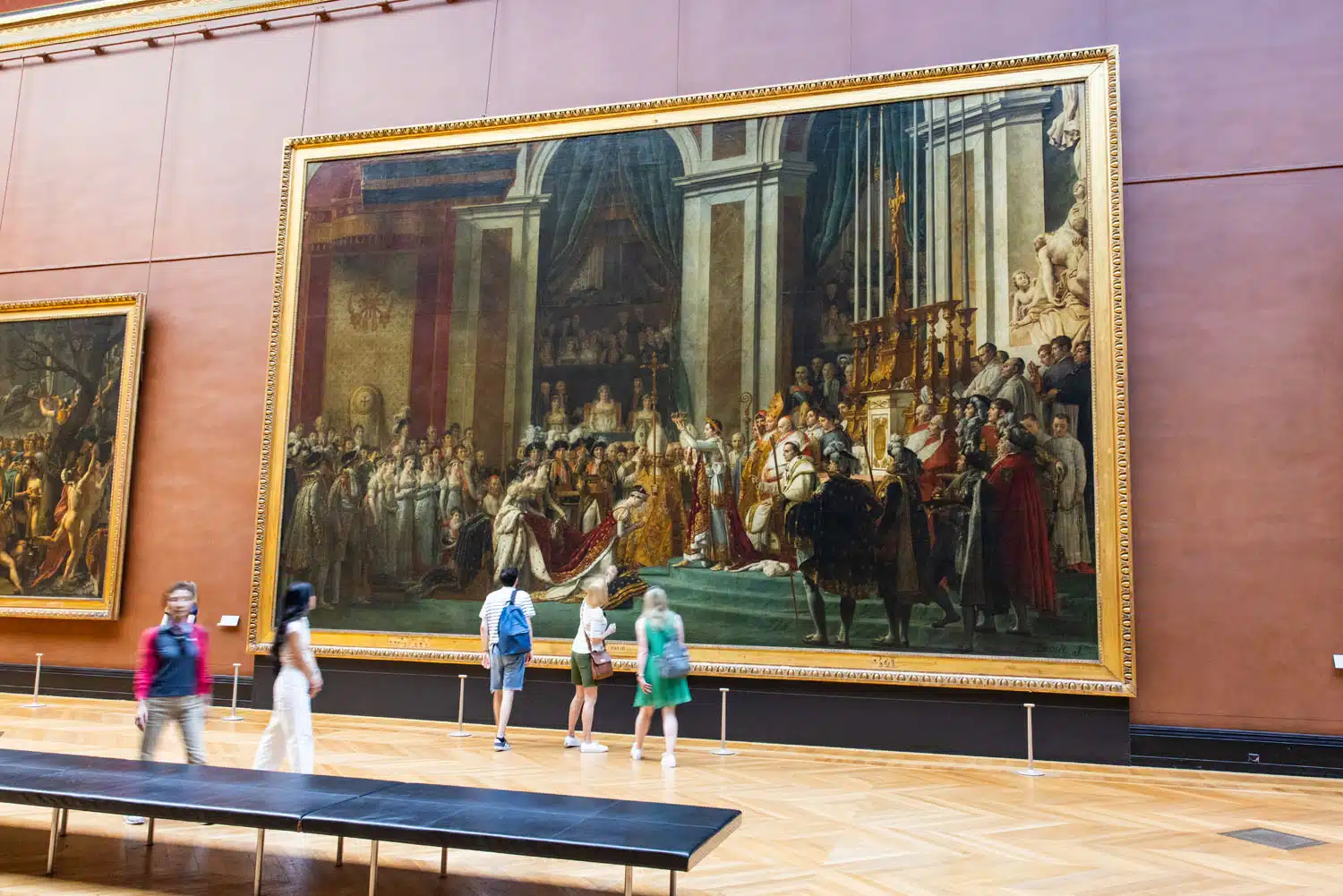
Napoleon’s Consecration
Stop 8: Raft of Medusa & Liberty Leading the People
Now back track to the room with the gift shop (701) and continue straight through that room and enter another long room (700).
About halfway on the left is The Raft of the Medusa by Theodore Gericault, an icon of French Romanticism.
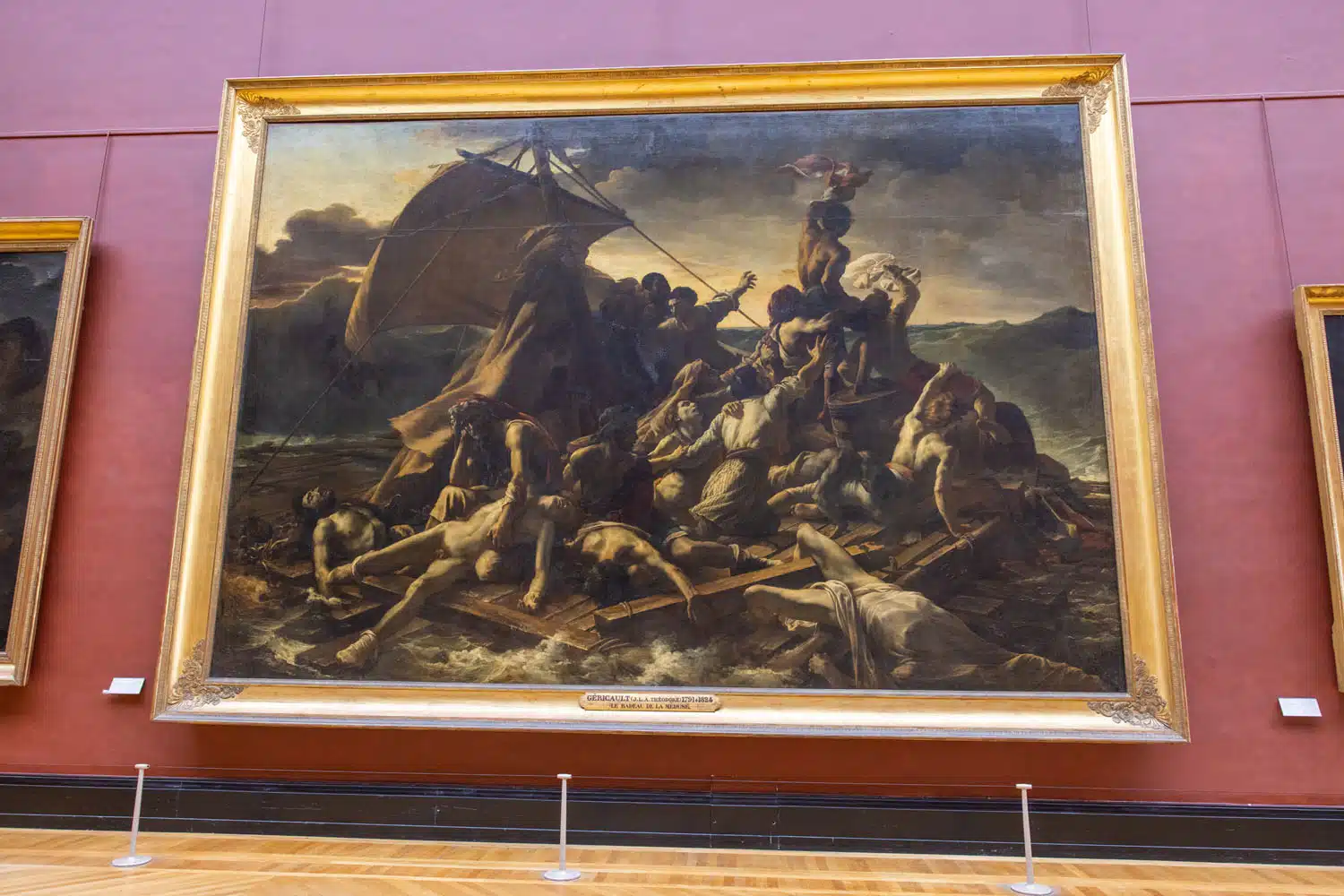
Raft of Medusa
In the same room is Liberty Leading the People by Eugene Delacroix. This painting commemorates the July Revolution of 1830 which toppled King Charles X.

Liberty Leading the People
Optional Stop: Café Mollien
Exit the far end of this room and you will come upon a cafe on the right, Café Molien. The Cafe does not open until 10:15 am. We made it here at 9:40 am but we moved very quickly through the Louvre. If it is open, you have the option to take a break, have a coffee or a snack, and enjoy the view. This café has an open terrace with a great view of the Pyramid (we returned to the café later in the day to take the photo below).
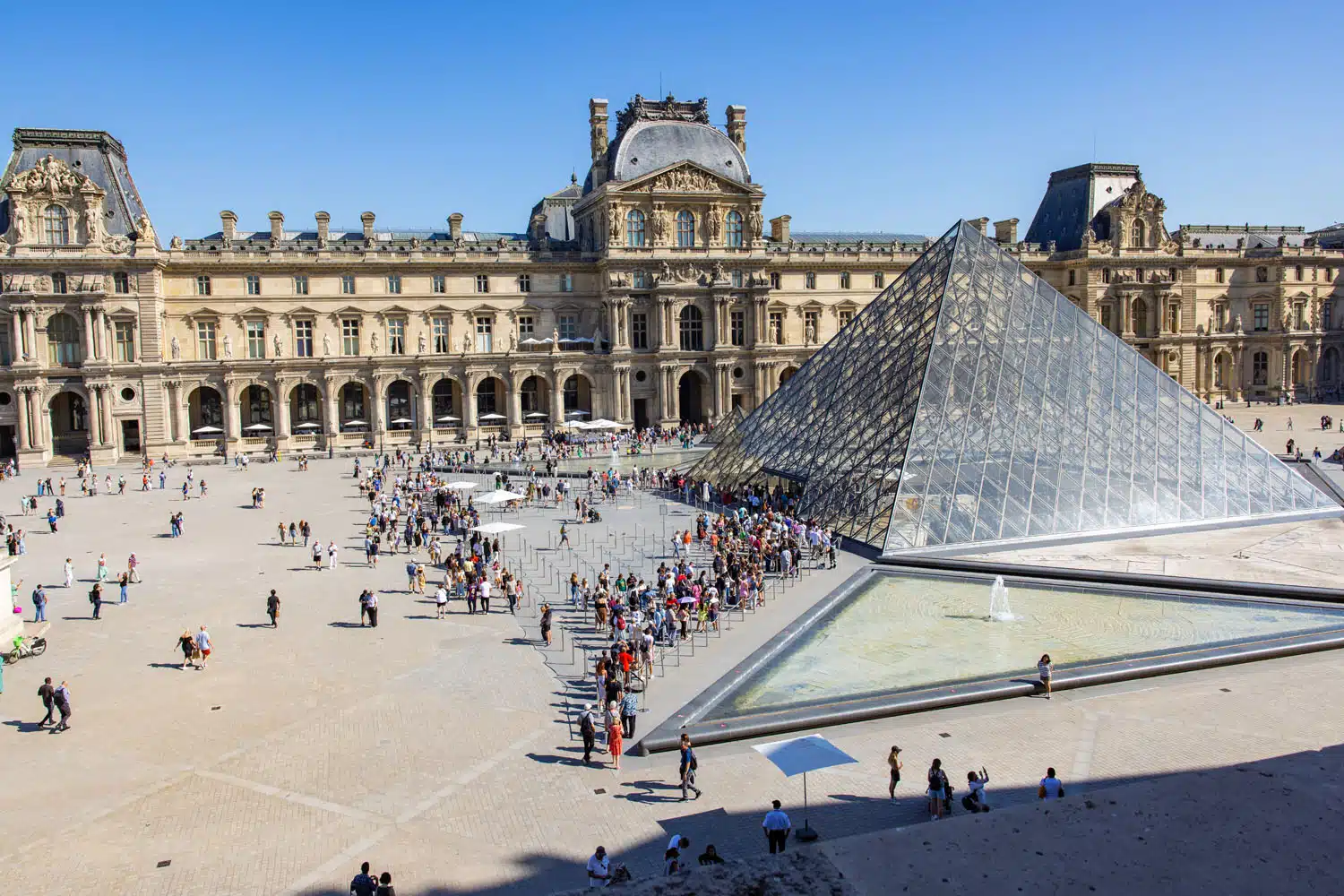
The view from Cafe Molien
Stop 9: Michelangelo’s Slaves & Psyche Revived by Cupid’s Kiss
Next to the cafe, descend down the large staircase to room 403. A short distance into the room are two sculptures, the Rebellious Slave and the Dying Slave, both of which were carved by Michelangelo.
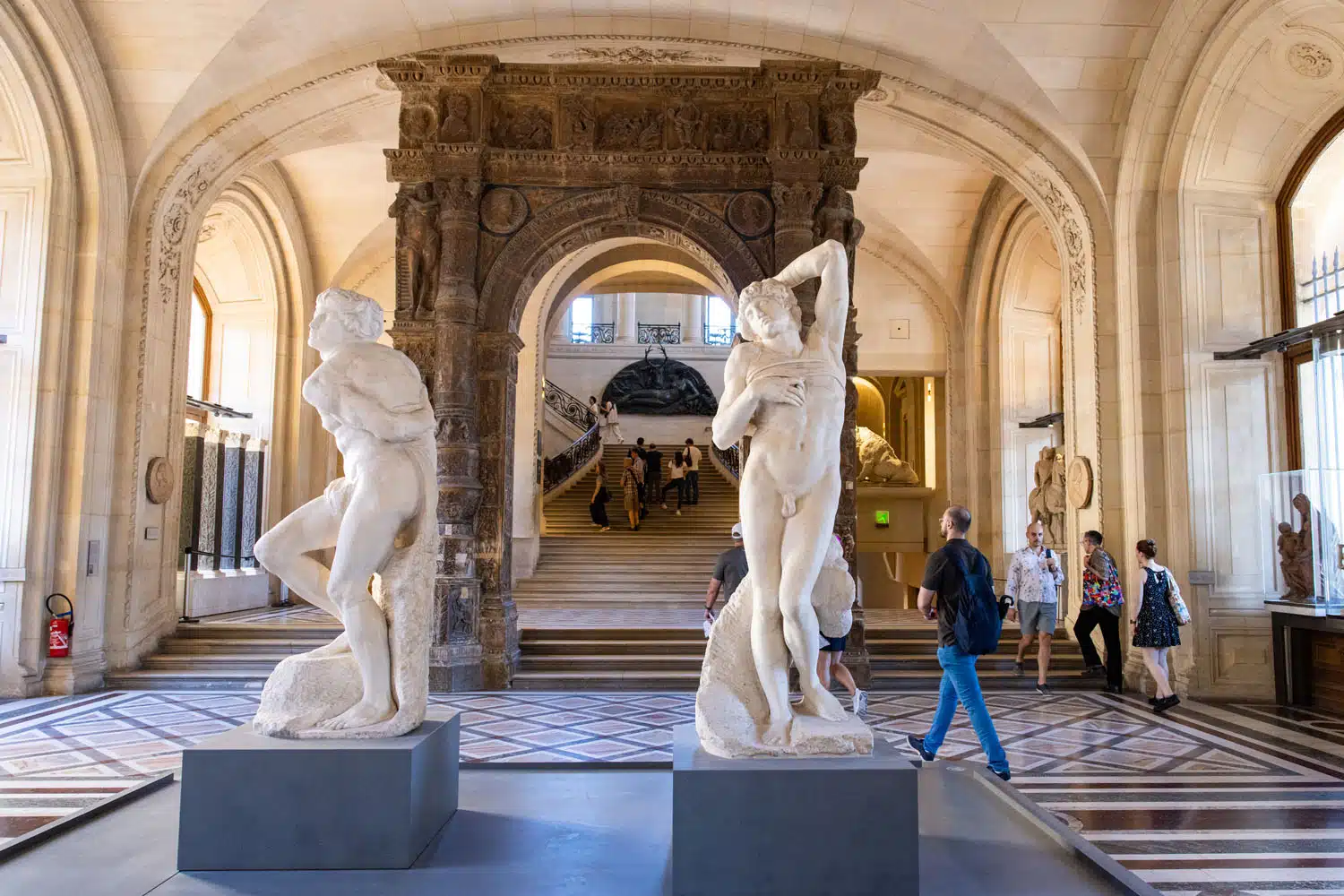
Michelangelo’s Slaves
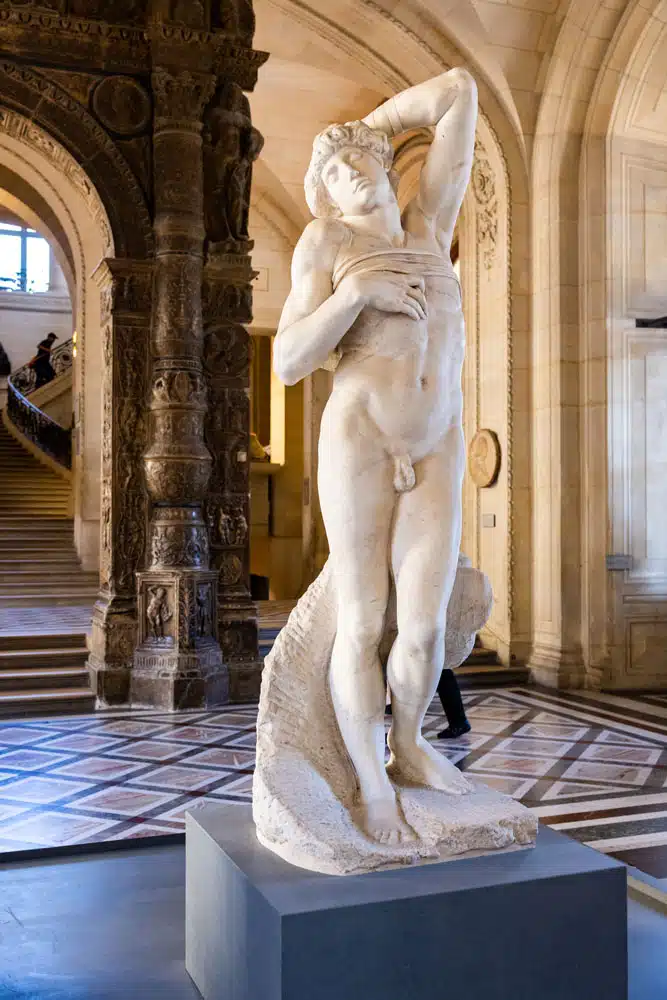
Dying Slave
Continue to the far end of room 403 to see Psyche Revived by Cupid’s Kiss by Antonio Canova.
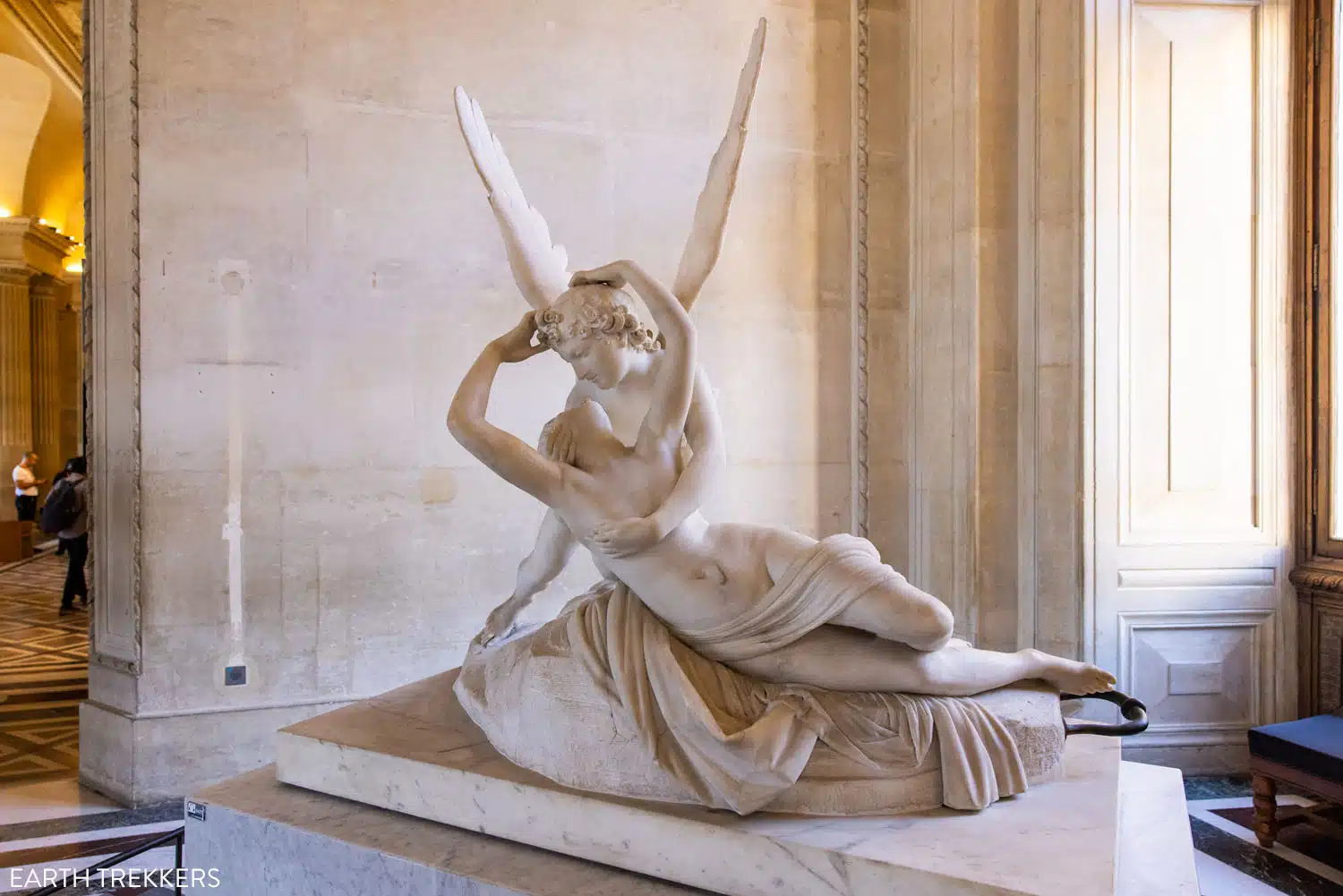
Psyche Revived by Cupid’s Kiss
Finish Part 1 or Continue?
At this point, you will have seen many of the Louvre’s most famous masterpieces. Depending on how quickly you moved and how long you spent at each work of art, Part 1 takes roughly 1 to 1.5 hours.
If that’s enough Louvre for one day, exit the Louvre. Leave room 403, go down the steps, enter room 404, go down the spiral staircase, following signs for the exit (sortie).
If you want to keep exploring, continue with Part 2: Medieval Louvre & Egyptian Antiquities. This adds another 1 to 1.5 hours and takes you from Renaissance paintings and sculpture much farther back in time.
Part 2: Medieval Louvre & Ancient Egypt
Time: 1 to 1.5 hours
If you have more time, continue into the Medieval Louvre and Egyptian Antiquities. This part of the tour feels completely different from Part 1: instead of Renaissance paintings and famous sculptures, you’ll walk through the foundations of the original Louvre fortress and then explore one of the world’s great collections of ancient Egyptian artifacts.
Things you will see include:
- Greek Antiquities
- Medieval Louvre
- The Great Sphinx of Tanis
- Egyptian Antiquities
The Route to Medieval Louvre
To get to Medieval Louvre, it is a short walk back through the Denon Wing to the Sully Wing. Here is the route.
From room 403, walk down the steps, enter room 404, and continue straight through to room 406 (Galerie Daru). At the far end of the room, only go up a few steps (don’t go all the way up to Winged Victory) and follow the hallway to the left to go back down some steps.
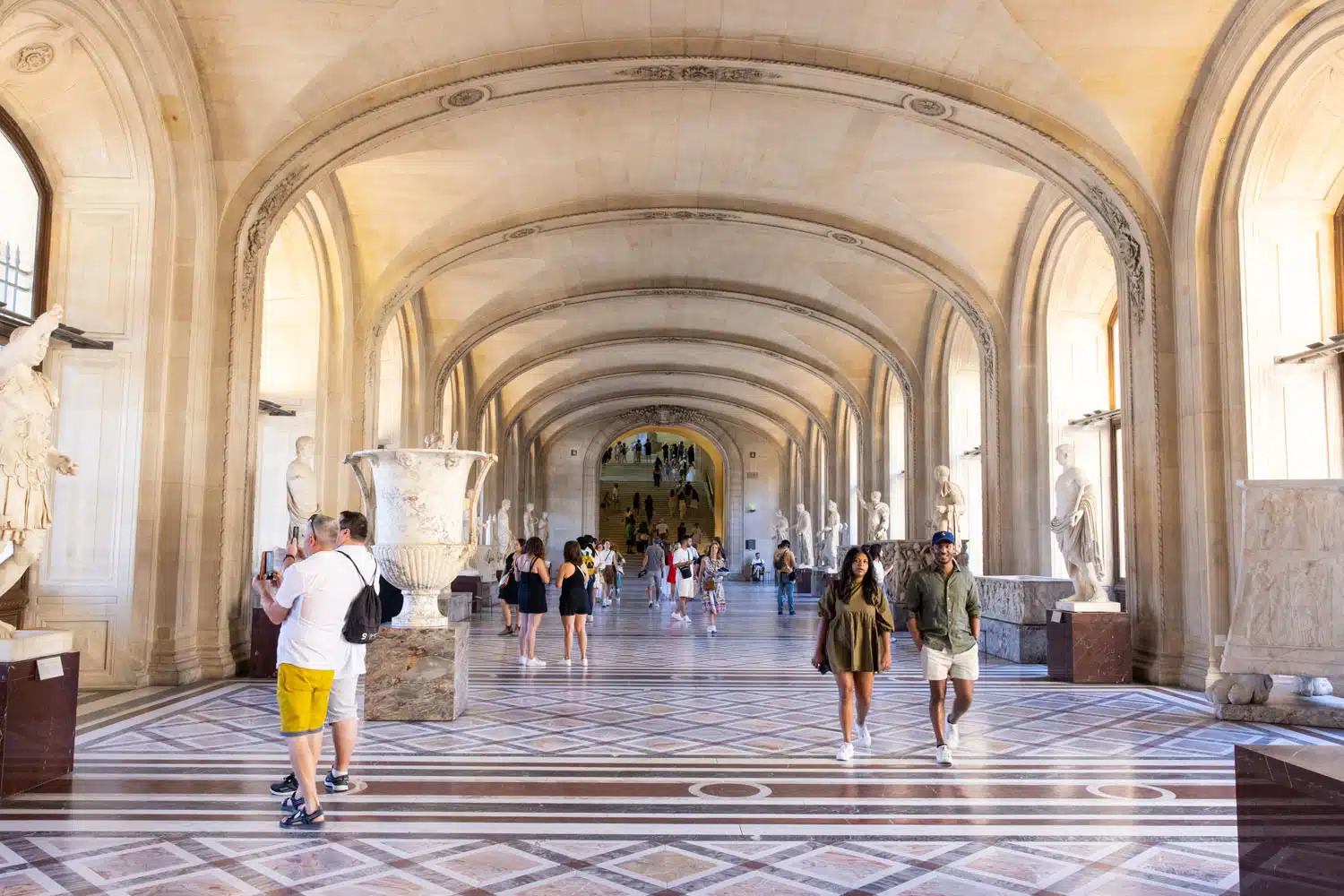
Galerie Daru
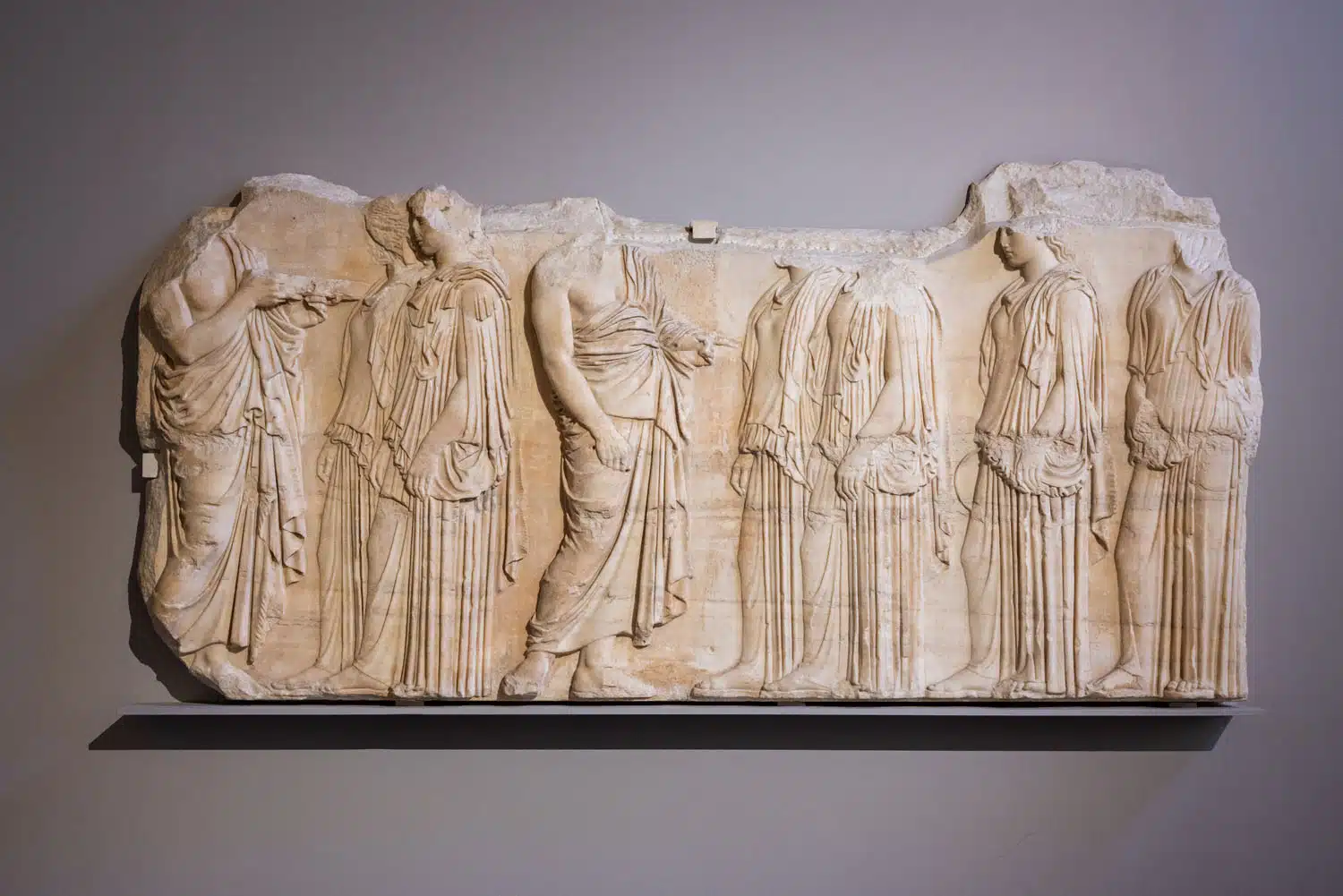
A piece of the Parthenon in Salle de Diane
Walk through room 347 (Salle de Diane) which contains Greek antiquities and pieces of the Parthenon. Then continue through room 345 and see the crowds around Venus de Milo.
Walk until Venus de Milo is on your right and then turn left into room 348 (Salle des Cariatides). Walk through the room and out the opposite side. Turn left and then go down the stairs. At bottom of steps swing a hard right almost like a U turn and then walk straight until you enter a room with stone walls (room 133). This is the Medieval Louvre.
Room closures and rerouting can alter the exact path through these galleries, so use the Louvre signs for the Medieval Louvre if they differ from these directions.
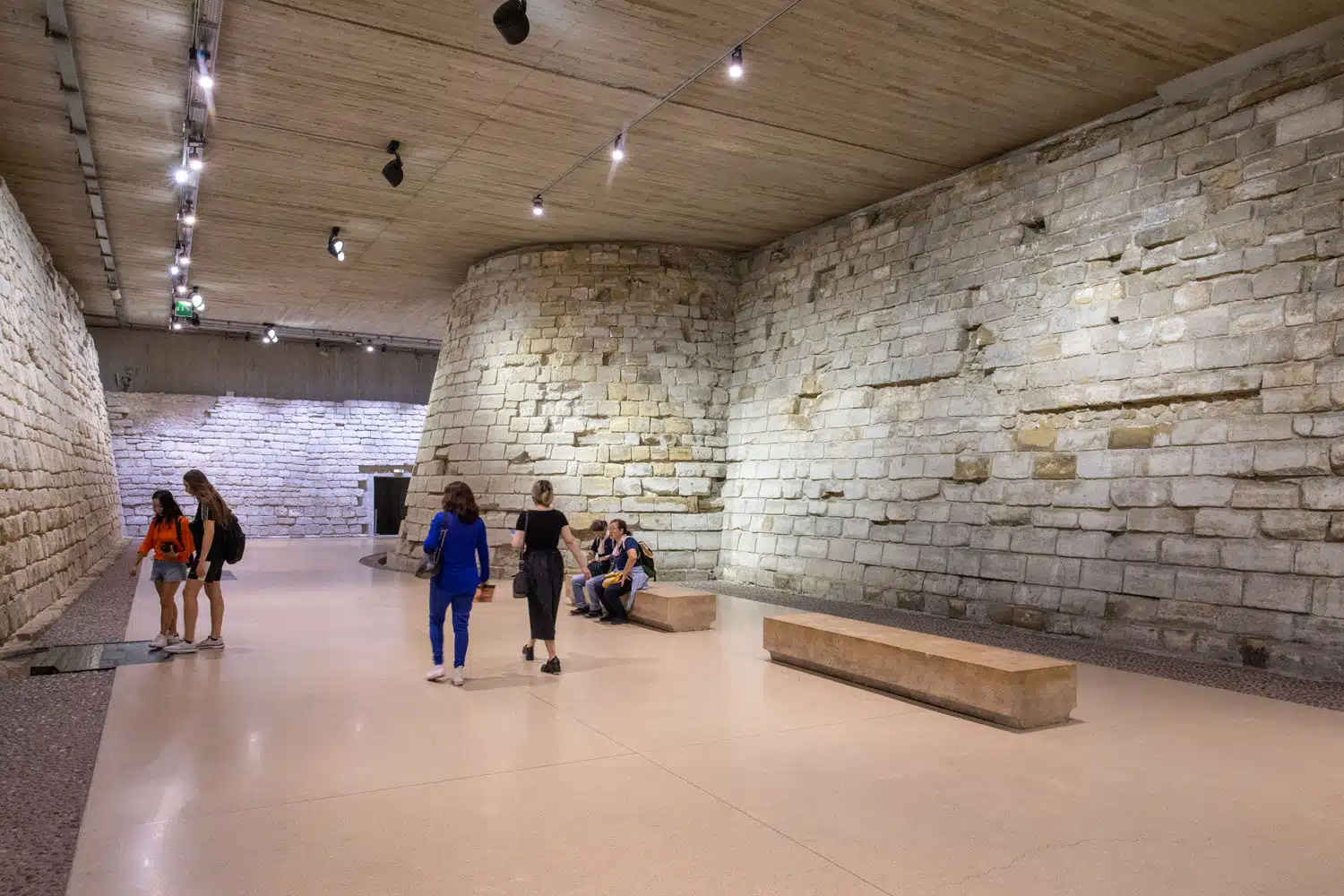
Medieval Louvre
Stop 1: Medieval Louvre
The Medieval Louvre is one of the most unexpected sights in the museum.
Long before the Louvre became a royal palace or an art museum, it was a fortress built during the reign of Philippe Auguste in the late 12th century. On the lowest level of the Sully Wing, you can walk alongside portions of the original fortress walls, moat, and massive stone foundations.
After seeing the ornate palace rooms upstairs, it is fascinating to come down here and see where the Louvre began.
Walk through the Medieval Louvre, following the original stone walls through the Pavillon de l’Horloge.
Stop 2: Great Sphinx of Tanis
From the Medieval Louvre, follow signs for Egyptian Antiquities and the Crypt of the Sphinx.
In Room 338, you’ll come face-to-face with the Great Sphinx of Tanis, an enormous granite sphinx discovered at the ancient Egyptian city of Tanis.
At nearly 5 meters long, it is one of the largest sphinxes outside of Egypt and marks the entrance into the Louvre’s Egyptian collection.
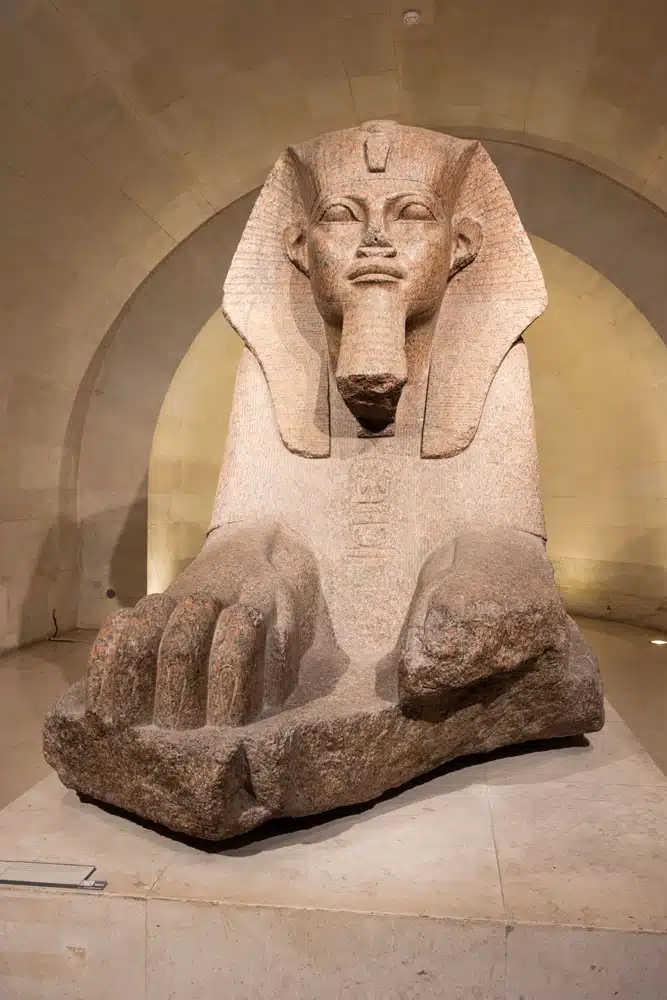
Great Sphinx of Tanis
From the sphinx, take the stairs into the Egyptian Antiquities galleries.
Stop 3: Egyptian Antiquities
The Louvre’s Egyptian collection spans thousands of years of history and occupies two levels of the Sully Wing. You’ll see everything from monumental statues and temple reliefs to hieroglyphics, jewelry, everyday objects, and sarcophagi.
This was one of our favorite parts of the Louvre.
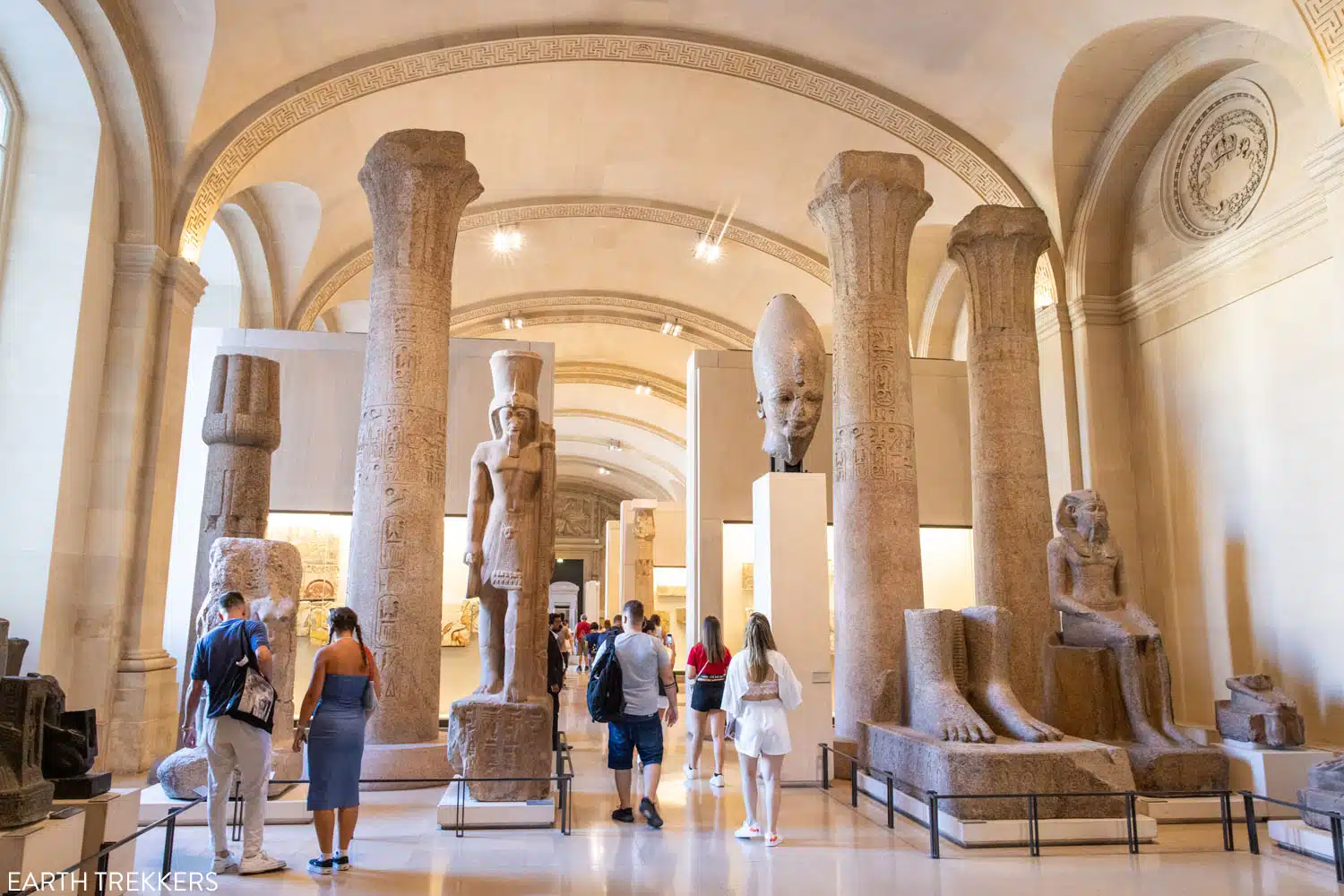
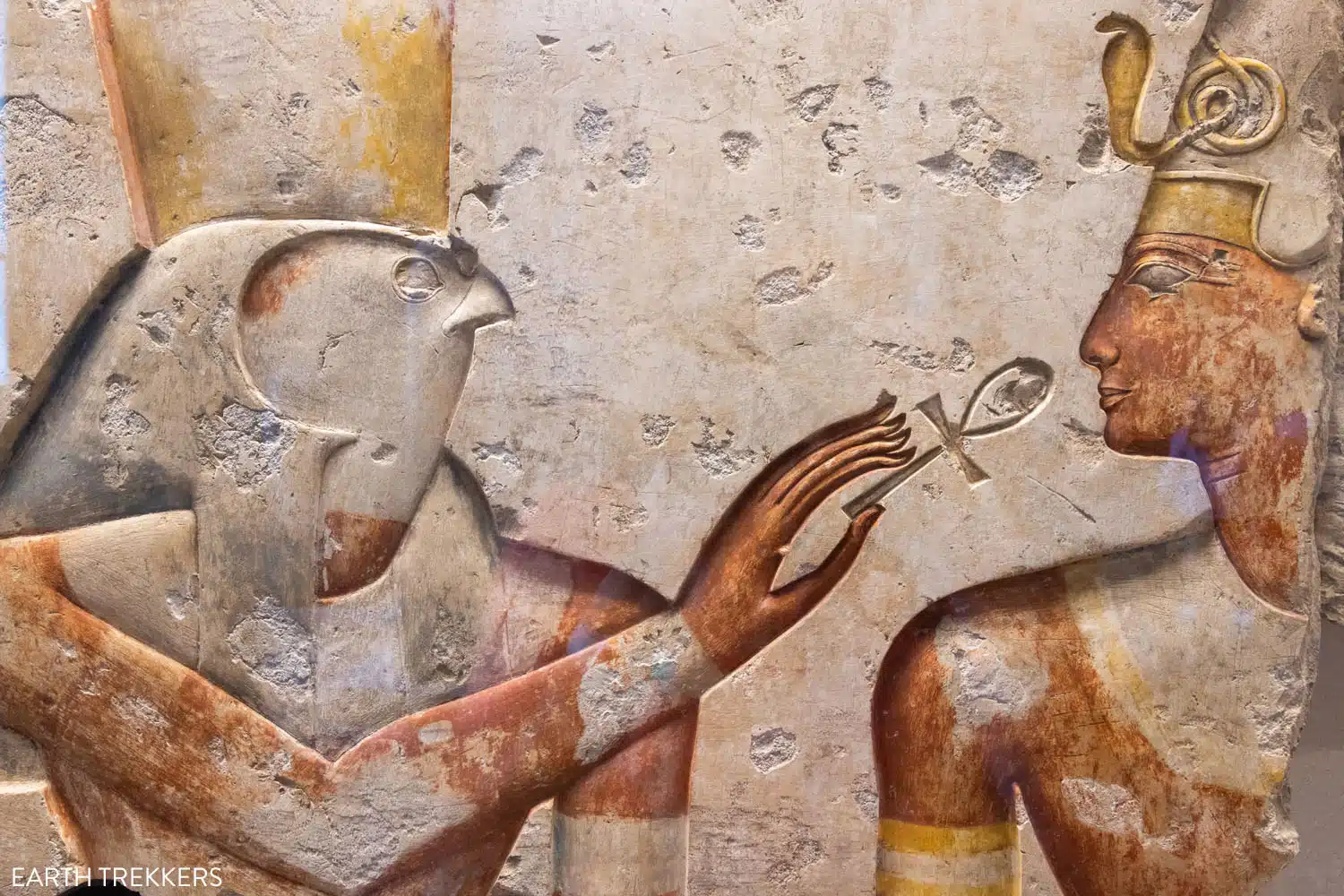
If you have a strong interest in ancient Egypt, you could easily spend several hours here. For this walking tour, we recommend following the lower-level themed galleries and stopping at the artifacts that interest you most rather than trying to see everything.
As you move through the galleries, follow the museum’s “Sens de la visite” signs for the direction of the visit.
Stop 4: Crypt of Osiris & Sarcophagi
Continue through the Egyptian galleries toward the Crypt of Osiris. Along the way you’ll pass statues of Egyptian gods, temple remains, hieroglyphic inscriptions, and objects illustrating daily life in ancient Egypt.
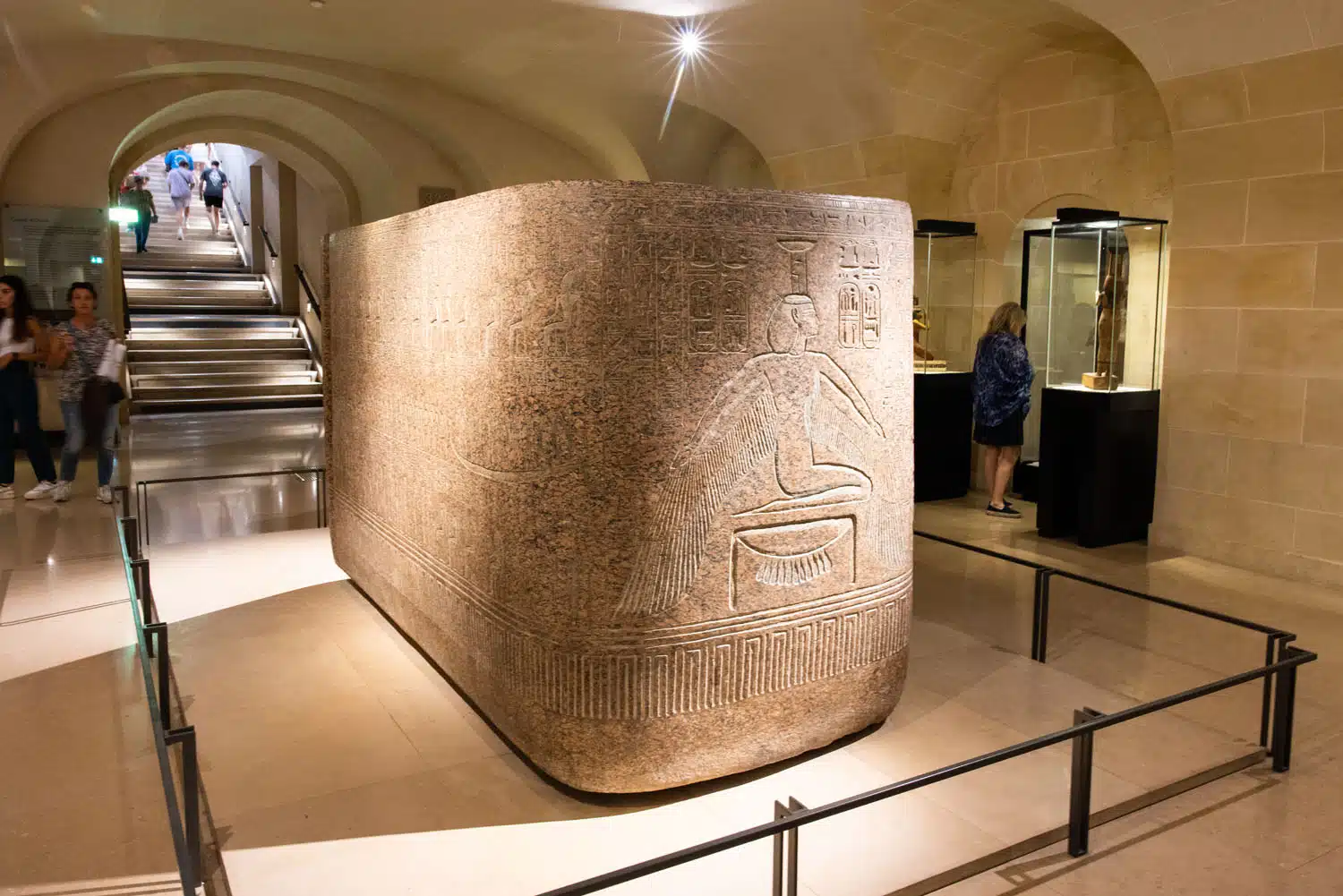
Crypte d’Osiris
From the Crypt of Osiris, continue into the nearby rooms containing the Louvre’s collection of sarcophagi and funerary objects. This is one of the most memorable stretches of the Egyptian galleries and a good place to finish Part 2.
Finish Part 2 or Continue?
By now, you will have spent roughly 2.5 to 3 hours in the Louvre if you completed both Parts 1 and 2. For most first-time visitors, we think this is an excellent place to end your visit. You’ve seen the Louvre’s most famous masterpieces, walked through its medieval foundations, and explored the Egyptian collection without trying to cover the entire museum.
If you still have time and energy, you can continue with Part 3: Richelieu Wing & Additional Highlights. Before doing so, check which Richelieu galleries are open, since renovations and temporary closures frequently affect this part of the museum.
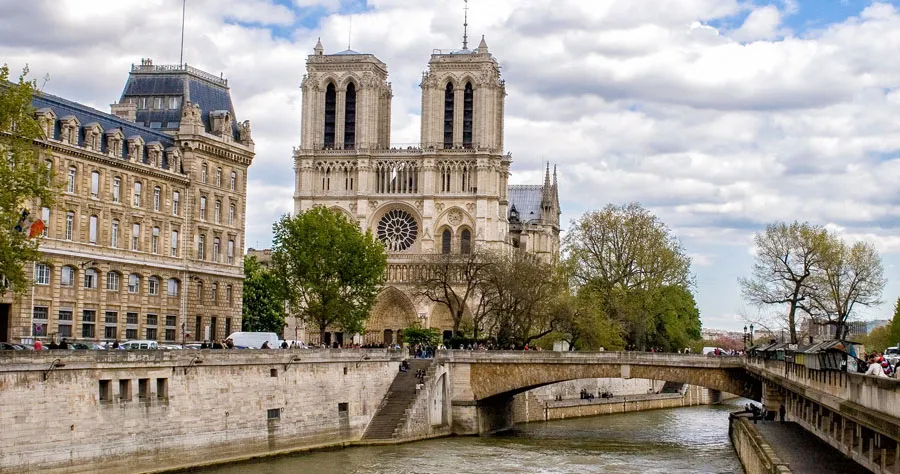
Part 3: The Richelieu Wing & Additional Highlights
Time: 1 to 2 hours
If you still have time and energy after Parts 1 and 2, continue into the Richelieu Wing. This part of the Louvre contains some very different experiences, from lavish Second Empire interiors to ancient Mesopotamian artifacts and monumental sculpture.
However, Part 3 is much more dependent on gallery openings than the first two parts of our route. Major sections of the Richelieu Wing periodically close for renovations, maintenance, or other reasons, so check the Louvre’s current room-opening schedule before following this part of the tour.
2026 Update: Several of the highlights on our original Richelieu route are currently closed, including the Napoleon III Apartments and the Mesopotamian galleries containing the Code of Hammurabi and Lamassus of Khorsabad. If these galleries are closed during your visit, we recommend ending your tour after Part 2 or simply exploring whichever Richelieu collections are open that day.
When open, these are the Richelieu highlights we recommend:
- Napoleon III’s Apartments
- The Code of Hammurabi
- Lamassus of Khorsabad Palace
- The Cour Puget
- Angelina’s
Terrasse Colbert & Café Richelieu
From room 320, walk up the stairs to level 1 on the Sully Wing to room 632 to enter the Object d’art.
The first room you see is the royal residence of Marie Antoinette who was queen of France from 1774 to 1792.
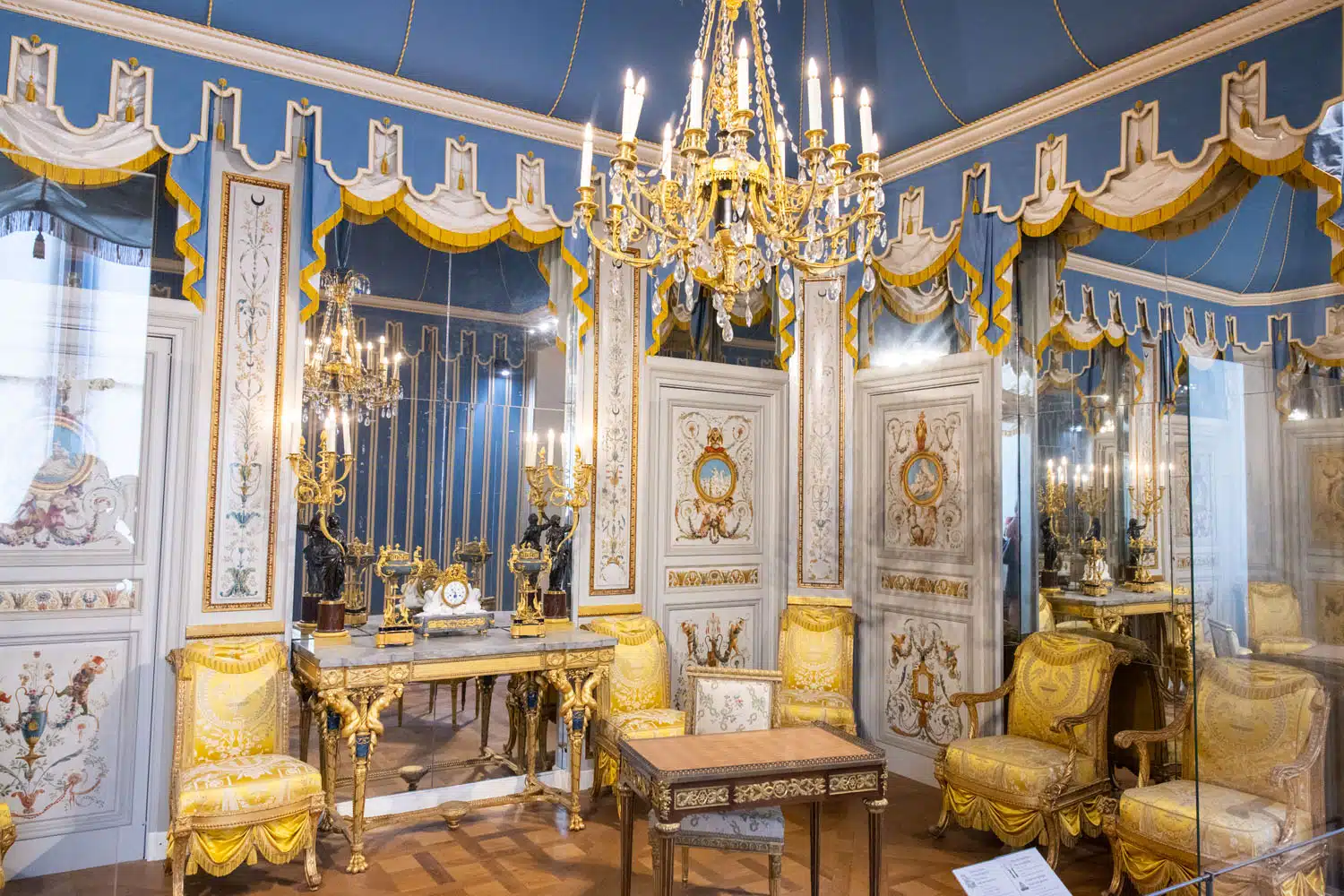
Room from the royal residence of Marie Antoinette
Continue walking straight, past small rooms filled with royal furnishings and art pieces. On this walk, you will enter the Richelieu Wing.
You will eventually come to some escalators. Walk past the escalators, remaining on level 1, until you get to Terrasse Colbert on the left. At this point, you can stop here for a snack or drink at one of two places.
Terrasse Colbert has the best view. From the open terrace, you overlook the Pyramid, making this one of the best viewpoints of the Louvre.
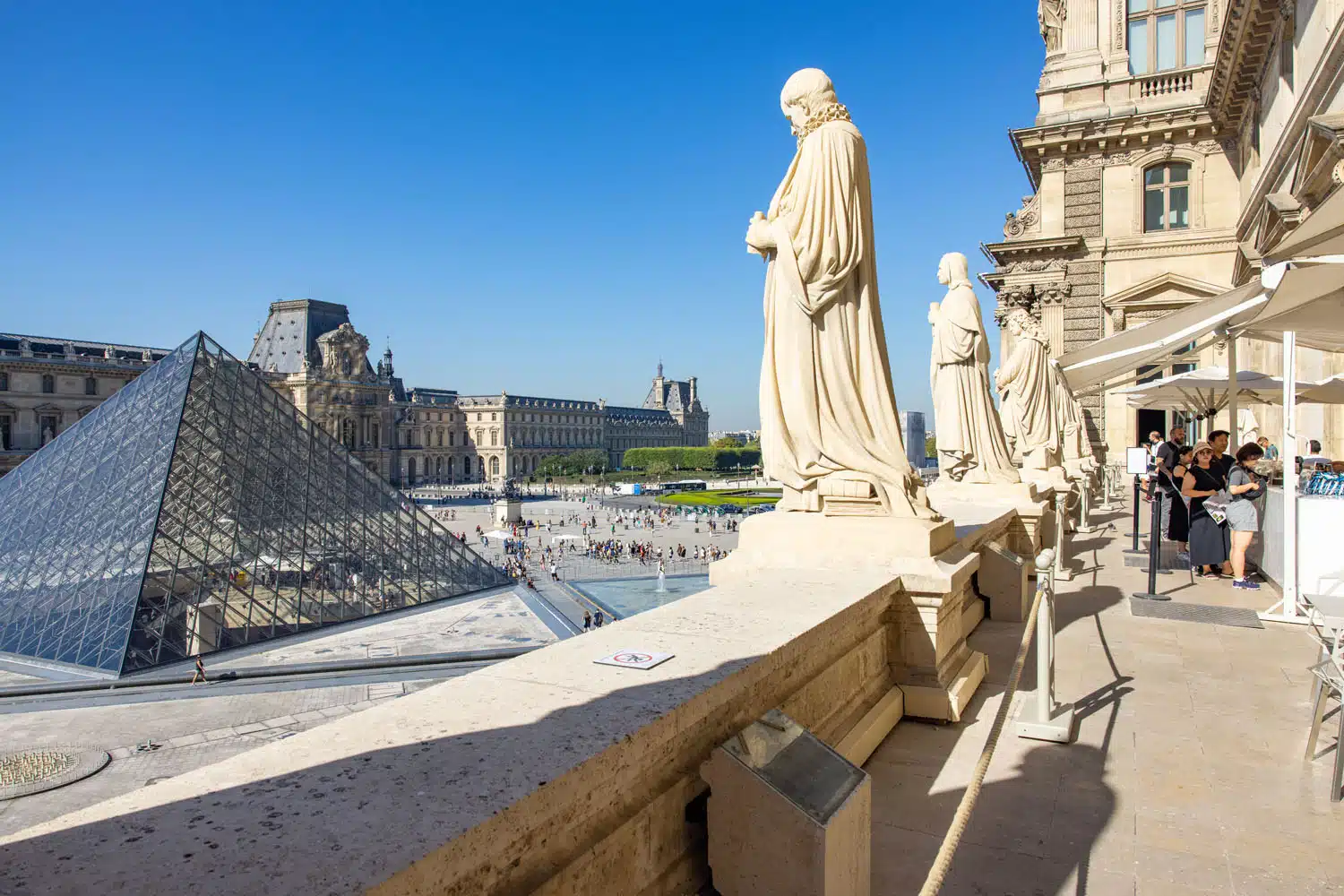
Terasse Colbert
Café Richelieu is a lovely place to take a break, particularly in warmer weather when you can sit on the terrace overlooking the Louvre courtyard and Pyramid. The café serves seasonal savory dishes and pastries created by Jessica Préalpato, who was named World’s Best Pastry Chef in 2019.
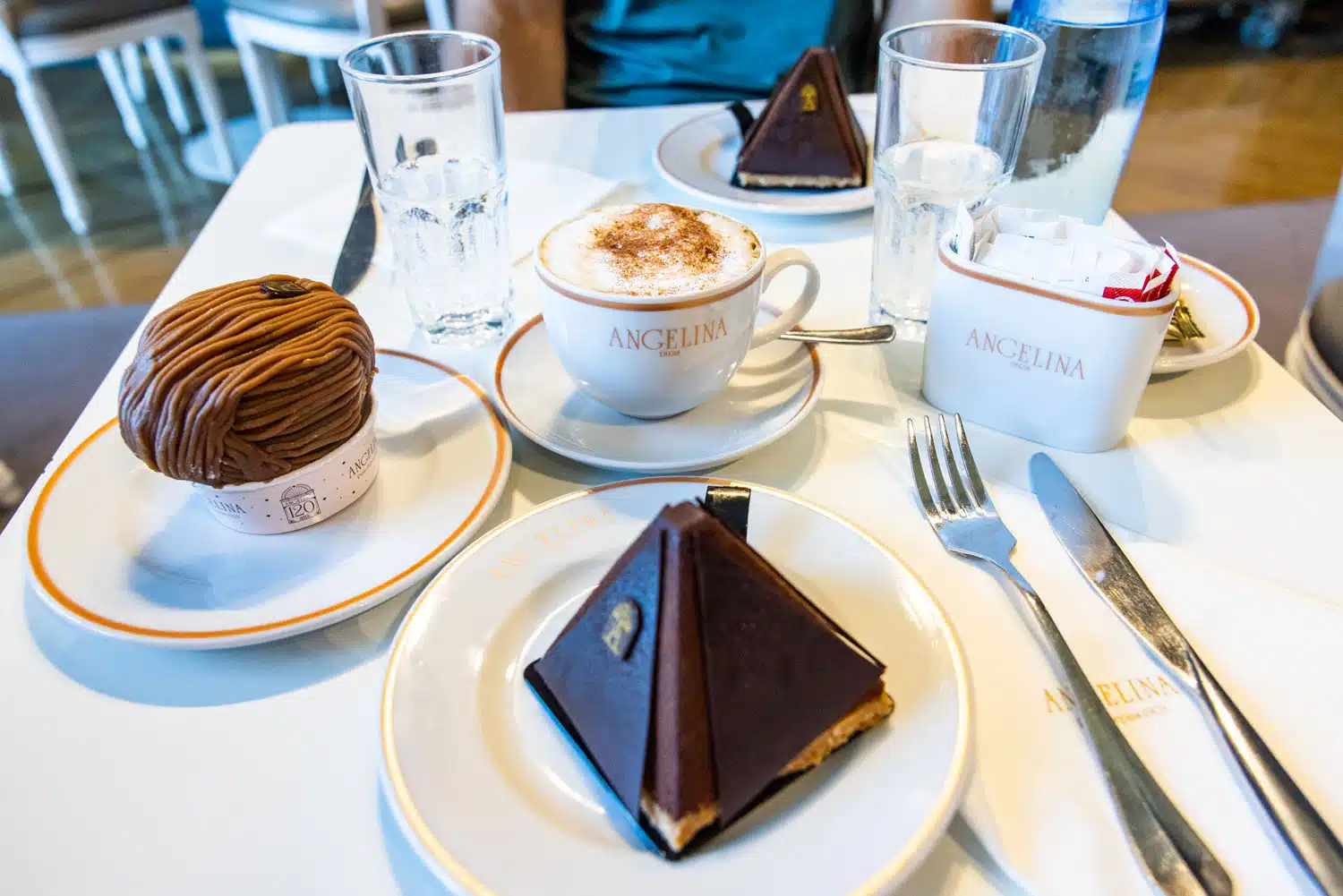
On our visit, pastries from Angelina’s were served at Café Richelieu. That has changed, with pastries created by Jessica Préalpato.
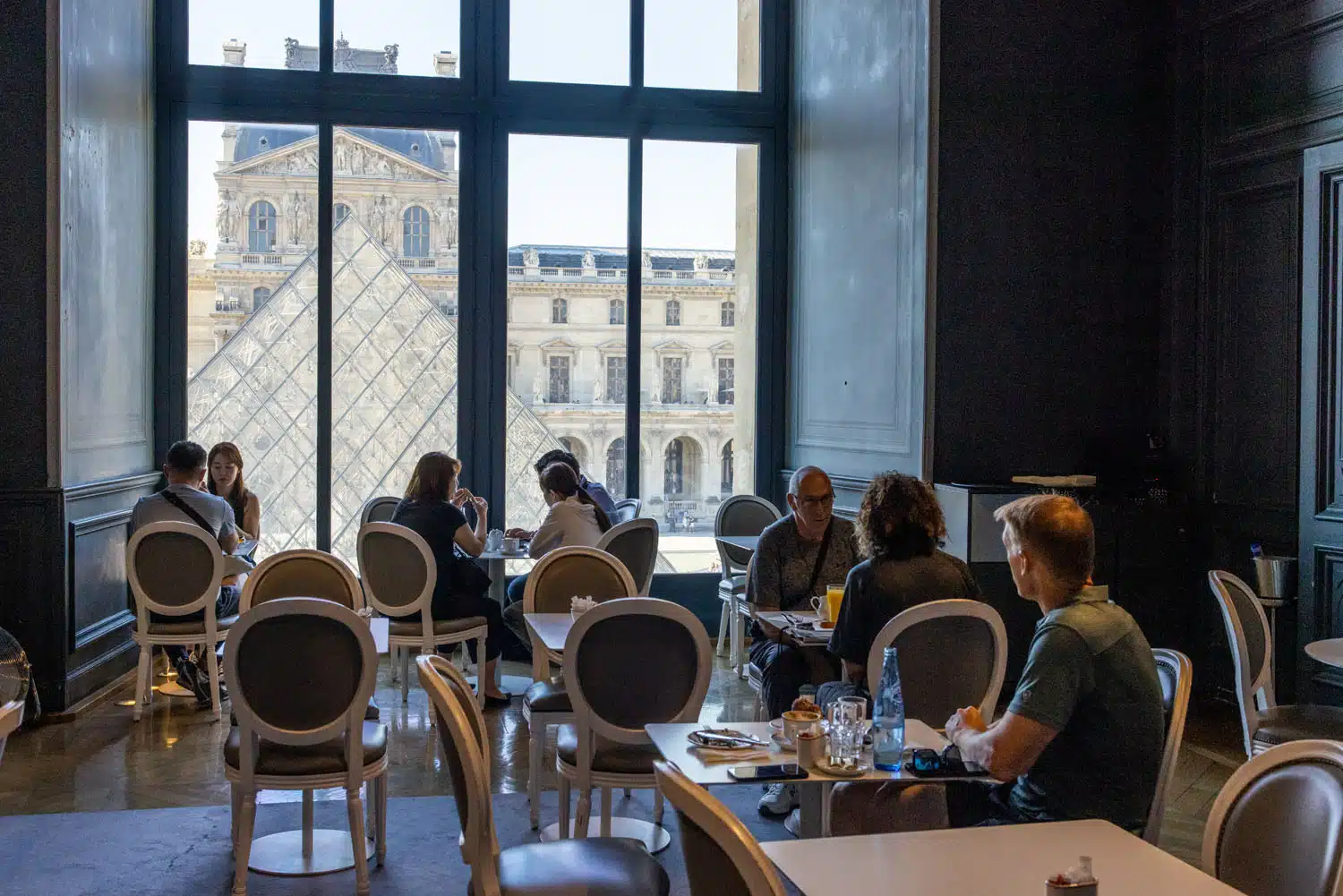
Cafe Richelieu
Napoleon III’s Apartments
If open, the Napoleon III Apartments are one of the highlights of the Richelieu Wing.
These lavish rooms date from the Second Empire and are filled with gilded ceilings, chandeliers, red velvet, elaborate furnishings, and ornate decoration. They give you a very different perspective on the Louvre, not as an art museum, but as a palace.
We were unable to tour the apartments on our most recent visit because they were closed that day, which is another reason to check the gallery schedule before your visit.
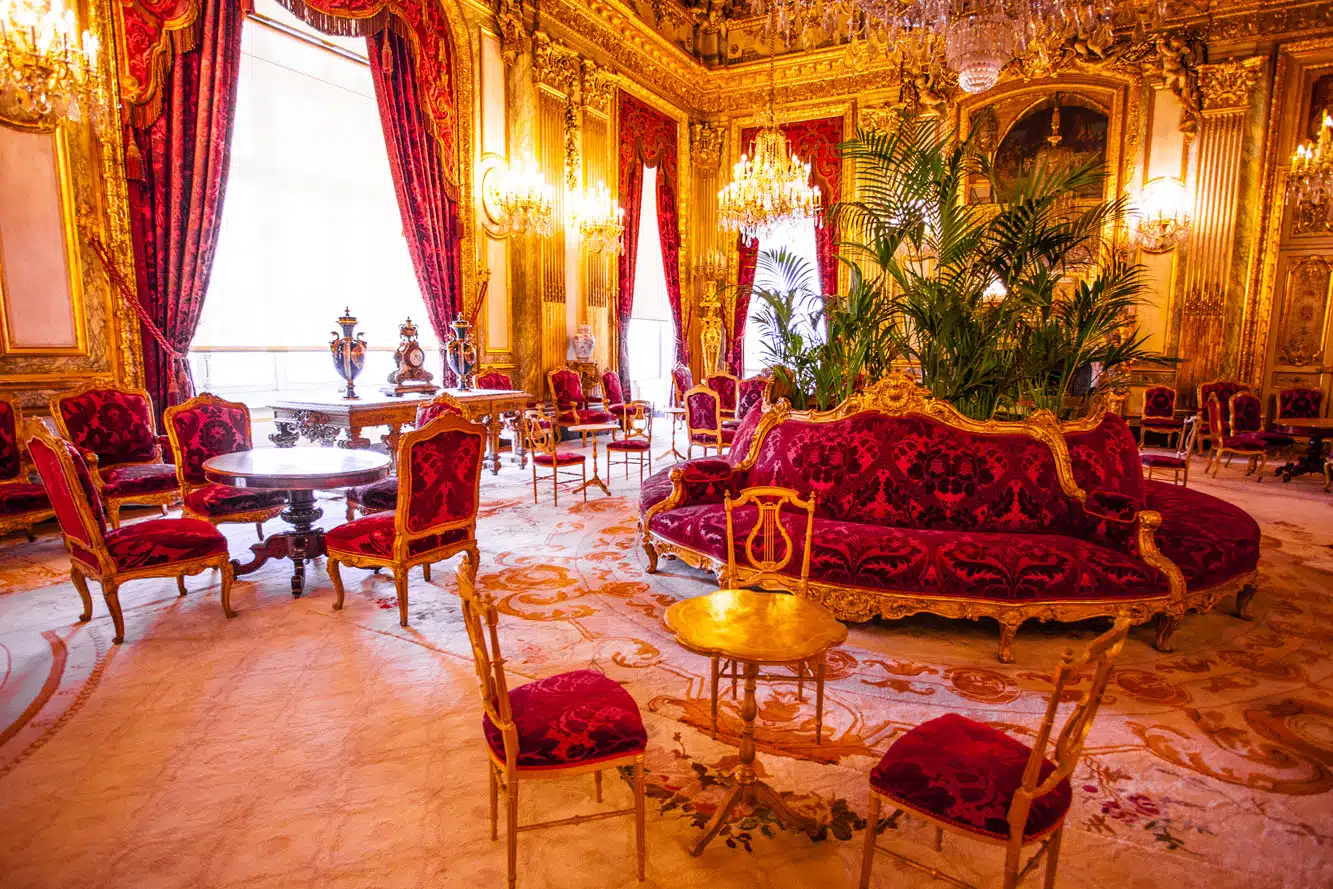
Napoleon’s Apartments | Alexandra Lande/shutterstock.com
Lamassus of Khorsabad Palace
Backtrack to the escalators, go down one level and make a U-turn off escalators and walk into Antiquities Orientales.
Walk through rooms 236 and 234 (in room 234, it’s worth a quick look at the Statue of Ebih-II, which dates back to 2,600 to 2,300 BC). Walk up a few steps to a landing, ignore the other staircases on this landing and turn left into room 228 and then immediately right into room 229.
If the Mesopotamian galleries are open, one of the most impressive rooms is the Cour Khorsabad (Room 229), which contains enormous winged bulls from the palace of the Assyrian king Sargon II.
These Lamassus are creatures that have a human head, the wings of eagles, and the body of a bull or lion. They were added to doorways and passages in the palace of Khorsabad, in present-day Dur-Sharrukin in Iraq. These Lamassus date back to sometime between 721 and 705 BC.
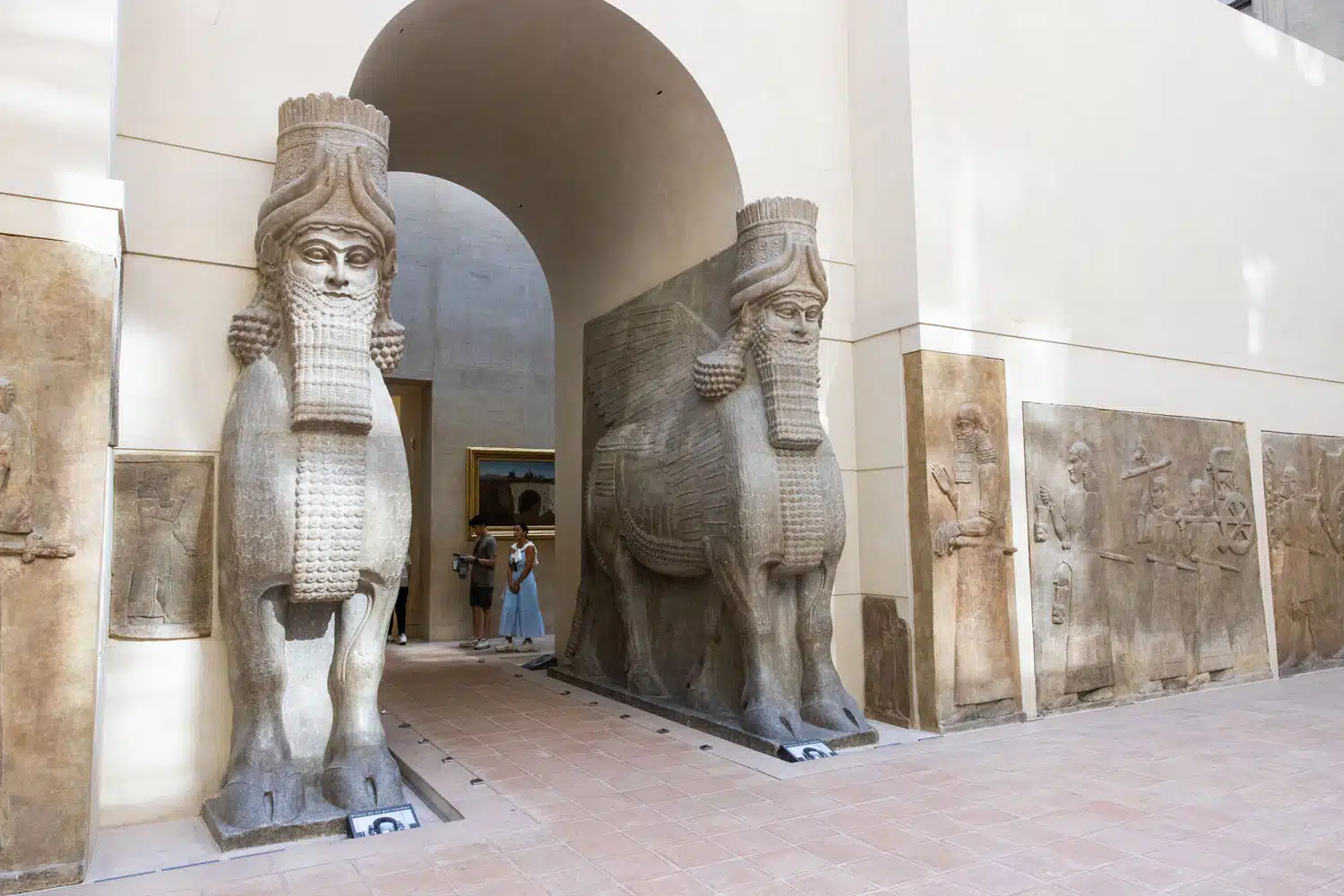
Lamassus of Khorsabad Palace
The Code of Hammurabi
From room 229, walk back into room 228. Look through the windows to Cour Puget, a courtyard in the Richelieu Wing that contains sculptures from the 17th to 19th century.
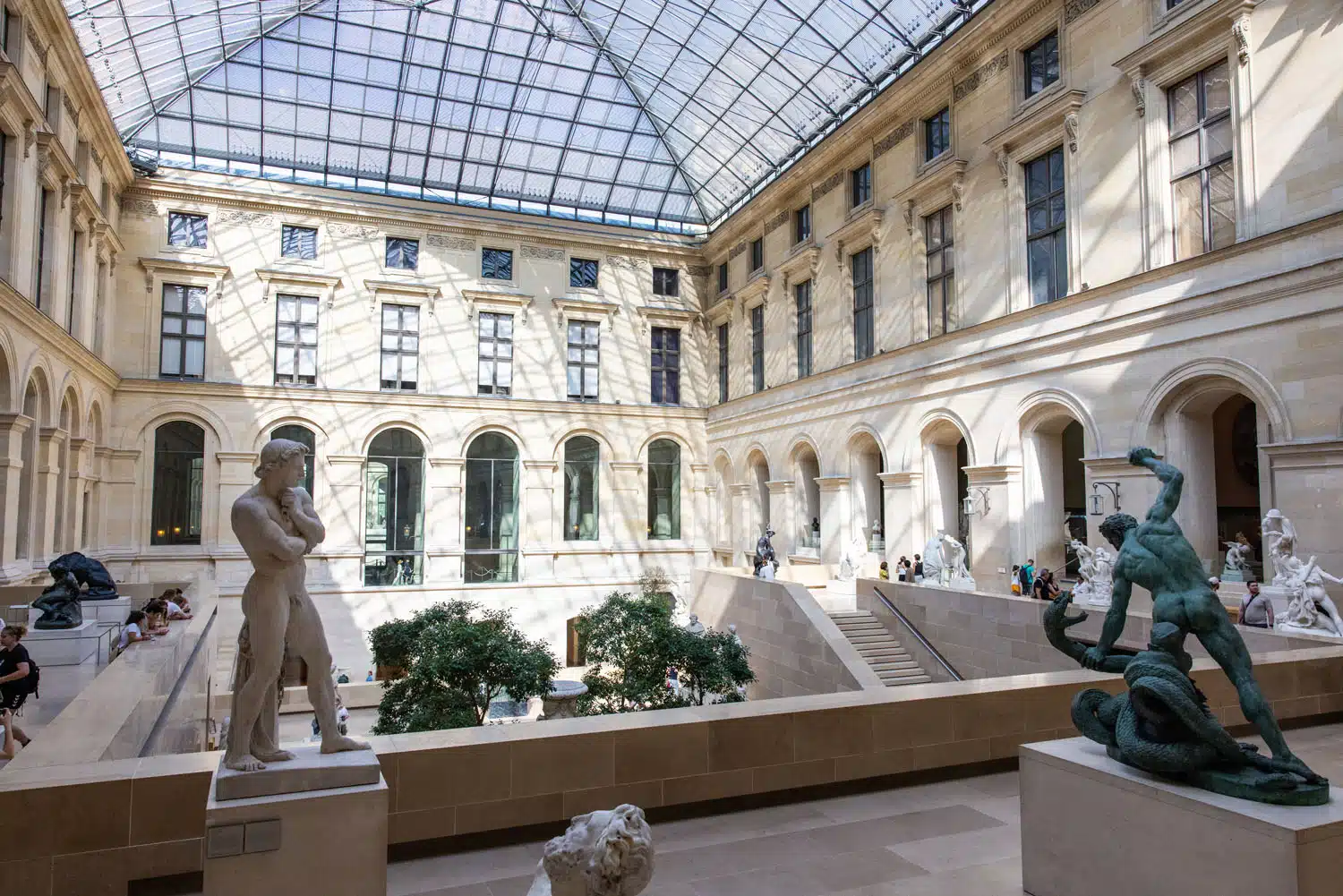
Cour Puget
From room 228, turn right into room 227. Sitting in the center of this room is the Code of Hammurabi. Created between 1755 and 1750 BC, this Babylonian legal text is written in the Old Babylonian dialect of Akkadian. It was written by Hammurabi, the sixth king of the Amorite First Dynasty of Babylon, and it is a code of laws. It is famous for being the longest and best-preserved legal text from the ancient Near East.
If the Mesopotamian galleries are open, we think the Code of Hammurabi and Lamassus are well worth adding to your Louvre visit.
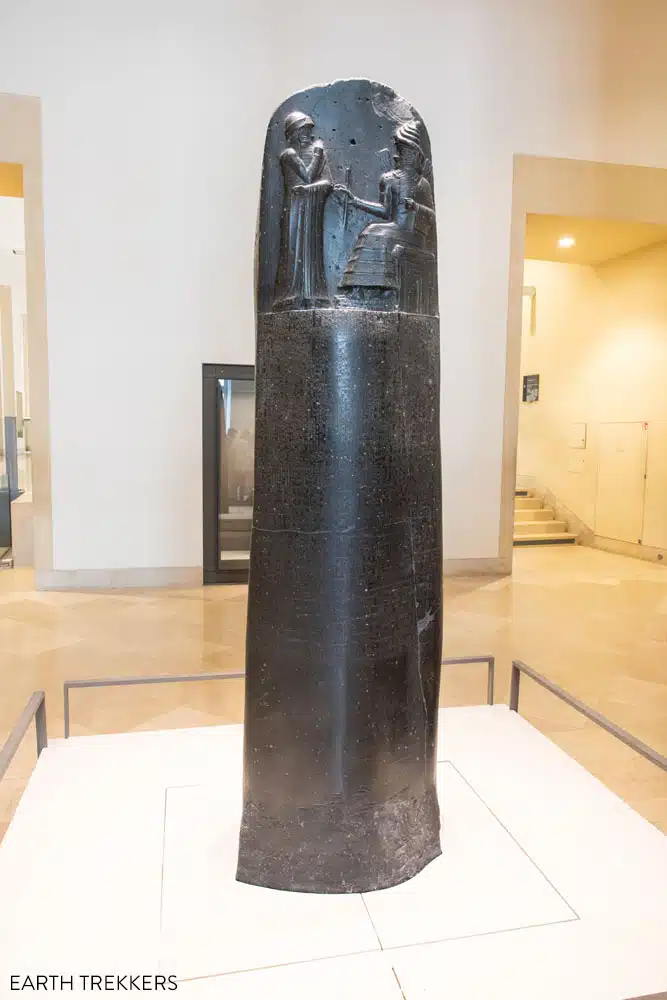
Code of Hammurabi
Ending Your Louvre Visit
Our tour ends with the Code of Hammurabi. However, we have instructions on how to exit the Louvre, since this massive building is a confusing maze of rooms.
Walk back to the escalators and go down one level to -1. Make a U-turn at the bottom of the escalators and down some steps. Continue straight and turn left following the sortie signs.
You are now back in the main reception hall, under the Pyramid. There are exit signs directing you out of the Louvre. You will walk down a long hallway and you will see a restaurant, cafe, and boutique shops. This hallway ends at the inverted pyramid, in Galerie du Carrousel.
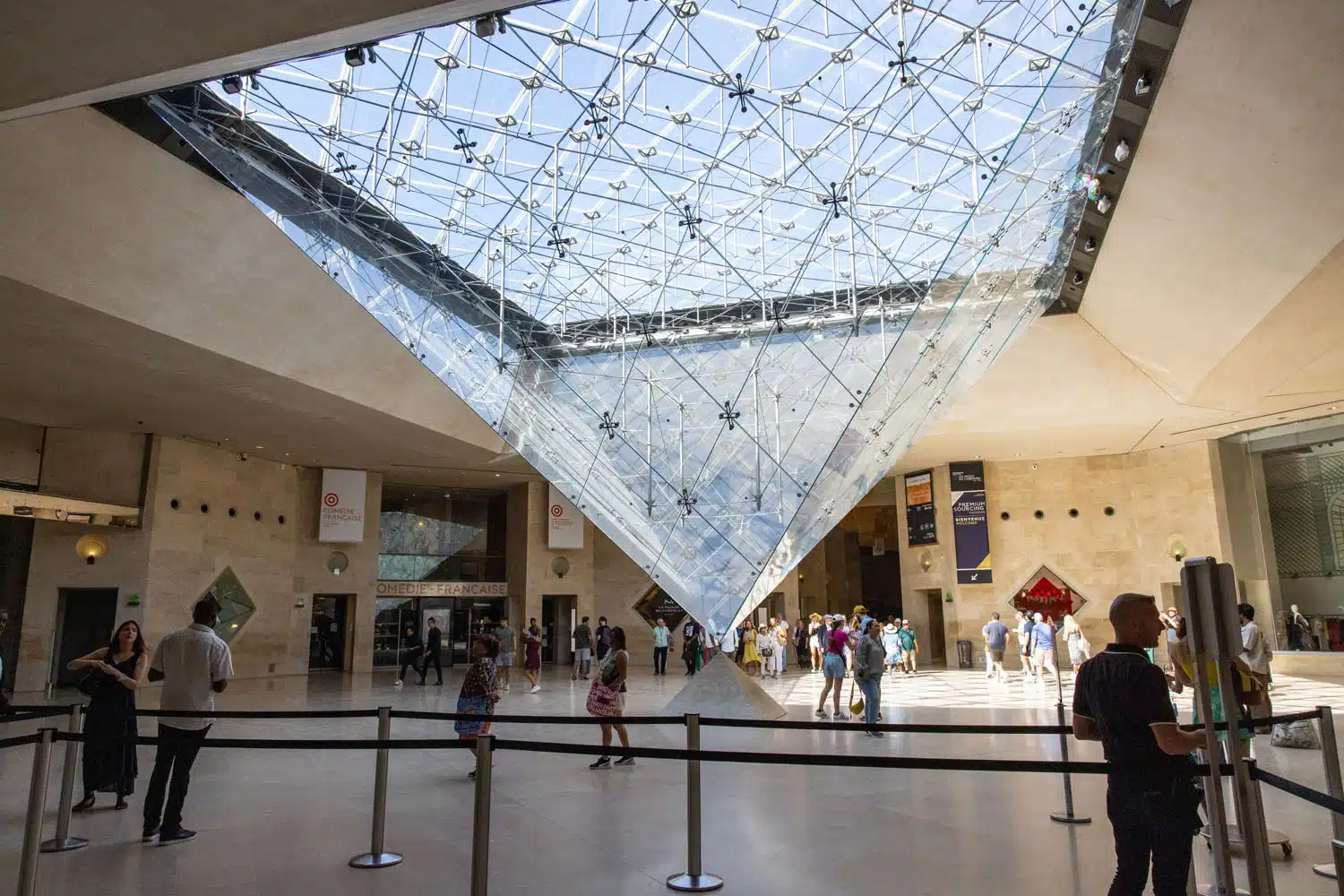
From this point, you can follow the metro signs to get on the metro at the Palais Royal – Musee du Louvre station or walk up the steps to Rue de Rivoli or Jardin du Carrousel.
I hope you enjoyed our walking tour of the Louvre and if you have any comments or suggestions for future readers, please let us know in the comment section below.
Get a Digital Download of this Louvre Walking Tour
Do you want a printer friendly version of this walking tour? How about an eBook version that can be downloaded onto your computer or mobile device?
Our Louvre Walking Tour eBook is a self-guided walking tour of the Louvre that will take you to the museum’s most important masterpieces. This guide covers how to purchase tickets, the different entrances, helps you navigate through the Louvre’s maze of rooms, and provides helpful tips for having the best experience. It is a 15-page document that you can download to take with you or print at home.
Click here to purchase the eBook on Etsy.com.
Frequently Asked Questions
How long do you need at the Louvre?
For a first visit to the Louvre, we recommend 2.5 to 3 hours. That gives you enough time to follow our masterpieces route and continue through the Medieval Louvre and Egyptian Antiquities without feeling rushed. If you only want to see the biggest highlights, allow 1 to 1.5 hours; if you want to complete all three parts of our route, plan on roughly 3 to 5 hours.
Can you see the Louvre in 2 hours?
Yes. Two hours is enough time to see many of the Louvre’s most famous masterpieces if you arrive with a plan. Follow Part 1 of our self-guided route to see Venus de Milo, Winged Victory of Samothrace, the Mona Lisa, the Grande Galerie, and several other highlights, then use any remaining time for the galleries that interest you most. Even the Louvre’s official masterpieces trail is designed to be completed in about 90 minutes.
Is the Louvre worth visiting?
Yes, especially if this is your first trip to Paris. The sheer size of the Louvre can be overwhelming, but you don’t have to see everything for the visit to be worthwhile. We have visited three times, and some of our favorite experiences are seeing Winged Victory at the top of the Daru staircase, walking through the Grande Galerie, and discovering quieter rooms away from the Mona Lisa crowds. The key is to choose a manageable route rather than trying to conquer the entire museum in one visit.
Do you need a guided tour of the Louvre?
No. A guided tour can be worthwhile if you want an expert to explain the art and history, but you do not need one to see the Louvre’s major highlights. With a museum map and a well-planned route, it is very doable to visit independently. We created the self-guided walking tour in this guide specifically for travelers who want to see the Louvre’s masterpieces efficiently without paying for a guided tour.
Is the Mona Lisa being moved?
Yes, a new dedicated space for the Mona Lisa is planned, but the painting has not moved yet. The Mona Lisa remains in the Salle des États in the Denon Wing. As part of the Louvre’s Nouvelle Renaissance project, a new visitor route and purpose-built display space are planned for the painting, with the goal of improving viewing conditions and reducing congestion in the surrounding galleries.
What changes are planned for the Louvre?
The Louvre is beginning a major multiyear transformation known as Louvre–Nouvelle Renaissance. Plans include a new entrance on the eastern side of the museum near the Colonnade, two new underground entrances and reception areas, new exhibition spaces, a dedicated visitor route and display space for the Mona Lisa, improved circulation through the museum, and additional cafés, shops, and places to take a break. The winning architectural team was announced in May 2026, and the plans are still being refined, so these changes will not affect most visitors immediately.
Tours of the Louvre
If you still prefer to take a tour of the Louvre with an experience guide, here are several highly rated tours.
Louvre Tours & Tickets
Plan Your Trip to Paris
- Deciding what else to see in Paris? → Our Best Things to Do in Paris guide covers the city’s top attractions and hidden gems beyond the Louvre.
- Building out your itinerary? → Our 3 Days in Paris guide covers how to fit the Louvre, the Eiffel Tower, and Montmartre into a first visit.
- Planning a day trip from Paris? → Our Versailles guide covers how to visit the palace and gardens without the crowds.
- Want to visit the Eiffel Tower next? → Our Eiffel Tower guide covers tickets, the best viewpoints, and how to skip the line.
If you have any questions about how to visit the Louvre or our walking tour of the Louvre, let us know in the comment section below.
More Places to Visit in Paris & France

France Travel Guide: How to Plan a Trip to France
Travel information and advice for France. Best things to do in France with itineraries for Paris, the French Riviera, and the Alsace wine region.

2 Days in Paris Itinerary: What to See & Do
Pinterest Facebook Flipboard Two days isn’t a lot of time in Paris, but with the right itinerary, you can still hit many of the city’s top attractions. This 2-day Paris itinerary takes you to the Louvre, Eiffel Tower, Notre-Dame Cathedral, Sainte-Chapelle, Musée d’Orsay, Montmartre, and the Arc de Triomphe, along with several of the city’s […]
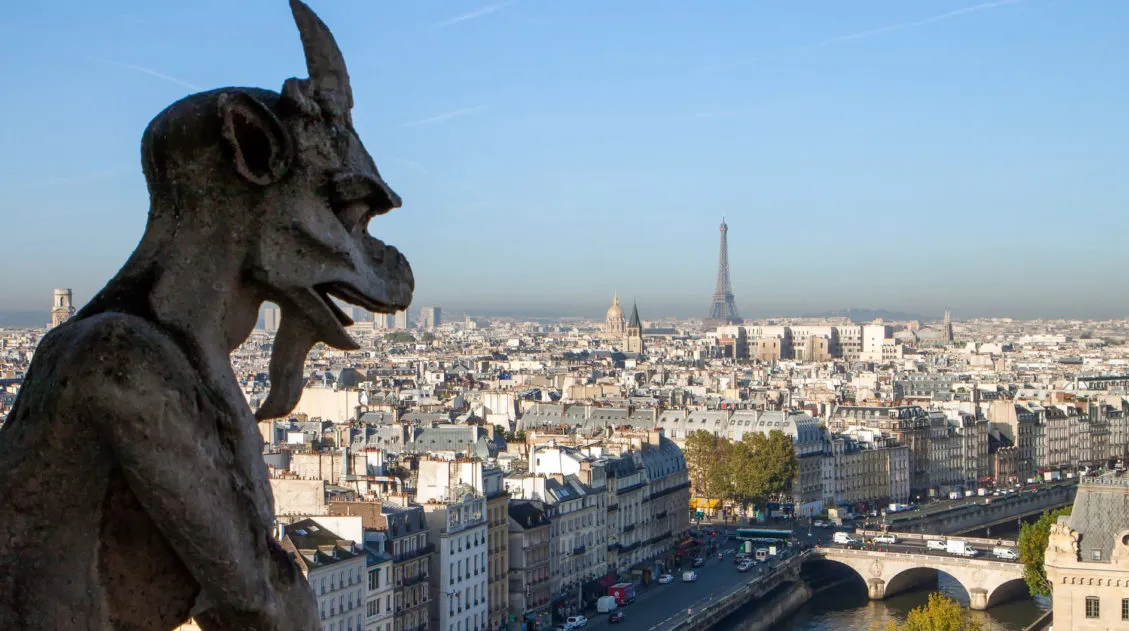
14 Best Views of Paris: Our Favorite Viewpoints & Photo Spots
Paris is one of the most photogenic cities in Europe. From sweeping views over the rooftops to classic views of the Eiffel Tower and Notre Dame, there are countless places to photograph the city. But some viewpoints are much better than others. We’ve visited Paris four times, and on every trip, photography has been a […]
Where to Stay in Paris for the First Time (+ Where Not to Stay)
Choosing where to stay in Paris for the first time can feel overwhelming. Paris is a BIG city, made up of many different neighborhoods (also called arrondissements) with its attractions scattered throughout the sprawling city center. Every neighborhood comes with is pros and cons, which we will get to in just a little bit, and […]
Rooftop Bars & Restaurants in Paris: Where to Dine with a View
There’s something special about watching the sun set over Paris with a cocktail in hand, the city’s rooftops spreading out below and the skyline glowing gold. As you’re planning your trip to Paris, rooftop bars are one of the best ways to combine three of the city’s biggest draws — food, views, and atmosphere — […]
We Visited Paris at Easter: Here’s What to Expect
Easter in Paris…sounds nice, doesn’t it? Spring flowers, mild temperatures, the view from the Eiffel Tower without a coat on. Sure, that sounds nice, but it’s not always the reality. We found that out firsthand. We spent three days in Paris over Easter weekend in 2018, arriving on Good Friday and staying through Sunday before […]
How to Plan an Amazing Day Trip to Versailles from Paris
Versailles is one of the most popular day trips from Paris, but how you plan your visit can make an enormous difference in your experience. Tim and I have visited the Palace of Versailles twice, and those two visits could not have been more different. On our first visit, we arrived mid-morning on a rainy […]
The Perfect 10 Day London Paris Itinerary
A visit to London and Paris is a classic European trip. Climb the Eiffel Tower, stroll up the Champs-Elysees, visit the world-class museums of the Louvre and the British Museum, and even take a day trip to Stonehenge. On this London Paris itinerary, visit two of Europe’s grandest cities and make some lifelong memories. For […]
10 Fairytale Towns to Visit on the Alsace Wine Route
When I first saw photos of the town of Colmar, it immediately got added to our travel wish list. With its colorful buildings, bouquets of flowers, and scenic streets, it looked like it was plucked right out of a fairy tale. With a little more research, I was thrilled to learn that Colmar is just […]

One Week in Europe: 25 Epic Itineraries
With one week in Europe, you have an infinite number of possibilities for coming up with your “perfect” itinerary. Do you dream of visiting world-class cities like Paris, Barcelona, or Venice? Or would you rather hike the Alps, go on a scenic train ride, explore the beautiful beaches and coastal towns in southern Europe, visit […]
London Bucket List: 50 Epic Things to Do in London
If you are planning a trip to London, how do you decide where to go? London is massive. It takes days, weeks really, to see the best of London and trying to figure out what to do can be overwhelming. Here is a list of the best things to do in London, 50 to be […]

30 Popular Tourist Attractions in Europe & How to Visit Them
What’s on your European bucket list? From world class museums and ancient archaeological sites to stunning natural wonders, Europe boasts a diverse array of attractions that attract millions of visitors every year. The Colosseum, the Eiffel Tower, and the Acropolis top the list for many first time visitors to Europe, but you can also explore […]


Comments 38