
With 4 days in Rome, you have enough time to visit Ancient Rome, the Vatican Museums, St. Peter’s Basilica, Rome’s historic center, the Borghese Gallery, and the Appian Way. The biggest advantage of having four days is that you can spread out the busiest attractions, slow the pace, and build in more time for meals, viewpoints, and experiences such as a cooking class or food tour.
One of our favorite things to do in Italy is eat, and Rome is filled with amazing restaurants, from cheap eats to memorable fine-dining experiences.
Having a good meal in Rome is just as important as touring the Colosseum, in our opinion, and you do not have to spend a fortune to eat well here. We mix these into the itinerary as well.
Four days also gives you time to go beyond the biggest sights. Rome has a long list of cathedrals and historical sites, so on the fourth day, you can pick and choose the places that interest you most. And if spending an afternoon touring churches doesn’t sound like your idea of fun, we have several other options, including the Appian Way, photo spots, food tours, rooftop bars, and cooking classes.
Our Experience in Rome: We have visited Rome twice. Our first trip was a 3-day visit in July with our kids, where we focused on Rome’s must-see landmarks. A few years later, Tim and I returned for a longer visit. On that trip, we spent a lot of time exploring rooftop bars and restaurants, and we went beyond the Colosseum and Vatican, visiting cathedrals, lesser-known historical sites, and places that gave us a deeper appreciation for Rome’s history. This 4-day itinerary brings all of those experiences together in the way we would plan a return trip to Rome. All photos are our own.
4 Days in Rome: At a Glance
DAY 1 | Colosseum, Roman Forum & Palatine Hill, Altar of the Fatherland, & Trastevere
DAY 2 | Vatican Museums, Sistine Chapel, Castel Sant’Angelo & Rome’s historic center
DAY 3 | St. Peter’s Basilica, Borghese Gallery, optional food tour, cooking class, or Colosseum night tour
DAY 4 | Appian Way & Catacombs in the morning, then choose between Rome’s cathedrals, Aventine Hill, or Domus Aurea
BOOK IN ADVANCE | Colosseum, Vatican Museums, St. Peter’s Basilica or dome if using timed entry, Borghese Gallery, and any food tours, cooking classes, or night tours
BEST FOR | First-time visitors who want to see Rome’s major sights at a more relaxed pace and add a few deeper experiences
October 2026 Update: We substantially updated this 4-day Rome itinerary with a new day-by-day structure, current ticketing and reservation information, and a better strategy for visiting the Vatican Museums and St. Peter’s Basilica based on our most recent trip to Rome.
What to Book in Advance
Book these first, since they have the biggest impact on how you organize your 4 days in Rome:
Colosseum: Reserve a timed ticket or guided tour in advance. If you want to visit the Underground, Arena Floor, or Attico, choose your ticket carefully. We cover ticket options in our guide How to Visit the Colosseum.
Vatican Museums: Reserve a timed-entry ticket or guided tour, ideally for opening time. If one of your days falls on a Wednesday, consider making that your Vatican Museums day.
St. Peter’s Basilica & Dome: Entry to the basilica is free, but you can reserve a timed visit. If you plan to climb the dome, book the dome ticket in advance; it includes scheduled access to St. Peter’s Basilica.
Borghese Gallery: Reservations are mandatory, so book your time slot before your trip.
Food Tours & Cooking Classes: Book these in advance if you want to include one on Day 3, especially during peak travel season.
Colosseum Night Tour: If you want to visit the Colosseum at night, check the schedule before your trip. Night tours are offered only on select days and tickets have limited availability.
PRO TRAVEL TIP: If one of your days in Rome falls on a Wednesday, consider visiting the Vatican Museums that day. In our experience, Wednesday morning can be one of the quieter times to visit the museums because many visitors are attending the Papal Audience in St. Peter’s Square. That’s what we did on our most recent trip.
The trade-off is that St. Peter’s Basilica may not open until later in the morning or early afternoon on Wednesdays when the Pope is holding the General Audience. For this 4-day itinerary, simply rearrange the days so you visit the Vatican Museums on Wednesday and St. Peter’s Basilica on another morning.
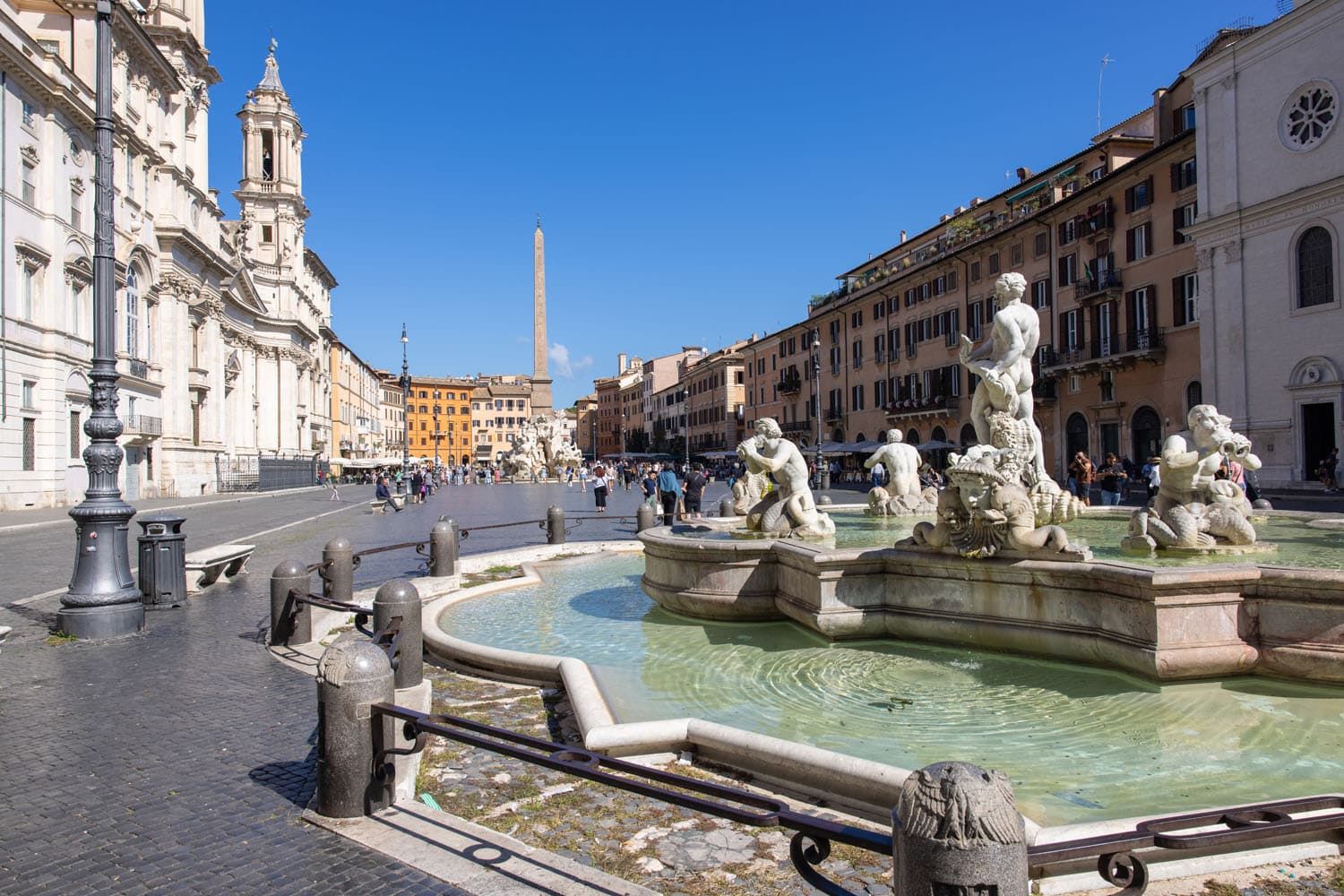
Piazza Navona
4 Days in Rome Itinerary
Day 1: Colosseum, Roman Forum, Altar of the Fatherland, Trastevere
Start your first day in Rome with Ancient Rome, visiting the Colosseum, Roman Forum, and Palatine Hill. From here, continue to the Altar of the Fatherland for one of our favorite viewpoints in the city. Then finish the day with an aperitivo overlooking Rome followed by dinner in Trastevere.
Most of today’s sights are clustered together, so once you arrive at the Colosseum, much of the day can be done on foot.
Here’s an overview of today’s itinerary:
9:00 am: The Colosseum
10:30 am: Roman Forum & Palatine Hill
12:30 pm: Lunch
1:30 pm: Via dei Fori Imperiali
2:00 pm: Altar of the Fatherland
3:00 pm: Capitoline Hill
5:00 pm: Aperitif at Oro Bistrot
6:00 pm: Trastevere
How to Use This Map: Click the tab in the top left corner of the map to see a list of the points of interest and to turn layers on/off. Click the icons on the map to get more information about each point of interest.
To take this map with you, click the star next to the title of the map which adds it to your Google account. Next, within your Google Maps app, select ‘Saved’ and then select ‘Maps’. This map title will now appear in your list.
9:00 am: The Colosseum
There is no better place to start than at the Colosseum, at one of Rome’s most iconic landmarks. The Colosseum is one of the Seven Wonders of the World and a UNESCO World Heritage Site.
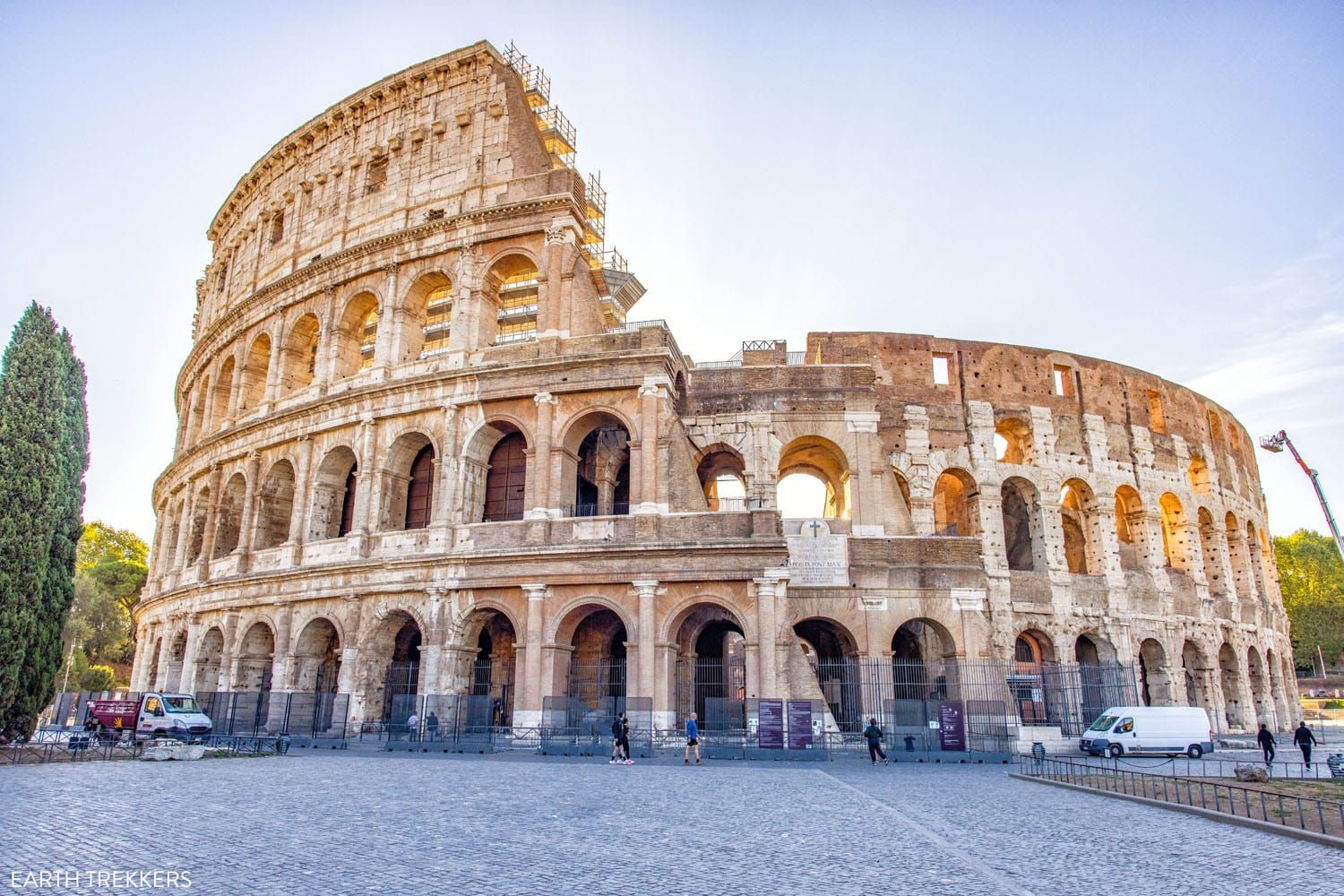
The Colosseum
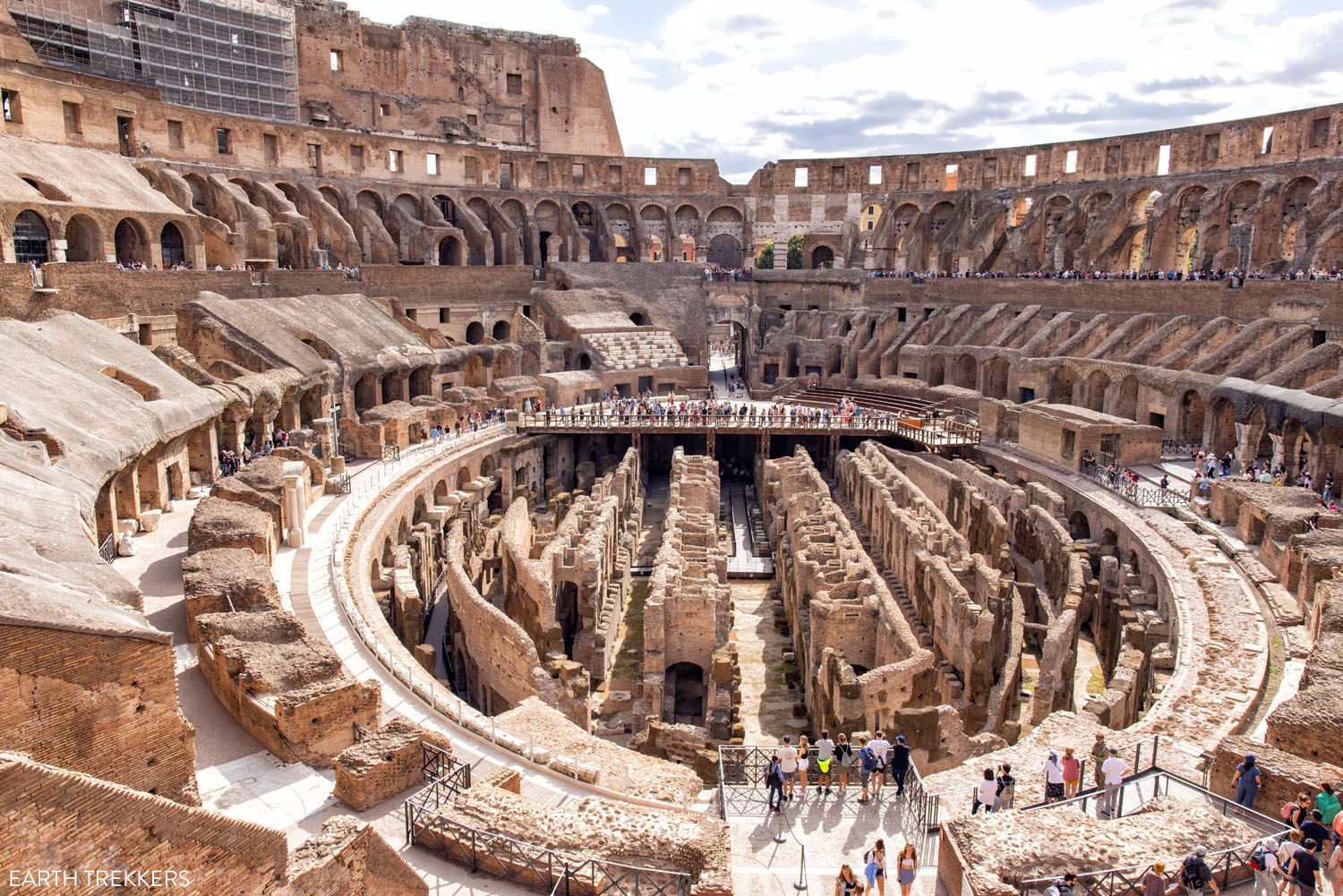
Inside the Colosseum
On a visit to the Colosseum, you can also add on the Arena Floor (stand on a portion of the floor and gaze up at the Colosseum…it’s well worth the few extra euros), the Underground (tour the maze of hallways under the Colosseum), and the Attic (the upper levels of the Colosseum). With 4 days in Rome, it’s worth adding on one of these additional experiences.
How to Visit the Colosseum
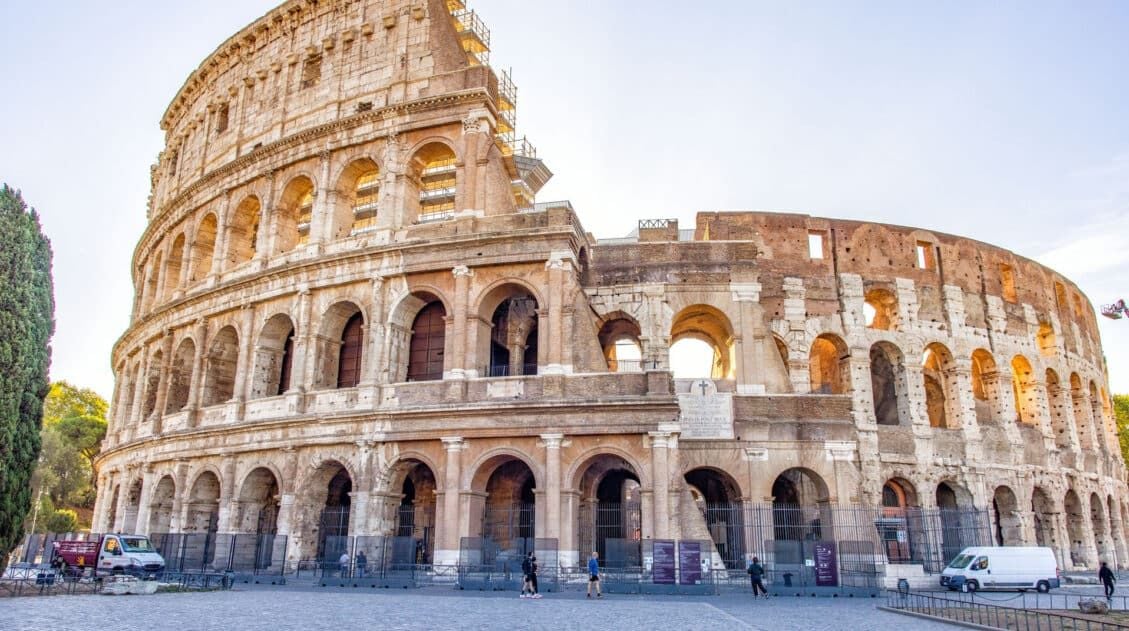
Reserve your ticket or tour in advance. Colosseum tickets are timed, and the different ticket options can be confusing. For this itinerary, aim for a morning entry around 9 am so you have plenty of time for the Roman Forum and Palatine Hill afterward.
You can purchase tickets through the official Colosseum website, although we frequently find that the site is slow or times out, and several of our readers have reported the same problem. If you prefer a guided tour, this Colosseum, Roman Forum, and Palatine Hill tour on GetYourGuide is a good option and includes all three sites.
Hours: Hours vary by season. Click here to get hours for your dates of visit.
Cost: €18 for the standard ticket that gets you in to the Roman Forum, Palatine Hill, and the Colosseum; there is also a Full Experience ticket that also includes a visit to the Colosseum arena and underground area for €24
Website: Get updated hours and pricing and purchase your ticket here.
Roma Pass: If you have the Roma Pass, you must make your reservation to visit the Colosseum in advance.
Getting Here: The closest metro stop is Colosseo. When you exit the metro station, the Colosseum will be right in front of you.
If you want to visit the Underground, compare ticket types, or learn more about the Arena Floor and Attico, read our How to Visit the Colosseum guide ↓
10:30 am: Roman Forum & Palatine Hill
From the Colosseum, continue into the Roman Forum and Palatine Hill, the center of political, religious, and everyday life in Ancient Rome. To get there from the Colosseum, walk up Via Sacra towards the Arch of Titus to enter the Roman Forum and Palatine Hill.
With four days in Rome, you have enough time to enjoy this area without rushing, but you still don’t need to see every archaeological site.
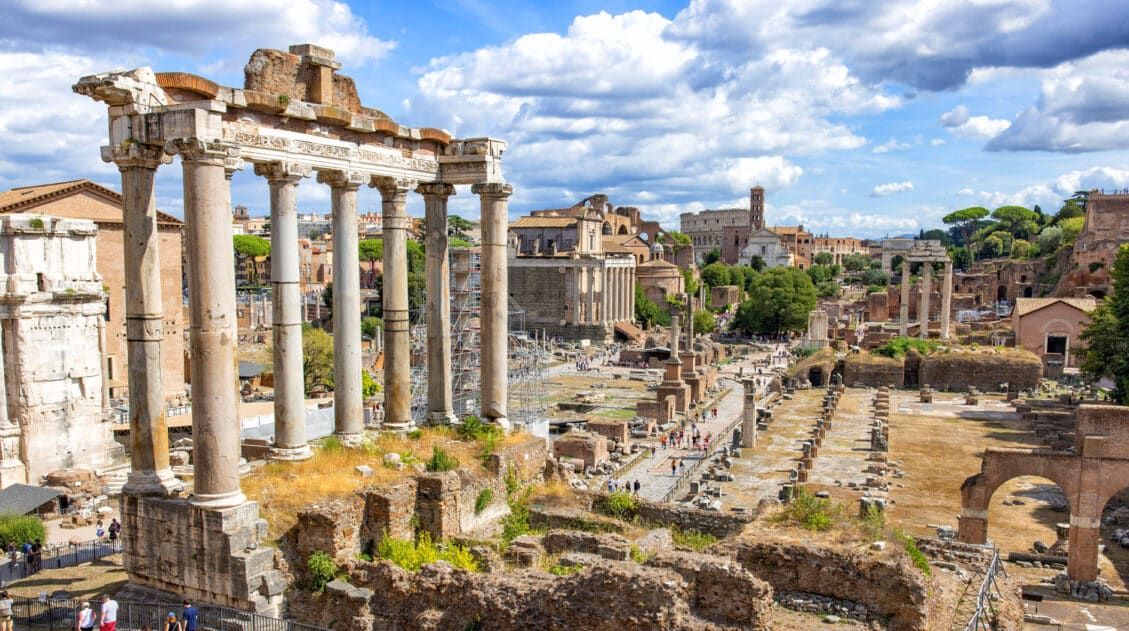
We recommend visiting Palatine Hill first, a complex of archaeological excavations, the remains of temples and imperial palaces, and a museum. Don’t miss Terrazza Belvedere del Palatino for one of the best views over the Roman Forum. Here is the view:
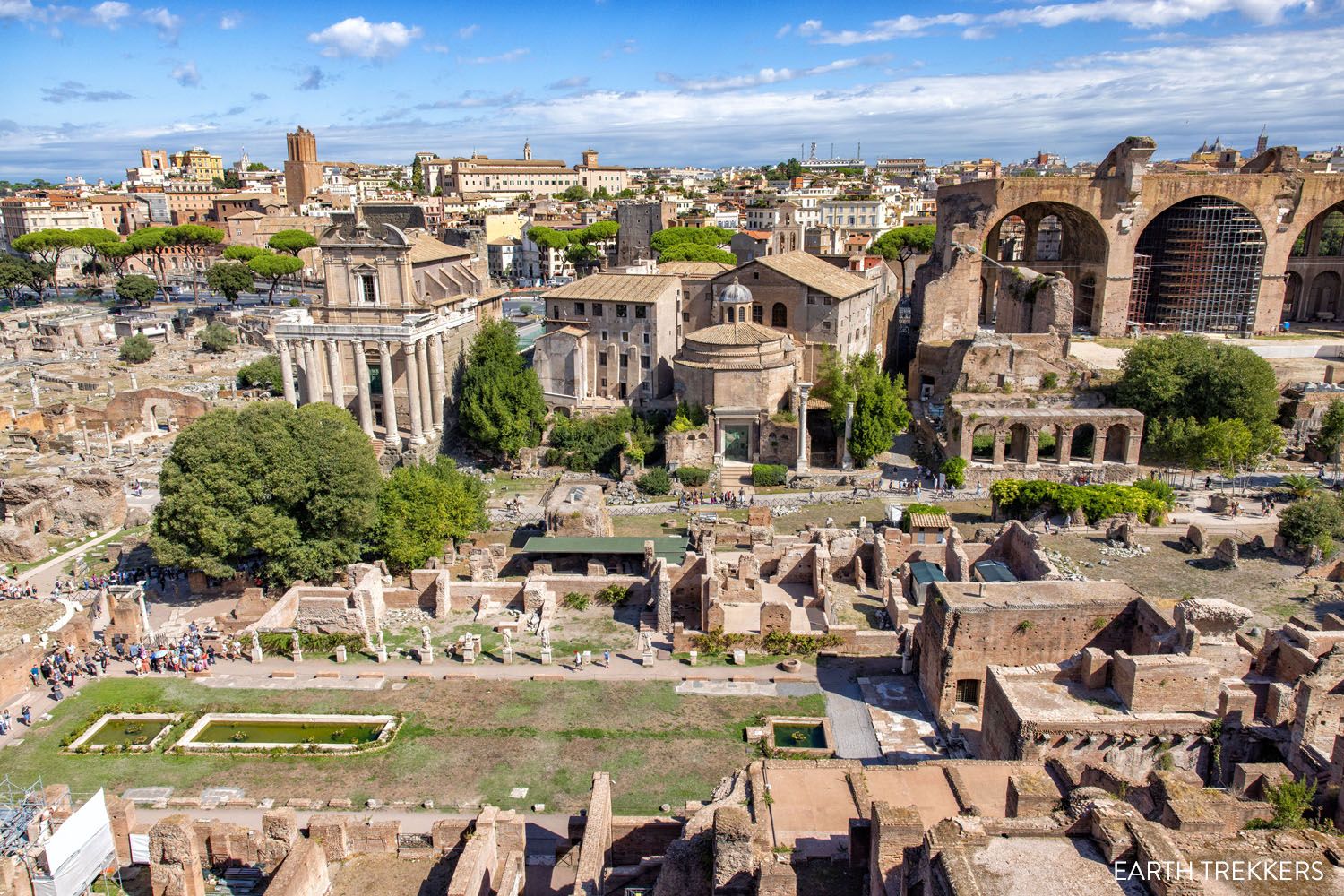
Overlooking the Roman Forum from Terrazza Belvedere del Palatino
Then walk through the Forum along Via Sacra, passing highlights such as the Temple of Vesta, Temple of Saturn, Arch of Septimius Severus, and Temple of Julius Caesar.
Allow about 1½ to 2 hours for the Roman Forum and Palatine Hill. If ancient history is one of your main interests, you could easily spend longer.
12:30 pm: Lunch
For lunch we recommend La Prezzemolina. This highly rated restaurant serves Italian street food and pizza al taglio (pizza by the slice) at budget-friendly prices. It’s one of our favorite restaurants in Rome.
For more restaurant recommendations, check out our Rome Restaurant Guide (it also includes some great rooftop restaurants that are perfect for dinner).
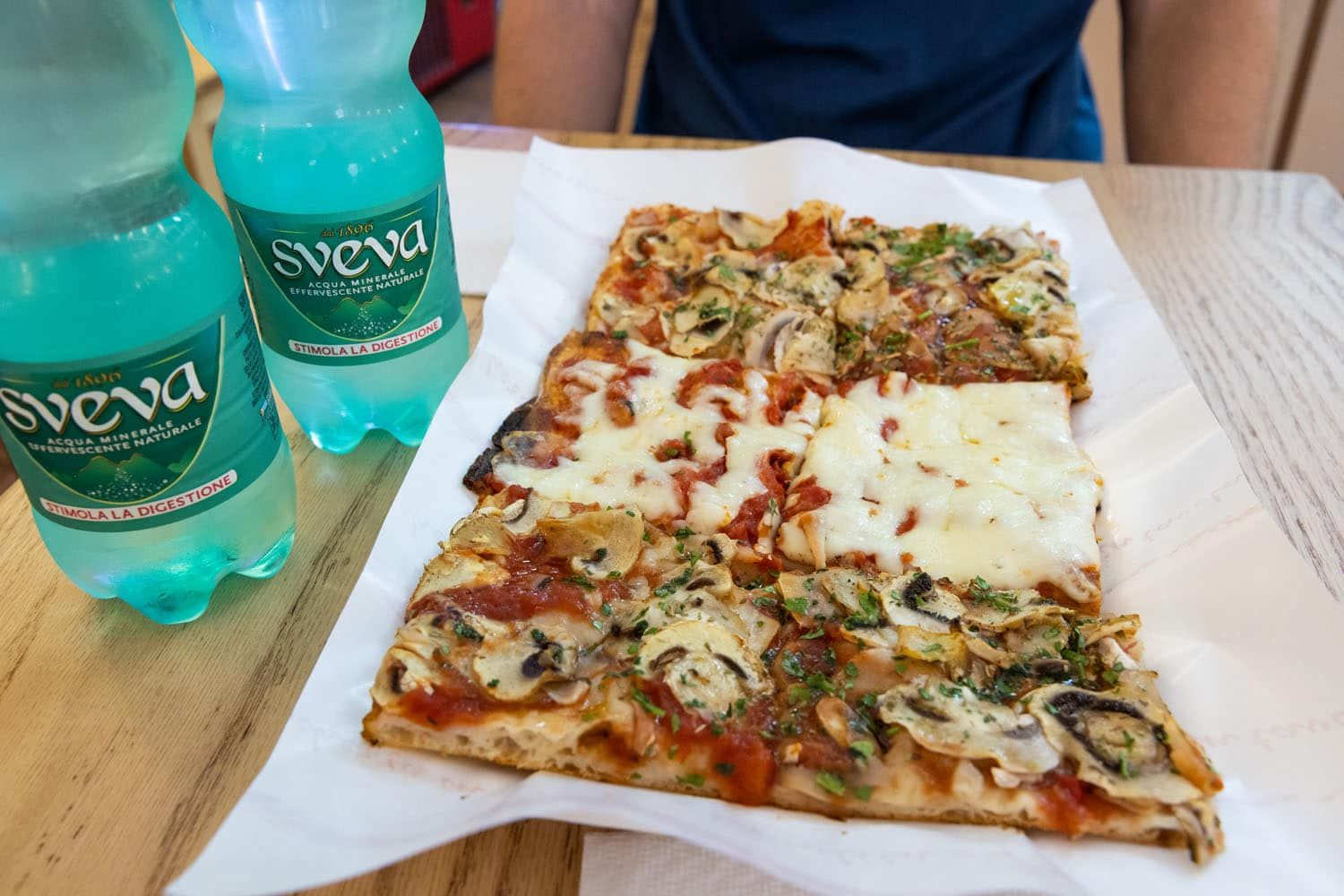
Pizza at La Prezzemolina
1:30 pm: Via dei Fori Imperiali
From La Prezzemolina, take a stroll along Via dei Fori Imperiali. This street runs between the Roman Forum and the Forum of Augustus and the Trajan Forum. Keep an eye out for Trajan’s Column, which was erected in 113 AD.
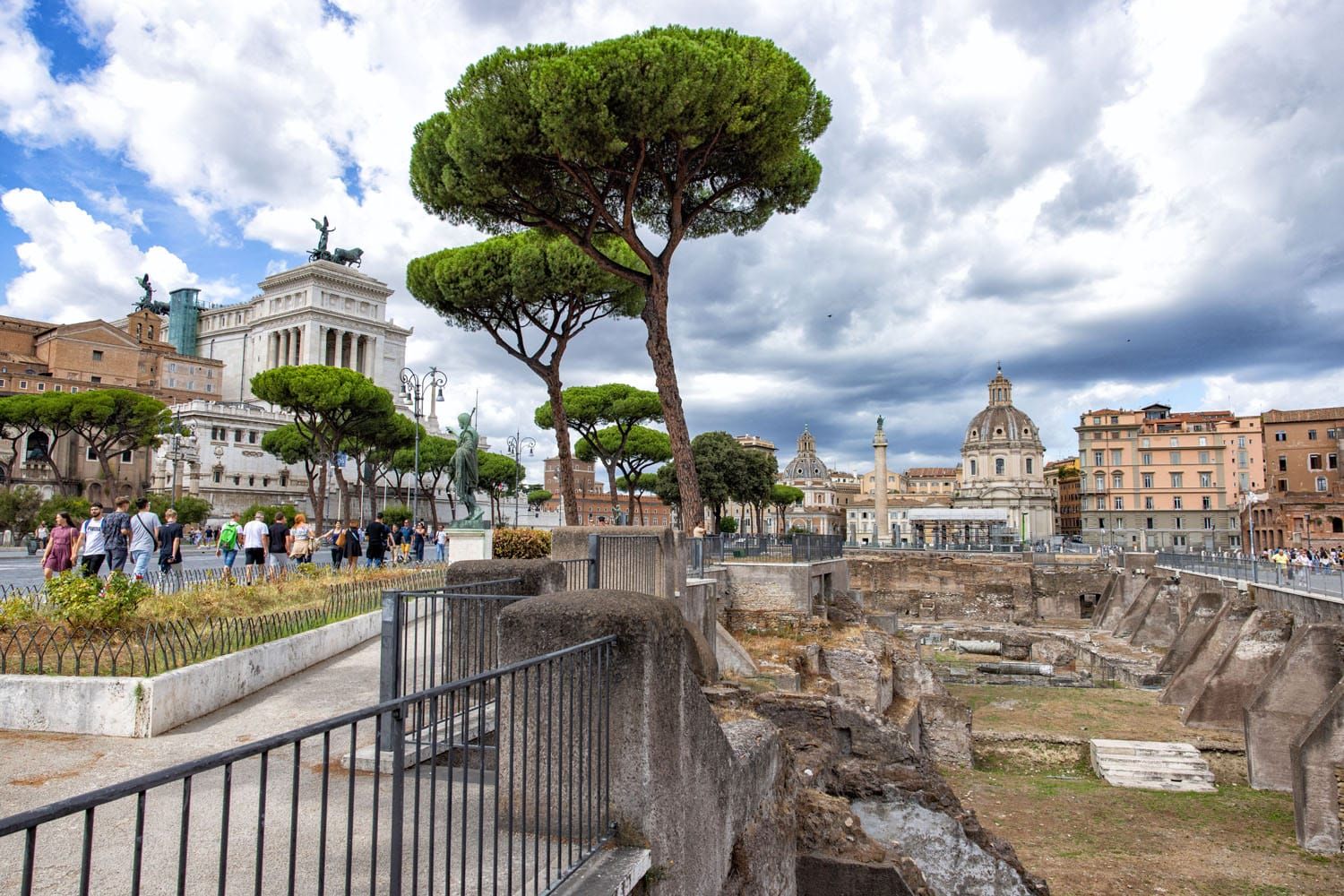
The view of the Forum of Augustus on the walk along Via dei Fori Imperiali
Via Fori dei Imperiali ends at Piazza Venezia. From here, you can climb the steps on the Altar of the Fatherland for one of the best views of Rome.
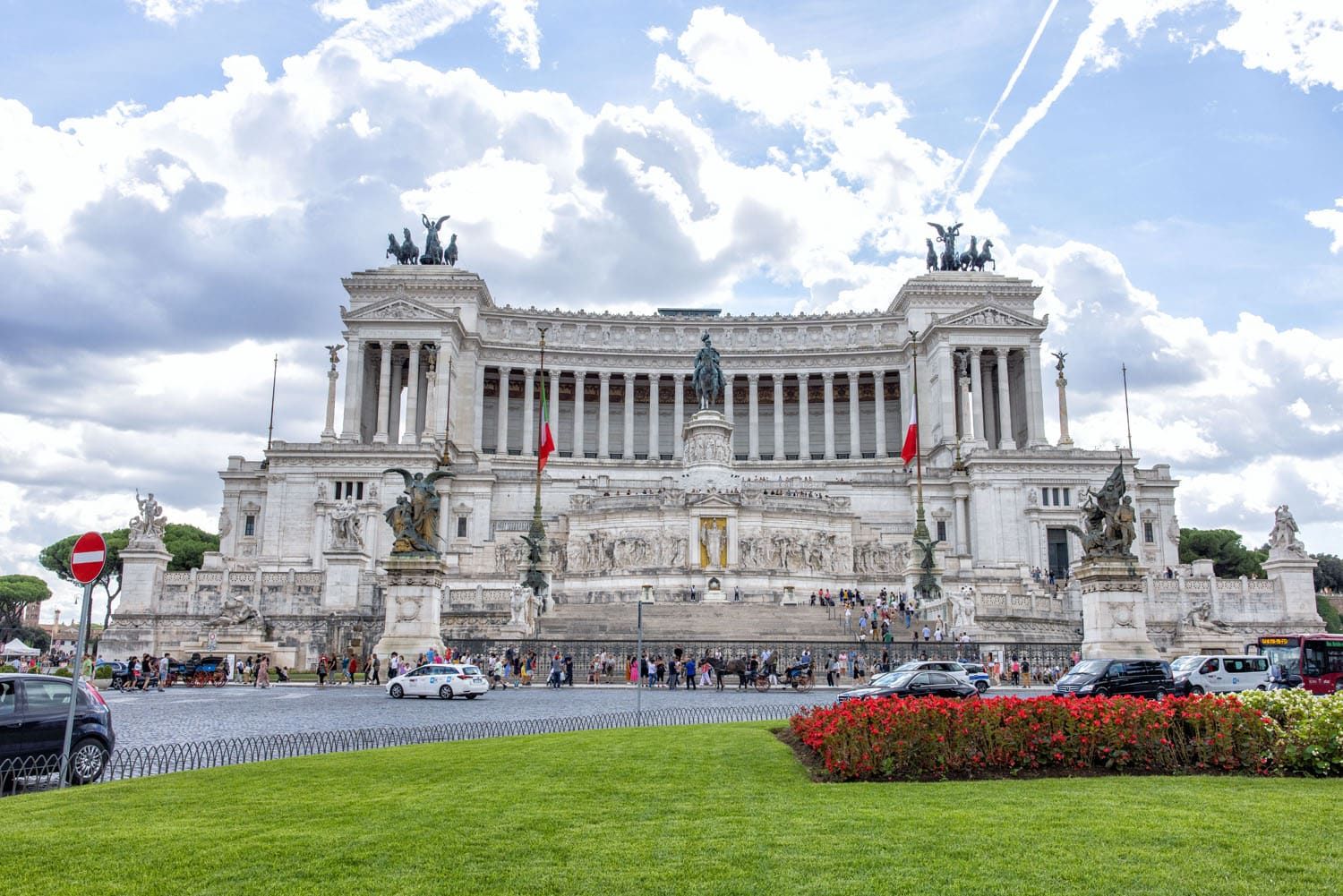
Altar of the Fatherland
2:00 pm: Altar of the Fatherland
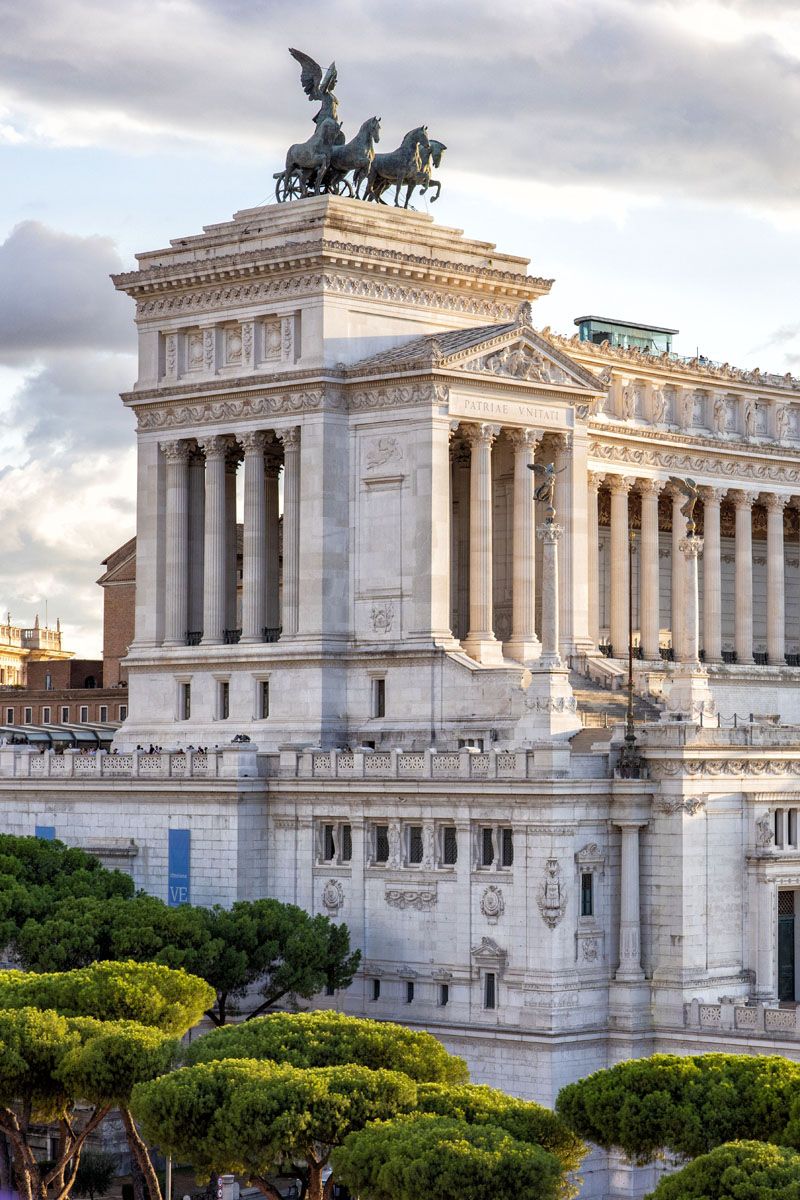
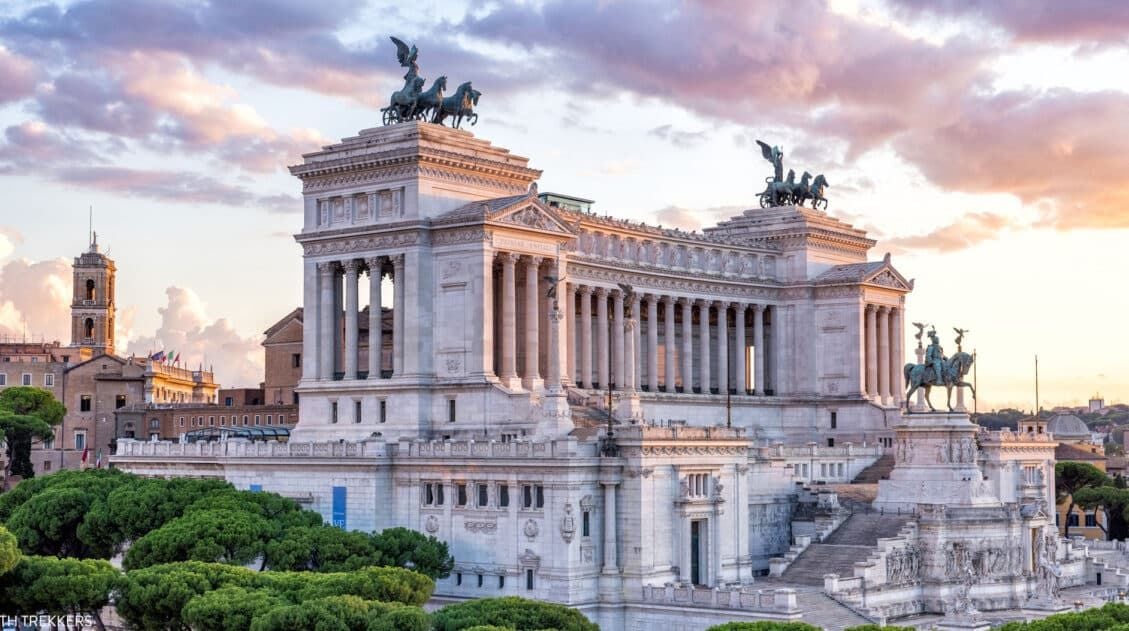
The Altar of the Fatherland, also called Altare della Patria, the Victor Emmanuel II Monument, or simply the “wedding cake,” is one of the most recognizable landmarks in Rome.
This national monument was built between 1885 and 1935 to honor Victor Emmanuel II, who was the first king of unified Italy. It contains the Tomb of the Unknown Soldier and an eternal flame.
This is one of our favorite viewpoints in Rome. From the upper terrace, you look directly over the Roman Forum and Colosseum, with wide views across the city in every direction.
You can climb partway up the monument for free, but we think the panoramic elevator to the top (€18) is worth it. The view from here is the reason we include this stop in the itinerary.
If you are running behind, you can shorten the visit by skipping the museum areas and heading straight for the terrace.
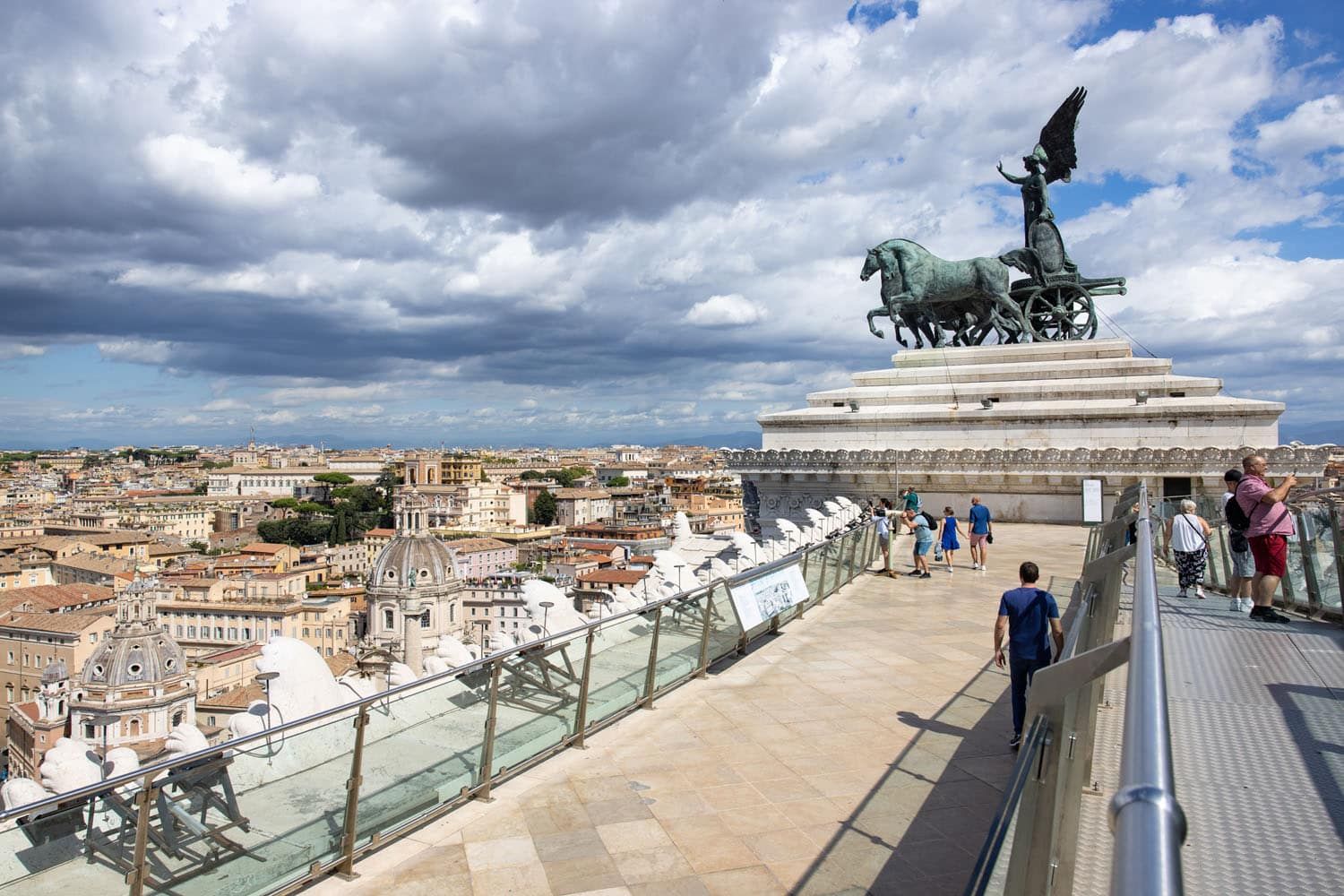
On the top level of the Altar of the Fatherland
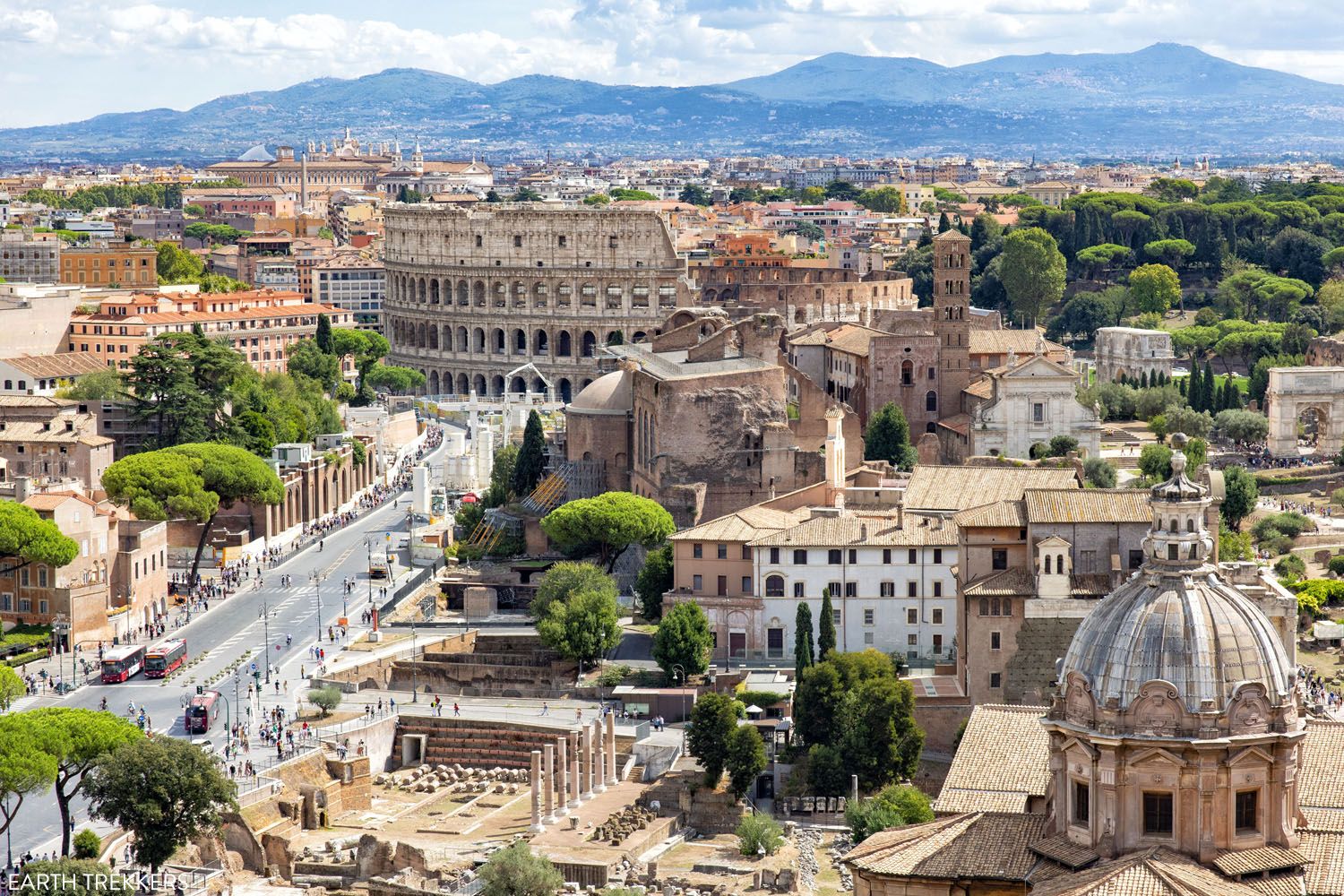
We took this photo from the Altar of the Fatherland
3:00 pm: Capitoline Hill
There are two reasons to visit Capitoline Hill: for a great view of the Roman Forum and to visit the Capitoline Museums.
To get here from the Altar of the Fatherland, it is a 3-minute walk along Via del Teatro di Marcello. You will walk up a series of steps to get to Campidoglio, which is the square on Capitoline Hill. This square was designed by Michelangelo.
The Capitoline Museums are located inside of Palazzo dei Conservatori and Palazzo Nuovo. These museums contain works of art by Caravaggio, Rubens, and Tiziano. Be sure to see the equestrian statue of Marcus Aurelius (a copy of this statue sits in Campodoglio Square) and the original statue of the she-wolf suckling Romulus and Remus, called the Capitoline Wolf (a replica of this statue sits next to the Senatorial Palace).
For hours and pricing, visit the official website.
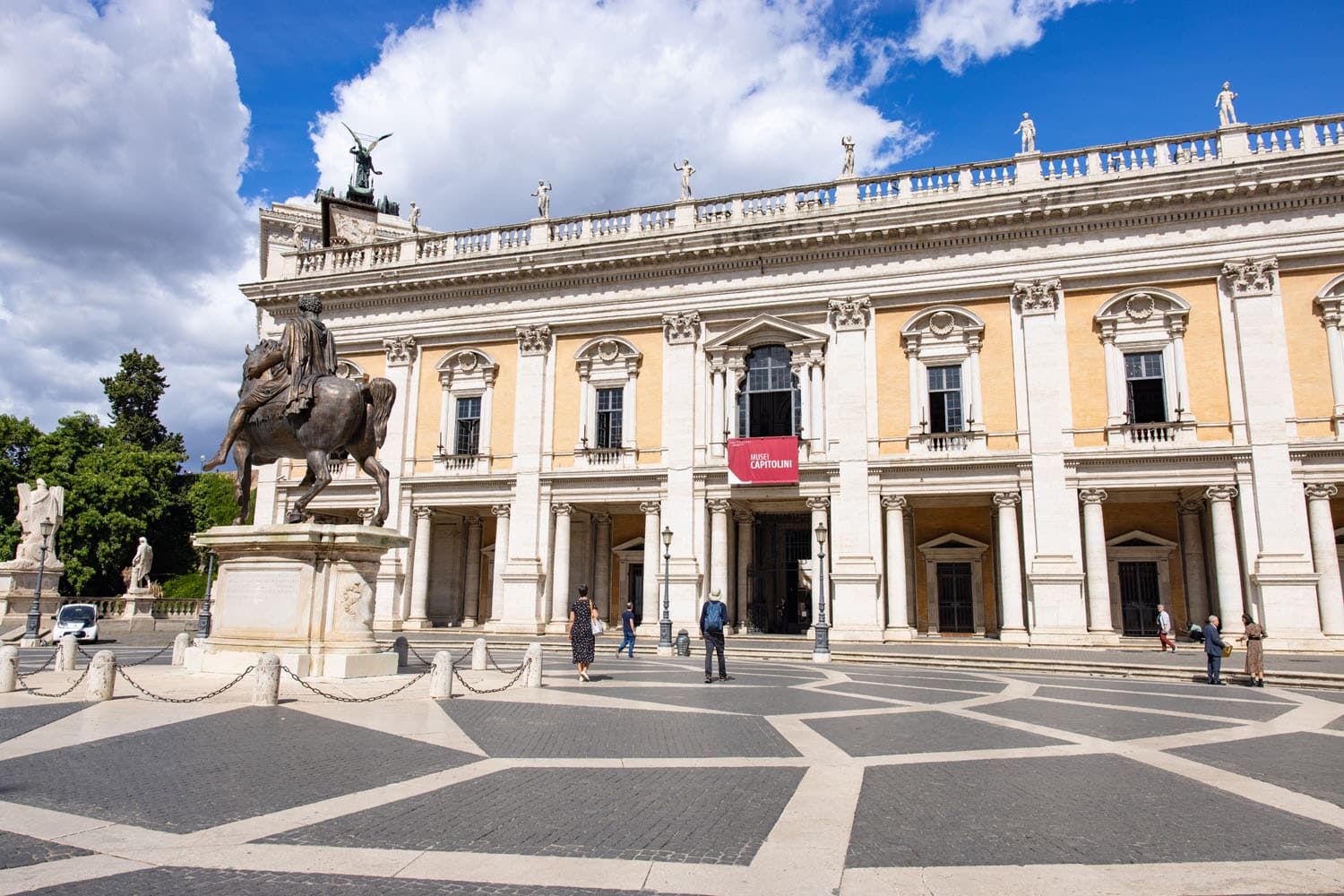
Campidoglio Square
For the best viewpoint of the Roman Forum from Capitoline Hill, walk between Palazzo dei Conservatori and the Senatorial Palace along Via del Campidoglio to Terrazza sul Foro for another great view of the Roman Forum.
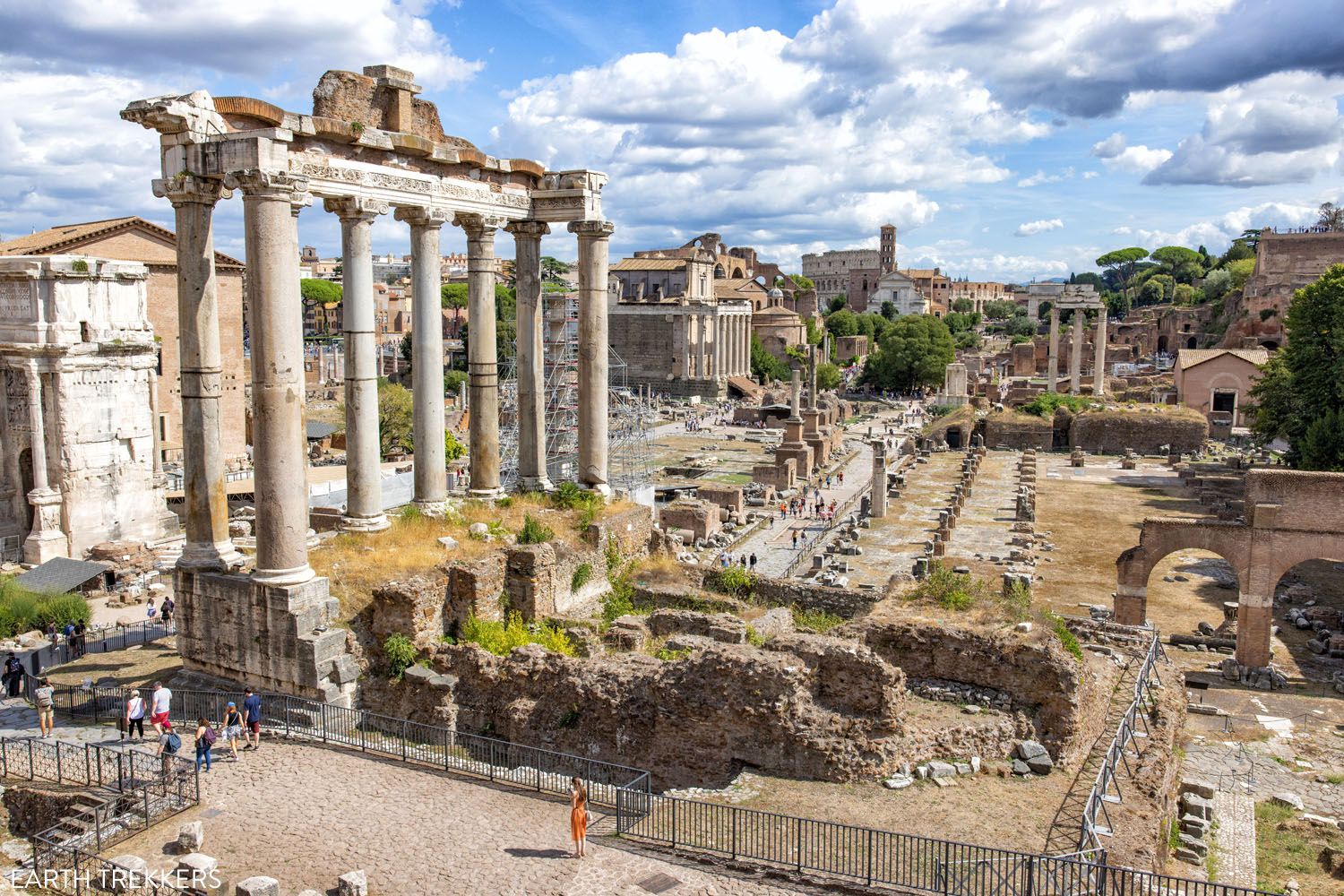
The view of the Roman Forum from Terrazza sul Foro
5:00 pm: Aperitivo at Oro Bistrot
End the afternoon with an aperitivo at Oro Bistrot, one of our favorite rooftop bars in Rome.
Watching the sunset from here is one of my favorite memories from both of our trips to the city. As the sun went down, the colors lit up the Altar of the Fatherland, and the view across Rome was spectacular.
Even if you don’t stay for dinner, we think it is absolutely worth stopping here for an aperitivo. Dinner was very good as well, so this can also be an easy place to stay for the evening if you don’t feel like heading somewhere else afterward. Make a reservation in advance for drinks and dinner.
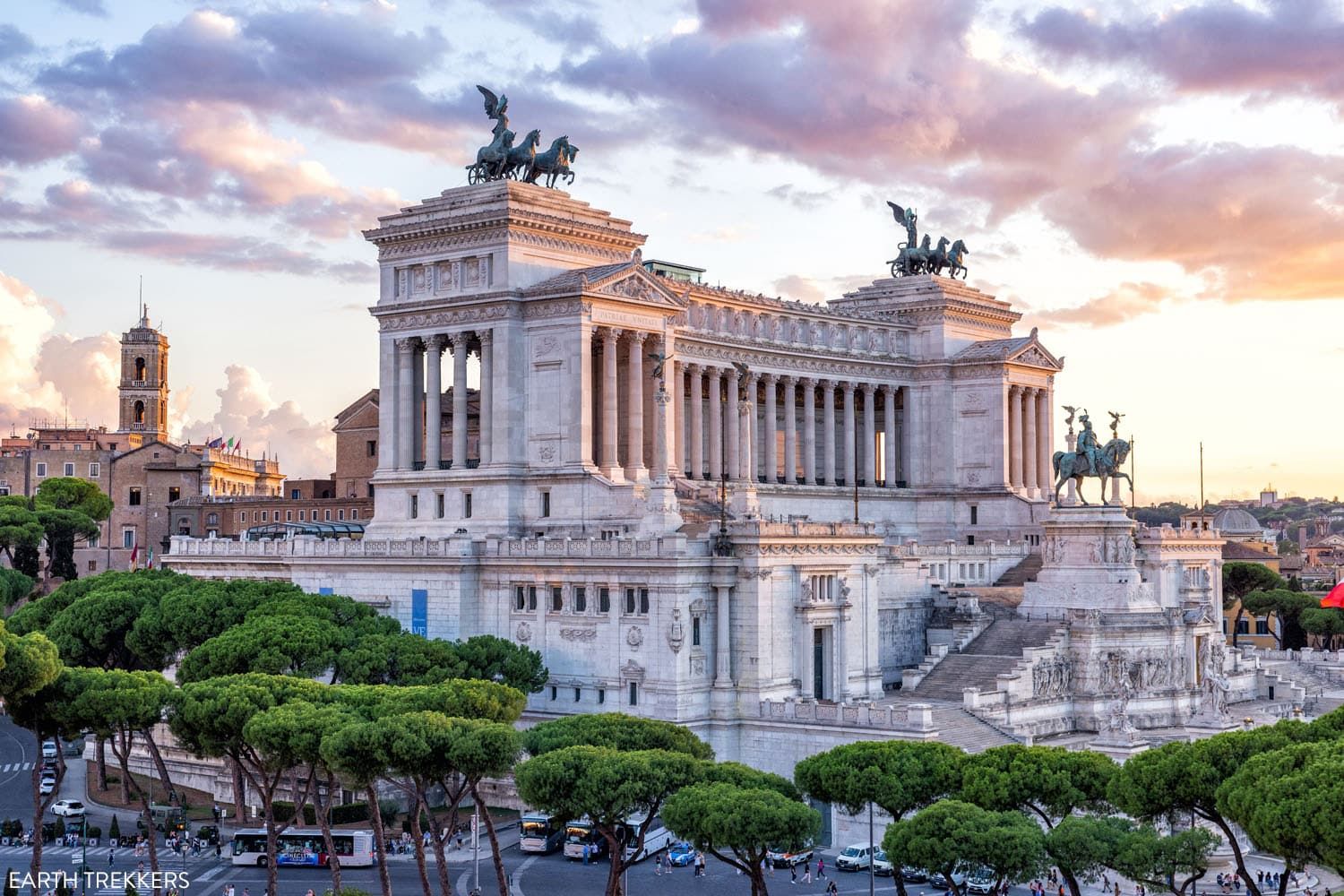
The view of the Altar of the Fatherland from Oro Bistrot
6:00 pm: Trastevere
You have the option to spend all evening at Oro Bistrot, or you can go to Trastevere. This neighborhood is filled with some of the best restaurants in Rome and it is a lovely area to explore. We recommend Nannarella, Enoteca Trastevere, and Trapizzino (make your reservations in advance, we have links to these restaurants on our Rome Restaurant Guide).
To get here, hire a taxi (you can walk but it is a 22-minute walk, about 0.6 km/1 mile from Oro Bistrot). The hotel staff at Oro Bistrot can call you a taxi. We were able to get a taxi at Piazza Venezia.
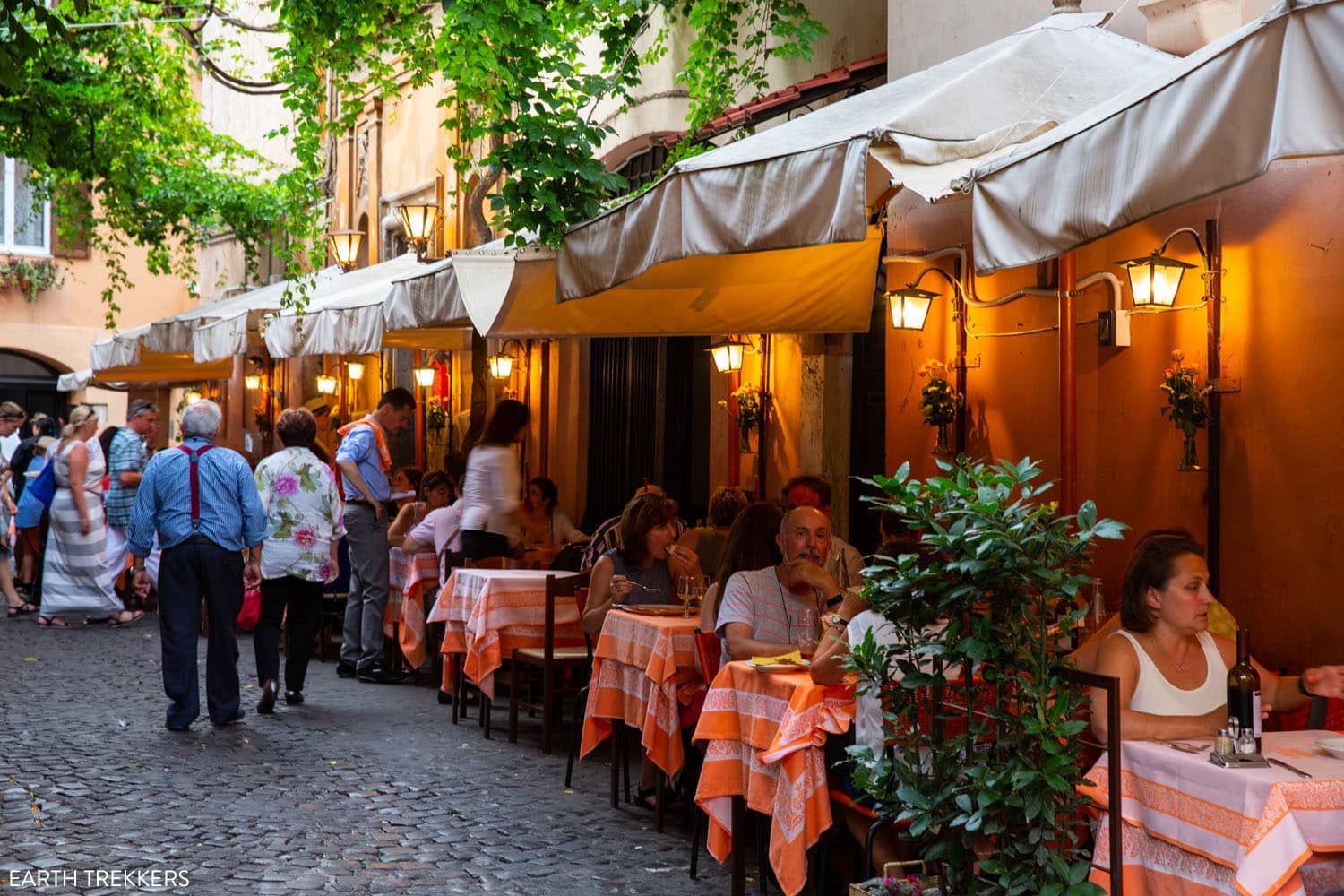
Trastevere
Day 2: Vatican Museums, Castel Sant’Angelo, Historic Heart of Rome
Start Day 2 at the Vatican Museums, ideally right when they open, and spend the morning exploring the galleries and Sistine Chapel. From here, continue to Castel Sant’Angelo and then walk into Rome’s historic center, visiting Piazza Navona, the Pantheon, Trevi Fountain, and Spanish Steps.
You’ll notice that St. Peter’s Basilica is not included today. With four days in Rome, we prefer visiting St. Peter’s early on a separate morning, when you have a better chance of avoiding the long security lines. It also gives you more time to enjoy the Vatican Museums without feeling rushed.
Here is an overview of today’s itinerary:
Morning (7:30/8:00 am): Vatican Museums & Sistine Chapel
12:00 pm: Lunch
1:30 pm: Castel Sant’Angelo
3:00 pm: Scenic Walk to Piazza Navona
3:20 pm: Historic Heart of Rome
5:30 pm: Free Time or Rooftop Bar
7:00 pm: Dinner
8:00 am: Vatican Museums & Sistine Chapel
Vatican City is the smallest country in the world. In Vatican City, there are three big sites to visit: the Vatican Museums, the Sistine Chapel, and St. Peter’s Basilica. Today you will visit the Vatican Museums and Sistine Chapel.
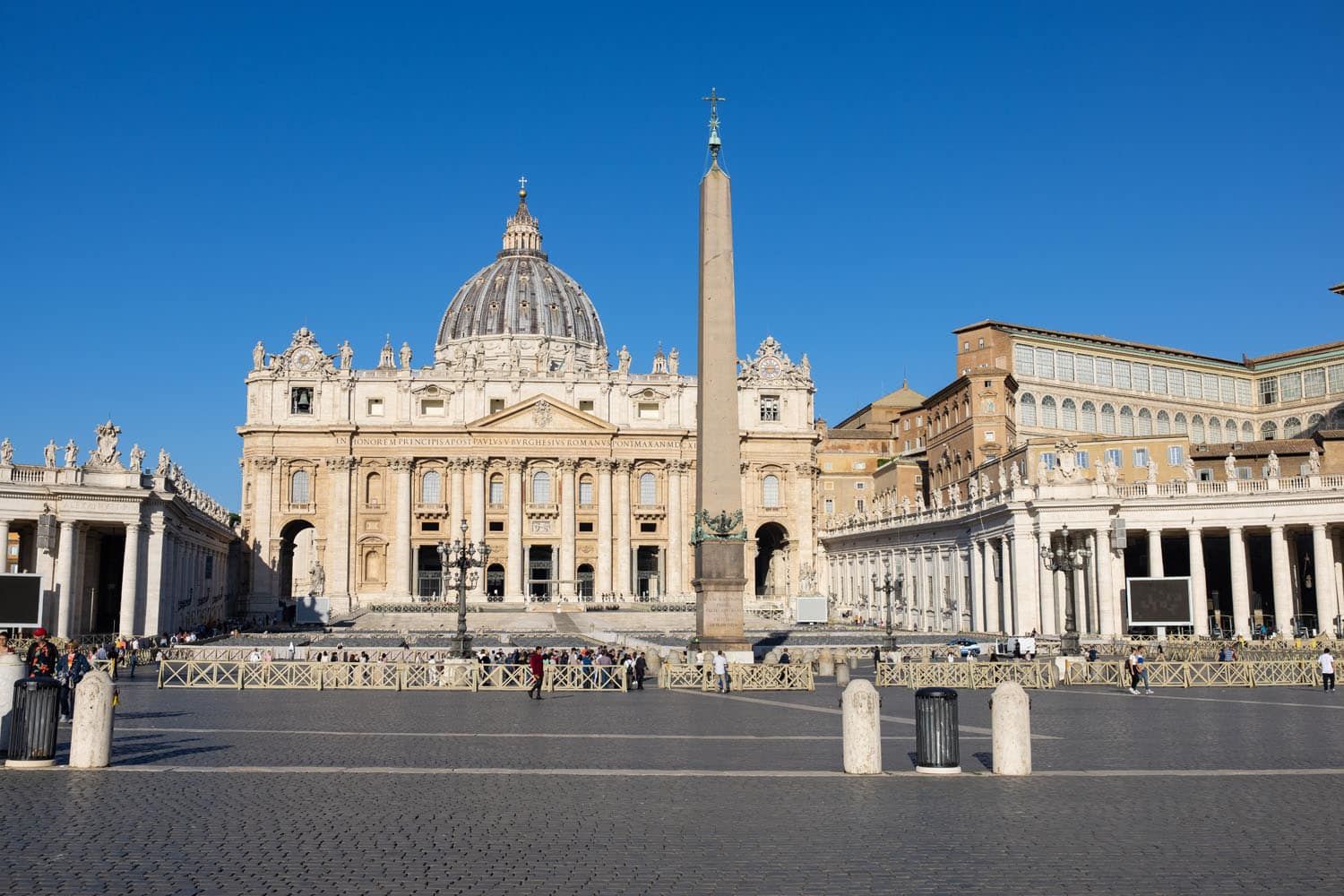
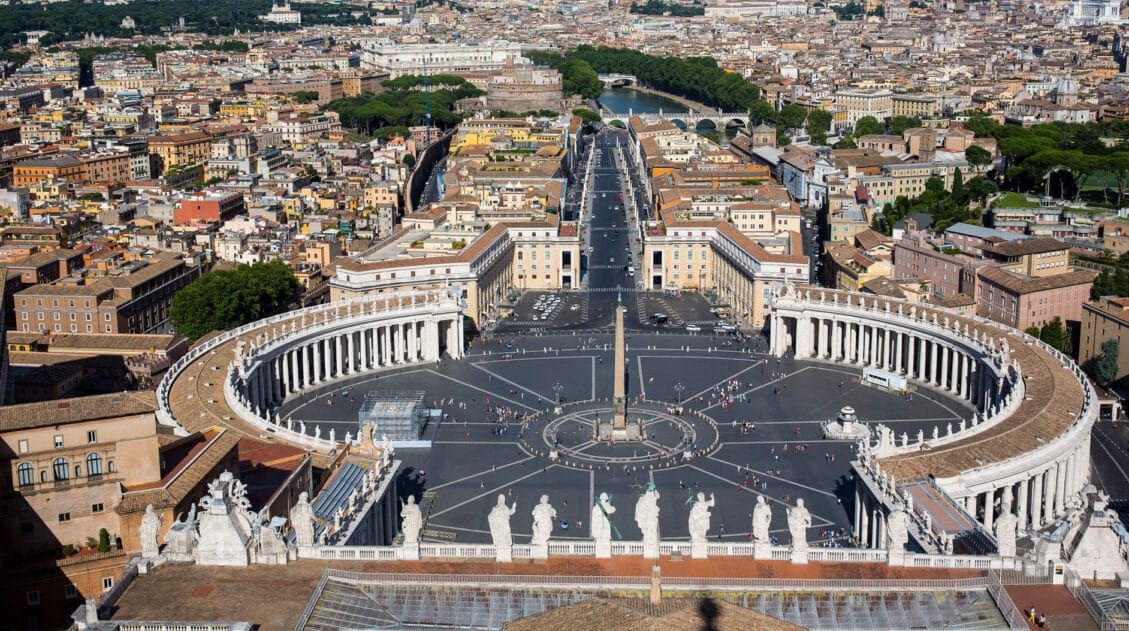
St. Peter’s Square
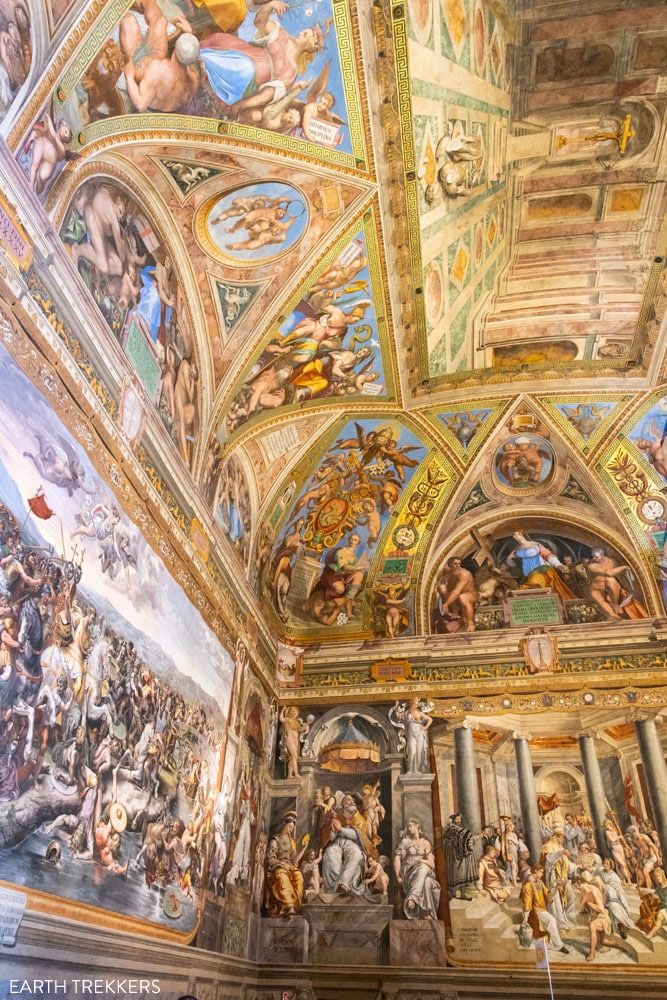
Rome of the Immaculate Conception
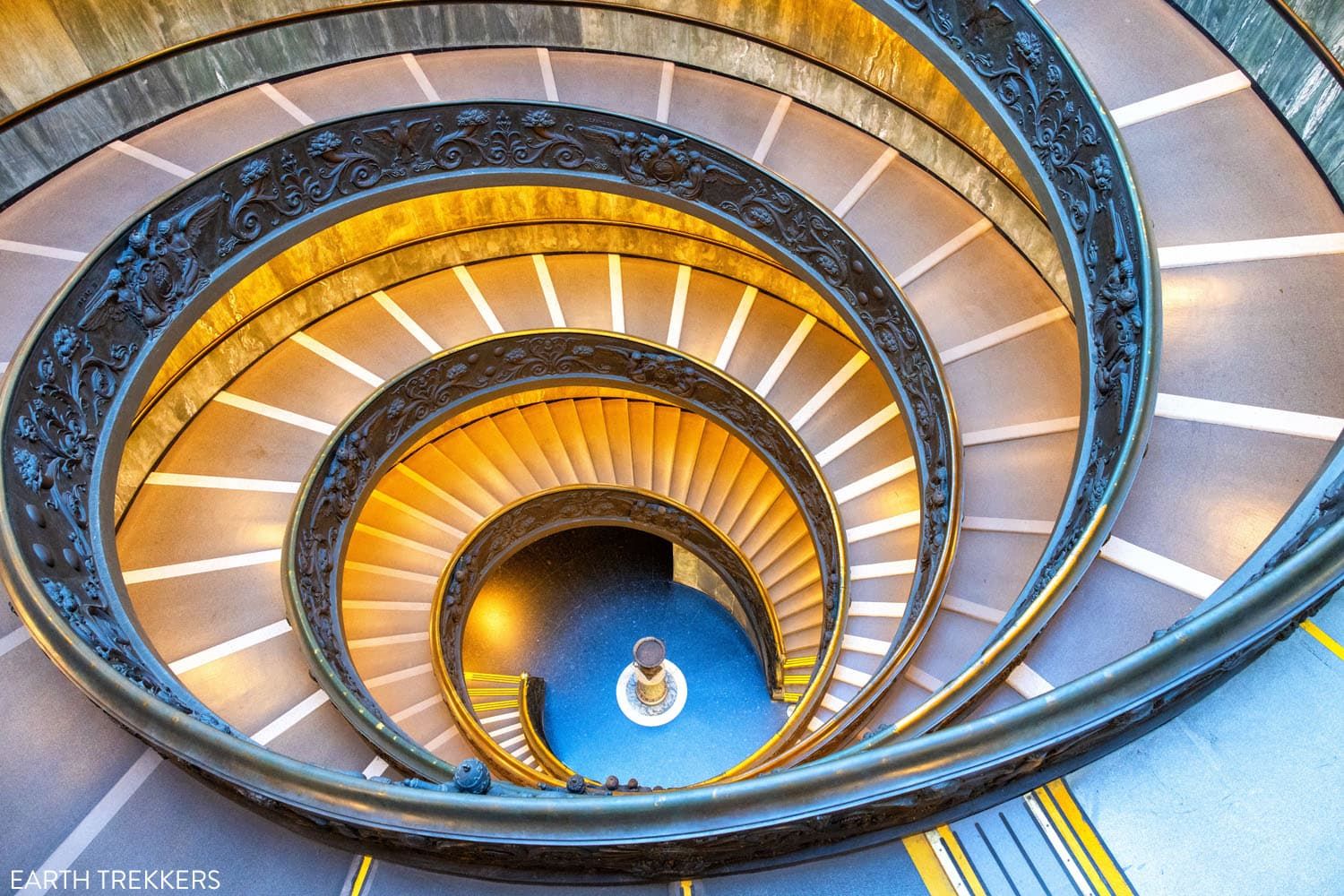
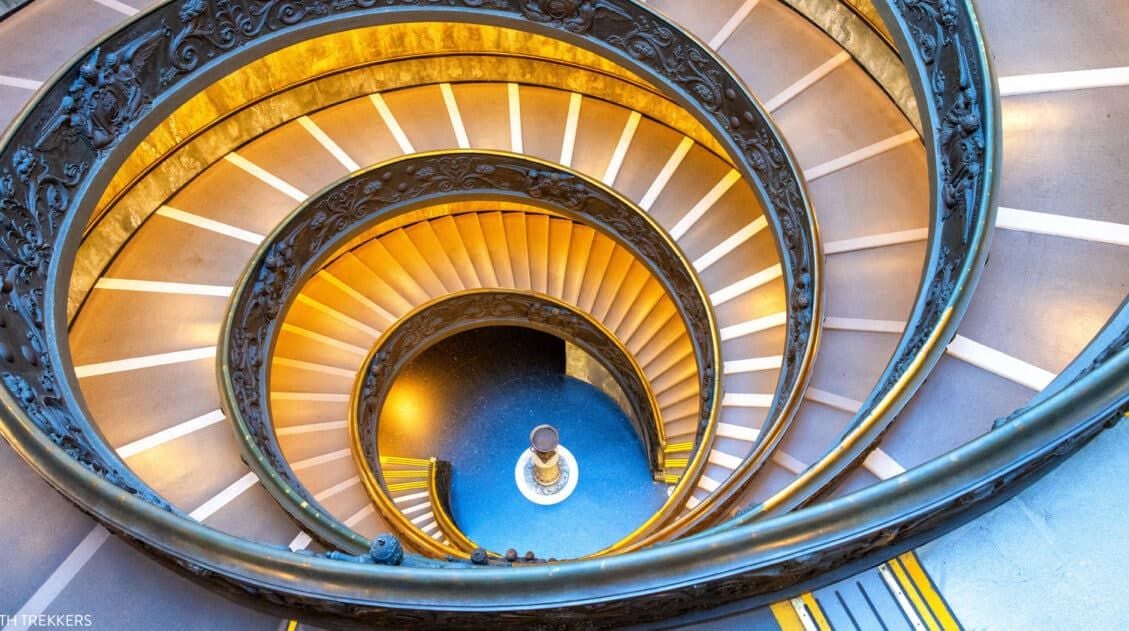
The staircase inside the Vatican Museums
Reserve an 8 am timed-entry ticket or book one of the first guided tours of the day. The museums become increasingly crowded as the morning goes on, so starting at opening time gives you the best chance of seeing some of the galleries before peak crowds arrive.
If this is your first visit, a guided tour can be worthwhile. The Vatican Museums are enormous, and having a guide makes it much easier to focus on the highlights rather than trying to see everything.
Plan on spending roughly 2½ to 3½ hours in the museums and Sistine Chapel, depending on how much time you want to spend in the galleries.
For tickets, tour recommendations, what to see, and our detailed crowd-avoidance strategies, read our How to Visit the Vatican Museums & St. Peter’s Basilica guide ↓
How to Visit the Vatican Museums & St. Peter’s Basilica
In this guide, we cover hours, pricing, and helpful tips for your visit. You also have the option to add on the “secret rooms” of the Vatican, such as the Cabinet of Masks, and we cover these as well.Why We Visit St. Peter’s on a Different Day: On our most recent trip, we visited the Vatican Museums early one morning and St. Peter’s Basilica early on another. Of the different ways we have visited Vatican City, this gave us the best experience with the crowds. With four days in Rome, you have enough time to do the same, so that is how we designed this itinerary.
Prefer to visit everything today? You certainly can. After the Sistine Chapel, visit St. Peter’s Basilica using a timed reservation, or choose a guided Vatican tour that includes the direct passage from the Sistine Chapel into the basilica when that passage is available. Doing both today frees up several hours on Day 3 for shopping, wandering Rome, a longer lunch, or simply taking a break from sightseeing.
Wednesday Warning: We do not recommend scheduling your St. Peter’s visit for Wednesday morning when the Pope is holding the General Audience in St. Peter’s Square, since access to the basilica can be delayed until later in the day. Wednesday can, however, be an excellent day for the Vatican Museums, which is exactly how we planned our most recent visit. If your trip includes a Wednesday, rearrange these four days to take advantage of it.
12:00 pm: Lunch
For lunch, we have three recommendations that are all within walking distance of St. Peter’s Square. You can either have a quick lunch or a longer, leisurely lunch.
We had a quick lunch at Alice Pizza, dining on pizza by the slice. It’s great if you are on a budget or are saving your money for dinner. Two restaurants we have not tried but sound amazing are Borghiciana Pastificio Artiginale and Scialla the Original Streetfood.
1:30 pm: Castel Sant’Angelo
Stroll along Via della Conciliazione towards Castel Sant’Angelo (and look back several times for the amazing view of St. Peter’s Basilica).
As you walk to Castel Sant’Angelo, you have the option to make a small detour to Ponte Vittorio Emanuele II for a beautiful view of the castle and Ponte Sant’Angelo.
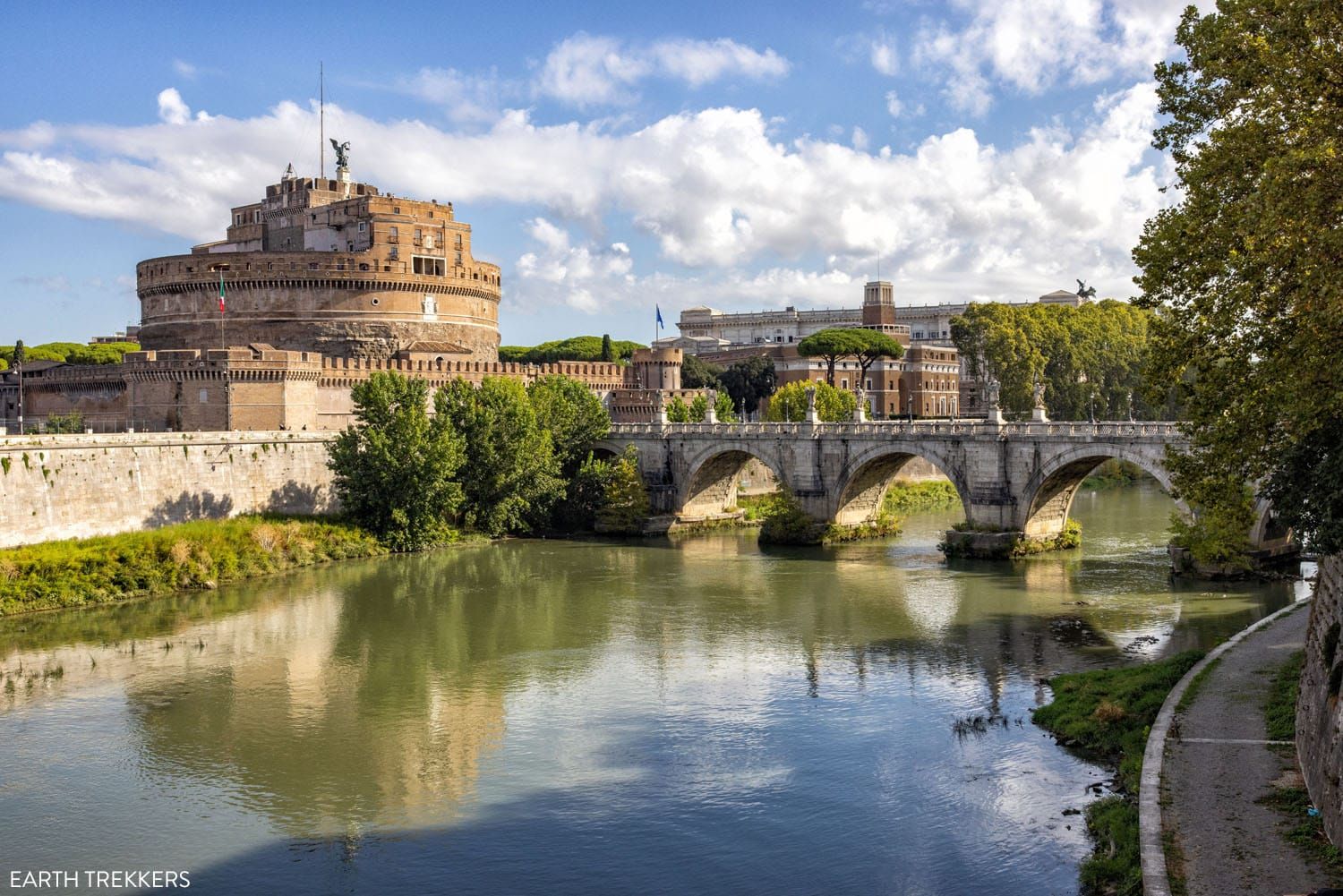
The view from Ponte Vittorio Emanuele II
Castel Sant’ Angelo, also known as the Mausoleum of Hadrian, was originally built as a mausoleum for Emperor Hadrian and his family. Later, it was used as a fortress, a prison, a castle, and now it is a museum.
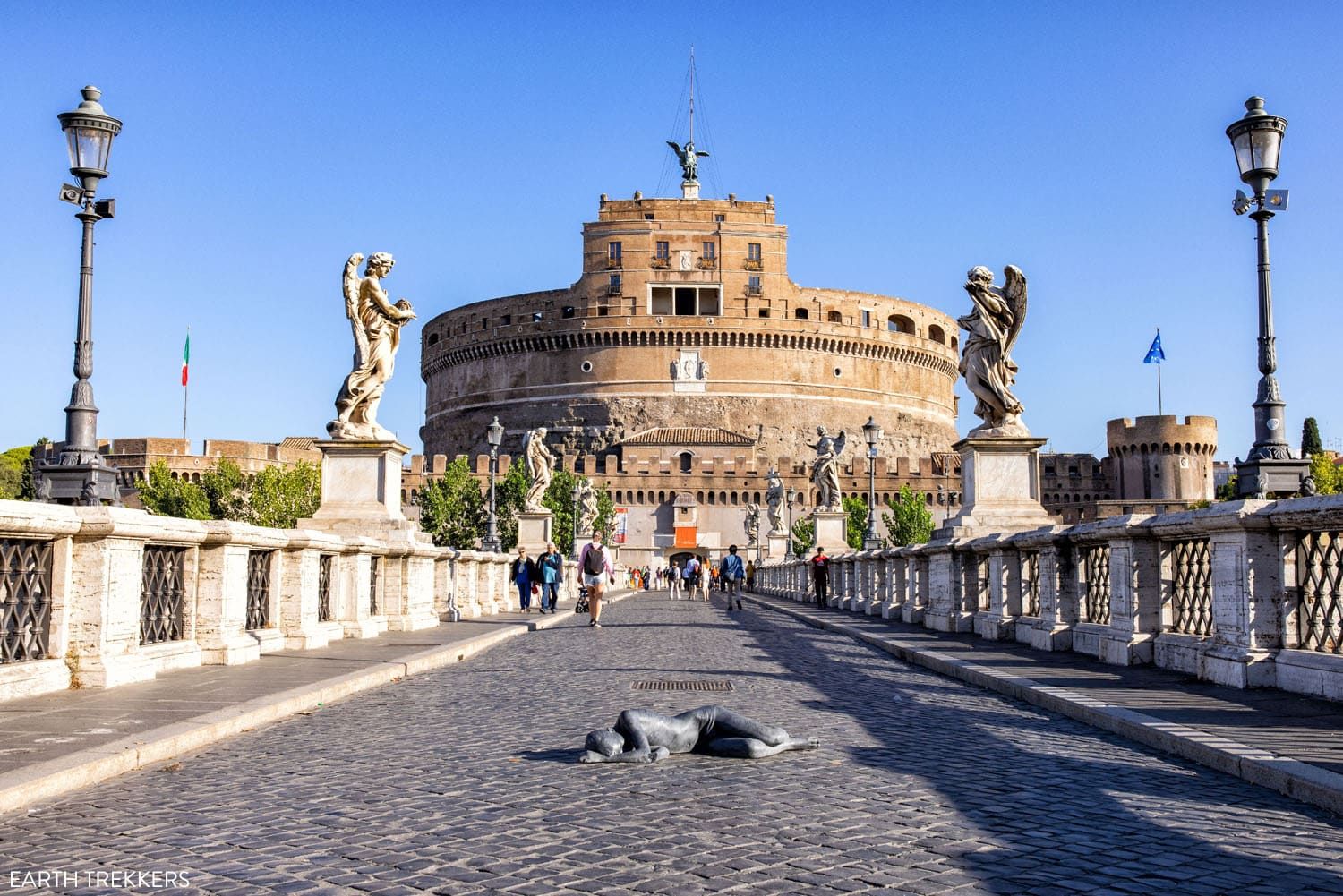
Castel Sant’ Angelo
During your visit, you will follow a walking route through the fortress. First, you make a loop around the lower level. At the end of this loop, you will enter the center building, and climb to the top on a series of ramps and steps.
From the highest terrace of Castel Sant’Angelo you have almost 360° views of Rome.
Get hours and pricing on the official website.
3:00 pm: Scenic Walk to Piazza Navona
Cross the Tiber River on Ponte Sant’Angelo (the bridge that crosses the Tiber River in front of Castel Sant’Angelo). This bridge is lined with angels and a great photo spot.
Walk east along the Tiber River. Once you get to Ponte Umberto I, walk a short distance on this bridge for an iconic view of St. Peter’s Basilica and the Tiber River.
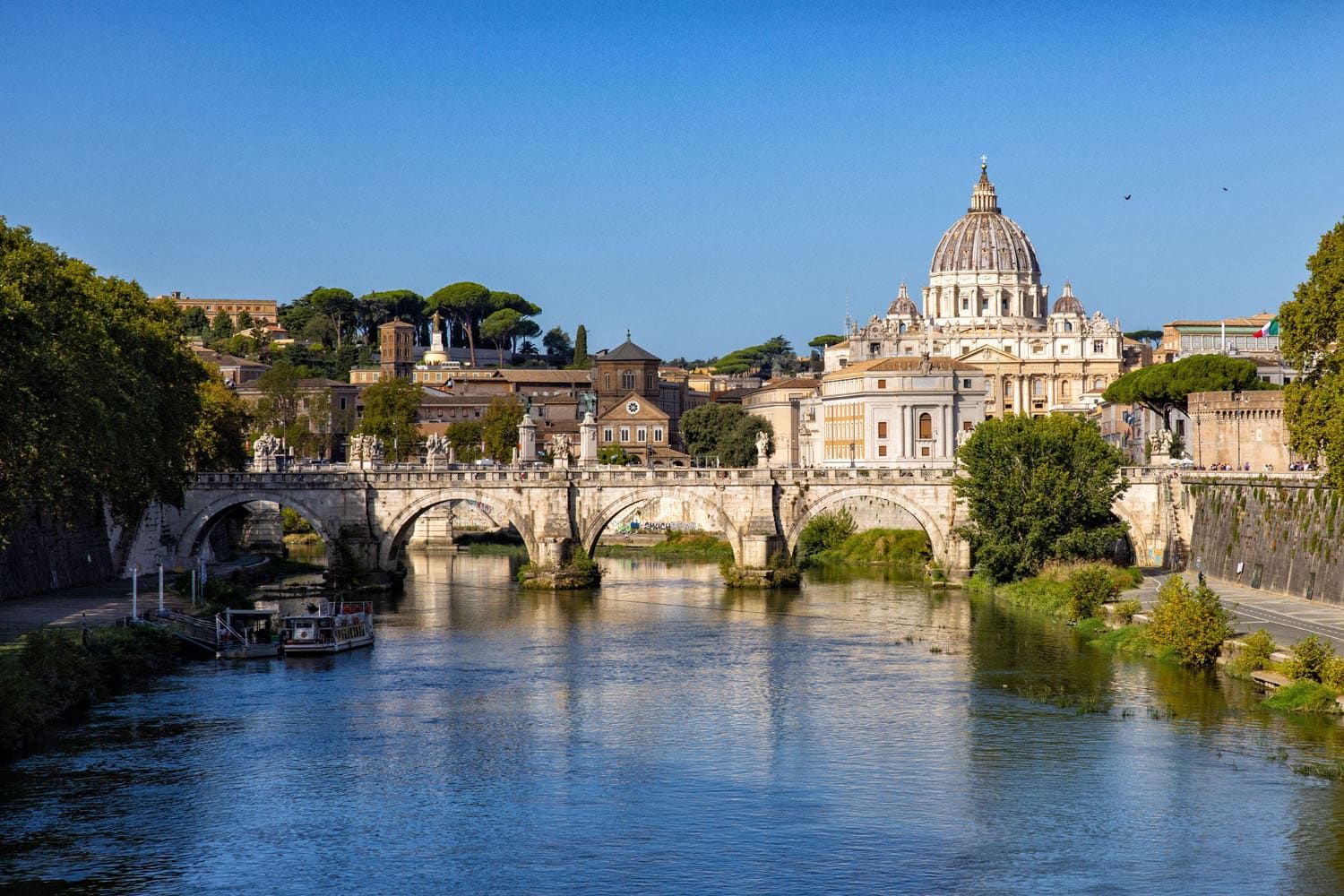
The view from Ponte Umberto I
Then walk down Via Giuseppe Zanardelli until you get to Piazza Navona.
This walk is 800 meters (0.5 miles) and takes 10 minutes without stops for photos.
3:20 pm: Historic Heart of Rome
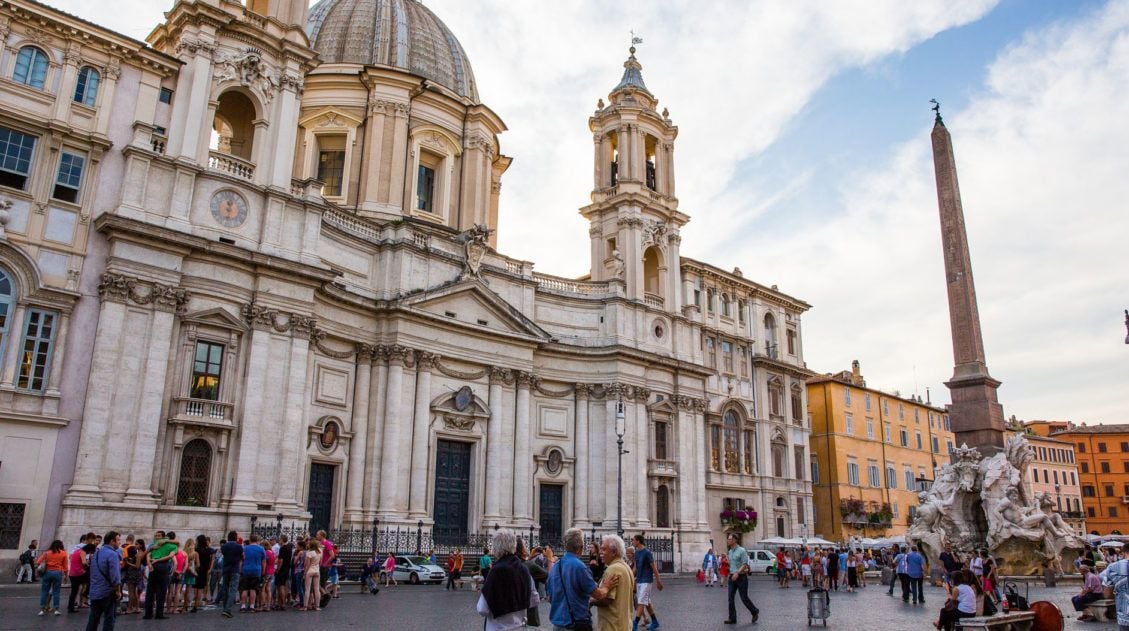
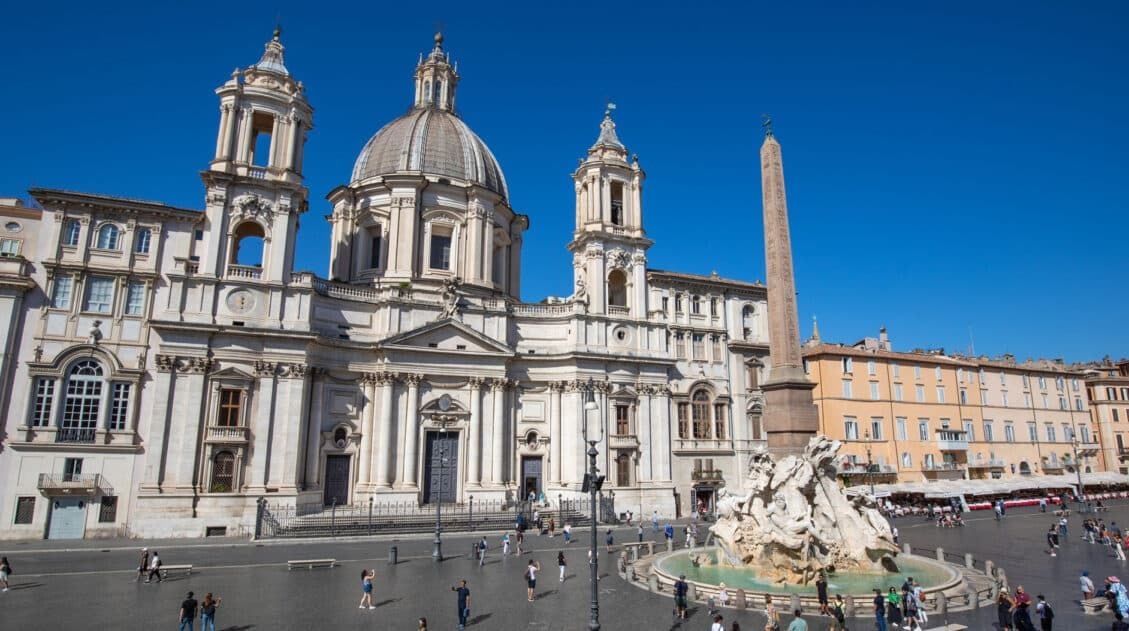
Piazza Navona is one of Rome’s most famous squares. It is filled with cafes, fountains, and lots of people. While you are here, take a look at the three fountains (the Fountain of the Four Rivers, the Fountain of Neptune, and the Fountain of the Moor), watch the street performers, and step inside Sant Agnese in Agone.
Piazza Navona is a good place to rest your feet for a few minutes. Many cafes get mediocre reviews, but it’s a nice spot to get a cup of coffee or glass of wine. We recommend Bernini.
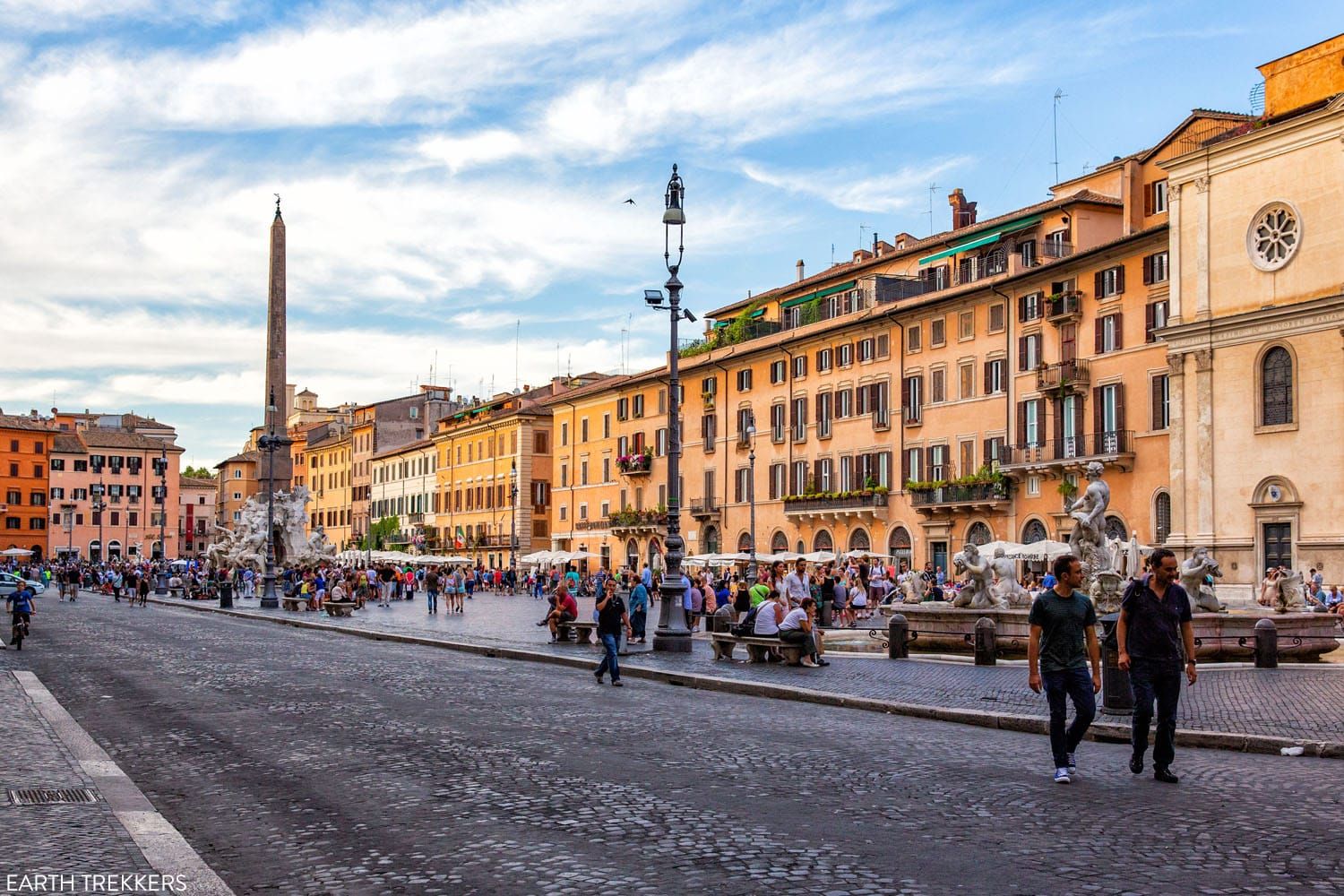
Piazza Navona
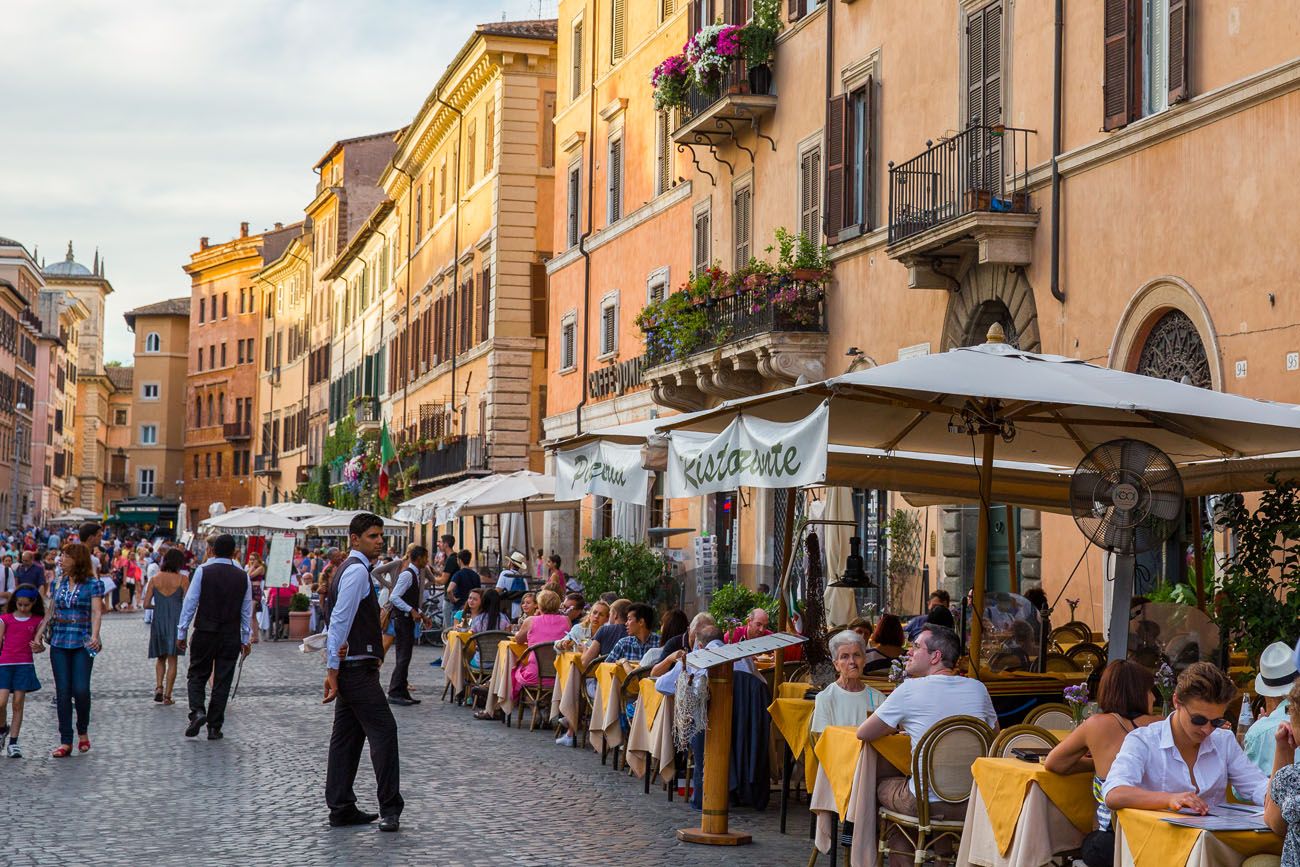
Cafes in Piazza Navona
Once you are finished in Piazza Navona, continue the stroll through the heart of Rome.
It’s a quick walk to the Pantheon. The Pantheon is one of the oldest buildings in Rome.
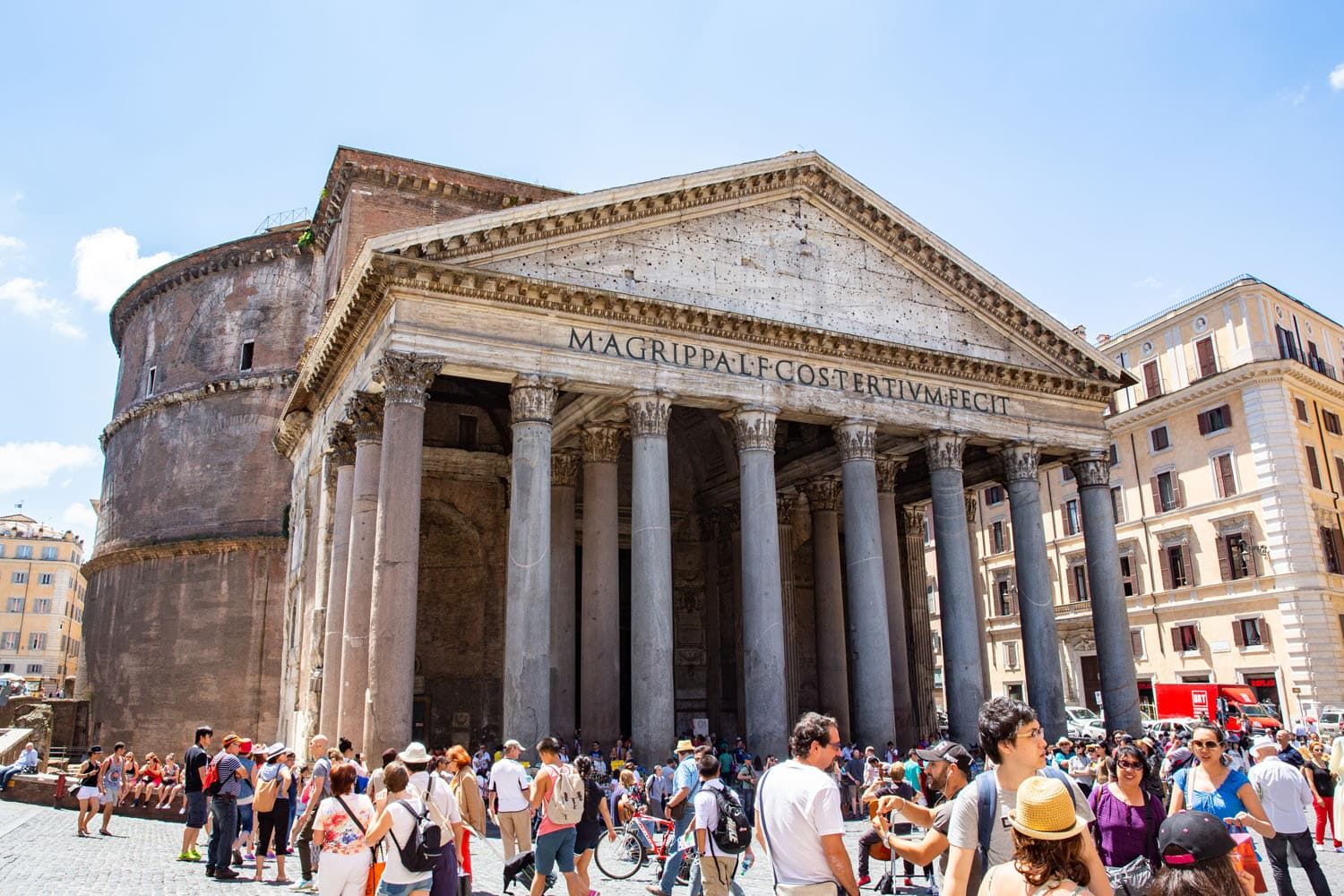
The Pantheon
Continue to the Trevi Fountain, passing by the Temple of Hadrian and Venchi (one of our favorite gelato shops in Rome).
The Trevi Fountain is one of the busiest places to visit in Rome. If you want to leave the crowds behind, visit Garden Roof Trevi (also called Trevi Rooftop). This tiny rooftop bar overlooks the Trevi Fountain. You can have a drink with a view and rest your feet for a few minutes.
It costs €2 to enter the area closest to the Trevi Fountain. You can still see the fountain for free from the piazza, so the fee only applies if you want to walk into the inner viewing area near the basin. Tickets are available online or at the entrance.
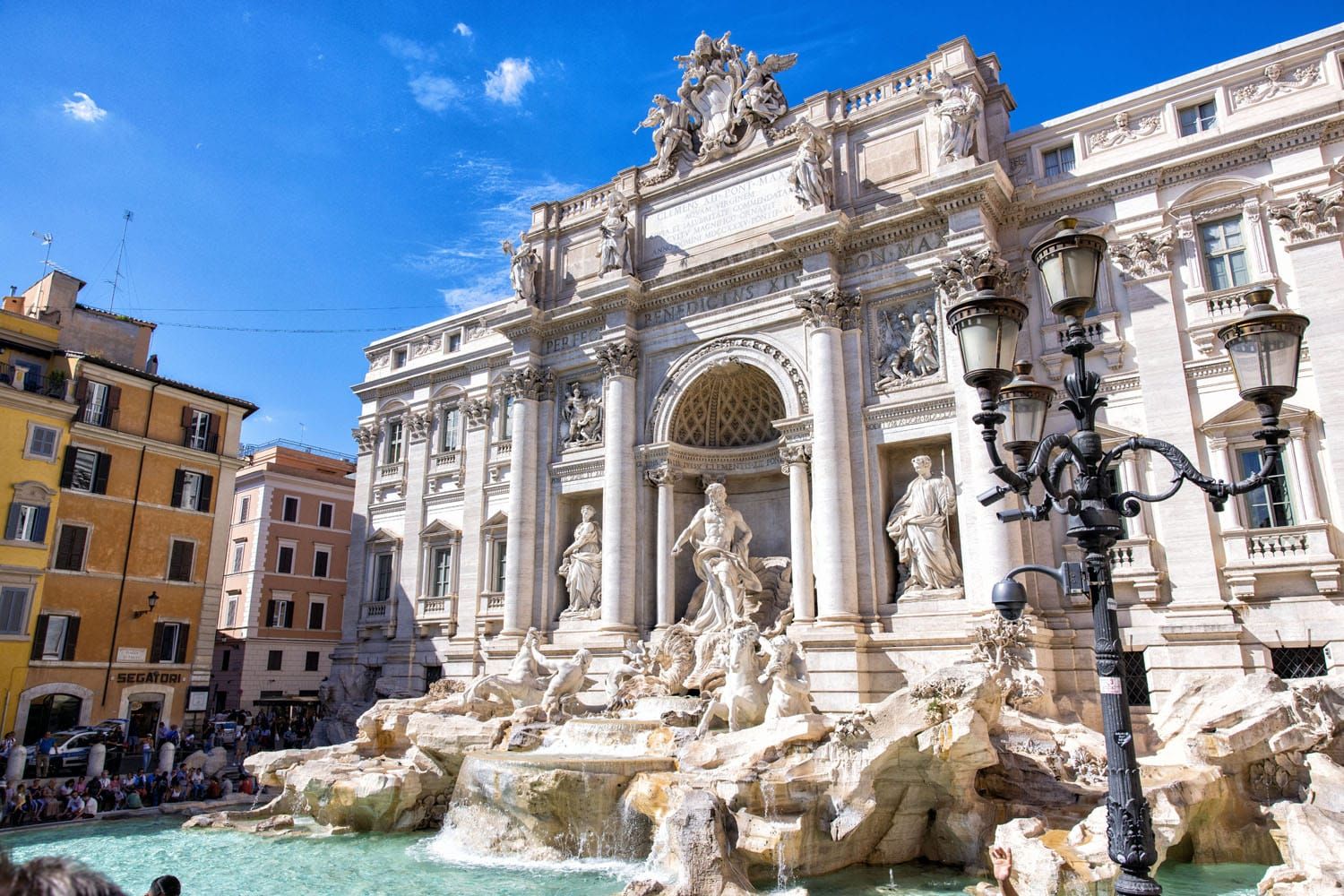
Trevi Fountain
Continue the walk until you get to the Spanish Steps.
This stairway is one of the most popular places to visit in Rome, frequently shows up in walking tours of the city, and is free to visit. The fountain that sits at the bottom of the Spanish Steps, Fontana della Barcaccia (Fountain of the Longboat), dates back to 1629 and was built by Pietro Bernini, father of Gian Lorenzo Bernini.
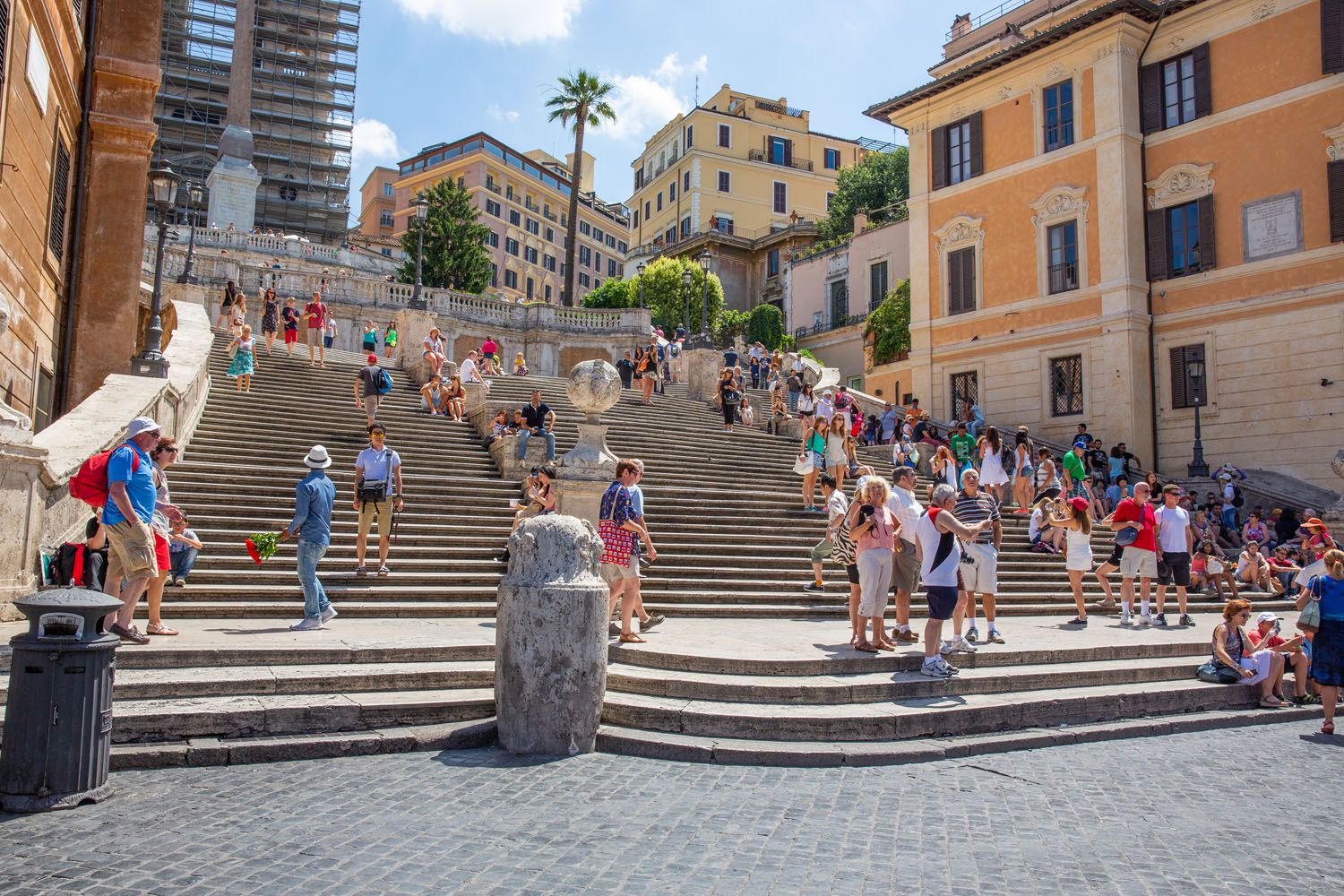
Spanish Steps
PRO TRAVEL TIP: If you are caught sitting on the Spanish Steps, you risk paying a €400 fine.
For a unique view of the Spanish Steps, go inside the Keats-Shelley House. It takes 30 minutes or less to tour this small museum. For hours of operation and pricing, visit the official website.
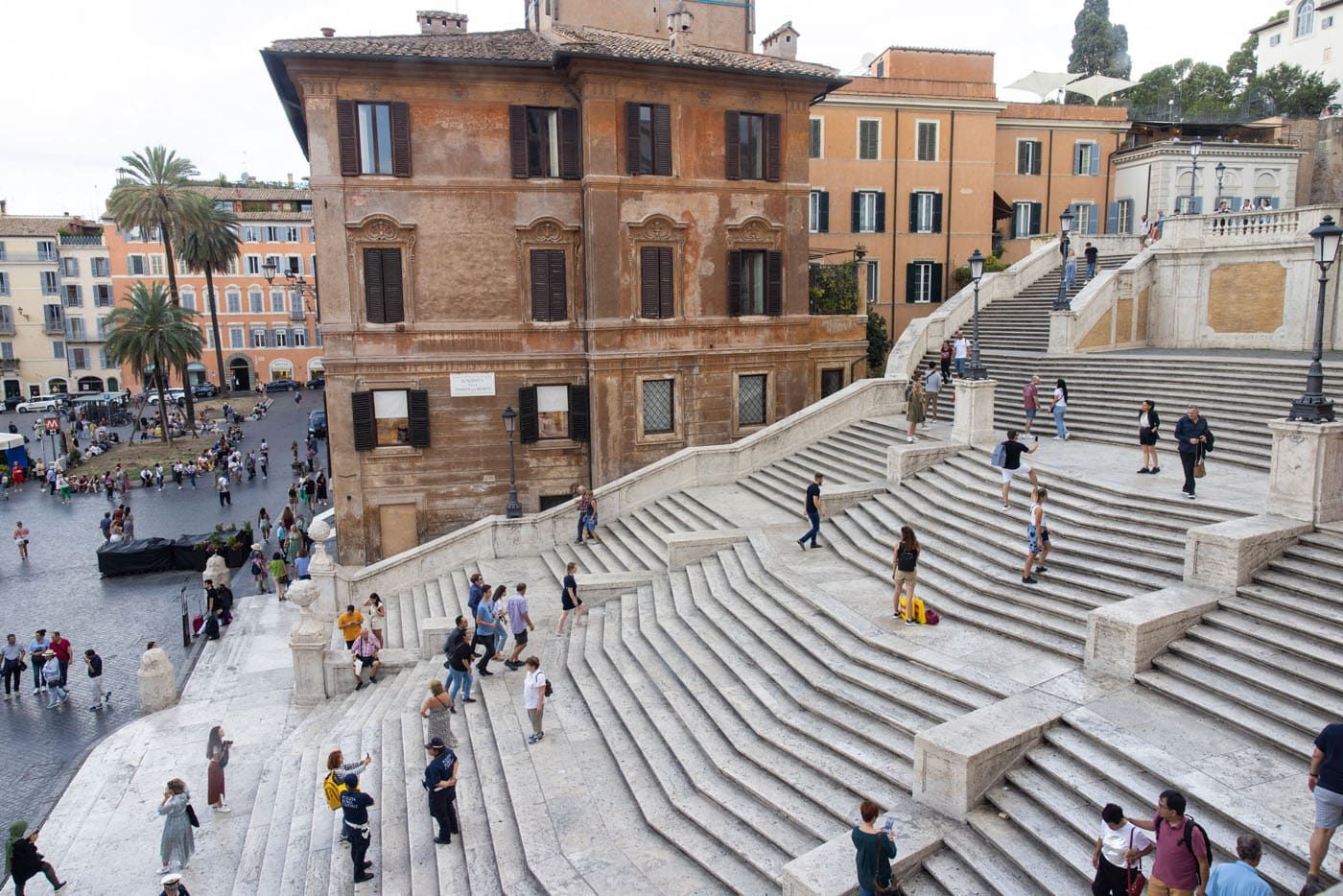
The view of the Spanish Steps from the Keats-Shelley House
5:30 pm: Aperitivo & Dinner
After the Spanish Steps, slow things down with an aperitivo and dinner.
This is a great part of Rome for rooftop bars, and after a long day of sightseeing, we think sitting down with a drink and a view is much more appealing than squeezing in another attraction.
Next to the top of the Spanish Steps is Cielo Terrace, which is on top of the Rocco Forte Hotel de la Ville. They serve both aperitifs and dinner, so you could stay for dinner. Learn more about the rooftop bars in our guide to the Rome Rooftop Bars.
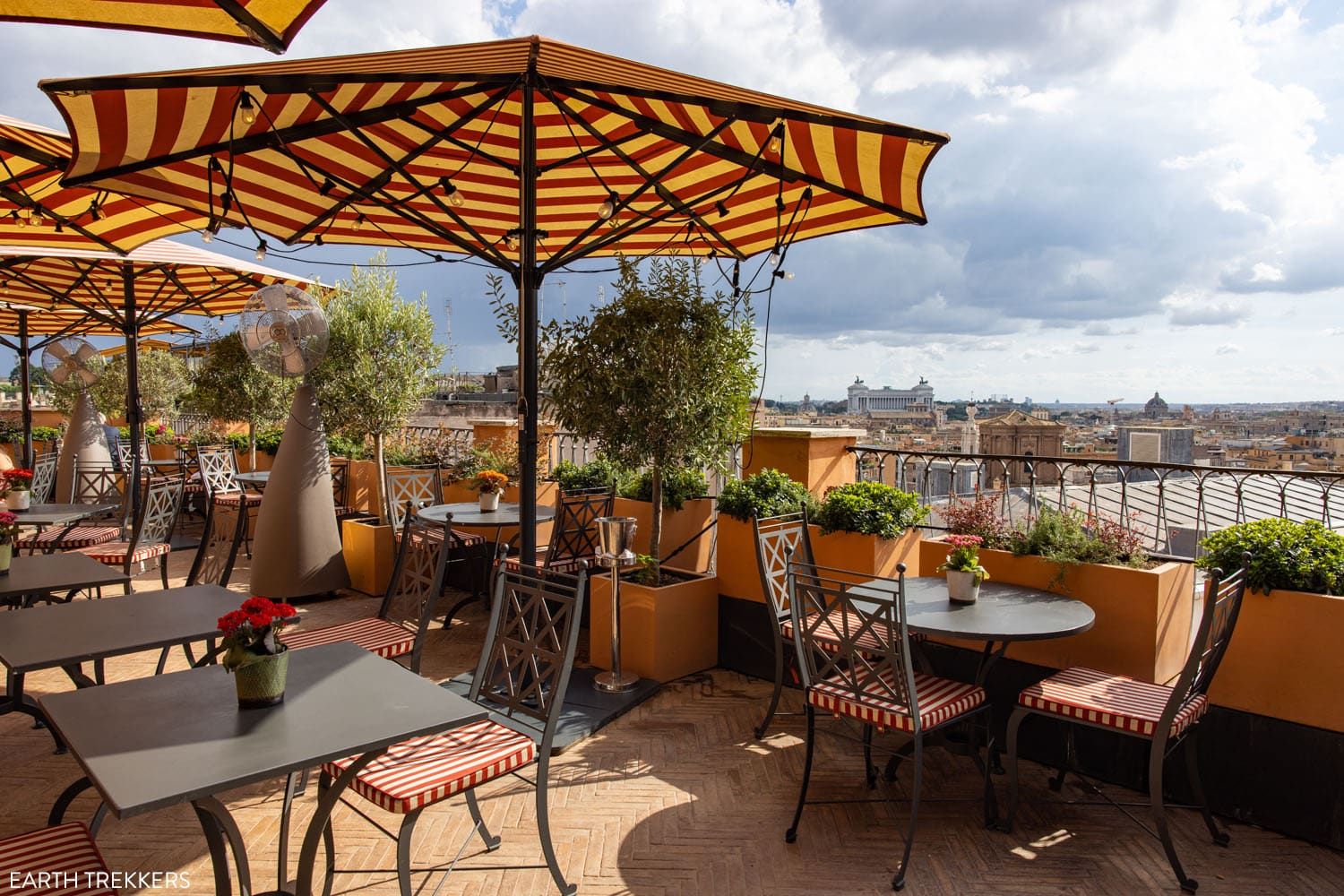
Cielo Terrace
You can start with an aperitivo at one of Rome’s rooftop bars and then head elsewhere for dinner, or choose a rooftop restaurant and stay for the evening. We have spent a lot of time exploring Rome’s rooftop bars and restaurants, and some of our favorite memories from the city are simply sitting above the rooftops with a drink as the sun goes down.
For recommendations, take a look at our Rome Restaurant Guide.
Day 3: St. Peter’s Basilica, Borghese Gallery & a More Relaxed Afternoon
After two busy sightseeing days, Day 3 moves at a slower pace.
Start early at St. Peter’s Basilica, with the option to climb the dome, then sit down for a proper brunch near the Vatican. From here, take the Metro to Piazza del Popolo and walk through Villa Borghese to the Borghese Gallery.
The afternoon and evening are intentionally flexible. Visit the Capuchin Crypt, take a food tour or cooking class, see the Colosseum at night if tours are running, or take some free time to enjoy Rome.
Here is an overview of today’s itinerary:
8:00 am: St. Peter’s Basilica
10:00 am: Brunch
11:30 am: Piazza del Popolo & Villa Borghese
1:00 pm: Borghese Gallery
Afternoon & evening: Choose Your Experience
8:00 am: St. Peter’s Basilica & Dome
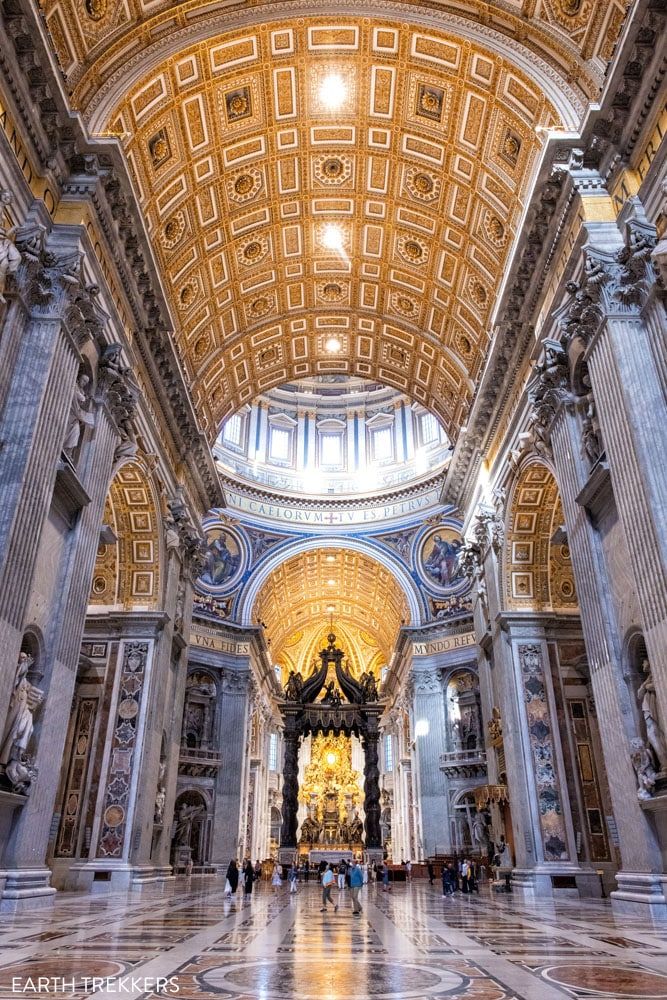
Start the morning at St. Peter’s Basilica. By visiting early, you have a much better chance of avoiding the long security lines that can build later in the morning.
Entry to the basilica is free, but you can reserve a timed visit in advance. This includes a digital audio guide and access through a dedicated entrance route, although everyone still has to pass through security.
If you want one of the best views in Rome, add the dome climb. You can reserve this in advance as well, and the dome ticket includes scheduled access to St. Peter’s Basilica.
Plan on spending about 1½ to 2 hours here if you visit both the basilica and dome.
Wednesday Warning: Avoid scheduling this part of the itinerary for Wednesday morning when the Pope is holding the General Audience in St. Peter’s Square. Access to the basilica can be delayed until later in the day. If your four days in Rome include a Wednesday, make that your Vatican Museums day instead.
For current prices, ticket options, dome information, and our detailed strategies for avoiding the crowds, see our How to Visit the Vatican Museums & St. Peter’s Basilica guide.
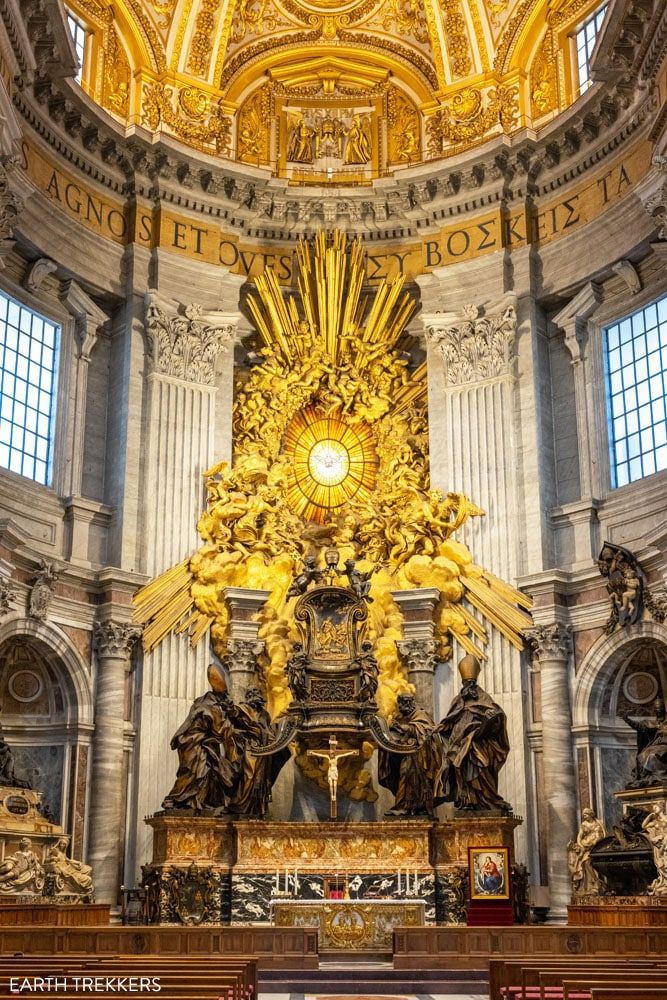
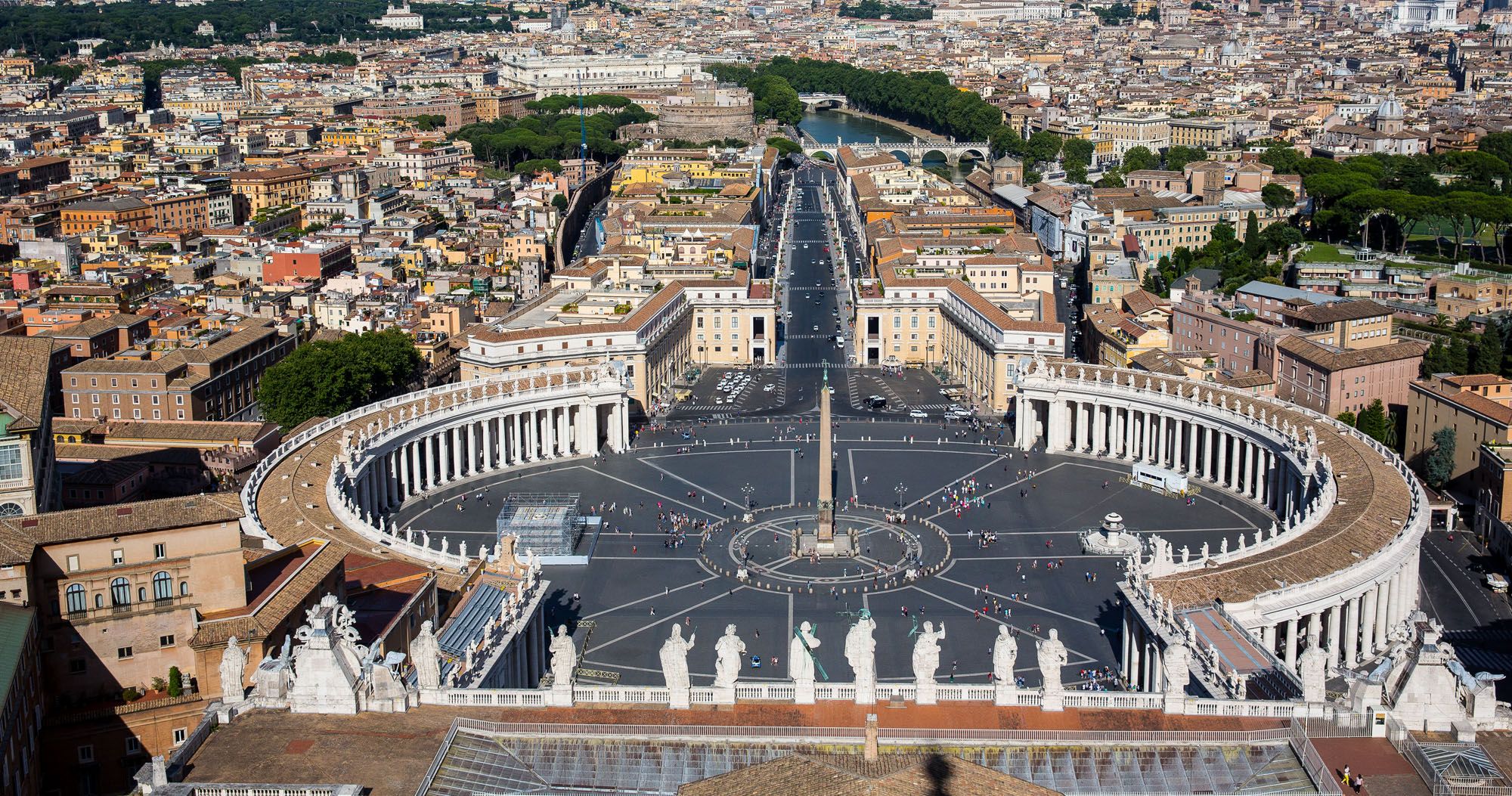
Overlooking St. Peter’s Square from the dome of St. Peter’s Basilica
10:00 am: Brunch at The Loft
After your early start, walk to The Loft, a brunch spot near Vatican City.
They serve eggs, pancakes, waffles, avocado toast, bagels, coffee, and other breakfast and brunch dishes, making this a good place to sit down for a more substantial meal after visiting St. Peter’s.
One reason we like adding brunch here is simply the change of pace. After two sightseeing-heavy days, it’s nice to have a leisurely meal instead of grabbing something quickly on the way to the next attraction.
From The Loft, walk to the Ottaviano Metro station and take the Metro to Flaminio.
11:30 am: Piazza del Popolo & Villa Borghese
From Flaminio, walk through Piazza del Popolo and climb to Terrazza del Pincio, one of the best viewpoints over the square.
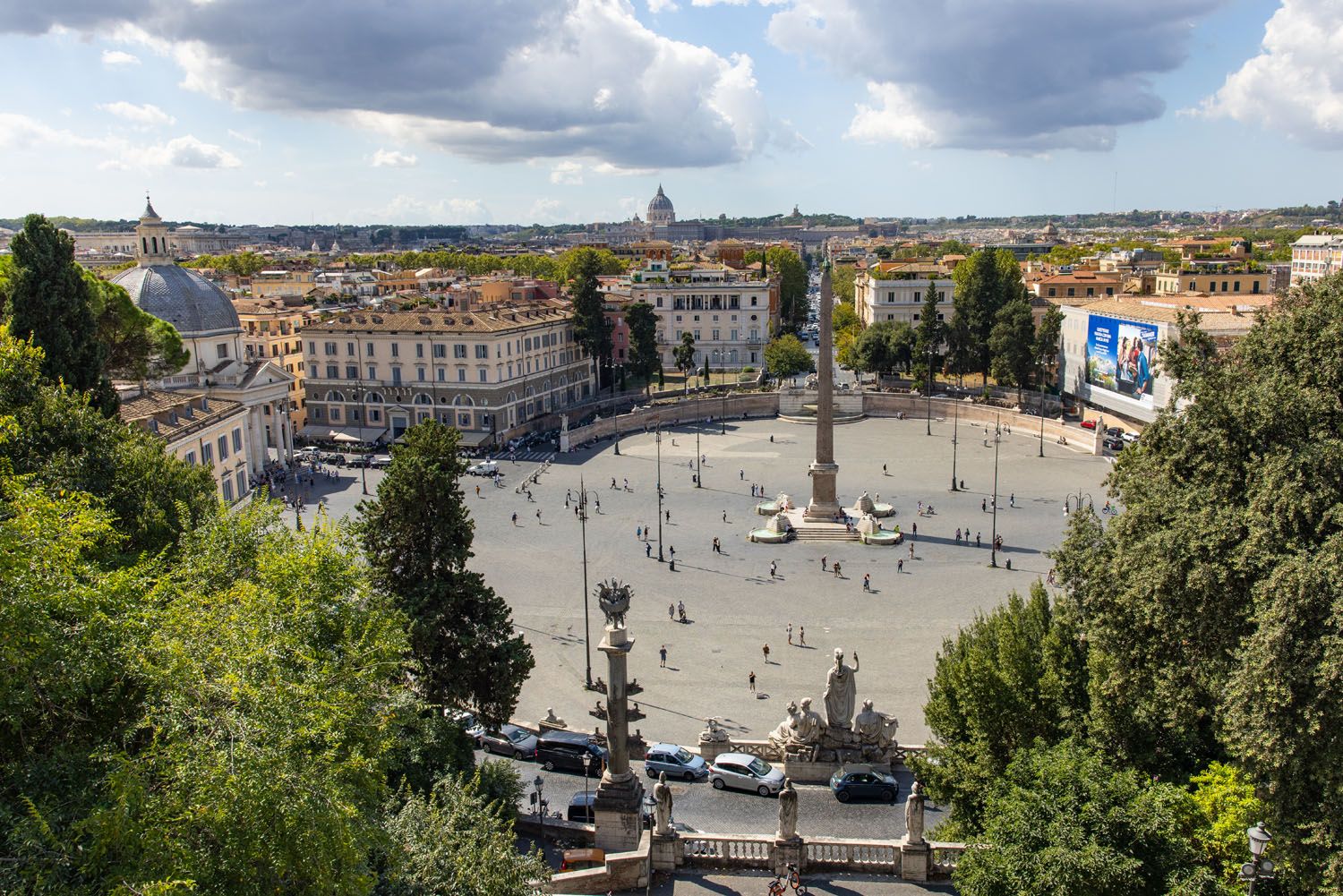
Piazza del Popolo
From here, continue into the Villa Borghese Gardens. This large park is a pleasant break from Rome’s busy streets and makes for an easy walk to the Borghese Gallery.
Give yourself some extra time to wander the gardens, relax on a bench, or simply enjoy a slower part of the day before your museum reservation.
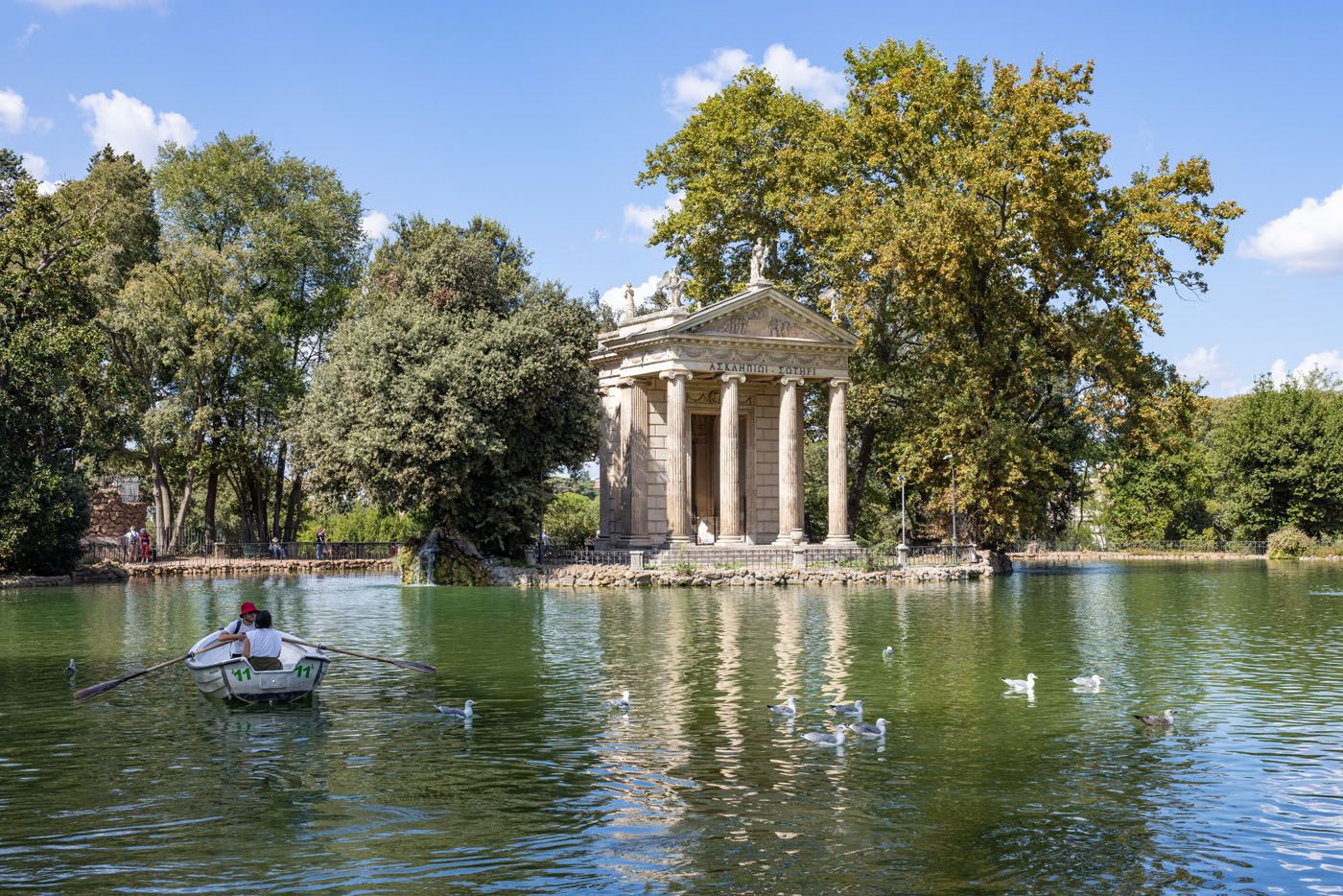
Tempio di Esculapio
3:00 pm: Borghese Gallery
The Borghese Gallery is one of our favorite museums in Rome. Its relatively compact size makes it much easier to visit than the Vatican Museums, yet the collection includes masterpieces by Bernini, Caravaggio, Raphael, and Titian.
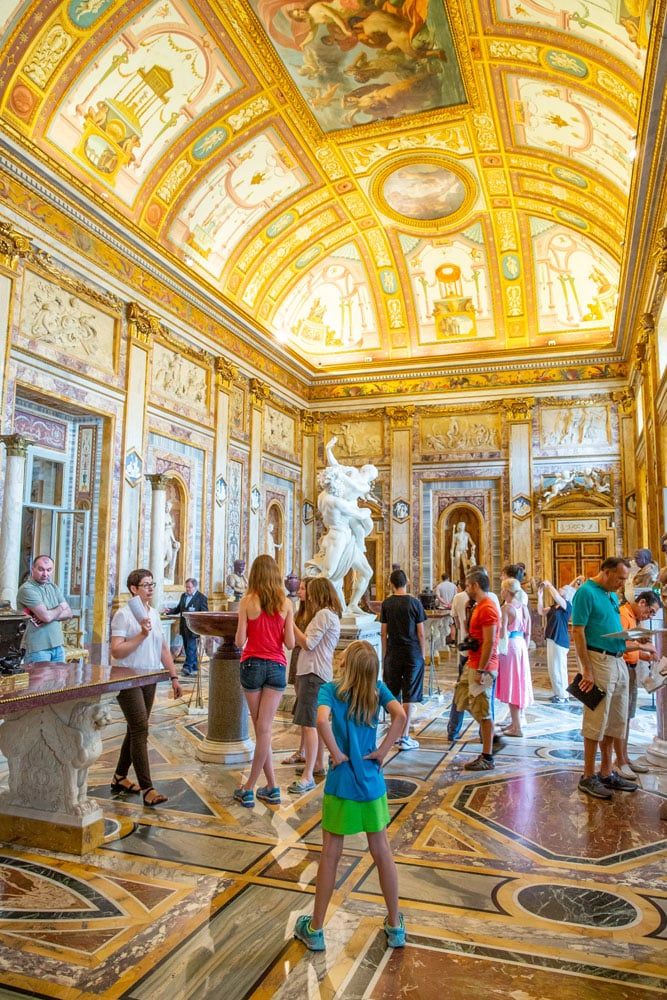
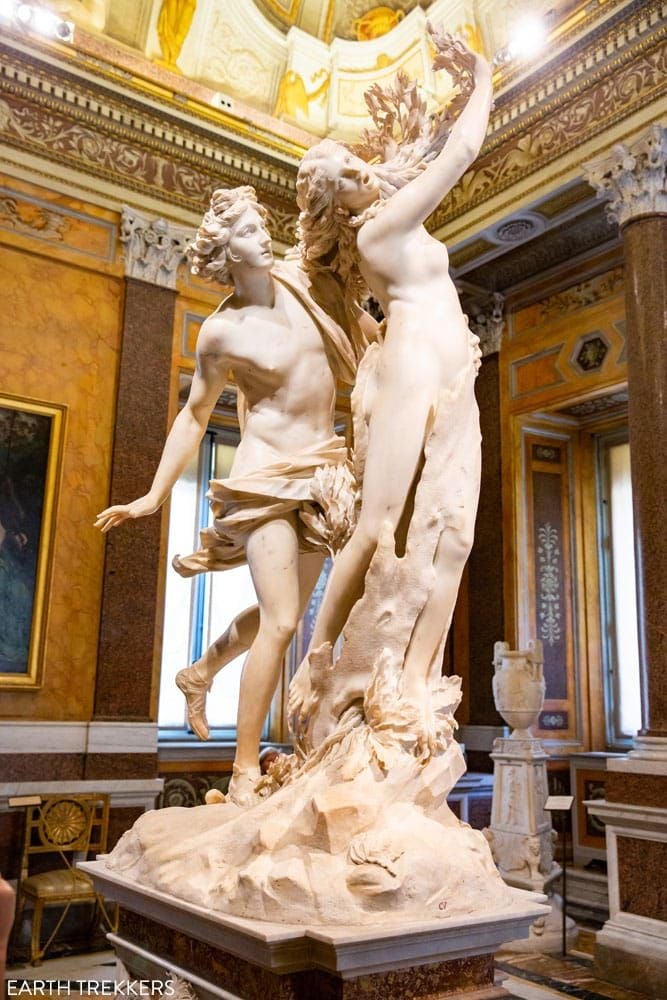
Reservations are mandatory, so book your time slot before your trip. Plan on spending about 2 hours inside. If you are unable to get a ticket on the official website, GetYourGuide is a good backup option.
Even if you don’t normally spend much time in art museums, we think this one is worth it. The collection is outstanding, the building itself is beautiful, and the timed-entry system keeps the visit relatively manageable.
Collect your tickets a half an hour before your time slot. For a 1 pm reservation, plan on arriving no later than 12:30 pm. If you arrive late, even 5 minutes late, they may turn you away. We saw this happen to other people who arrived late for their reservation.
Afternoon & Evening: Choose Your Experience
After the Borghese Gallery, keep the rest of the day flexible. This is a good opportunity to choose an experience that matches your interests, or simply take a break.
Option 1: Capuchin Crypt
Visit the Capuchin Crypt, one of Rome’s more unusual sights. Beneath the church are several small chapels decorated with the bones of thousands of Capuchin friars.
This is a relatively quick visit and works well if you want to add one more sight without committing to another long afternoon of sightseeing. To get here, it is a 20-minute walk from the Borghese Gallery.
Option 2: Take a Food Tour or Cooking Class
After several days of museums and historical sites, a food tour or cooking class is a fun change of pace.
Learn how to make pasta, pizza, or gelato, or join a food tour through one of Rome’s neighborhoods. This is also a great way to turn dinner into an experience rather than simply choosing another restaurant.
We think food deserves just as much attention as sightseeing in Italy, so if you have four days in Rome, this is one of our favorite ways to spend an evening.
This highly rated street food tour takes visitors through Trastavere.
Or take a food and wine tour of Trastevere or this food and wine tour also includes a visit to a market.
In this cooking class, learn how to make authentic pasta and pizza, taste limoncello and tiramisu, and enjoy unlimited red wine.
Option 3: Take the Rest of the Day Off
Four days in Rome gives you the luxury of not filling every hour.
Head back to your hotel, do some shopping, sit at a café, revisit a favorite neighborhood, or enjoy a long aperitivo before dinner. After two very full days and an early morning at St. Peter’s, having a few unscheduled hours can feel pretty wonderful.
Evening: Dinner
If you aren’t getting tired of rooftop bars yet, we have a few more recommendations. Just a short walk from Piazza del Popolo is Terrazza Nainer. A little farther away is AcquaRoof Terrazza Molinari. This rooftop bar and restaurant serves amazing pasta dishes.
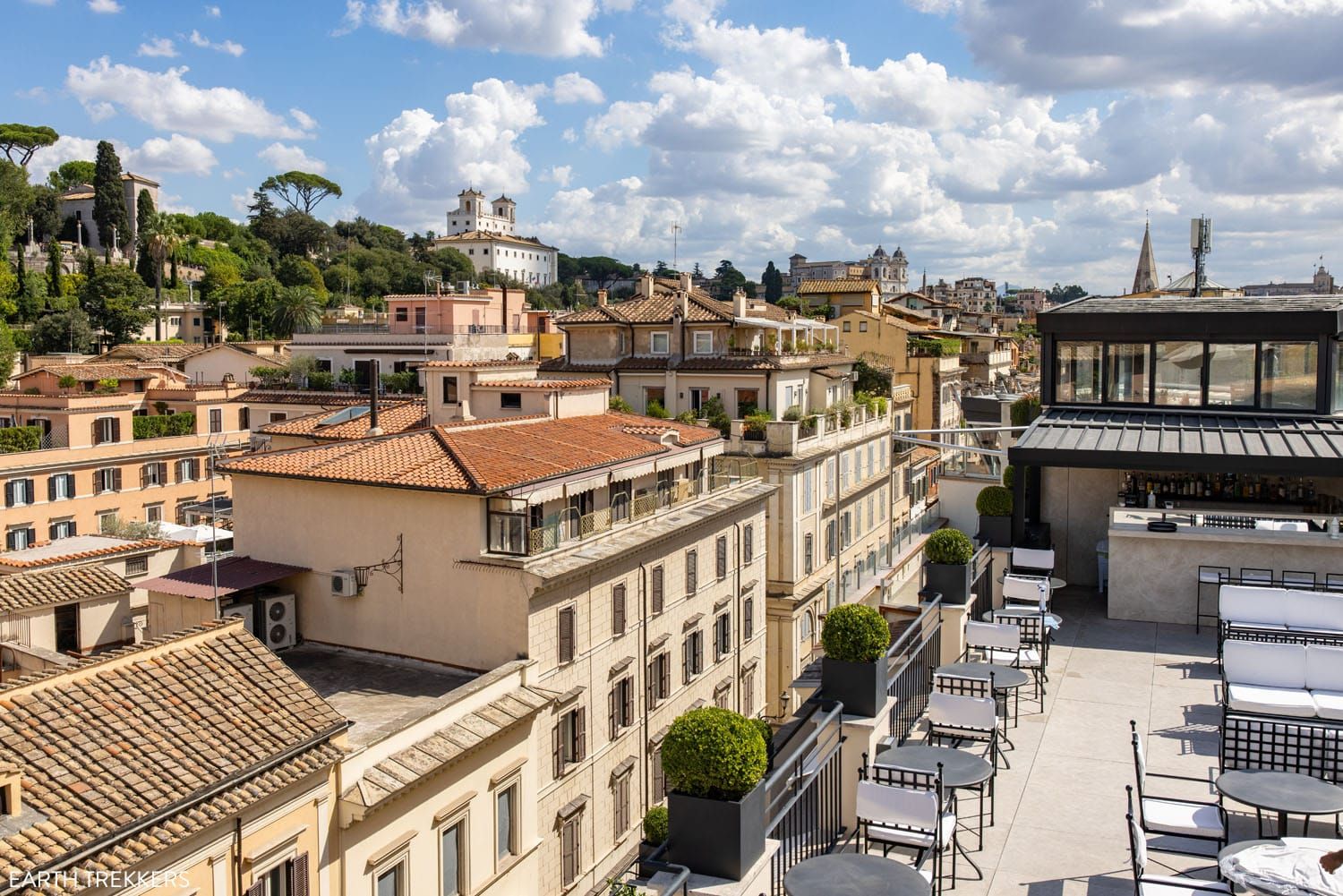
Terrazza Nainer
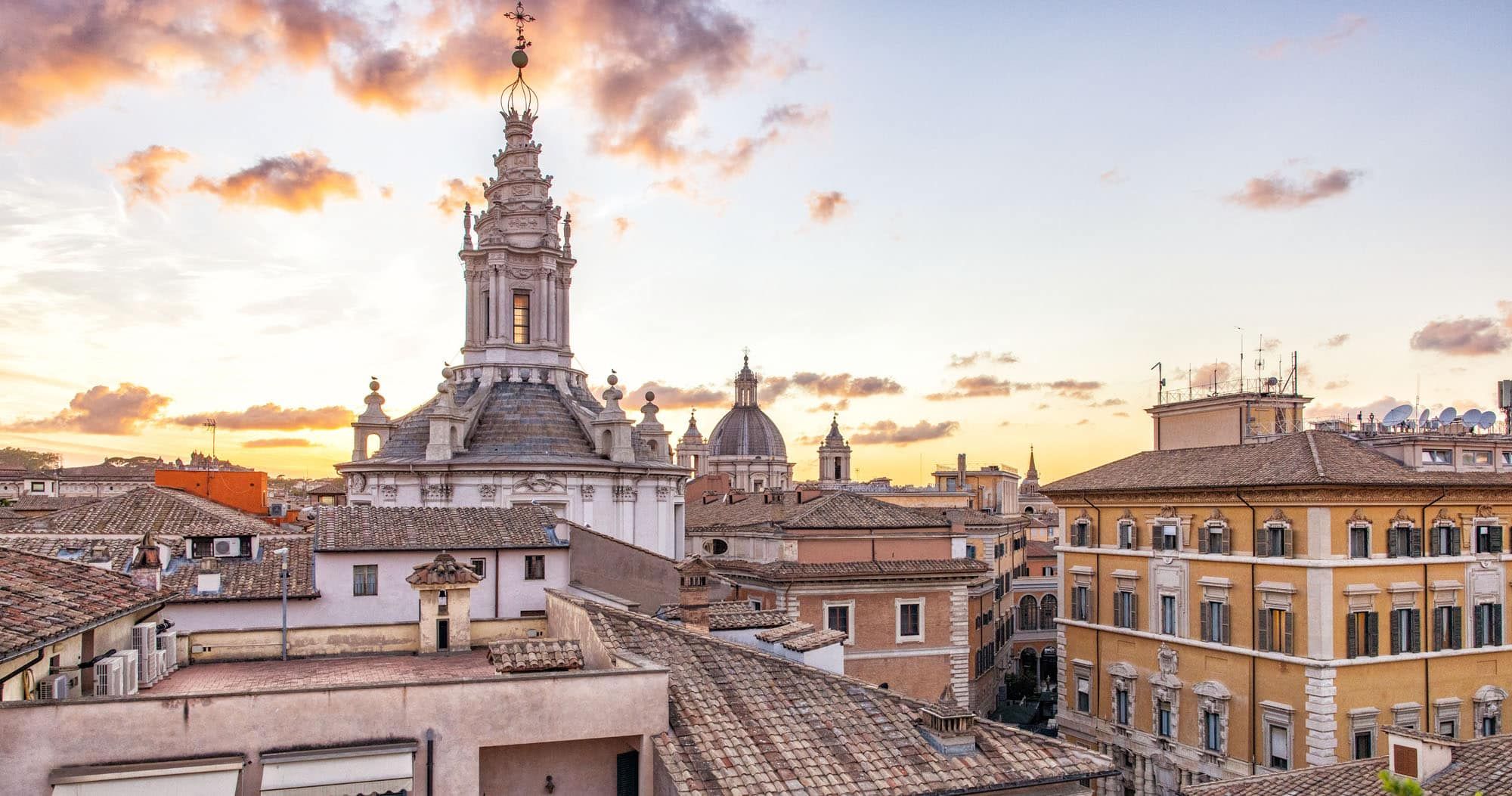
Another recommendation is Divinity Restaurant & Lounge, which is near the Pantheon. They have an outdoor terrace where you can have an aperitif and they also have an outdoor restaurant. The food and drinks are great and here is the view at sunset (the view from Divinity Restaurant is also the header photo for this itinerary):
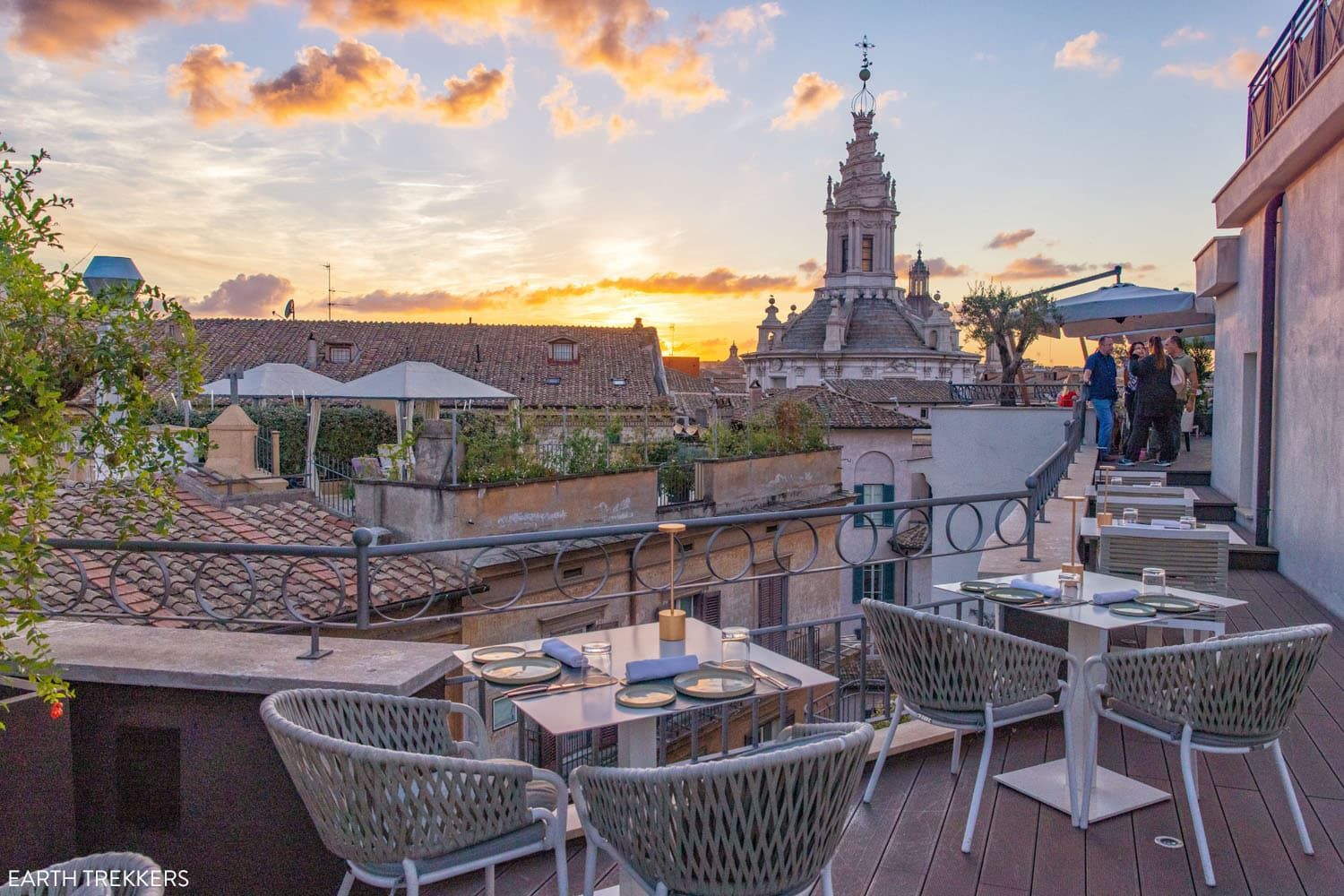
Divinity Restaurant & Lounge
Day 4: Appian Way, Catacombs & Choose Your Experience
Start your final day in Rome on the Appian Way, cycling or walking along one of the oldest roads in the Roman Empire and visiting the Catacombs.
In the afternoon, choose the part of Rome that interests you most. You can spend a few hours visiting some of the city’s most important cathedrals, explore Aventine Hill and several of our favorite photo spots, or tour Domus Aurea for a deeper look at Ancient Rome.
This day is intentionally flexible. By now, you’ve already seen Rome’s major sights, so use the afternoon to focus on the places and experiences that best match your interests.
Morning: The Appian Way & the Catacombs
The Appian Way is an ancient Roman road that was built to connect Rome to Brindisi. Many monuments lie along this road, including the Circus of Maxentius and numerous catacombs.
If you are visiting Rome with kids, this is one of the best things to do in Rome.
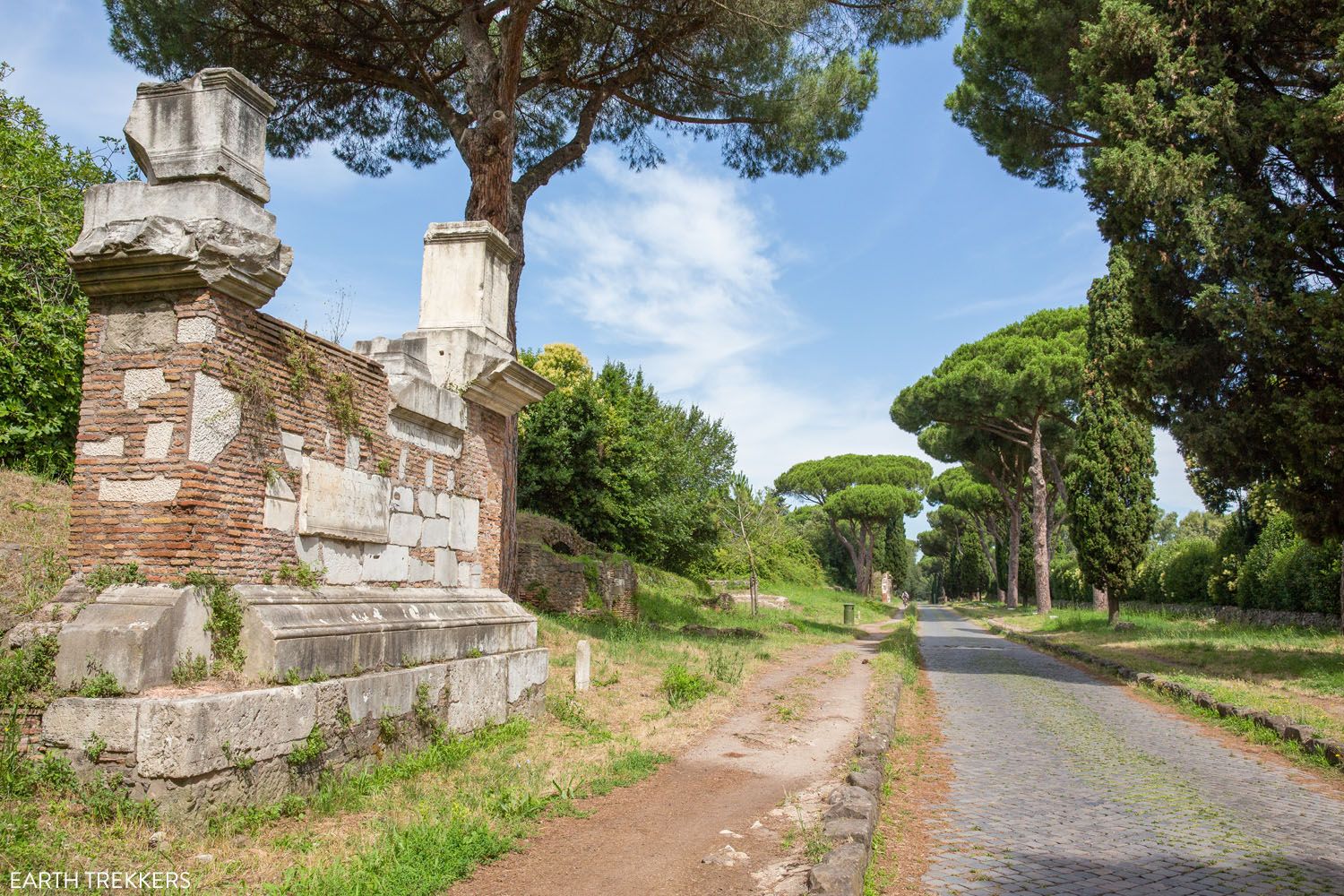
Appian Way
To visit the Appian Way, you can either rent bikes and cycle the road on your own or take a tour. Many tours use e-bikes and include a visit to the catacombs.We took the bus to the Appian Way, rented bikes at a small shop (Appia Antica Caffe), and cycled the road on our own, ending the morning with a visit to San Sebastian Catacombs. This takes about 3 hours, so if you get started at 9 am, you will finish around 12:00 pm. To learn how to do this on your own, take a look at our article about the Appian Way.
Joining a tour takes out a lot of the hassle of getting to and from the Appian Way (we used a combination of the metro and bus to get here). Plus, you get to tour the catacombs with a guide, so you’ll get the most out of your visit.
Here are several of the highest rated tours of the Appian Way and Catacombs. Some take 3 hours and there is one on this list that takes 6 hours. If you plan to visit the Borghese Gallery, take a shorter tour so you have enough time to also visit the Borghese.
Appian Way Tours
Afternoon: Choose Your Experience
Option #1: A Tour of Rome’s Cathedrals
This walking tour takes you to some of Rome’s oldest and grandest cathedrals. Some cathedrals close midday. We have provided the links to each one so you can get updated hours and pricing before your visit.
This walking route is 3.3 km/2 miles point-to-point. It starts at the Termini metro station and ends at the San Giovanni metro station. From the Termini metro station, it takes 3 minutes to walk to Santa Maria Maggiore.
Santa Maria Maggiore
This is the largest Catholic Marian church in Rome and a Major Papal Basilica. Things to see include the coffered ceiling (the gold on the ceiling was brought by Christopher Columbus to Ferdinand and Isabella), the Salus Populi Romani, the Crypt of the Nativity (which contains wood from the crib of Jesus Christ), and mosaics. Get hours here.
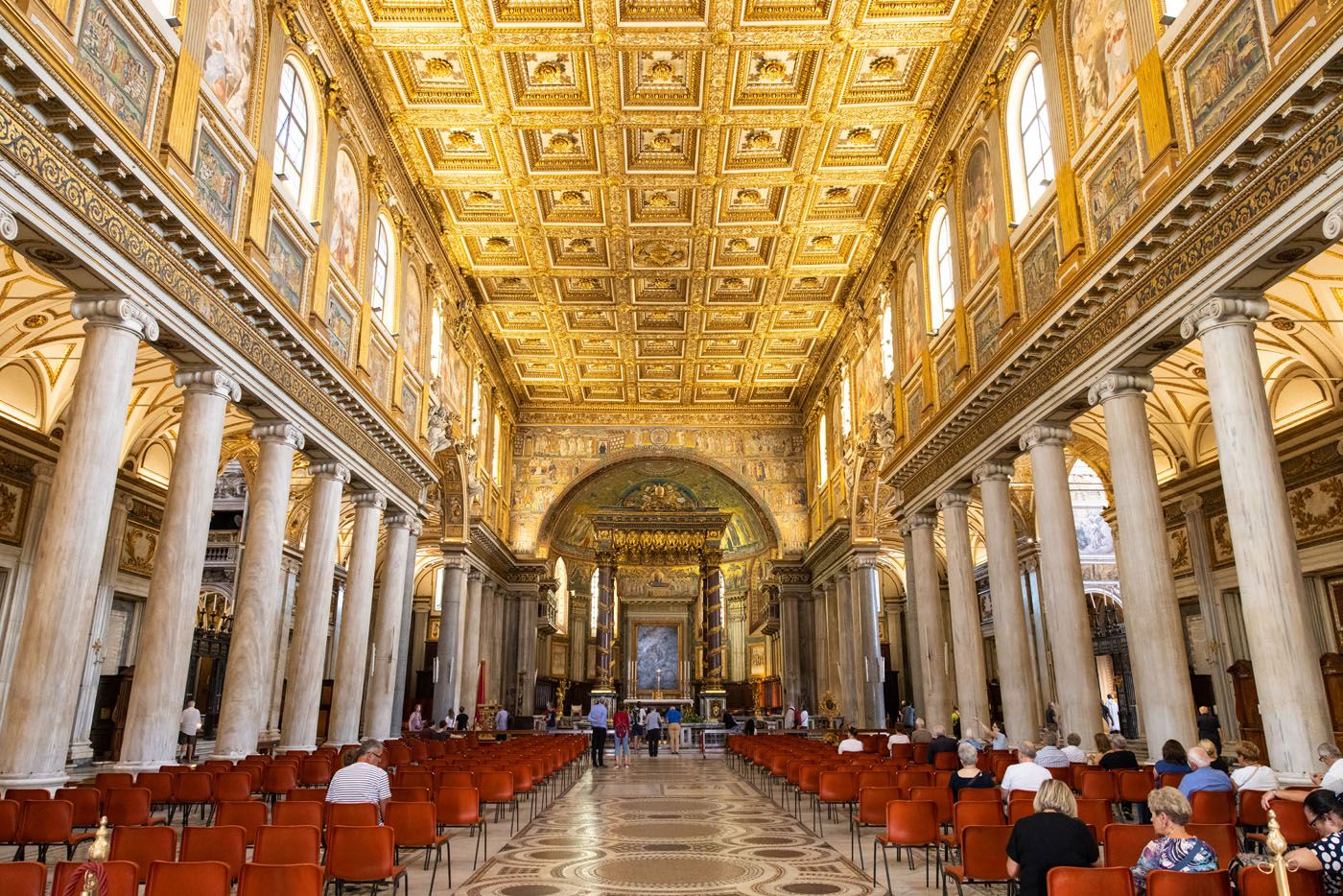
Santa Maria Maggiore
Basilica of San Pietro in Vincoli
It is a 10-minute walk from Santa Maria Maggiore to San Pietro in Vincoli. This church is famous for Michelangelo’s statue of Moses and a reliquary containing the chains of St. Peter. Get hours here (this basilica is closed midday).
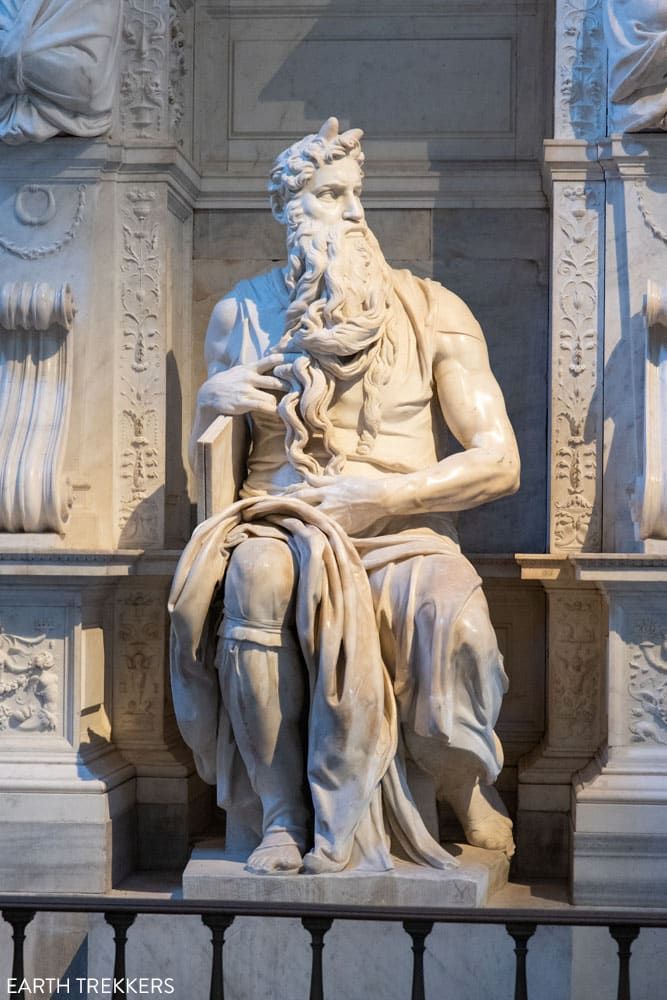
Moses by Michelangelo
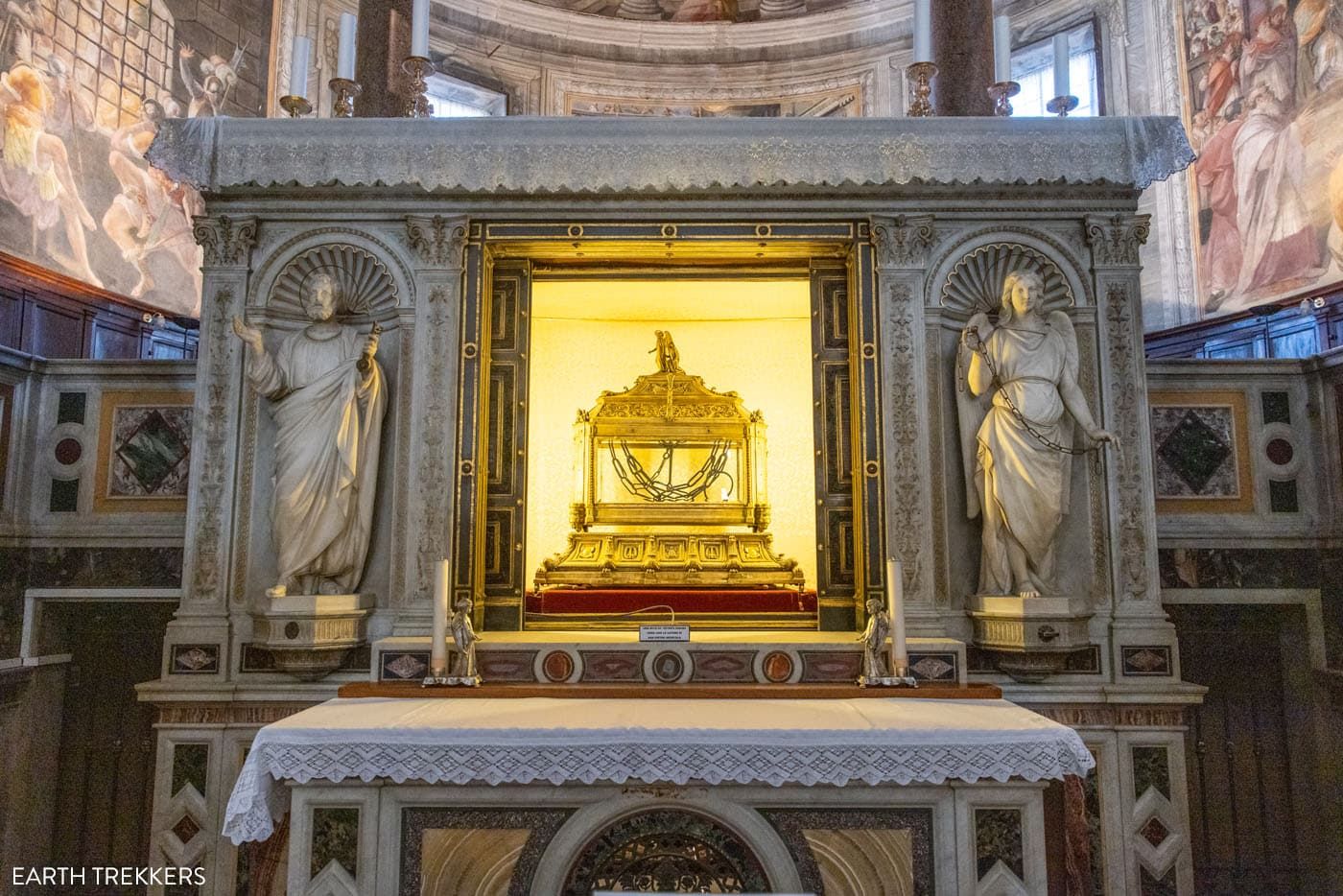
The chains of St. Peter
Colosseum
Next, you will walk past the Colosseum on the way to the next place to visit, the Basilica of San Clemente.
Basilica of San Clemente
The Basilica of San Clemente is famous for its three-tiered design: a present-day church that sits atop two much older churches. The oldest church, which is now underground, dates back to the first century. The spring that runs through this church also runs to the Colosseum. Get hours and pricing on the official website.
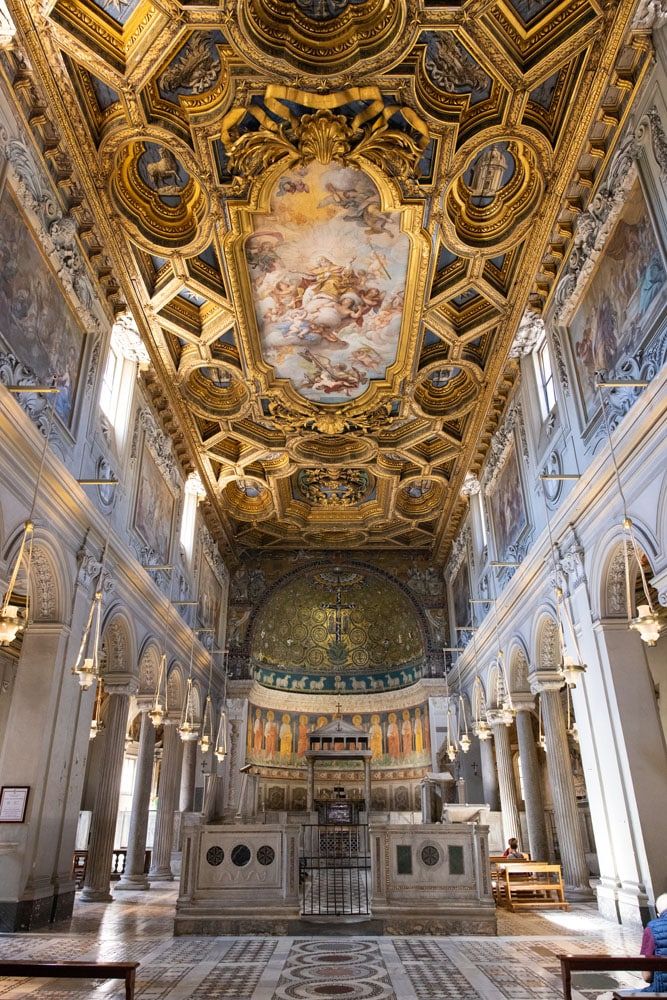
Basilica of St. Clemente
Scala Sancta
The Scala Sancta, or Holy Stairs, is a staircase of 28 marble steps that lead to the Sancta Sanctorum (Holy of Holies). The Sancta Sanctorum is the first private Papal chapel. It is believed that Jesus Christ climbed these same stairs several times a day while imprisoned in Pontius Pilate’s palace in Jerusalem. The stairs were later relocated to this site in Rome.
At the top of the Holy Stairs is the Sancta Sanctorum. You can get a peek of it through the window or spend a few euros for a ticket to enter the chapel, which is well worth it. This small chapel is covered in colorful mosaics and a beautiful place to visit.
Get hours and pricing on the official website.
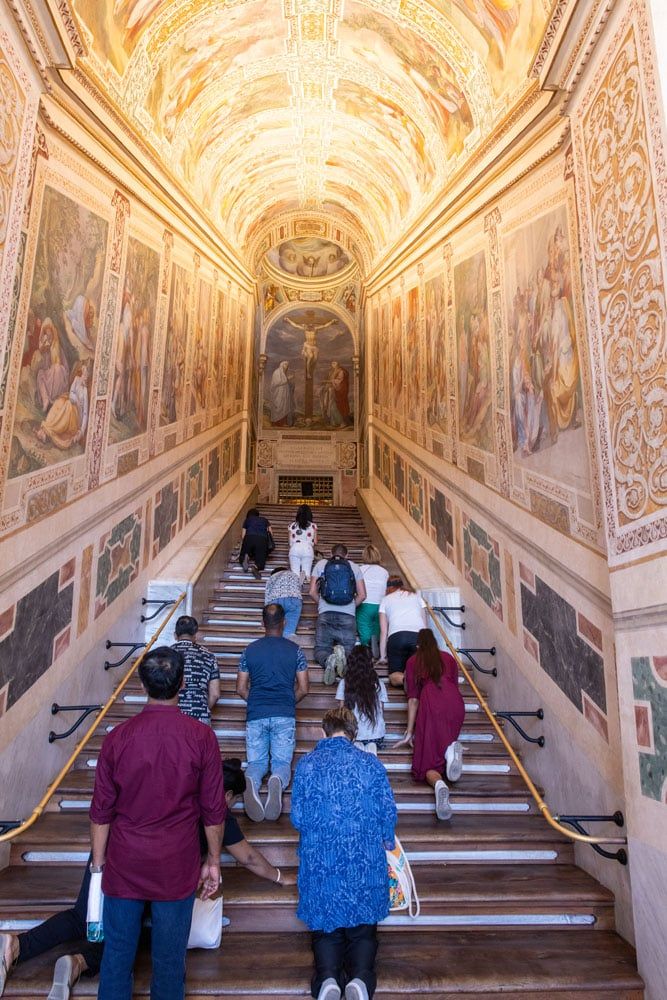
Scala Sancta
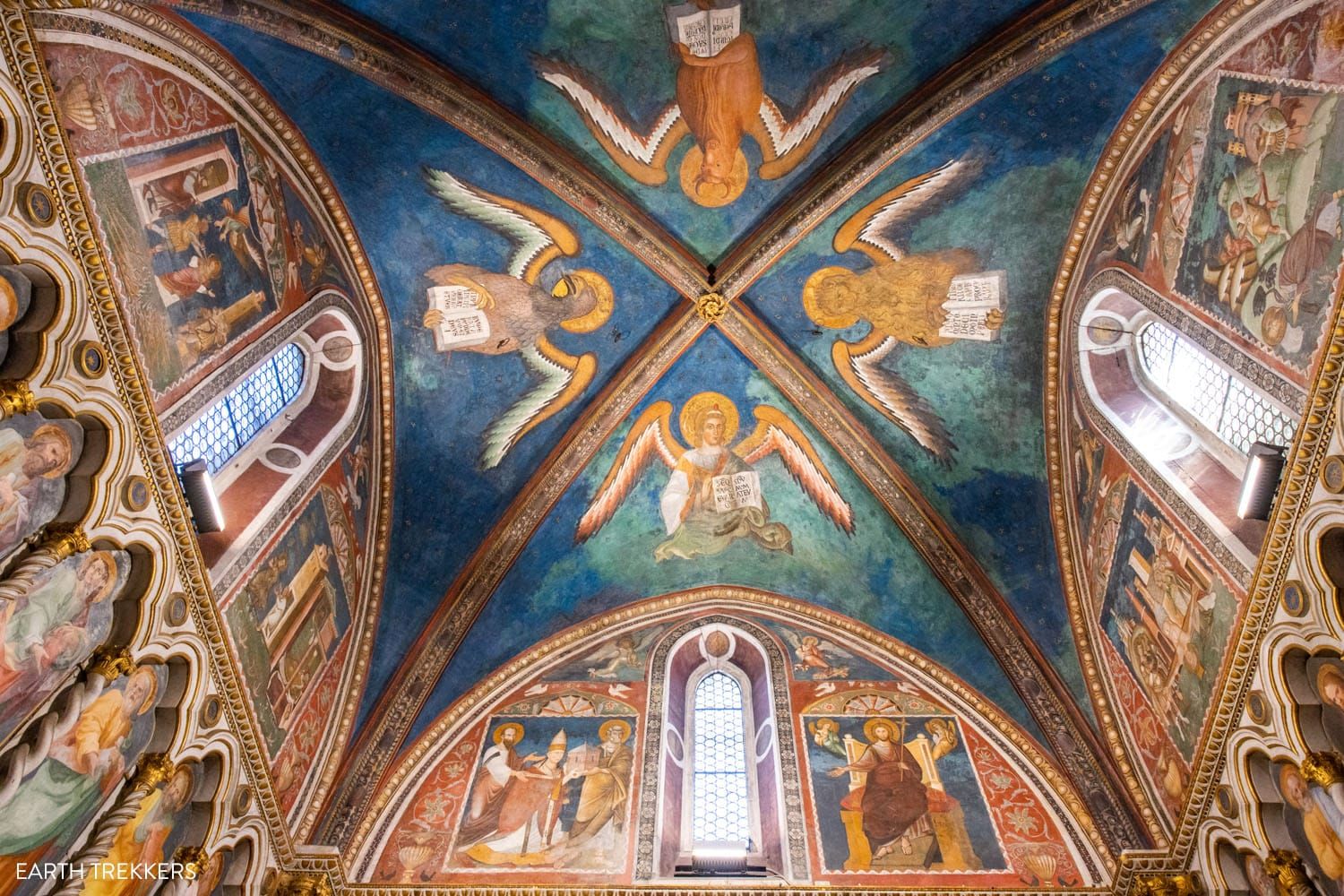
Ceiling of the Sancta Sanctorum
Basilica of Saint John Lateran
This basilica, which is across the street from Scala Sancta, was founded in 324 AD, making it the oldest basilica in the Western world. It is also the Pope’s official seat. A visit here is free, but for a few more euros, you can visit the cloister and monastery, which is well worth it.
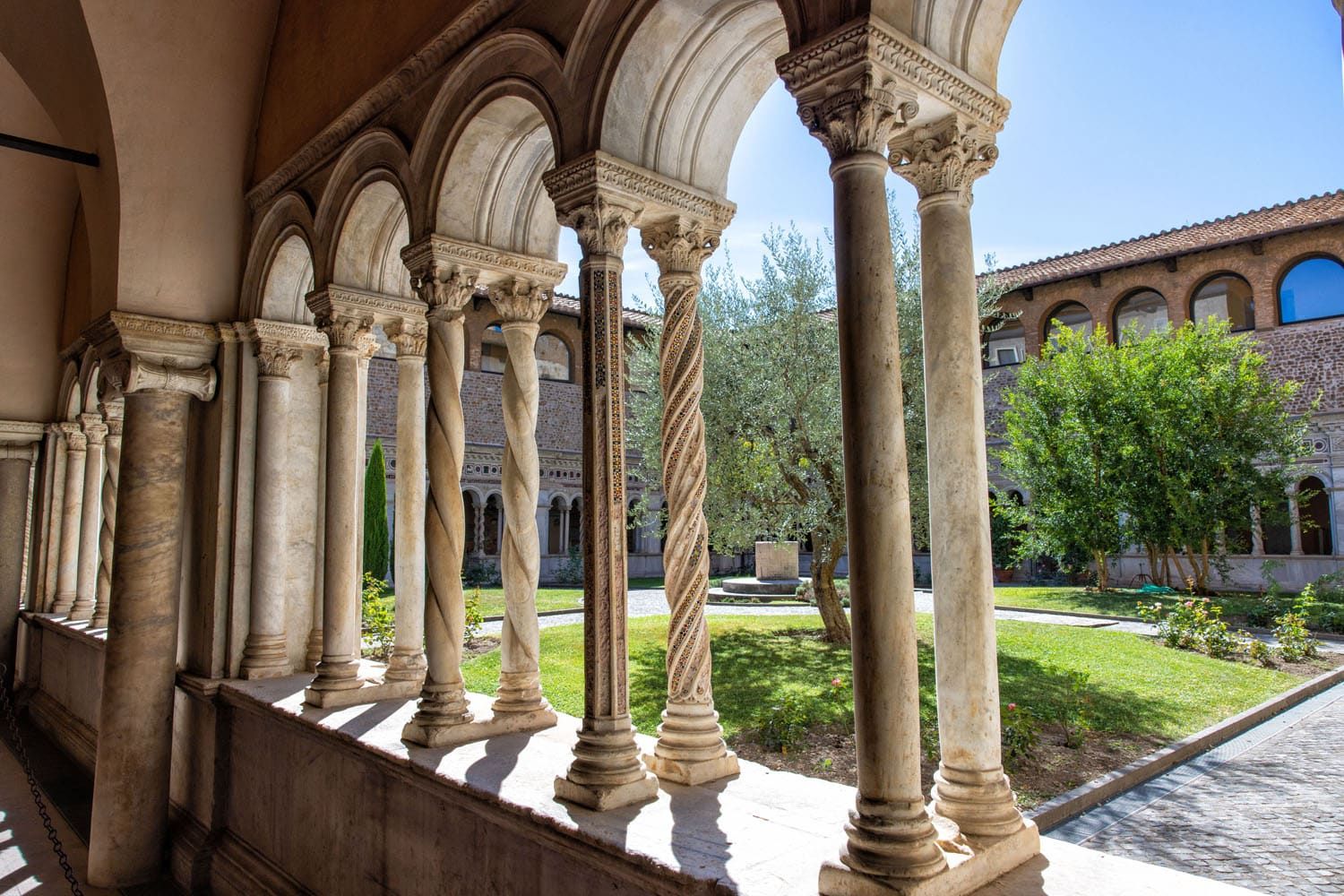
Cloister of Saint John Lateran
Option #2: Aventine Hill, Jewish Ghetto & Mouth of Truth
This half day itinerary takes you to some interesting, off the beaten path destinations. This point-to-point walk is 3.2 km/2 miles. It starts on Aventine Hill and ends at the Spada Gallery.
Knights of Malta Keyhole
This keyhole is famous for its view of the dome of St. Peter’s Basilica. There is usually a short line to look through this keyhole. When we did this, a black bar sat across the keyhole, obstructing most of the view. So, before you go, just be aware that you may not get the same great view that you have seen online or on Instagram.
It is free to visit and plan on spending about 15 minutes in line.
View from the Orange Garden
From the keyhole, walk through the Orange Garden to a viewpoint called Terrazza Belvedere Aventino. From here, you get a sweeping view of Rome and the Altar of the Fatherland is the main focal point.
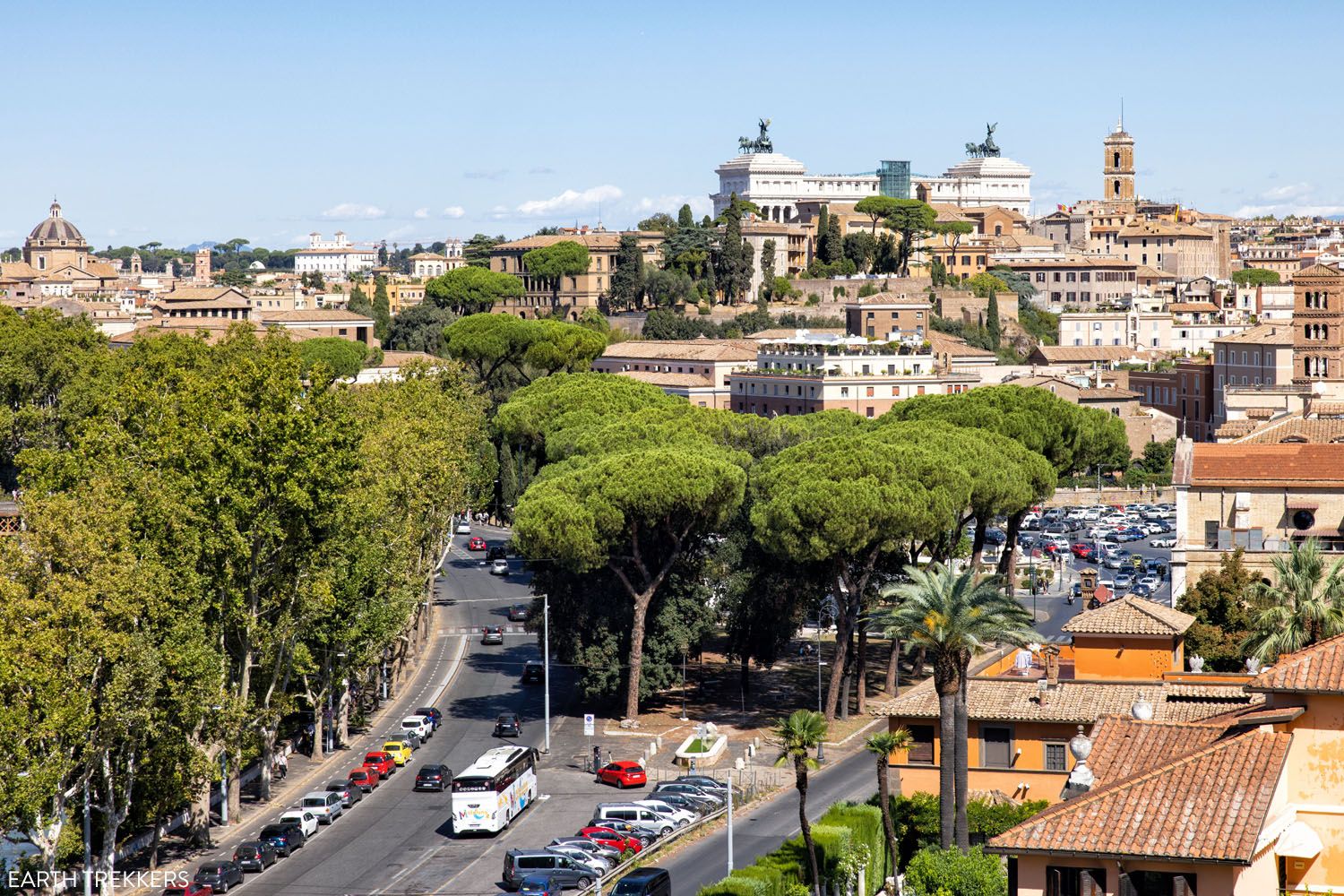
View from the Orange Garden
Bocca della Verita
From the Orange Garden, it is a downhill walk to get to Santa Maria in Cosmedin.
The Mouth of Truth is a marble mask that is located in the portico of the Santa Maria in Cosmedin church. Legend has it that it will bite off the hand of anyone who tells a lie while their hand is inside of the mouth.
After having your photo with the Mouth of Truth, you have the option to enter Santa Maria in Cosmedin. Inside, you can visit the crypt and see the skull of St. Valentine, which sits in a side altar on the left side of the church.
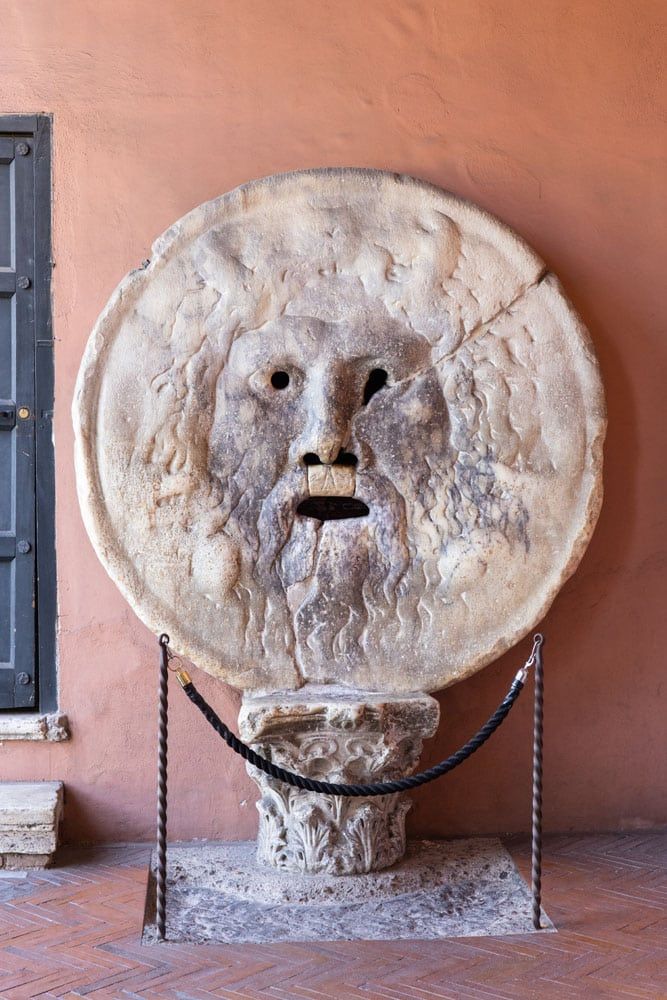
Mouth of Truth
Theatre Marcellus and Porticus Octaviae
From Santa Maria in Cosmedin, it is a 5-minute walk to Theatre Marcellus. This building looks like a smaller version of the Colosseum. It’s older than the Colosseum and could hold up to 20,000 spectators. It has been turned into a palace but you can still see the ancient exterior walls of the theater.
Walk around Theatre Marcellus and take the pathway to Porticus Octaviae, which was built in 27 BC to enclose the temples of Jupitor Stator and Juno Regina. The theatre and the remains of the Porticus are located together and take just a few minutes of your time.
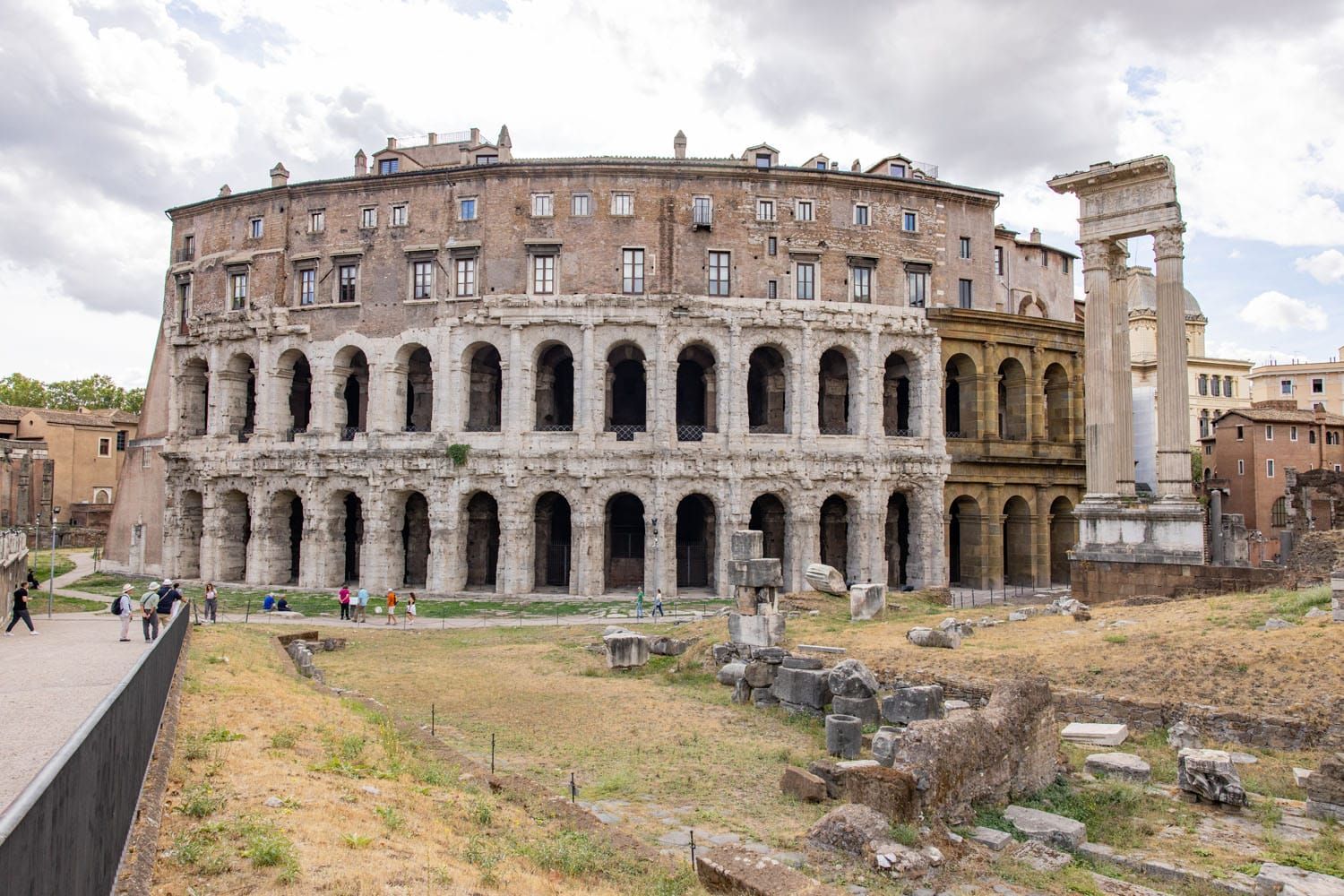
Theatre of Marcellus
Jewish Ghetto
Spend the next 30 to 60 minutes strolling through the Jewish Ghetto. See the Turtle Fountain and the Great Synagogue (Tempio Maggiore di Roma). You can also grab a bite to eat. We had a drink at the bar at Chapter Roma. They have a rooftop bar but it does not open until the evening.
Spada Gallery
Galleria Spada is an art museum that is located inside of Palazzo Spada. This gallery contains four rooms filled with Baroque paintings that were collected by Cardinals Bernardino and Fabrizio Spada. In these rooms, you will see works of art by Titian, Caravaggio, Rubens, and Guido Reni.
The main attraction here is the perspective gallery that was created by Borromini. This is the best place to see an optical illusion in Rome. The colonnaded gallery is only 8 meters (26 feet) long and the statue of Mars is only 60 centimeters (24 inches) high, but they look much larger than this.
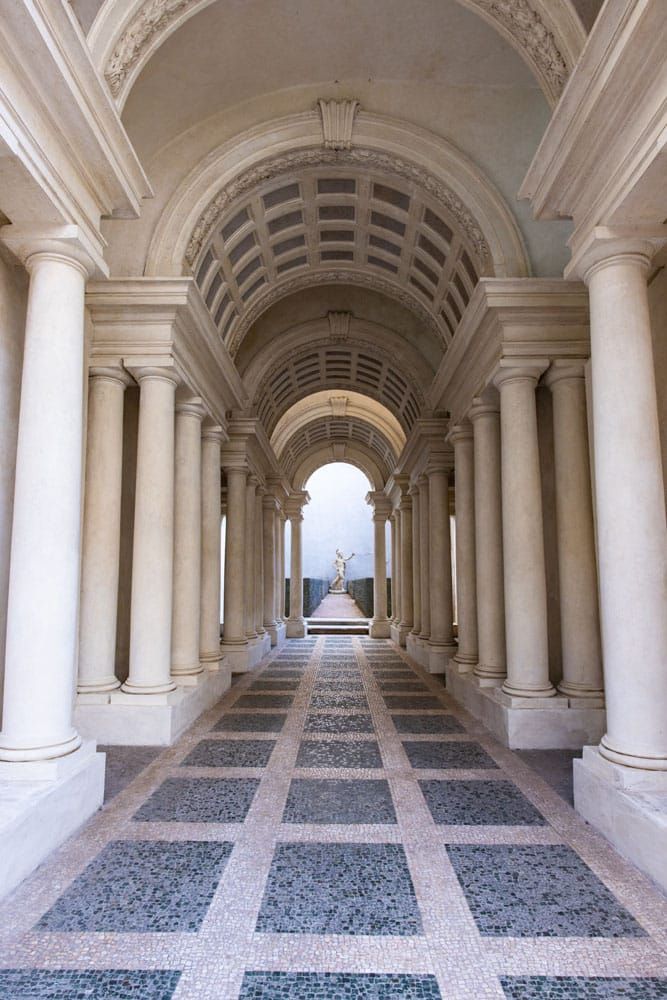
Spada Gallery
Tickets can be bought online or at the palazzo. We purchased our tickets onsite and there were just a few other people here during our visit.
From the Spada Gallery, it is a 3-minute walk to Campo de’Fiori and a 7-minute walk to Piazza Navona. You can also retrace your steps back to the Jewish Ghetto, cross the Tiber River, and then spend a few hours in Trastevere.
Option #3: Domus Aurea
Domus Aurea is massive villa that was built by Emperor Nero. This immense, opulent palace, also called the Golden House, was covered in marble and gold. It had 300 rooms. After Nero’s death, the palace was stripped of its marble and jewels and much of the palace was filled with dirt, which helped preserve it. It is now one of Rome’s most important archaeological sites.
It can only be visited on a small group tour. If this sounds like a place you would like to visit, take a look at the official website for pricing, hours, and information on booking your visit.
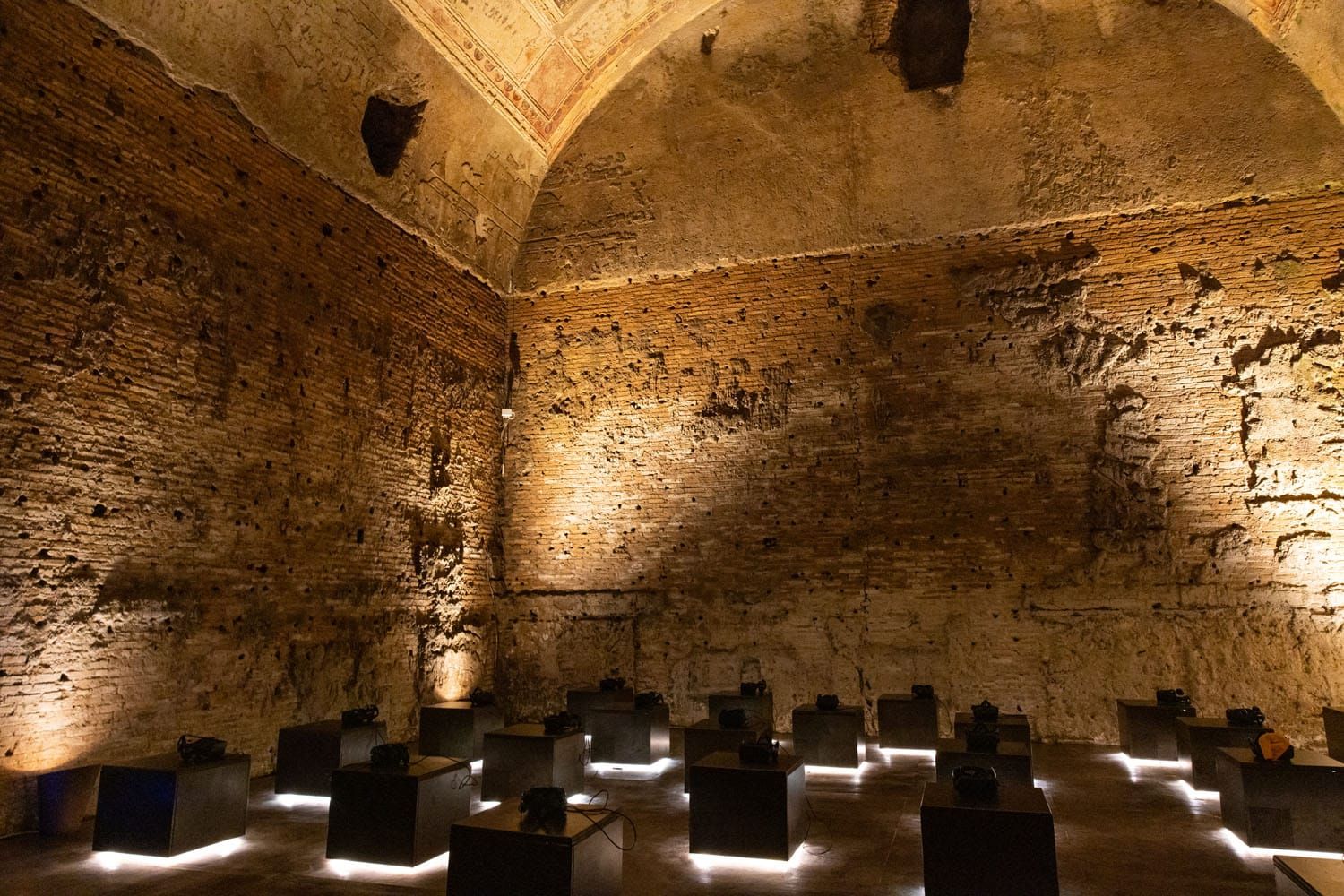
Seating for the Immersive Reality experience in Domus Aurea
Option #4: Colosseum at Night
One of the best ways to visit the Colosseum is on a nighttime tour. It’s a wonderful way to end your visit to Rome. These tours sell out far in advance since spots are limited and this is a very popular thing to do.
Are the Travel Passes Worth It?
There are several different travel passes in Rome, including the Roma Pass, the Omnia Card, and the Turbo Pass. Of the three passes, the Roma Pass is best for this itinerary. The Roma Pass is the cheapest of the three (the Omnia Card and Turbo Pass are expensive and cover a lot of sites not listed in this itinerary, so you won’t get your money’s worth).
The 3 day Roma Pass costs €62.90. It also covers a long list of sites that are not in our itinerary, but it does cover the Borghese Gallery, Spada Gallery, the Capitoline Museums, and the Colosseum and Roman Forum. The first two sites you visit are free and then the remainder get a discount. You also get free use of the public transportation. The savings are minimal and with the Roma Pass, you still have to make your Colosseum reservation in advance (if Colosseum tickets are sold out, you will then have to offer a tour, so the Roma Pass is of no benefit in this situation). We don’t think it is worth it, but you can learn more about it on the official website.
How to Get Around Rome
The majority of the must-see sights in Rome are located in central Rome. It’s possible to get around mainly by walking, but you can save your steps, and a little bit of time, by also using the Rome metro or taking a taxi.
Taxi stands are set up throughout the city. On Google Maps, you can search “taxi stand” for the ones closest to your location. Then you get in the taxi first in line and tell them your next destination. We frequently do this and in 2022, every taxi we took used credit cards (but it is good to have some cash on hand as a back up). To tip the taxi driver, we added on 1 to 2 euros to the fare.
You can also use Uber but we ended up spending a lot of time waiting for the Uber to arrive and figured out it was quicker to walk to the closest taxi stand.
The metro is fast, cheap, and easy to use. It’s a lot more economical than a taxi. Just beware of pick pockets on the metro and in other crowded places throughout Rome.
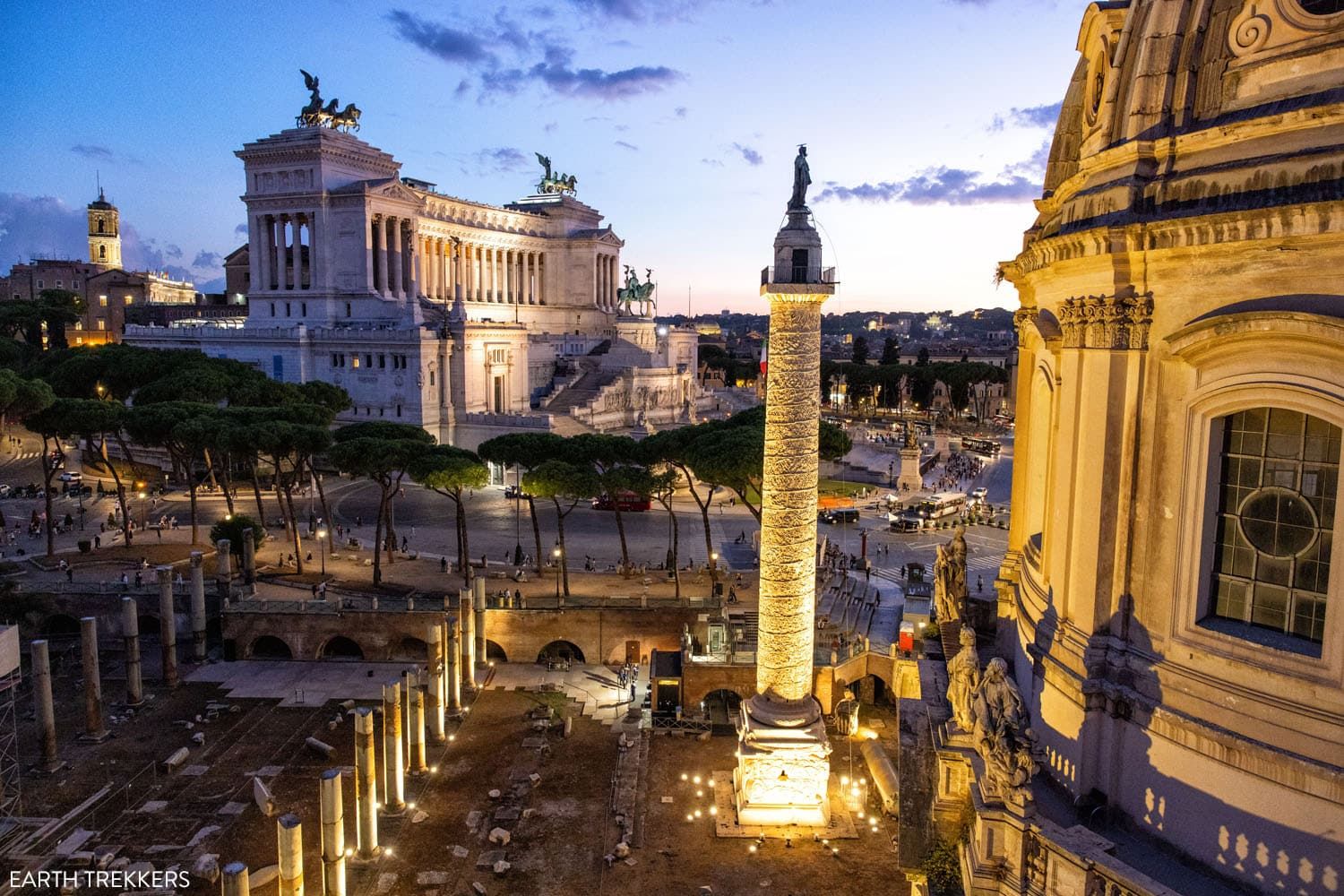
The view from Oro Bistrot in the evening
Best Time to Visit Rome
Spring and fall are the best times of the year to visit Rome. During this time, the weather is great for sightseeing and crowds tend to be lower than the busy summer months. But here is a breakdown by season of what you can expect in Rome:
WINTER: It’s chilly in Rome during the winter months. Daytime high’s average around 13°C (55°F) and it is a little colder at night. Rainfall is slightly above average for the year (averaging about 7 days of rain per month in December, January, and February).
SPRING: In early spring, the high temperature is 17°C (62°F) and it continues to get warmer week by week, reaching an average high of 29°C (85°F) by June. Rainfall chances go down the closer you get to the summer months. May and June have warm weather and lower chances of rain than the fall and winter months.
SUMMER: Expect the biggest crowds of the year and hot weather during the summer months. Daily high temperatures average 32°C (90°F) but they can easily get up to 35°C (95°F). Rainfall is the lowest of the year. If you plan to visit in the summer months, make your hotel reservations far in advance as well as your entrance tickets into the museums.
FALL: In early fall, crowds can still be high, not really quieting down until the end of October. Daytime high’s range from 27°C (80°F) in early fall and cooling off to 17°C (62°F) by late fall. Autumn is the wettest time to visit Rome (mid-September through early December with rainfall peaking in November), so bring an umbrella if you plan to be here at this time.
Where to Stay in Rome
For recommendations on where to stay, read our article on the Best Places to Stay in Rome. Learn where to stay for a great view of the Colosseum and Piazza Navona and get recommendations whether you are looking for a budget hotel, luxury hotel, or if you are traveling as a family.
Where to Eat in Rome
We listed several recommendations in this itinerary, but for a bigger list of recommended restaurants, take a look at our Rome Restaurant Guide. And for rooftop bars, take a look at our guide about the Rome Rooftop Bars.
Where Are You Going Next?
If you are just beginning to plan your Italy itinerary, take a look at our 10 Days in Italy Itinerary for five different ways to spend 10 days in Italy. We also have a detailed 10 day itinerary that includes Rome, Florence, the Cinque Terre, and Venice.
For those with more time, check out our 14 day Italy itinerary, which covers the highlights of Italy.
On this 10 day southern Italy itinerary, visit the Amalfi Coast, Castelmezzano, Matera, Alberobello, and more towns in Puglia.
If you have any questions about this 4 days in Rome itinerary, let us know in the comment section below.
Plan Your Trip to Italy
We have TONS more information about Italy in our Italy Travel Guide, including Rome, Florence, Venice, Tuscany, the Dolomites, the Amalfi Coast, the Cinque Terre, Basilicata, Sicily, and Puglia.
30 Things to Do in Rome | The Ultimate Rome Bucket List
Pinterest Facebook Flipboard Rome is the capital city of Italy and one of the largest cities in Europe. With its long, rich history, famous landmarks, museums and archaeological sites, the to-do list for visitors is enormous. 30 things to do in Rome sounds like a lot, and it is, but there are many more places […]
How to Visit the Vatican Museums & St. Peter’s Basilica in 2026
A visit to Vatican City is one of the highlights of a trip to Rome, but it’s also one of the trickiest parts to plan. We learned this the hard way on our first visit. We visited the Vatican Museums in July, midday, with our kids. We had tickets, so getting in was easy, but […]
7 Best Rooftop Bars in Rome with Amazing Sunset Views
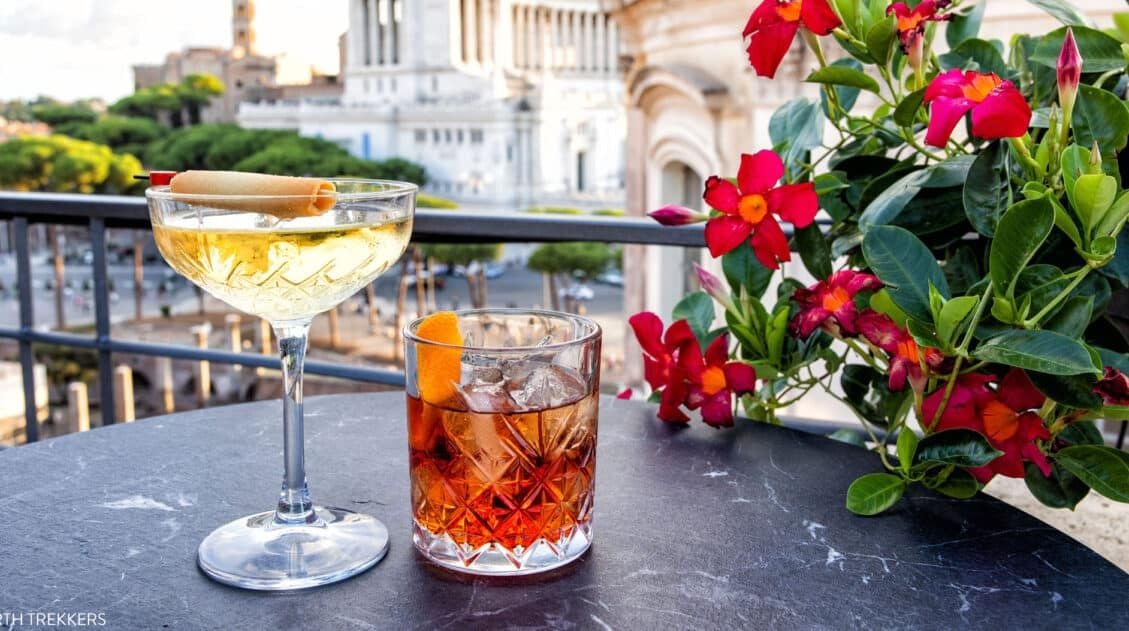
Drinks with a view…one of the best things to do in Rome is to visit a rooftop bar. Sipping on a cocktail or a glass of wine is the perfect way to wind down after a day of sightseeing, and from a rooftop bar, you also get to enjoy the view. In this guide, we […]
One Day in Rome: 3 Unique Ways to Plan Your Itinerary
If you are planning to spend one day in Rome, there are several ways you can do it. Do you want to spend the day visiting the highlights of Rome, including the Colosseum, Roman Forum, Vatican, and historic heart of Rome? With proper planning, you can do this ambitious itinerary, but it will be an […]
2 Days in Rome: Our Itinerary for First-Time Visitors
With 2 days in Rome, you have just enough time to visit the city’s biggest sights, including the Colosseum, Roman Forum, Vatican Museums, St. Peter’s Basilica, Trevi Fountain, and Pantheon. This itinerary is designed for first-time visitors who want to see the highlights without wasting time crisscrossing the city. Day 1 focuses on Ancient Rome […]
How to Spend 3 Days in Rome: A Realistic Itinerary
Visit the Colosseum, stroll through the historic heart of Rome, tour the Vatican Museums, climb to the top of the dome on St. Peters’ Basilica, cycle the Appian Way, have an aperitivo with a spectacular view of Rome, dine on gelato and pizza by the slice…these are all things you can with 3 days in […]
Where to Stay in Rome for the First Time (+ Where NOT to Stay)
If you are trying to decide where to stay in Rome for the first time, you have a lot of options. Do you want to stay in the heart of Rome and easily walk to the city’s top sights? How about a romantic apartment tucked away in a charming neighborhood? Or a hotel with a […]
25 Best Places to Visit in Italy
After six trips to Italy, these are the 25 places to visit in Italy we keep recommending — the ones that reward first-timers and repeat visitors alike, from the iconic cities of Rome and Florence to lesser-known gems like Matera and Puglia. We’ve been to Italy six times over the past ten years, and we’re […]
Italy Travel Guide: How to Plan a Trip to Italy
Italy Travel Guide From the ruins of ancient Rome to the hiking trails of the Dolomites, the trulli of Puglia to the hilltop villages of Tuscany, Italy is a country that rewards every kind of traveler, and keeps pulling you back. We’ve traveled to Italy six times, exploring the country from the lakes and mountains […]
2 Days in Florence: Detailed Day-by-Day Itinerary
Two days in Florence is the sweet spot for a first visit. It’s enough time to see everything that matters, without the feeling that you’re sprinting from one landmark to the next. With two days, you can climb the dome of the Florence Cathedral, stand in front of Michelangelo’s David, spend a proper morning in […]
24 Best Things to Do in Tuscany, Italy: Cities, Hill Towns & Hidden Gems
From world-famous cities like Florence and Siena to quiet hill towns and scenic drives through vineyard-covered hills, Tuscany offers a wide range of experiences, but deciding what to do (and what to skip) can be overwhelming. We’ve explored Tuscany on two very different trips: a one-week highlights tour with our kids and a longer 10-day […]
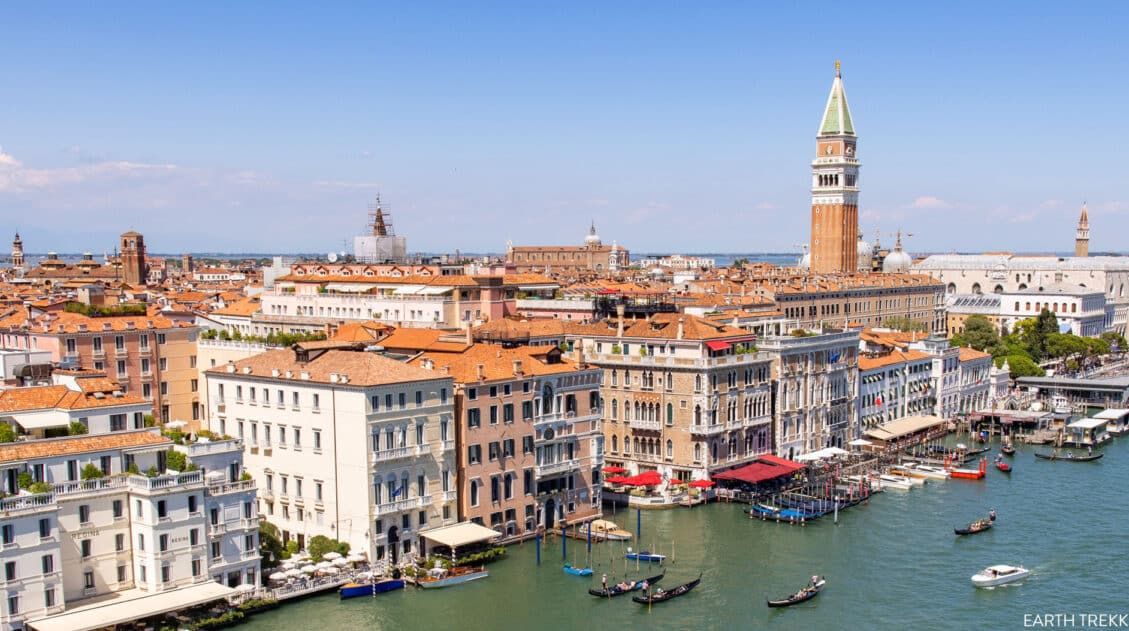
20 Best Things to Do in Venice, Italy (2026 Guide)
Discover 20 things to do in Venice, Italy, from strolling its canals and island-hopping to Murano and Burano, to visiting St. Mark’s Basilica and the Rialto Bridge. Venice is one of our favorite spots in Italy. With its winding canals and centuries-old architecture, it’s an easy place to fall in love with, and small enough […]
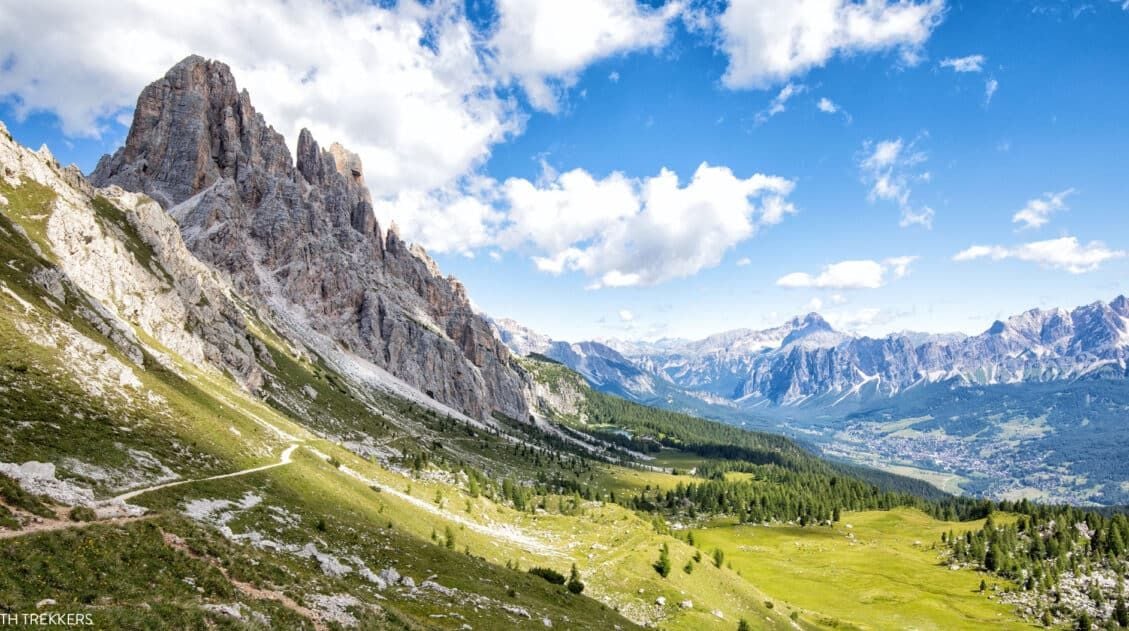
What We Wish We Knew Before Visiting the Dolomites
The Dolomites. This is where jagged pinnacles of rock soar into the sky, mountain huts and cabins dot the green, rolling hills, cable cars whisk hikers and skiers to the highest mountain peaks, and hiking trails connect small hamlets and towns. It’s easy to fall in love with the photos. Planning a smooth trip here, […]


Comments 16