
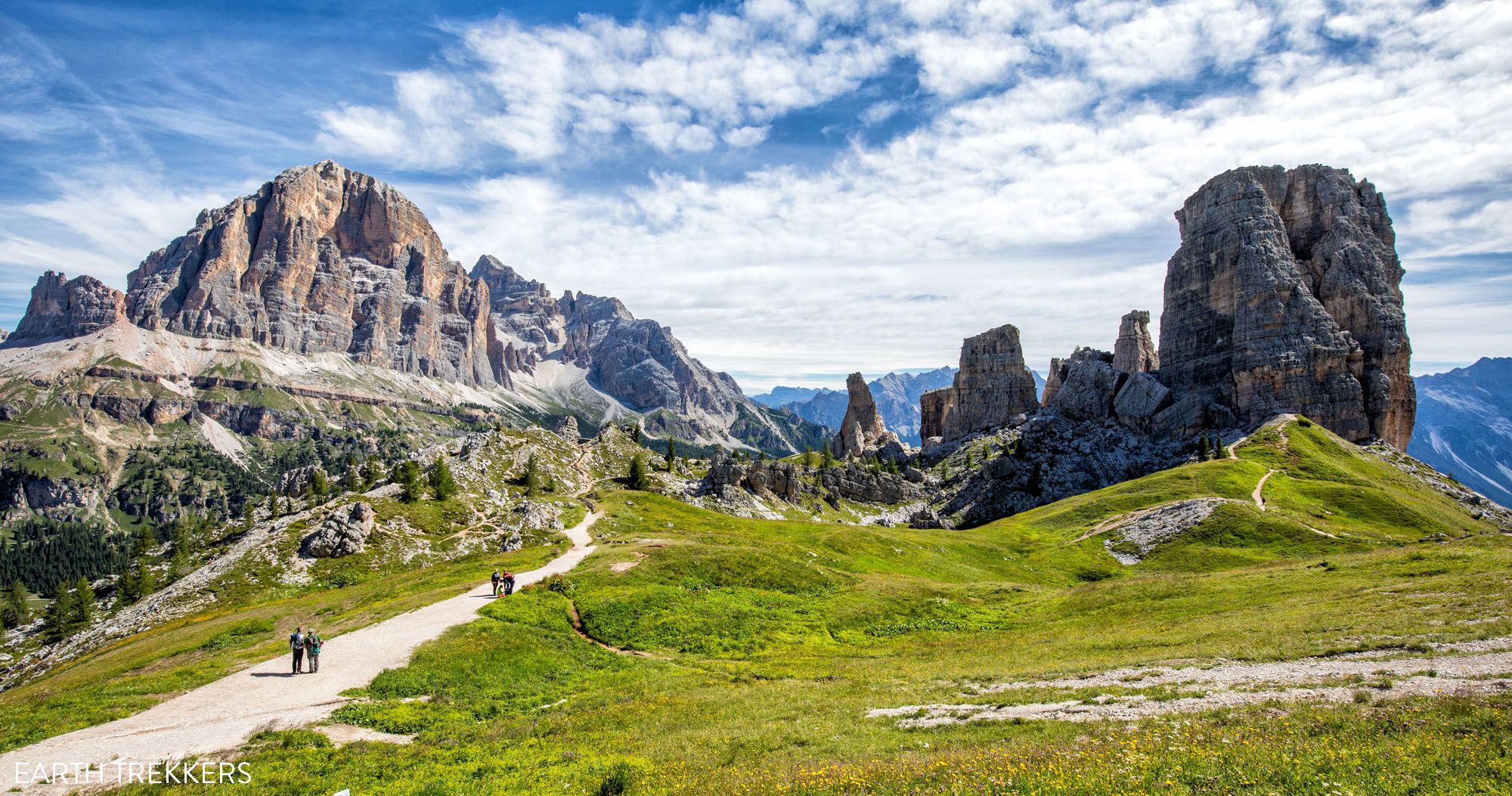

We’ve explored the Dolomites across multiple trips, hiking Tre Cime, the Puez-Odle Altopiano, Lago di Sorapis, and more, and we have strong opinions about what’s worth your time. The Cinque Torri belongs near the top of any list.
It’s one of the most recognizable rock formations in the Dolomites: five jagged towers rising above alpine meadows, with sweeping views of Tofana and Falzarego in every direction. A chairlift gets you there in minutes, making it accessible for all ages and fitness levels, and WWI bunkers and trenches woven right into the trail give it a layer of history that sets it apart from anywhere else in the region.
But add on Rifugio Averau and Rifugio Nuvolau, and what started as a scenic morning turned into one of our favorite single-day experiences in the entire Dolomites — a rifugio lunch with staggering panoramic views, and a perspective of the five towers from above that you simply can’t get from below.
In this guide, we cover everything you need to visit the Cinque Torri: how to get there, the chairlift, the best hiking route, what to expect at the WWI museum, and how to extend your day to Rifugios Averau and Nuvolau.
If this is your first time visiting the region, we also recommend starting with our Dolomites Travel Guide, where we share how to plan your trip, where to stay, and how to build an itinerary that includes hikes like this one. In our guide Best Hikes in the Dolomites, you can see how this one compares to other hikes in the region.
The Essentials
WHAT IS IT | A short, family-friendly hike around iconic pinnacles of rock and a WWI open-air museum
QUICK STATS | 1.9 km/1.2 mile loop, easy hike, allow 1 hour
CHAIRLIFT | The chairlift to Rifugio Scoiattoli makes it easy to get to
COST | The hike is free but it costs €27–€30 to ride the chairlift
DON’T MISS | Add on Rifugios Averau and Nuvolau for jaw-dropping panoramic views
WHEN TO GO | June through early October, when the chairlift is running
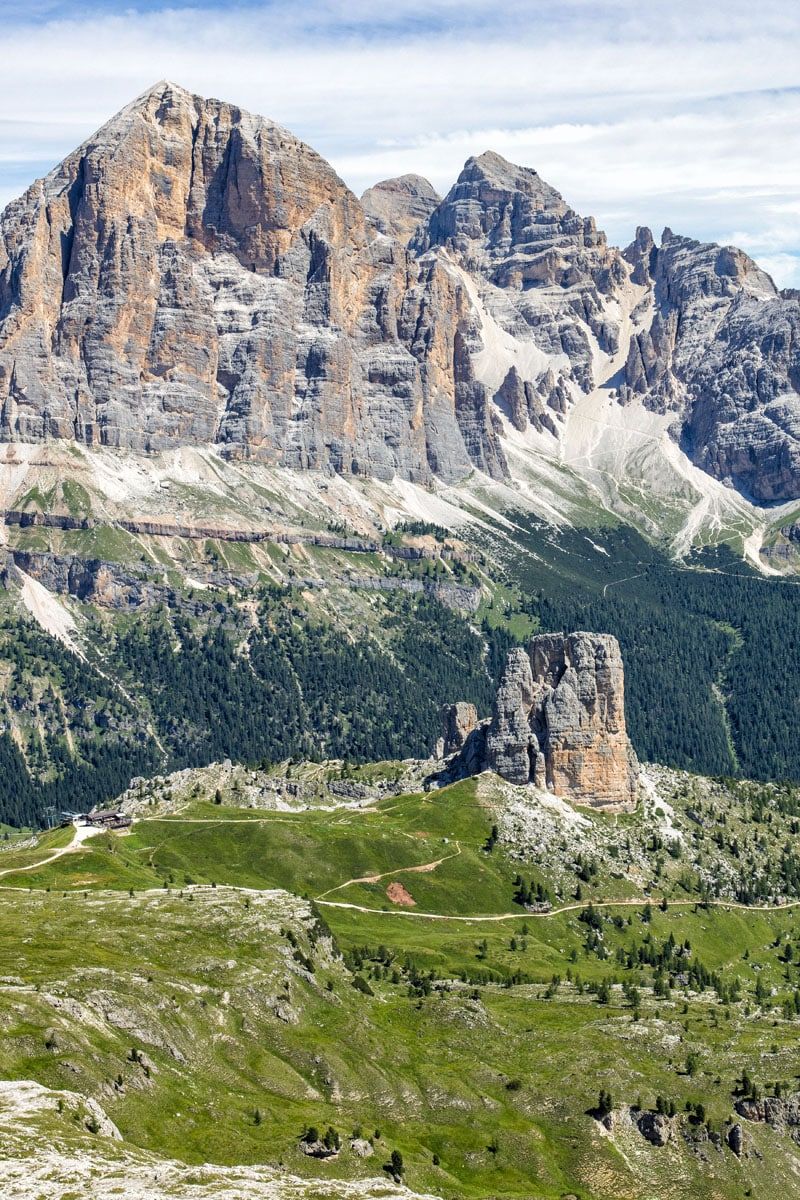
Photo: View of the Cinque Torri from Rifugio Nuvolau
April 2026 Update: Added updated pricing and hours of the chairlift for 2026.
What is the Cinque Torri?
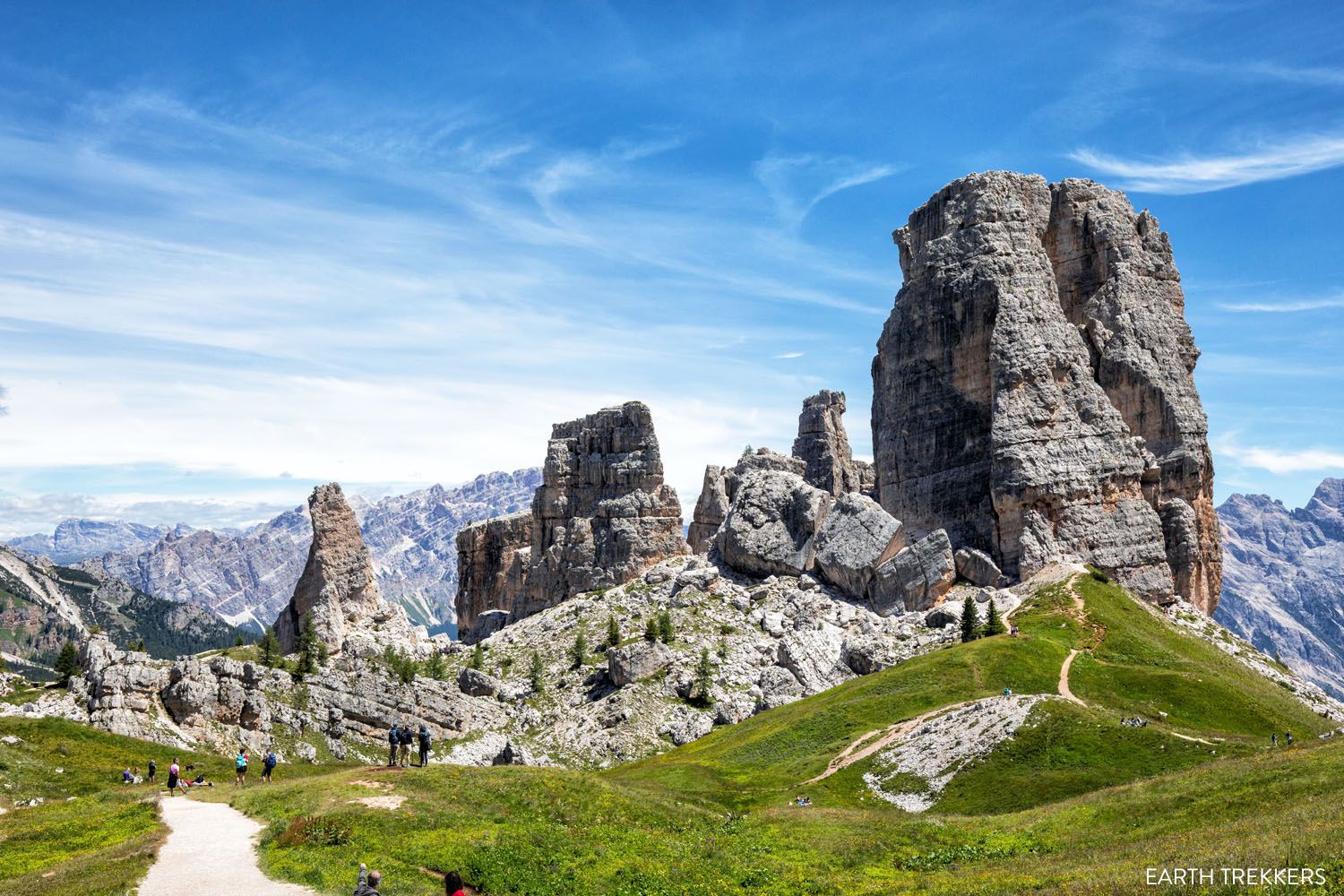
The Cinque Torri is a rock formation in the Dolomites. At first glance, it appears that there are five main pillars, which is how this rock formation got its name (in Italian, cinque is five). But once you get closer, you see that there are many more smaller pillars and towers in this rock formation.
Each of the main towers has a name. The largest and most prominent tower is named Torre Grande. The remaining towers are named Torre Seconda, Torre Latina, Quarta Torre, and Quinta Inglese. Torre Grande and Torre Seconda each have numerous rock climbing routes.
More than 100 years ago, during World War I, this area was the site of conflict between the Italians and the Austro-Hungarians. Bunkers and trenches were built amidst the Cinque Torri towers, and after the war, once the area was abandoned, these formations remained. More recently, the trenches and bunkers were restored and the Cinque Torri is now a WWI open air museum (the Museum of the Great War).
Cinque Torri
Is the Cinque Torri Worth It?
Yes, absolutely.
The Cinque Torri is one of the easiest, lowest-effort experiences in the Dolomites. Ride the chairlift up, walk the loop, and you’ve got breathtaking 360° views of some of the most dramatic mountain scenery in Italy without a punishing climb to earn them. That makes it genuinely great for all ages and ability levels, including families with young kids, older travelers, or anyone who wants a spectacular Dolomites experience without a full day of strenuous hiking.
We loved it from start to finish — the quick, scenic chairlift ride up (it’s even better on the way back down), exploring the WWI bunkers and trenches, and hiking through the towers themselves. And if you want to linger, have lunch at Rifugio Scoiattoli at the top of the chairlift. The setting alone makes it worthwhile, and you can add as much or as little extra walking as you feel like.
Then there’s the option to continue up to Rifugios Averau and Nuvolau, which takes the whole experience to another level entirely. But even if you just do the loop and head back down, you’ll leave having checked off one of the most rewarding easy experiences in the Dolomites.
How to Visit the Cinque Torri
There are a few ways to experience the Cinque Torri depending on your time and energy:
- Loop + Rifugios Averau & Nuvolau: The full day experience, and our personal recommendation. Transforms a great morning into one of the best days in the Dolomites.
- Just the chairlift + WWI museum: The lightest option, great for families or non-hikers. Ride up, walk through the open-air museum, enjoy the views, ride back down.
- The full loop hike: The sweet spot for most visitors. About an hour, easy terrain, spectacular views. This is what we cover in detail below.
How Do You Get to the Cinque Torri?
The Cinque Torri is located between Cortina d’Ampezzo and Falzarego Pass in the eastern Dolomites, making it easy to reach whether you’re driving or relying on public transport.
By Car
Drive to Baita Bai de Dones, located on SR48 about 25 minutes west of Cortina d’Ampezzo and an 8-minute drive east of Falzarego Pass. There is a large parking lot here, but it fills up fast. By late morning on summer weekends it can be completely full. Aim to arrive by 9 am to guarantee a spot.
By Public Transport
If you don’t have a car, take the bus from Cortina d’Ampezzo toward Falzarego Pass and ask to be dropped at the Cinque Torri chairlift stop (Baita Bai de Dones). Buses run regularly in summer along this route. Check current timetables at dolomitibus.it before you go, as schedules change seasonally.
The Cinque Torri Chairlift: What to Know Before You Go
From the parking area, the chairlift carries you up to Rifugio Scoiattoli in just a few minutes, and it’s a scenic ride in its own right, with great views of Averau opening up as you climb.
Round-trip tickets cost €27.50–€30 per person depending on the month. The chairlift runs daily from 9 am to 5 pm, and in 2026 operates from June 6 through October 11. Get updated hours and pricing here.
Is the chairlift worth it? Absolutely. The alternative is hiking up a trail beneath the lift through trees with almost no views, about an hour of moderately strenuous climbing that doesn’t pay off scenically. We’d strongly recommend taking the chairlift and saving your energy for the loop itself, or better yet, for adding on Rifugios Averau and Nuvolau afterward.
OUR TOP TIP: The ride back down at the end of the day is arguably even better than the ride up. You’ll have the full sweep of the valley and surrounding peaks in front of you.
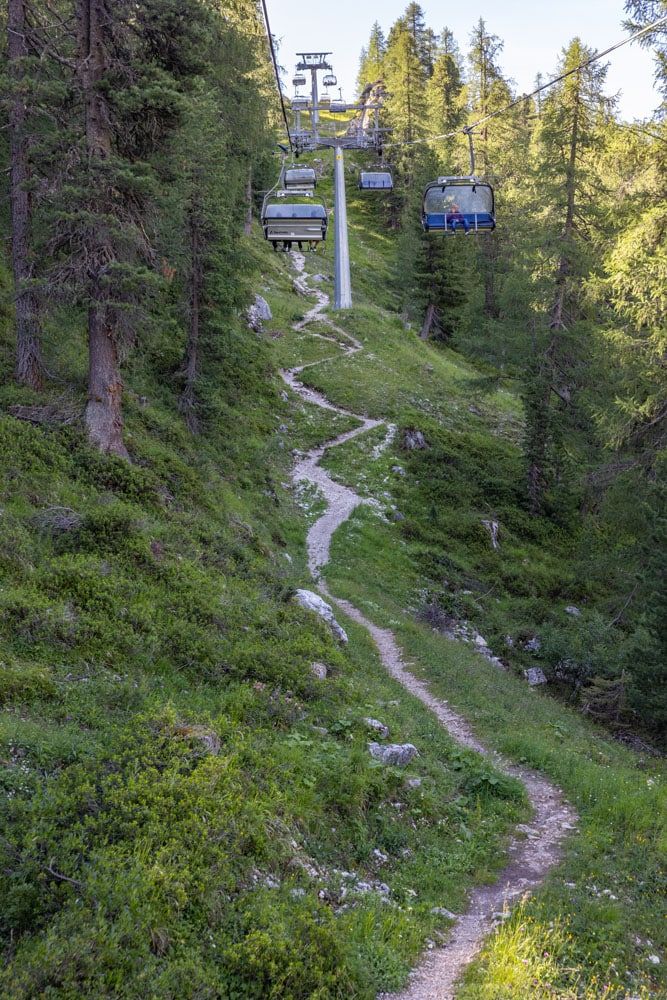
The trail under the chairlift.
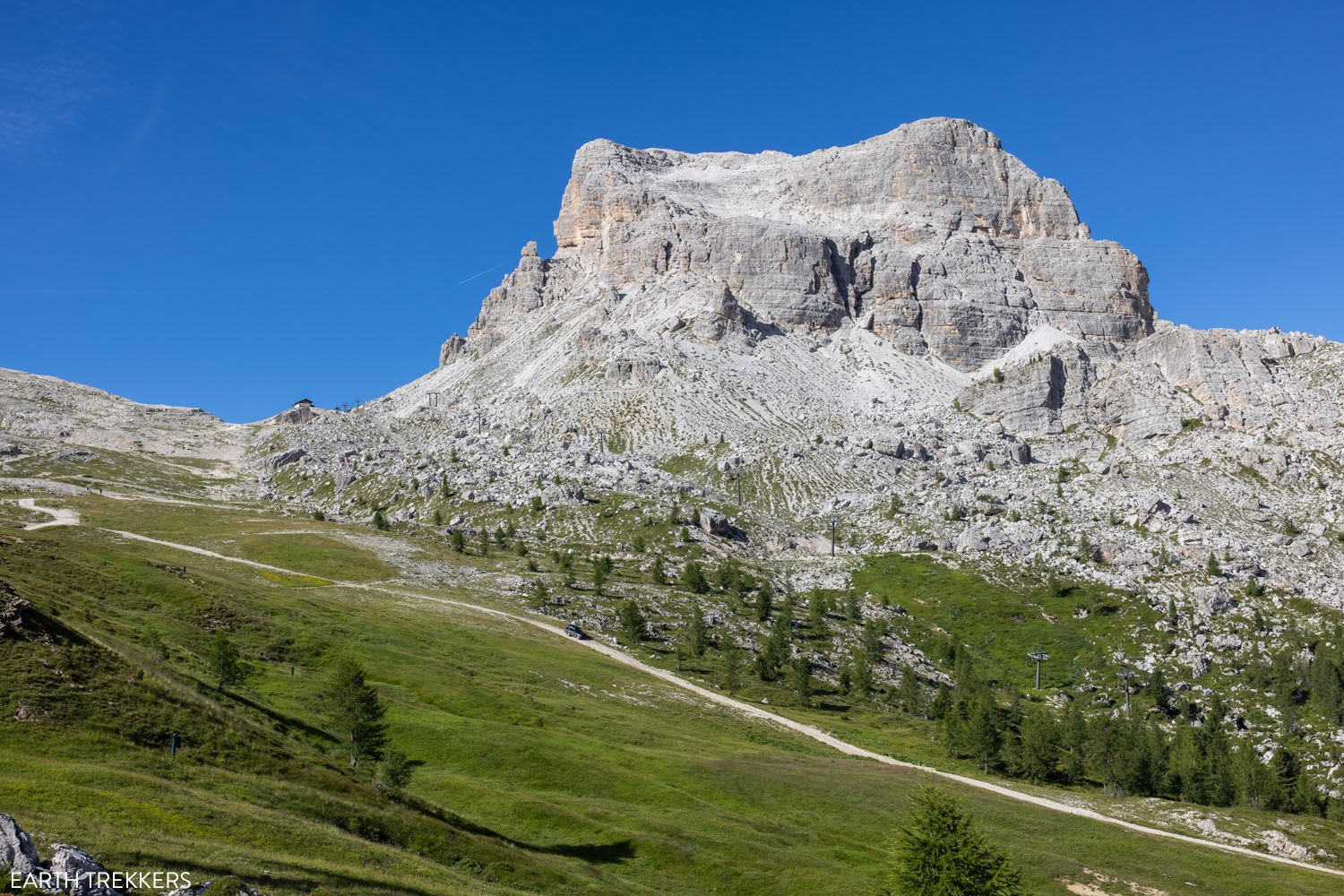
The view of Averau from the chairlift.
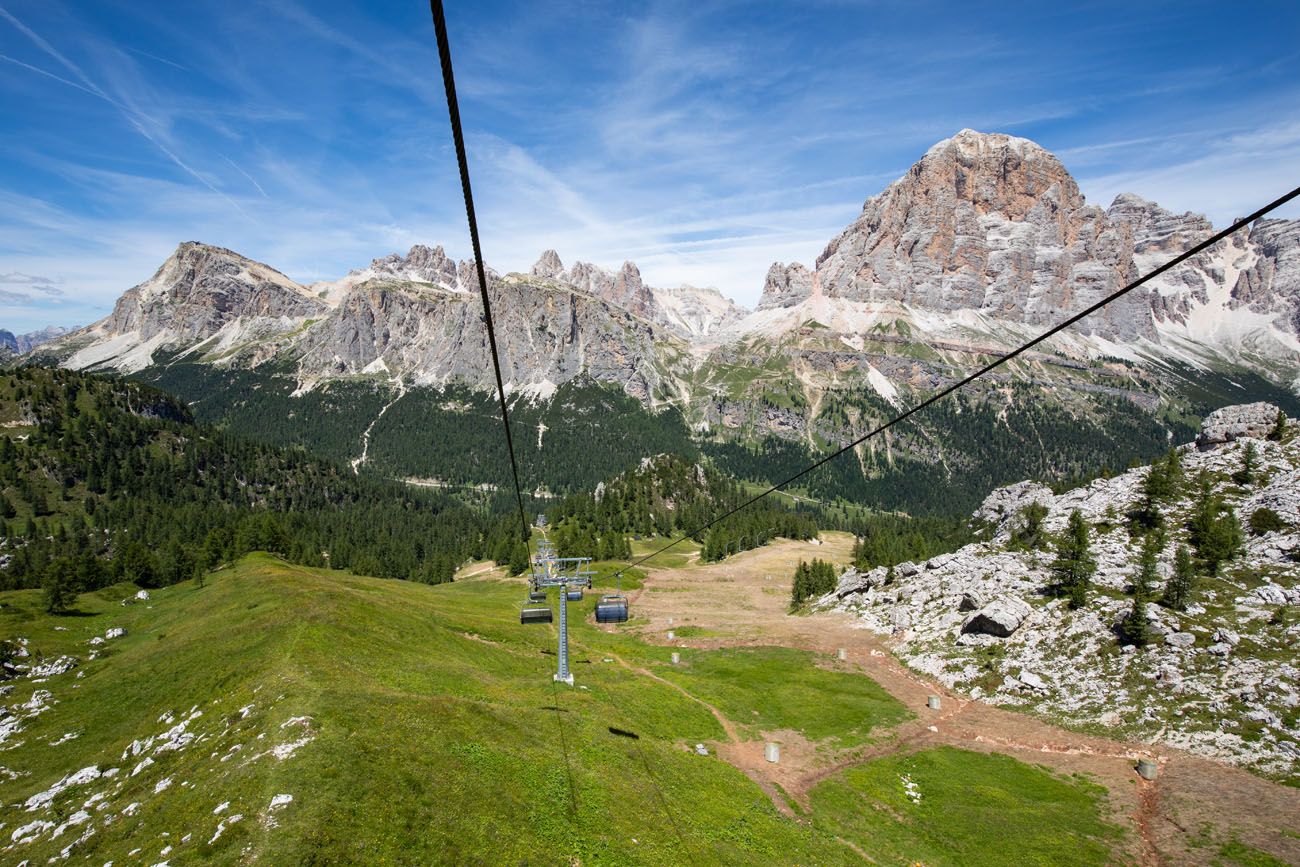
And later in the day, this is the view on the chairlift ride back down to the parking area.
Cinque Torri Hiking Stats & Elevation Profile
Hiking distances will vary based on which route you choose (covered in the next section). These are our hiking stats, which includes hiking through the Cinque Torri, which is shorter than walking the perimeter around the entire cluster of towers.
Distance: 1.9 km (1.2 mile) loop
Difficulty: Easy
Total Ascent: 130 meters (430 feet)
Highest Elevation (Trailhead): 2,265 meters (7,430 feet)
Lowest Elevation: 2,175 meters (7,135 feet)
Length of Time: 1 hour
When: June through early October
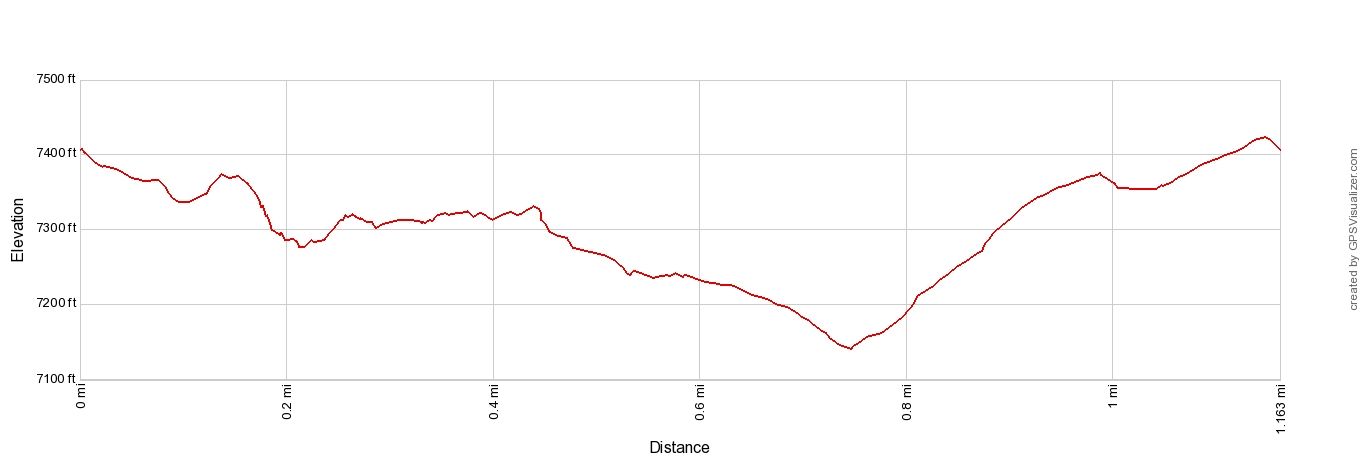

Cinque Torri Elevation Profile
Additional Information & Helpful Tips
Best Time of Day to Visit the Cinque Torri: Morning if you want fewer crowds; afternoon for better lighting and photography
Toilet: At the lower chairlift station and at Rifugio Scoiattoli
Food: At the lower chairlift station and at Rifugio Scoiattoli. We didn’t eat at Rifugio Scoiattoli but it sure did smell good!
Cost: Free (other than the chairlift)
Please practice the seven principles of Leave No Trace: plan ahead, stay on the trail, pack out what you bring to the hiking trail, leave areas as you found them, minimize campfire impacts, be considerate of other hikers, and do not approach or feed wildlife.
Maps of the Cinque Torri Trail
Below is a photo of the map at the trailhead. As you can see, there are several ways to hike around the Cinque Torri. And there are trails that aren’t even shown on this map (we hiked through the Cinque Torri on an official trail, but it is not indicated on the trail map below).
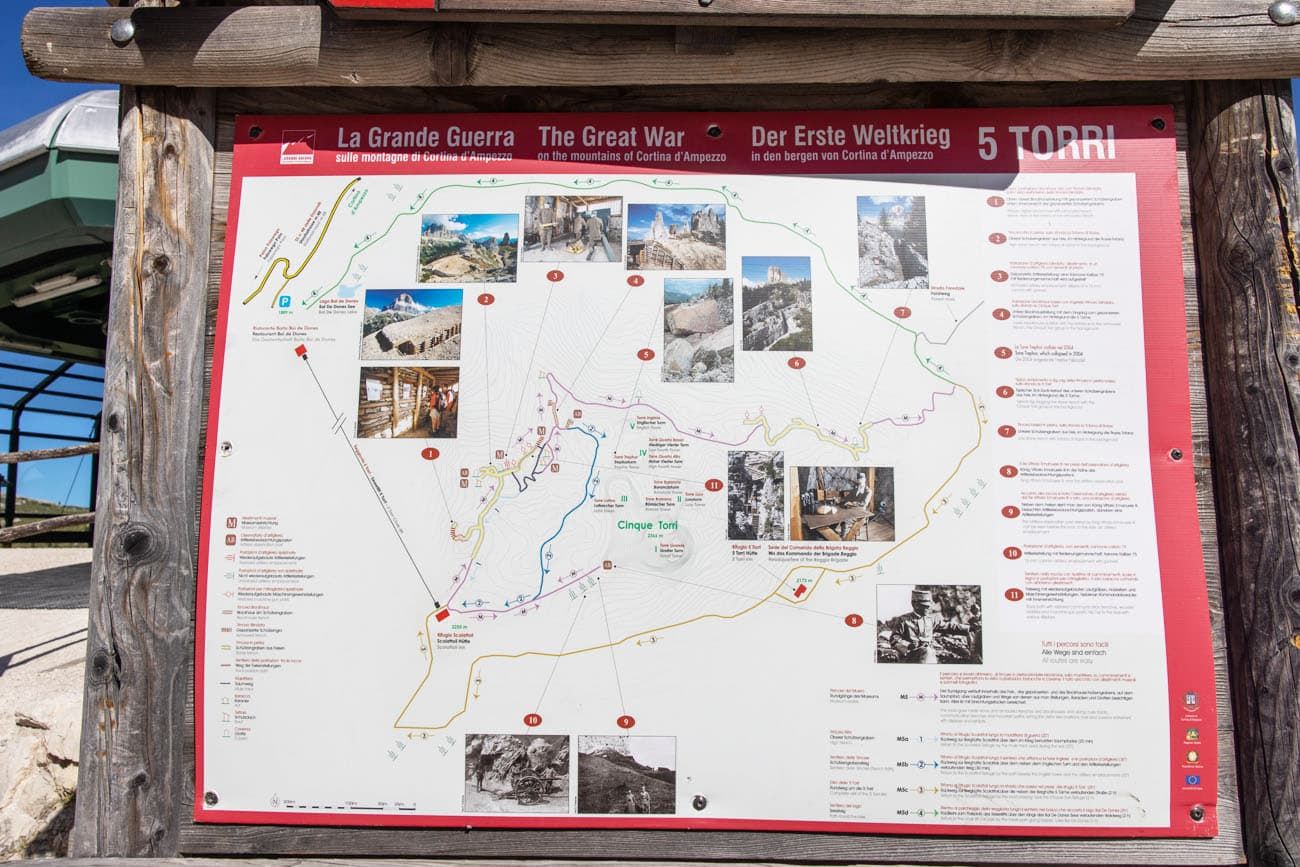
Map of the Cinque Torri and WWI walking trails (from the sign at the Cinque Torri trailhead). Most of the WWI sites are located to the west and north of the Cinque Torri. You have the option to hike the full perimeter around the Cinque Torri or you can hike through the Cinque Torri, like we did, which is lots of fun and you get great views the entire hike. NOTE: This map does not show all of the trails that circle in and around the Cinque Torri.
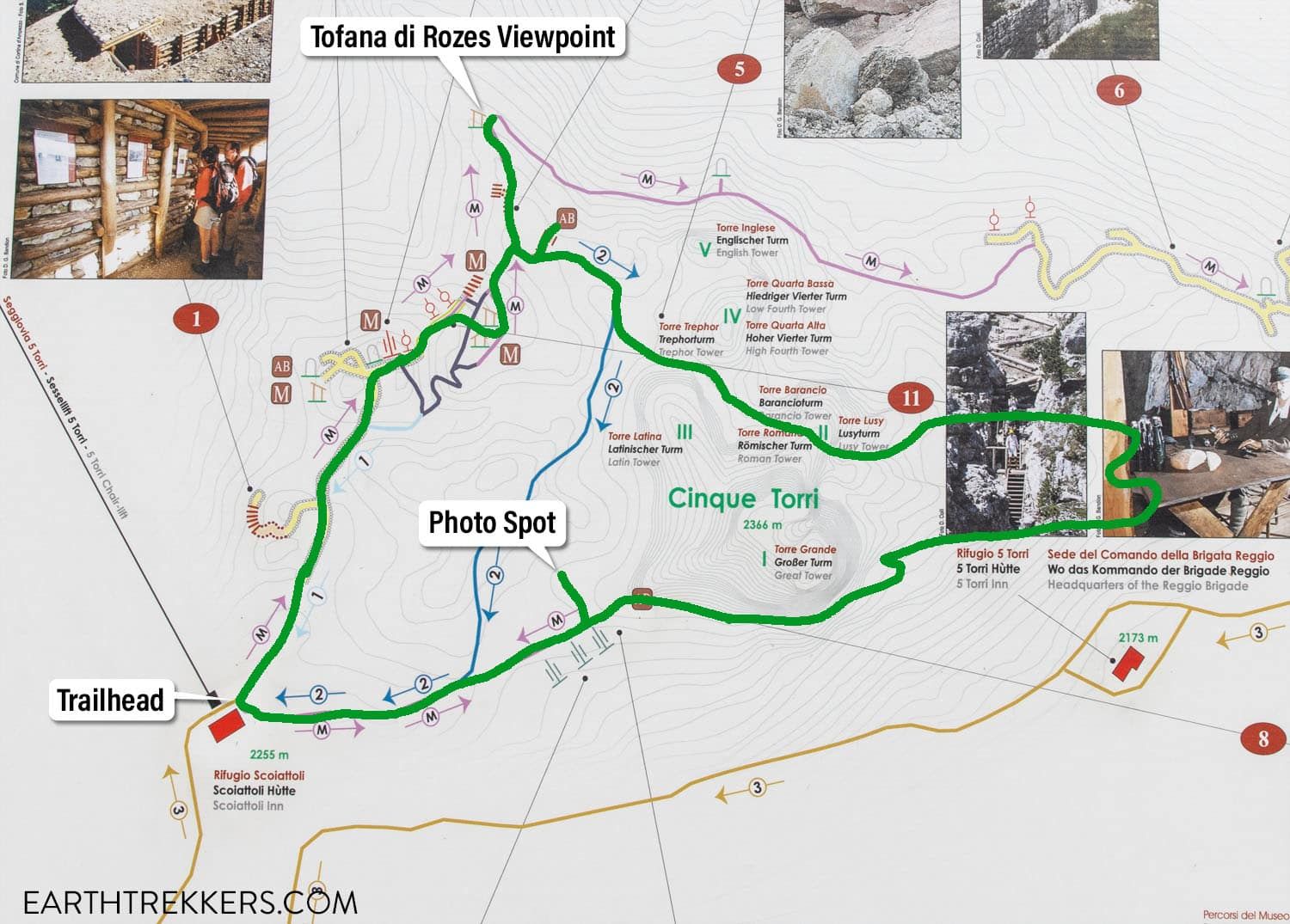
Map of our hiking route (the green line). I marked a great viewpoint along trail (what I am calling the Tofana di Rozes viewpoint) and a photo spot that is great for a family photo.
Basically, a maze of trails weaves their way in and around the Cinque Torri. You will explore these based off of what looks interesting to you as you go. As long as you keep moving in a clockwise direction, eventually you will end up back at Rifugio Scoiattoli.
With all that being said, below I’ll share with you our route, just so you have some idea of what to expect.
Cinque Torri Step-By-Step Trail Guide
Trailhead to Cinque Torri
This hike is a loop. You can do it in either direction, but we liked going clockwise. In this direction, you hike through the WWI exhibits first, and then circle through/around the Cinque Torri.
The trail starts next to Rifugio Scoiattoli. Look for the wide, gravel trail that heads towards the Cinque Torri.
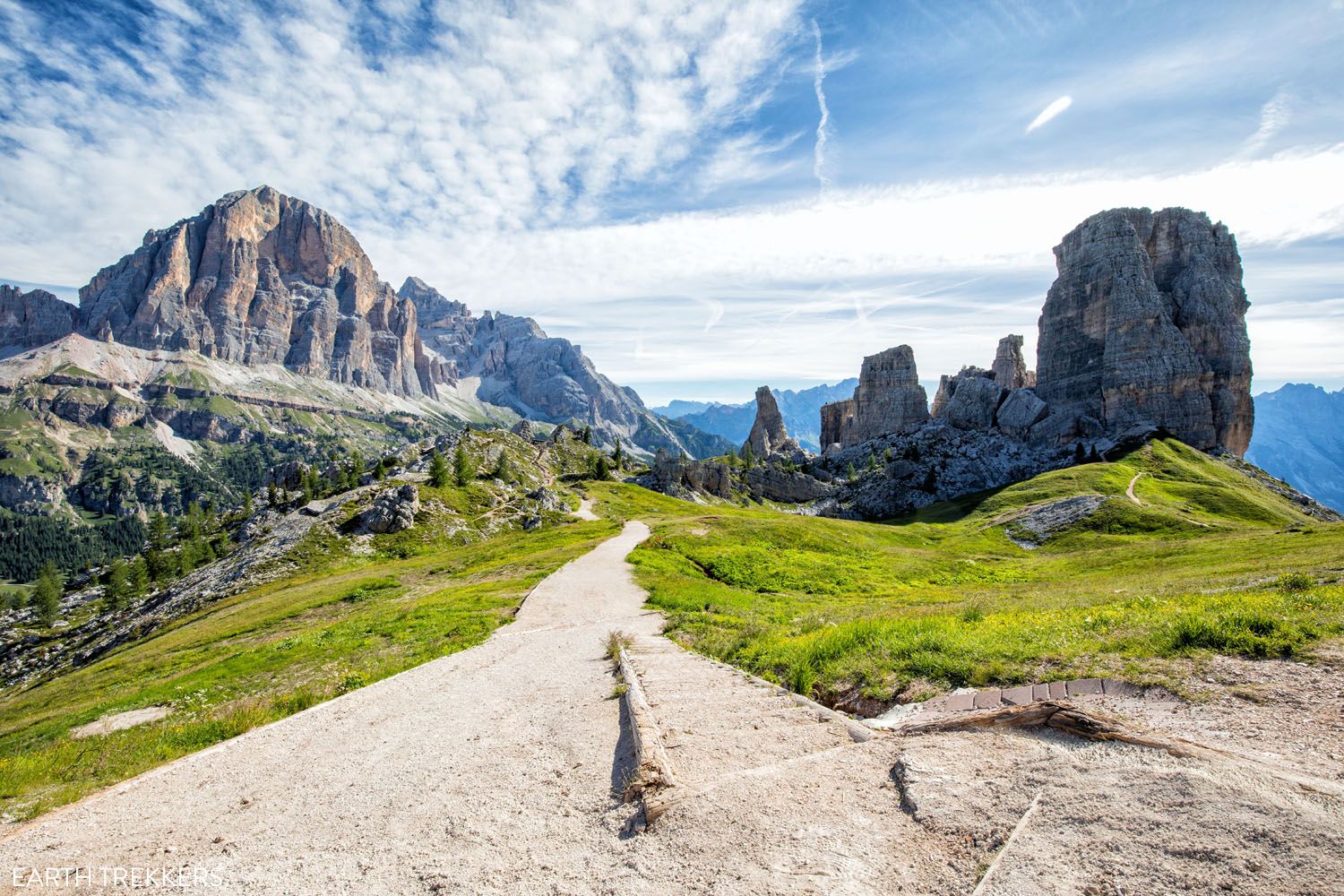
Cinque Torri trailhead
We walked down this trail and stayed to the left to go to the WWI exhibits, and it takes just a minute or two to reach the first one. As you head through the WWI exhibits, there will periodically be maps of the WWI area plus additional informational signs. It is a maze of hiking trails, trenches, bunkers, look-out towers, and buildings used for storage and artillery.
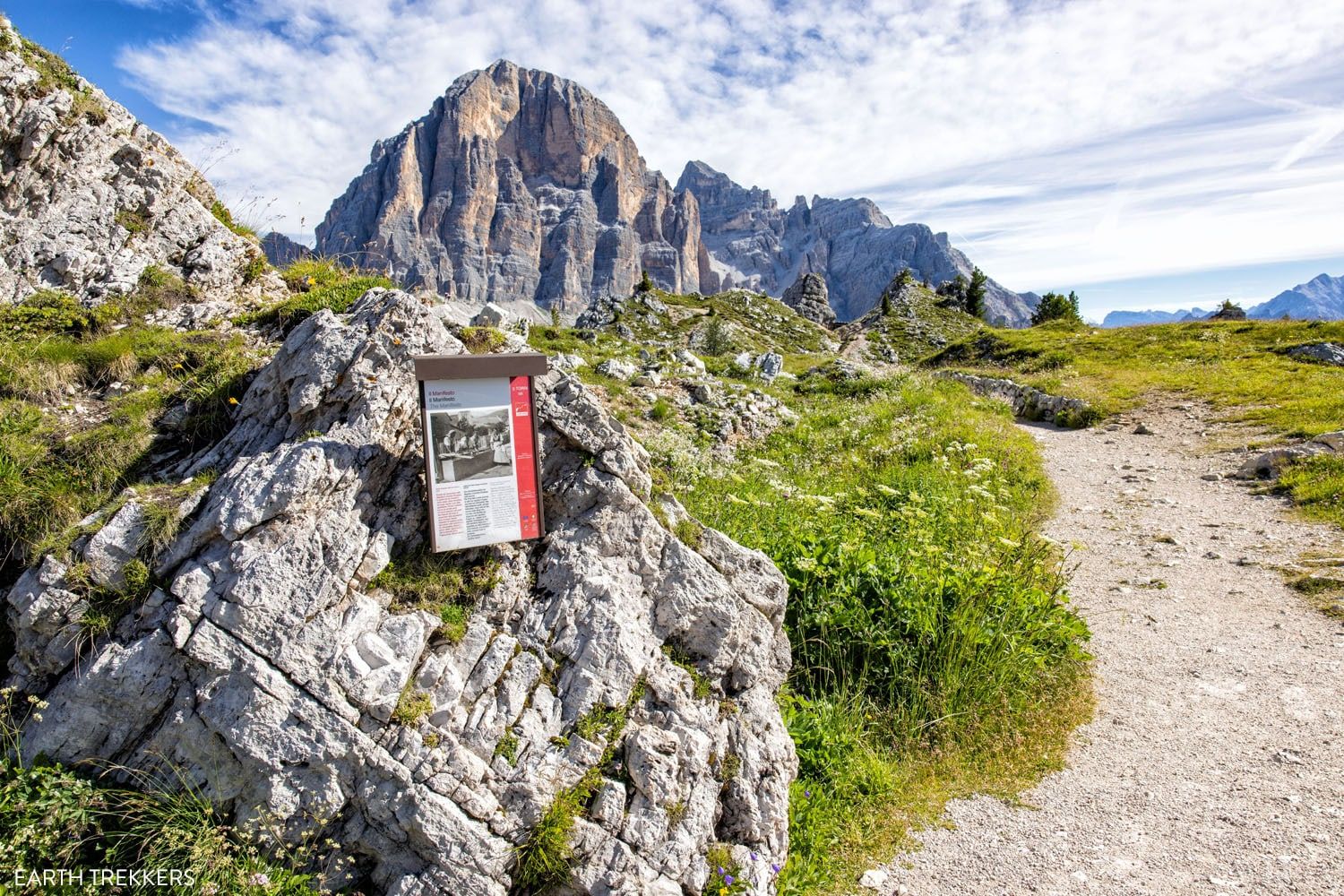
As you hike through the World War I exhibits, there will be signs like this one marking important sites.
You can stop and read every sign or simply move through the area, picking the route that interests you the most. We honestly thought the maps were a little hard to follow, but we liked visiting the bunkers and walking through the narrow trenches.
One of the things we loved about this part of the hike was the views looking out towards Tofana and Falzarego. It’s one of the best reasons to do this hike.
Here are our photos from the trail.
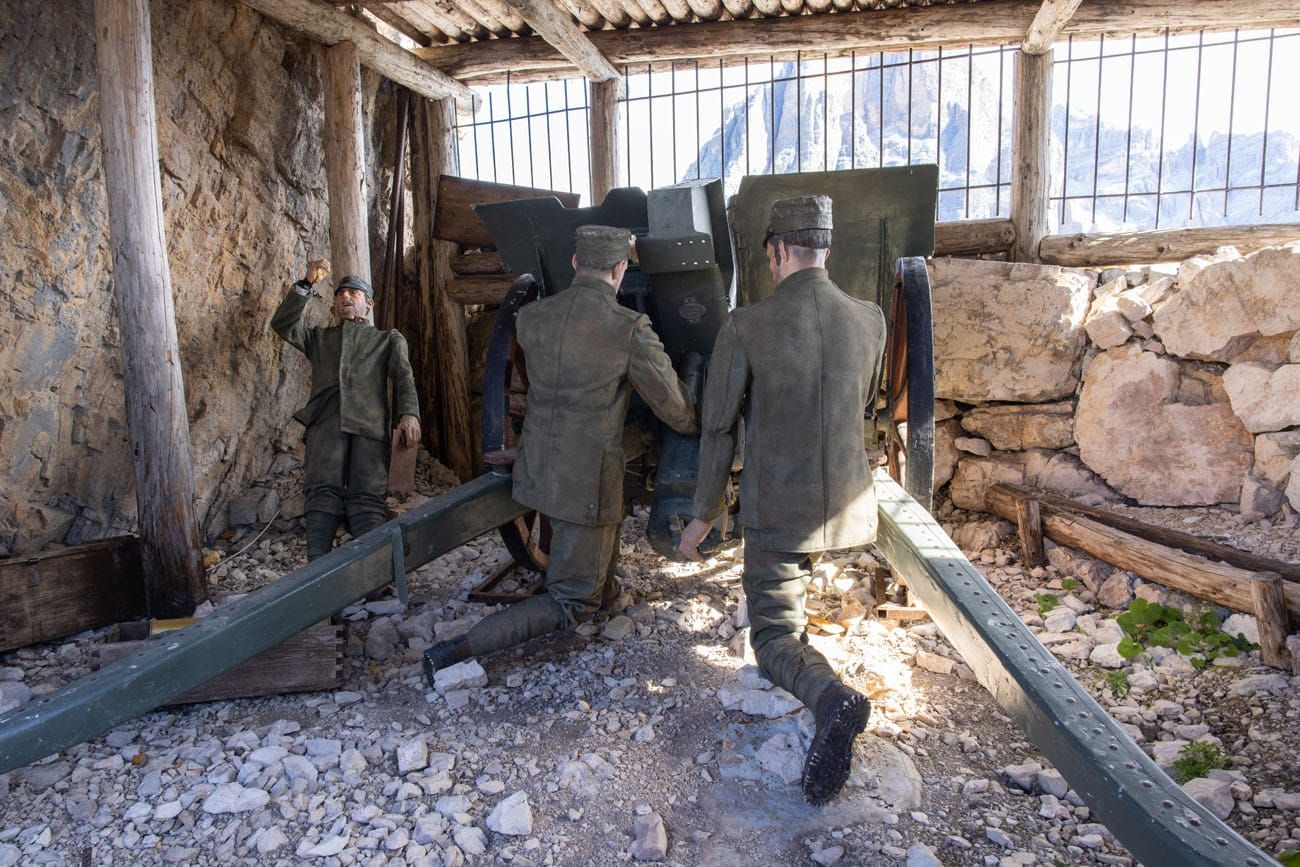
Artillery bunker
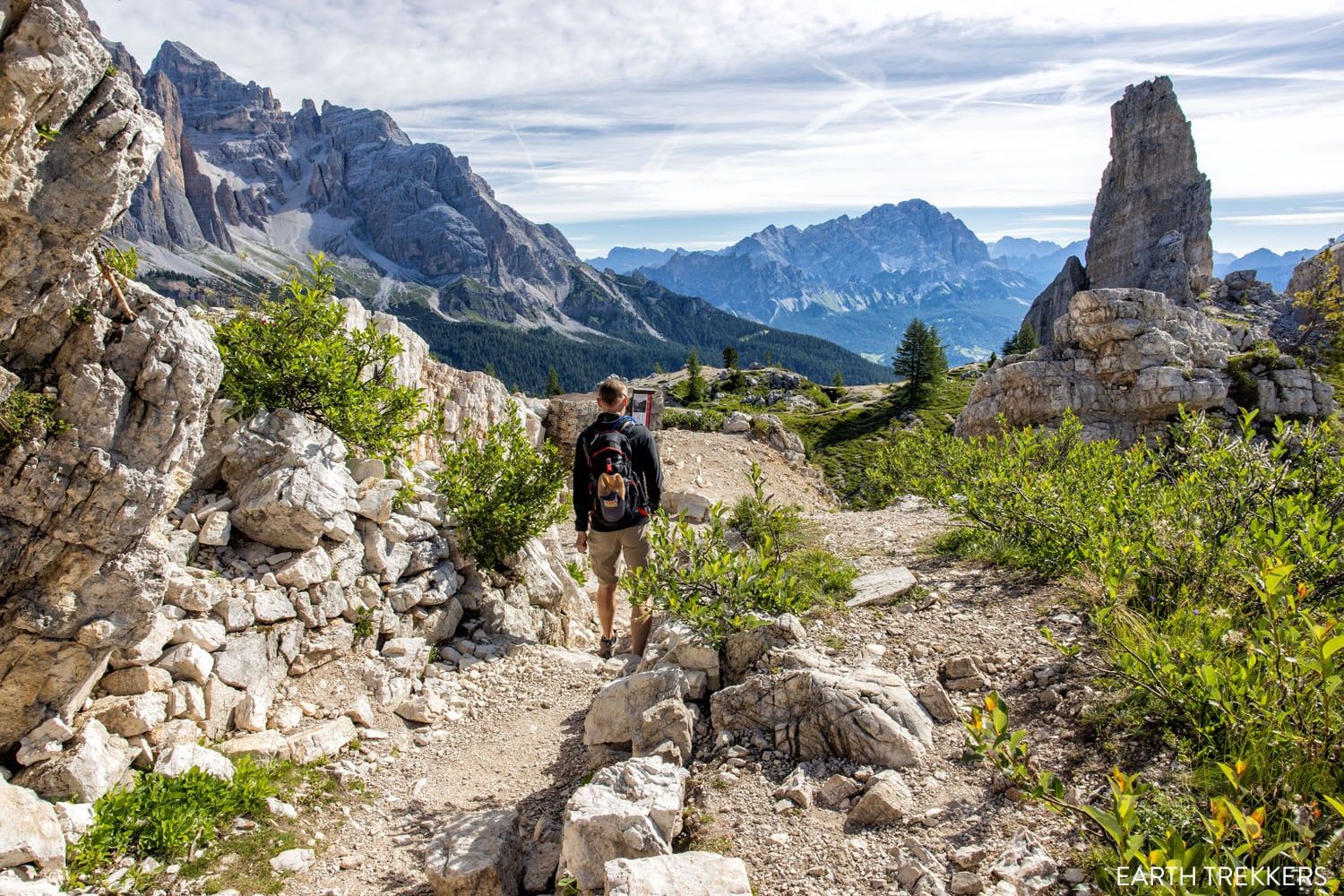
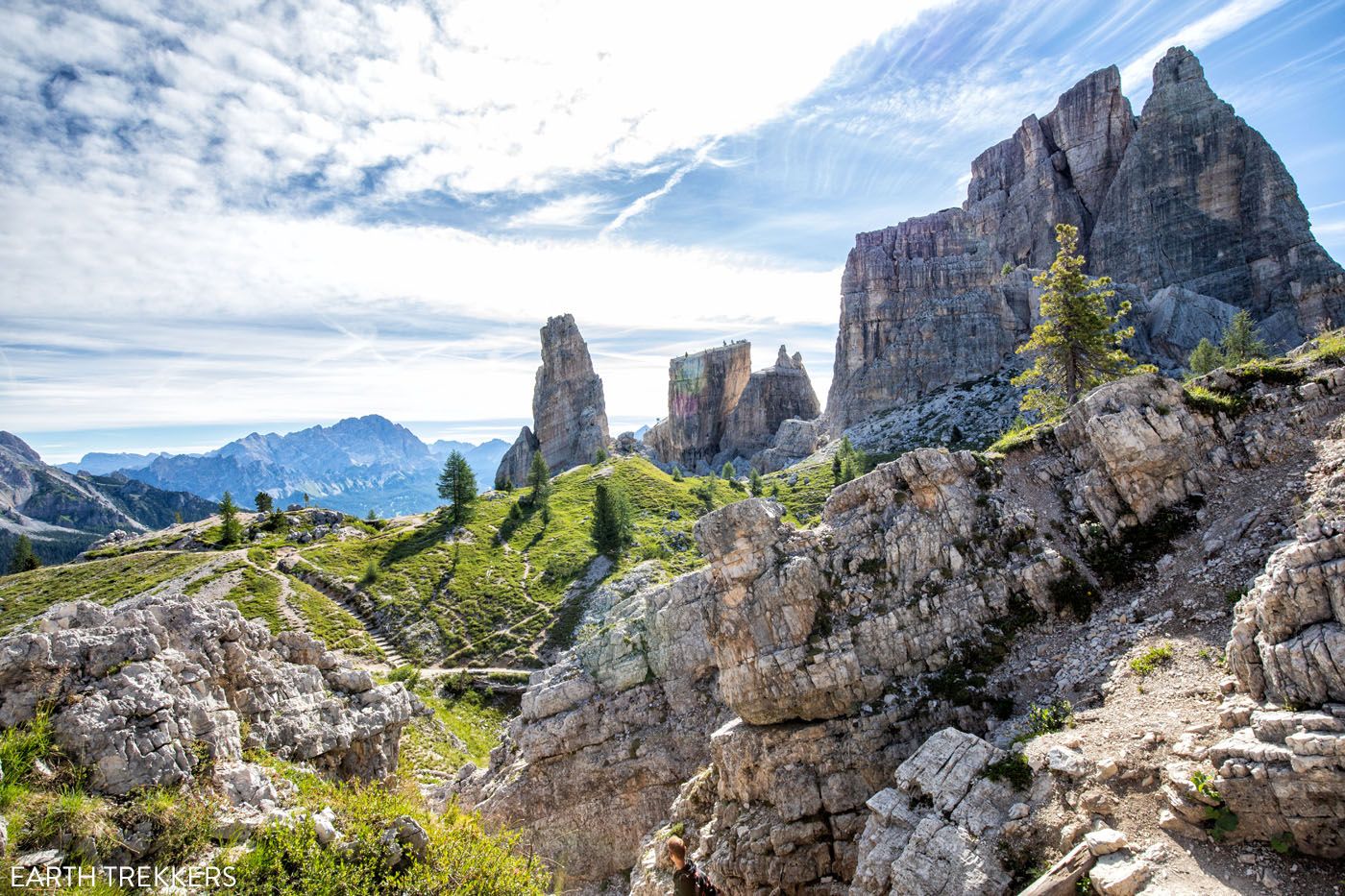
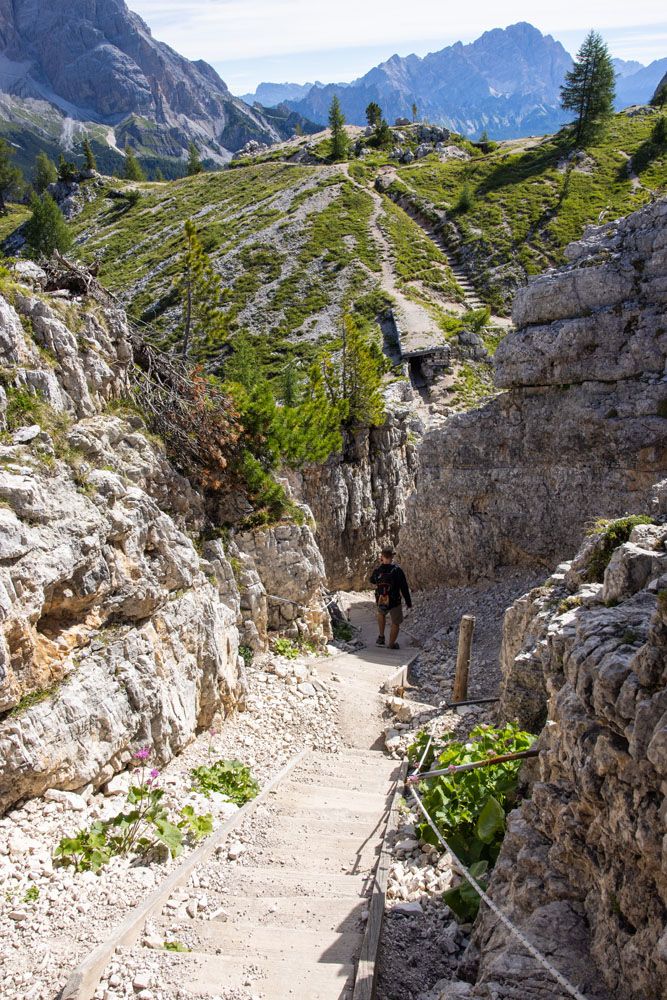
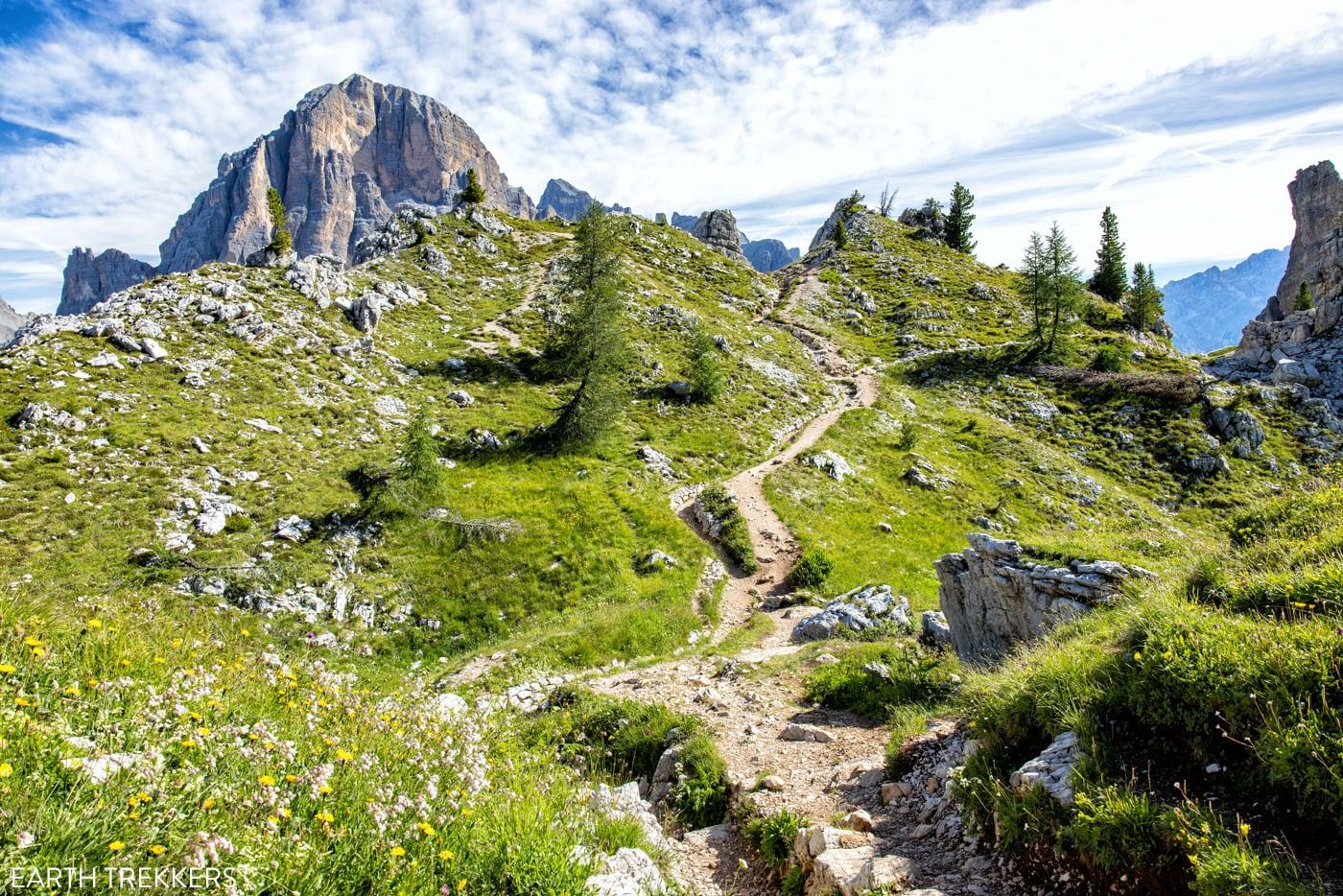
There will be some steep downhill sections, sometimes with stairs and others as a gravelly trail.
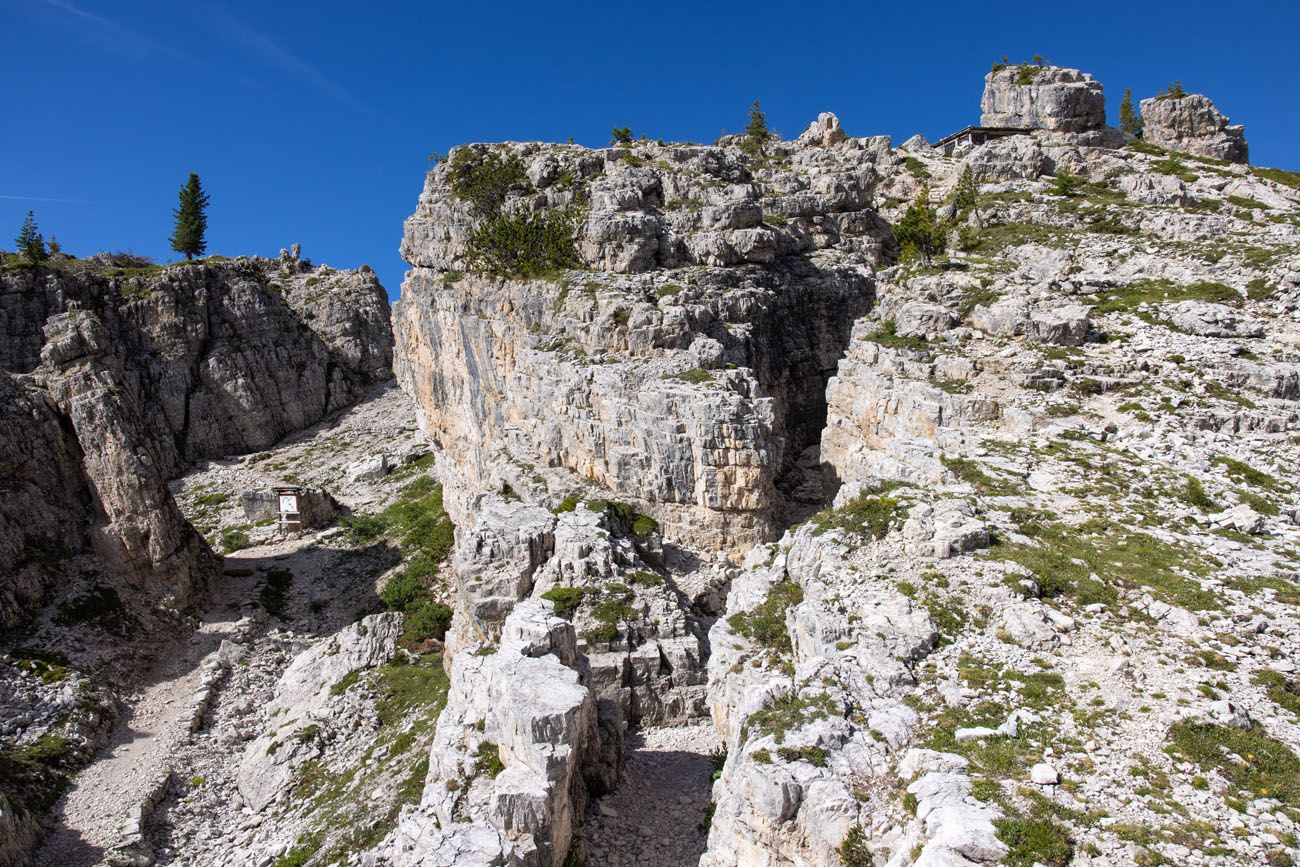
A view of the rocky outcroppings and a hiking sign along the trail.
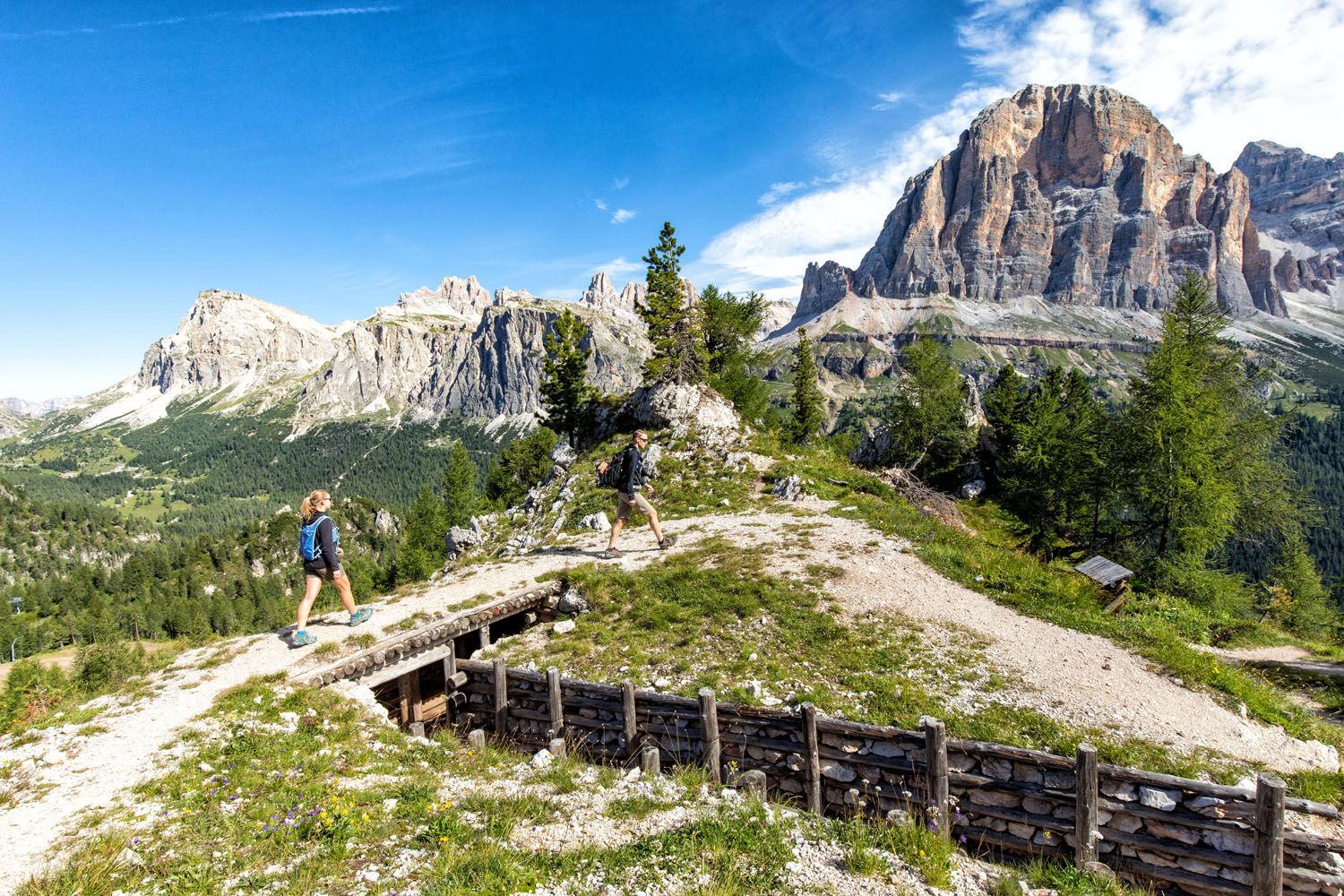
One of our favorite parts of the hike was walking out to viewpoint (the Tofana di Rozes viewpoint on our map earlier in this guide) beyond the trenches. From here, you have a great view of Tofana di Rozes, Falzarego, and back to the Cinque Torri.
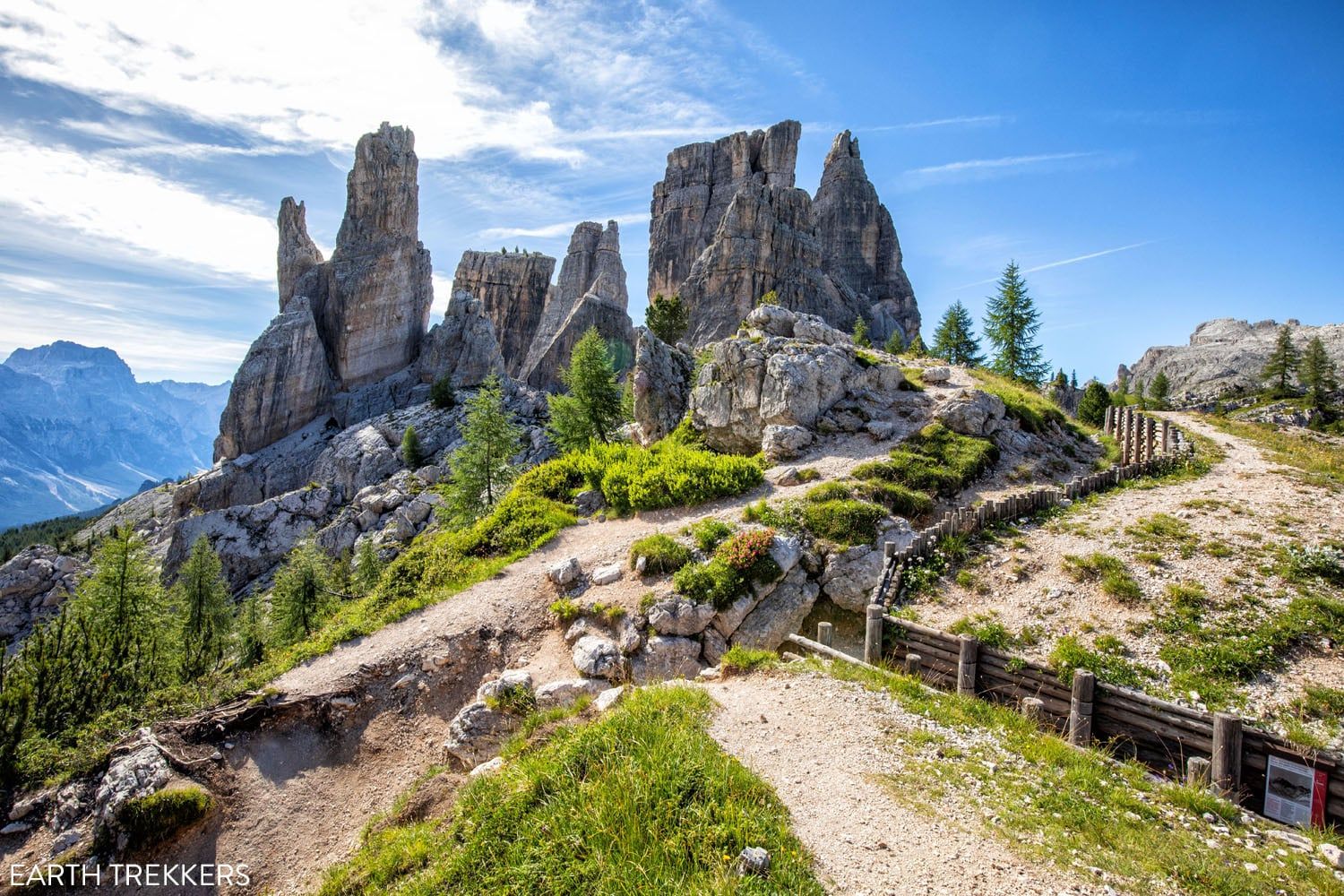
View looking back at the Cinque Torri and the WWI trenches from the Tofana di Rozes viewpoint.
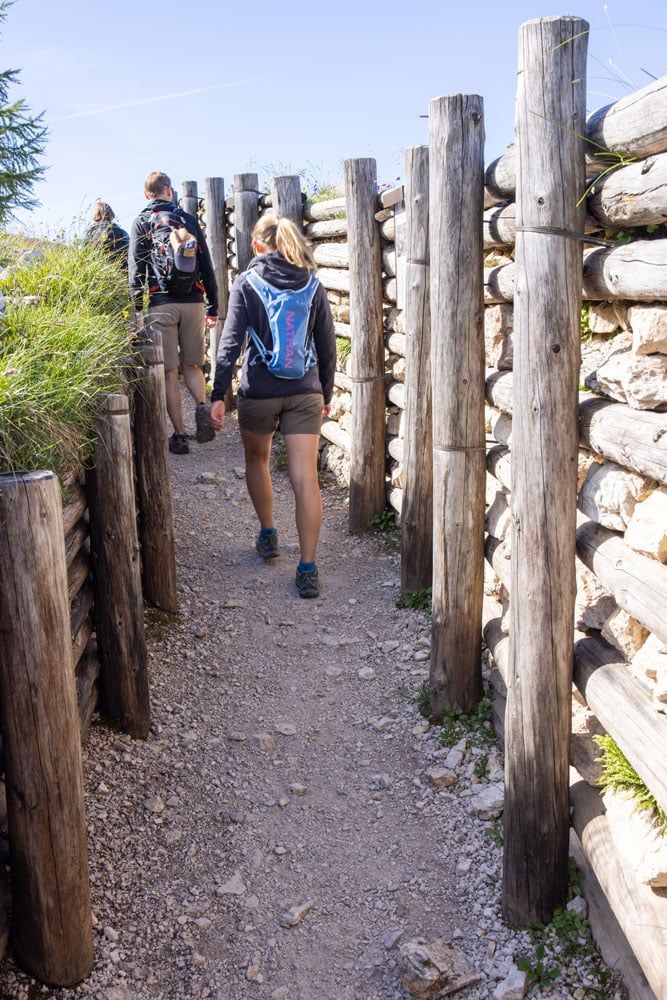
WWI trench
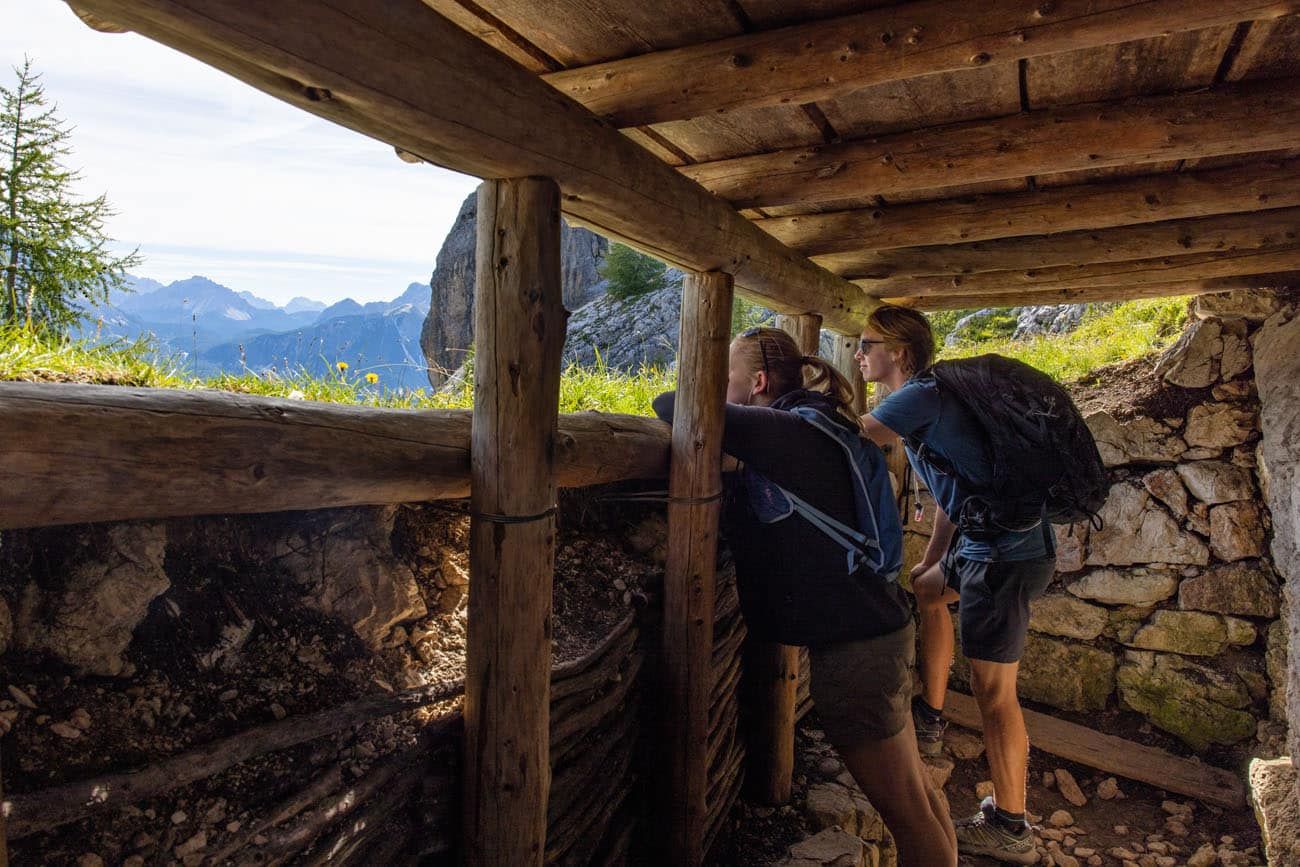
WWI bunker
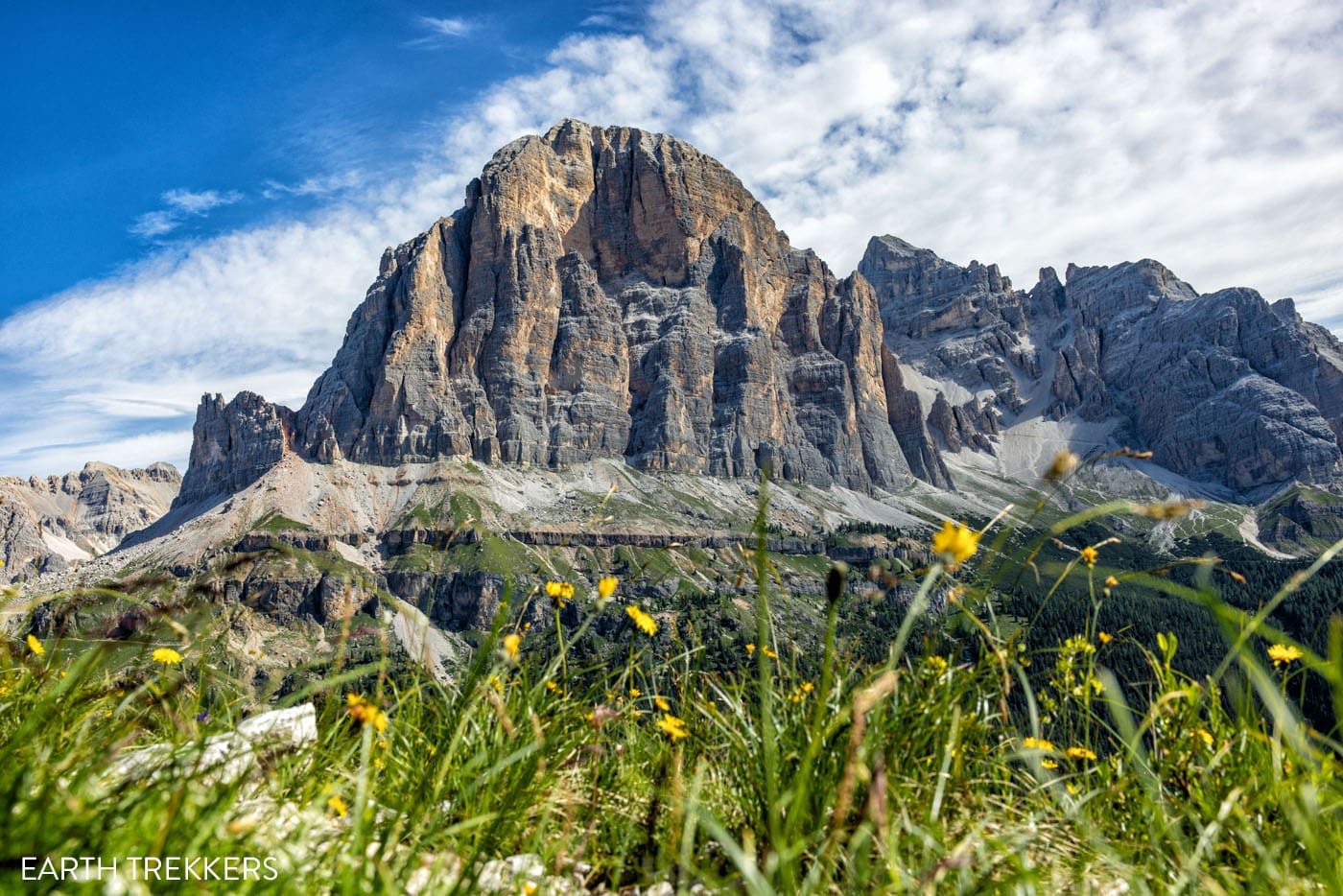
Tofana di Rozes from the bunker
Hiking through the Cinque Torri
Just past the long trench and the artillery observation post (labeled AB on the main map at the trailhead), we took route #2 (the blue route) into the Cinque Torri.
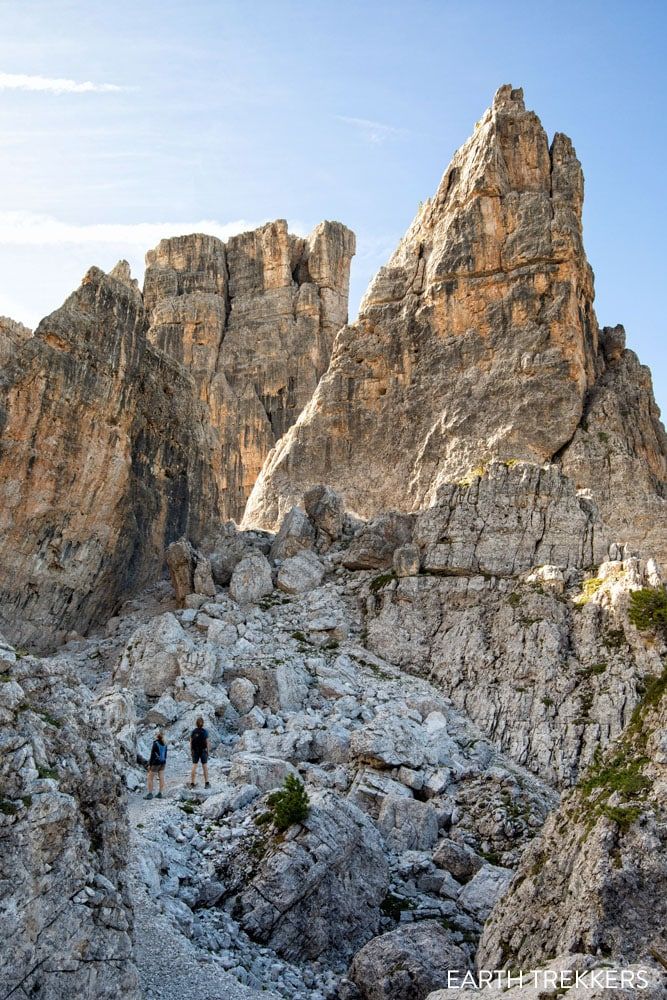
Hiking the blue route into the Cinque Torri.
The trail continues into the Cinque Torri, even though it is no longer indicated on the main trail map. But there are trail signs here labeling it as “Giro delle Torre.” We followed this trail through the Cinque Torri, out the “backside,” and continued clockwise around the rock formation.
Here are photos from along this route. Note, it’s mostly downhill until you get in view of Rifugio 5 Torri.
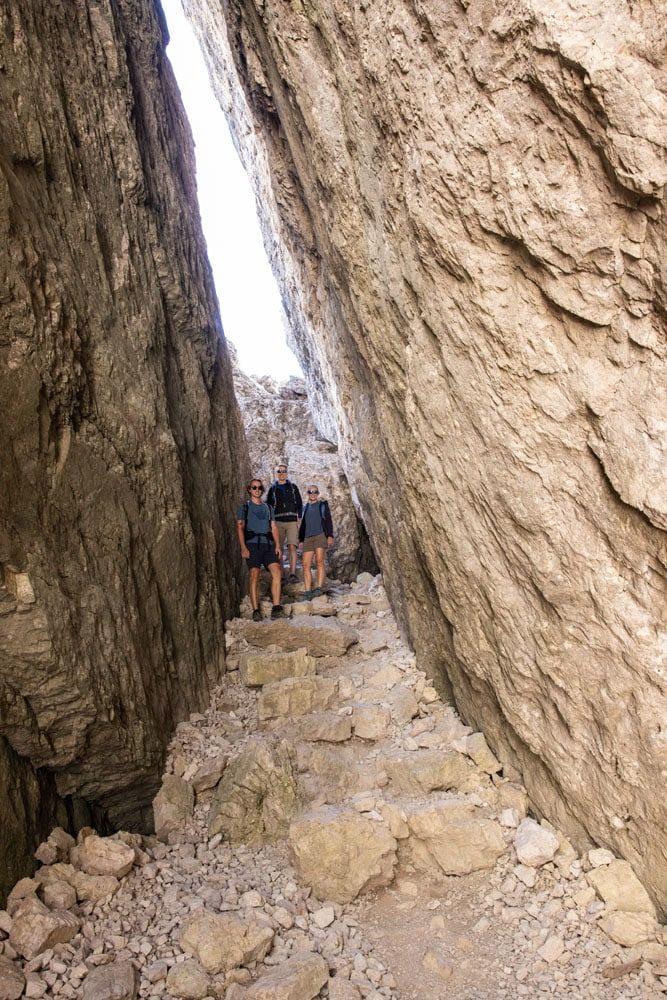
As you hike through the Cinque Torri, you will hike through this “tunnel” in between the towers.
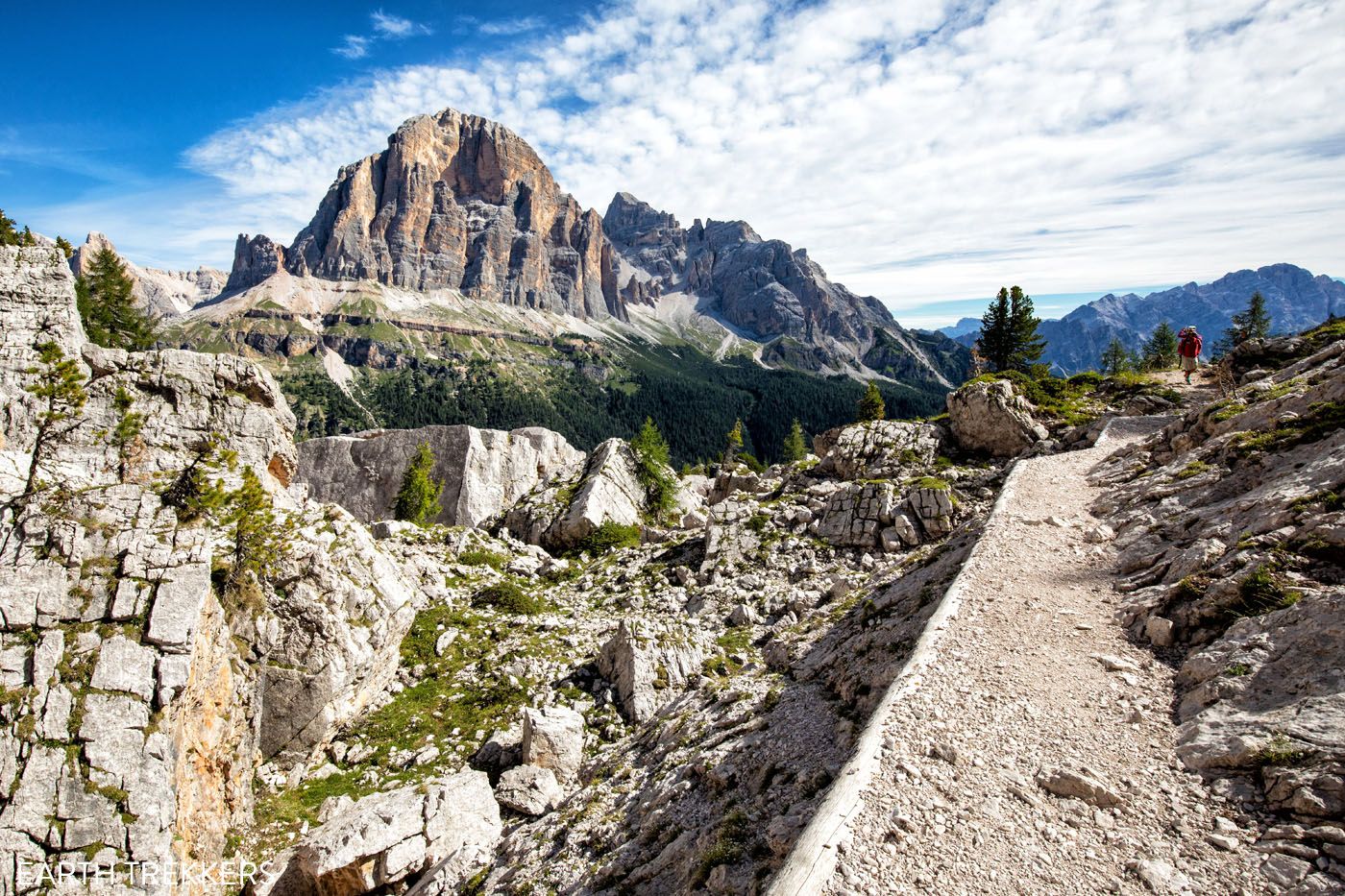
Exiting the opposite side of the Cinque Torri.
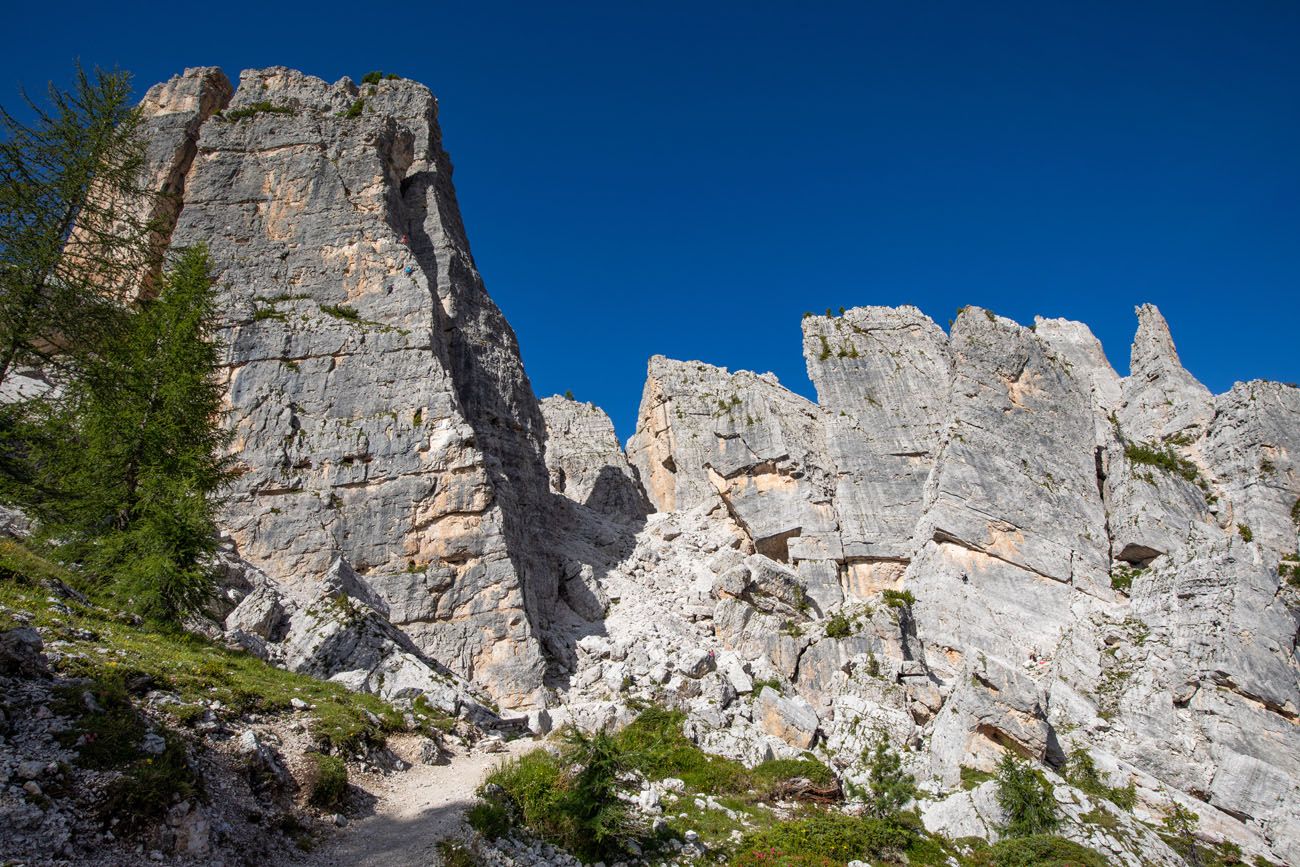
Looking back at the Cinque Torri. On the large tower to the left, if you look closely, you can see several rock climbers.
Once in view of Rifugio 5 Torri, we continued on Giro delle Torre towards the chairlift and Rifugio Scoiattoli. This is the most strenuous part of the hike, as it is mostly uphill here.
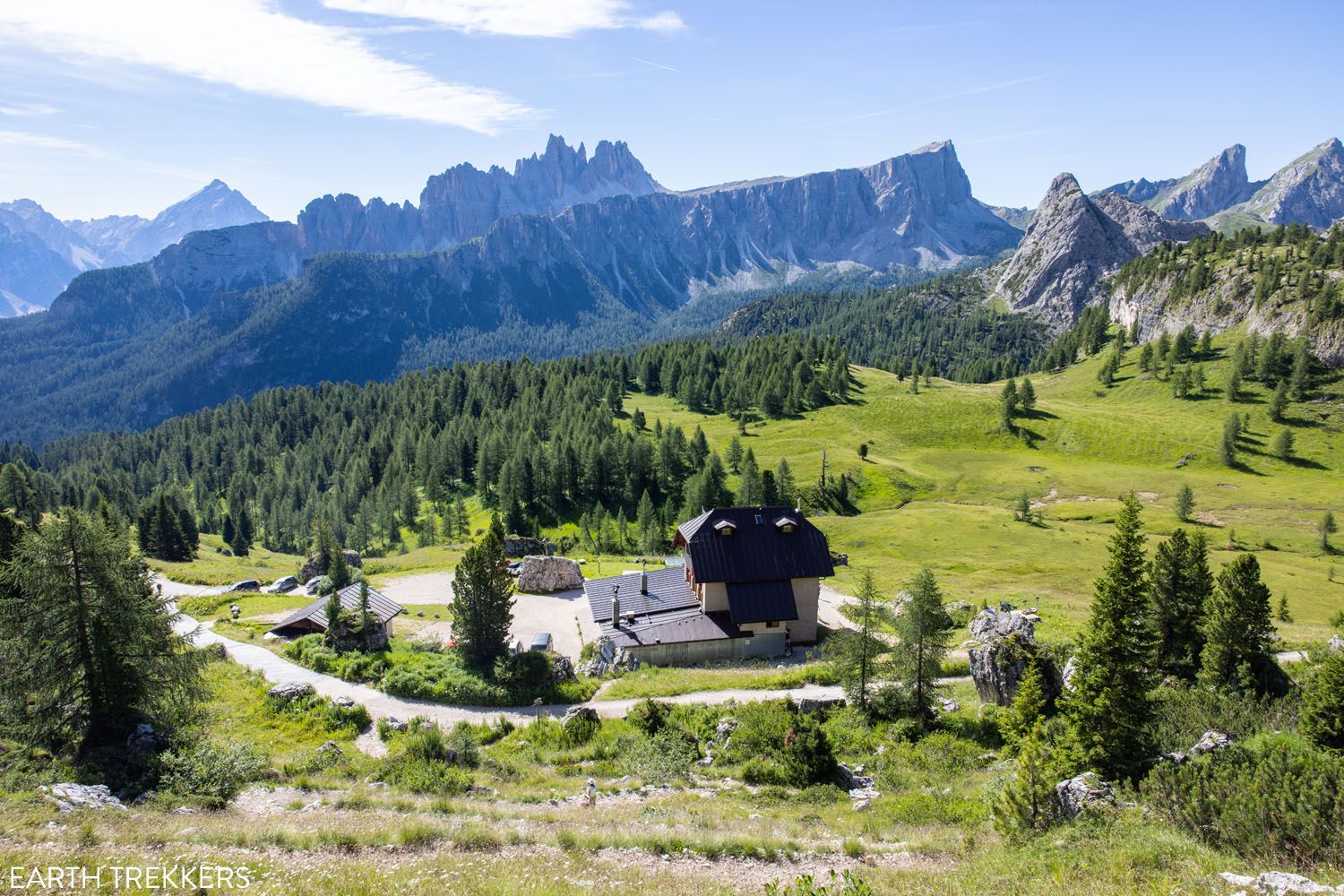
View of Rifugio 5 Torri from the trail.
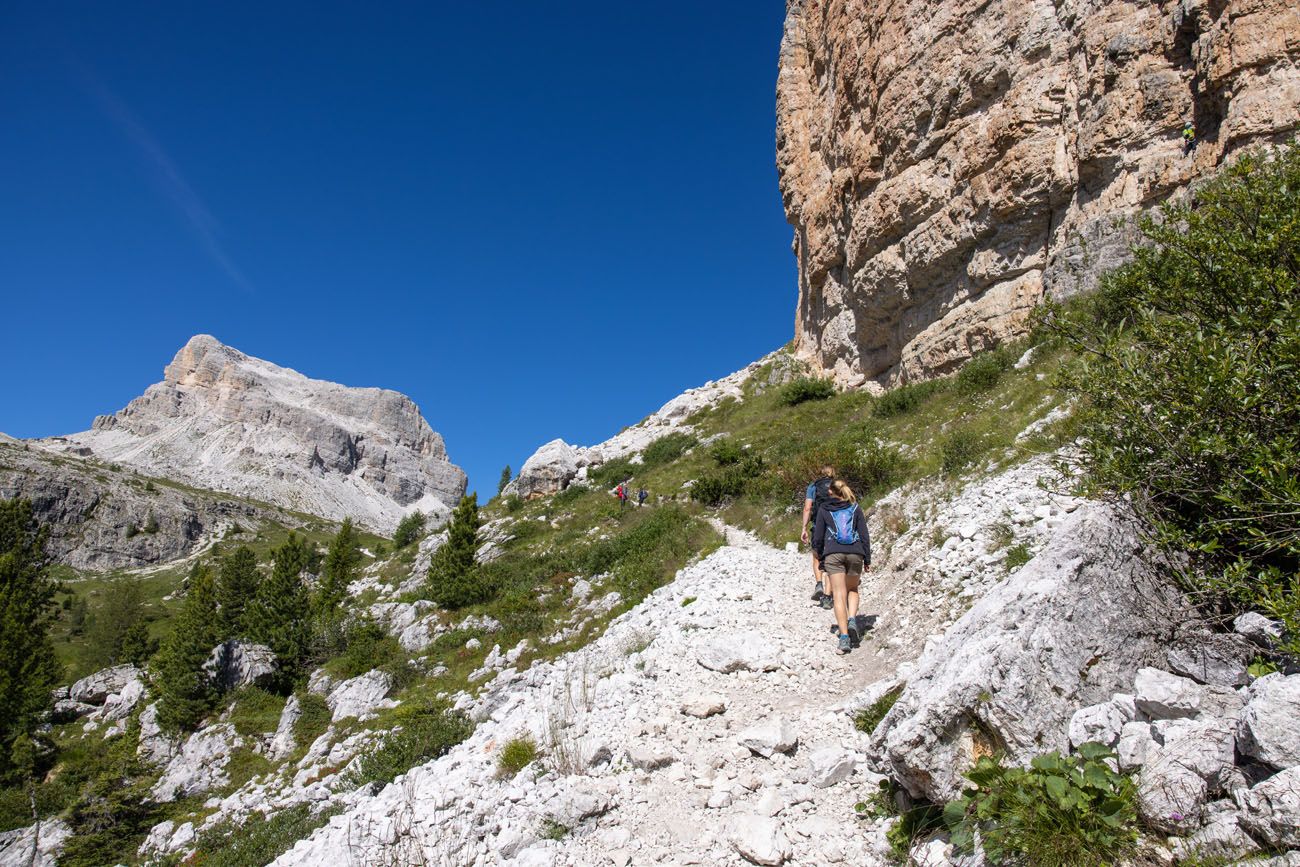
Hiking uphill towards Rifugio Scoiattoli. This is the toughest part of the hike.
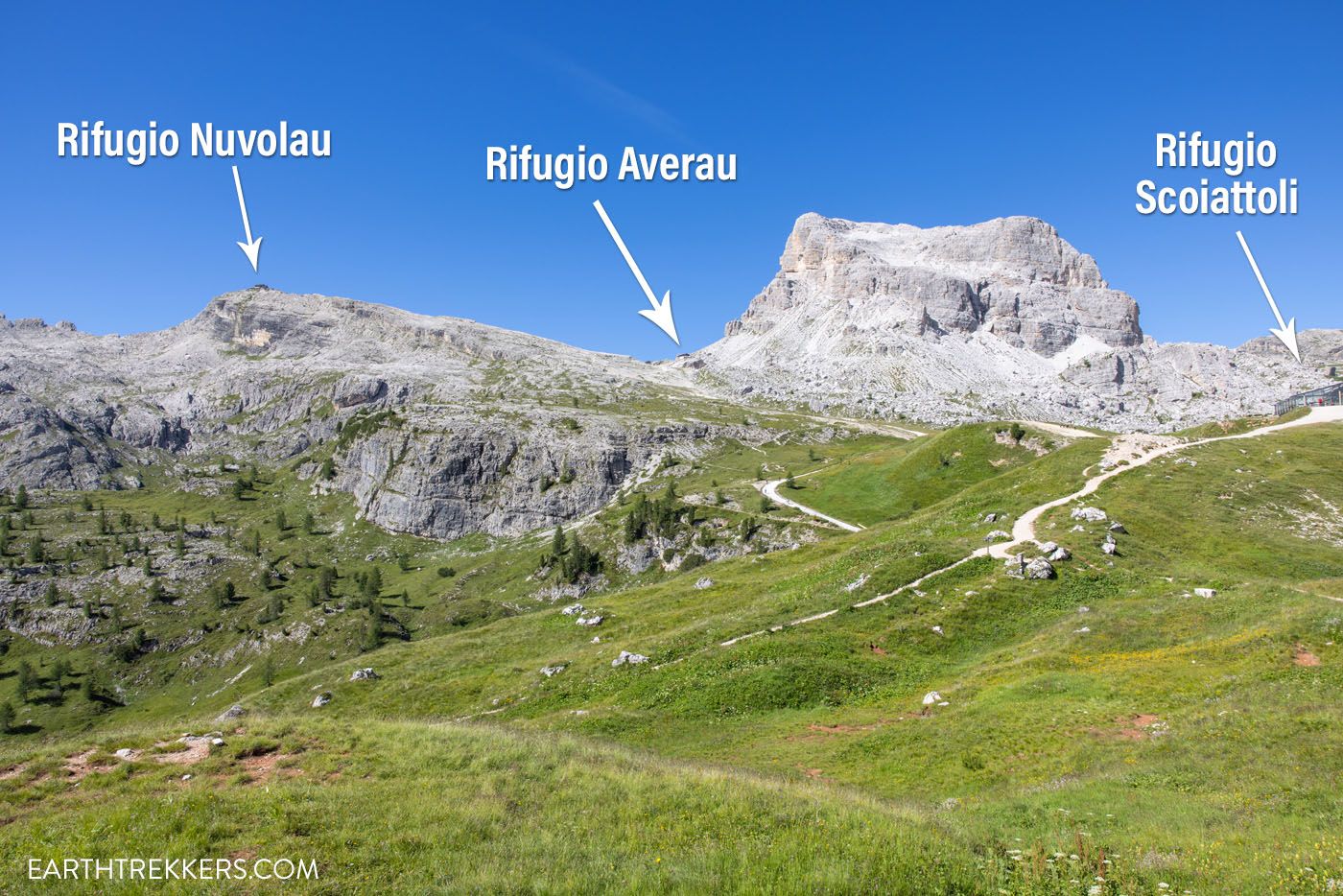
As you approach the top of the hill, Rifugio Scoiattoli comes into view again, along with Rifugio Averau and Rifugio Nuvolau, two mountain huts that are well worth adding onto the Cinque Torri hike.
Once you get past the Cinque Torri, look for a path leading up to a viewpoint…a great place for a family photo.
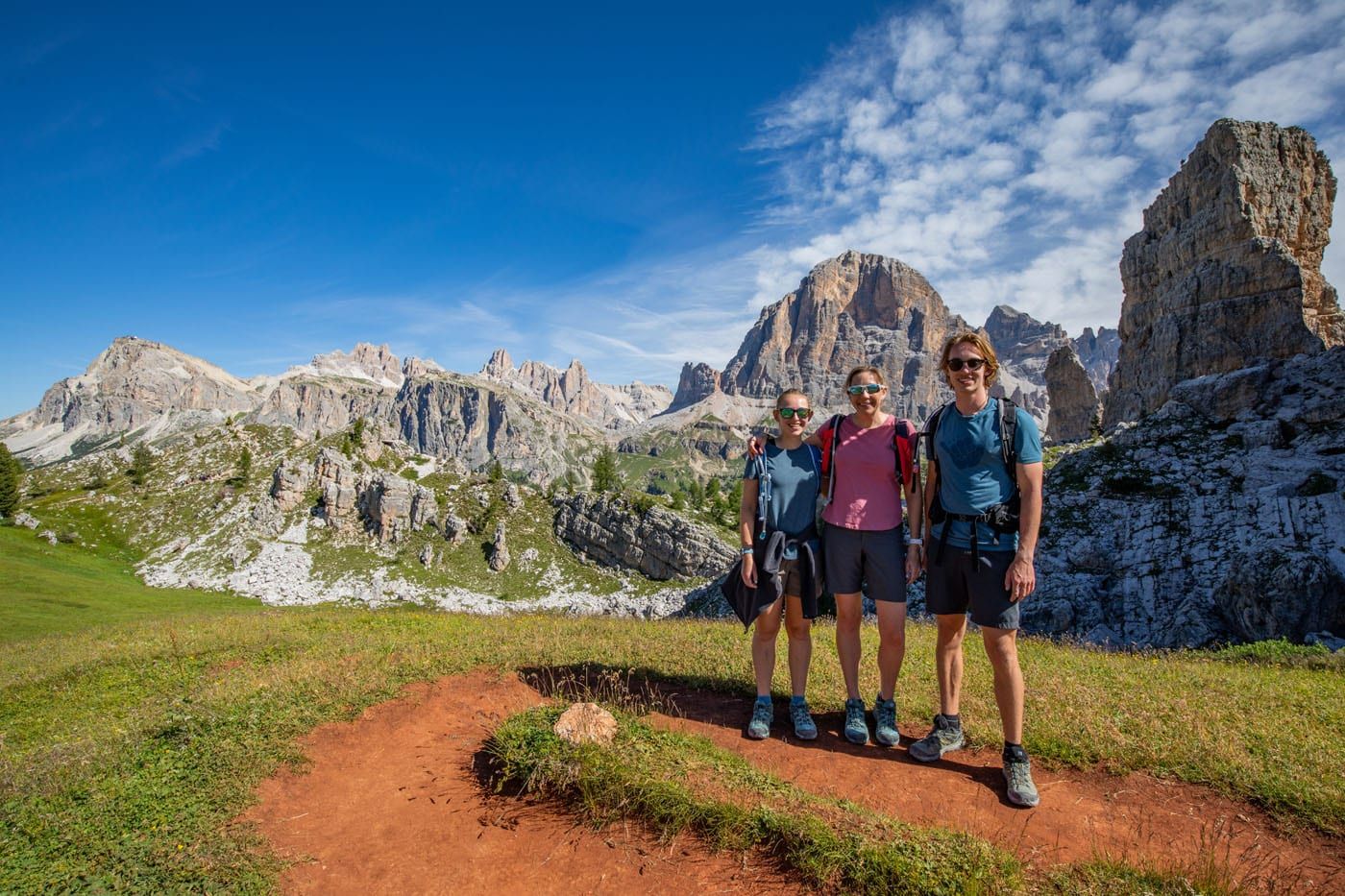
Then, complete the hike by walking back to Rifugio Scoiattoli.
From here, you can have a snack or a meal, ride the chairlift back to your car, or continue on to Rifugio Averau and Rifugio Nuvolau (highly recommended!).
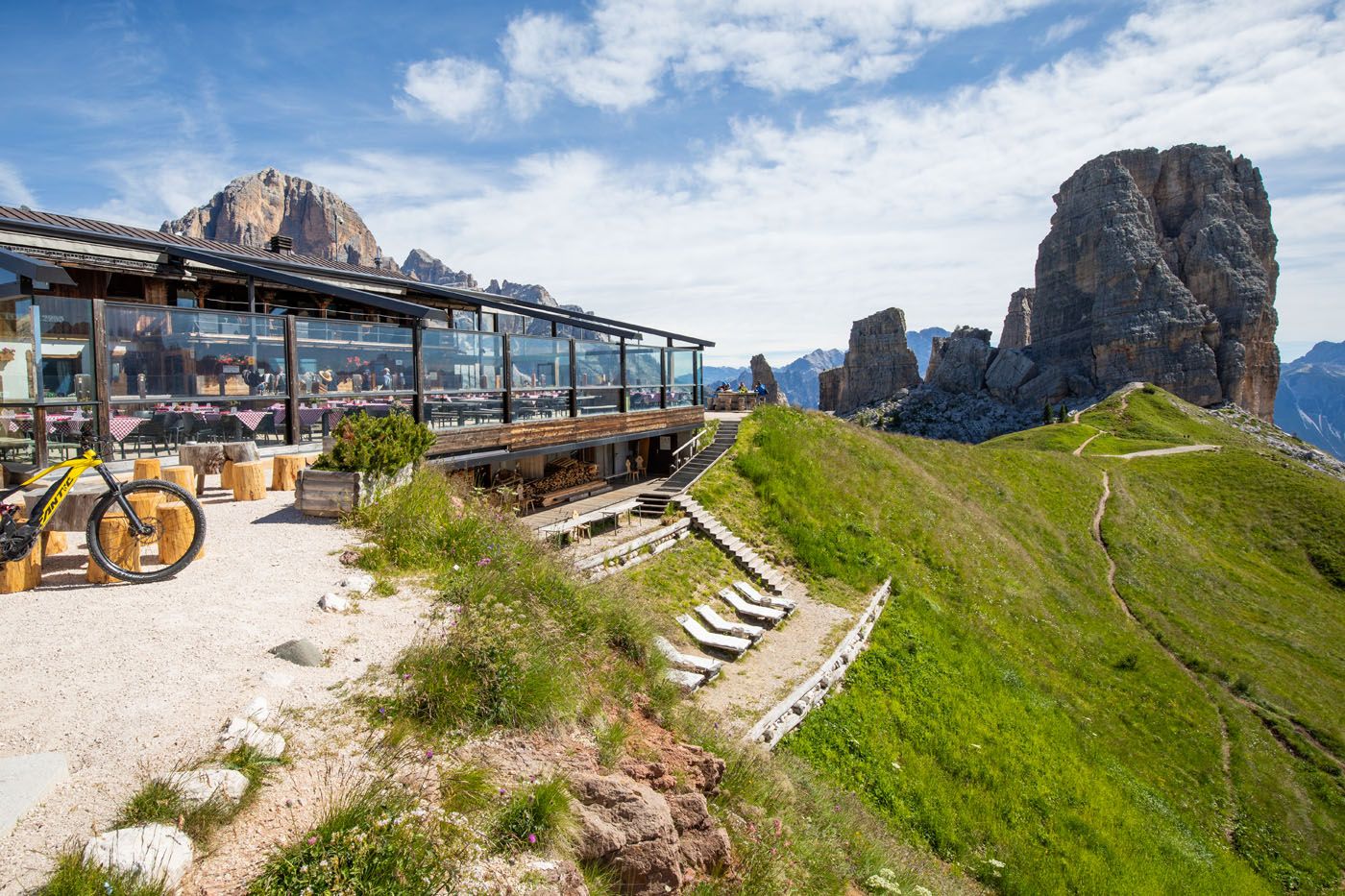
Rifugio Scoiattoli
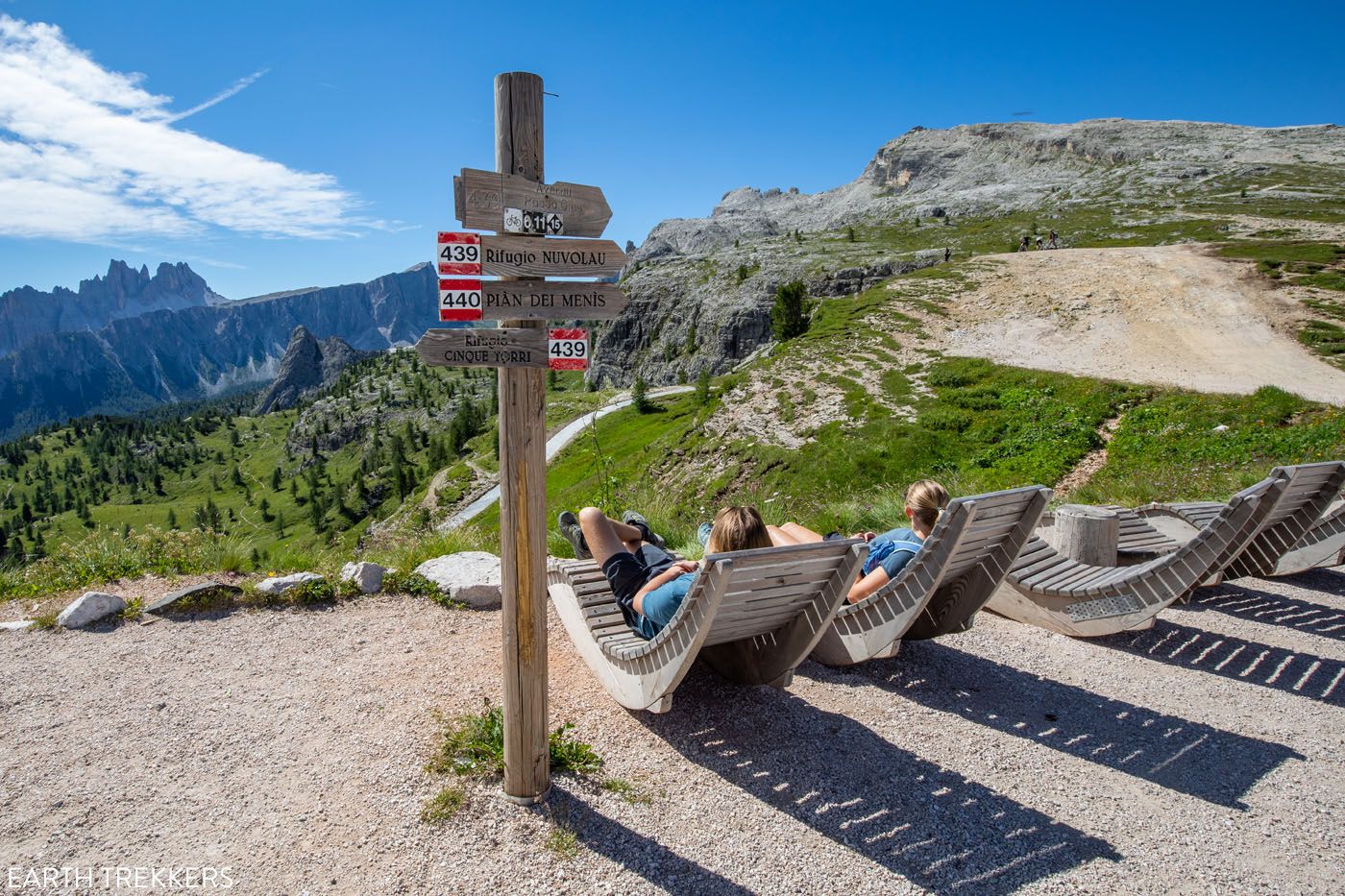
Lounge chairs near Rifugio Scoiattoli
The WWI Open-Air Museum (Museum of the Great War)
More than 100 years ago, the Cinque Torri was the site of fierce conflict between Italian and Austro-Hungarian forces during World War I. Bunkers, trenches, and artillery positions were built among the towers, and after the war ended and the area was abandoned, these structures remained.
In recent years, they’ve been restored and opened as an open-air museum, the Museum of the Great War (Museo della Grande Guerra), making the Cinque Torri one of the most historically significant hiking destinations in the Dolomites.
The museum is woven into the first section of the loop trail. As you head clockwise from Rifugio Scoiattoli, you’ll pass through narrow trenches, duck into bunkers, and encounter mannequins and artillery structures staged to show what life looked like for soldiers fighting at this altitude.
Informational signs throughout explain the history and significance of each site. It’s not a traditional museum, as there are no indoor exhibits or ticket booths, but walking through the actual fortifications where soldiers lived and fought is a striking experience, especially set against the backdrop of one of the most beautiful mountain landscapes in Italy.
One practical note: the museum portion is concentrated in the first half of the loop, before you enter the Cinque Torri rock formation itself. Once you move into the towers, the trail shifts to pure scenery. So if the history is a big draw for you, take your time on that first section rather than rushing through to the rocks.
Upgrade Your Visit: Add On Rifugios Averau & Nuvolau
If you only walk the Cinque Torri loop, you’ll get incredible views. But if you have the time and energy to go a bit farther, adding Rifugio Averau and Rifugio Nuvolau turns this into one of the most memorable experiences in the Dolomites.
The Cinque Torri loop is beautiful and relatively quick, but extending the hike to these two rifugios adds bigger views, fewer crowds, and a true “high alpine” feel. For us, this combined route was one of our favorite experiences in the Dolomites.
What Makes This Extension Special
- Rifugio Averau sits at 2,413 meters and is known for having some of the best food in the Dolomites. It’s the perfect place to take a break, grab a drink, or sit down for a meal with a view.
- Rifugio Nuvolau is perched even higher, at 2,575 meters, with 360° panoramic views. From here, you can see some of the most iconic peaks in the Dolomites, making it one of the most scenic viewpoints in the region.
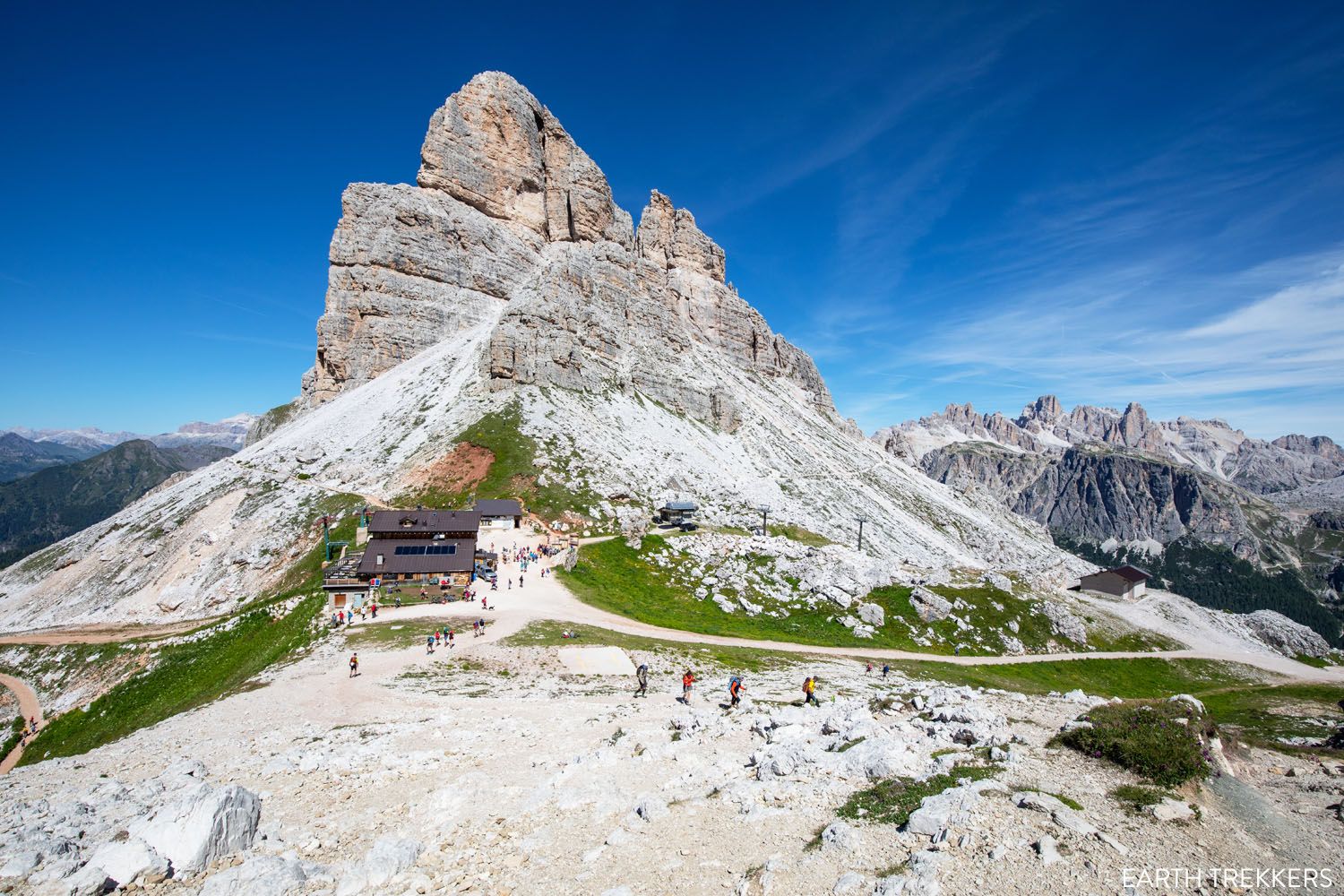
Rifugio Averau (from the trail to Rifugio Nuvolau)
What to Expect
From Cinque Torri, it’s a steady uphill hike to reach Rifugio Averau, followed by a short but steeper climb to Rifugio Nuvolau. The trail is well-marked but does require more effort than the Cinque Torri loop.
- Extra time: 1.5 to 2.5 hours round trip
- Difficulty: Moderate (due to elevation gain)
- Best for: Active travelers and hikers who want more than a quick viewpoint
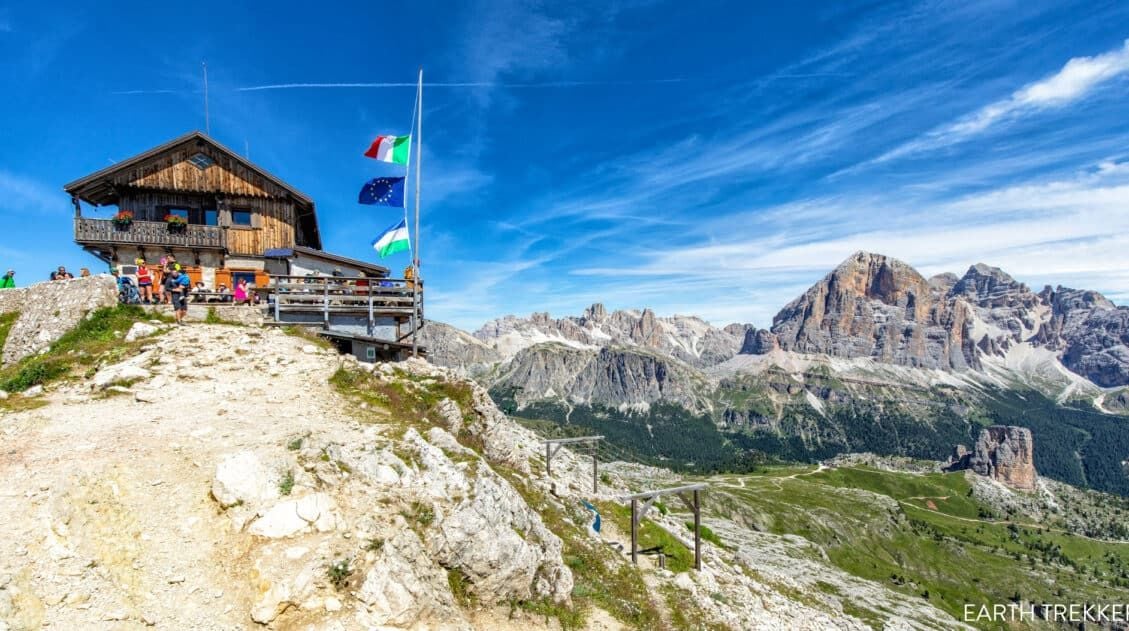
How to Hike Rifugios Averau & Nuvolau for Stunning Dolomites Views
How to add on Rifugios Averau and Nuvolau onto the Cinque Torri.Is It Worth It?
Absolutely. If you’re deciding between just visiting Cinque Torri or turning it into a longer hike, we strongly recommend adding Rifugio Averau and Rifugio Nuvolau. It’s the difference between a quick scenic stop and a standout Dolomites experience.
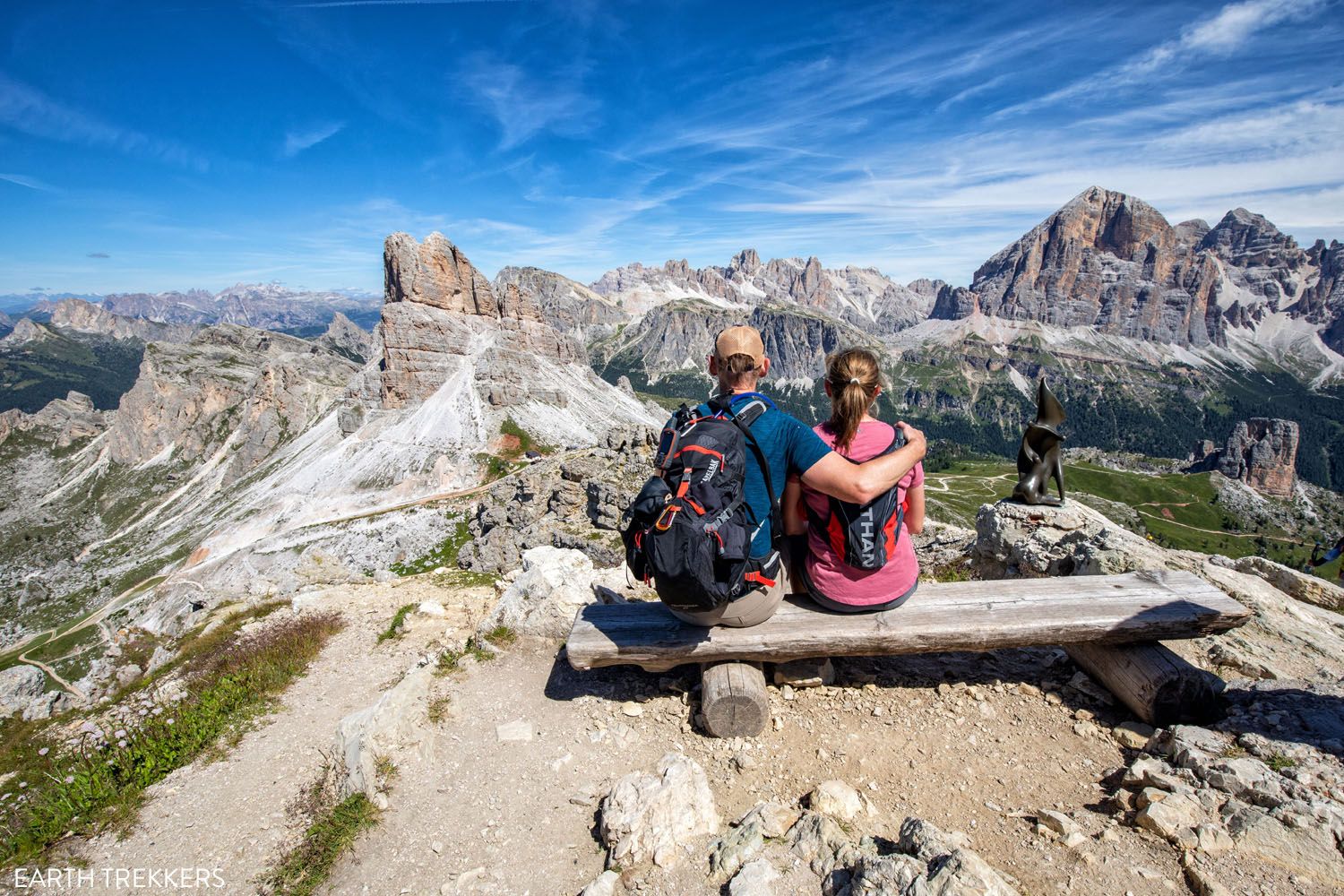
View from Rifugio Nuvolau
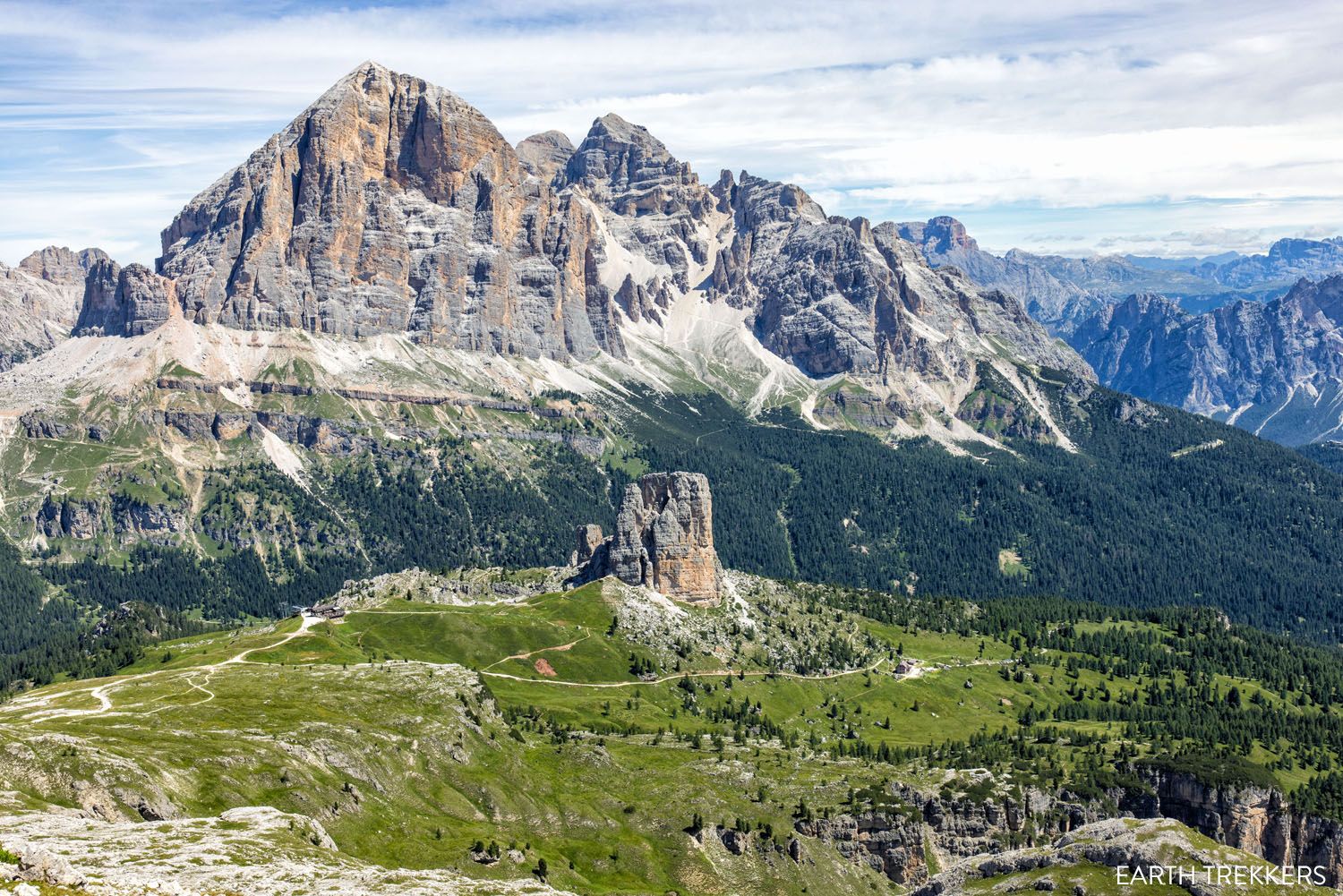
Another view from Rifugio Nuvolau (of the Cinque Torri and Tofana di Rozes)
What to Bring on the Cinque Torri Hike
Walking shoes or hiking shoes. A good pair of walking shoes is sufficient for this hike. However, if you plan to add on Rifugio Averau or Rifugio Nuvolau, then you should wear hiking shoes, since it is a much longer hike over uneven terrain.
Water. I recommend bringing a liter of water per person. It’s not a long hike, but it can be warm in the summer, and it might be nice to have some cool water to drink during the hike.
Sunscreen, hat, and sunglasses. Most of the trail is fully exposed to the sun.
Tips From Our Visit to the Cinque Torri
Start early. We can’t stress this enough. Ride one of the first chairlifts of the day at 9 am. This gives you the Cinque Torri loop almost entirely to yourself, enough time to hike up to Rifugio Nuvolau before it gets overwhelmed, and a real shot at getting a table for lunch. We arrived at Rifugio Nuvolau around 11 am and it was already busy. An hour later when we left, every table was taken. Midday crowds at the Cinque Torri itself are heavy every day in peak summer, not just weekends.
Plan for a half day, minimum. Our visit ran from 9 am to about 1:30–2 pm, which covered the chairlift up, the full Cinque Torri loop, and the add-on to Rifugios Averau and Nuvolau including lunch.
Photography tip. The towers face west, which means they’re backlit by the morning sun when viewed from Rifugio Scoiattoli and the trailhead. If you want the towers well-lit for photos from that angle, afternoon is better, but you’ll be dealing with more people in your shots. For crowd-free photos, go early and accept the backlighting, or focus your photography on the views looking outward toward Tofana and Falzarego, which are stunning at any time of day.
Make the most of your afternoon. Finishing by early afternoon leaves time for more. Two great options nearby: the Cima Tofana gondola (Freccia nel Cielo) for jaw-dropping high-altitude views with minimal effort, or the Lagazuoi cable car followed by the downhill WWI tunnel hike to Falzarego Pass — another incredible combination of history and scenery right on your doorstep.
Sun protection. Most of the trail is fully exposed with very little shade. Bring sunscreen, a hat, and sunglasses regardless of the time of year.
Toilets and food. Toilets are available at the lower chairlift station and at Rifugio Scoiattoli. Food is available at both as well, and if you’re doing the full day we recommend saving your appetite for lunch at one of the rifugios higher up.
Frequently Asked Questions
When is the best time to hike the Cinque Torri?
We started the Cinque Torri hike just after 9 am. We caught one of the first chairlifts of the day, so we were one of the first people hiking here. In the morning, the west side of the Cinque Torri (the side you see from the chairlift and trailhead) is shaded in the morning, so it’s not a great time for photographing it from this side. But crowds were low at 9 am, which made exploring the WWI sites more enjoyable. If you want the best conditions for photography, plan on visiting the Cinque Torri in the afternoon (but you’ll have a lot of people in your photos).
Can you visit the Cinque Torri without hiking?
Yes, and this is one of the things that makes the Cinque Torri so accessible. The chairlift takes you directly up to Rifugio Scoiattoli, and from there you can walk through the WWI open-air museum and around the base of the towers on relatively flat, easy terrain. You don’t need to be a hiker to have a fantastic experience here. It’s also a great option for families with very young children or anyone with mobility limitations who still want to experience the Dolomites up close.
Is the Cinque Torri good for kids?
It’s one of the best places in the Dolomites to bring kids. The chairlift eliminates the hard work of getting up there, the loop itself is short and manageable, and the WWI bunkers and trenches are genuinely fascinating for children in a way that most hikes aren’t. There’s something to explore around every corner. We’d recommend it for kids of most ages, though the terrain is uneven in places so younger toddlers will need to be carried on some sections.
What should I do after hiking the Cinque Torri?
Continue up to Rifugio Averau and Rifugio Nuvolau for even better views of the Dolomites. You could have lunch at one of these mountain huts as well. Less than 10 minutes away from the bottom station of the chairlift is the Lagazuoi cable car. From the top station, more BIG views of the Dolomites awaits and you can hike the short, easy trail from Lagazuoi to the Falzarego Pass back to your car. Or go for a scenic drive, driving over Falzarego Pass and/or Giau Pass.
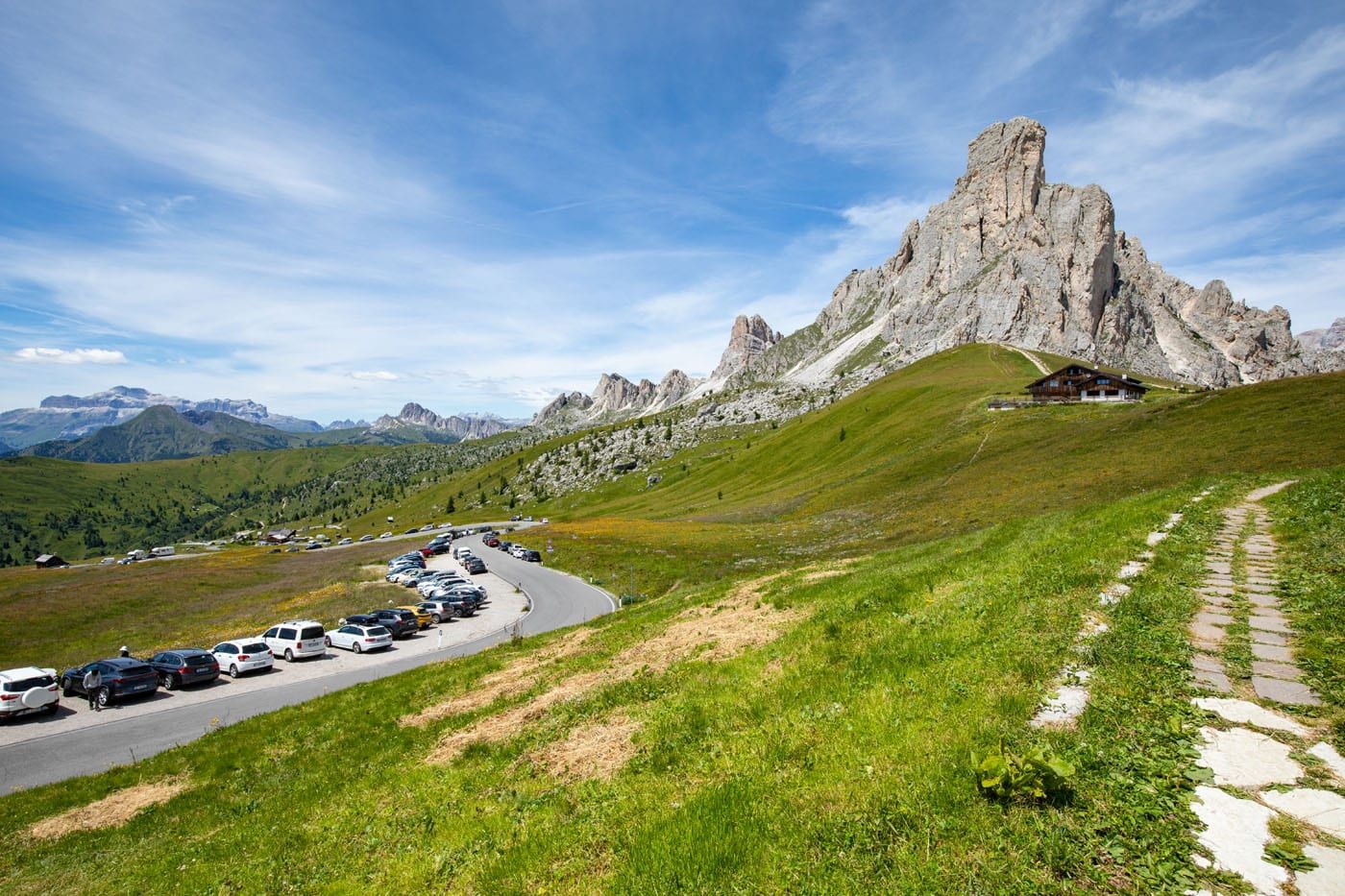
Passo Giau
Plan Your Dolomites Trip
If you’re planning a trip to the Dolomites, the Cinque Torri is just one of many incredible places to explore. We’ve written detailed guides to help you plan your itinerary, choose the best hikes, and make the most of your time in the region.
Start with our Dolomites Travel Guide, which covers when to go, where to stay, and how to get around. For more ideas, see our Best Things to Do in the Dolomites, which includes Cinque Torri along with the region’s top experiences.
If you’re building your itinerary, check out our Dolomites Itinerary, where we show how to combine Cinque Torri with nearby highlights like Lagazuoi, Seceda, and Tre Cime di Lavaredo.
We also have detailed guides to nearby experiences, including Seceda, Lago di Braies, and Tre Cime di Lavaredo, and more of our favorite hikes in the Dolomites.
If you have any questions about the Cinque Torri hike, or if you want to share your experience, let us know in the comment section below.
More Information for Your Trip to Italy
We have TONS more information about Italy in our Italy Travel Guide, including Rome, Florence, Venice, Tuscany, the Dolomites, the Amalfi Coast, the Cinque Terre, Sicily, and Puglia.
What We Wish We Knew Before Visiting the Dolomites
Pinterest Facebook Flipboard The Dolomites. This is where jagged pinnacles of rock soar into the sky, mountain huts and cabins dot the green, rolling hills, cable cars whisk hikers and skiers to the highest mountain peaks, and hiking trails connect small hamlets and towns. It’s easy to fall in love with the photos. Planning a […]
Exactly How to Hike to the Cadini di Misurina Viewpoint
The hike to the Cadini di Misurina viewpoint is one of our favorite short hikes in the Dolomites. This is a gorgeous hike every step of the way, with panoramic views of the surrounding mountains, a unique view of the “backside” of Tre Cime di Lavaredo, and of course, an awesome view of the Cadini […]
Lago di Sorapis Hike: Out-and-Back or As a Loop?
Lago di Sorapis (Lake Sorapis) is one of the most popular hikes in the Dolomites. Located just outside of Cortina d’Ampezzo, this aquamarine lake attracts hundreds of hikers every day during the summer months. The vast majority of people hike out-and-back to Lago di Sorapis on the main trail. What many people don’t know is […]
10 Day Northern Italy Itinerary (Dolomites, Venice & Lake Como)
This 10-day itinerary through Northern Italy features Venice, the Dolomites, Verona, Milan, and Lake Como, with hiking suggestions, hotel recommendations, and practical planning advice based on our numerous trips to Italy. We’ve visited Italy numerous times, exploring these destinations on separate trips over the years, hiking in the Dolomites, wandering the canals of Venice, strolling […]
15 Best Hikes in the Dolomites (Easy to Challenging)
Jagged limestone peaks rise above green valleys, cable cars make it easy to reach the high mountains, and many trails lead to rifugios where you can stop for lunch with an incredible view. The Dolomites are one of the best hiking destinations in Europe, and this guide ranks the 15 best hikes in the Dolomites, […]
Tofana di Mezzo & Cima Tofana: The Freccia nel Cielo Cable Car
There are many fantastic cable car rides in the Dolomites. Most visitors head straight to Seceda or Marmolada and miss this. Cima Tofana delivers jaw-dropping views with a fraction of the crowds, plus you have the option to add on a very short but thrilling hike. We rode the Freccia nel Cielo cable car to […]
Croda da Lago Circuit Hike (+ Lago Federa & Forcella Ambrizzola)
The Croda da Lago Circuit is one of the most underrated hikes that we did in the Dolomites. We’ve explored this region on multiple trips and hiked many of its classic trails, and this loop still stands out for its variety: soaring limestone peaks, quiet alpine meadows, and the impossibly photogenic Lago Federa tucked beneath […]
15 Surprising Things to Do in the Dolomites That Aren’t Hiking
We have traveled to the Dolomites twice, spending 12 days exploring alpine lakes, mountain passes, and hiking trails. This guide features the very best things to do in the Dolomites that require minimal or no hiking, based on our personal experiences. It’s no secret that the Dolomites are a great place to go hiking. But […]
Best Way to Visit Seceda (with Little to No Hiking)
The ridgeline of Seceda looks almost unreal — a dramatic wall of jagged peaks rising above the green pastures of Val Gardena. It’s one of those views that stops you in your tracks, the kind you’ve seen in photos of the Dolomites and wondered, Is it really that beautiful in person? (Yes. It is.) And […]
Hiking the WWI Frontline Trail From Lagazuoi to Passo Falzarego
The Lagazuoi to Passo Falzarego Trail is an easy, downhill hike in the Dolomites that combines stunning alpine views with World War I history. It’s a great hike for families and those looking for a short, sweet hike combined with a thrilling cable car ride. This was the very first hike that we did in […]
Where to Stay in the Dolomites (2026 Guide to the Best Towns & Hotels)
Wondering where to stay in the Dolomites? It’s one of the most important decisions you’ll make when planning your trip. This region may look small on a map, but winding alpine roads and high mountain passes mean travel times are longer than expected. Stay in the wrong town and you could spend hours driving instead […]
Is Marmolada Worth It? Visiting the Highest Peak in the Dolomites
We visited Marmolada while road tripping through the Dolomites, driving from Cortina d’Ampezzo to Val Gardena. Since it is the highest peak in the Dolomites, it had long been on our list of places to visit, and adding it as a stop along this scenic drive made perfect sense. After hiking many of the region’s […]
Dolomites Travel Guide: How to Plan a Trip to the Dolomites
Dolomites Travel Guide The Dolomites are one of the most breathtaking mountain destinations in Europe. Jagged pinnacles of rock soar into the sky, mountain huts and cabins dot the green, rolling hills, cable cars whisk hikers and skiers to the highest mountain peaks, and hiking trails connect small hamlets and towns. We’ve spent 12 days […]


Comments 49