
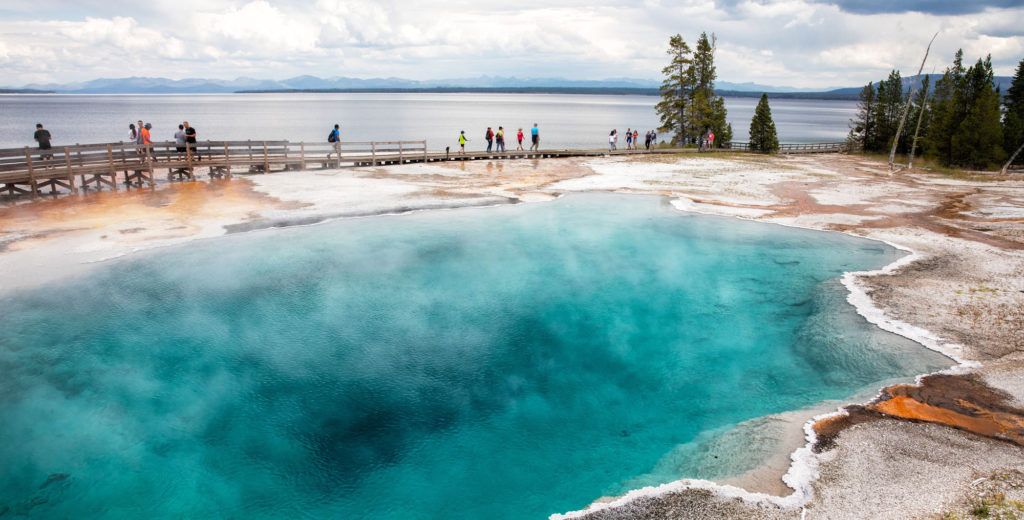
Yellowstone National Park has the highest concentration of geothermal features of anywhere else on earth. The land literally smokes, bubbles and hisses. Numerous geysers erupt on a regular basis, including the most famous geyser in the world, Old Faithful.
We’ve been to Yellowstone four times, and exploring the geyser basins has been a highlight of every trip. We’ve visited every basin in this guide, some of them multiple times over the years, and for two of our favorites, Old Faithful and Grand Prismatic Spring, we’ve put together dedicated guides with even more detail. All of the photos in this post are our own.
In this post, learn how to visit each geyser basin in Yellowstone and which ones are worth your time.
August 2026 Update: Swapped out Boiling River Hot Spring (still closed since the 2022 flood) for the Firehole Swim Area, the park’s other in-park swimming spot, and added clearer verdicts on which geyser basins are actually worth the detour.
Yellowstone Geyser Basins at a Glance
| Geyser Basin | Worth It? | Best For |
| Upper Geyser Basin & Old Faithful | Must-see | Watching Old Faithful erupt |
| Midway Geyser Basin & Grand Prismatic Spring | Must-see | The Grand Prismatic Spring overlook |
| Lower Geyser Basin | Skip if short on time | A quick look at all four geothermal features |
| Mammoth Hot Springs | Worth it | Travertine terraces, flexible time commitment |
| Norris Geyser Basin | Worth it | Otherworldly landscape, fewer crowds |
| Artists Paintpots | Worth it | Bubbling mud pots, a quieter boardwalk |
| West Thumb Geyser Basin | Worth it | Blue springs + Yellowstone Lake views |
| Mud Volcano | Skip for most | Bubbling mud (seen elsewhere too) |
| Firehole Swim Area | Worth it if open | Swimming (unpredictable season) |
About Yellowstone and Its Geysers
Most of Yellowstone sits atop a supervolcano. A supervolcano is a volcanic field that can produce a massive eruption. The Yellowstone supervolcano sits over a giant pool of magma which contains enough magma to fill the Grand Canyon 11 times.
This supervolcano powers the geothermal activity in the park, creating the geyser basins and bubbling mud pots that attract thousands of visitors every year.
The Yellowstone supervolcano last erupted 640,000 years ago. Scientists have been monitoring the volcano, and there are no signs of a future eruption.
Terminology
There are four geothermal features you will see in geyser basins in Yellowstone National Park: geysers, hot springs, fumaroles, and mud pots.
GEYSER: A geyser is a vent in the Earth’s surface that periodically ejects hot water and steam. Water on the surface of the earth seeps down into the earth. This water is heated by a magma chamber. The water is superheated and once it becomes hot enough, it is forcefully ejected out of the vent.
There are about 1000 geysers in the world and most of these can be seen in Yellowstone. The word “geyser” comes from the Icelandic name “Geysir,” the proper name of a hot spring in Iceland.
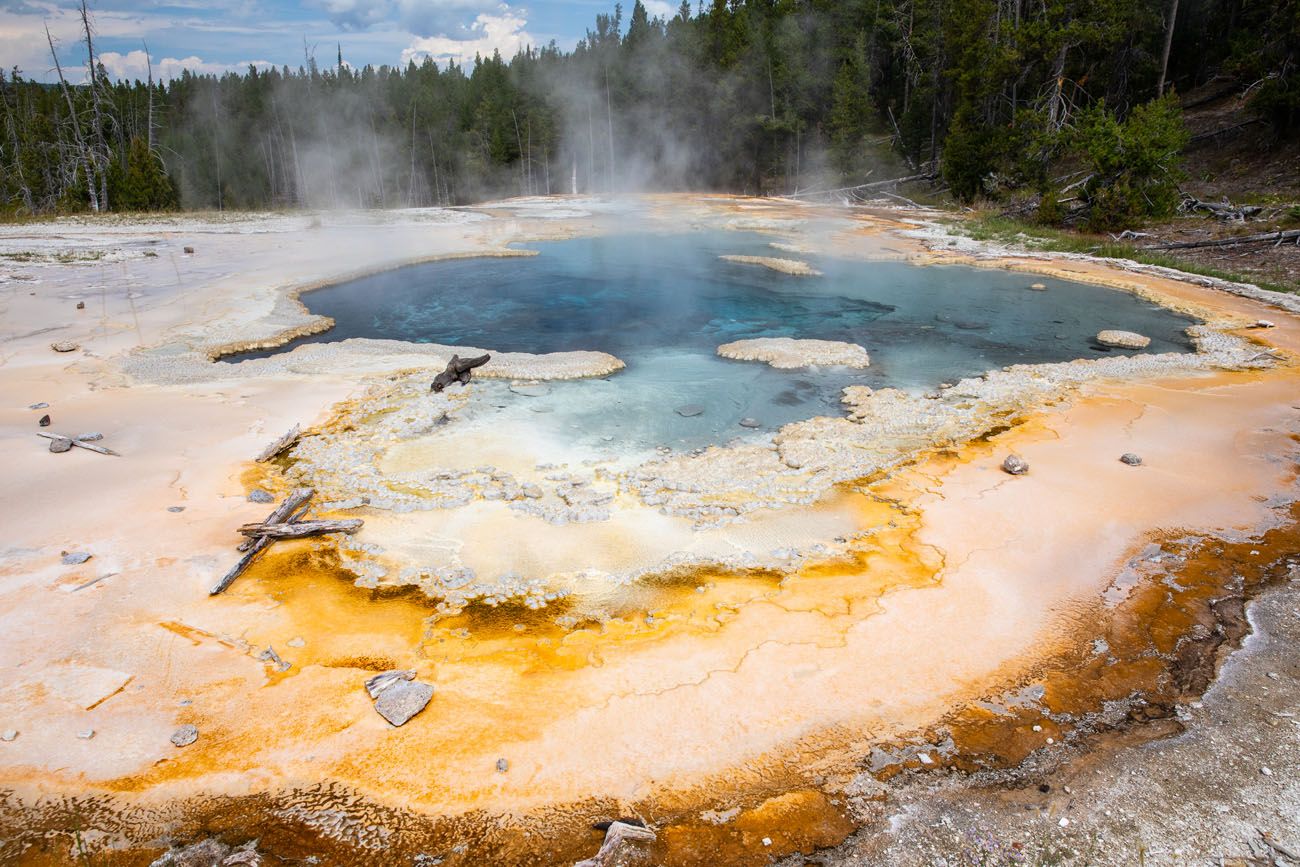
HOT SPRING: A hot spring, also called a thermal spring, is a spring with water temperatures that are much higher than the air temperature. Some, but not all hot springs are heated by magma below the Earth’s surface.
The colors in hot springs are caused by the bacteria and algae that live and thrive on these hot conditions.
FUMAROLE: A fumarole is a vent in the Earth’s surface that emits steam and volcanic gases.
MUD POT: A mud pot is an acidic spring with limited water. The mud bubbles, hisses, and belches hydrogen sulfide gas, with gives mud pots the odor of rotten eggs.
How to Use This Map: Click the icons on the map to get more information about each point of interest. To take this map with you, click the star next to the title of the map which adds it to your Google account. Next, within your Google Maps app, select ‘Saved’ and then select ‘Maps’. This map title will now appear in your list.
Upper Geyser Basin & Old Faithful
Our Take: A must. This is where you’ll watch Old Faithful erupt and wander past dozens of other geysers on one of Yellowstone’s best boardwalk walks. Plan on at least two hours here, more if you add the walk out to Morning Glory Pool.
Within 1 square mile, there are over 150 geothermal features, making this one of best places in the park to see hot springs and geysers.
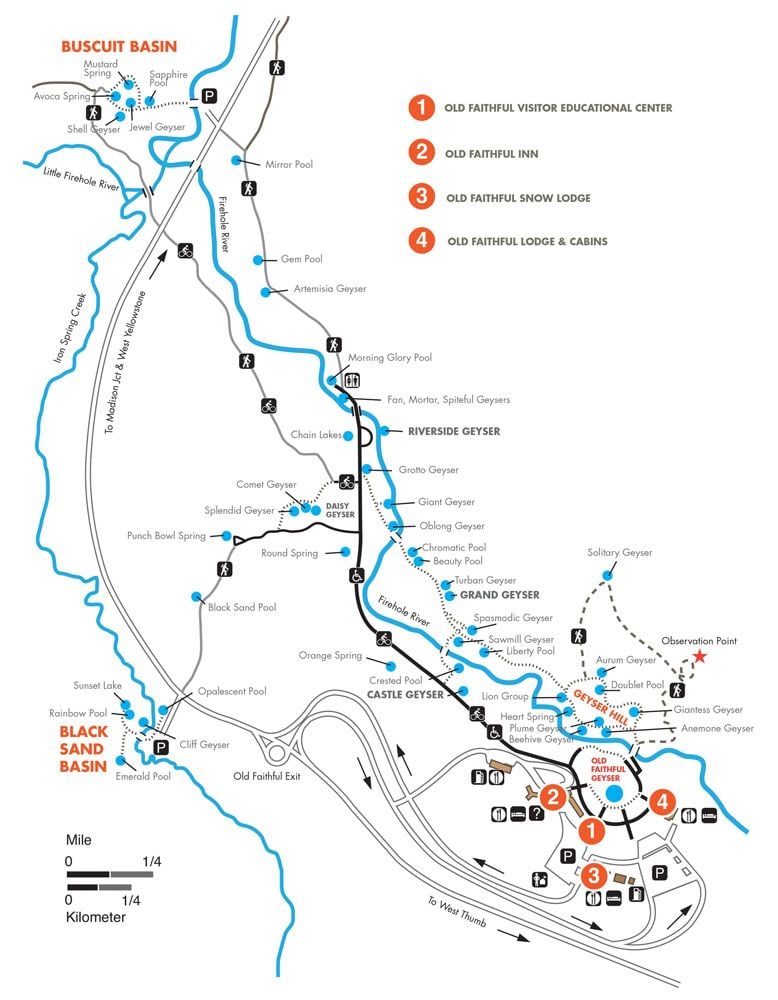
There are several sections of Upper Geyser Basin:
- Old Faithful
- Geyser Hill
- Along Firehole River
- Black Sand Basin
- Biscuit Basin
Old Faithful
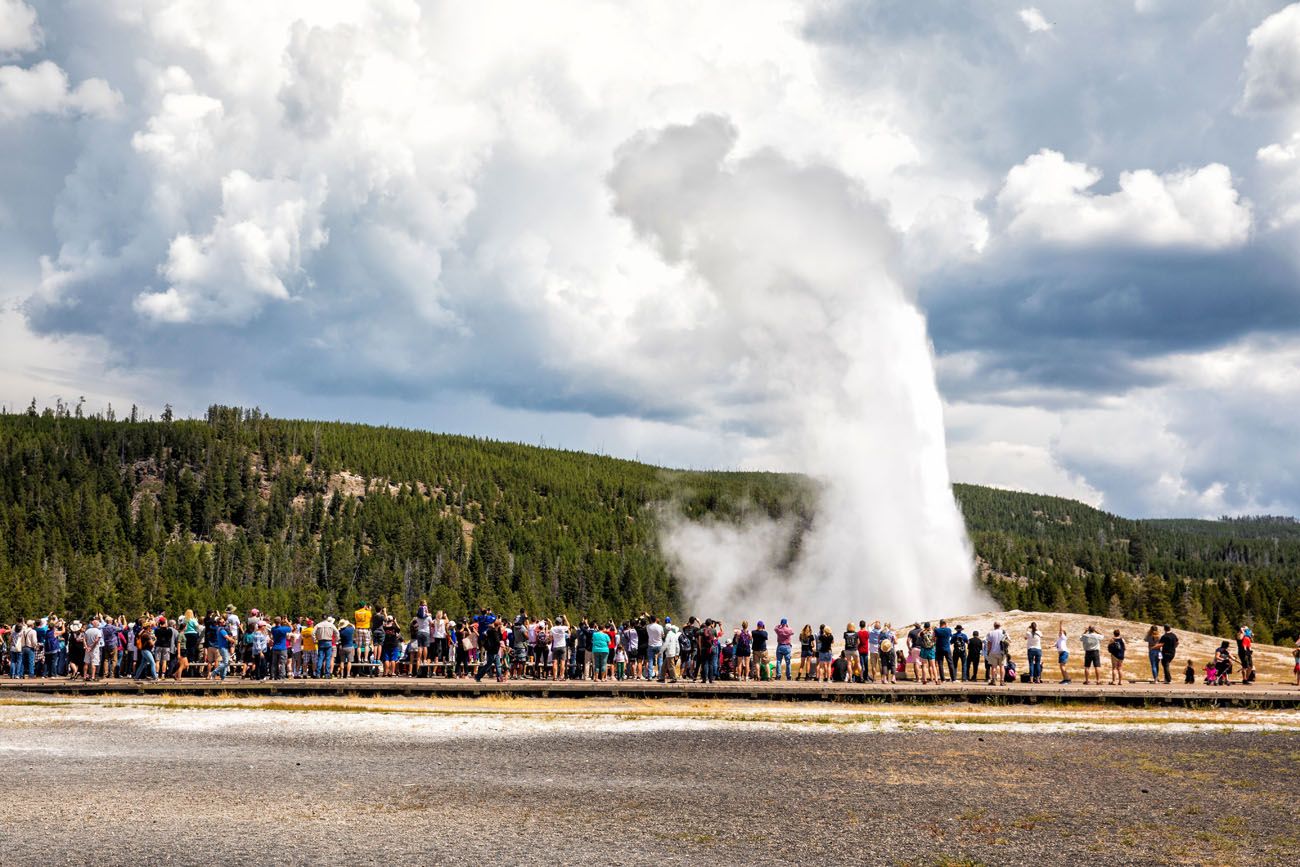
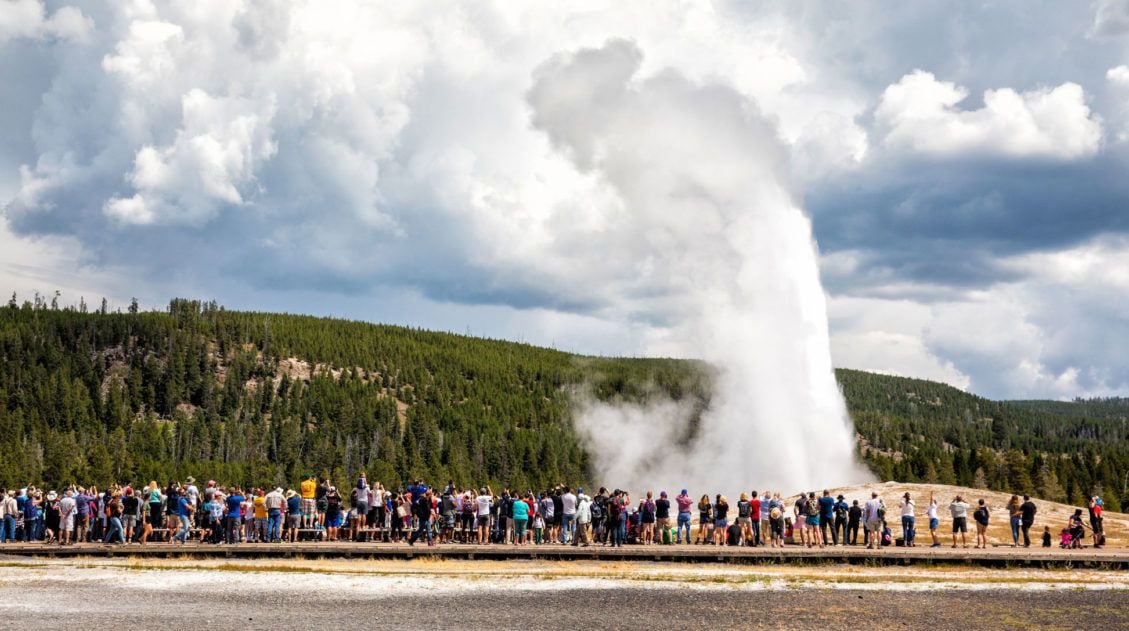
Old Faithful is the world’s most famous geyser. For decades, this geyser has been erupting on a very reliable schedule. So reliable, in fact, that you can even get expected eruption times online to help you plan your visit.
Old Faithful Eruption Schedule: Old Faithful erupts roughly every hour and thirty minutes, give or take 10 minutes (although on rare occasions, it can take up to 2 hours for the next eruption). The eruption typically lasts 3 to 4 minutes. Get the next predicted eruption time here.
There are three ways to view the eruption of Old Faithful:
Grab a seat on the boardwalk that surrounds the geyser. This is the most popular and the most crowded viewpoint, since you can walk right up to the geyser to watch it erupt.
Hike to Observation Point on Geyser Hill for a bird’s eye view of Old Faithful. With just a handful of people, this is a great place to escape the crowds and still get a stunning view of the eruption. To get here, it is a 1.1-mile round trip hike. It’s a short, strenuous uphill walk to get the viewing area. We got here 30 minutes before the predicted eruption time and had a picnic lunch while waiting.
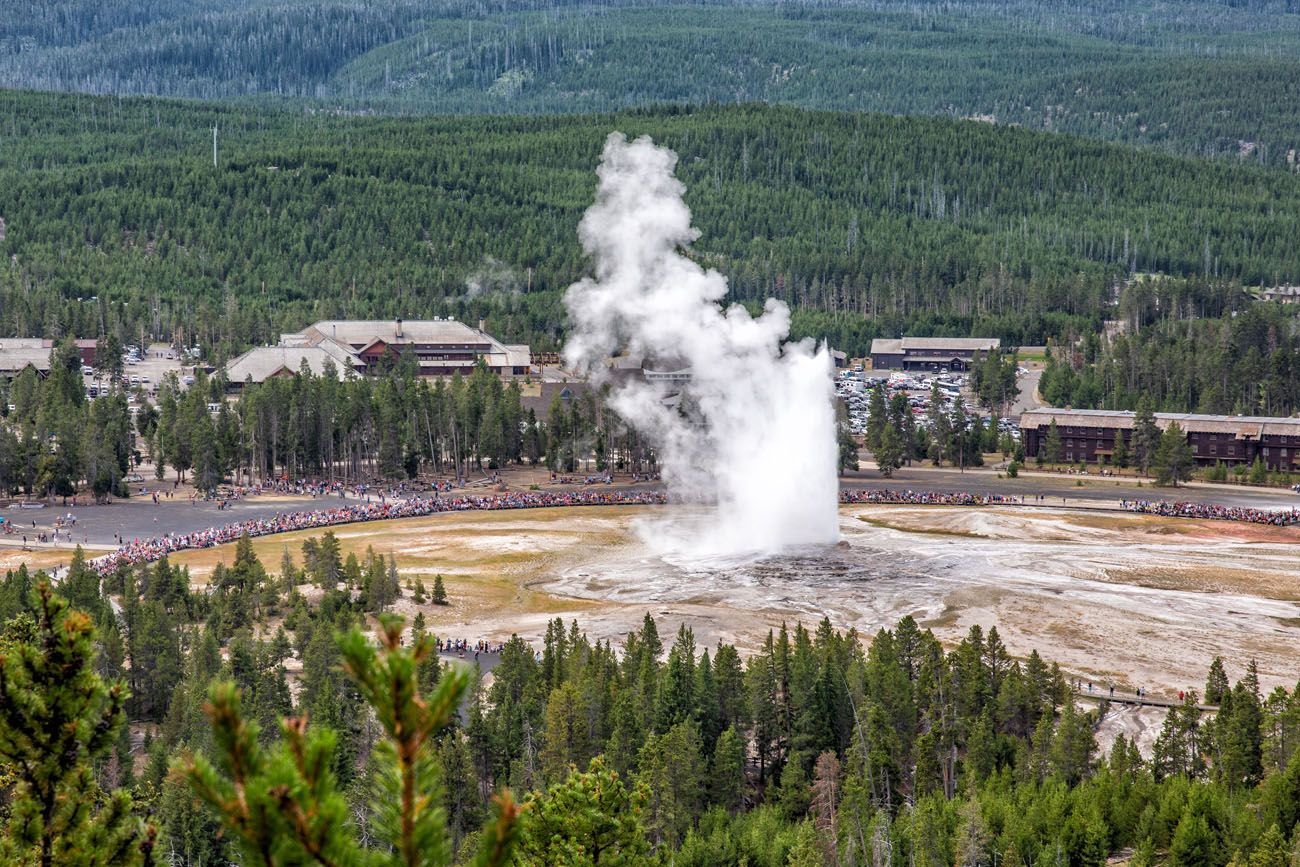
Take a seat at the viewing deck at the Old Faithful Inn. Get a drink at the bar, have a seat, and enjoy the view.
For full details on how to visit Old Faithful, with tips on how to avoid the crowds and how to plan your time, read our Guide to Old Faithful ↓
How to Visit Old Faithful in Yellowstone: Best Views, Timing & Tips
Everything you need to know to visit Old Faithful and the nearby geyser basins.Geyser Hill
Geyser Hill is just a short walk from Old Faithful. Boardwalk trails weave their way between a handful of geysers, including Beehive Geyser and Giantess Geyser.
Beyond the boardwalk trail is a hiking trail that takes you farther up the hillside.
Observation Point sits at the top of this hill and it is our favorite viewpoint to watch an eruption of Old Faithful. It is 1.1 miles round trip to hike to Observation Point. To get up to Observation Point, you will hike up a series of switchbacks to get to the viewpoint.
Before you head back down towards Old Faithful, it is worth making the quick detour to Solitary Geyser. Most eruptions occur every 4 to 8 minutes and last 1 minute.
Along Firehole River
Stretching along the Firehole River, from Geyser Hill to Morning Glory Pool, is a boardwalk trail that passes by an incredible number of geysers and hot springs.
There are enough geysers in this short section that you will probably get to see at least one in action. The most notable geysers are:
- Grand Geyser: the tallest predictable geyser known
- Riverside Geyser: this geyser sits on the side of Firehole River and erupts into the river
- Grotto Geyser: this geyser erupts every 8 hours but once it gets going, the eruption can last anywhere from 10 minutes to several hours
- Castle Geyser: a cone geyser that erupts every 10 to 12 hours and lasts 20 minutes
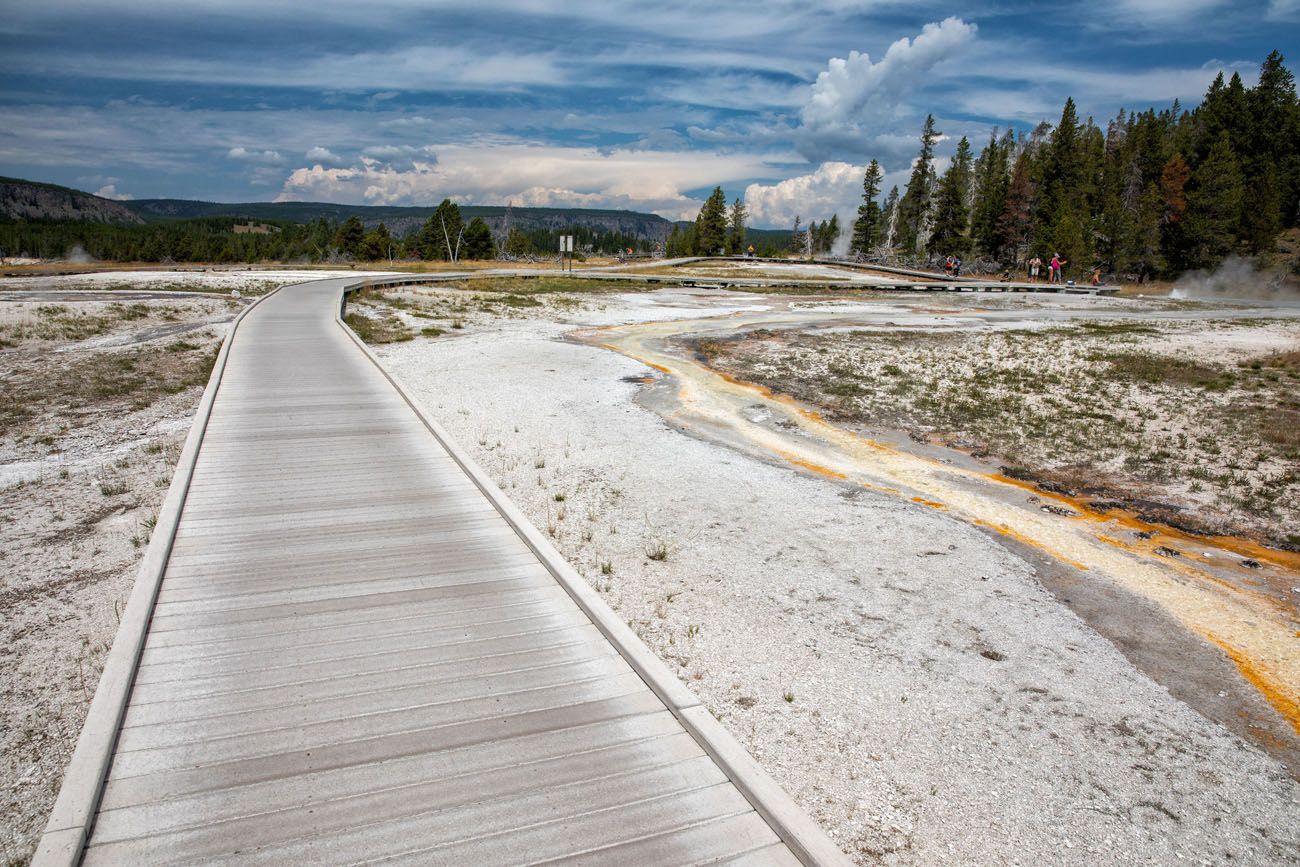
Boardwalk trail in Upper Geyser Basin
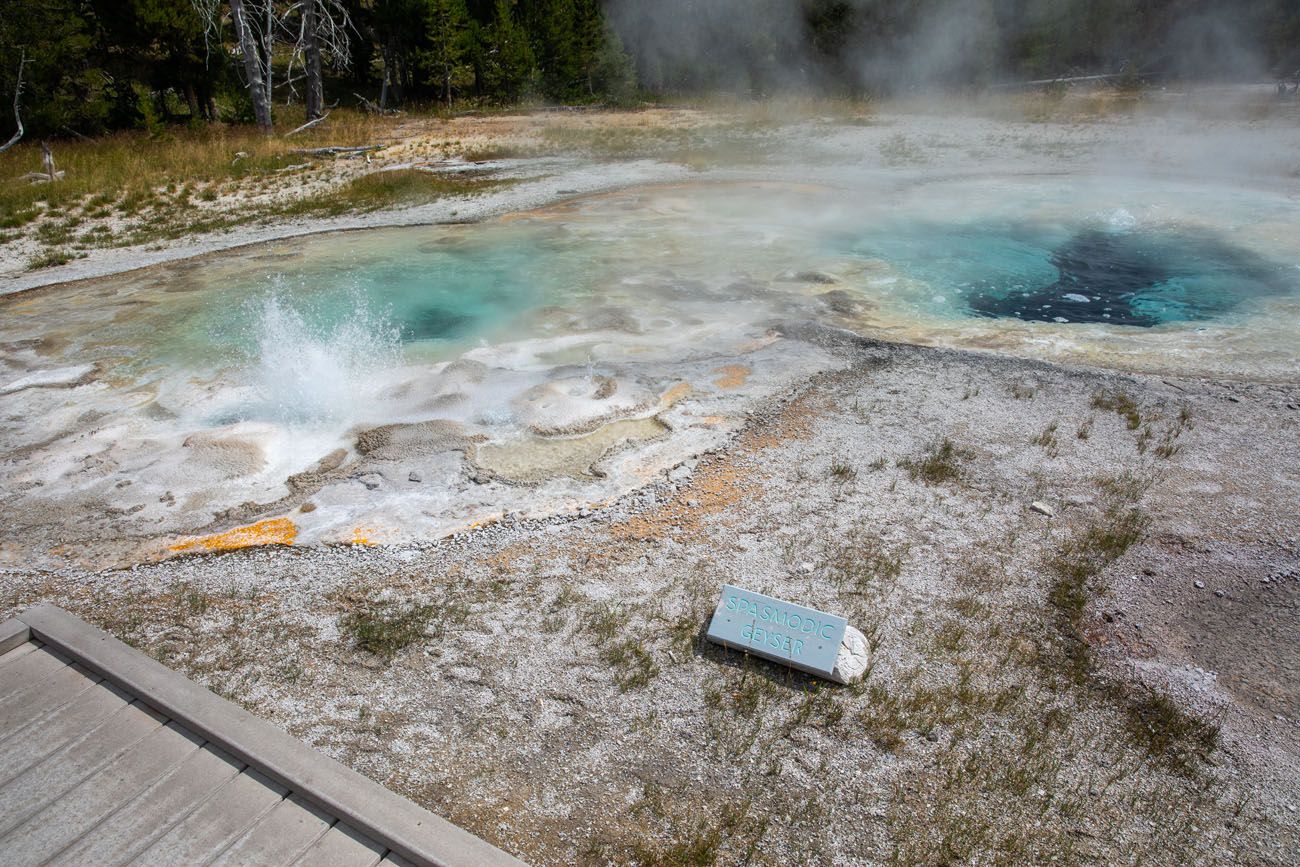
Spasmodic Geyser
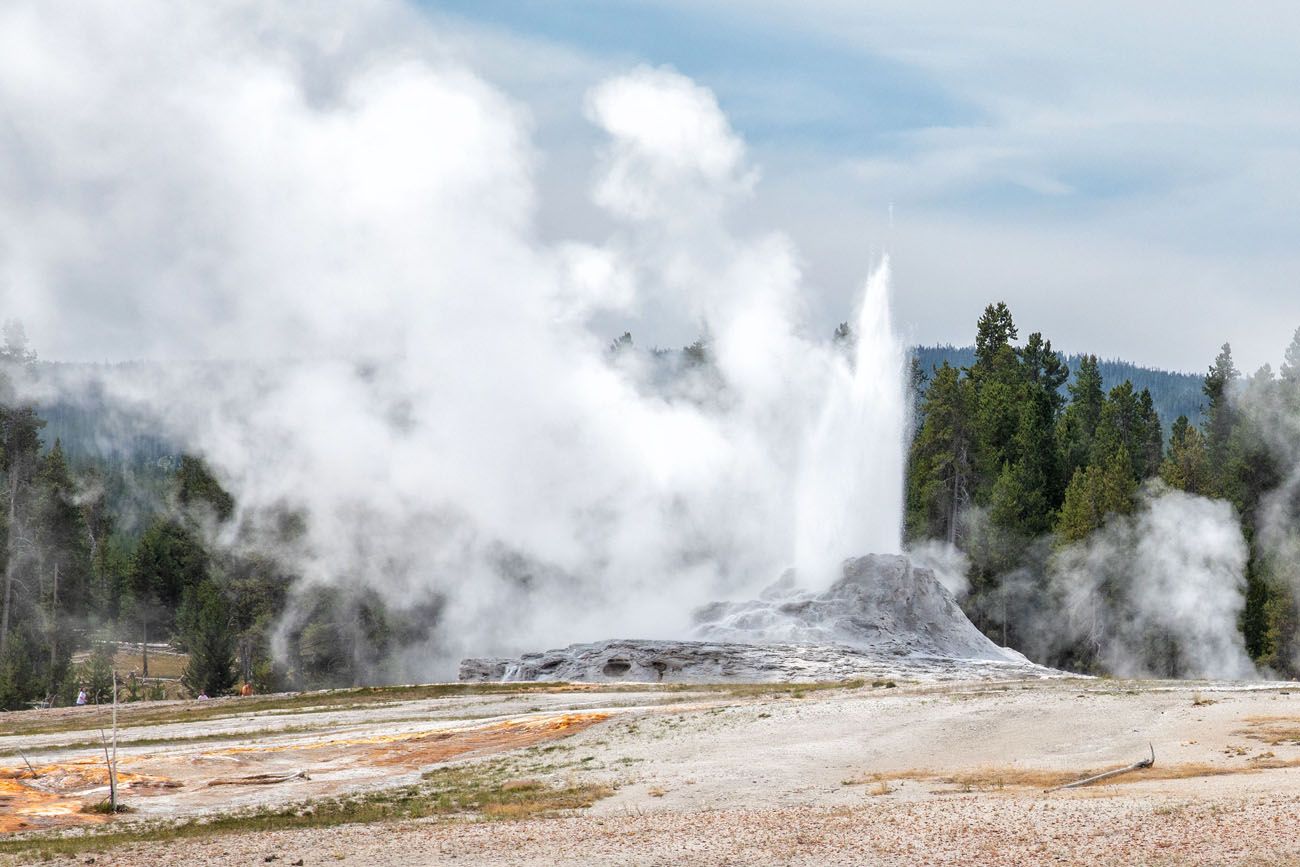
Castle Geyser
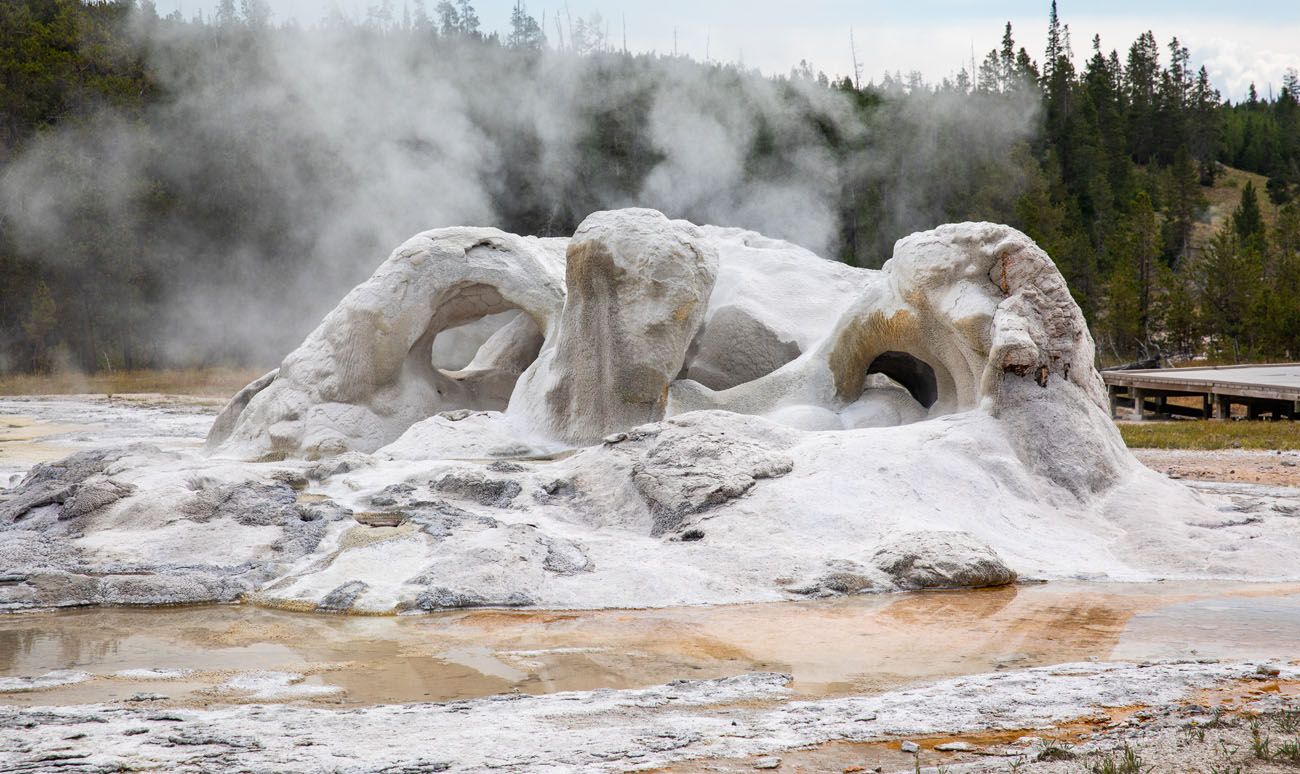
Grotto Geyser
Morning Glory Pool sits at the north end of this section of geysers. This vibrantly colored pool is one of the prettiest features in Upper Geyser Basin and it is well worth the 3-mile round trip walk from Old Faithful.
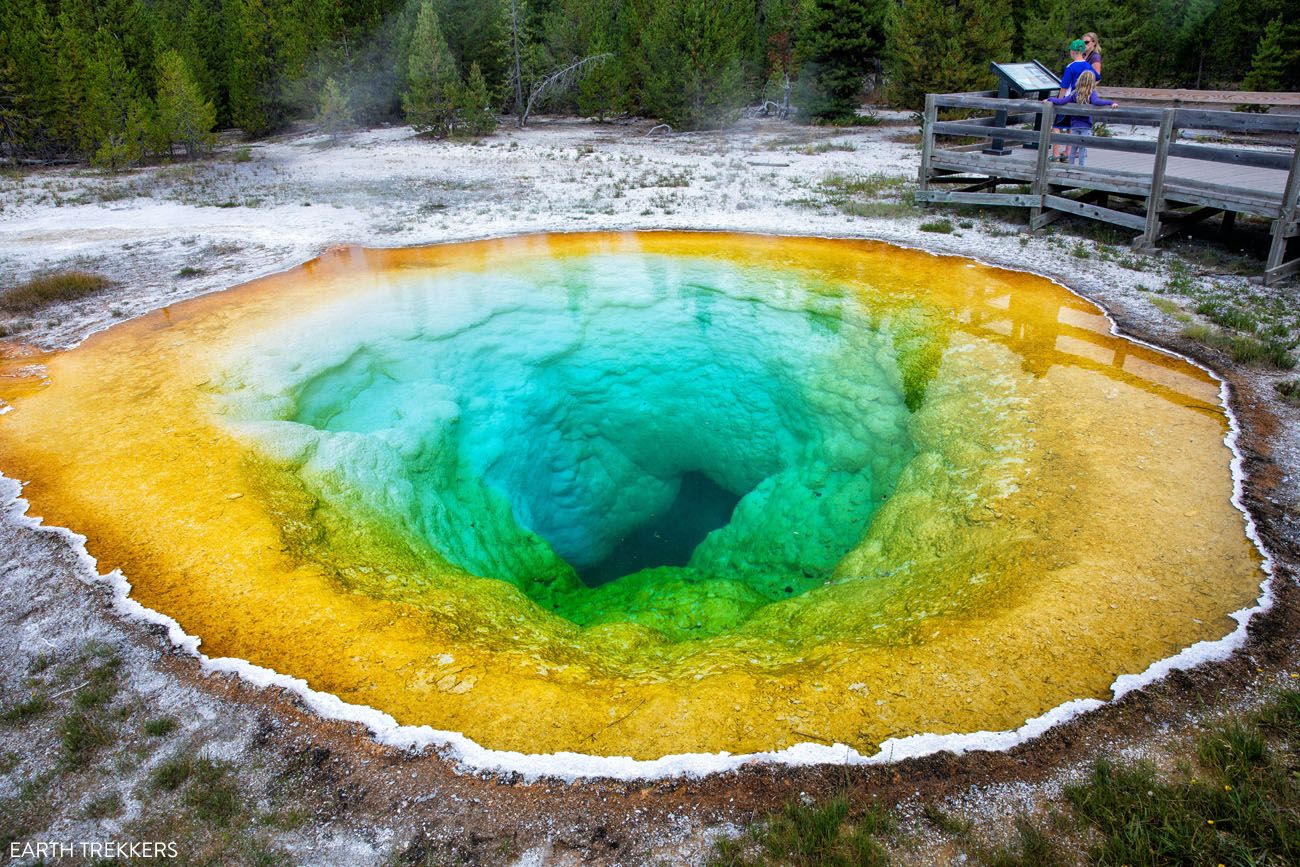
Upper Geyser Basin Walking Route: Combine Old Faithful, Geyser Hill, and Firehole River into one easy-to-do walking loop. Watch the eruption from the boardwalk that surrounds Old Faithful. Walk the paved path out to Morning Glory Pool and then follow the boardwalk trails to Geyser Hill. From Geyser Hill, walk up to Solitary Geyser and Observation Point. If you get your timing right, you will be able to watch a second eruption of Old Faithful from here.
Black Sand Basin
This geyser basin is part of the Upper Geyser Basin. You can walk here from Old Faithful, but it’s a long walk, so I recommend driving here instead.
This geyser basin is named for its black sand, which is formed from obsidian, which occurs when lava cools very quickly. This is a showcase of colorful pools and Cliff Geyser, which erupts every few minutes.
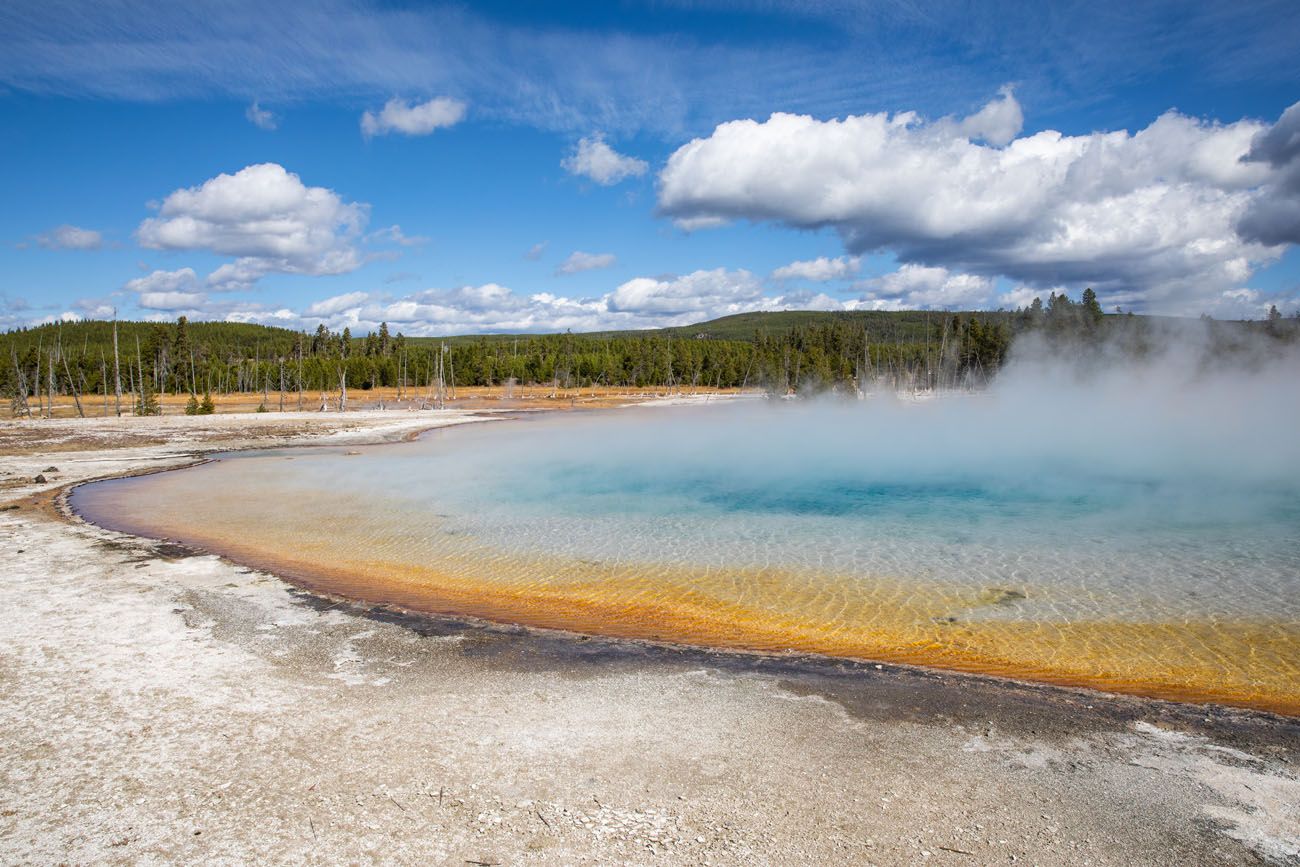
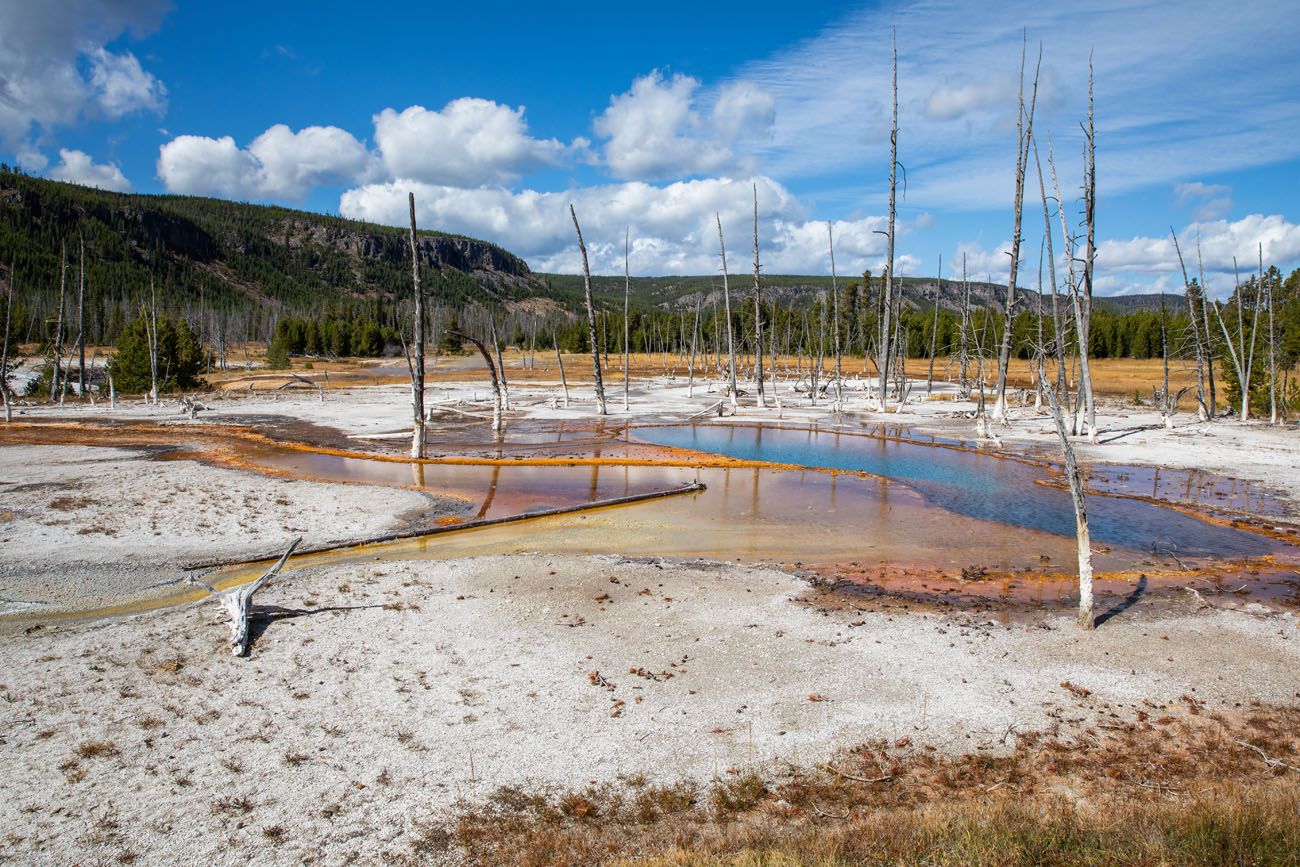
Biscuit Basin
This geyser basin is also part of Upper Geyser Basin. Like Black Sand Basin, I recommend driving here, to save yourself a lot of time and energy, rather than walking.
The highlight here is Sapphire Pool, aptly named for its deep blue color.
Note: Biscuit Basin is closed in 2025 due to a hydrothermal explosion in 2024.
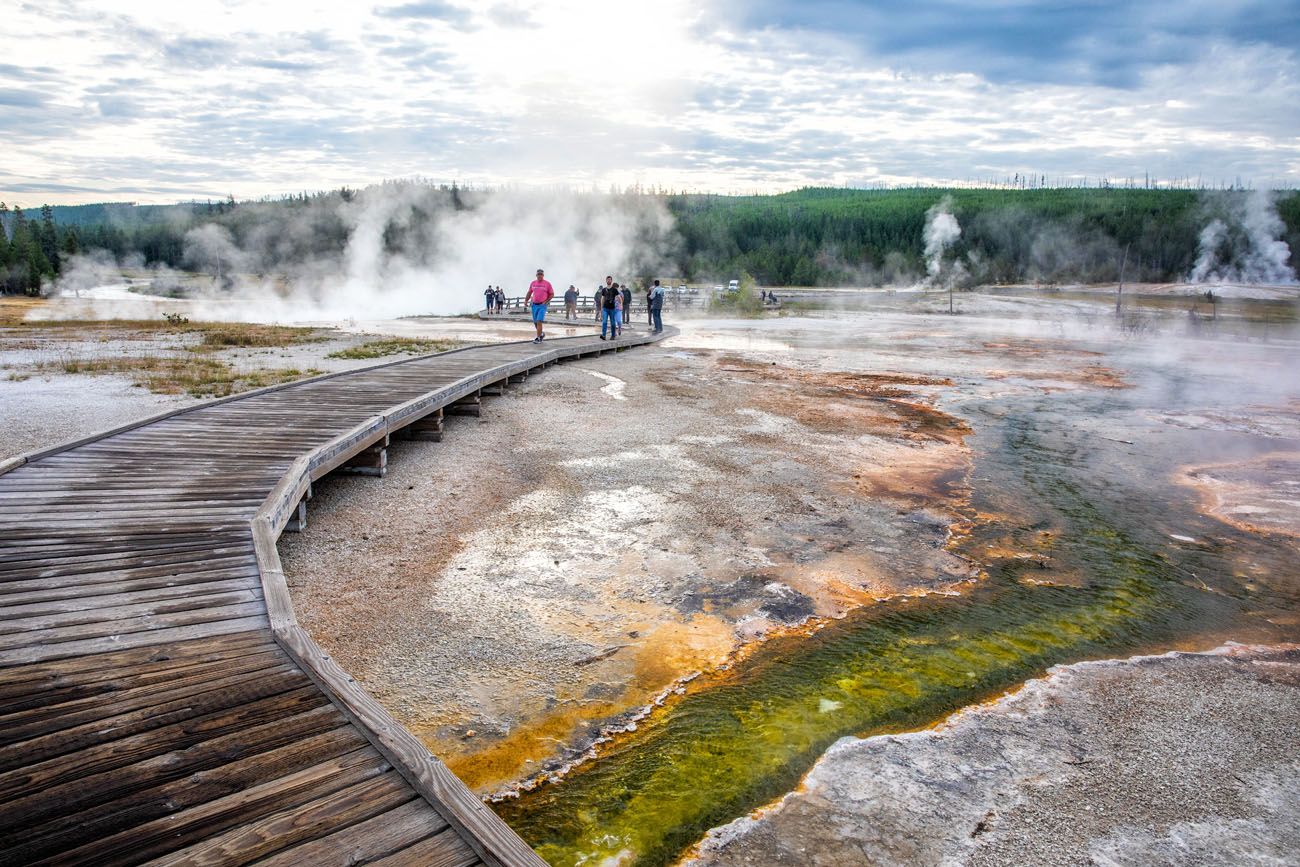
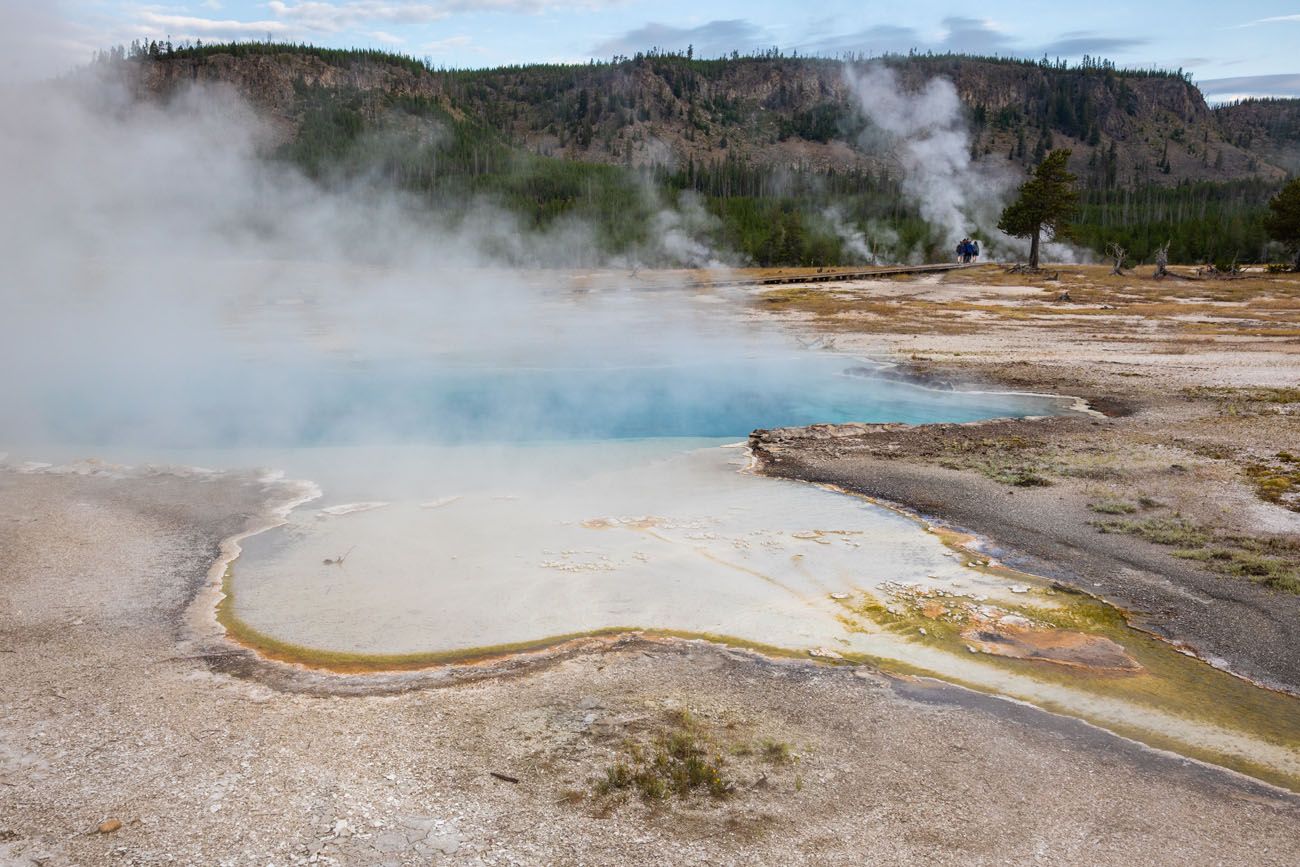
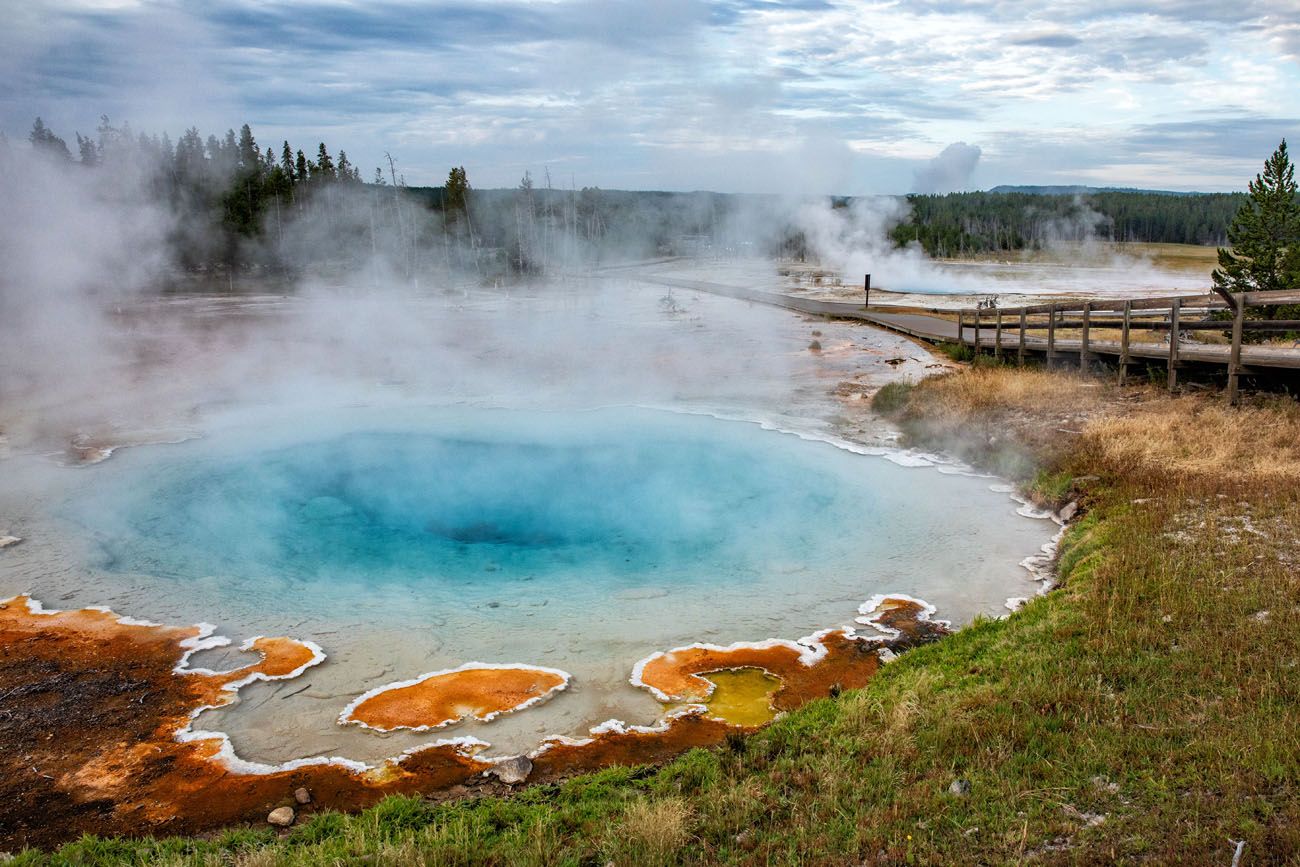
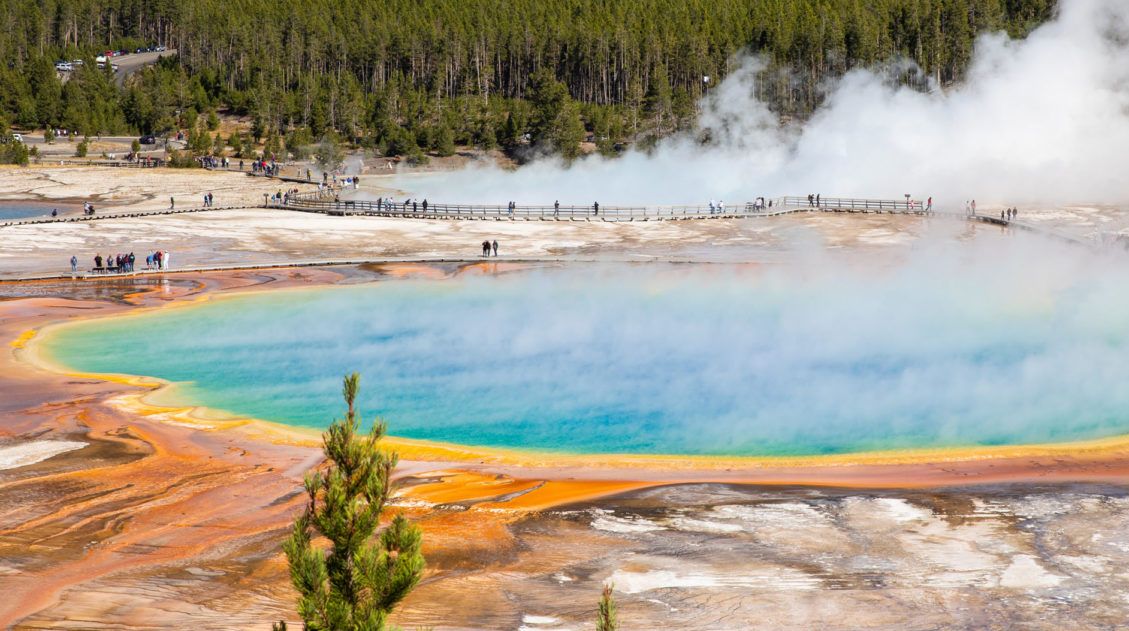
PRO TRAVEL TIP: During the morning hours, the hot springs can be covered in mist (our photo above was taken at about 8 am). It is impossible to capture the brilliant colors like you would see midday, but this can be a very quiet and peaceful time to visit these basins.
Midway Geyser Basin & Grand Prismatic Spring
There are two parts to a visit to Midway Geyser Basin: a walk along the boardwalk trail to get up close with Grand Prismatic Spring and the Grand Prismatic Spring Overlook.
Our Take: Absolute must-see. The overlook view of Grand Prismatic Spring was one of our favorite experiences in Yellowstone, so much so that we did it twice on the same trip (and three times total). If you only have time for one geothermal stop in the park, make it this one.
Midway Geyser Basin Boardwalk
Midway Geyser Basin’s star attraction is the Grand Prismatic Spring.
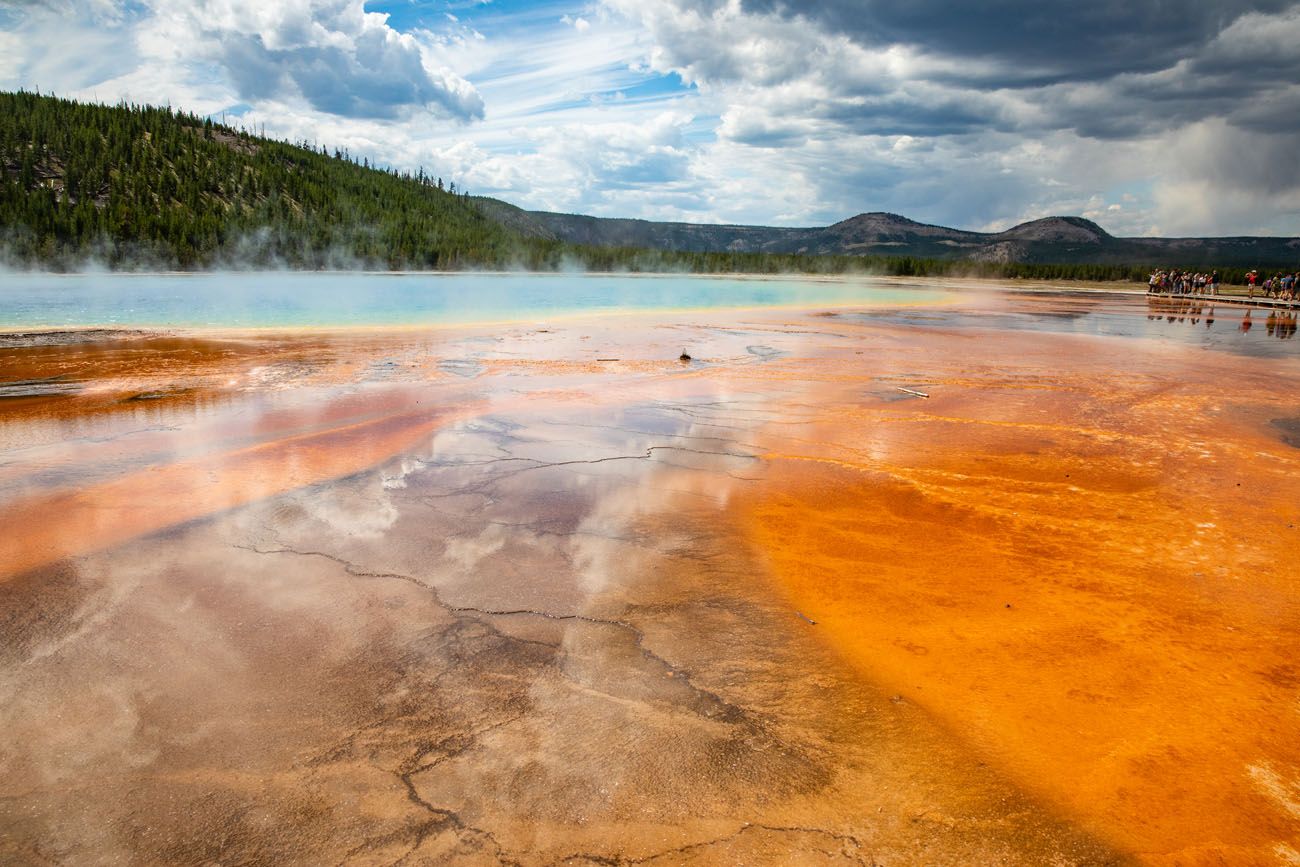
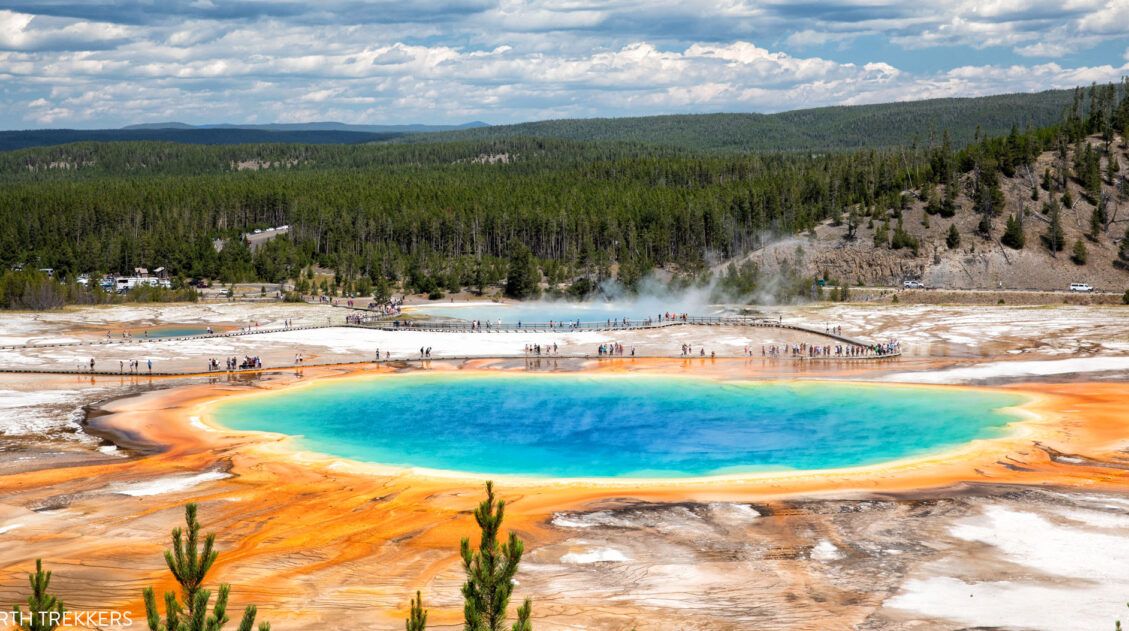
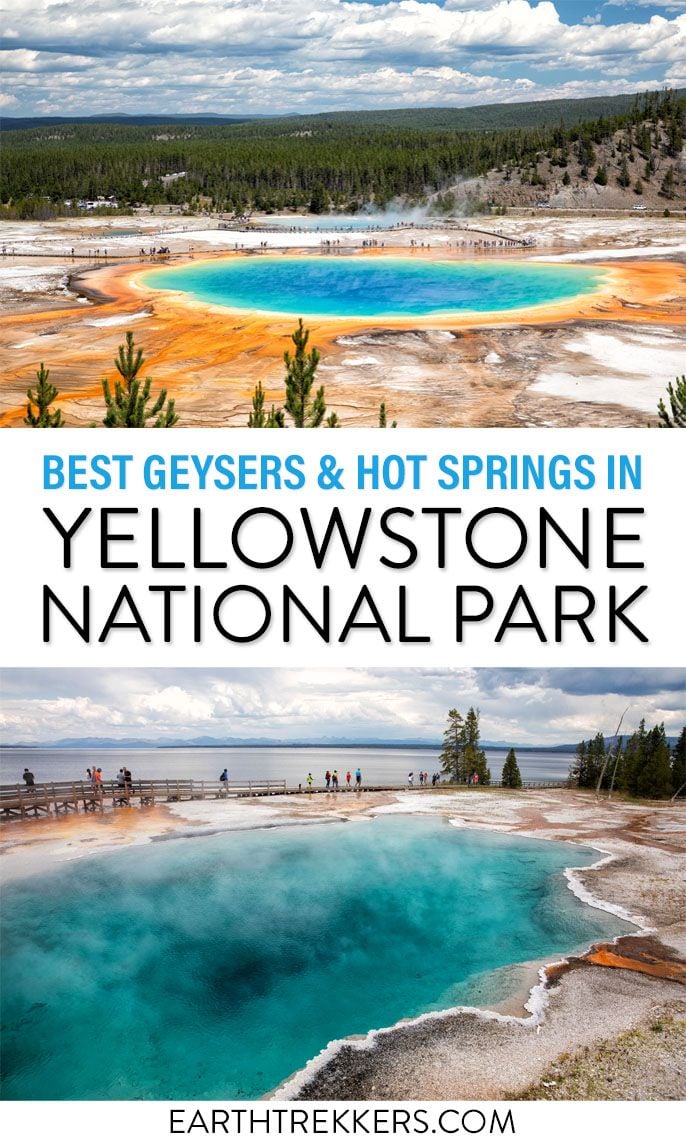
Grand Prismatic Spring is the largest hot spring in the United States. The vibrant, rainbow of colors are a result of microbial life along the edges of the hot spring. The colors can change depending upon the presence of different microbes and the temperature of the water.
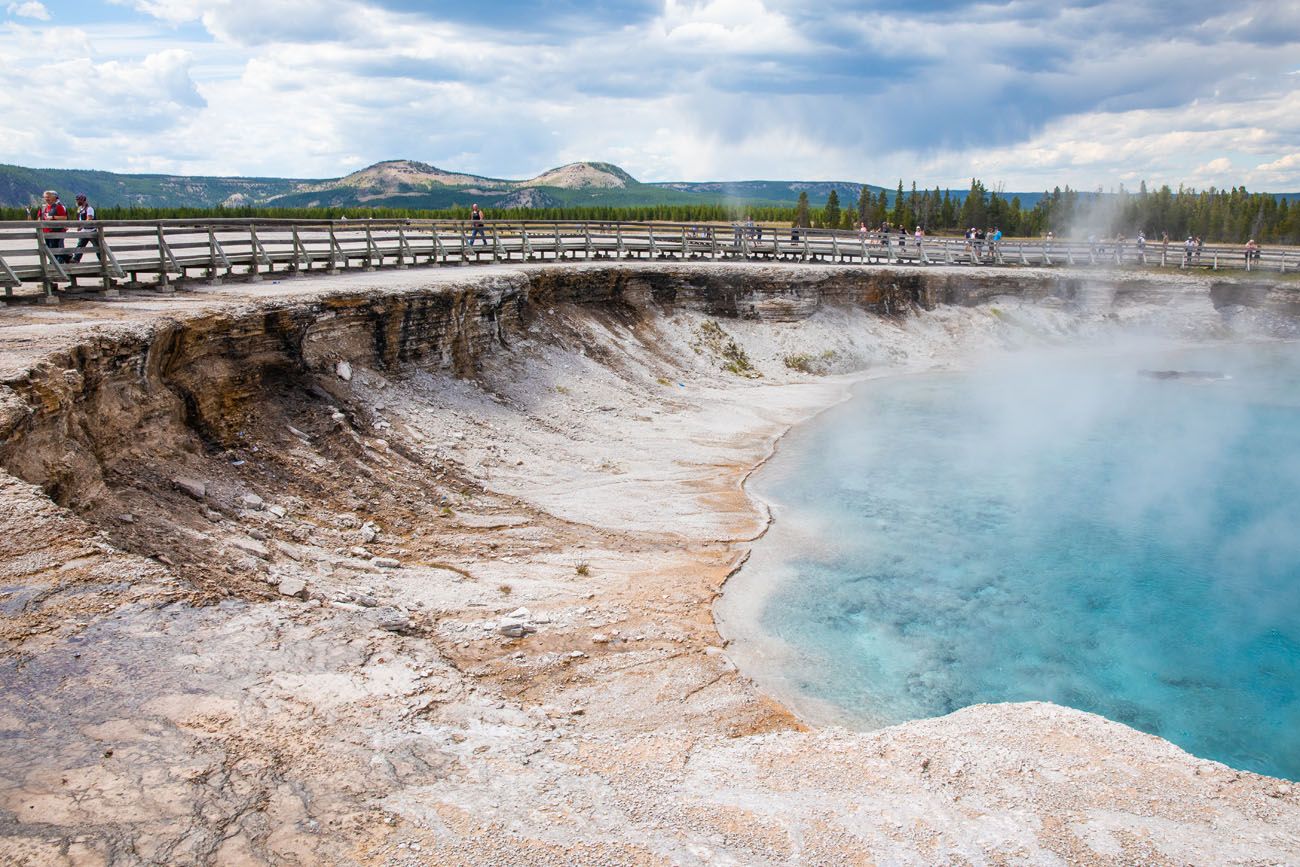
Grand Prismatic Spring may be the star of the show, but you can also see other brilliantly colored hot springs at Midway Geyser Basin: Excelsior Geyser Crater, Opal Pool, and Turquoise Pool.
A 0.8-mile boardwalk takes visitors past all of these hot springs. You will get up close to the Grand Prismatic Spring and the other hot springs. The boardwalk is one-way only.
Parking at Midway Geyser Basin
The parking lot is ridiculously small for the number of visitors that the Grand Prismatic Spring gets. Most of the parking spills out onto the park road.
Normally, I would recommend waiting for a space in the parking lot, but if everyone did this, it would create stand-still traffic on the park road. There are large turn outs on the park road very close to Midway Geyser Basin. If the parking lot is full, park in one of these turn outs.
The busiest time to visit Midway Geyser Basin is from 9 am to 6 pm, which is essentially all day.
You can get here early to avoid the crowds, but the Grand Prismatic Spring is covered with mist in the morning, making it lackluster and it can be a disappointment. For the best experience, visit midday, once the mist burns off. Yes, it will be crowded, but it is worth it to see these colors.
Grand Prismatic Spring Overlook
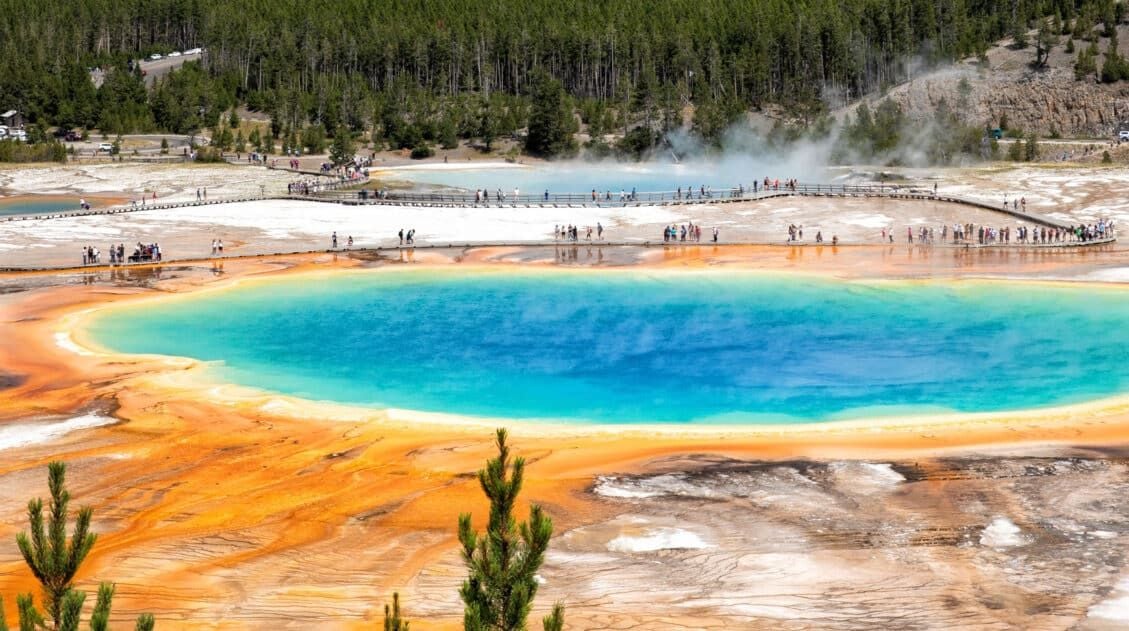
For a jaw-dropping view of the Grand Prismatic Spring, don’t miss the view from the overlook. On a sunny day, the colors are spectacular.
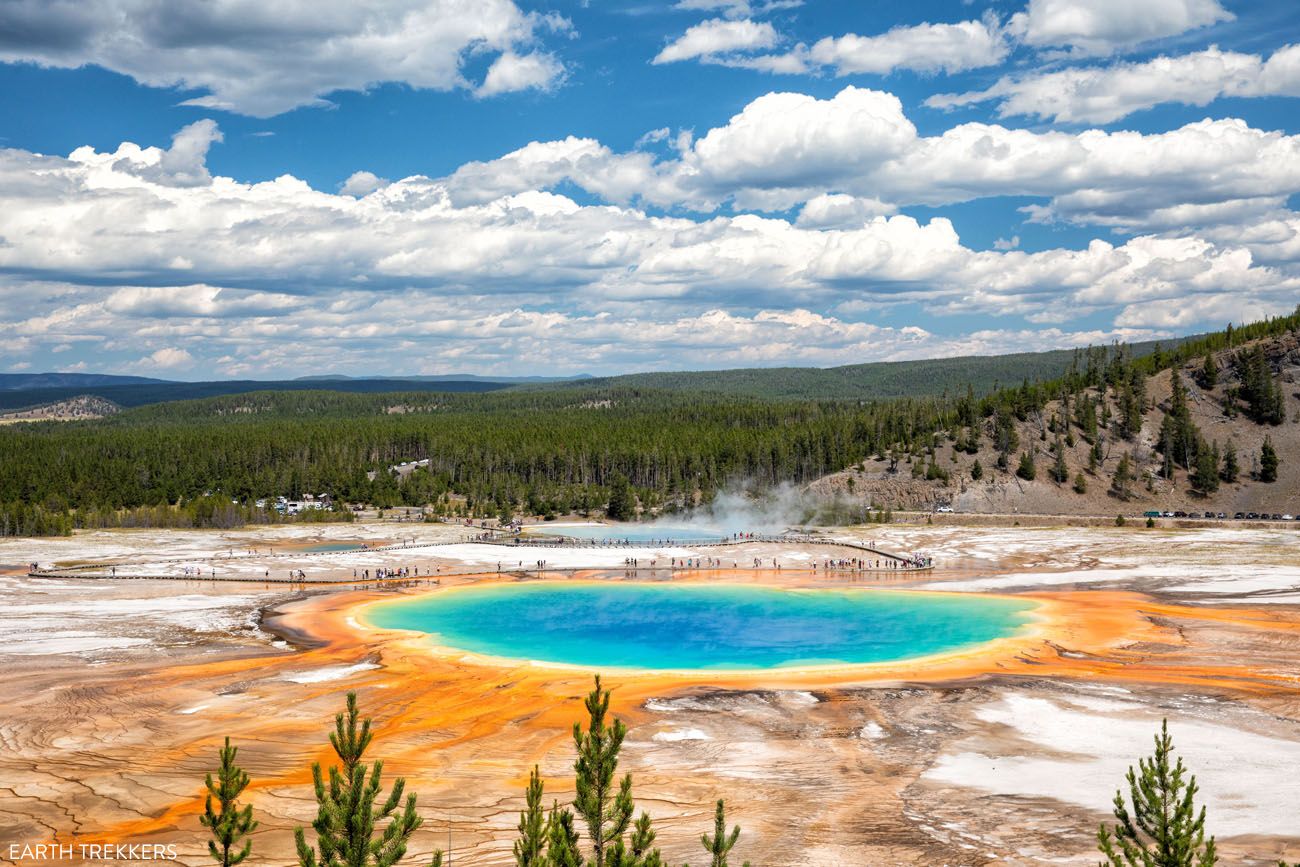
To see the spring from the overlook, you will have to drive and park at a different lot than the one for Midway Geyser Basin. It would be a very long walk (over two miles one way) to get from Midway Geyser Basin to the Grand Prismatic Spring overlook.
Park at the Fairy Falls parking lot. This is a large parking lot (much larger than the one for Midway Geyser Basin) but even so it can be difficult to get a spot midday.
Note: RV’s, buses, and cars pulling trailers are not permitted to park in this parking lot.
From the parking lot, it is a 0.8-mile walk to get to the overlook (1.6 miles round trip). Everything I read online lists this distance as 0.6 miles, but I walked the trail two days in a row with two different GPS devices and both gave the distance as 0.8 miles.
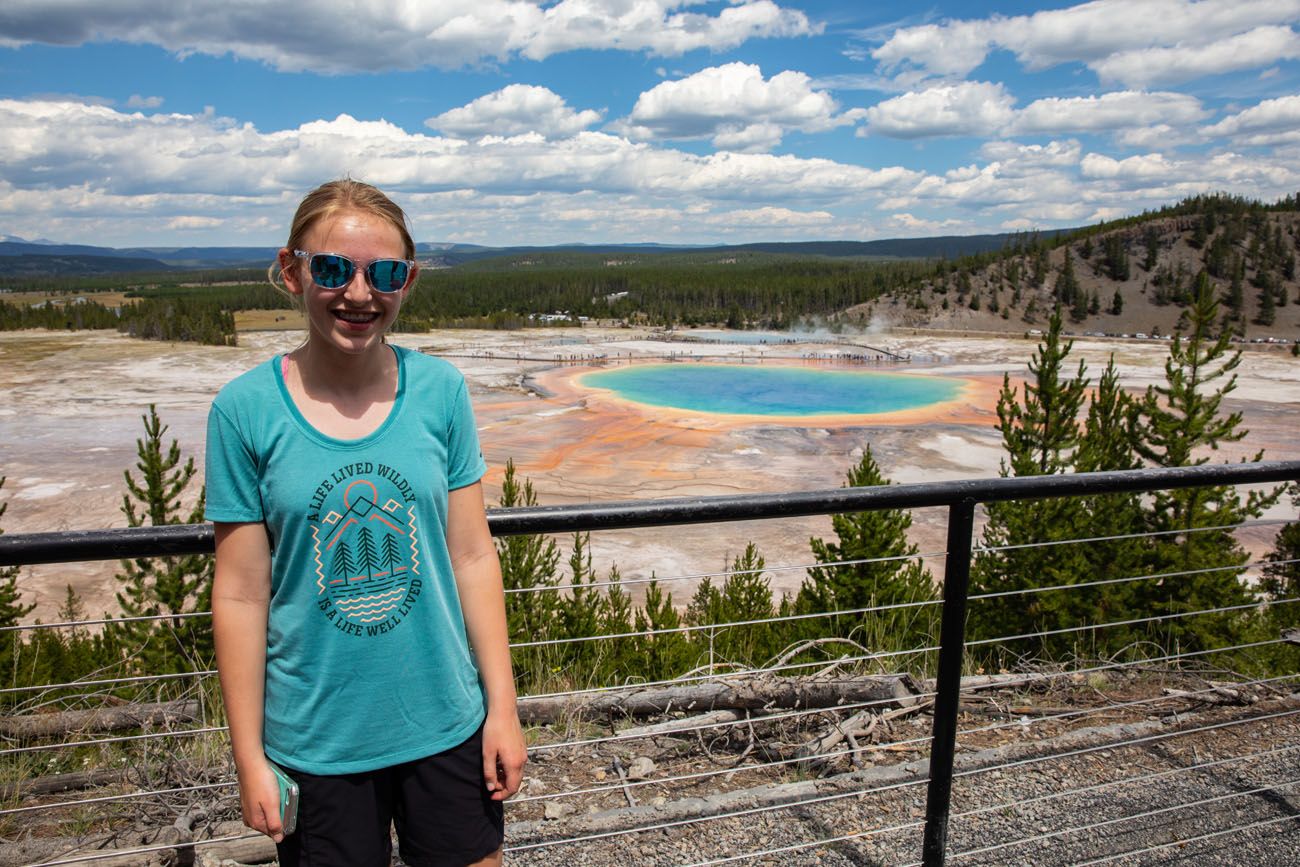
It takes 15 to 20 minutes to walk to the Grand Prismatic Spring Overlook from the Fairy Falls parking lot, so plan on this visit lasting 45 minutes.
You also have the option to add on the short and relatively easy hike to Fairy Falls.
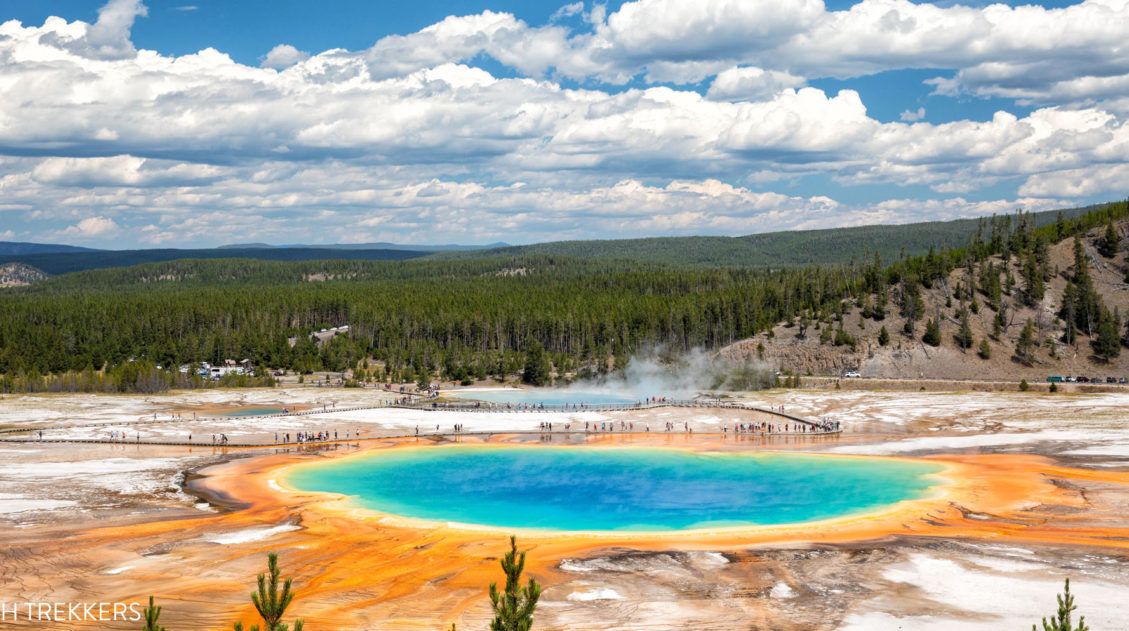
How to Visit Grand Prismatic Spring Overlook (+ Fairy Falls)
This guide has more information on how to visit Grand Prismatic Spring and hike to Fairy Falls.Lower Geyser Basin
Our Take: Worth a quick stop if you’re driving past, but it’s the most skippable basin on this list. Fountain Paint Pot Trail shows you the same four geothermal features you’ll see elsewhere here, so if you’re short on time, this is the one to cut.
Lower Geyser Basin contains about 100 geothermal features located across five square miles. This geyser basin sits to the north of Midway Geyser Basin.
Lower Geyser Basin contains about 100 geothermal features located across five square miles. This geyser basin sits to the north of Midway Geyser Basin.
You can see most of these geysers, hot springs, and fumaroles along Firehole Lake Drive, a one-way road that is just over 3 miles long. This is one of our favorite lesser-known stretches of road in the park, since most visitors drive right past it on their way to Old Faithful.
The highlight is Great Fountain Geyser, one of the few geysers in Yellowstone, besides Old Faithful, with predicted eruption times posted at the visitor centers. When it goes off, it erupts in a series of fan-shaped bursts that can reach 150 feet or more. It’s worth checking the prediction before you set out, since eruptions are 8 to 15 hours apart and it’s not a stop you want to gamble on.
Further along, White Dome Geyser is easy to spot from the road, thanks to its cone, one of the largest in the park, built up from thousands of years of mineral deposits. Near the end of the drive, a short boardwalk loops around Firehole Lake itself, fed by Steady Geyser.
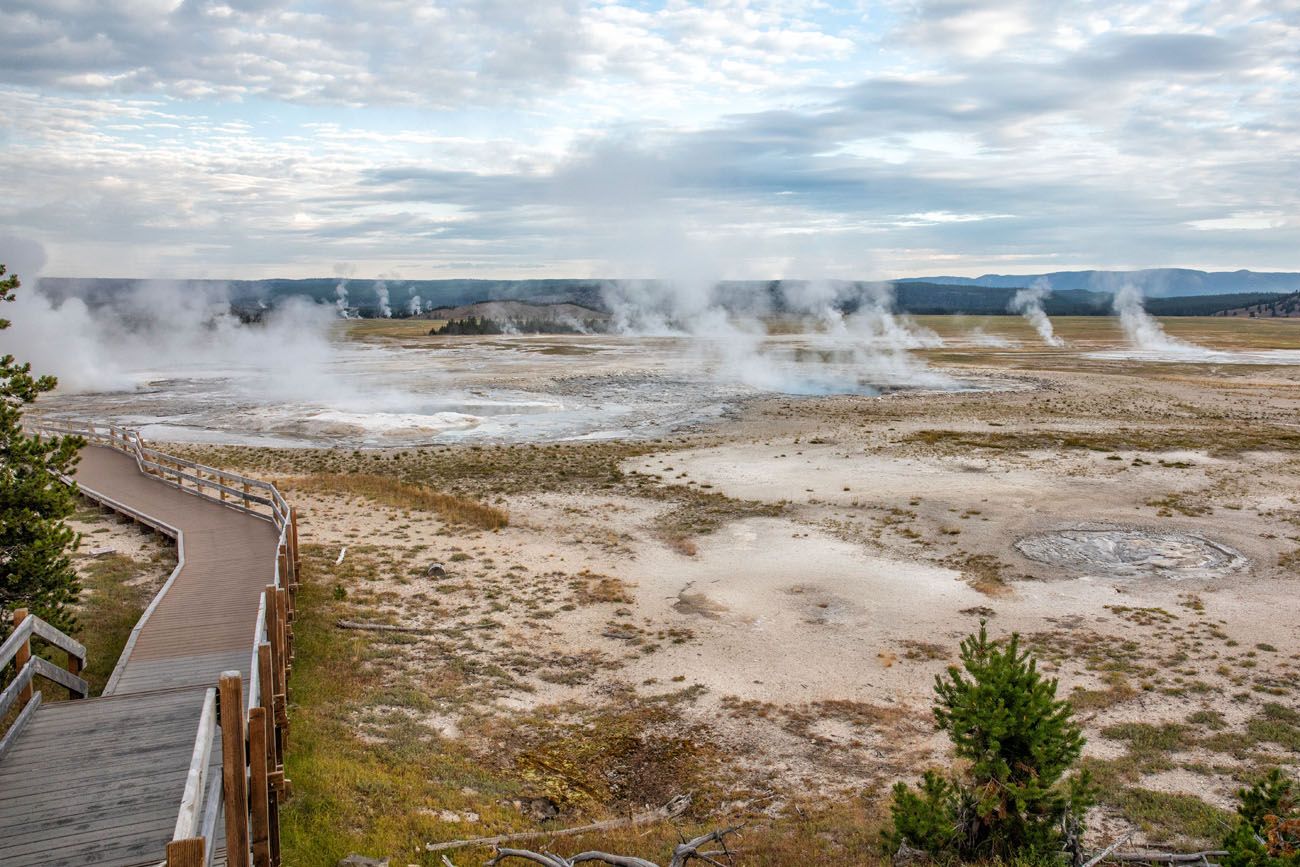
Fountain Paint Pot Trail is a half-mile walk on a boardwalk that takes you past the four major hydrothermal features in Yellowstone: hot springs, geysers, mud pots, and fumaroles.
Mammoth Hot Springs
Our Take: Worth the visit, and it’s easy to work into your schedule, whether you have a few minutes or a lot longer. Get a good look at the travertine terraces in 15 minutes, or spend a couple of hours walking the boardwalks and driving the upper loop.
Mammoth Hot Springs is a large complex of hot springs that is located in north Yellowstone. Hot, steaming water spills out over travertine terraces, making this one of the most unique geothermal areas in the park.
These hot springs are spread over a large area. A visit here can be quick, with a short walk to one or two viewpoints. Or, you can spend an hour or two walking the boardwalk trails and going on the scenic drive.
The quickest way to get a look at these hot springs is to park along Grand Loop Road. There are several small parking lots here. Walk to the Lower Terraces to see the Liberty Cap and Devils Thumb.
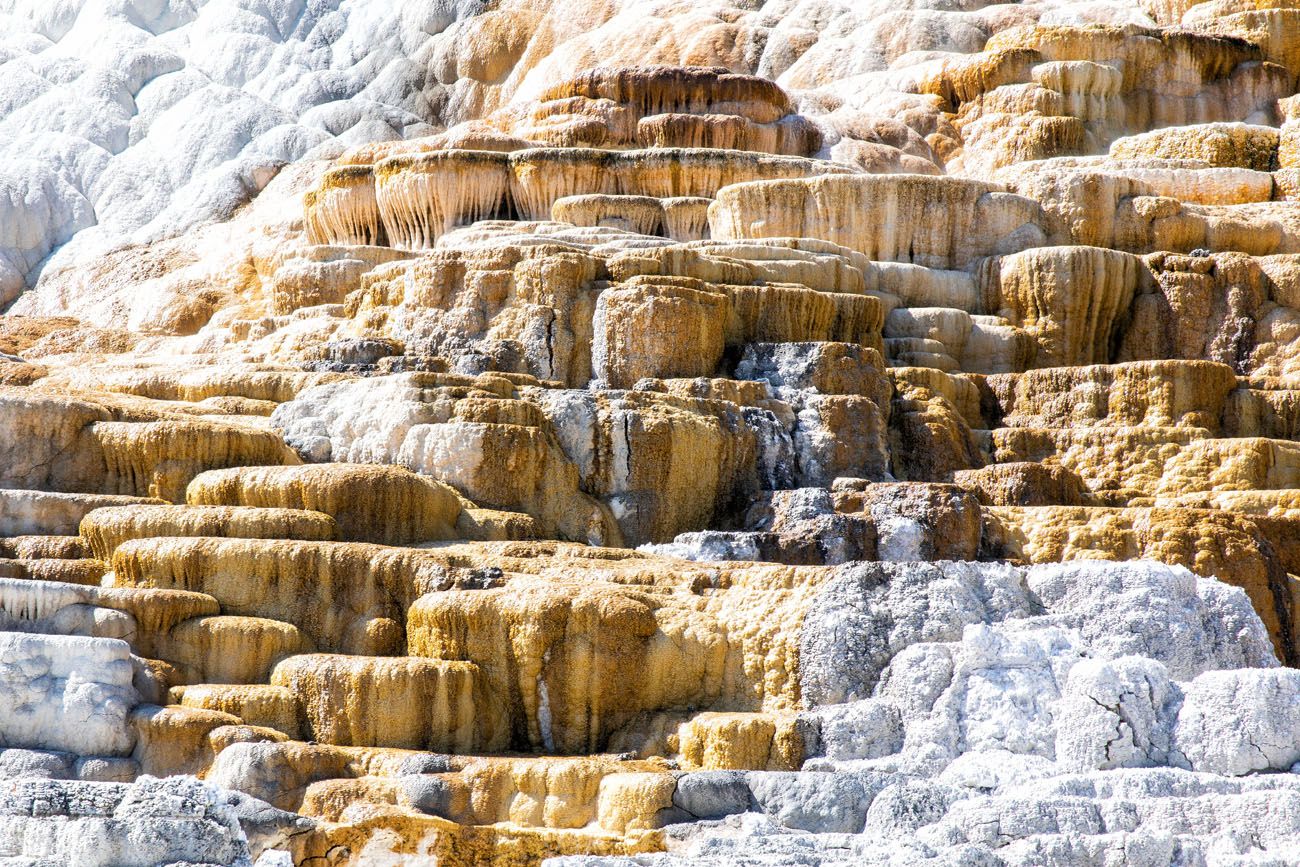
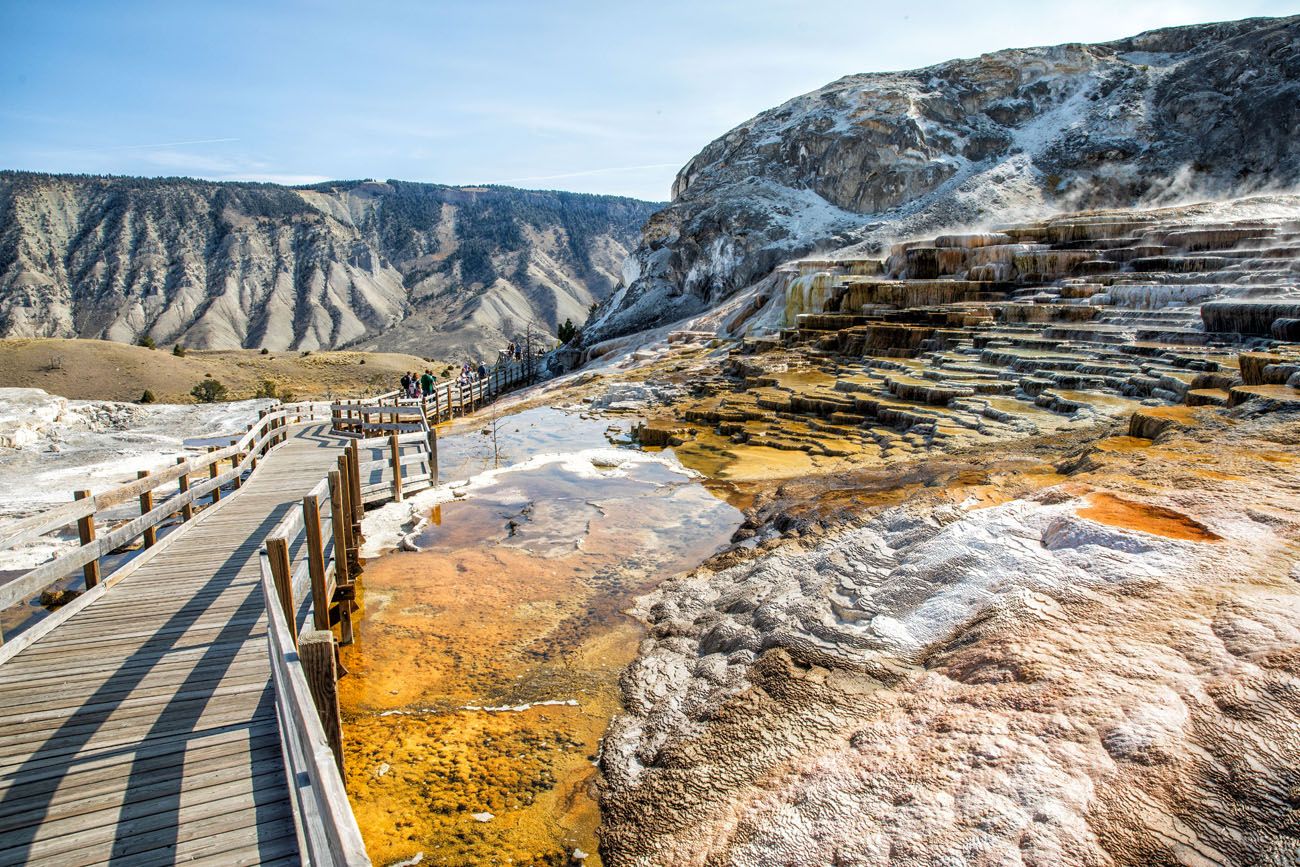
Your visit can end here, but if you want to see more, follow the path uphill and walk the boardwalk trails around the higher level of terraces. The entire walk is 1 mile long and will take 30 to 40 minutes.
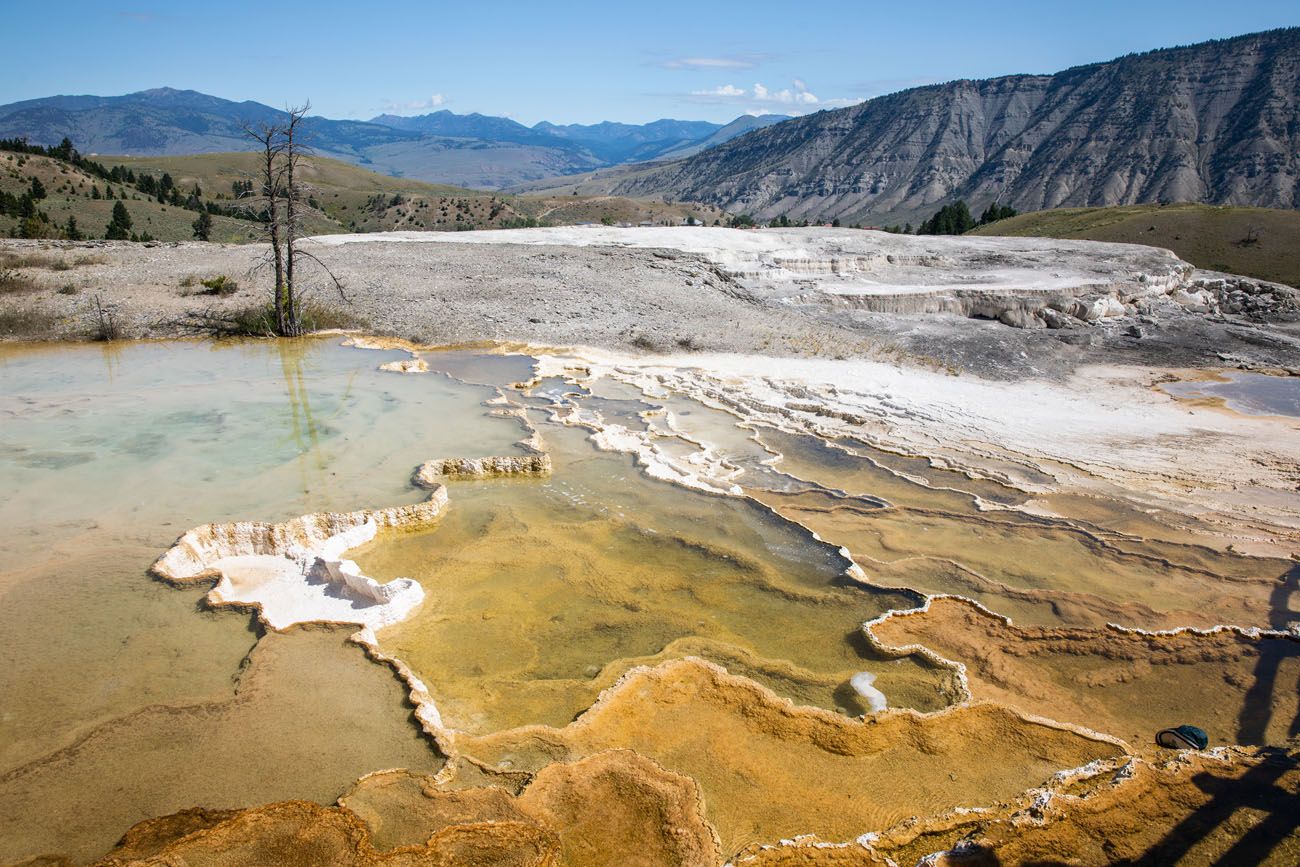
For the full experience, hop in your car and drive the one-way road through the Upper Terraces.
Norris Geyser Basin
Similar to the Upper Geyser Basin, this is another fairly large collection of geothermal features. It’s also one of the most rapidly changing basins in the park.
A visit here consists of seeing two basins: Back Basin and Porcelain Basin.
Our Take: Yes, it’s worth visiting. Norris doesn’t have a single marquee attraction like Old Faithful, but it’s one of the most otherworldly, rapidly changing basins in the park. We visited first thing in the morning and had it almost to ourselves.
Back Basin
Back Basin is the larger basin.
It is here that you can see Steamboat Geyser, the world’s tallest active geyser. Major eruptions are very unpredictable but the geyser can spew hot, steaming water more than 300 feet in the air (for reference, Old Faithful eruptions are somewhere between 100 and 185 feet high).
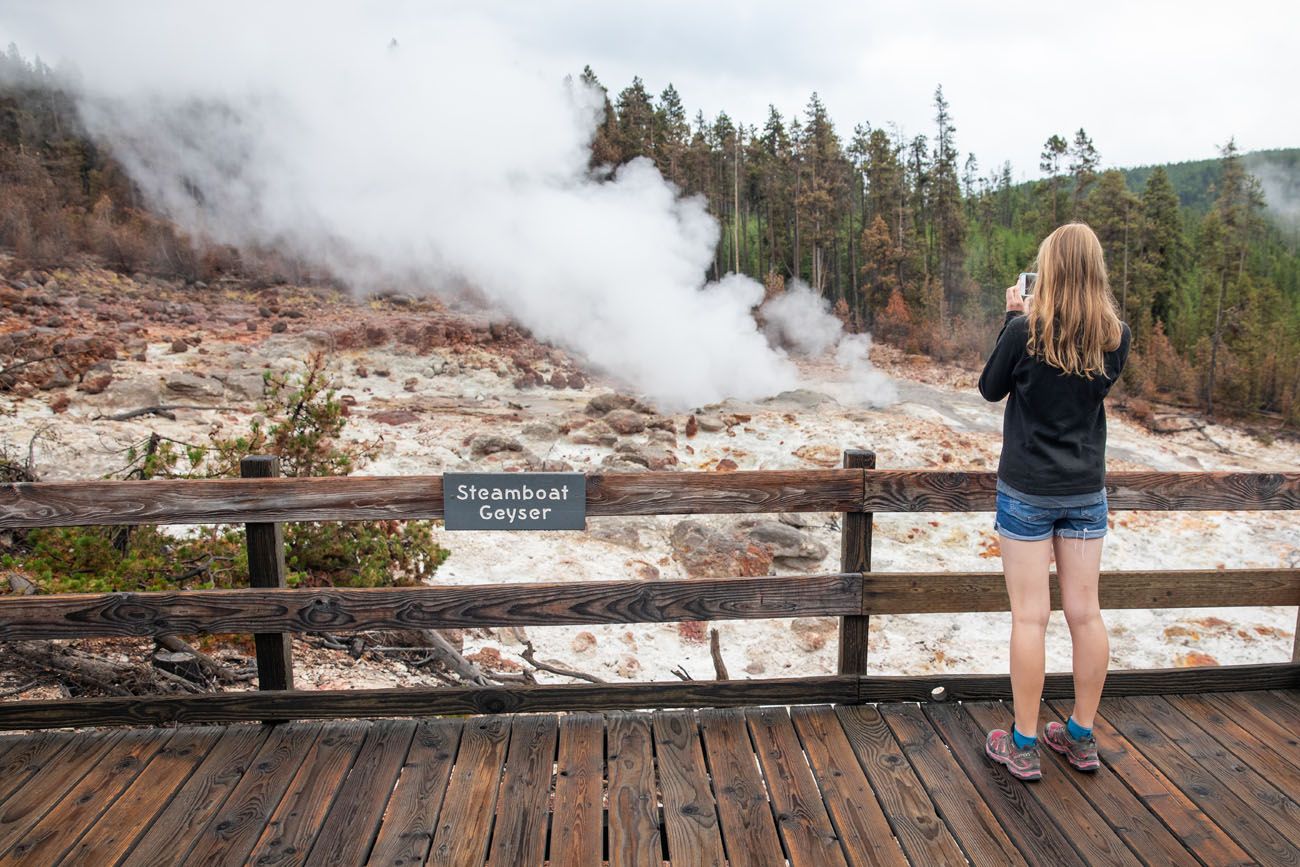
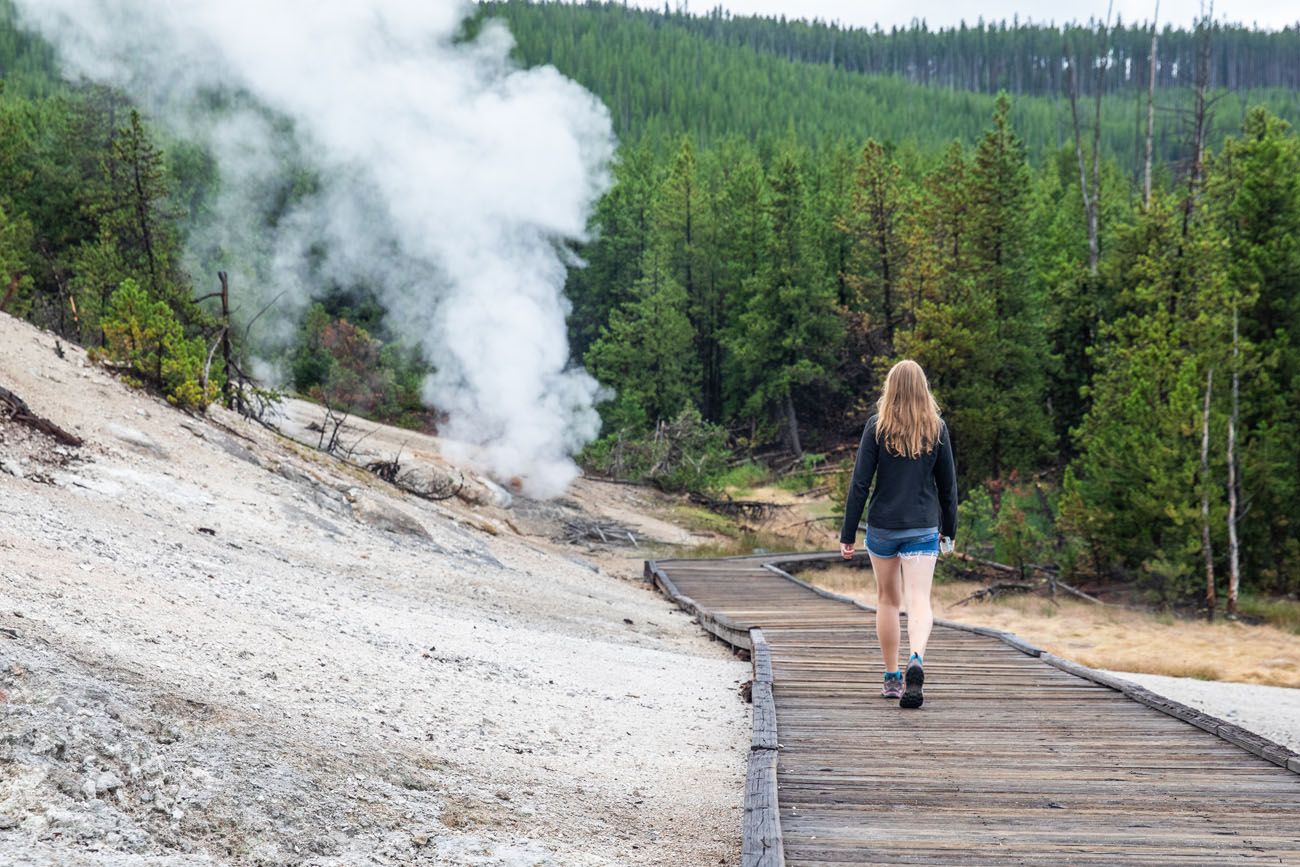
There are numerous other hot springs and geysers in Back Basin, including Emerald Spring, Green Dragon Spring, Porkchop Geyser, and Puff ‘N Stuff Geyser (our favorite named geyser).
Porcelain Basin
Unless you catch Steamboat Geyser in action, Porcelain Basin is more thrilling. There is a lot of activity here. Steaming hot springs, light blue thermal pools, and noisy fumaroles really get your attention.
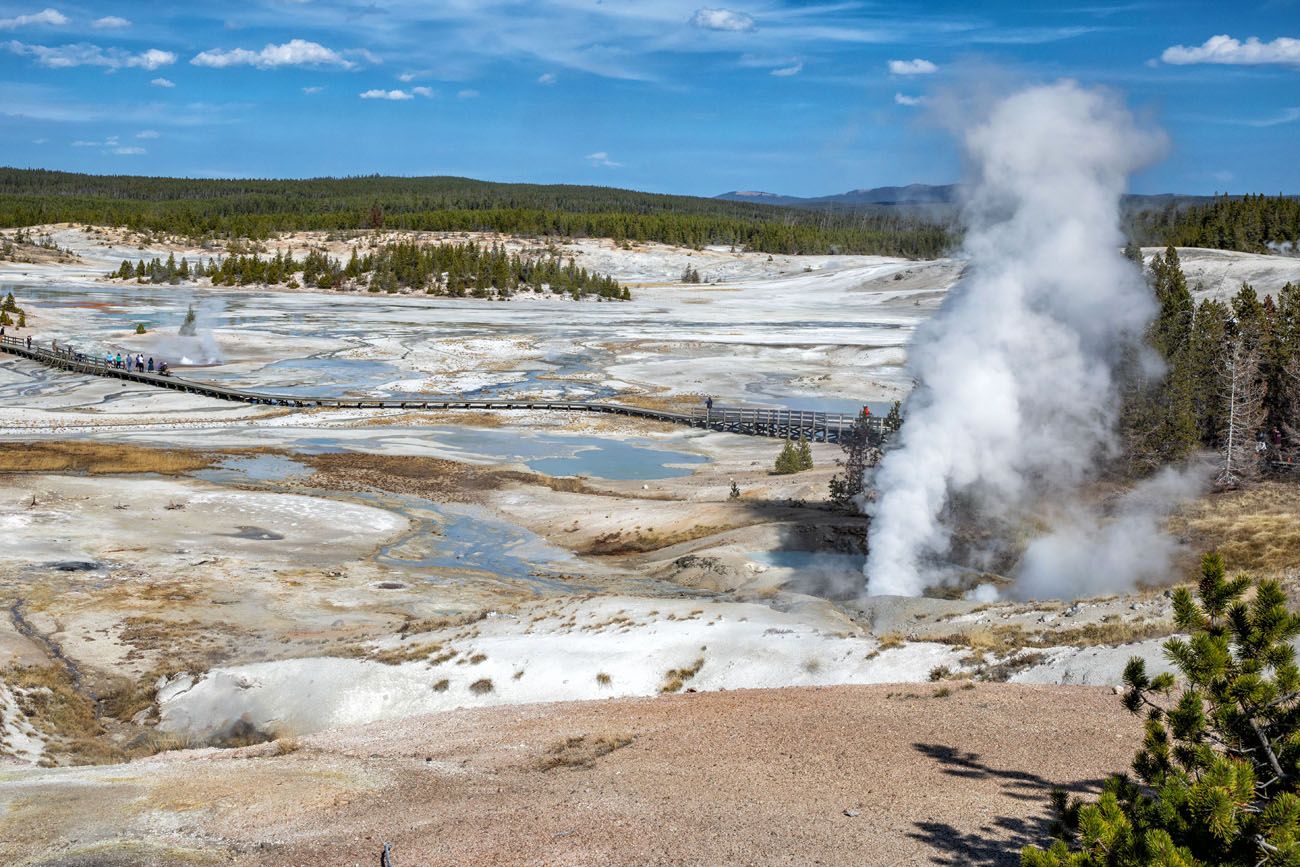
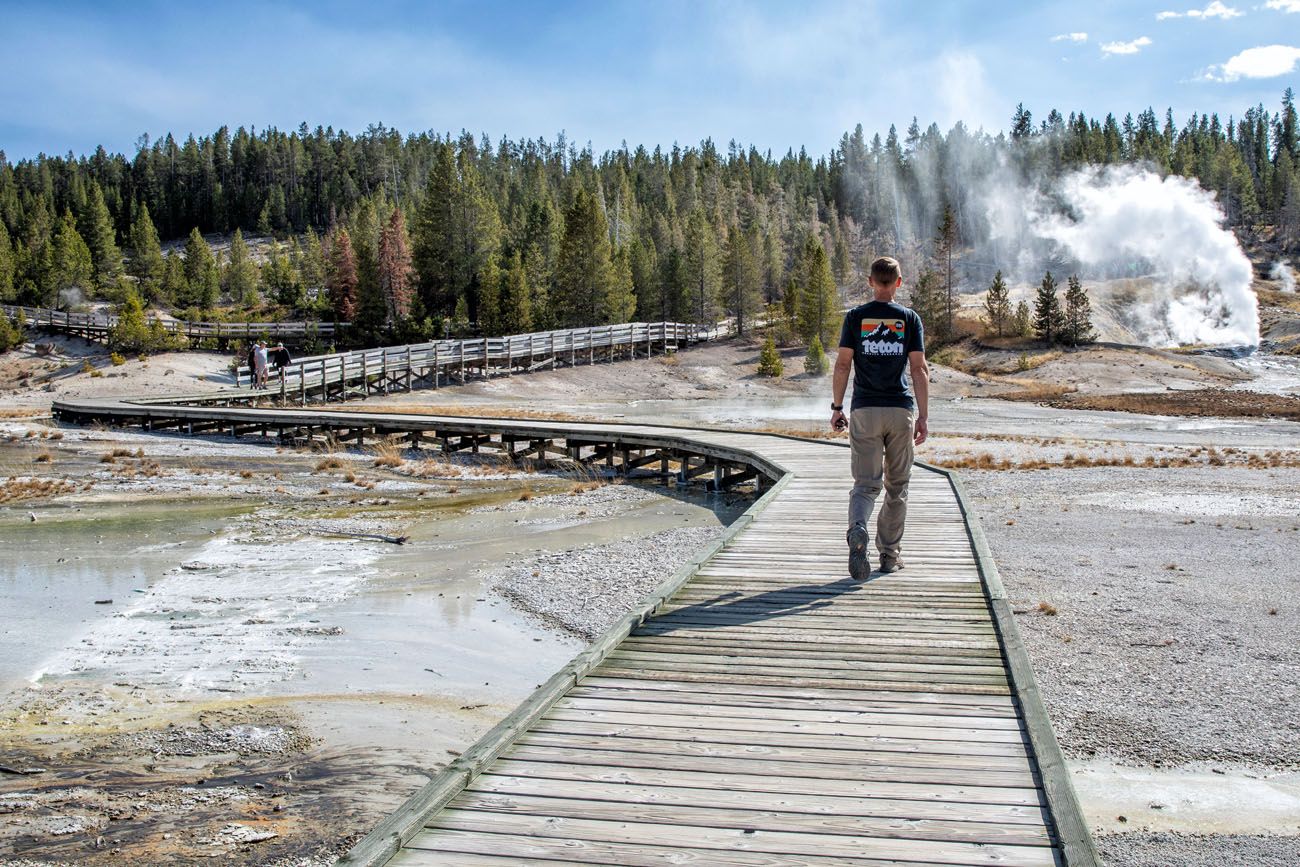
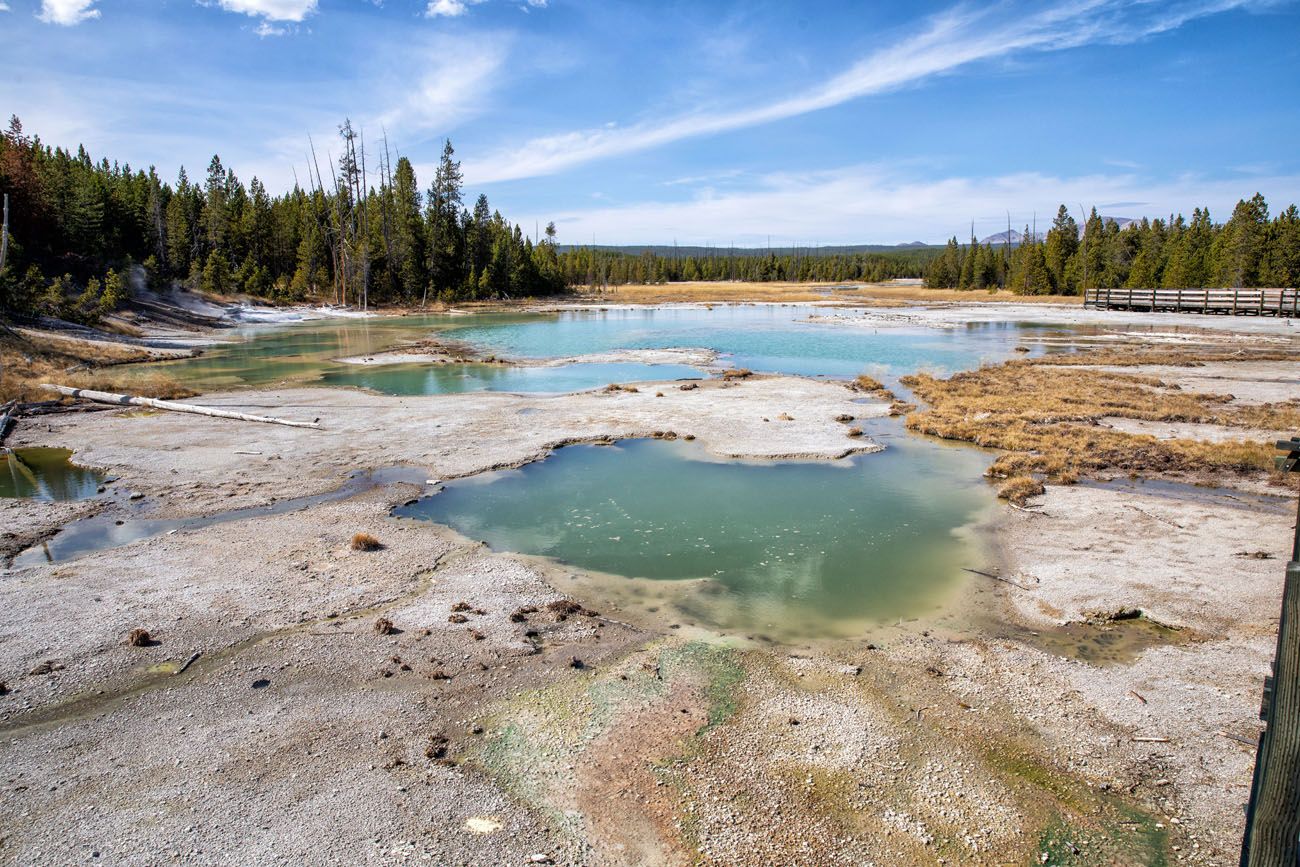
A visit to Norris Geyser Basin lasts 1.5 to 2 hours, if you visit both Back Basin and Porcelain Basin.
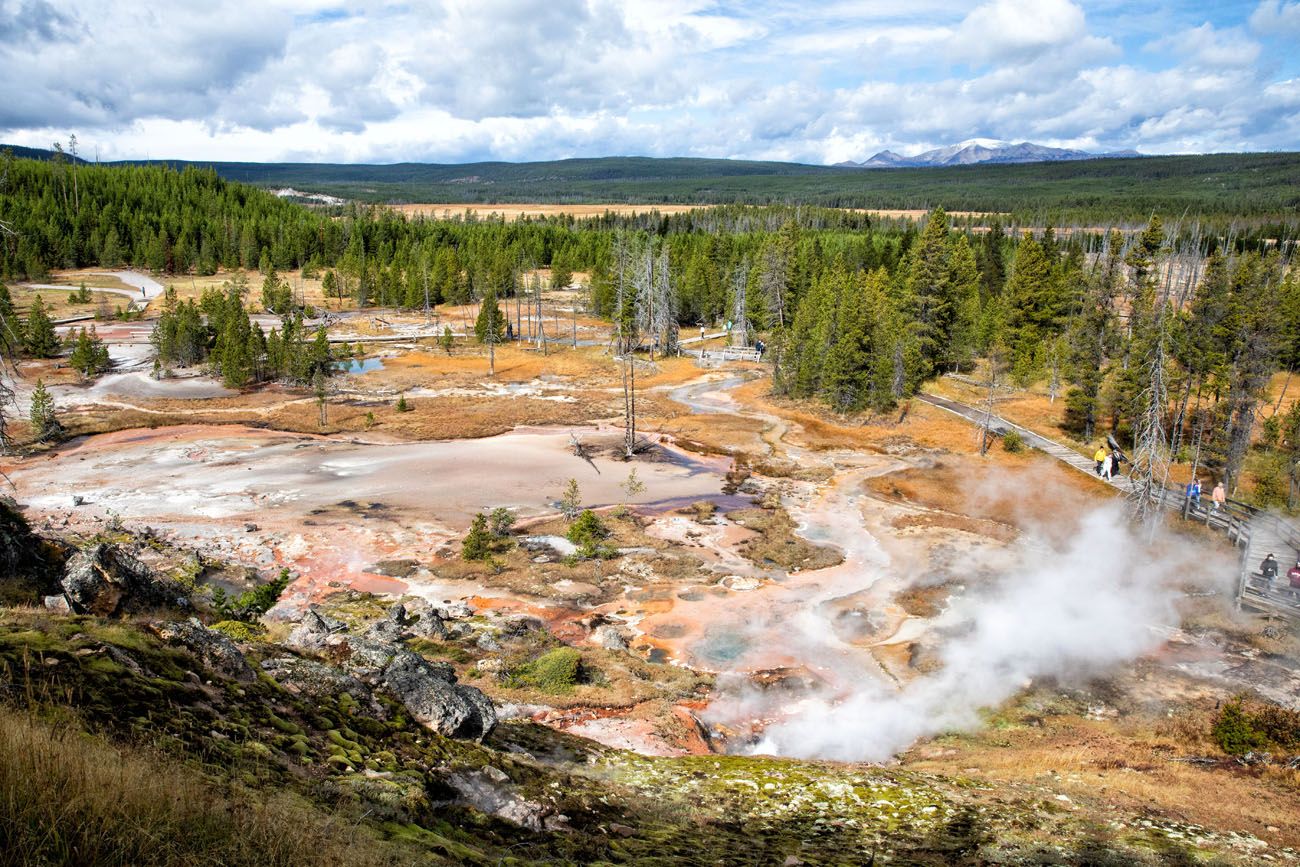
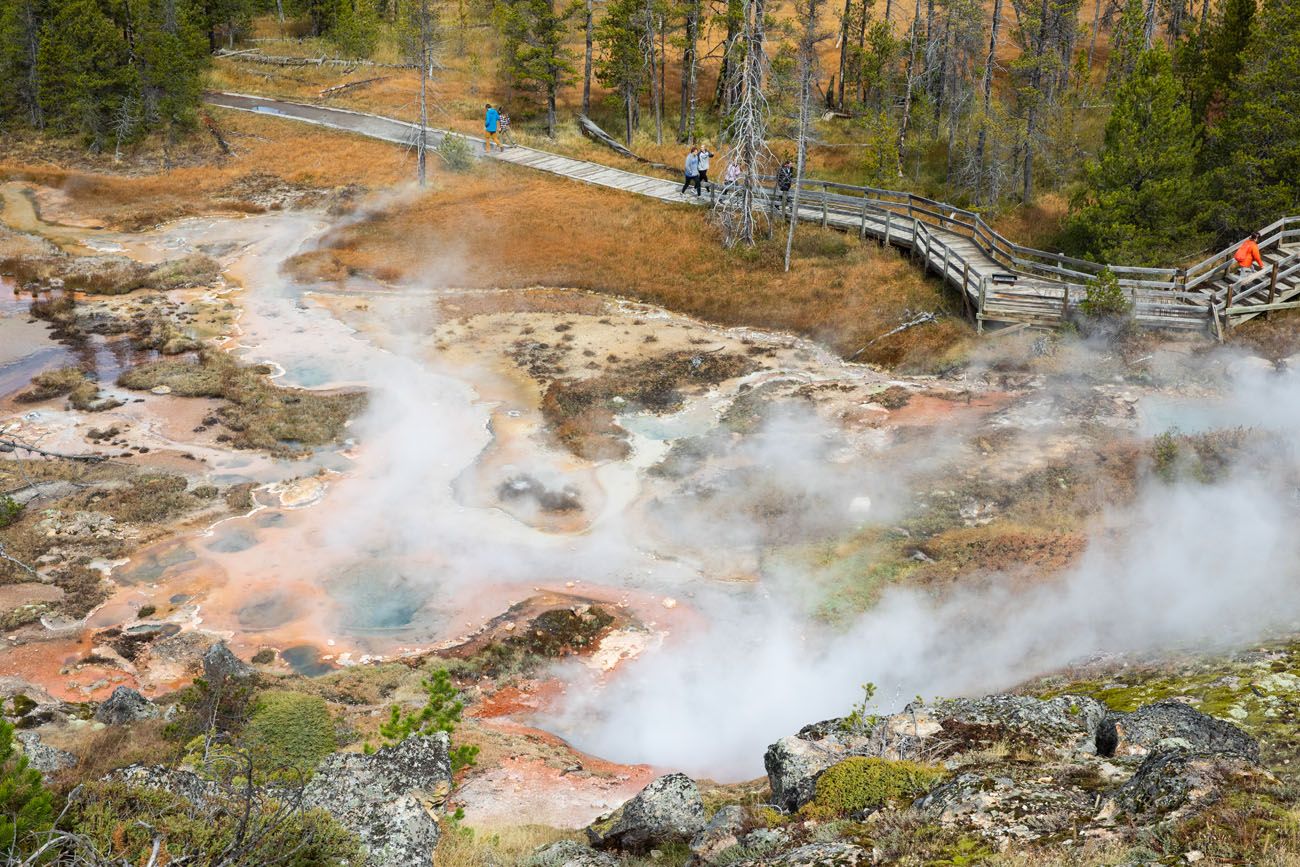
Artists Paintpots
Our Take: Worth the detour. It’s a longer walk from the parking lot than most stops on this list, but we loved the view from the upper boardwalk and the bubbling mud pots.
Just south of Norris Geyser Basin is Artists Paintpots, a small area that contains several hot springs and mud pots. It feels like a long walk to get from the parking lot to the geyser basin (about a half-mile one-way) but it’s worth it. We loved the view from the upper boardwalk trail and the bubbling mud pots.
West Thumb Geyser Basin
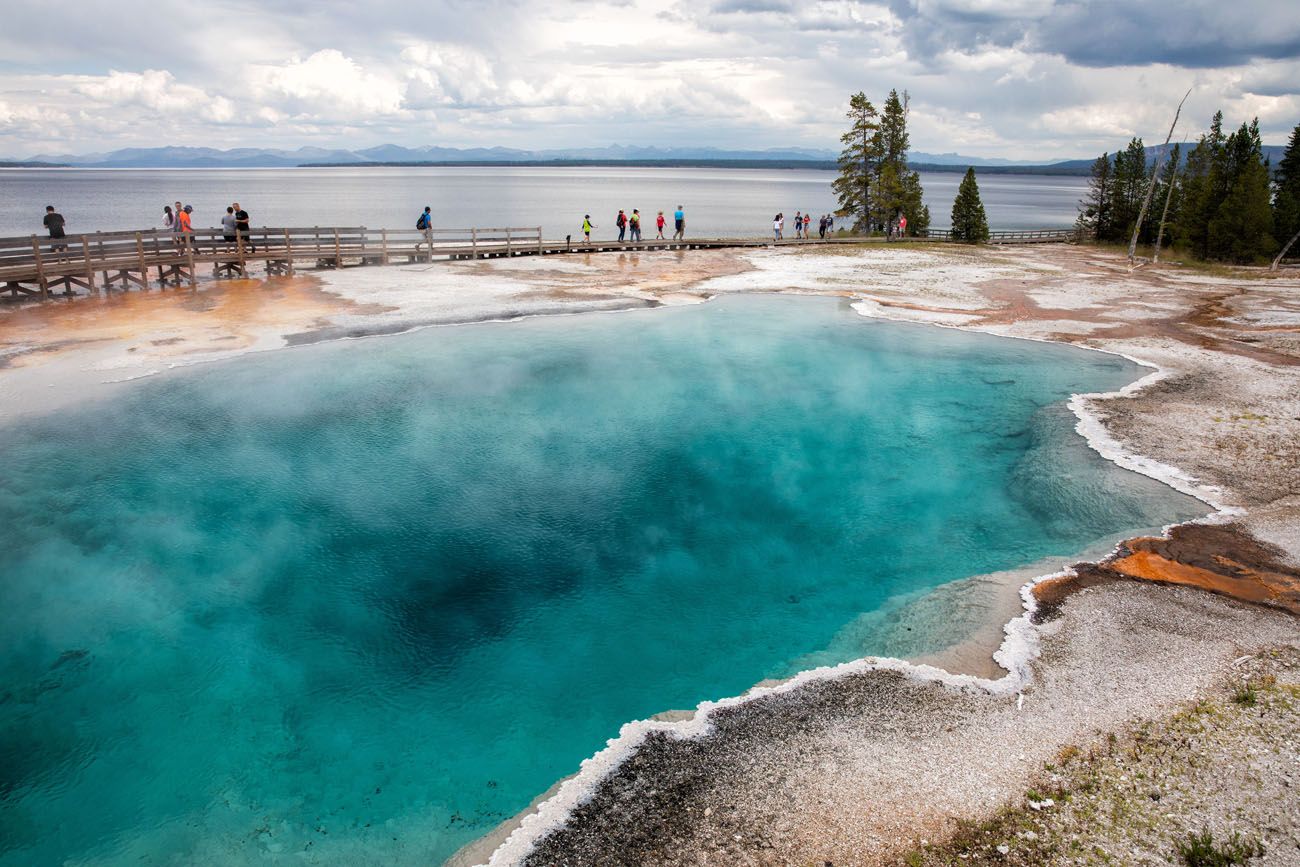
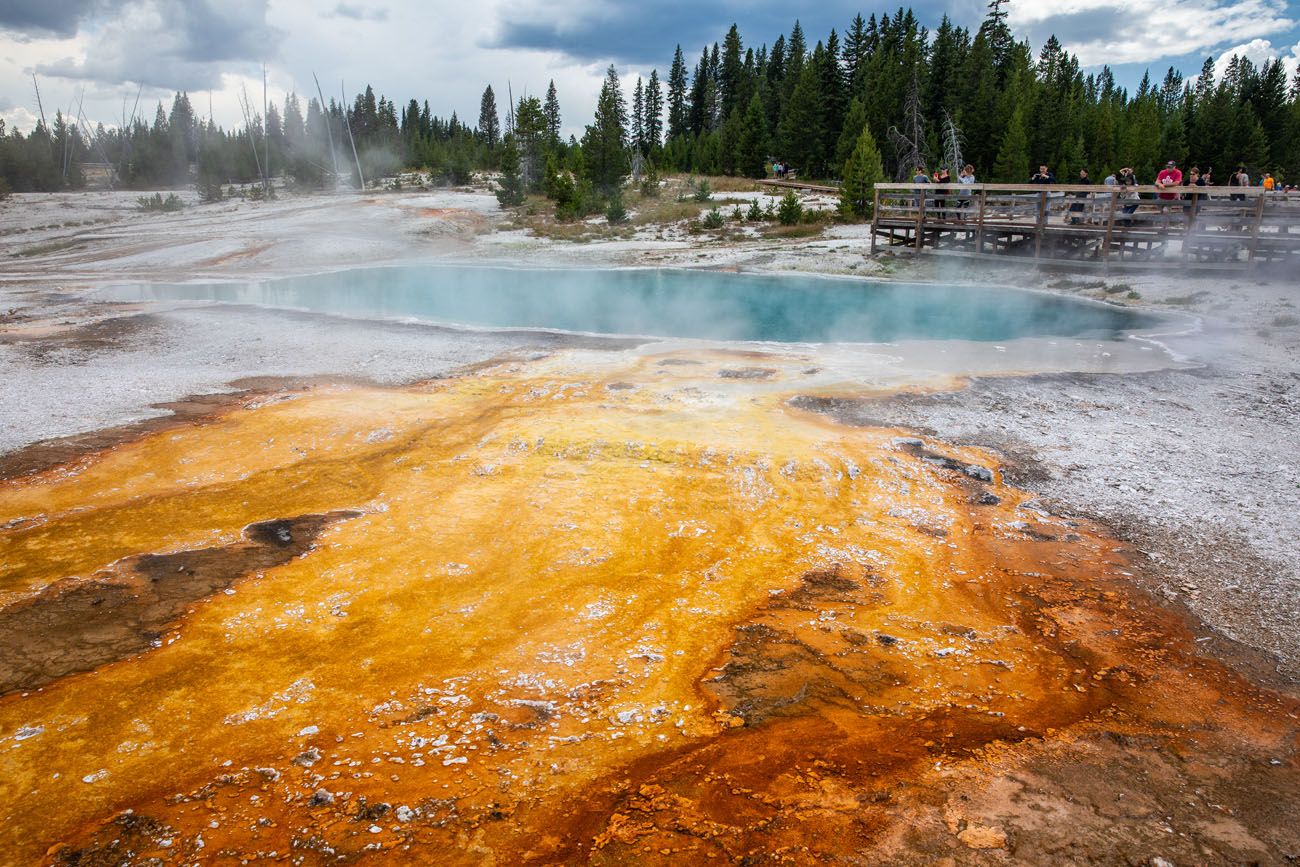
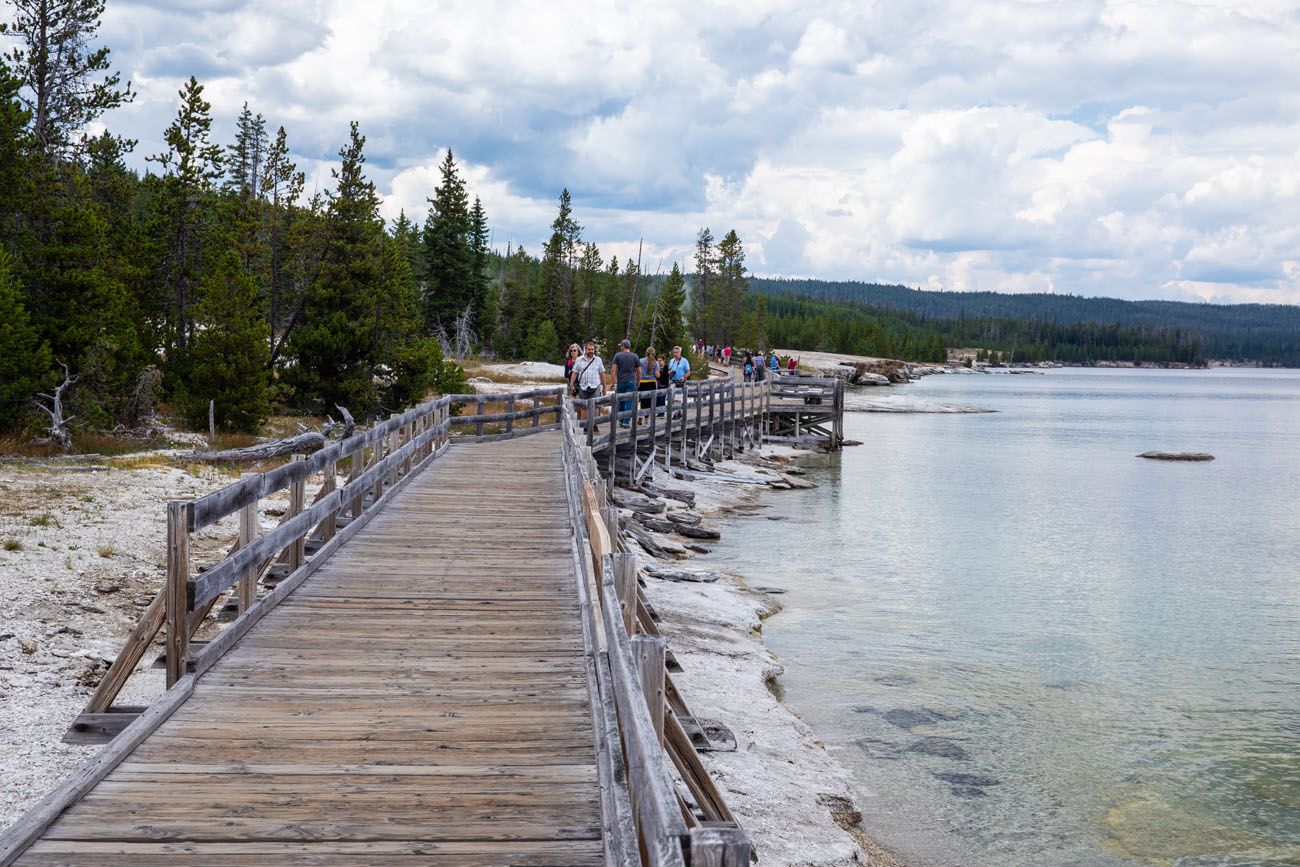
Our Take: One of our favorite smaller basins in the park. It only takes about 30 minutes to walk through, the springs are a striking blue, and the views across Yellowstone Lake make it feel different from anywhere else on this list.
West Thumb Geyser Basin is located right on Yellowstone Lake. This is a small geyser basin and it only takes about 30 minutes to walk through all of it. The highlight is Abyss Pool, a brilliantly blue hot spring, but it is also very cool to see geothermal activity right along the edge of the lake.
Mud Volcano
Our Take: Skippable for most visitors. It sounds interesting on paper, but we found it fairly forgettable, and you’ll see mud pots at other stops on this list, including Fountain Paint Pot Trail.
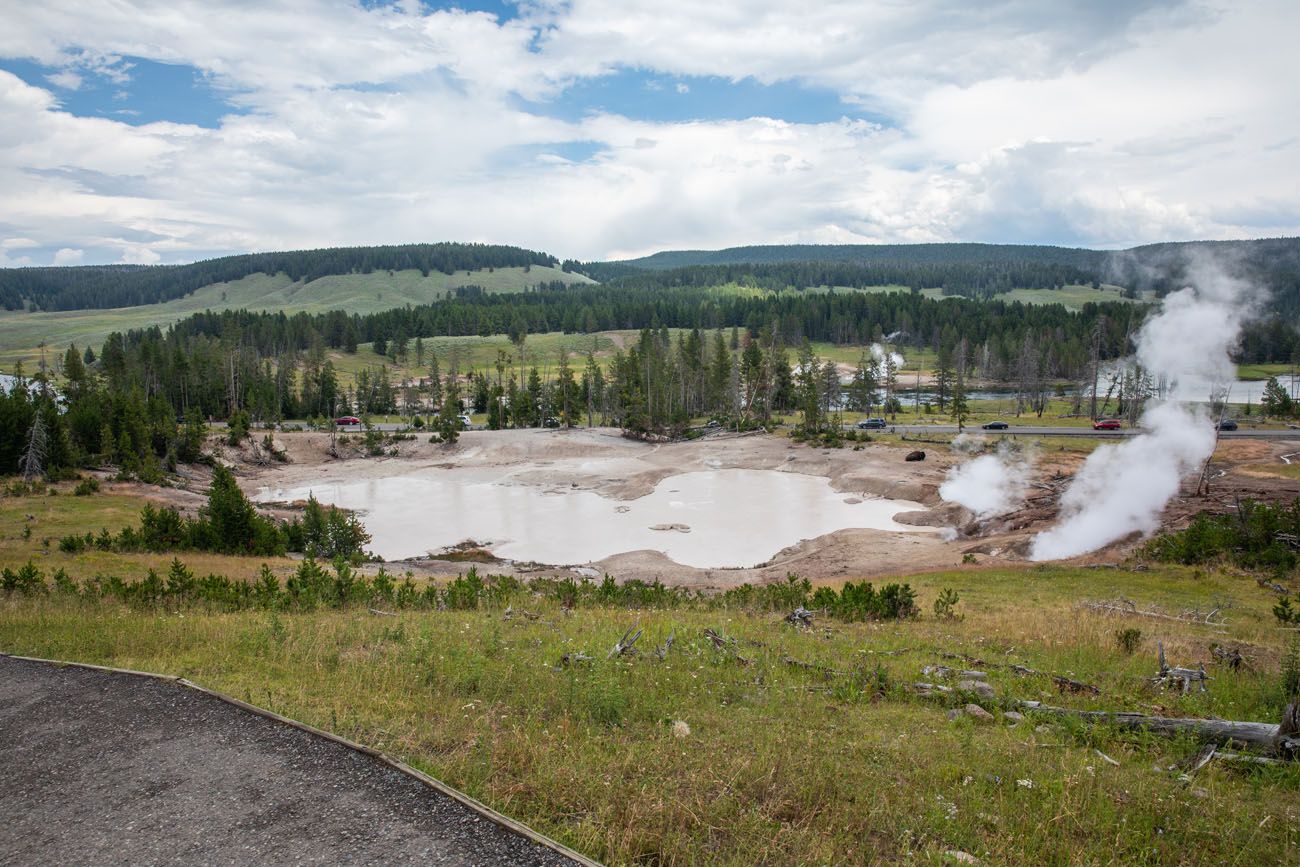
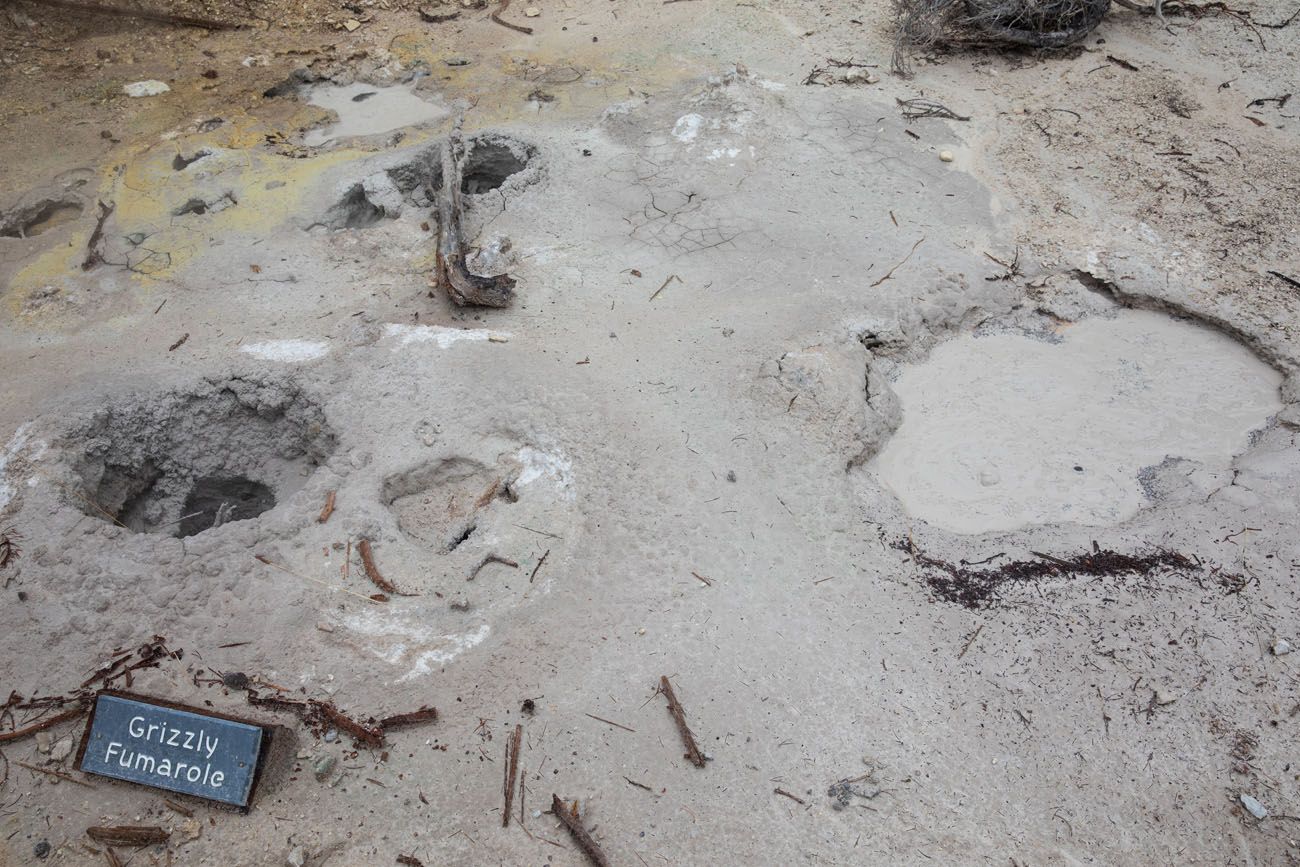
Mud Volcano is located near Hayden Valley. This is one of the best places watch, and listen to, bubbling mud.
A series of boardwalk trails climb up a hillside, past pots of bubbling mud and hot springs. This part of the park smells like rotten eggs, from the hydrogen sulfide gas that is emitted from these mud pots and hot springs.
Firehole Swim Area
Our Take: Worth a stop if it happens to be open and you’re up for a swim, but its opening window is unpredictable, so don’t plan your day around it.
This is the park’s other designated swimming spot, located along Firehole Canyon Drive, a short one-way scenic road between Madison Junction and Old Faithful. The Firehole River runs noticeably warmer here than elsewhere in the park, fed by hot springs upstream, and a set of wooden stairs leads down to a rocky beach in a small canyon.
The swim area usually doesn’t open until midsummer, once high water and strong currents from spring runoff die down, and in heavy snowpack years it can stay closed for the entire season. Firehole Canyon Drive itself is not open to RVs, campers, or buses.
Note: The swim area is closed for the 2026 season, with an estimated opening no earlier than late summer/early fall. Check the current conditions page before you go.
How Many Geyser Basins Should You Visit?
Do you need to see all nine of these geyser basins and hot springs on one trip? Of course not. They can start to feel repetitive, and there’s so much more to do in Yellowstone: hiking trails, scenic drives, wildlife watching. Once you’ve decided which ones interest you most, group them by location rather than trying to hit them in the order they appear in this post.
Old Faithful Area: Upper Geyser Basin, Midway Geyser Basin & Grand Prismatic Spring, Lower Geyser Basin, and the Firehole Swim Area all sit within about 15 miles of each other on the same stretch of road. This is the easiest cluster to combine, and where most visitors spend the bulk of their geyser-basin time.
North Loop: Mammoth Hot Springs, Norris Geyser Basin, and Artists Paintpots sit along the road between the North Entrance and Norris Junction. These pair well with a day that also covers Lamar Valley or the Grand Canyon of the Yellowstone.
Near Yellowstone Lake: West Thumb Geyser Basin and Mud Volcano are both close to the lake, on the road between Old Faithful and Canyon/Fishing Bridge. Easy to fold into a day that includes the Grand Canyon of the Yellowstone or Yellowstone Lake.
If you’re trying to fit all nine into one visit, spread them across two or three days instead of one, otherwise you’ll spend more time driving the length of the park than exploring it. For day-by-day routes, see our One Day in Yellowstone and Yellowstone Itinerary guides.
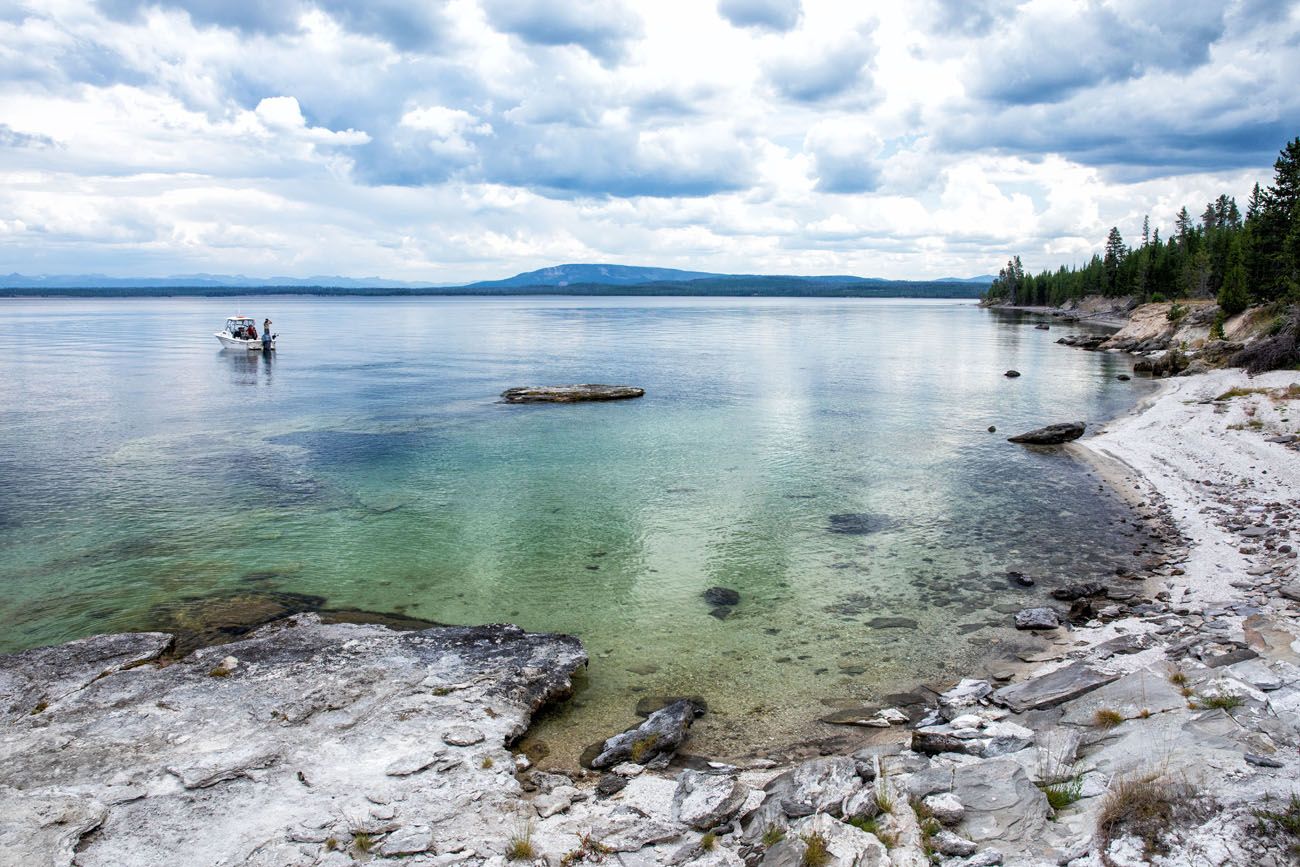
We took this photo of Yellowstone Lake from West Thumb Geyser Basin
Plan Your Trip to Yellowstone
- Want the full details on watching Old Faithful erupt? → Our How to Visit Old Faithful guide covers the best viewing spots, timing, and how to avoid the crowds.
- Want to make the most of Grand Prismatic Spring? → Our How to Visit Grand Prismatic Spring Overlook guide covers the hike to the overlook and whether to add on Fairy Falls.
- Planning more than a day in the park? → Our Yellowstone Itinerary guide covers how to plan 1 to 5 days in Yellowstone.
- Only have one day? → Our One Day in Yellowstone guide covers route options based on which entrance you’re using.
- Deciding where to stay? → Our Where to Stay in Yellowstone guide covers the best hotels and lodges by area.
- Want to see everything the park has to offer, not just geysers? → Our Yellowstone Travel Guide has links to all of our Yellowstone content, including more things to do, itineraries, and important planning information.
If you have any questions about how to visit the geyser basins in Yellowstone, let us know in the comment section below.
Explore More of Yellowstone & the US National Parks
23 Best Things to Do in Yellowstone National Park
Pinterest Facebook Flipboard Yellowstone National Park is a wonderland of geothermal activity, dramatic landscapes, and abundant wildlife. Steam hisses from the ground beside wooden boardwalks, bison bring traffic to a standstill on the park roads, and technicolor hot springs amaze even the most seasoned travelers. In this guide, we cover the best things to do […]
Exactly How to Visit the Grand Canyon of the Yellowstone
The Grand Canyon of the Yellowstone is a 24-mile, 1,200-foot-deep canyon carved by the Yellowstone River, with two waterfall, Upper Falls and the much larger, more famous Lower Fall, dropping into it. It’s one of the top attractions in Yellowstone National Park, with a series of overlooks along the North Rim, South Rim, and Brink […]
Beartooth Highway: Driving One of America’s Most Scenic Roads
Beartooth Highway is one of the most scenic drives in the United States, climbing to nearly 11,000 feet while passing alpine lakes, mountain passes, and sweeping views on the way to Yellowstone National Park. Connecting Red Lodge, Montana, with Cooke City near Yellowstone’s northeast entrance, this unforgettable road trip is often called the most beautiful […]
Grand Teton, Yellowstone and Glacier National Parks: 10 Day Road Trip Itinerary
Grand Teton, Yellowstone, and Glacier National Parks are three of the most spectacular parks in the United States, and with 10 days, you can visit all three on one unforgettable road trip. Start in Grand Teton, where the lakes and the jagged mountain range create a hiker’s and photographer’s paradise. Journey north to Yellowstone, a […]
The Perfect Yellowstone & Grand Teton Itinerary for First-Timers
Yellowstone and Grand Teton sit side by side in northwest Wyoming, and together they make one of the best national park trips in the country. Spend your days watching Old Faithful erupt and geysers bubble across Yellowstone’s thermal basins, then drive an hour south to hike beneath the jagged Teton Range, paddle Jenny Lake, and […]
Yellowstone Day Trip from Jackson Hole & Grand Teton: Our Itinerary
A Yellowstone day trip from Jackson Hole or Grand Teton National Park is a long day, but with an early start and a well-planned route, you can see many of Yellowstone’s most iconic sights. On this itinerary, you’ll drive Yellowstone’s Lower Loop, visiting Hayden Valley, the Grand Canyon of the Yellowstone, Grand Prismatic Spring, Old […]
Wyoming Travel Guide: Places to Visit in Wyoming
Wyoming Travel Guide Beautiful Wyoming… a land rich in wildlife, soaring mountains, roaring geysers, and technicolor hot springs. This state is the home to some of our favorite National Parks: Yellowstone and Grand Teton, and these parks sit directly next to each other, making it a perfect way to see both in one trip. You […]
15 Best US National Parks to Visit in August
Planning a trip to the US national parks in August and don’t know which ones to visit? August is a busy time to visit the national parks, but crowd levels aren’t quite at their peak (that typically happens in July for many parks). In this guide, we list some popular summertime parks to visit plus […]
One Perfect Day in Grand Teton National Park
Grand Teton National Park has something for everyone. Hikers will love the long list of trails that head into the Teton mountain range. Photographers will love capturing sunrise at Mormon Row and Oxbow Bend. Families will love the easy-to-visit overlooks, crossing Jenny Lake by boat, and spotting moose and elk as you drive through the […]
The Ultimate Guide to the 63 US National Parks
Stretching from the South Pacific, across the United States to the Caribbean, are 63 national parks. These national treasures preserve iconic landscapes, majestic mountains, primordial forests, arid deserts, misty coastlines, immense canyons, wildlife, and historic landmarks. We have visited 56 of the 63 US national parks, from the towering granite walls of Yosemite and the […]
United States Travel Guide: Places to Visit in the USA
Plan your visit to the United States. Learn about the best things to do, how to plan your time, road trip ideas, and sample itineraries.
Best US National Parks to Visit Month-By-Month
Best National Parks to Visit Month-By-Month Most national park planning advice tells you the “best” month to visit a park without showing you the full picture. This guide does both. We’ve visited 56 of the 63 US national parks, many of them multiple times and in different seasons, and timing is consistently one of the […]


Comments 4