
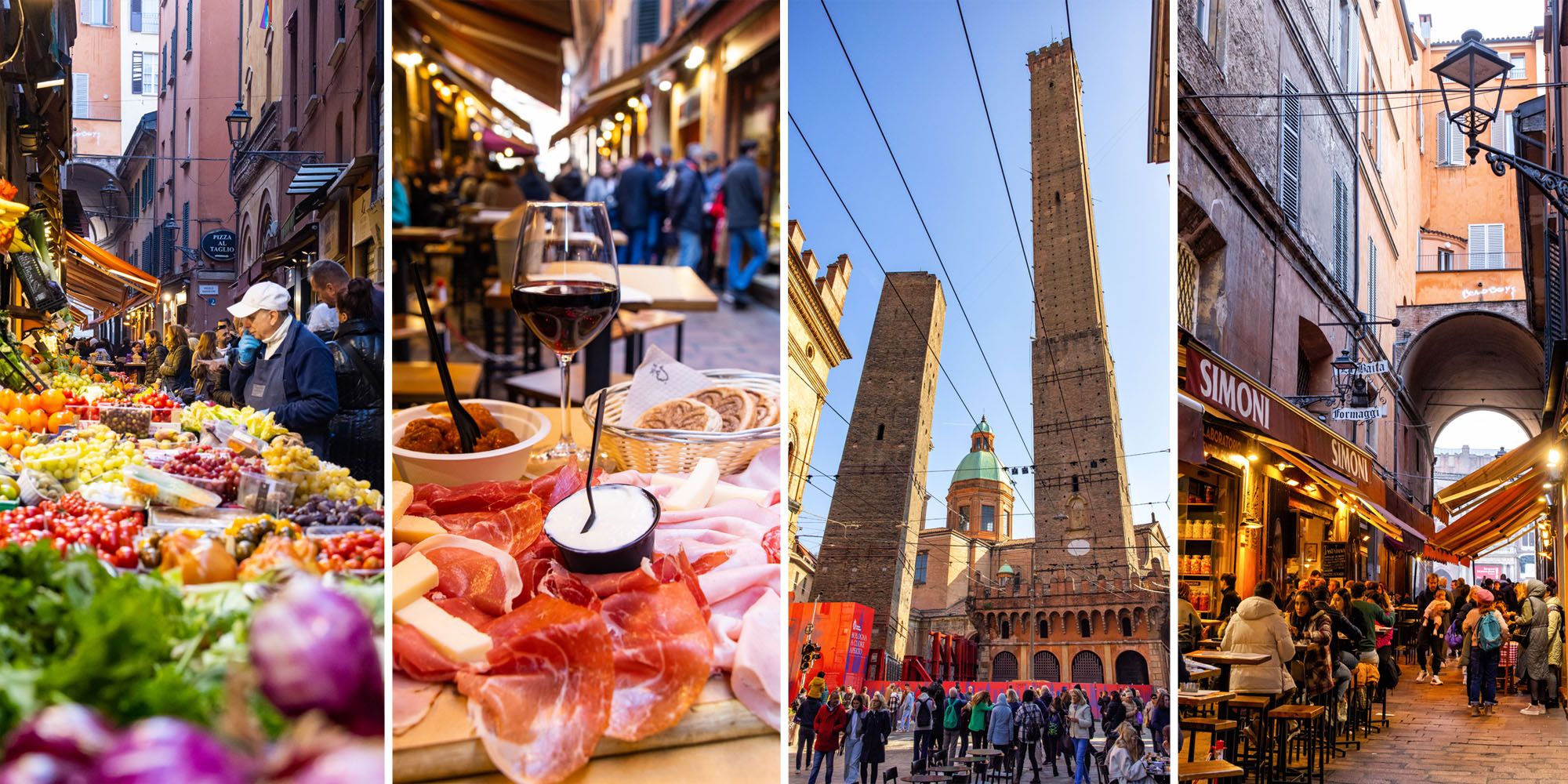
Bologna doesn’t get the attention it deserves. The best things to do in Bologna revolve around food, from rolling fresh pasta in a cooking class, wandering the Quadrilatero while cheese wheels and cured meats hang in every doorway, and sitting at a wine bar long enough to understand why locals call this city La Grassa, aka The Fat One. It earns the nickname.
But Bologna isn’t only about food. The city has medieval towers, 40 kilometers of UNESCO-listed porticoes, a basilica with an unfinished façade, an incredibly unique 17th-century anatomical theater, and day trips to Ferrari, Lamborghini, and Pagani — the holy trinity of Italian supercars.
It was on our sixth trip to Italy that Tim and I finally made it here, and within hours, we were asking each other why it had taken us so long. We spent several days in November 2024 exploring the city, and it quickly joined our short list of favorite Italian destinations.
Below, we cover 20 things to do in Bologna, including what we did firsthand, what we’d recommend skipping, and a few things we’d add on a return visit.
Bologna: At a Glance
LOCATION | Emilia-Romagna
DON’T MISS | The Quadrilatero, Piazza Maggiore, the porticoes, the Archiginnasio, take a cooking class, climb a tower
BEST TIME TO VISIT | May and June; Mid-September through October
HOW MANY DAYS | 1 to 2 days
GETTING THERE | High-speed train from Florence (35 min), Venice (1hr 20 min), Milan (1hr), Rome (2hrs)
GETTING AROUND | Almost entirely walkable; compact historic center
WHERE TO STAY | Historic center, within walking distance of Piazza Maggiore
April 2026 Update: Expanded from 10 to 20 things to do, added food markets, Best Time to Visit, and Quick Picks sections. Updated Asinelli Tower closure status, expanded FAQ, and added fresh detail throughout based on our visit.
Quick Picks: Best Things to Do in Bologna
Not sure where to start? Here are our top picks across the three things Bologna does best.
Food Experiences
- Spend a morning in the Quadrilatero, Bologna’s ancient market district
- Take a cooking class and learn to make fresh pasta and ragù from scratch
- Go on a food tour to taste your way through the city’s best bottegas and wine bars
- Browse the Mercato delle Erbe food market
- Eat at Marsalino for the best pasta in the city; don’t skip the Bolognese
Must-See Sites
- Piazza Maggiore and Neptune’s Fountain: the heart of the city
- Basilica of San Petronio, one of the largest Gothic churches in the world
- The Archiginnasio and its extraordinary 17th-century Anatomical Theater
- The Porticoes — wander them without a map and see what you find
- The Clock Tower for the best views over Piazza Maggiore (Asinelli is currently closed)
Day Trips
- Ferrari, Lamborghini, and Pagani museums — a full day in Motor Valley
- A Parmigiano Reggiano or balsamic vinegar factory tour in the Emilia-Romagna countryside
Best Things to Do in Bologna
1. Piazza Maggiore & Neptune’s Fountain
Piazza Maggiore is the main square in Bologna. This busy, bustling place is surrounded by some of the oldest and most important buildings in the city, including Palazzo Comunale, Palazzo del Podestà, Palazzo dei Notai, and the Basilica of San Petronio.
This piazza is great place to get your bearings. It is centrally located and many food and walking tours will start here. If you have plans to take the San Luca Express to the Sanctuary of Madonna di San Luca, that leaves from here as well.
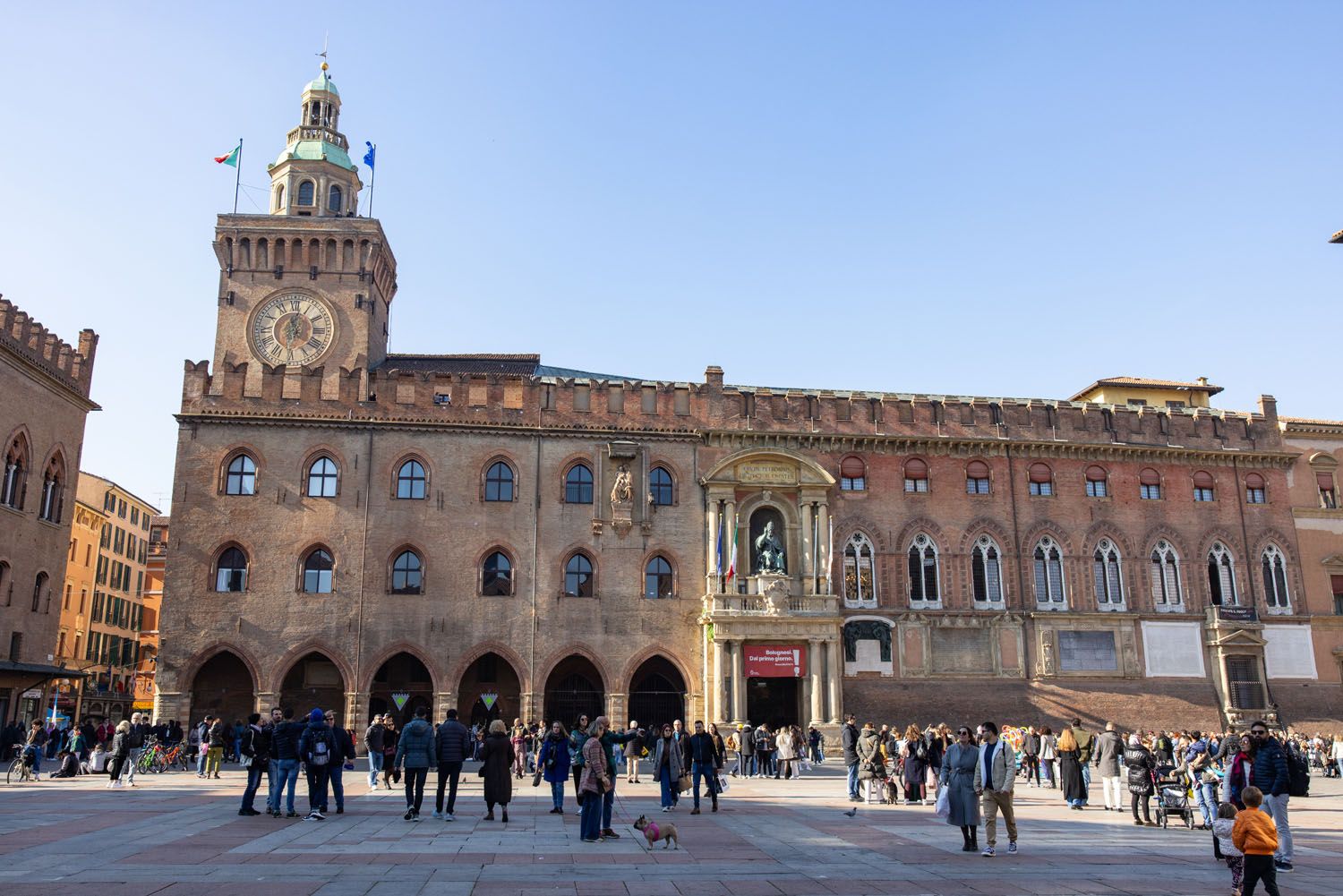
Palazzo Communale and Torre dell’Orologico
Neptune’s Fountain
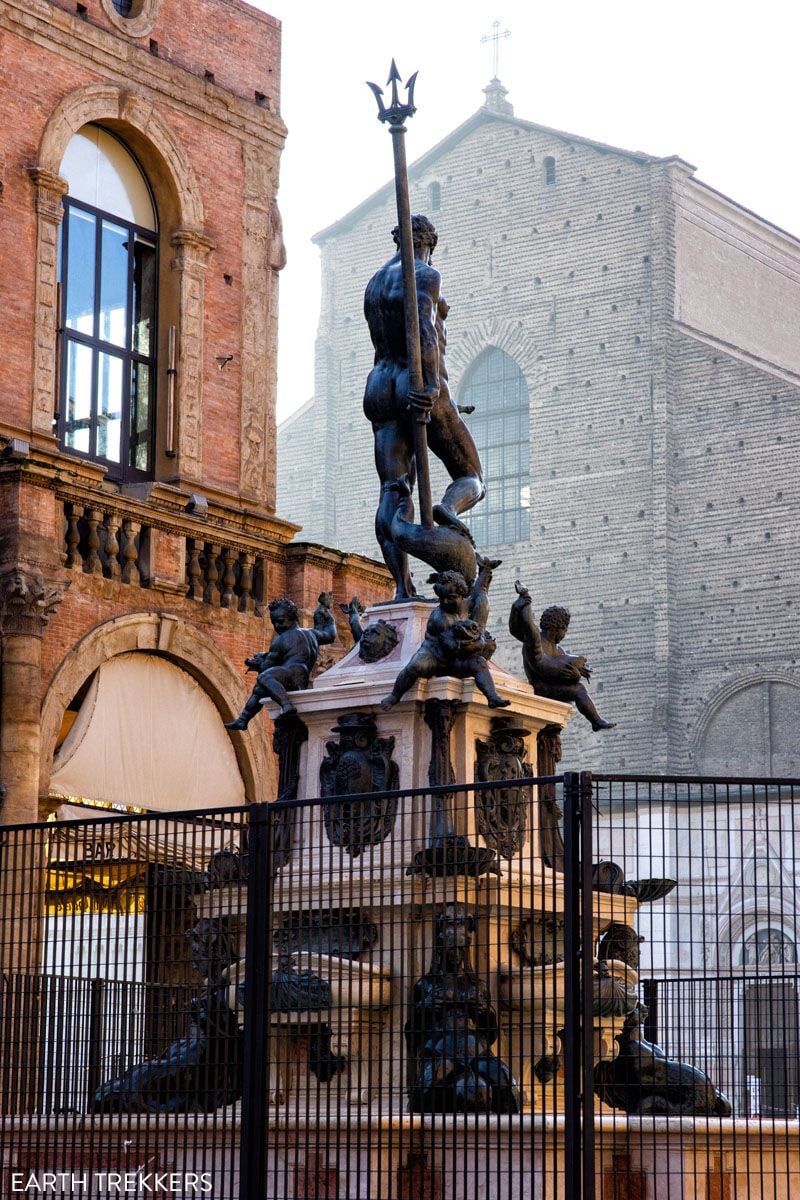
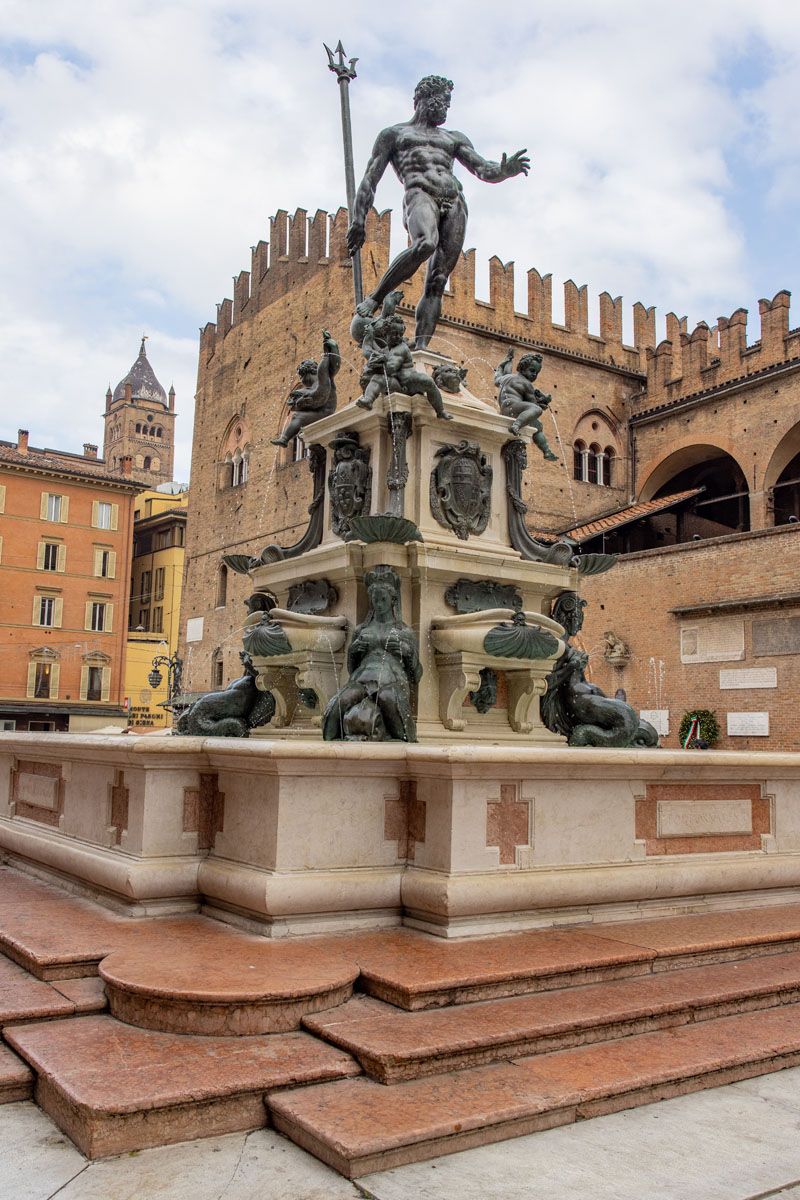
Neptune’s Fountain (Fontana del Nettuno) is a 16th-century fountain that sits next to Piazza Maggiore. It was commissioned to symbolize Pope Pius IV’s power. Pope Pius IV had concerns about the large size of Neptune’s genitals and ordered them to be made smaller. Giambologna, the sculptor, made the change but altered the statue such that if you approach it from behind, Neptune’s arm sticks out in a way that at first, you might think it is something else…
COOL FACT: Also of note is that the trident that Neptune is holding served as inspiration for the emblem of Maserati, a luxury car company based in Bologna.
2. Don’t Miss the Chapels Inside the Basilica of San Petronio
The Basilica of San Petronio sits on Piazza Maggiore. This massive basilica is one of the largest in Europe and it is the largest Gothic church in the world built from brick. It’s also unfinished, with marble adorning just its bottom half.
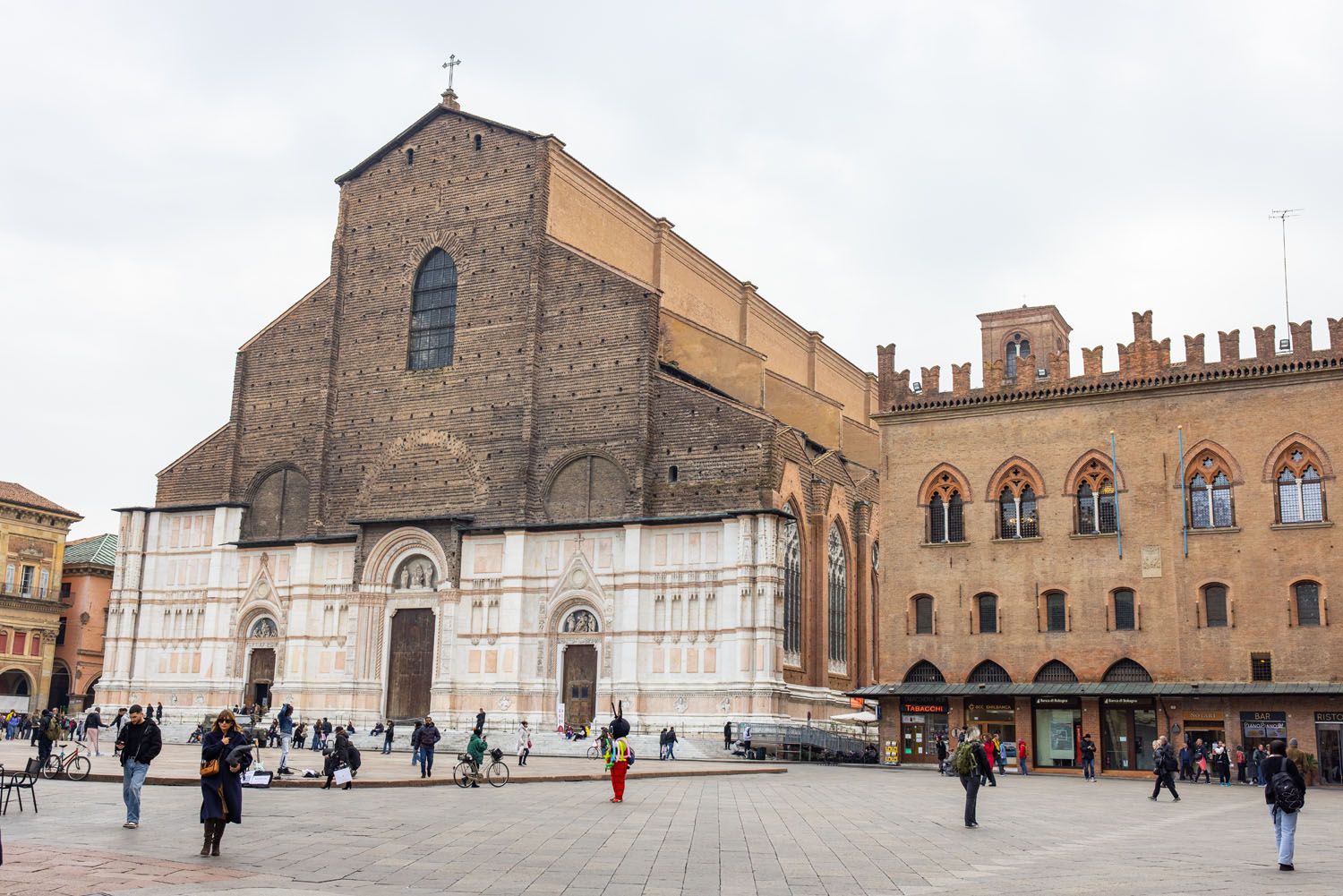
Basilica of San Petronio and Piazza Maggiore
Inside of the basilica, there are a few important things to see.
The Nave
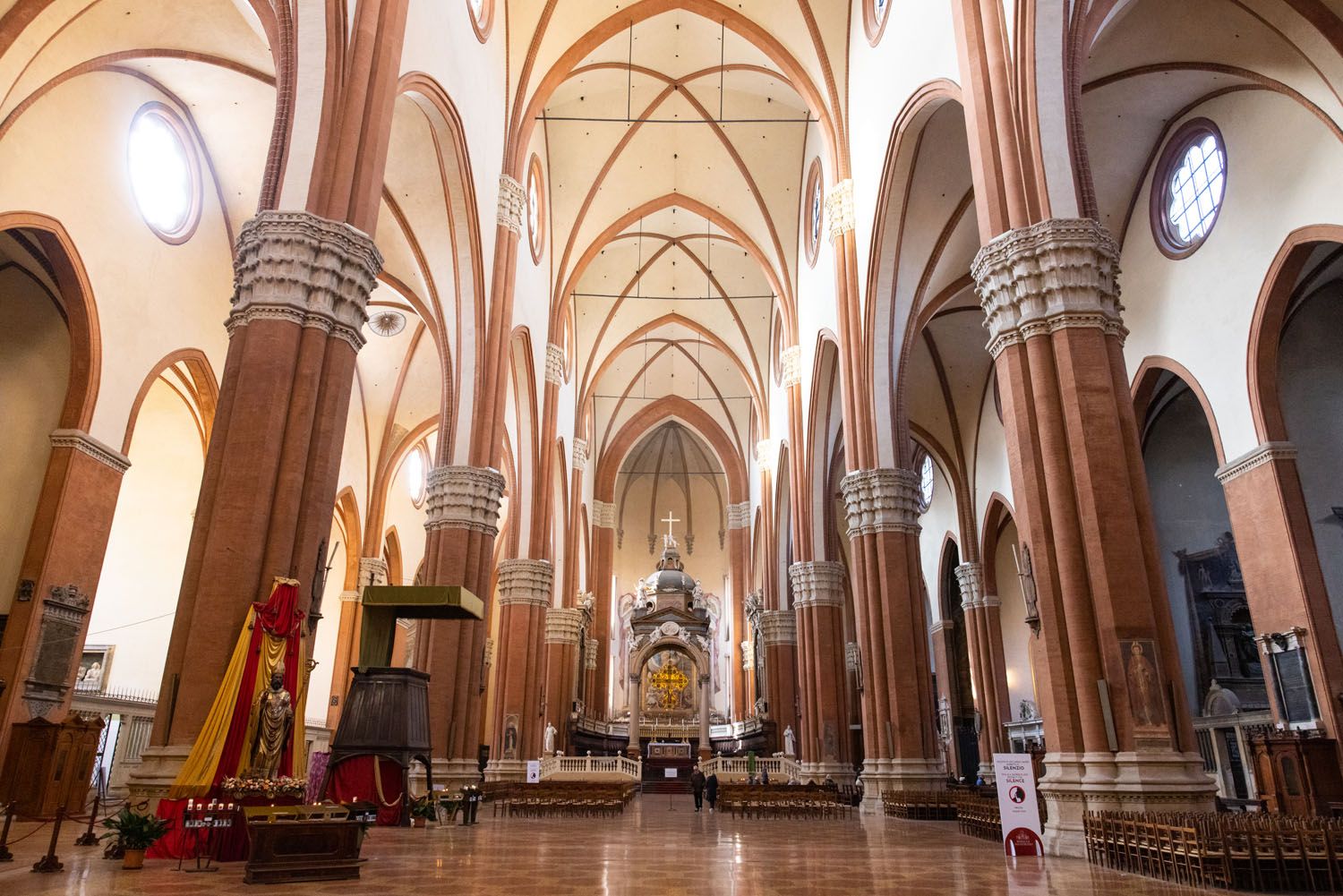
We were amazed at the sheer size of this basilica. It’s enormous, right up there with St. Peter’s Basilica in the Vatican. The stained-glass windows are gorgeous.
The Sundial
In 1655, Cassini created a meridian line (sometimes referred to as the sundial) inside of the basilica to measure the position and size of the Sun. This line helped him determine that the Earth’s orbit is elliptical. This replaced the original meridian line that was created by Danti in the 16th century.
The meridian line runs at an angle through the basilica. There are markings on the floor that show the position of the Sun throughout the year.
PRO TRAVEL TIP: The best time of day to visit the basilica is midday, if you want to see the sunlight appear on the floor.
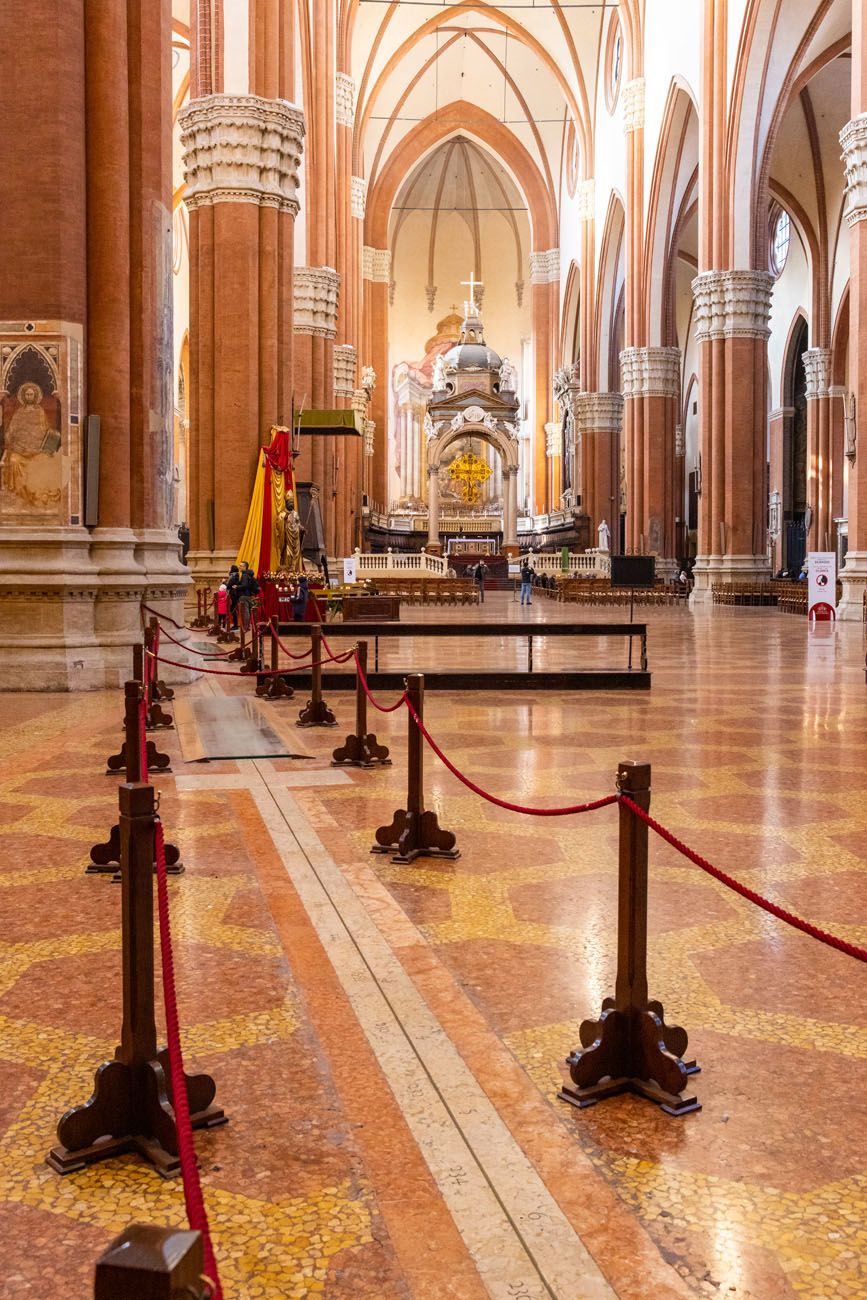
The meridian line
The Chapels
There are numerous chapels in the basilica, but there are three important chapels that require a small fee.
These chapels are frequently overlooked, but for us, they were the highlight of visiting the basilica, especially the Chapel of Re Magi.
The most notable is the Chapel of Re Magi. This chapel has frescos that date back to the early 15th century, when the basilica was built. Among these is the Last Judgement, with scenes representing Heaven and Hell, resembling Dante’s Inferno. Also in this chapel is a wooden polyptych and a stained-glass window that dates back to the very early 15th century.
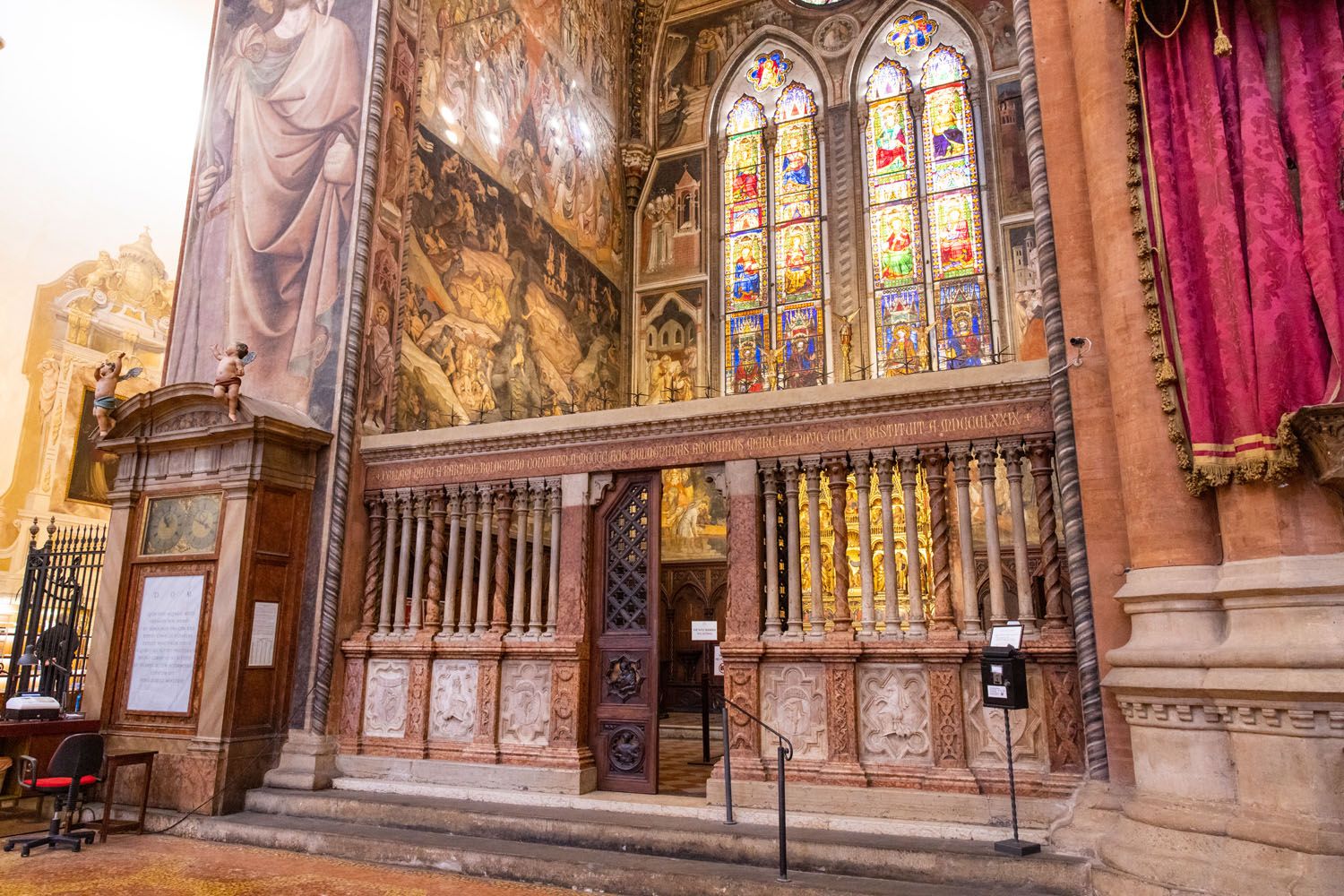
Chapel of Re Magi
The Chapel of San Petronio houses the body and head of Saint Petronio.
The Chapel of Sant’Abbondio was the site of the first Holy Mass in the basilica on October 4, 1392. Legend has it that Charles V of Habsburg was crowned Holy Roman Emperor here in February 1530.
PLANNING YOUR VISIT: The basilica is free to enter. There is a small fee to enter the chapels and photography is not permitted inside of these chapels. In the past, visitors were allowed to walk on the upper terraces but in our visit in 2024, we were told they were closed indefinitely. Get hours and pricing on the official website.
GOOD TO KNOW: Knees and shoulders must be covered while inside the basilica. Make sure you dress appropriately or bring a jacket or scarf to cover up.
3. Explore the Quadrilatero
The best thing to do in Bologna is to eat, and the next two entries embrace the best food experiences in the city.
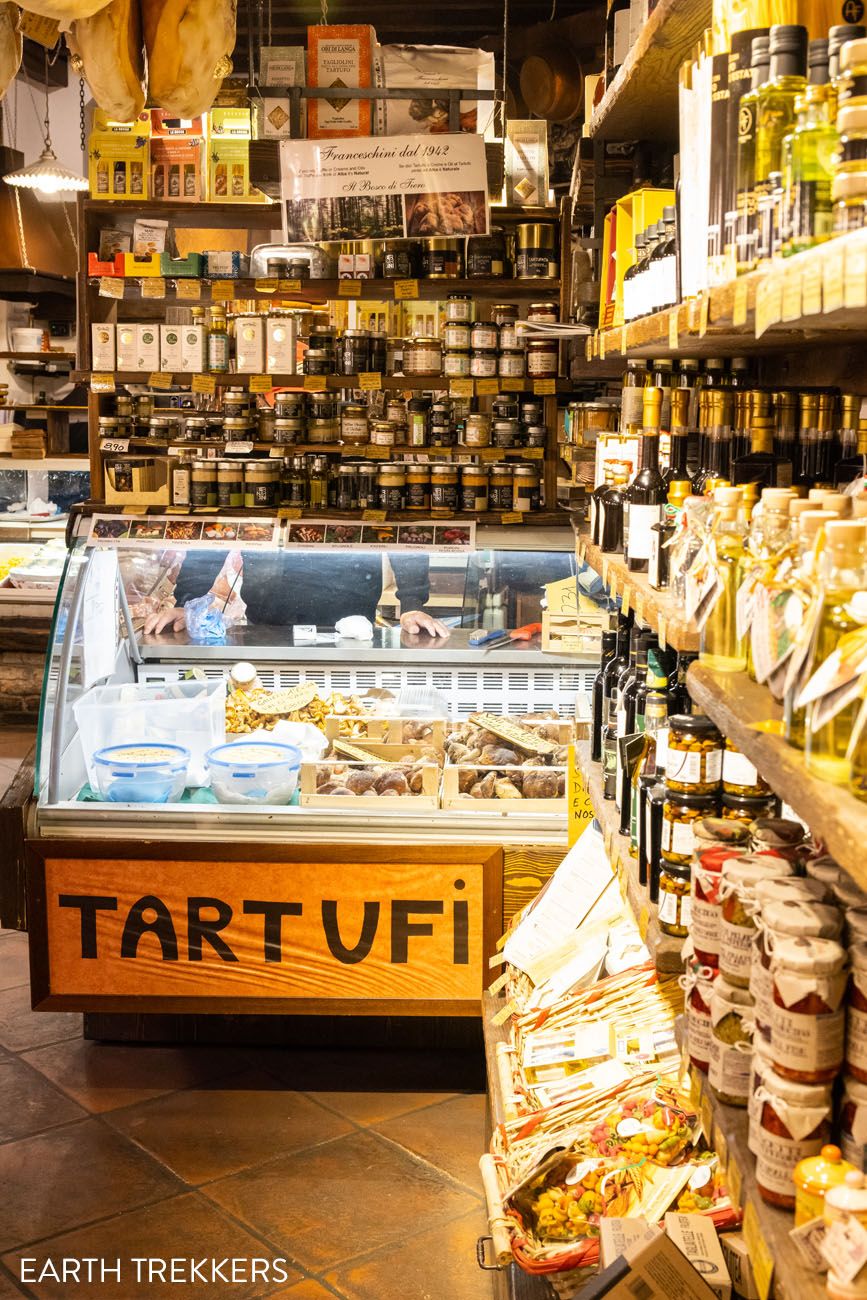
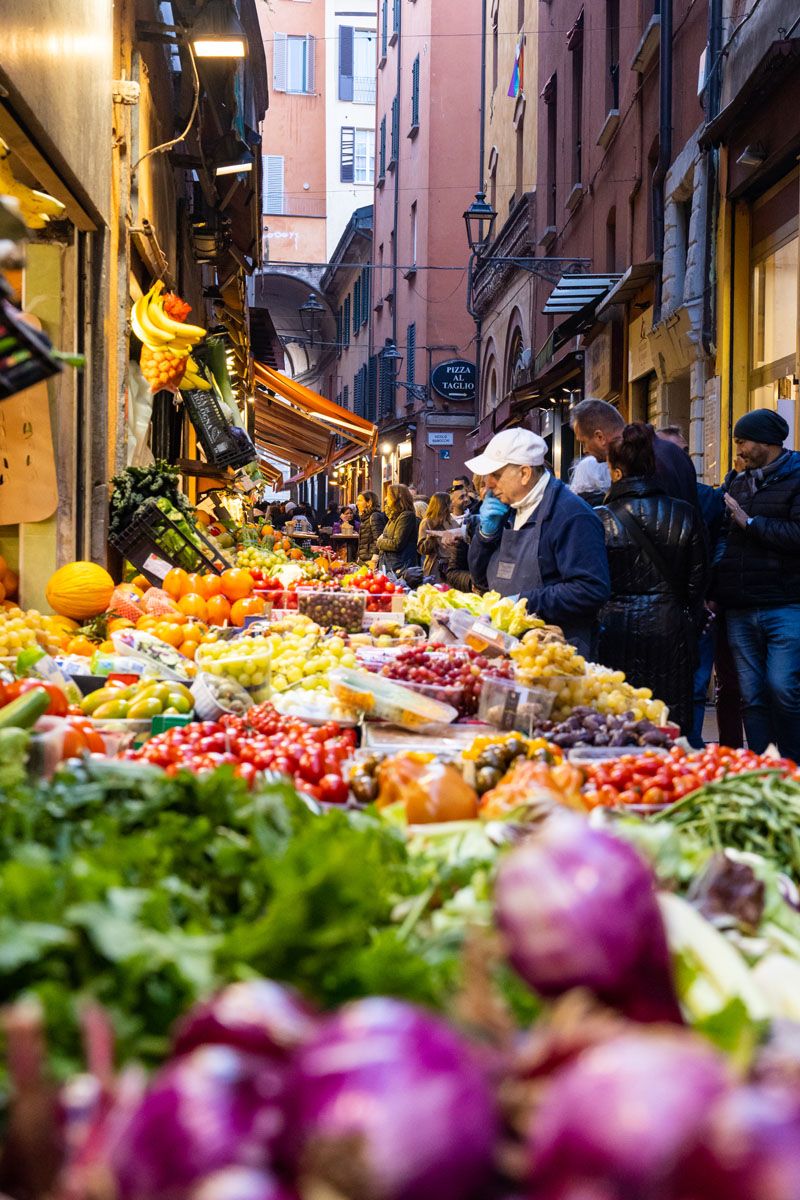
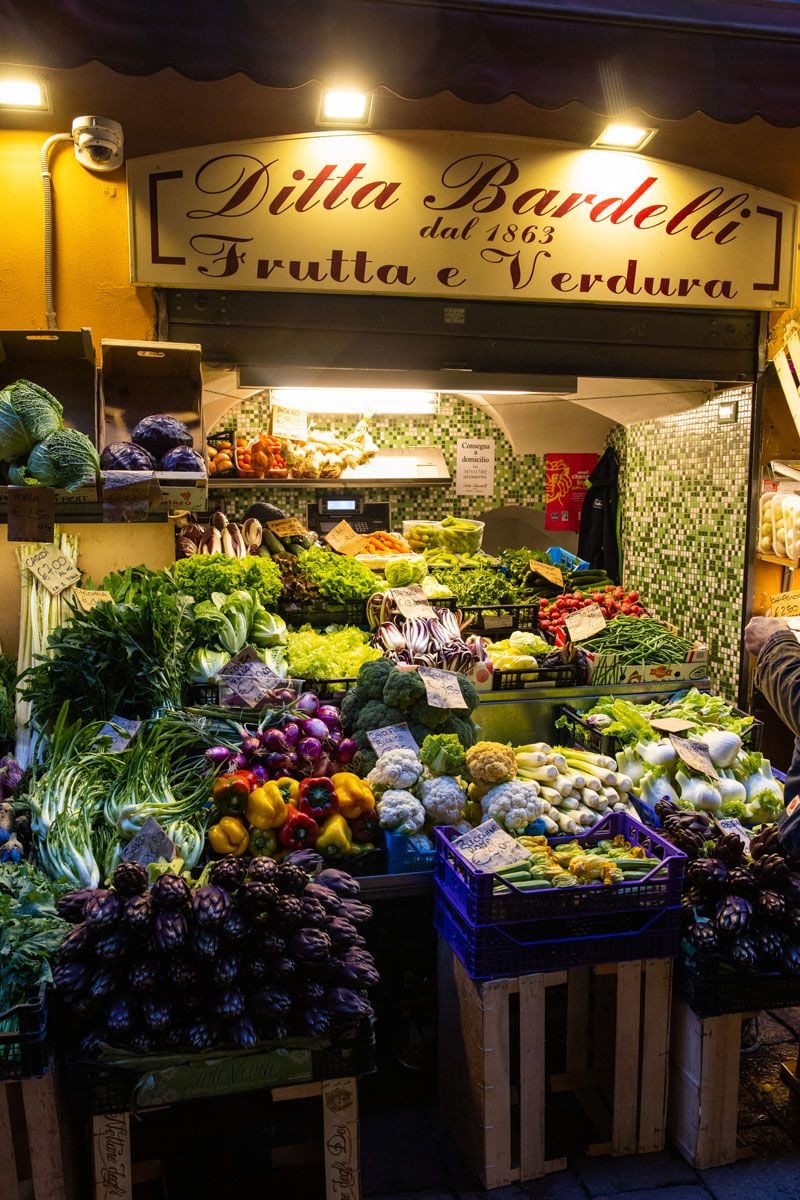
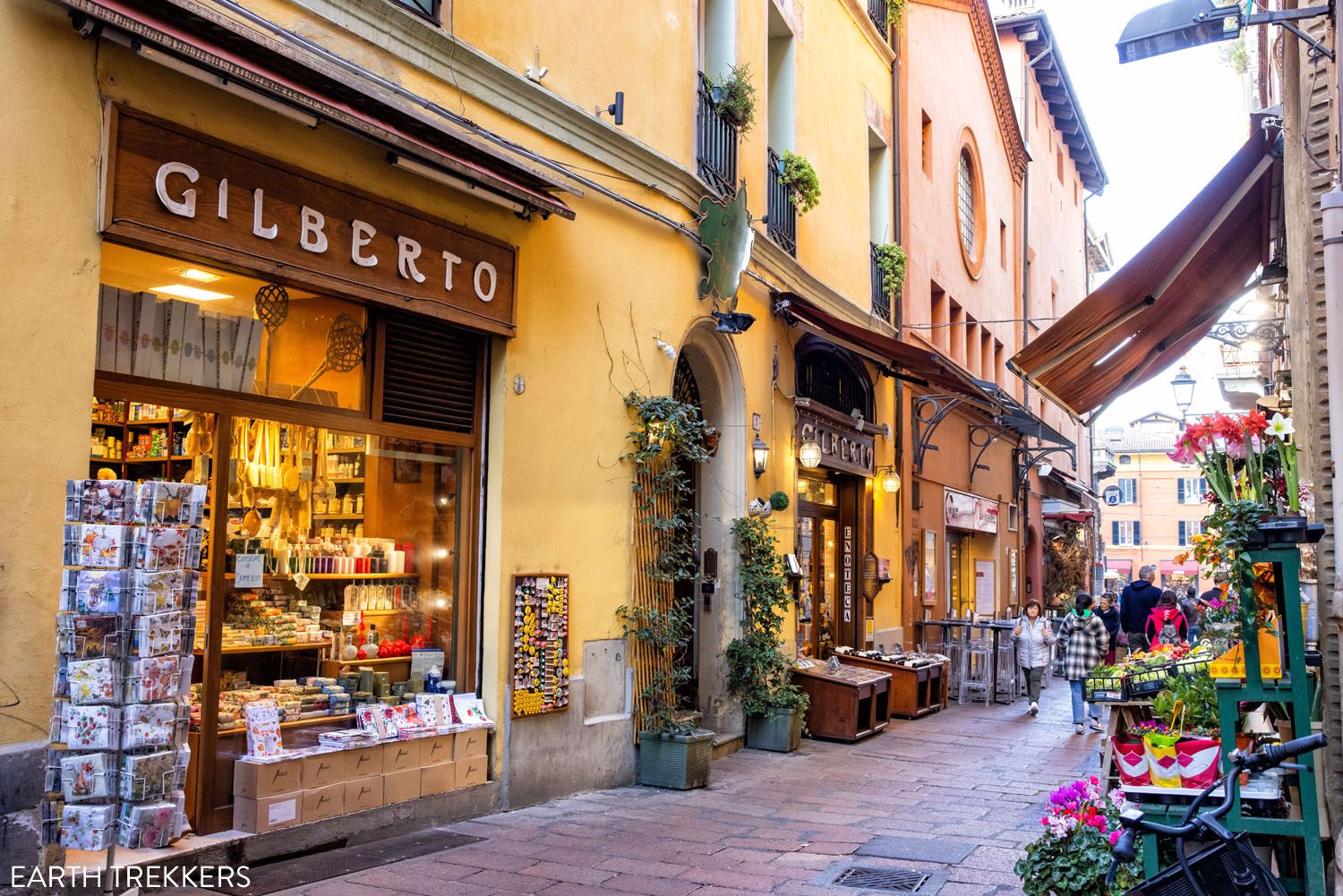
Strolling the streets of the Quadrilatero was one of our favorite things to do in Bologna. We visited this area several times on each of the three days we were here, and it never got old. It’s a bit touristy but it’s still a very interesting place to visit.
The Quadrilatero is the old market area of the city. A tangle of narrow streets is lined with shops, small grocery stores, wine bars, and outdoor cafes. It is a busy place but so fun to explore, especially for foodies.
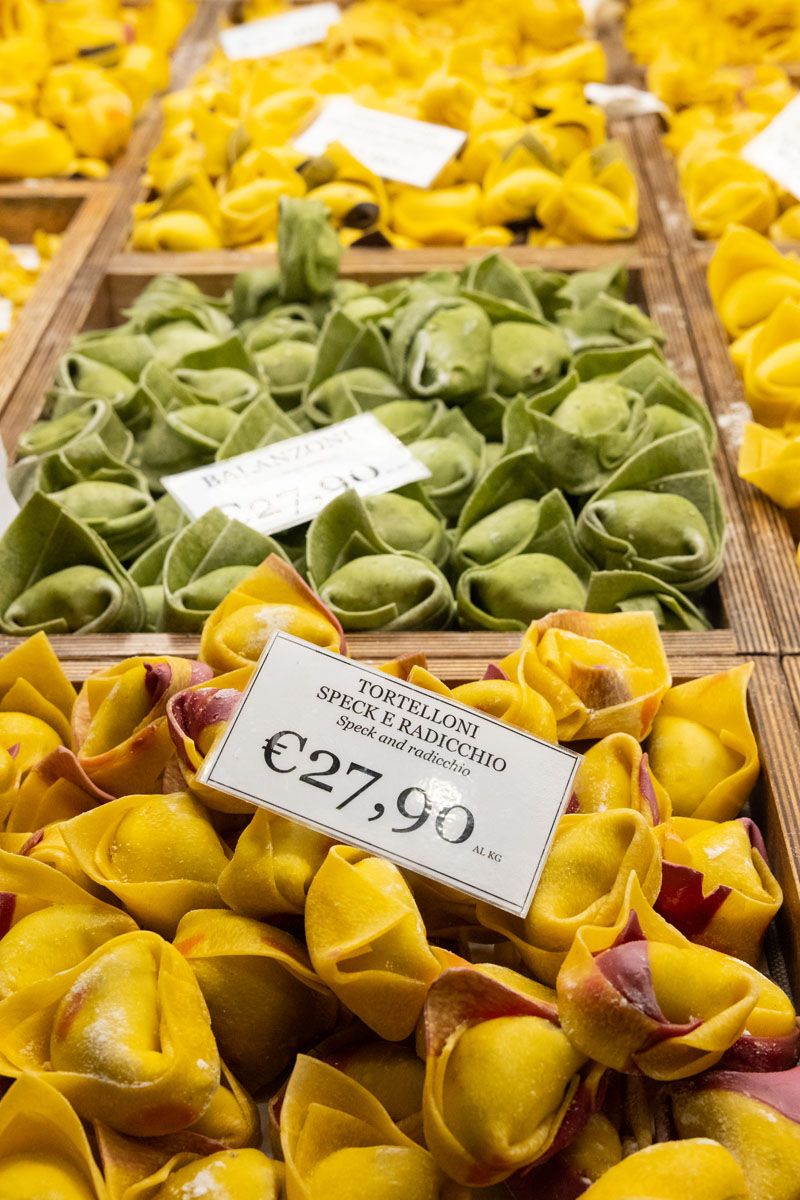
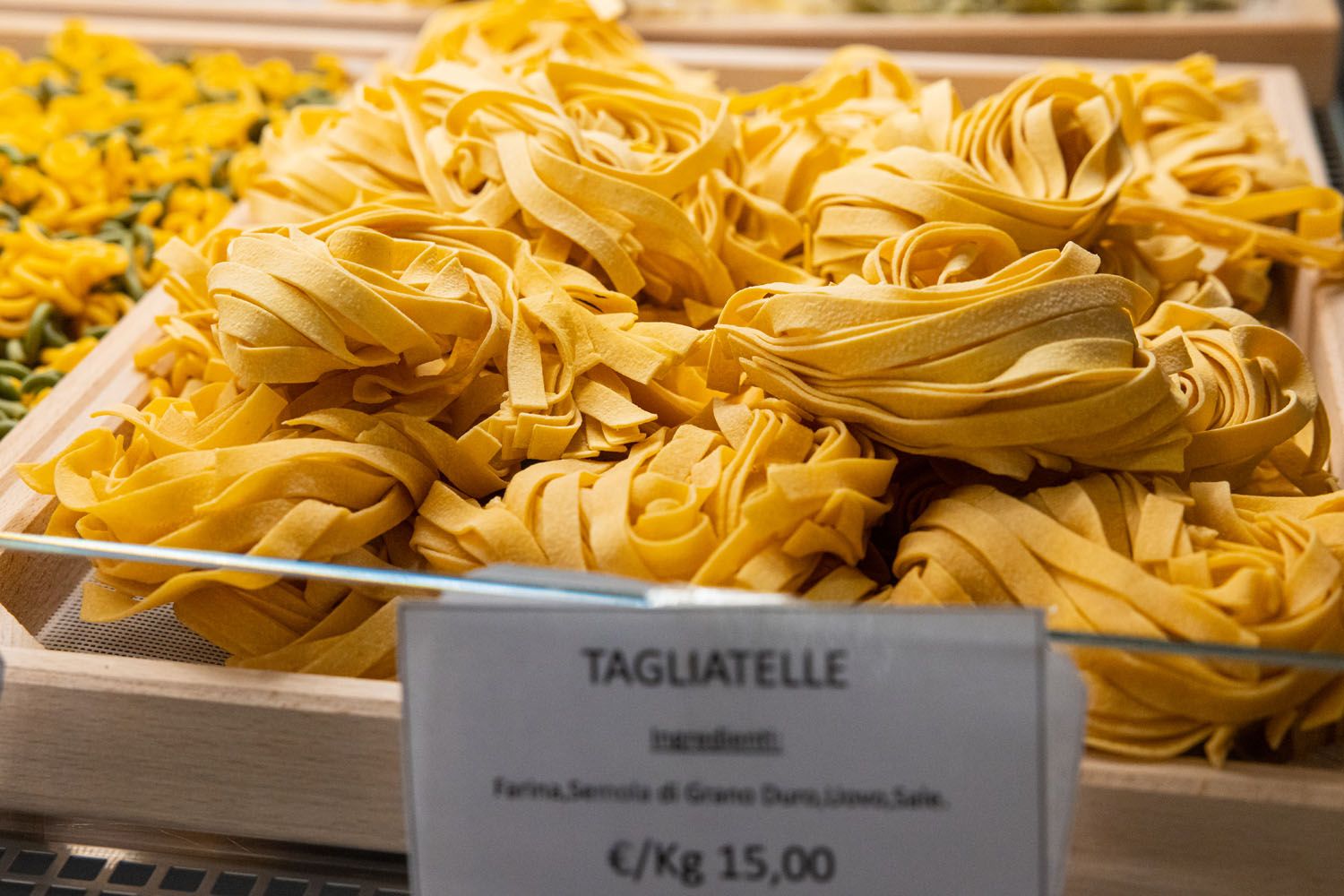
Things you will see are display cases filled with cheese, cured meats hanging from the rafters of the grocery stores, SO MUCH fresh pasta, and tables filled with patrons. The wine is flowing and meats, cheeses, bread, and olive oil are the top things to try here.
DON’T MISS!: The most photogenic street is Via Pescherie Vecchie. There are several restaurants here, the perfect place to take a quick break, have a glass of wine, and a charcuterie board. We ate at Zerocinquantuno, and it was fantastic, but its neighbor Salumeria Simoni Laboratorio gets slightly better reviews (and bigger crowds).
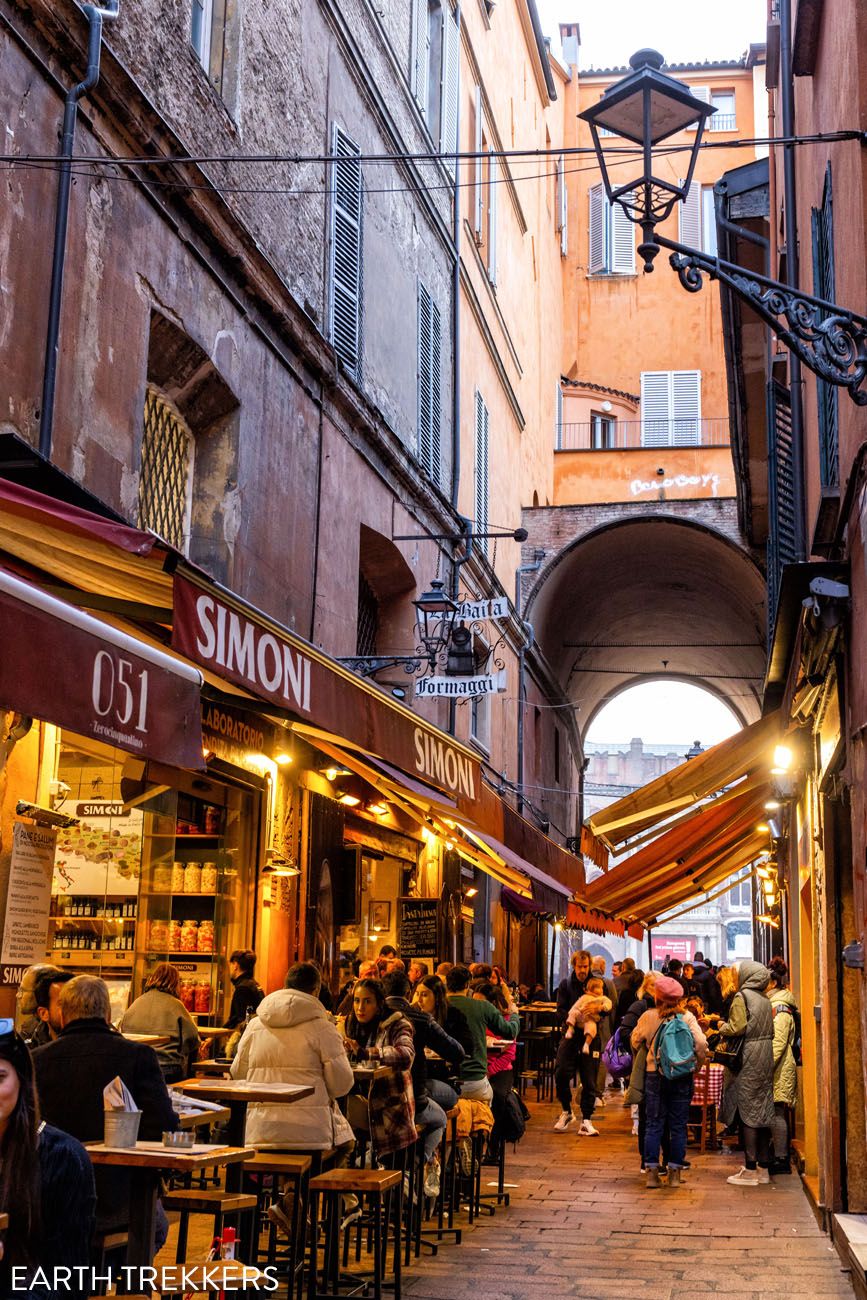
Via Pescherie Vecchie
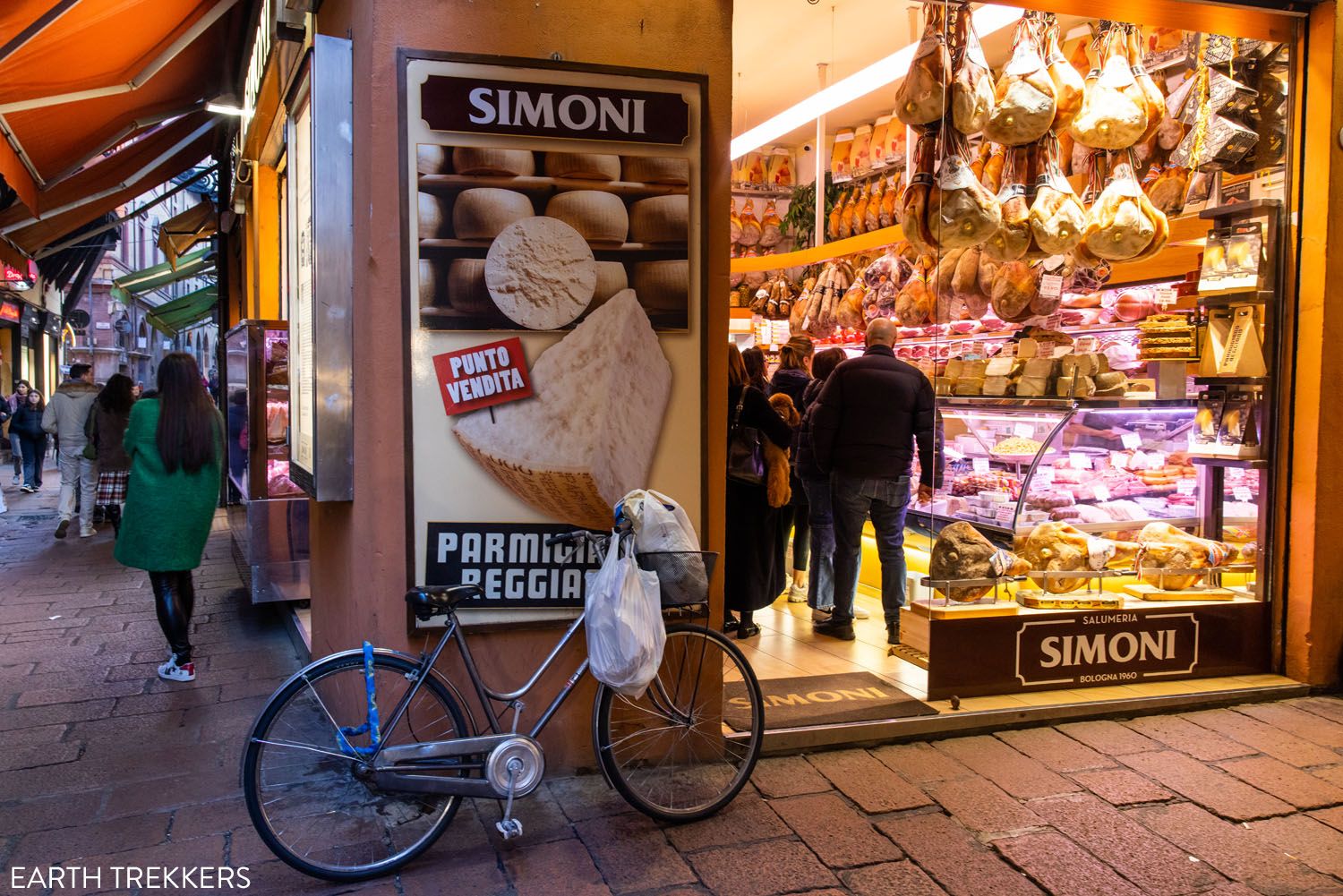
4. Visit Bologna’s Food Markets
Beyond the Quadrilatero streets themselves, Bologna has several dedicated market halls worth knowing about and each has a distinct character and a different kind of crowd.
We visited Mercato Ritrovato, an outdoor farmers market held on Saturday mornings and Wednesday evenings at the Cineteca di Bologna. Producers sell everything from fresh pasta, cheese, and organic vegetables to honey, baked goods, and craft beer. It’s a genuinely local experience, quieter and more neighborhood-feeling than the Quadrilatero.
Mercato delle Erbe is Bologna’s largest covered market, combining fresh produce stalls with a handful of eateries and wine bars, making it a good option for lunch or a mid-morning snack.
Mercato di Mezzo, located in the Quadrilatero itself, is the more touristy of the two, with food stalls and communal tables serving pasta, pizza, and antipasto. Think of it less as a traditional market and more as a lively food court in a medieval building.
PRO TRAVEL TIP: If you’re short on time, the Quadrilatero streets give you most of the market atmosphere without committing to a specific venue. The indoor markets are worth it if you want to sit down and eat in a market setting.

5. Take a Food Tour or Cooking Class
There’s no better way to get to know Bologna than on a food tour or in a cooking class.
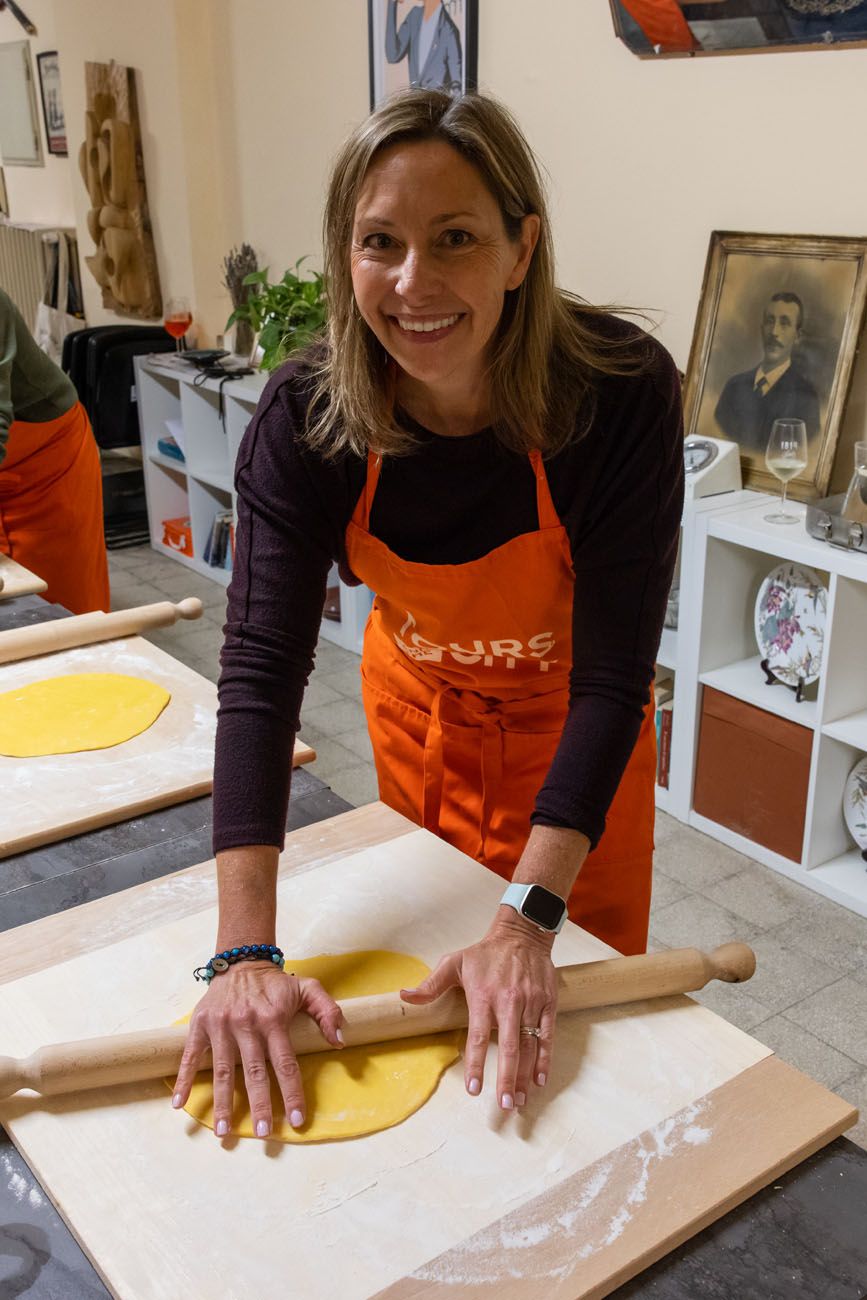
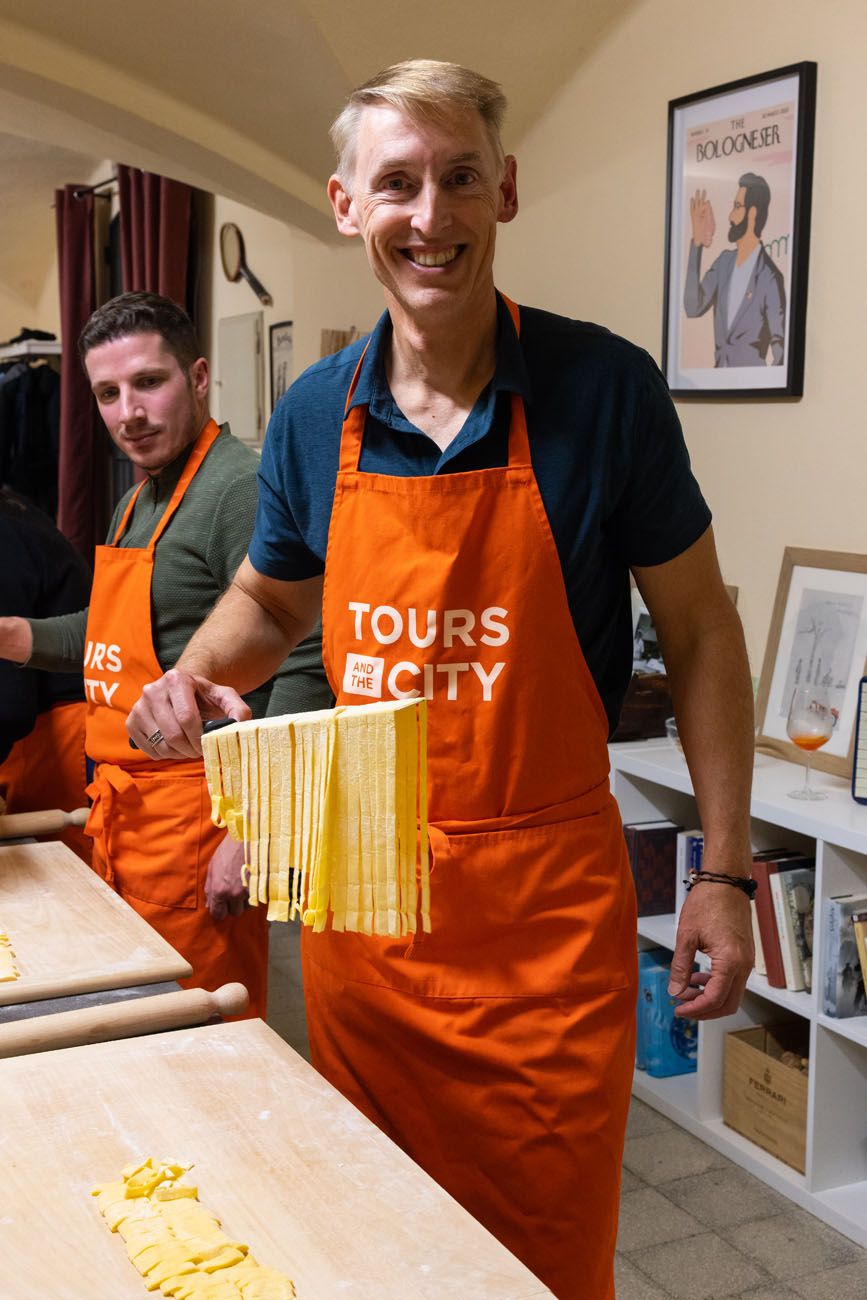
We elected to take a cooking class, learning how to make fresh pasta. We took this 3-hour cooking class, where we learned how to make a spritz and tagliatelle pasta. It was a fun, laid-back experience, with a lot of the time dedicated to making the pasta (rolling the dough paper thin takes some effort, so this can feel like a mini workout). It is one of the top-rated cooking classes in Bologna.
Dinner is your tagliatelle masterpiece, topped with ragu made by the staff, along with a glass of wine. We did not make the Bolognese sauce, but it was excellent (maybe the best we had in Bologna, and we were on a mission to sample it at as many places as possible), and they provide the recipe at the end of the class.
It’s a fun experience and the tour is held at the end of the day, so you have plenty of time all day to see the sights in Bologna.
If you like the idea of taking a food tour (I would do this on a return visit to Bologna), this food tour visits several bakeries and Osteria del Sole, gets excellent reviews, and looks like a lot of fun.
Cooking Classes & Food Tours
6. Eat & Drink: Best Restaurants and Wine Bars in Bologna
In a city nicknamed La Grassa — The Fat One — eating well isn’t optional, it’s the whole point. Bologna is the birthplace of tagliatelle al ragù, tortellini, mortadella, and lasagna, and the restaurants here take them all seriously. We ate our way through the city over several days, and these are the places we’d go back to without hesitation.
Marsalino
This small, unpretentious restaurant serves some of the best pasta we had in Bologna. In a city where the bar is high, that’s saying something. The Bolognese here was exceptional: rich, slow-cooked, exactly what it should be. Make a reservation in advance; it fills up quickly and the space is tiny.
The Gallery Pizzart Food & Drink
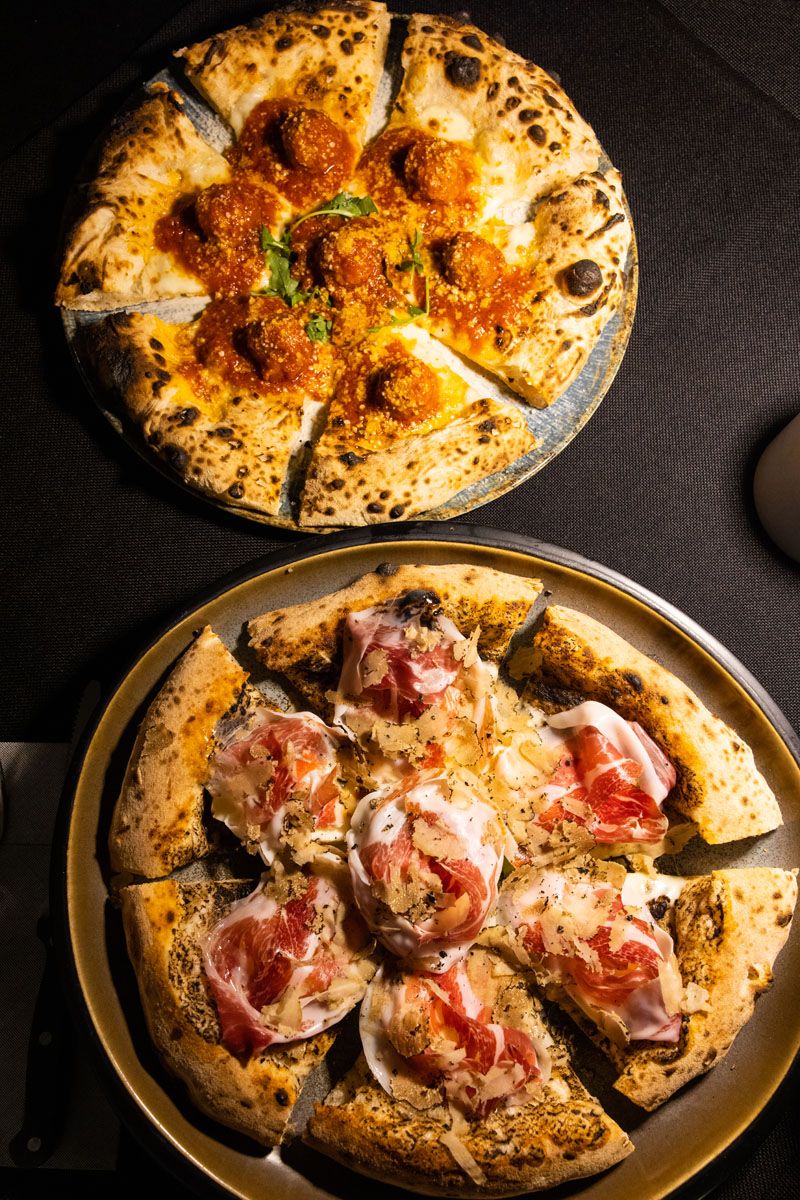
One of the most creative pizza places we’ve ever eaten at, full stop. The menu reads like a chef’s tasting menu that happens to be on pizza: Wagyu, duck breast, black truffle cream with Iberian ham. We ordered the Polpetta (meatballs) and the Patanegra e Tartufo and both were outstanding. If you think you’re too much of a food purist for gourmet pizza, this place will change your mind.
Salumeria Simoni Laboratorio and Zerocinquantuno
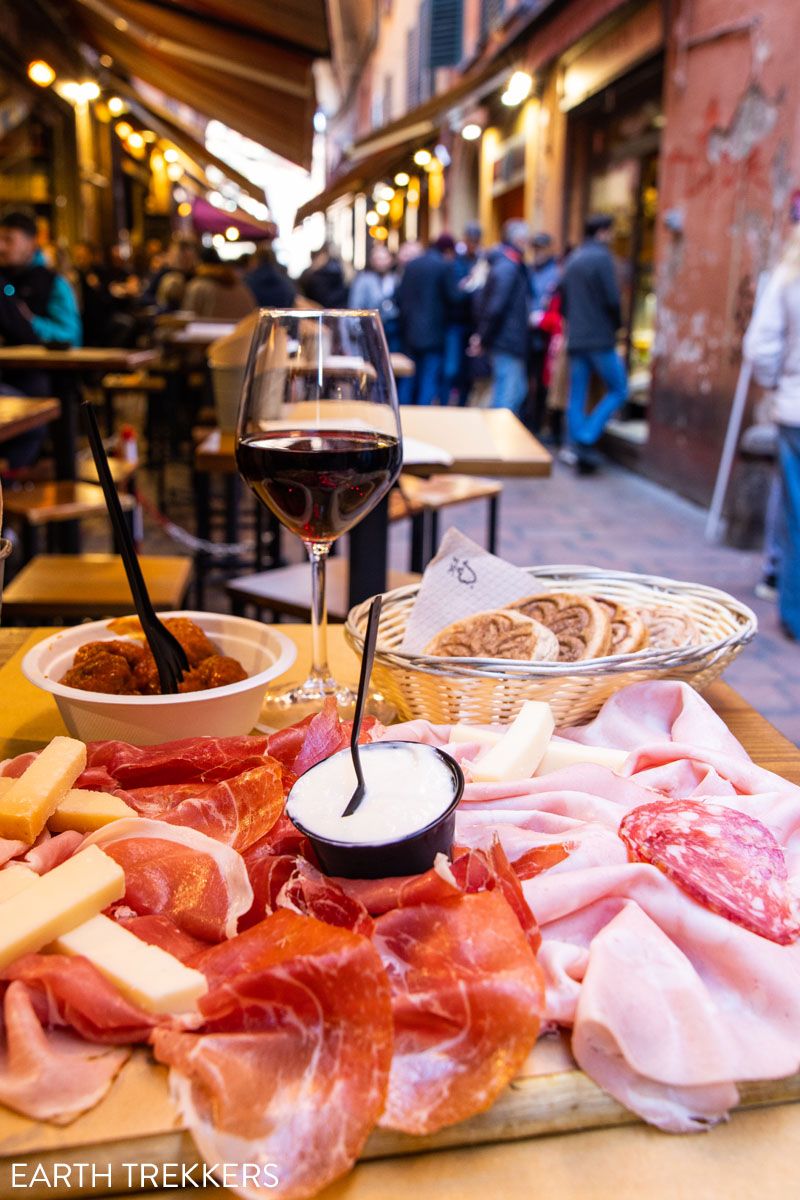
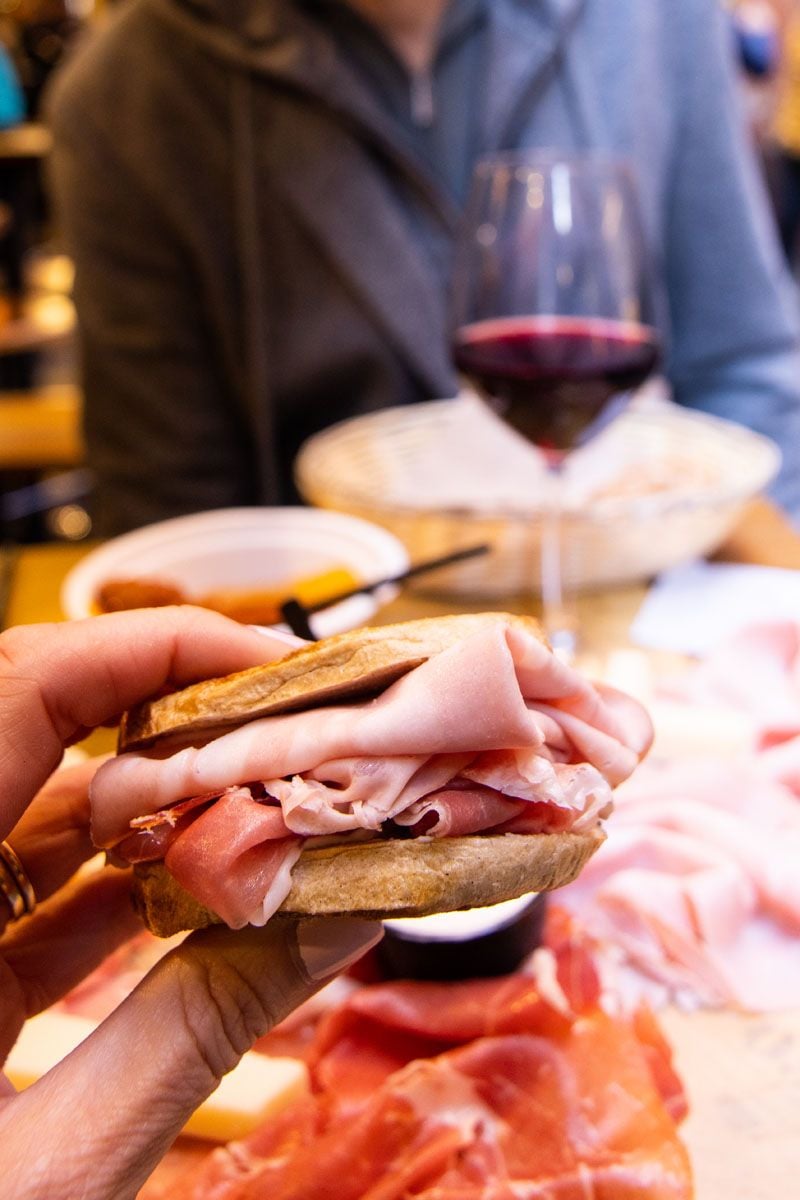
These two restaurants sit side by side on Via Pescherie Vecchie in the heart of the Quadrilatero. Salumeria Simoni gets slightly better reviews and bigger crowds, but we ate at Zerocinquantuno and loved it. Both serve meat and cheese boards, meatballs, and cestino, the typical hot bread of Bologna, alongside good wine. Perfect for a long, leisurely lunch.
Osteria Angolo degli Orefici
Also in the Quadrilatero, this one feels more touristy than Marsalino but the pasta is very good and the location makes it an easy stop while you’re already exploring the market streets.
Our Favorite Wine Bars
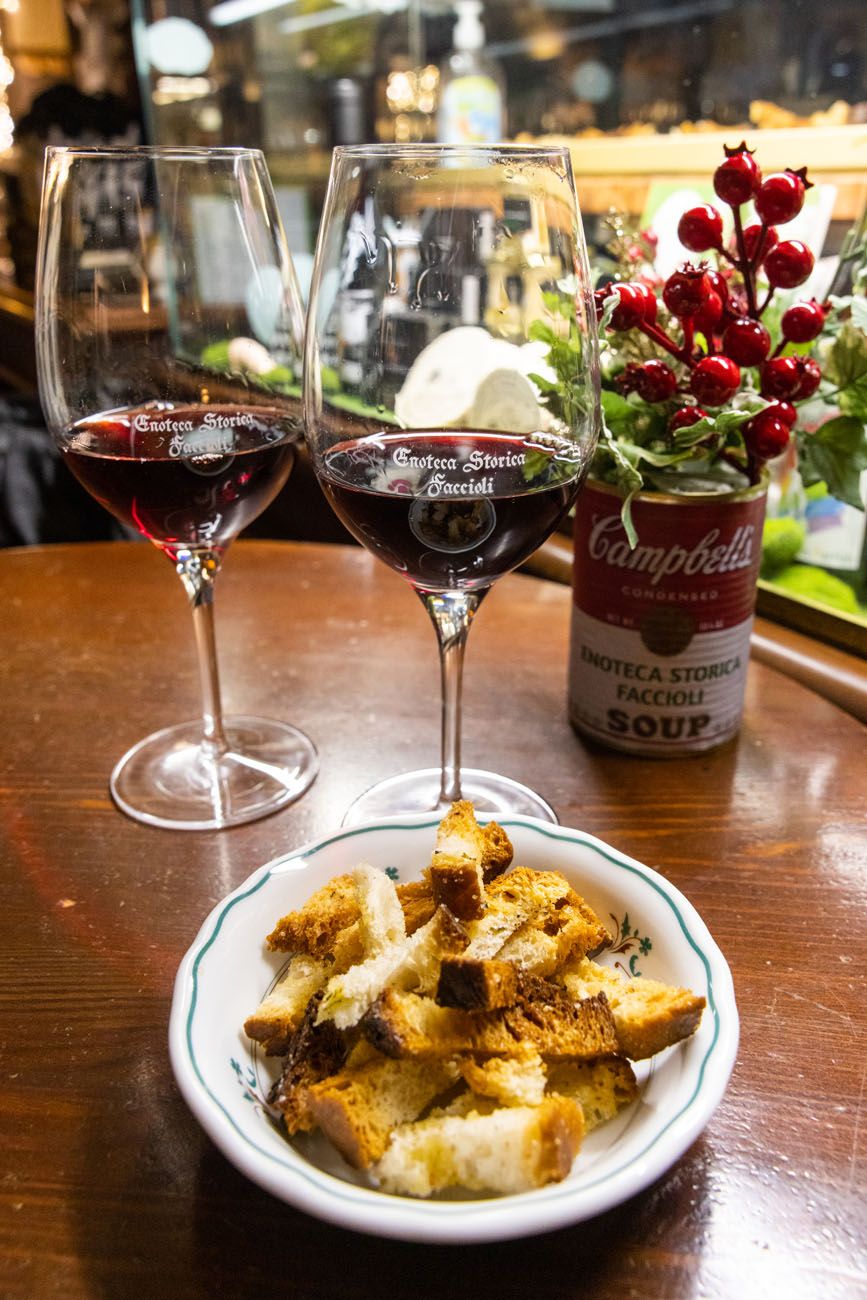
Medulla Vini was our favorite wine bar in the city. The staff are genuinely passionate and take real time with you to find a glass you’ll love, not a common experience. Enoteca Storica Faccioli has a cozy, local atmosphere but lacks that personal touch. Fior di Sale is beautiful inside and a great spot for an aperitif or an after-dinner drink.
7. Climb Asinelli Tower
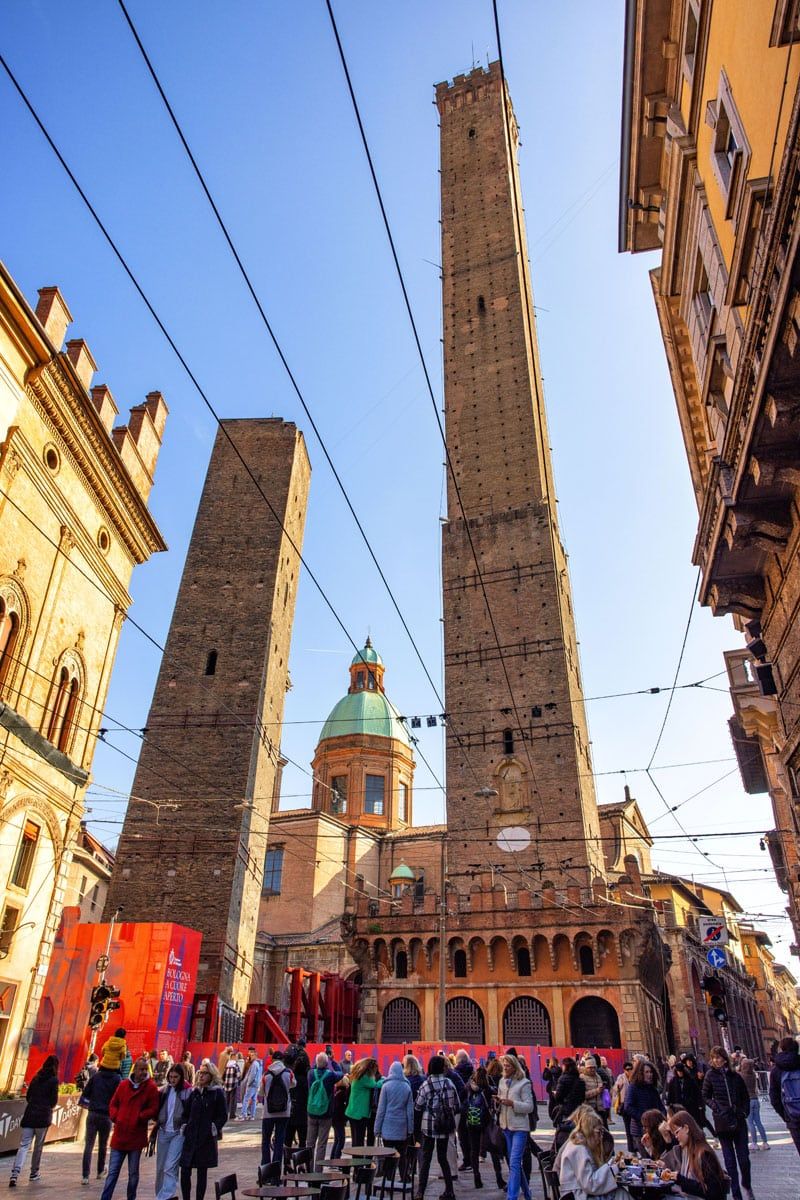
Asinelli Tower is one of the Two Towers (Le Due Torri). It is Bologna’s tallest medieval tower and one of the city’s most famous landmarks. Climbing this leaning tower is one of the best things to do in Bologna.
Asinelli Tower: At a Glance
- Height: 97 meters
- Built: Between 1109 and 1119, by the Asinelli family
- Steps: 498 steps to the top (no elevator)
- Importance: One of the two main towers of Bologna and a symbol of the city
- Tickets: Sold in advance on the official website; a time slot must be reserved in advance.
- Website: Get hours and pricing on duetorribologna.com
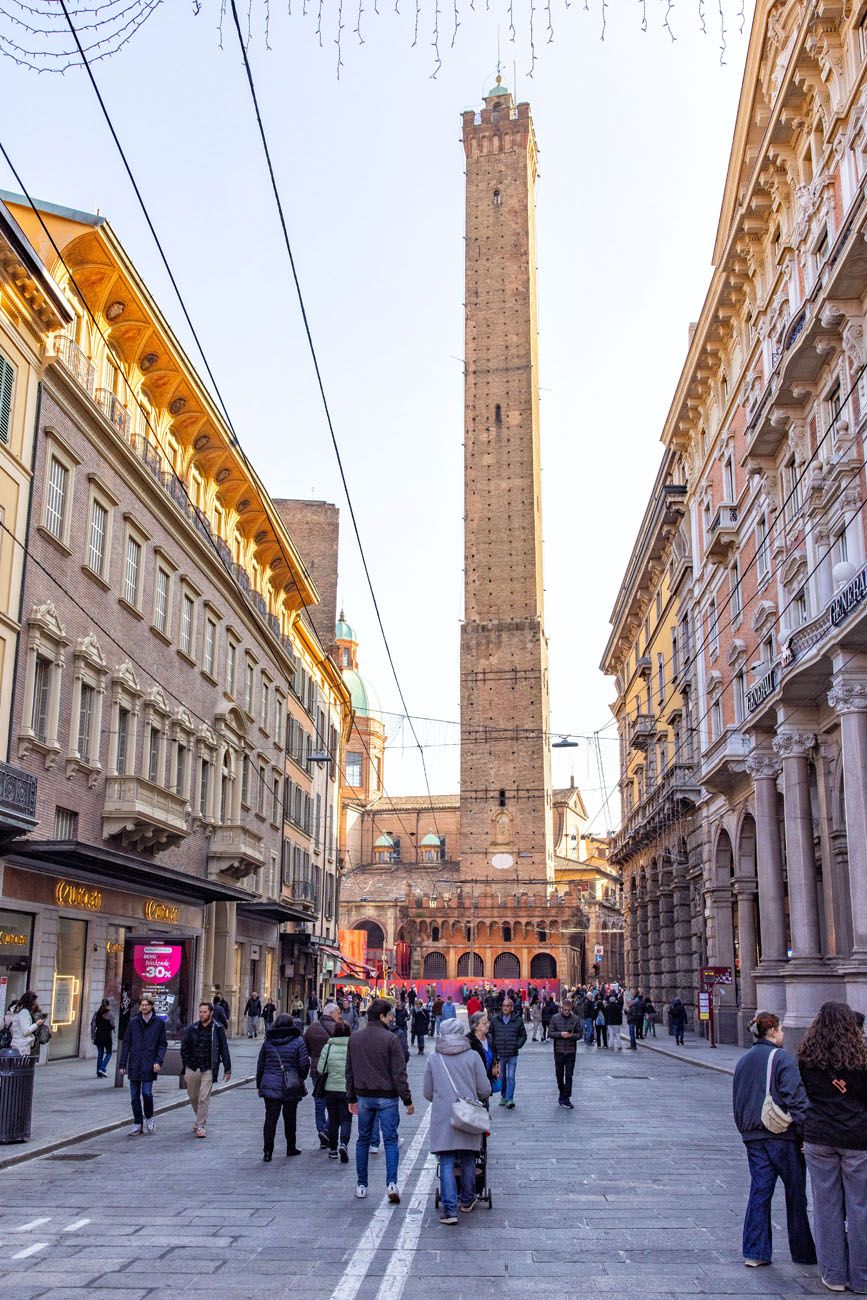
Asinelli Tower
WHAT TO EXPECT: It’s a big stair climb, 498 steps to the top…the perfect way to walk off the pasta and mortadella you may have been eating. The view from the top is extraordinary.
THE TOWER IS CLOSED FOR RENOVATIONS: Asinelli Tower was closed during our visit for maintenance, and is currently closed, the last we checked (you can get updates here). Once it does open, tickets must be purchased online in advance. Until it reopens, the Clock Tower (Torre dell’Orologico) is also very nice.
8. Photograph the Porticoes of Bologna
The Porticoes of Bologna are one of those things that sneak up on you. You’re walking to the basilica or heading to dinner, and suddenly you stop and realize you’ve been wandering under one of the most beautiful urban structures in Italy for the past ten minutes without even noticing.
Bologna has roughly 40 kilometers of these covered colonnaded walkways lining the streets of the city center, and in 2021, twelve specific stretches were inscribed as a UNESCO World Heritage Site. They are recognized not just for their architectural beauty but for the way they shaped the city’s social and economic life over nearly a thousand years.
Built between the Middle Ages and the early 20th century, they were originally constructed to accommodate the growing University of Bologna, creating covered extensions above existing walkways so the streets below could remain open.
What makes them worth seeking out is how varied they are. Some have painted ceilings, others feature decorated columns or ornate lighting. Some feel grand and ceremonial; others are narrow and intimate. Part of the pleasure of Bologna is simply wandering and discovering them on your own.
That said, two stood out enough for us to note specifically. The portico next to Piazza Cavour is one of the prettiest in the city center. It’s elegant, well-preserved, and easy to find. The one at Libreria Nanni has a beautiful, quieter character that rewards a slower pace.
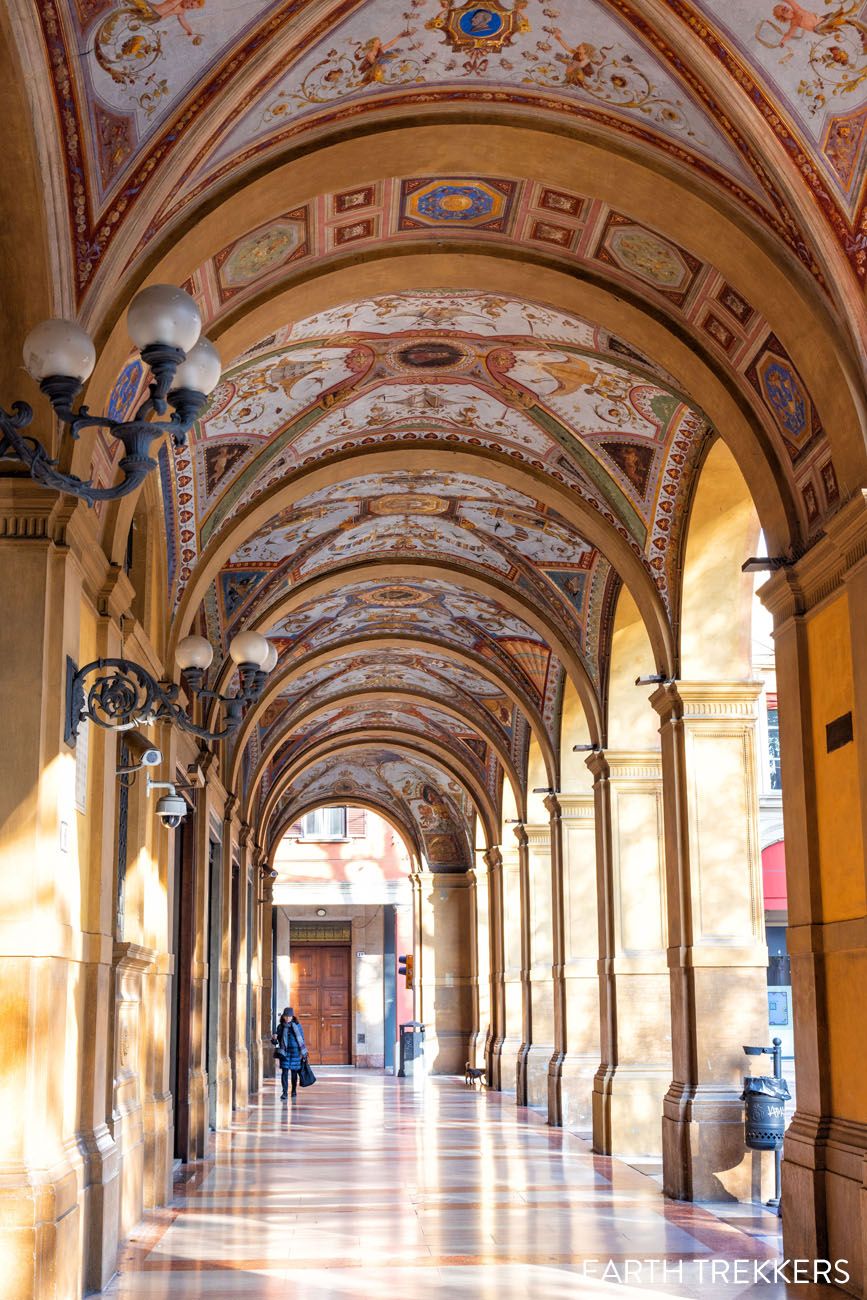
Portico next to Piazza Cavour
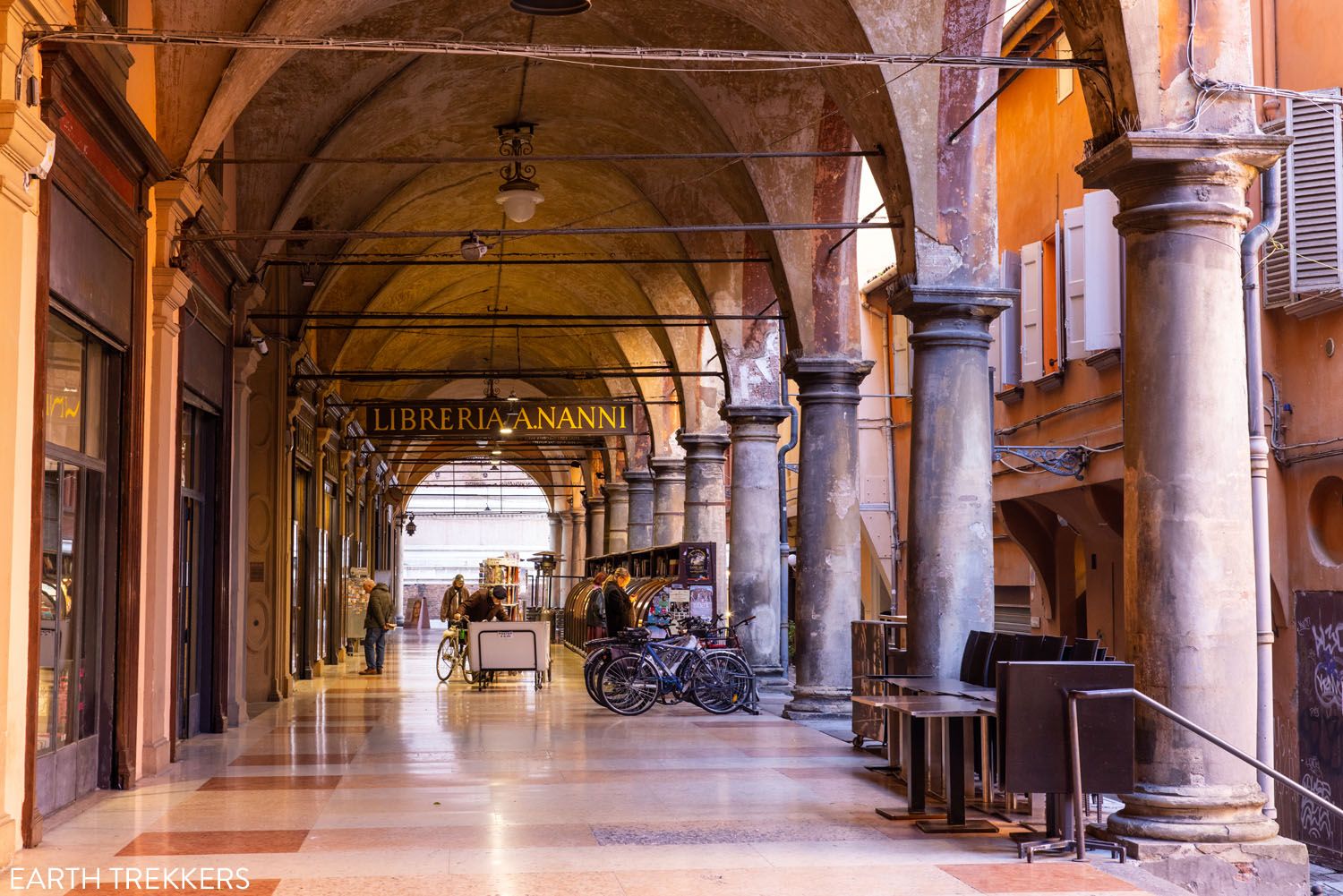
Portico at Libreria Nanni
The longest portico in the city — the Portico di San Luca, with 666 arches stretching 3.8 kilometers — leads up to the Sanctuary of the Madonna di San Luca. We cover that separately below.
PRO TRAVEL TIP: The porticoes are worth photographing at any time of day, but the light plays differently depending on the hour: warm and golden in the late afternoon, atmospheric and moody in the evening. Keep your camera out whenever you’re walking the city center.
9. Enjoy the View from the Clock Tower
At a Glance: Fantastic view of Bologna, it only takes 30 to 45 minutes, and the stair climb is manageable for most people (just over 100 steps).
Palazzo d’Accursio (aka Palazzo Comunale) is Bologna’s Town Hall. It is located on Piazza Maggiore. On a visit here, you can climb up to the Clock Tower (Torre dell’Orologico) for a view over Piazza Maggiore. The ticket also includes the Municipal Art Collections, which has paintings, furniture, and ceramics from the Middle Ages to present day.
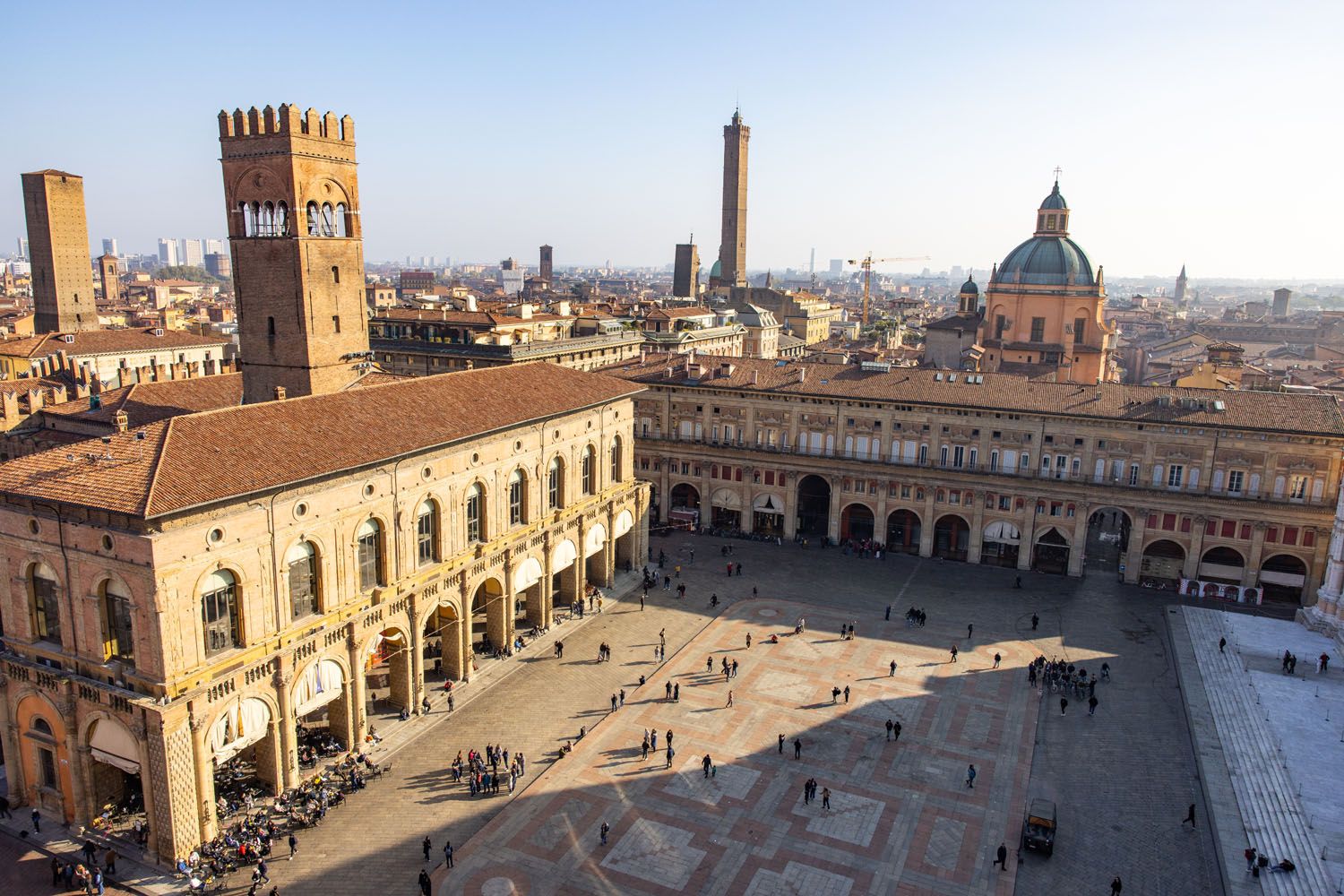
The view of Piazza Maggiore
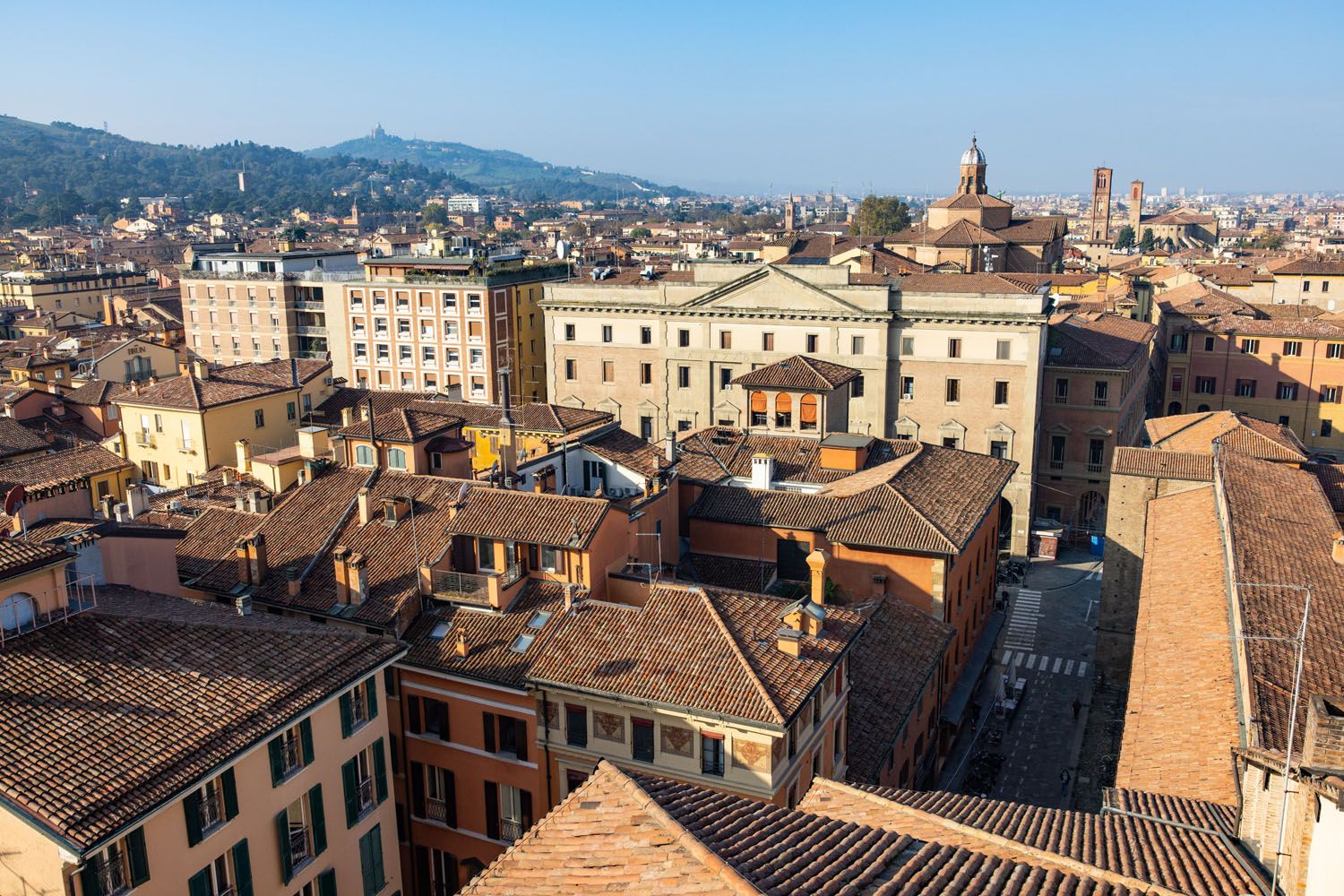
Another view from the Clock Tower. Off in the distance is the Sancturary of the Madonna di San Luca.
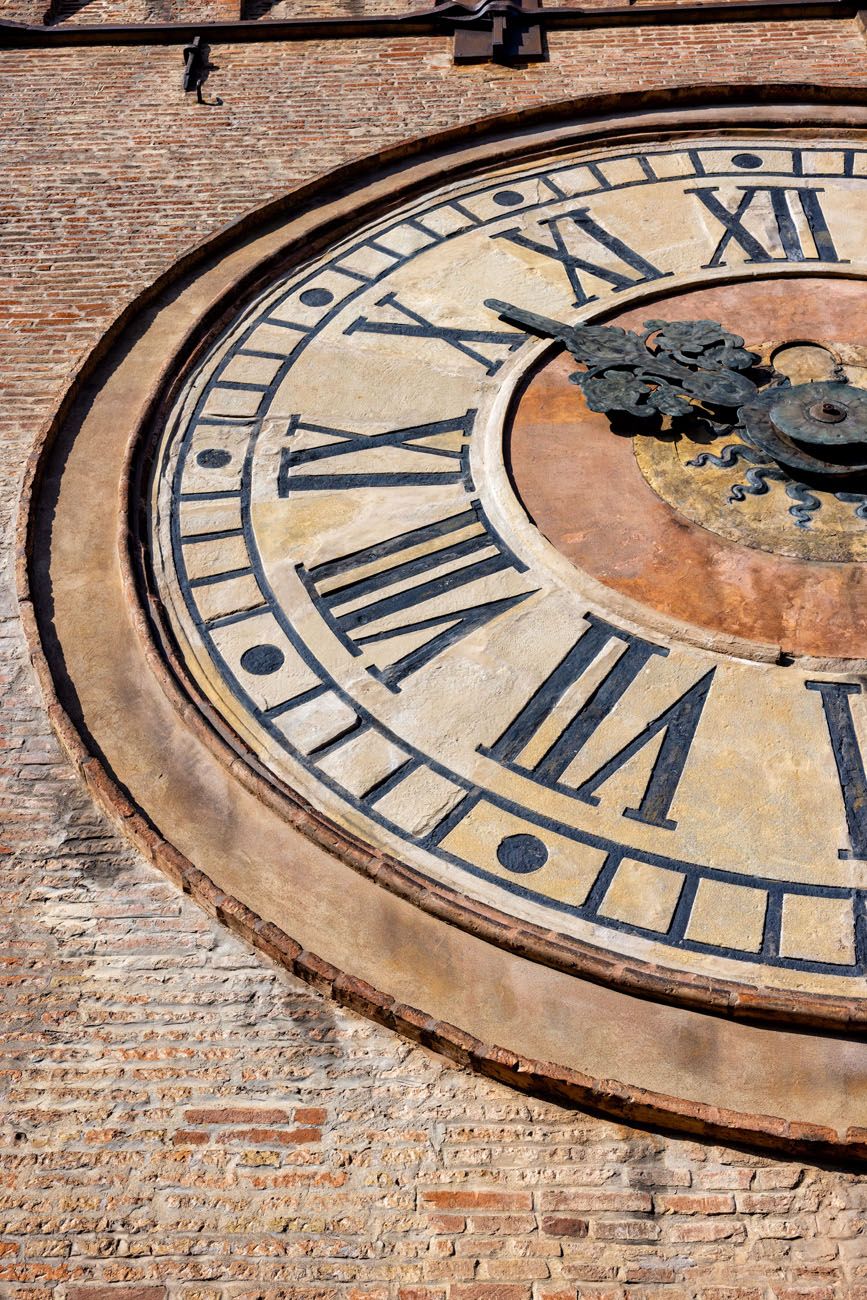
On our visit to Bologna, several of the towers were closed for maintenance, so this was the only one we climbed. A time slot must be booked in advance, which makes this quick and easy to do, because you simply show up at your scheduled time, climb the tower, and enjoy the view. The entire experience takes 30 to 45 minutes.
It’s not a huge stair climb (Tim counted a total of 106 steps), but they make you sign a waiver, since some of the staircases are very narrow and steep.
Overall, we really enjoyed the experience and liked the view overlooking Piazza Maggiore. However, if Asinelli Tower is open and you only have the time and desire to climb one tower, that one would get our vote.
Get hours and pricing and book your tickets here.
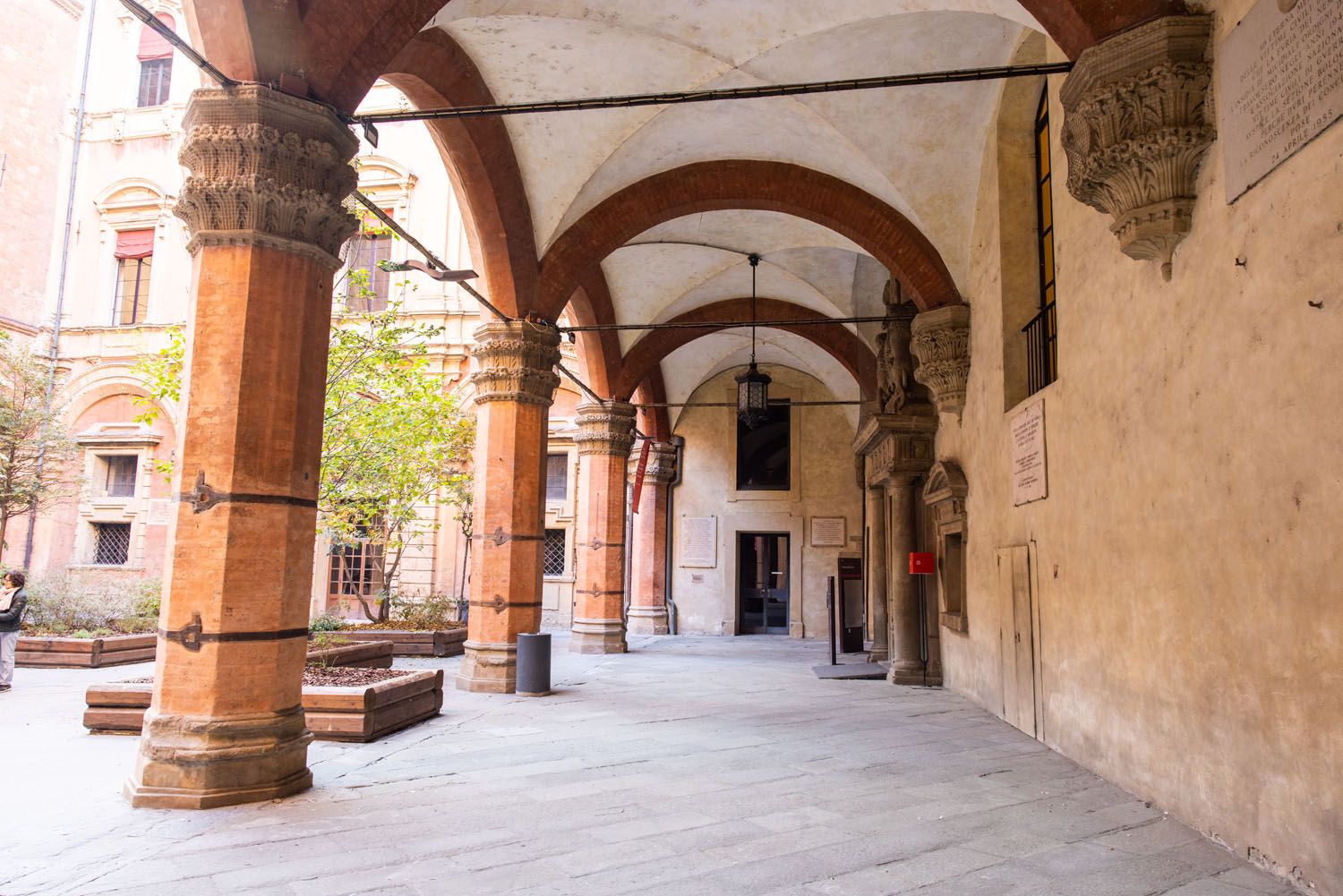
The courtyard of Palazzo Comunale
10. Archiginnasio of Bologna & the Anatomical Theater
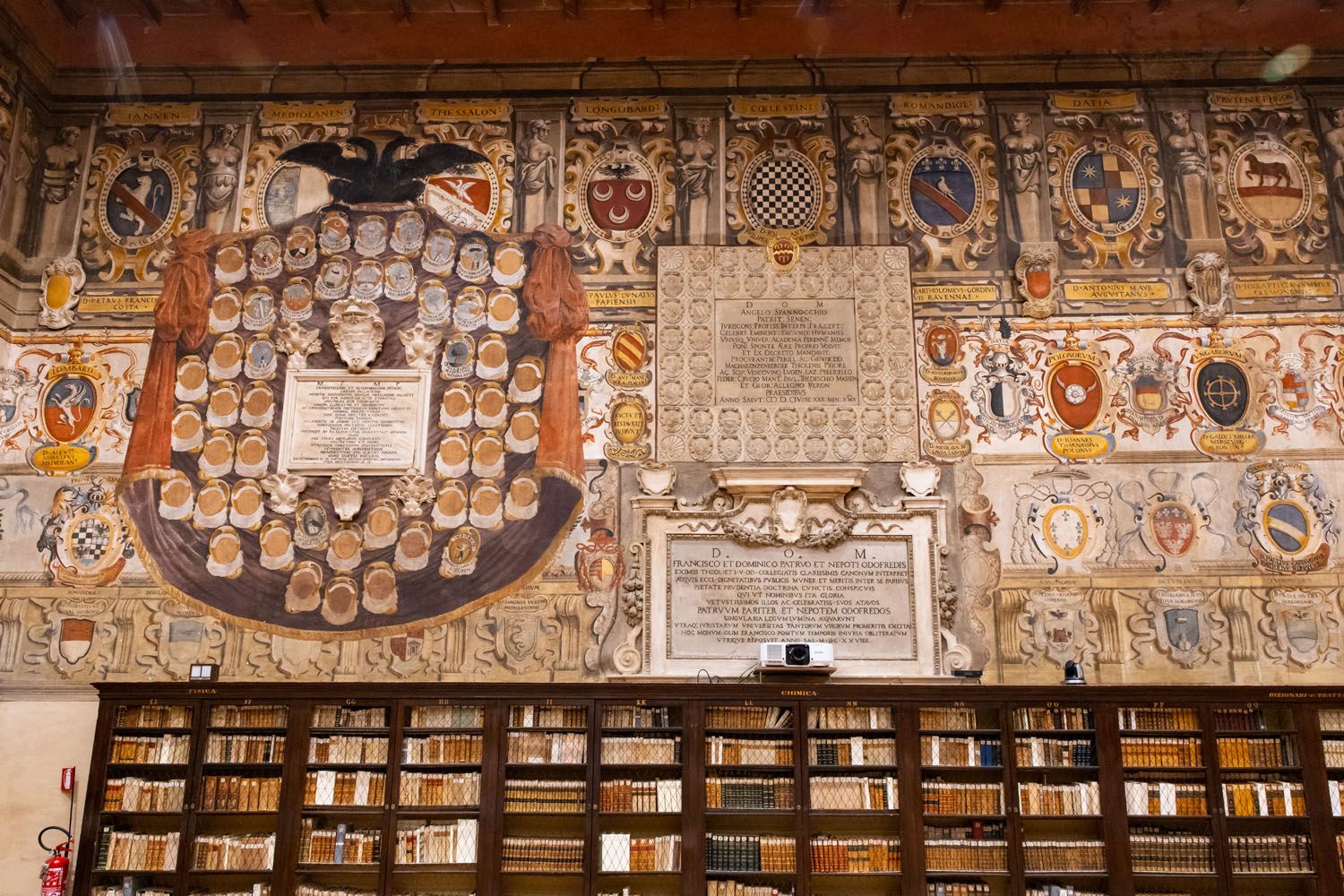
This is amazing! This is one of the most beautiful buildings we visited in Bologna, with its porticoes, coats of arms, and historic rooms.
The Archiginnasio was built in the 16th century. This palace was the seat of the university and now has several historic rooms that visitors can see.
When you first enter the Archiginnasio, you are greeted with views of its amazing porticoes and the coats of arms that adorn the walls. There are two levels here, so be sure to take the stairs to the upper level to get the full experience. And this part of the Archiginnasio free to visit.
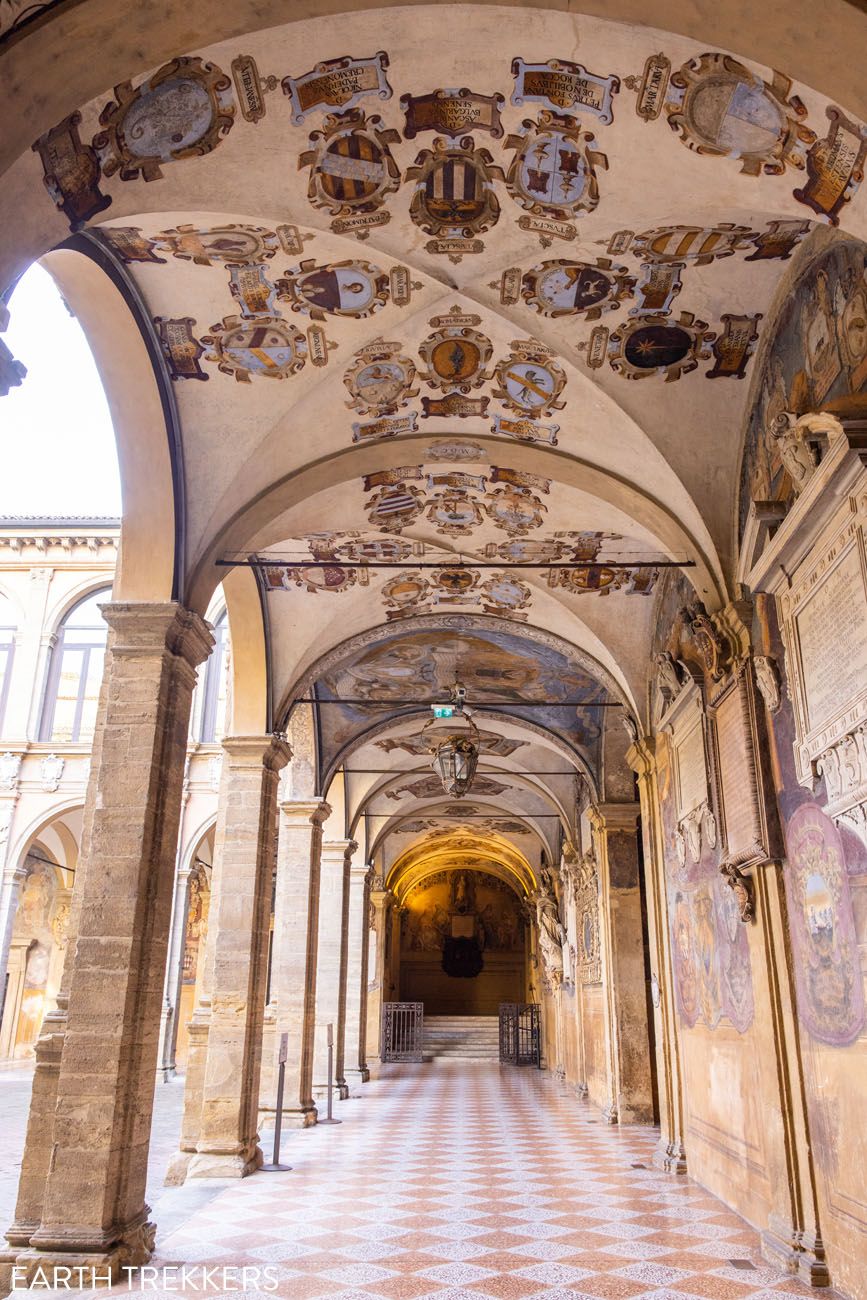
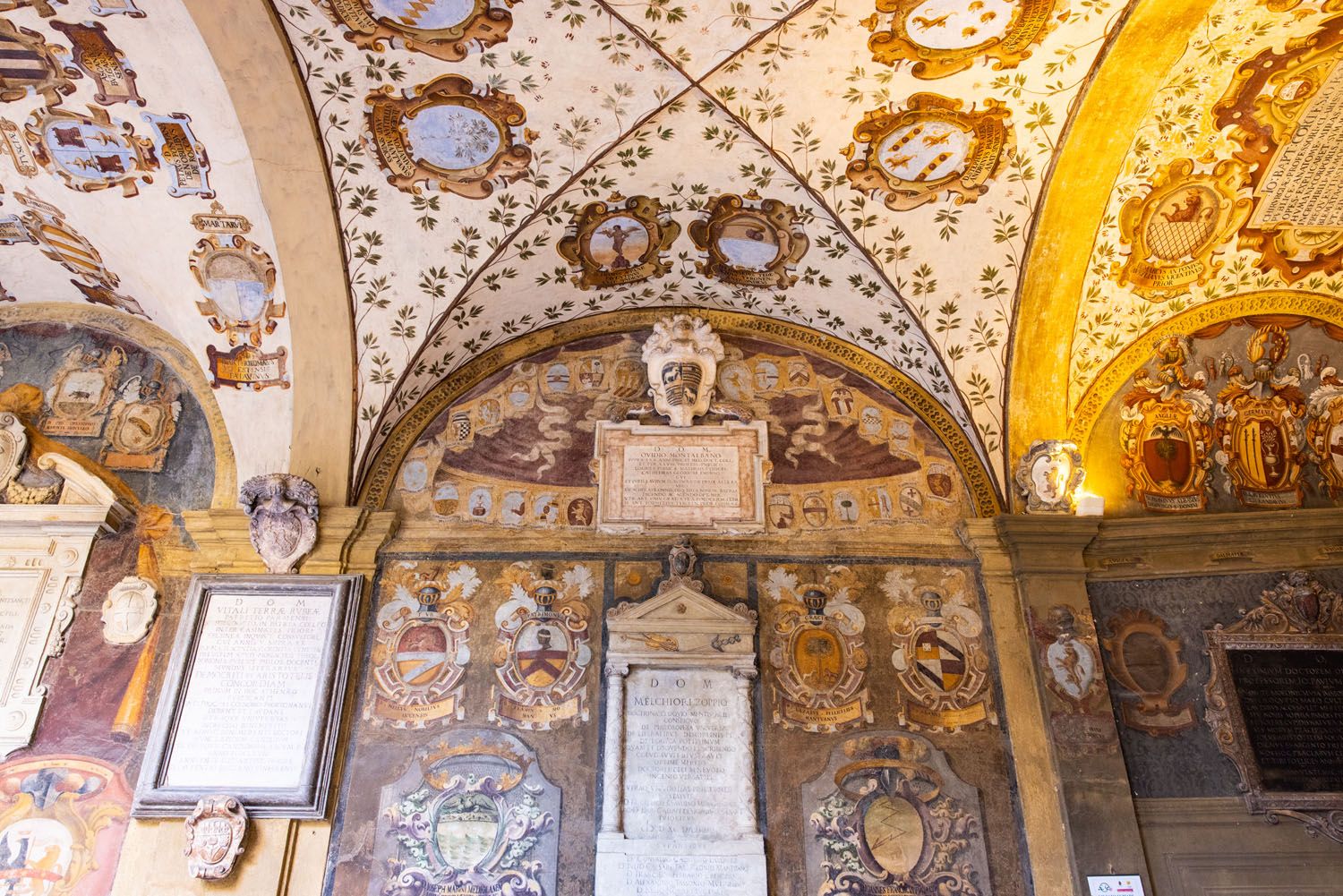
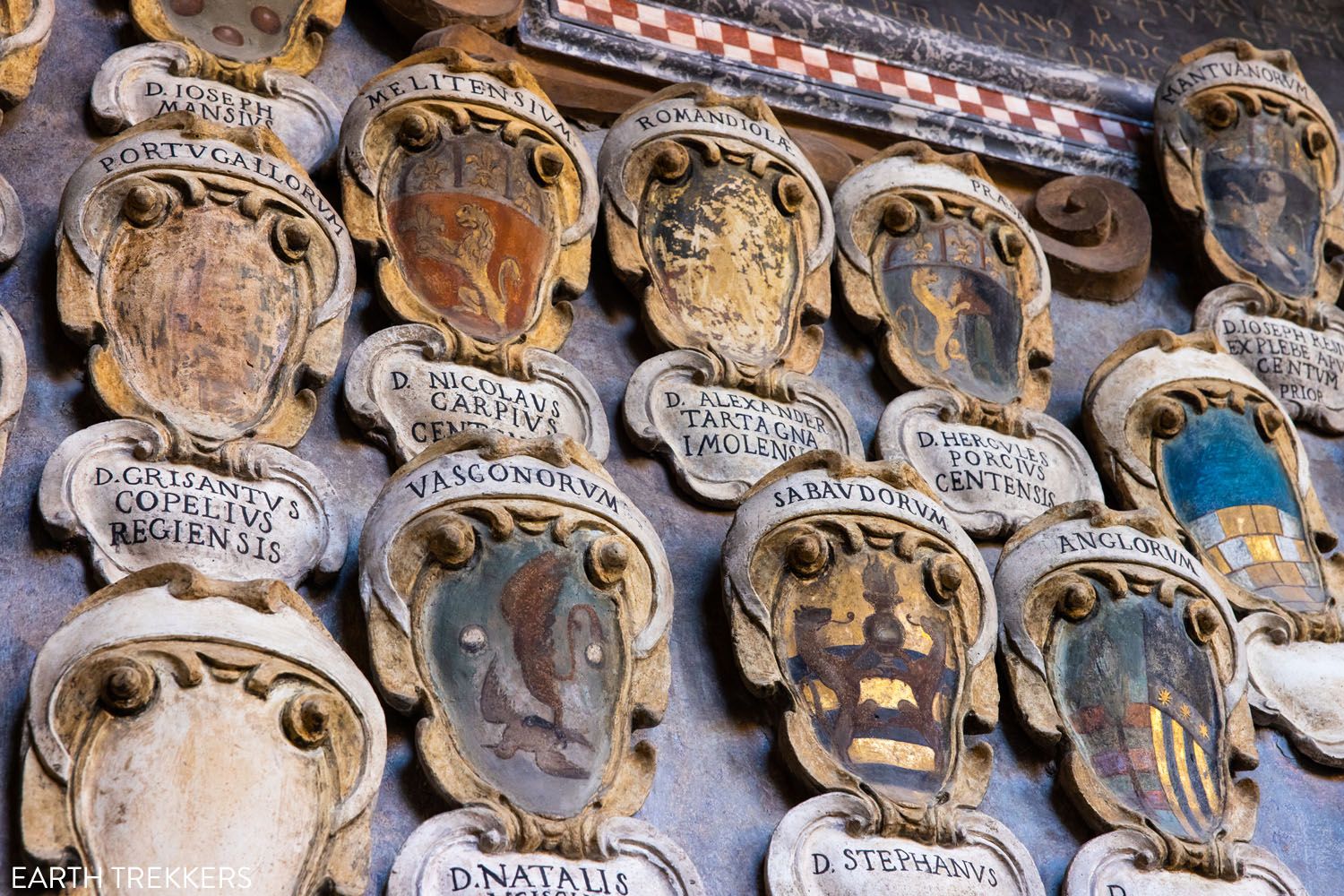
Coats of arms in the Archiginnasio
The Biblioteca (the library) is only open to students and residents, not to tourists. But there are two other very interesting rooms to visit. These two rooms require a ticket, but at 3 euros, it’s one of the best deals in Bologna.
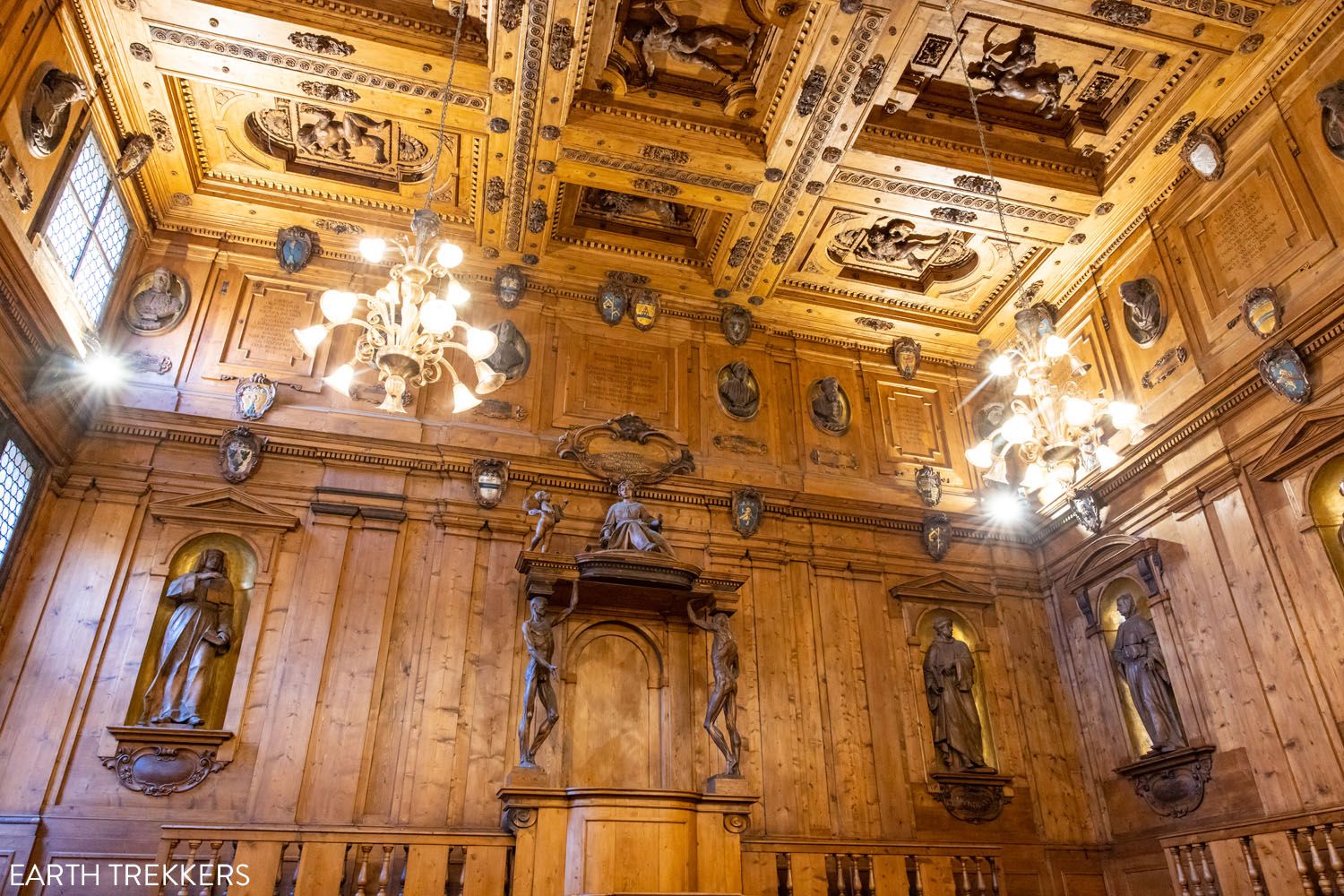
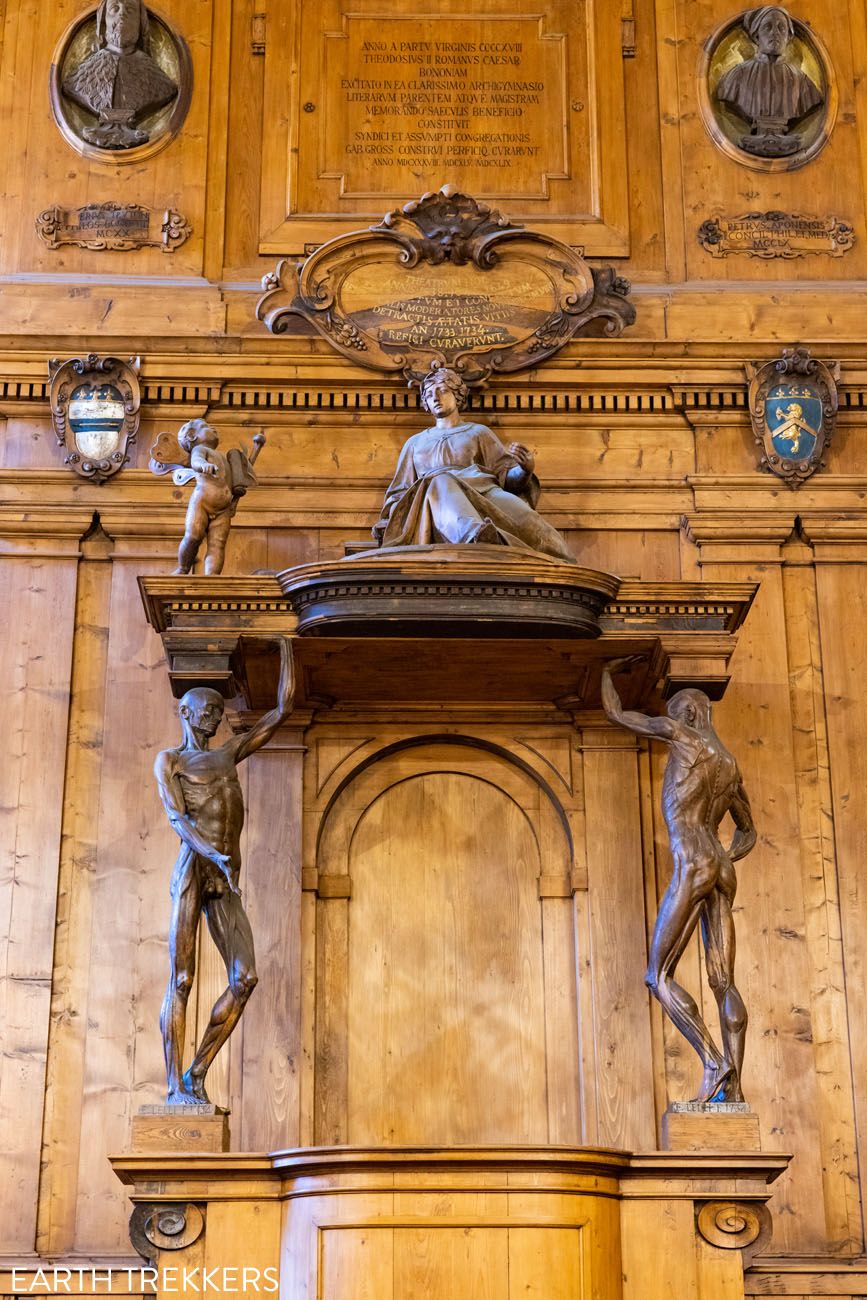
The Anatomical Theater
The Anatomical Theater was designed in 1637. Statues of famous doctors decorate the room. The two statues that sit on either side of the demonstrator’s chair are skinned, called Pellati. This room suffered extensive damage during WWII but it was immediately rebuilt using the original wood.
The Stabat Mater Room
The Stabat Mater Room is the auditorium where law students gathered. The fresco of the Virgin and Child dates back to 1569. From this room, there is a window with a view into the library.
Stabat Mater Room
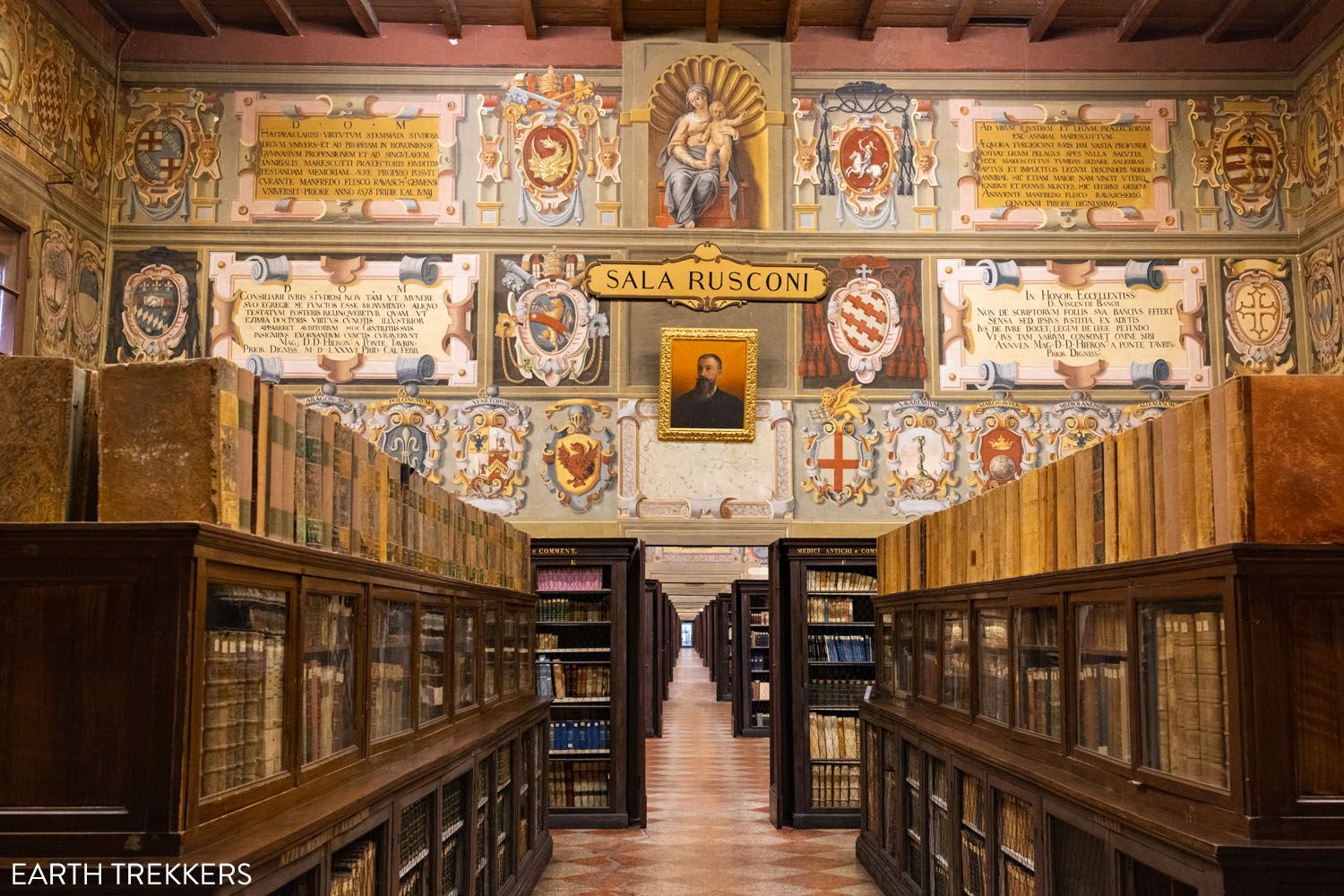
The view into the library from the Stabat Mater Room
Get hours, pricing, and the link to purchase a ticket in advance here. On our visit, there was a sign that said advance tickets were mandatory for Saturday visits.
11. The Complex of the Seven Churches
The Santo Stefano Complex is where several churches, chapels, and courtyards form one of the most important religious sites in the city.
Altogether, this complex of buildings has the designation of a minor basilica.
The oldest building here is the Church of the Holy Sepulchre, which dates back to the 5th century, and is a smaller version of the Church of the Holy Sepulchre in Jerusalem. Two churches (the Church of Saint Stephen and the Church of the Saints Vitale and Agricola) are also very old but have since been rebuilt. Also part of the complex is the Church of the Trinity, the Chapel of the Bandage, and the Courtyard of Pilate.
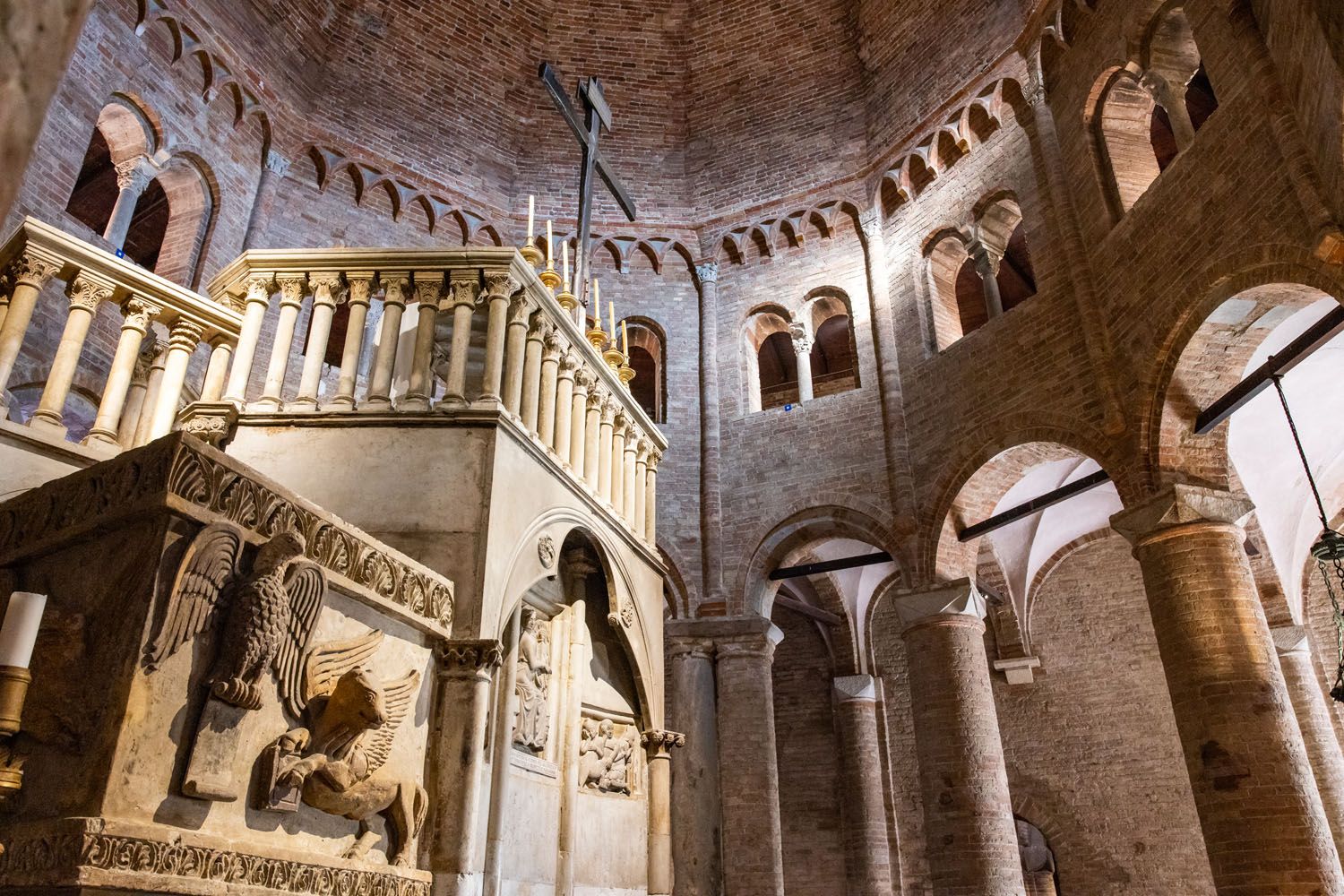
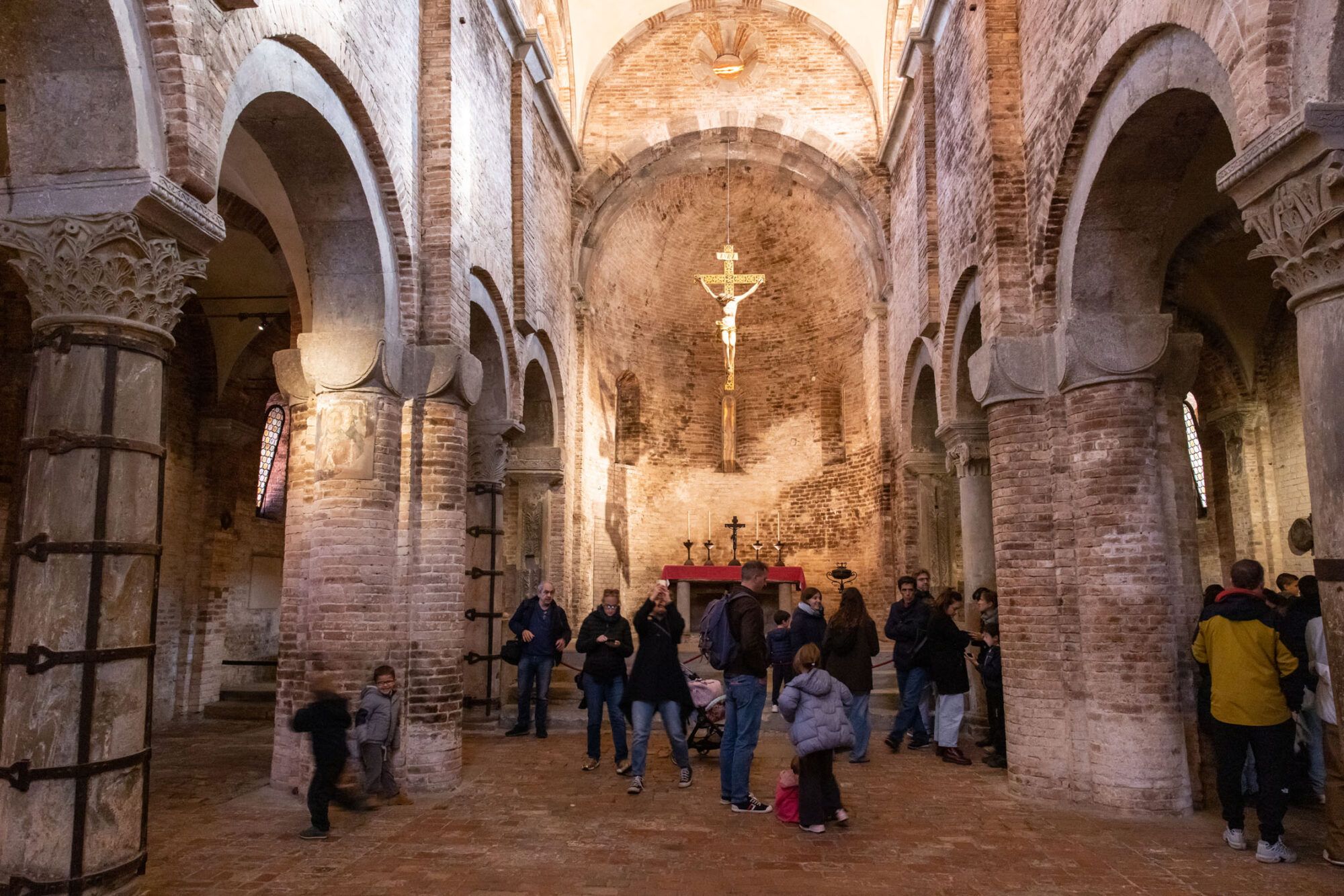
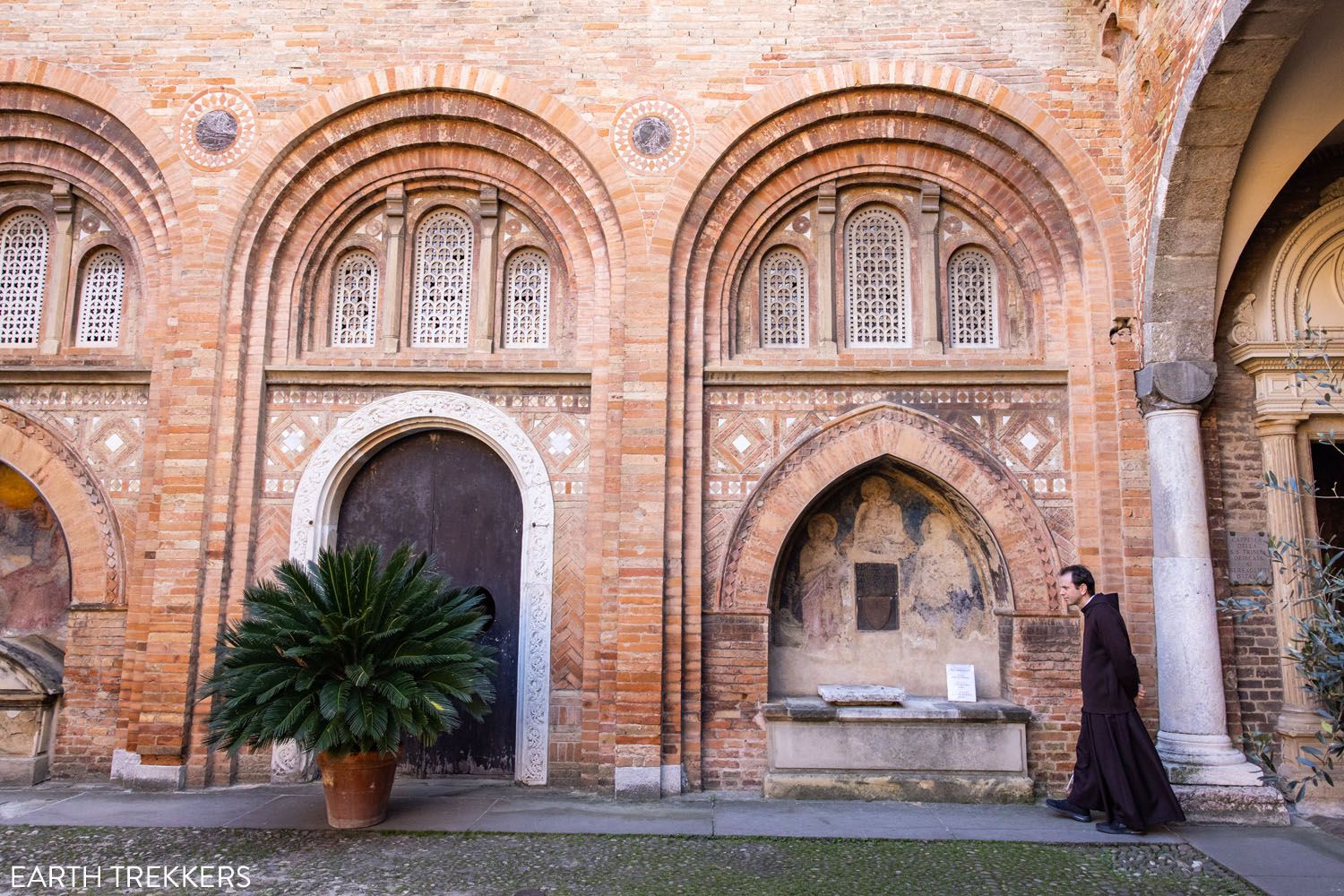
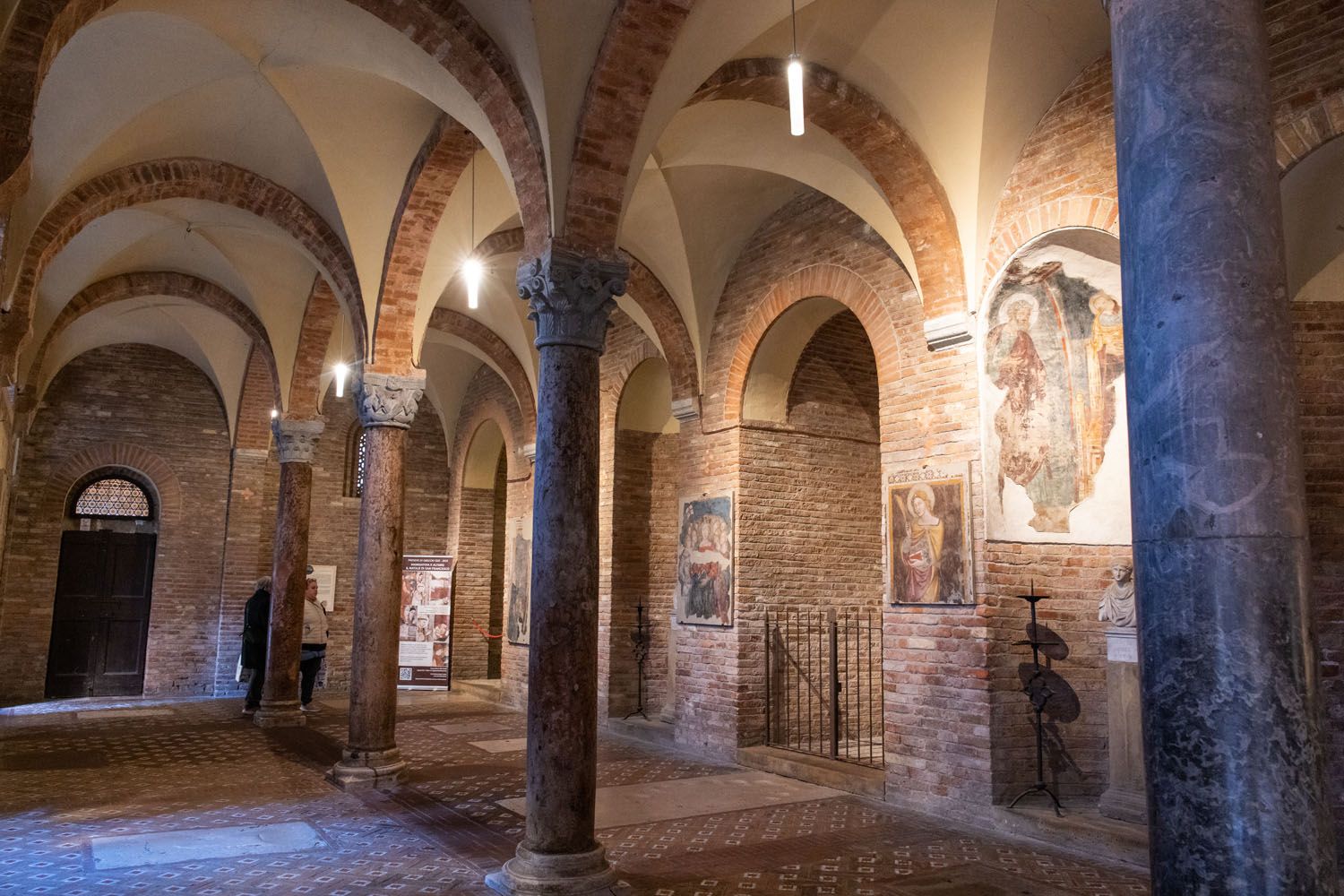
These churches and chapels are all built next to each other and are quick and easy to visit, as they are all connected. We spent about 30 minutes here.
It is free to visit. Get hours here before you go (it is open in the morning and afternoon, but closes for a few hours midday).
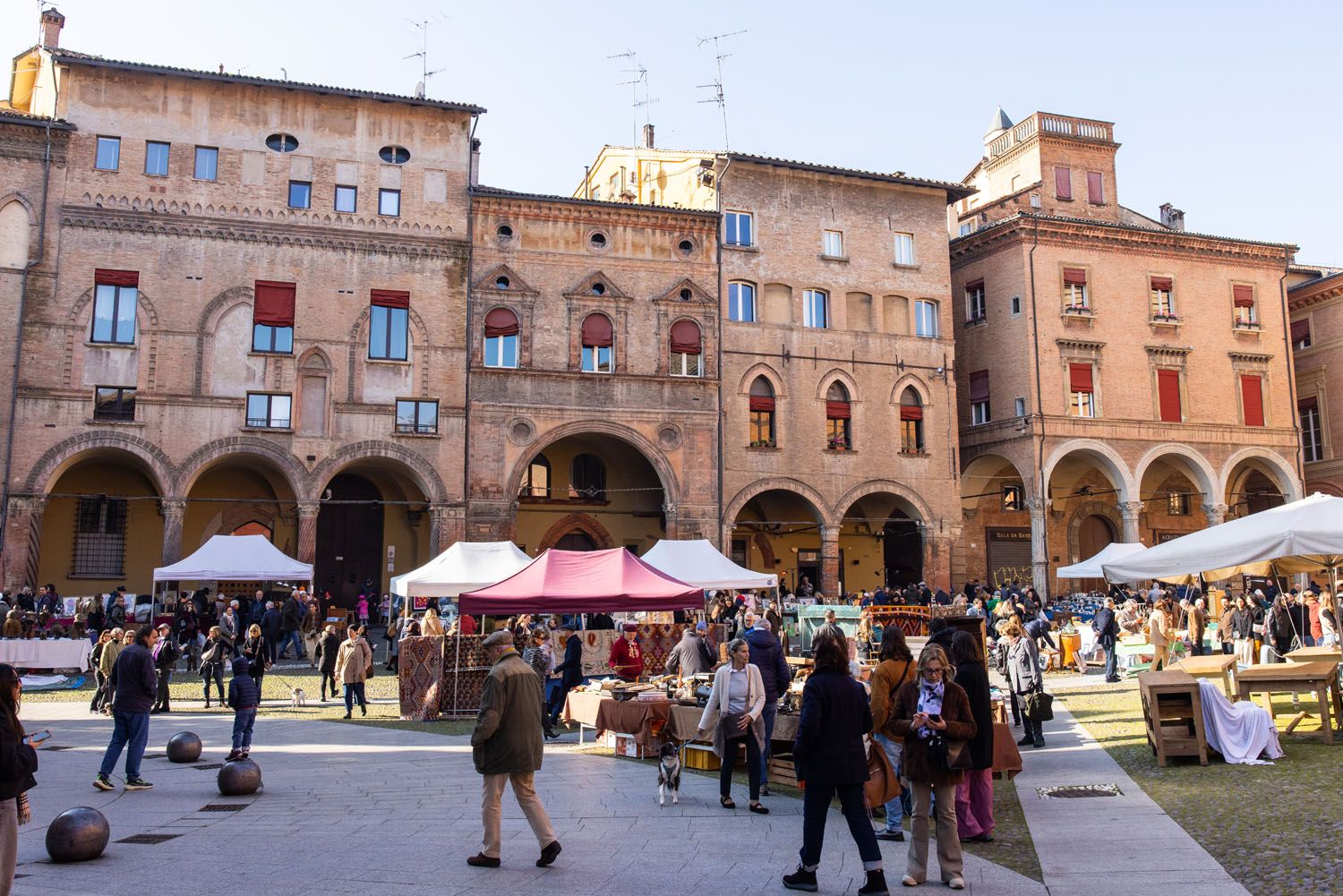
Piazza Santo Stefano
12. Walk the Portico di San Luca to the Sanctuary of the Madonna di San Luca
The Sanctuary of the Madonna di San Luca sits on a hilltop called Colle della Guardia, reached via the Portico di San Luca, the longest portico in the world, stretching 3.8 kilometers with 666 arches. It’s one of Bologna’s most recognizable icons and shows up on virtually every “things to do” list for the city.
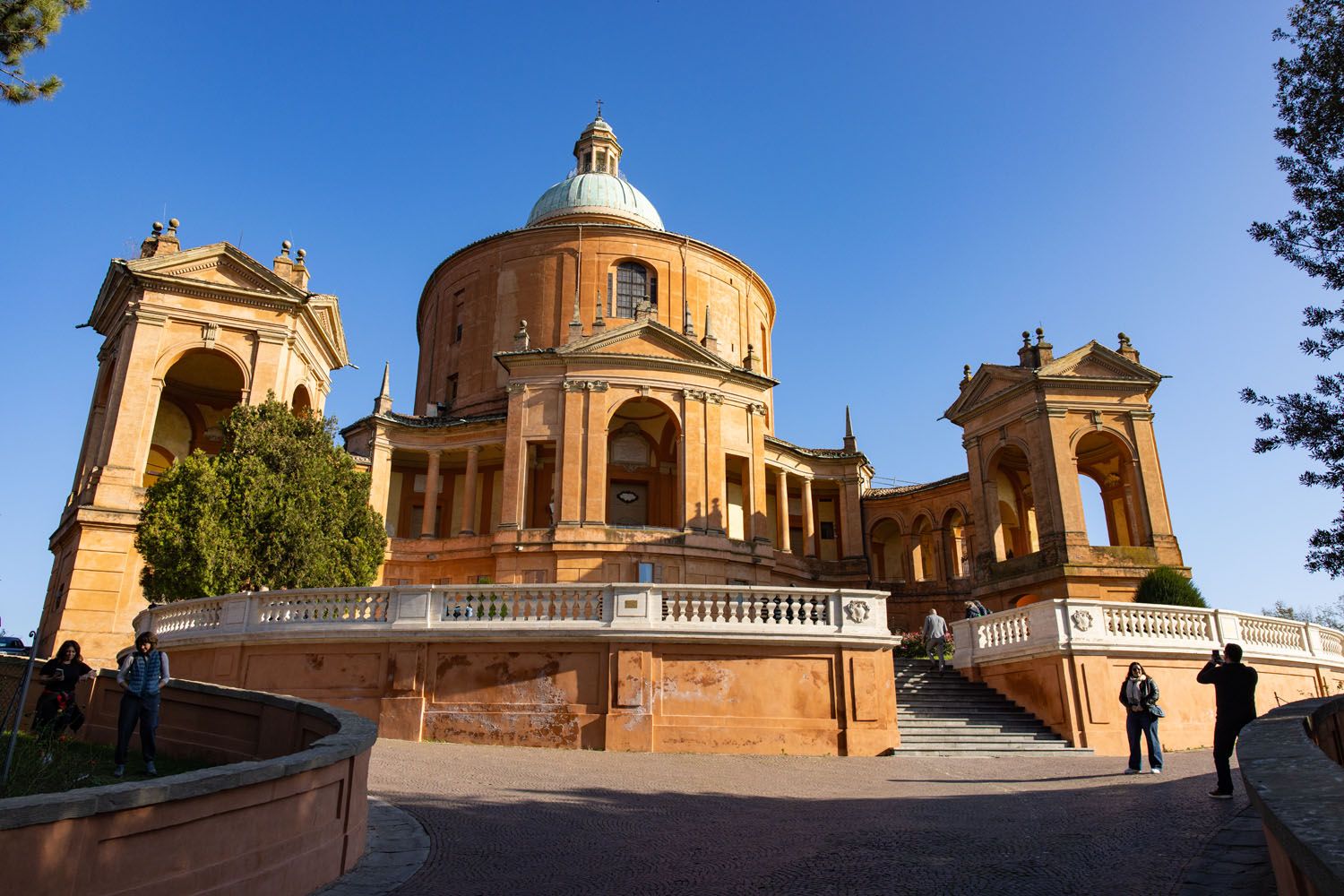
Sanctuary of the Madonna di San Luca
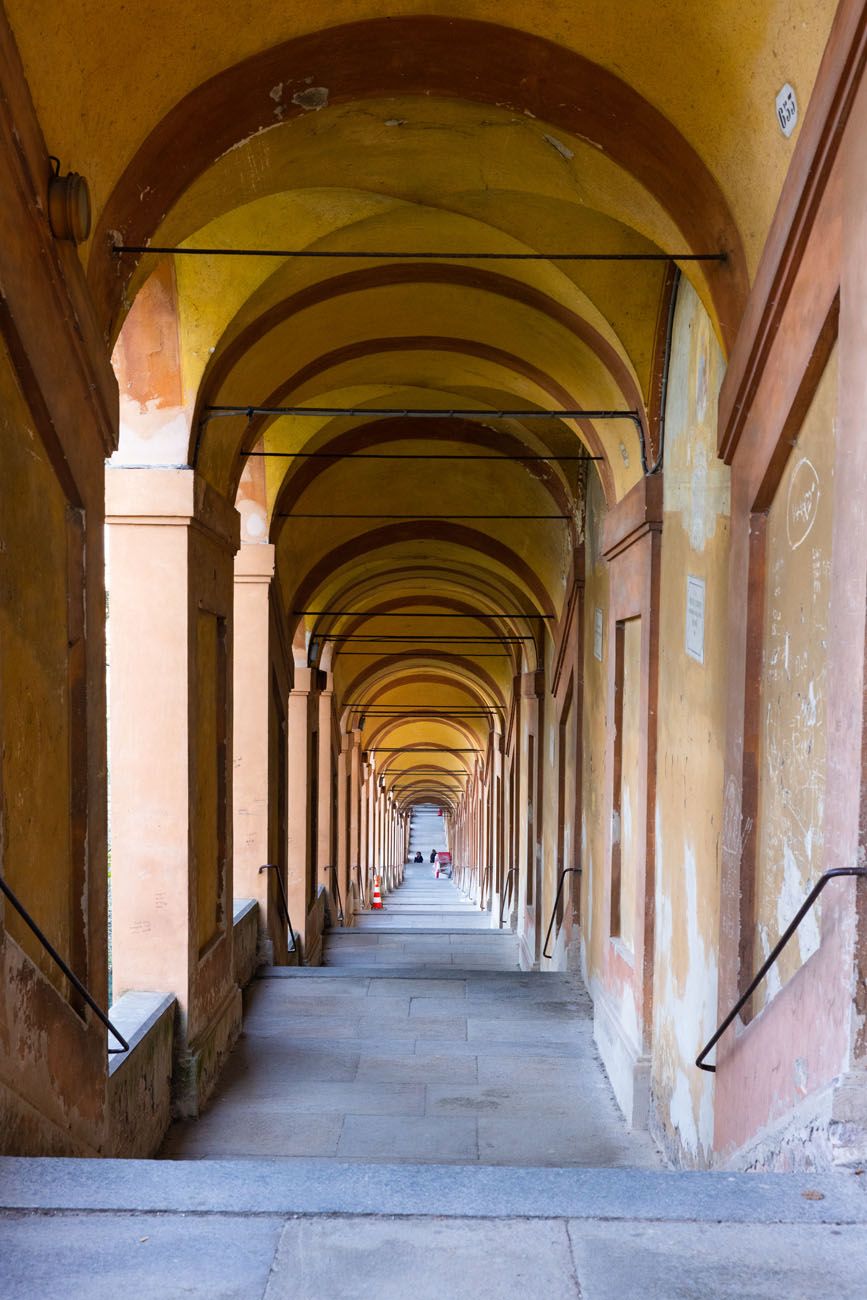
Portico di San Luca
We’ll be honest with you: we’re not sure it deserves quite that billing.
We visited at the end of our day trip, driving up rather than walking the full portico. We walked a portion of the covered walkway, which is genuinely beautiful, and the sanctuary itself is pleasant enough, a baroque basilica completed in 1723 that houses a revered icon of the Virgin Mary. But the views over Bologna from the hilltop are more modest than you’d expect, and the sanctuary alone isn’t remarkable enough to anchor a visit.
The bigger issue is time. Walking the full portico out and back is a 3-to-4 hour commitment, which is a significant chunk of a short Bologna itinerary when the city center has so much to offer. For visitors with just one or two days, we’d prioritize almost everything else on this list first.
Who should go: Anyone with 3 or more days in Bologna who would have FOMO leaving without seeing it, or someone who simply wants a good walk and some fresh air outside the city center. In that case, the portico itself is the draw — the rhythm of the arches, the steady climb, the views as you ascend — more than the sanctuary at the top.
Getting there: If you don’t want to walk the full portico, the San Luca Express tourist train departs from Piazza Maggiore and is a good option for those without a car. We didn’t take it ourselves, but it’s worth knowing about if you want to visit without the full time commitment of the walk.
13. Finestrella di Via Piella & the Hidden Canals
Bologna has a 60-kilometer network of canals dating back to the Middle Ages. Most are now covered by roads and buildings as the city expanded, but a few glimpses remain, and the most famous is the Finestrella di Via Piella, a small window in an alleyway wall that frames a view of the Canale di Reno below.
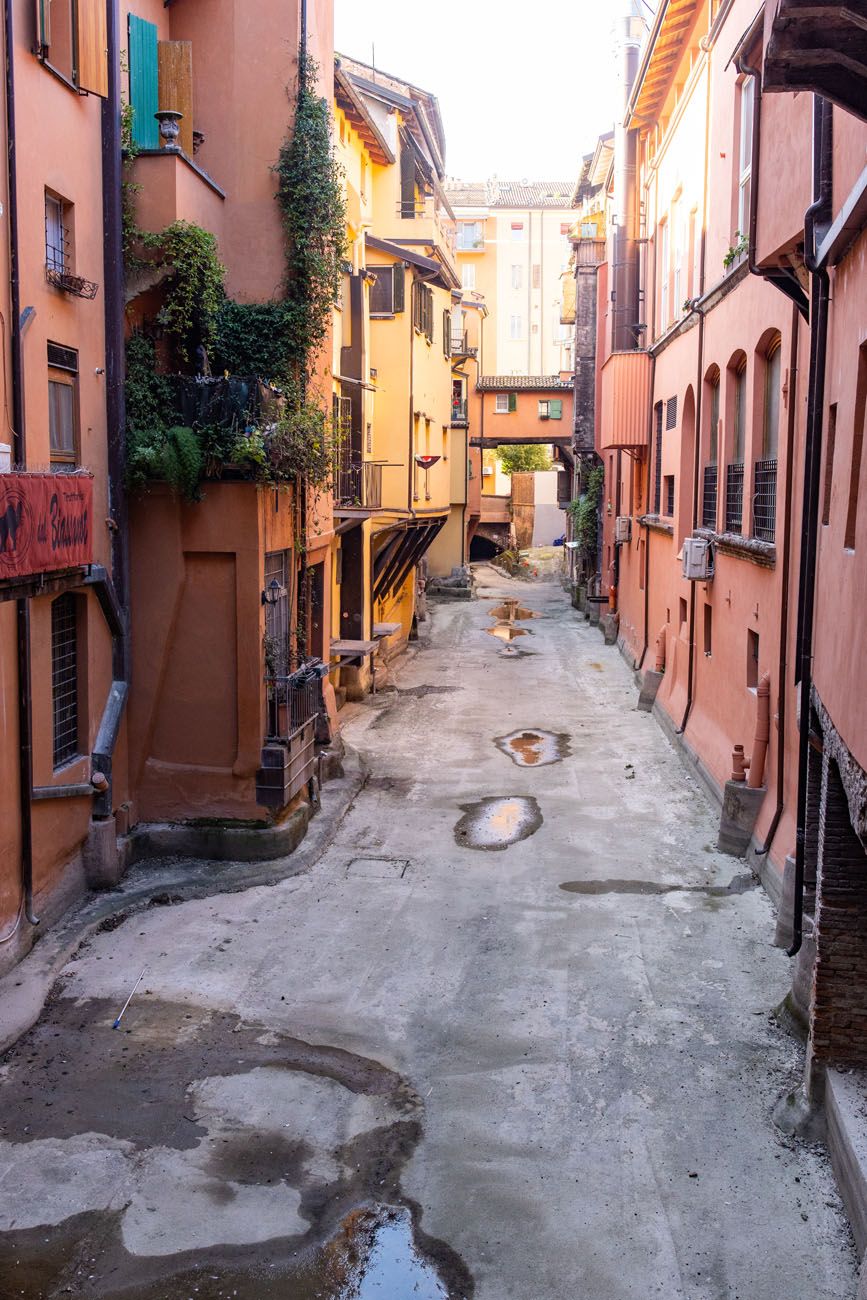
Finestrella di Via Piella
We sought this one out specifically, and we’ll be straight with you: it’s a canal viewed through a window in an alleyway. If you happen to be walking nearby, take the small detour — it’s about 10 minutes from Piazza Maggiore. But we wouldn’t rearrange your day around it. It might look more dramatic after heavy rain when the water level is higher, but on a typical visit, it’s a quick look and you’re done.
The more interesting takeaway is the history itself, the idea that beneath the streets you’re walking, a medieval canal network is still flowing. Other glimpses can be found at Via Capo di Lucca, where the Moline canal runs partially uncovered between buildings, and from the bridge on Via Malcontenti, the only remaining watering place once used for washing carts and animals.
PRO TRAVEL TIP: If you’re already in the area, combine this with a walk through the nearby streets. The surrounding neighborhood has a quieter, more residential feel than the city center and is worth a slow wander.
14. Cathedral of Saint Peter
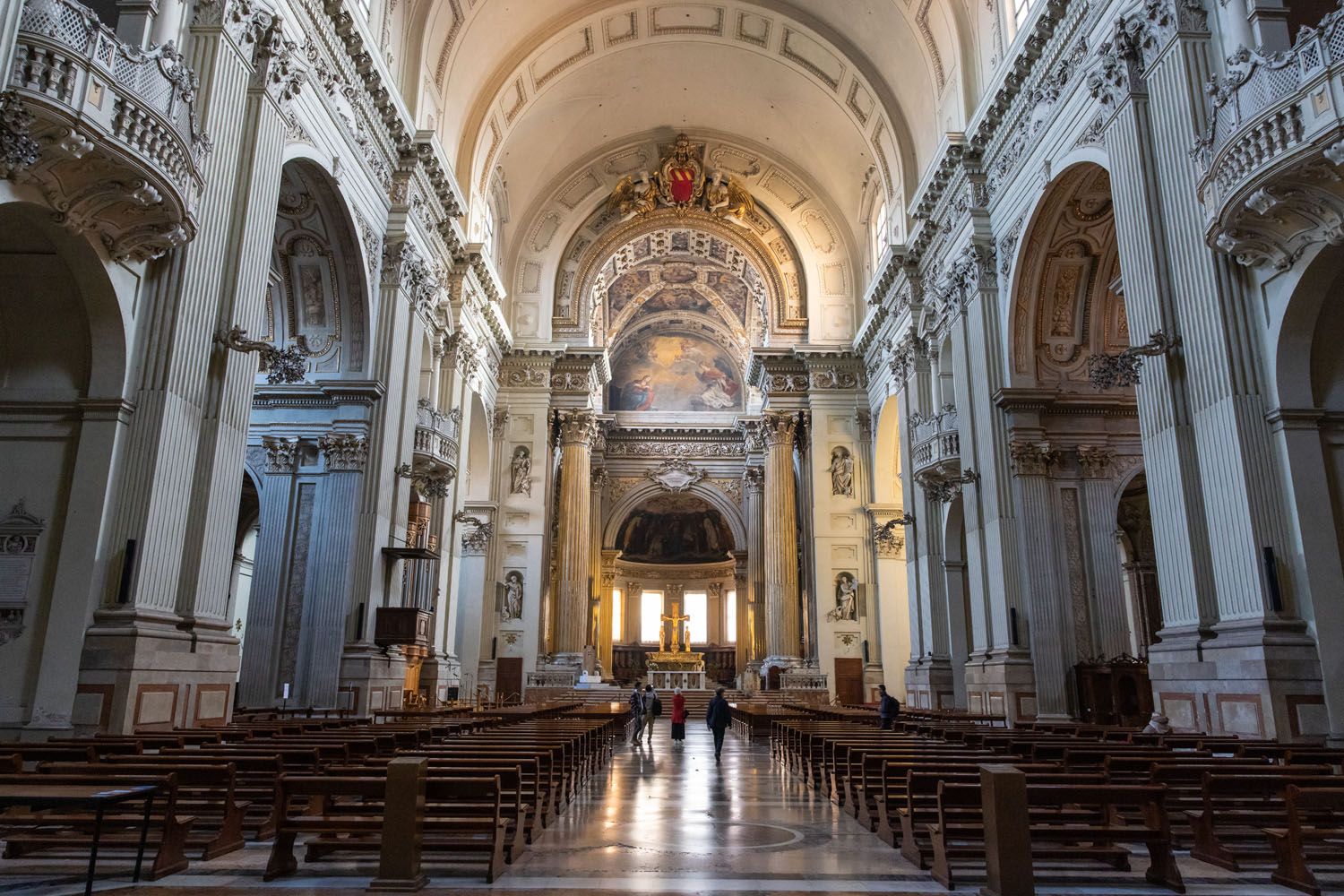
The Bologna Cathedral (Cattedrale Metropolitana di San Pietro) sits on Via dell’Indipendenza, a short walk from Piazza Maggiore. The baroque interior is worth a quick stop as you pass through. It’s free to enter and has a quiet, unhurried atmosphere that contrasts nicely with the busier sites nearby.
The bell tower, known as “La Nonna,” is the second tallest in Bologna and can be climbed on Saturday and Sunday afternoons for a small donation. It wasn’t open during our visit, but if your timing works out, it’s worth adding on. Get current hours before you go as they are limited.
15. Torre Prendiparte (Sky Experience)
This tower, also called Coronata Tower, is a medieval tower that was built in the 12th century. From the top floor, you get panoramic views over Bologna. If Asinelli Tower is not open, this is a good one to add to your itinerary, if you want to climb one of Bologna’s medieval towers.
Learn more on the official website.
16. Visit the University of Bologna, the World’s Oldest University
The University of Bologna was founded in 1088, making it the oldest university in the world that has been in continuous operation. The Archiginnasio, mentioned earlier, was the main seat of the university from 1563 to 1803. Now, the campus sits to the east of the city center, but still easily within walking distance.
There are a few places open to visitors. We visited the Museum of Zoology, which was free to visit but not very interesting. Musei di Palazzo Poggi is a collection of museums, with exhibits on human anatomy, geographical maps, obstetrics, physics, and natural history.
17. See the Roman Ruins at Biblioteca Salaborsa
The Salaborsa library is a public library located in the city center. What makes it unique are the Roman ruins located under the glass floor of the library. Fitting this into your schedule can be difficult, as the archaeological excavations are only open 2 days a week (Monday and Tuesday). Learn more here.
18. Basilica of San Domenico
This basilica is famous for its Ark of Saint Dominic, which contains the remains of Saint Dominic. A portion of the Ark was built by Nicola Pisano, who was also the builder of the Opera del Duomo in Pisa and the Siena Cathedral. Michelangelo created some of the statues that sit on the Ark.
19. National Art Gallery of Bologna
The Pinacoteca Nazionale di Bologna houses an extensive collection of paintings by Emilian artists from the 13th to the 18th century, including works by Raphael and Tintoretto. We didn’t visit during our stay, but for art lovers with time to spare it’s worth an afternoon. Learn more on the official website.
20. Take a Day Trip
There are quite a few great day trips to take from Bologna, ranging from tours of the high-end luxury car brands to parmesan cheese and balsamic vinegar tastings.
#1 Italian Super Cars
We spent a day touring Lamborghini, Pagani, and Ferrari, although Ducati is popular as well. To do this, you will either need to rent a car or take a tour that handles your transportation. We had a rental car.
Was It Worth It? We thought this would be interesting (it’s one of the main reasons we visited Bologna), but by the time we got to Ferrari (our third and final museum of the day), these visits felt repetitive. Parking was challenging, even in November, which is the off season. Taking a factory tour would make it more interesting, but these should be scheduled in advance, as tour times are very limited.
How Long Does It Take: It took us about 6 hours to visit all three museums, including driving time to and from Bologna. We did not take a factory tour at any of the museums. If you prefer to visit just one or two museums, this would take half of a day, and it can be paired with a visit to Parma or Modena.
If you don’t have a car, this small group tour includes Ferrari, Lamborghini, and Pagani, plus lunch.
Lamborghini
Lamborghini has a rather small museum and on display are cars that were produced over the past several decades. There’s not much information on display about each car, so a visit here is more about seeing the cars and taking a few selfies with them. Honestly, I found it to be a bit boring.
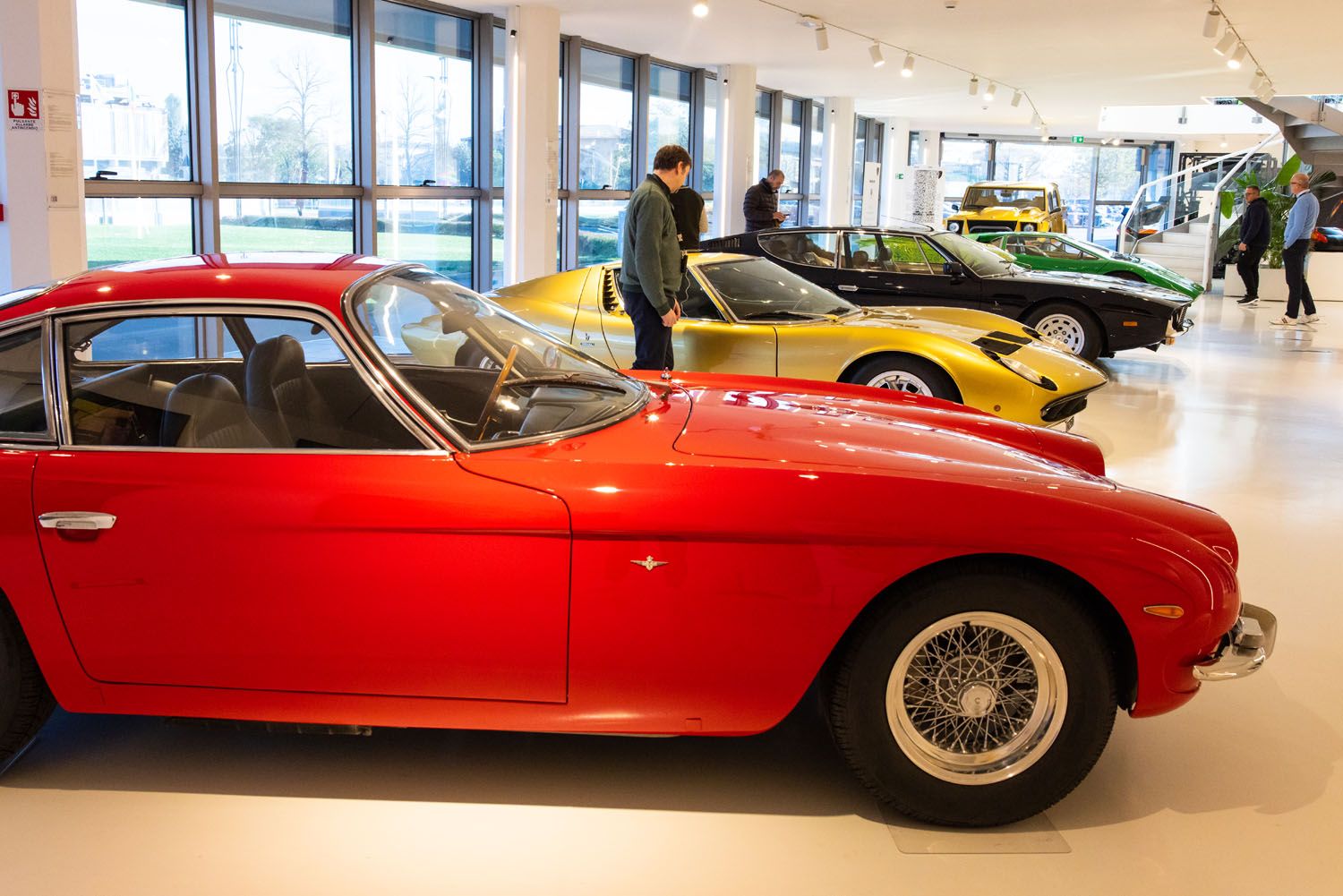
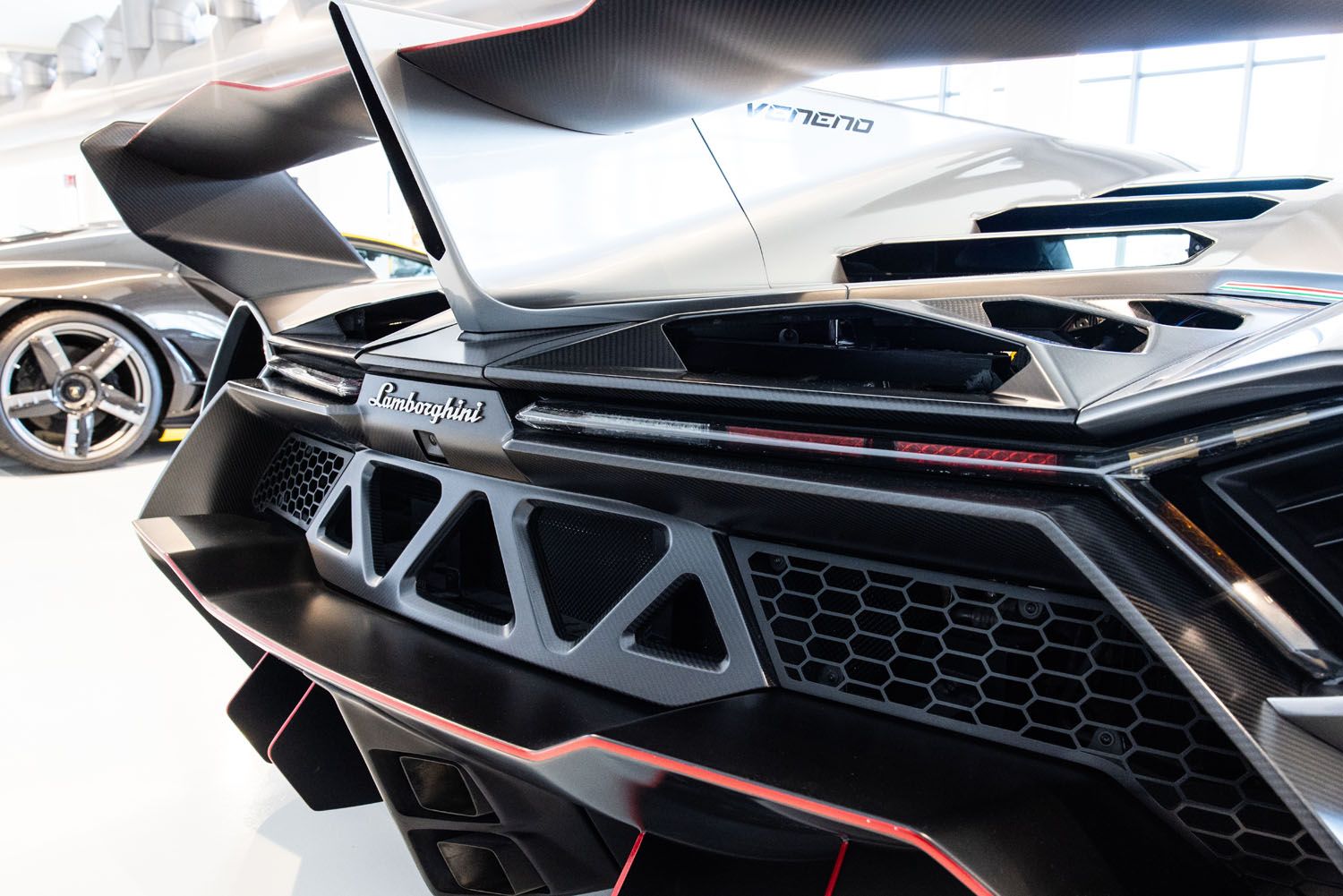
You can take a tour to see the production line, which is worth it for Lamborghini aficionados. It’s best to set this up in advance, as tour times are very limited throughout the day.
On our visit, we had to park roughly 800 meters away and walk to the museum, as they do not offer parking.
Get more information, pricing, hours, and the link to make a tour reservation on the official website.
Horacio Pagani Museum
Of the three car manufacturers we visited, Pagani was by far the most interesting. Pagani produces high-end super cars and they are more of a boutique car manufacturer, compared to Ferrari or Lamborghini. The museum is very small, with just a few cars on display, but there are a lot of exhibits around the room that tell the history of Pagani and why each car is unique.
If you only went to one car museum, this one would get our vote.
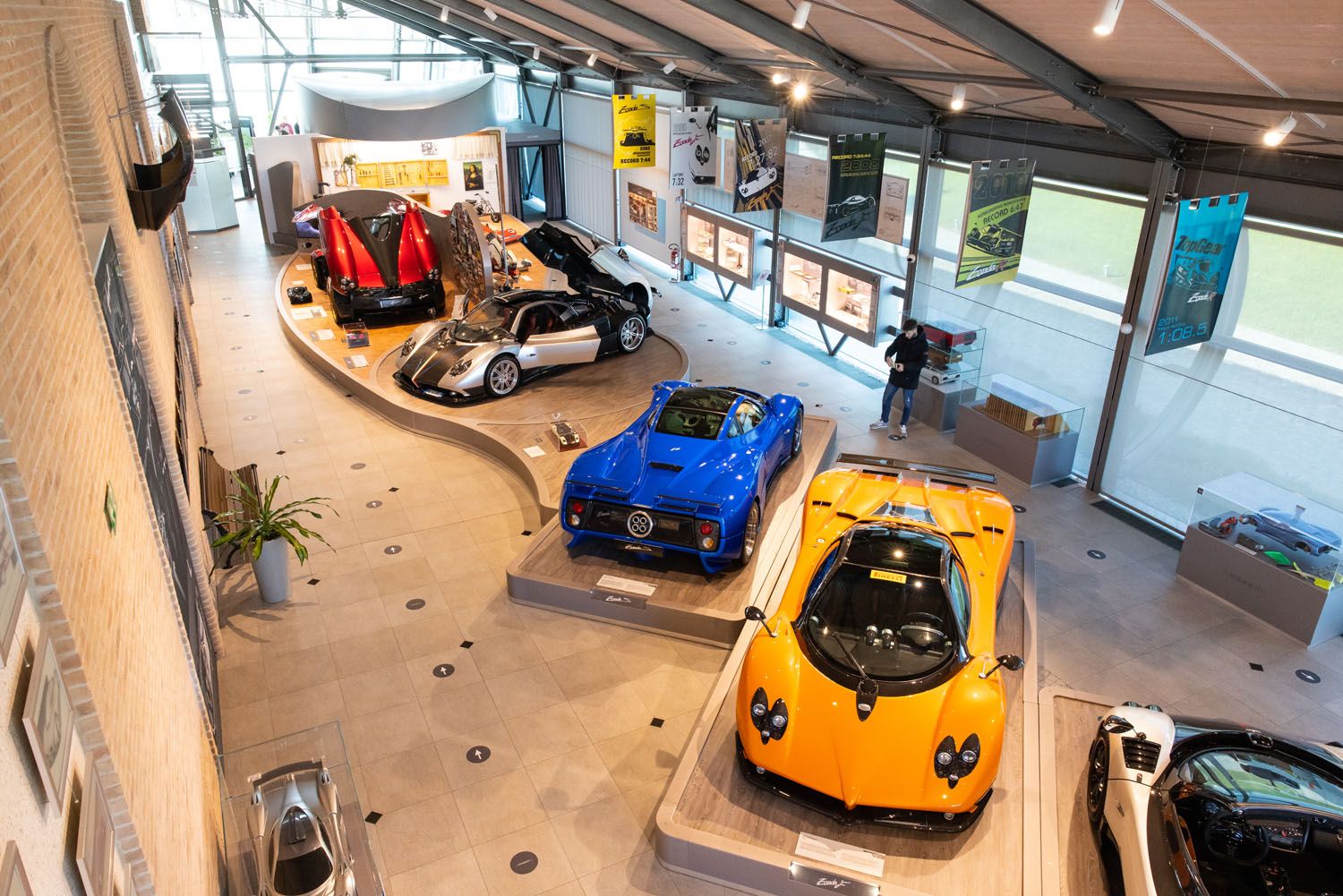
Horacio Pagani Museum
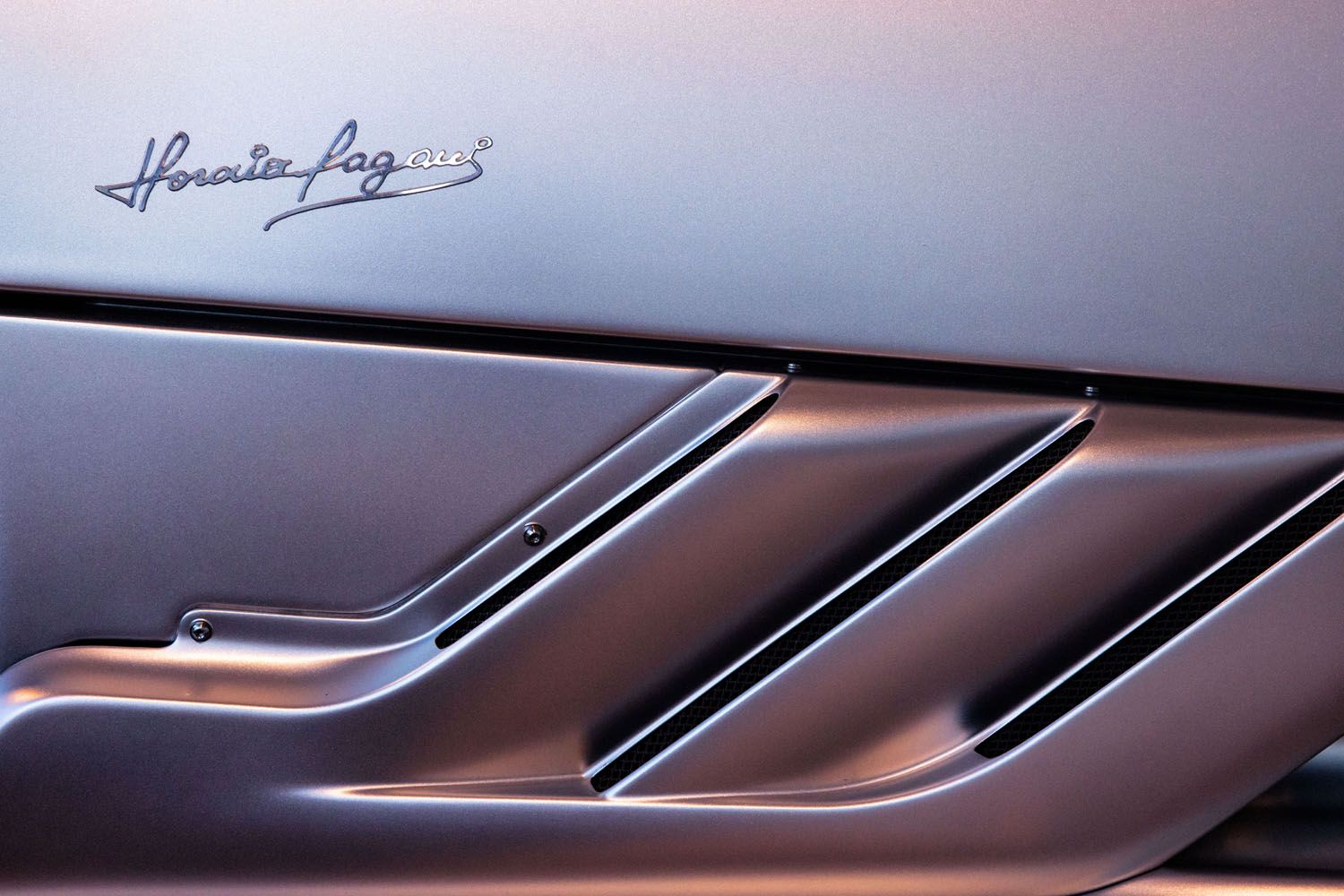
Parking was much easier (there is street parking next to the museum) and there were only a few other visitors while we were here.
Get pricing, hours, and schedule your factory tour on the official website.
Ferrari Maranello Museum
This is the biggest, busiest museum we visited. Ferrari has a small parking lot, with overflow parking throughout town, but midday in November, we circled these parking lots for 15 minutes until we could find a spot.
The entry fee is the highest of the three museums we visited, but the museum is a lot larger with many displays about the Ferrari brand, history, and facts about the cars on display. Altogether, it is a very well-designed museum. Taking a factory tour here would be very interesting.
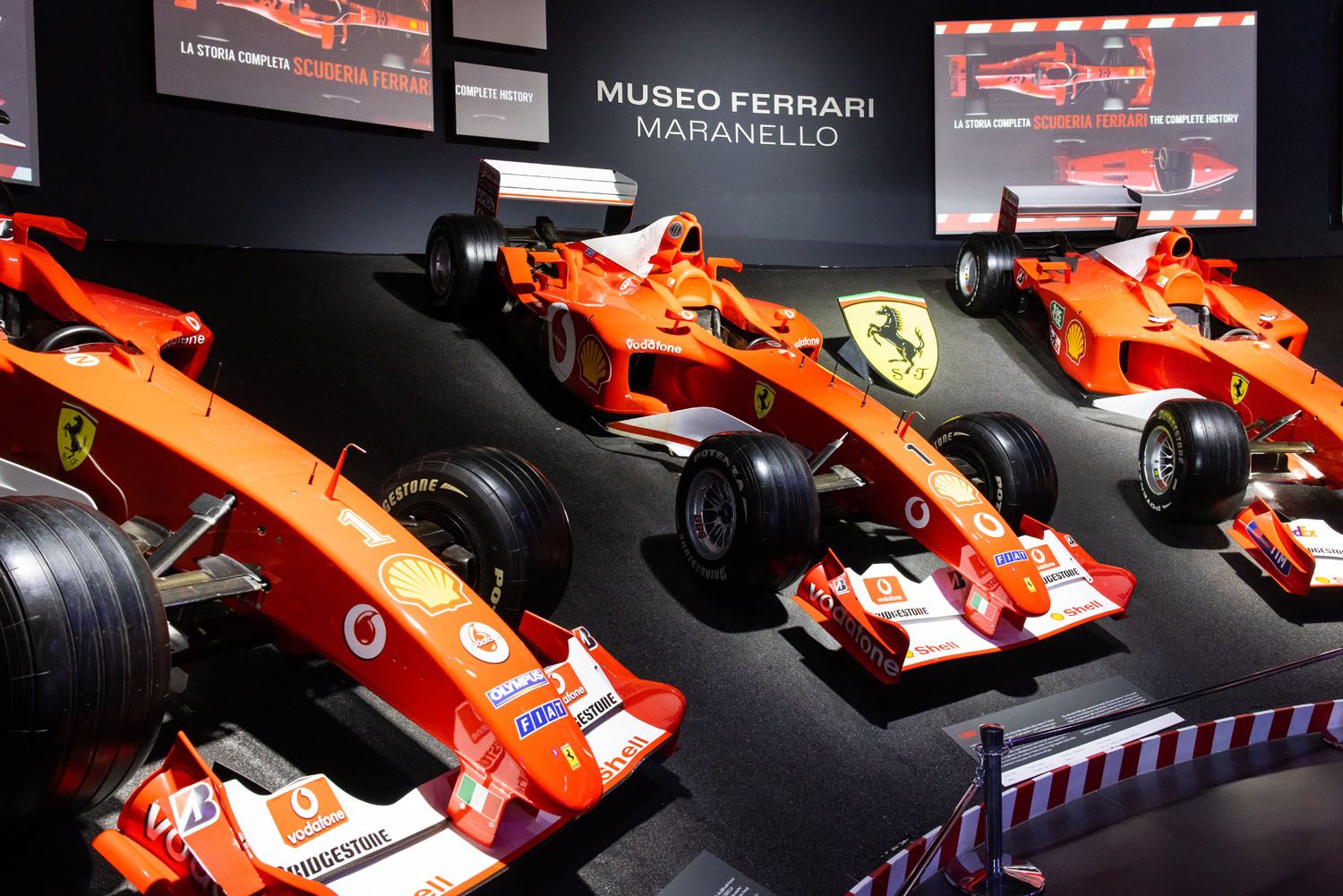
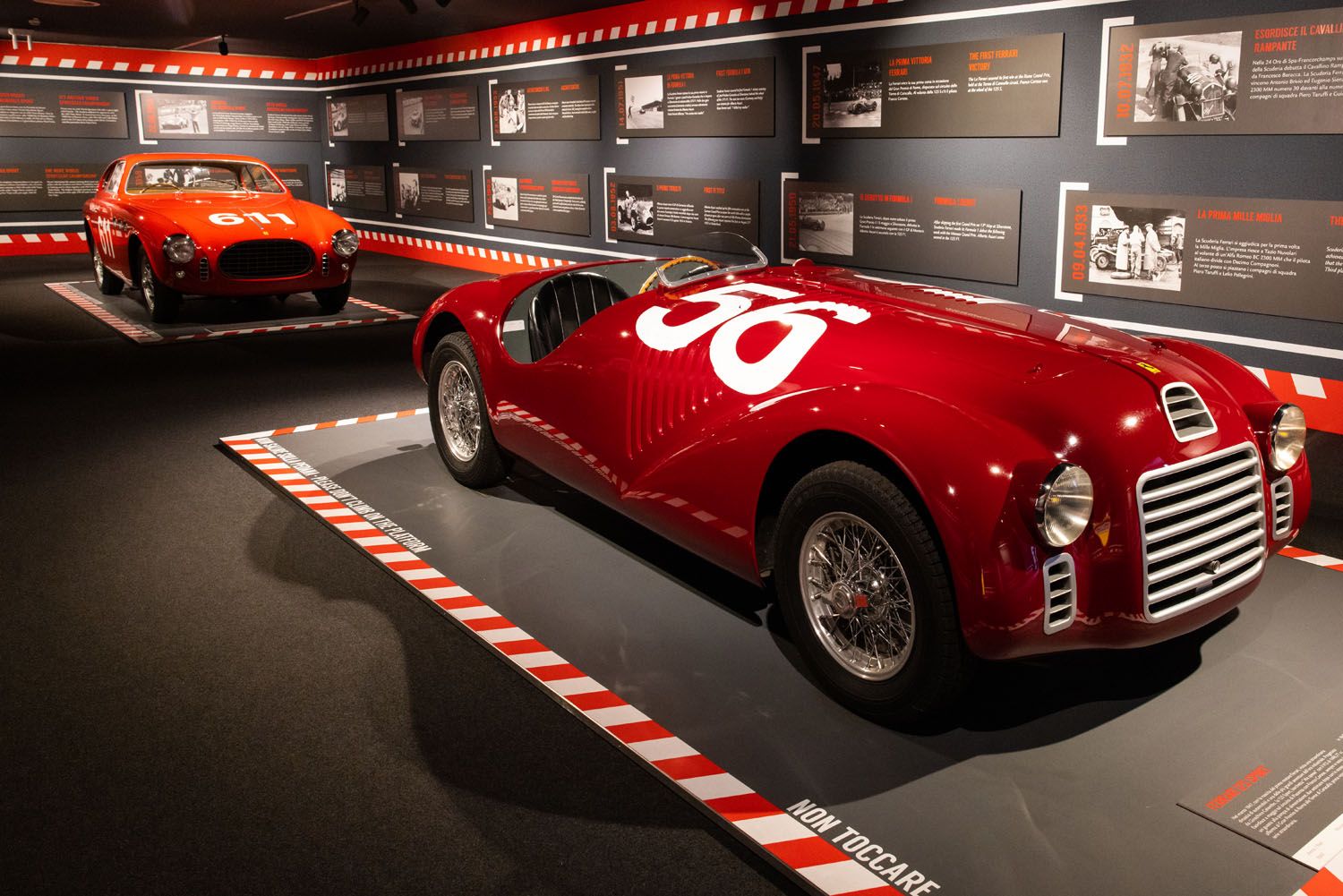
There are also private companies throughout the town that offer rides in Ferrari cars, if you like the idea of riding in one or driving one.
Get more information on the Ferrari website.
Museo Ducati
Ducati produces high end motorcycles. The museum is located just outside of Bologna, making it easy to add on to the car museums already listed. We did not visit this museum. Learn more on the official website.
Parmesan Cheese & Balsamic Vinegar
Taking a tour of a Parmigiano Reggiano cheese factory is just as popular, maybe even more popular, than a visit to the luxury car museums.
Bertinelli is located right outside of Parma (about an hour and a half drive from Bologna). They have a restaurant, offer guided tours of the factory, and even have an inn where you can spend the night.
Caseificio Bio Reggiani is closer to Bologna (about an hour drive) and near the Pagani and Lamborghini Museums. They also offer guided tours of their cheese factory.
Modena is where balsamic vinegar is produced and taking a day trip to Modena to tour a balsamic vinegar factory is also an option.
PRO TRAVEL TIP: If you like the idea of doing a balsamic vinegar tasting but don’t want to travel all the way to Modena, in Bologna visit the Giusti Boutique store. We tasted the Giusti Modena balsamic vinegar (who knew there were so many flavors?!) and bought some to take home.
Day Trips from Bologna
Map of Things to Do in Bologna
How to Use This Map: Click the tab in the top left corner of the map to see a list of the points of interest and to turn layers on/off. Click the icons on the map to get more information about each point of interest.
To take this map with you, click the star next to the title of the map which adds it to your Google account. Next, within your Google Maps app, select ‘Saved’ and then select ‘Maps’. This map title will now appear in your list.
Bologna Welcome Card
The Bologna Welcome Card is a tourist card that includes the museums, a visit to the Clock Tower, and a walking tour, plus additional experiences such as the San Luca Express or a city bus tour. There are two options to choose from, easy or plus, that differ in price and the experiences that come with the card.
Visit the official website for more information and how the card works. If you plan to visit many of the museums in Bologna, this card may save you money (add up what you plan to visit and compare that with the price of the card).
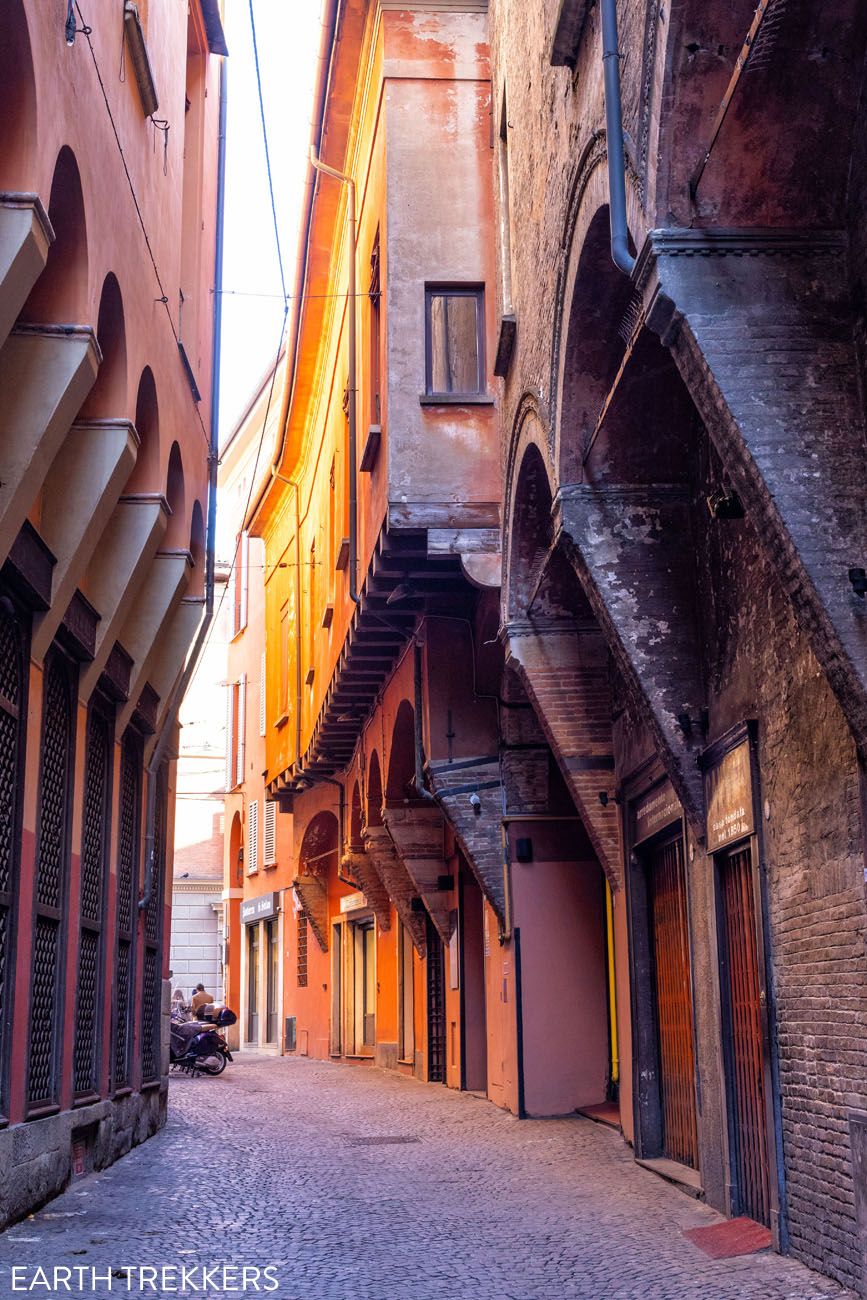
Is Bologna Worth It?
It took us multiple trips to Italy to finally make it to Bologna, and within hours of arriving, we were asking ourselves why it had taken so long. Tim and I were instantly captivated by the busy, bustling Quadrilatero, the kilometers of beautiful porticoes winding through the city, and a medieval city center that somehow feels both grand and completely livable. The cooking class, the wine bars, the Archiginnasio — it all added up to one of our favorite Italian cities.
Bologna isn’t Rome or Florence. It doesn’t have the Colosseum or the Uffizi, and it doesn’t try to. What it has is a city that feels genuinely Italian in a way that the most visited destinations sometimes don’t — full of locals going about their lives, students filling the bars in the evening, and food that takes itself seriously in the best possible way.
If you’re a foodie, Bologna belongs on your Italy itinerary without question. And if you’ve already done Italy’s big hitters and are ready to go a little deeper, this is exactly the kind of city that rewards that instinct.
Is Bologna Worth Visiting? Yes — unequivocally.
Best For: Foodies, repeat Italy visitors ready to go beyond the tourist trail, travelers who want a city that feels authentically Italian, and anyone who wants to combine great food with real history and architecture.
Not Ideal For: First-time Italy visitors with limited time who need to prioritize the major landmarks — save Bologna for your second or third trip, when you’re ready to slow down and eat your way through a city.
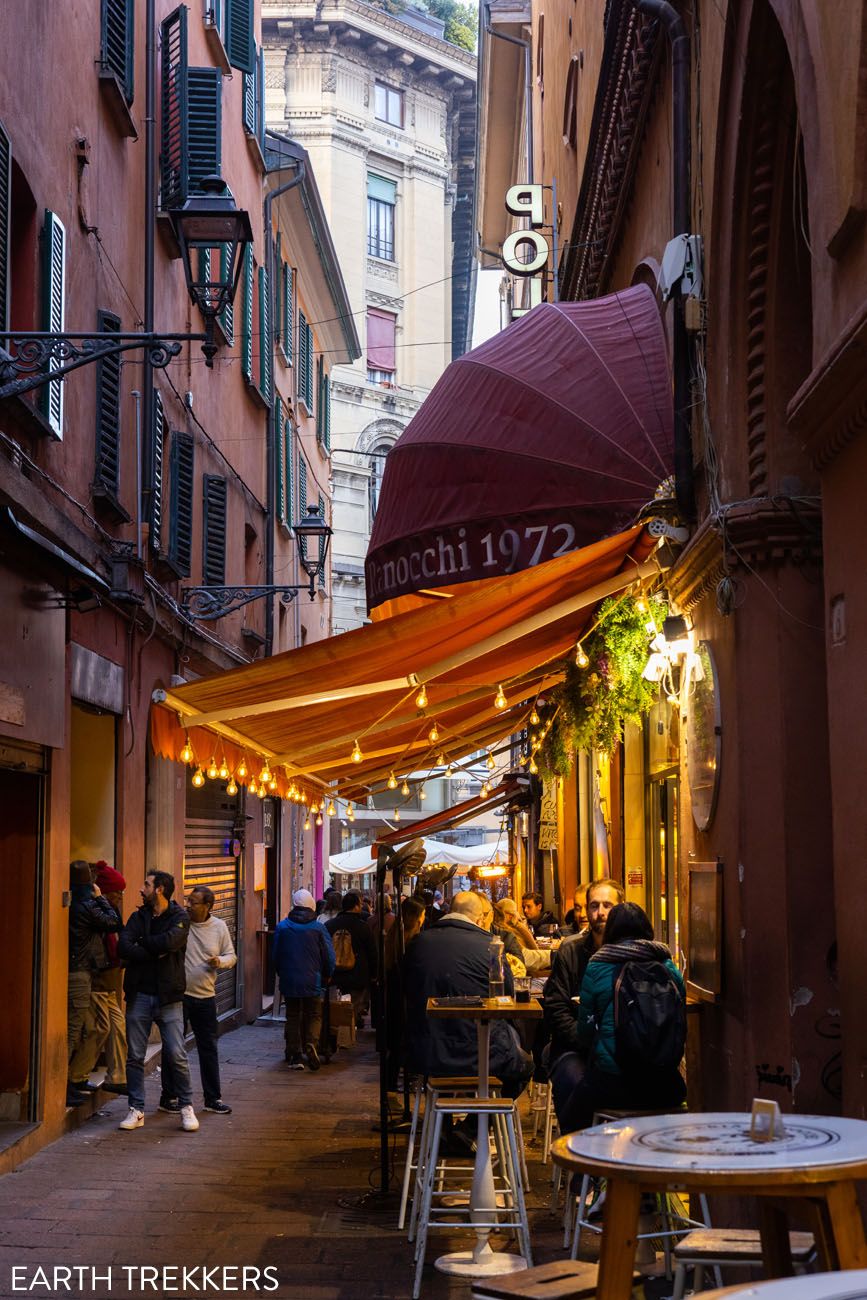
The Quadrilatero
How Many Days Should I Spend in Bologna?
With one day in Bologna, you have just enough time to explore the historic city center, take a food tour or cooking class, photograph the porticos, and climb a tower for a view over the city.
With two days in Bologna, the additional day gives you enough time to either take a day trip OR spend more time in the city center.
For those who want to do both, thoroughly explore Bologna plus take a day trip, plan on spending 3 or more days in the city.
We cover how to plan your itinerary, plus where to stay and where to eat, in our 1 to 2 Days in Bologna Itinerary ↓
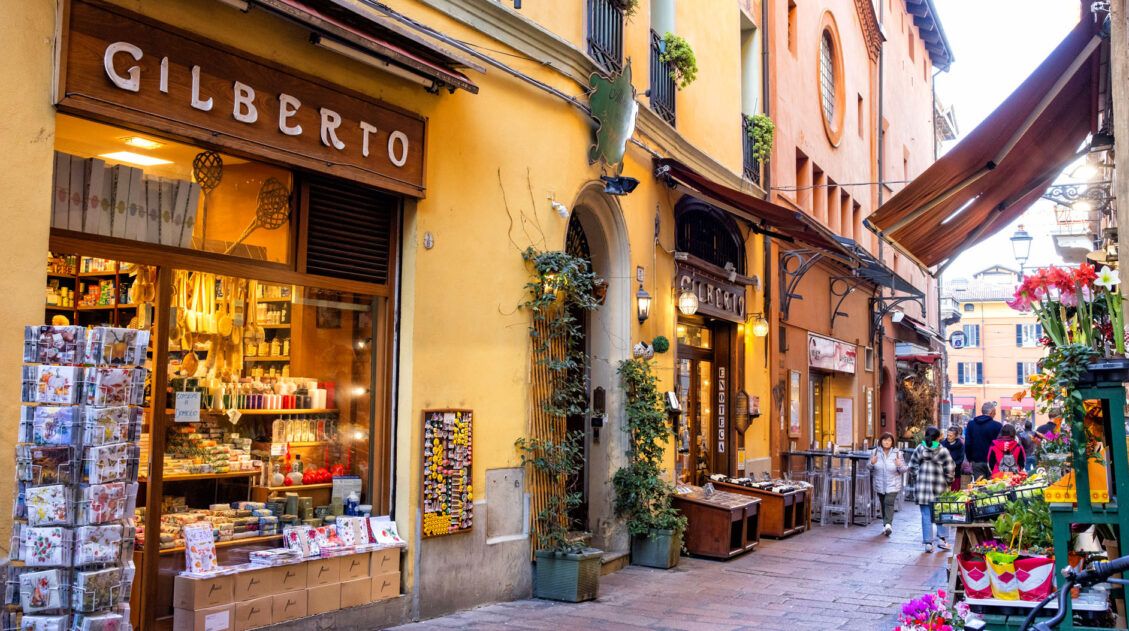
Bologna Itinerary: 1 to 2 Days in Bologna
Detailed one and two day itineraries for Bologna, Italy.Frequently Asked Questions
How do you get to Bologna?
You can reach Bologna easily by train, plane, or car. The Bologna Centrale train station is a major hub with high-speed connections to cities like Florence, Milan, Venice, and Rome. Bologna Guglielmo Marconi Airport (BLQ) is just 6 km from the city center, with a quick 15-minute ride on the Marconi Express train. If you’re driving, Bologna sits at the crossroads of major highways in northern Italy.
How far is Bologna from other Italian cities?
Bologna is exceptionally well connected by Italy’s high-speed train network, which makes it easy to combine with other destinations. Florence is roughly 35 minutes by fast train, making Bologna one of the best day trips from Florence. Venice is about 1 hour 20 minutes, Milan is just over an hour, and Rome is approximately 2 hours. Bologna Centrale station is a major hub, so connections are frequent throughout the day.
What is the best way to get around Bologna?
Bologna is a very walkable city. It’s flat and most of the main attractions, restaurants, food tours, and cooking classes are located in the city center.
What is Bologna famous for?
Bologna is famous for its rich food culture (it’s the home of tagliatelle al ragù, mortadella, and tortellini), its beautiful medieval architecture and porticoes, and its historic university, which is the oldest in the world. It’s also known for its twin leaning towers, lively piazzas, and less touristy atmosphere compared to other Italian cities.
Is Bologna safe?
Yes. We felt completely safe throughout our visit, including walking around in the evenings. Bologna is a university city with a lively, active street life well into the night, which actually makes it feel more energetic than threatening after dark. As with any European city, use common sense in crowded areas. Keep an eye on your belongings in the Quadrilatero and around Piazza Maggiore.
Where is the best neighborhood to stay in Bologna?
Stay in or as close to the historic center as possible, within easy walking distance of Piazza Maggiore. Bologna is a compact, walkable city and being central means you can reach virtually everything on this list on foot. We stayed at the Grand Hotel Majestic già Baglioni, which is beautifully located and one of the finest hotels in the city. For a full breakdown of where to stay in Bologna across different budgets, see our Bologna itinerary.
More Information for Your Trip to Italy
For a full overview of planning a trip to Italy, including where to go, how long to spend, and what to know before you arrive, visit our Italy Travel Guide. If you’re ready to start planning your time in Bologna specifically, our 1 to 2 Day Bologna Itinerary covers exactly how to structure your visit, where to stay, and where to eat.
Bologna also makes an excellent base for exploring northern Italy. We have detailed guides on nearby Venice (about 1 hour 20 minutes by train), Florence (just 35 minutes away), and Tuscany — all easy to combine with a Bologna visit on a broader northern Italy itinerary.
If you have any questions about the best things to do in Bologna, or if you want to share your favorite experiences, let us know in the comment section below.
More Information for Your Trip to Italy
We have TONS more information about Italy on our site, including Rome, Florence, Venice, Tuscany, the Dolomites, the Amalfi Coast, the Cinque Terre, Basilicata, and Puglia. Here are just a few of our guides.
25 Best Places to Visit in Italy
Pinterest Facebook Flipboard After six trips to Italy, these are the 25 places to visit in Italy we keep recommending — the ones that reward first-timers and repeat visitors alike, from the iconic cities of Rome and Florence to lesser-known gems like Matera and Puglia. We’ve been to Italy six times over the past ten […]
Things to Do in Lake Garda: 25 Experiences Worth Your Time
Lake Garda is the largest lake in Italy, and one of the most rewarding destinations in northern Italy, if you time your visit right. Ringed by colorful lakeside towns, medieval castles, Roman ruins, vineyards, and mountains that plunge straight into the water, there is plenty here to keep you busy for days. The list of things […]
Best Day Trips from Florence: 15 Picks for Every Type of Traveler
Florence is one of the best home bases for exploring Tuscany and nearby cities. The most popular day trips from Florence are conveniently accessible by train, with destinations like Pisa, Lucca, Bologna, Arezzo, and Siena just one to two hours away. Renting a car or joining a guided tour provides access to Tuscan hill towns, […]
14 Day Italy Itinerary: Best Way to Spend Two Weeks in Italy
We have been to Italy six times, and this route — Rome, Pompeii, the Amalfi Coast, Florence, Tuscany, the Cinque Terre, and Venice — is the one we recommend above all others for a first visit. We’ve traveled every stretch of it firsthand and refined the planning advice in this post trip by trip. What […]
20 Best Things to Do in Venice, Italy (2026 Guide)
Discover 20 things to do in Venice, Italy, from strolling its canals and island-hopping to Murano and Burano, to visiting St. Mark’s Basilica and the Rialto Bridge. Venice is one of our favorite spots in Italy. With its winding canals and centuries-old architecture, it’s an easy place to fall in love with, and small enough […]
Visiting San Marino: Europe’s Most Underrated Destination
San Marino is a tiny, independent nation completely surrounded by Italy, perched high on the rocky summit of Monte Titano near the Adriatic coast. The capital city, also called San Marino, is a maze of medieval streets, stone towers, and hilltop piazzas with sweeping views over the Italian countryside below. In this guide, we cover […]
Best Things to Do in Arezzo, Tuscany (+ Map, Tips & Itinerary)
After two trips through Tuscany, we’ve visited a lot of hill towns, including Siena, Cortona, Montepulciano, Pienza, and a handful of smaller villages tucked into the countryside. Arezzo was one of the last ones we visited, and arriving on a Sunday in early October, we weren’t sure what to expect. What we found was one […]
The Best Things to Do in Siena, Italy
Some cities in Italy overwhelm you with options. Siena does the opposite, and that’s exactly what we loved about it. The historic center is compact and entirely walkable, the main sights are clustered within easy reach of each other, and the city has a pace that makes it easy to slow down. The things to […]
12 Best Things to Do in Verona, Italy (+ One Day Itinerary)
From ancient Roman ruins to pastel streets made for evening strolls, Verona feels like stepping into a storybook. Here are the best things to do in Verona, plus how to plan the perfect one-day visit. Have you ever visited a new place and instantly fallen in love with it? For us, that was Verona. On […]
Best Way to Visit Seceda (with Little to No Hiking)
The ridgeline of Seceda looks almost unreal — a dramatic wall of jagged peaks rising above the green pastures of Val Gardena. It’s one of those views that stops you in your tracks, the kind you’ve seen in photos of the Dolomites and wondered, Is it really that beautiful in person? (Yes. It is.) And […]
Is Ravello Worth Visiting? Best Things to Do & Travel Tips
Ravello is one of the most beautiful towns on the Amalfi Coast, perched high in the hills above Amalfi and Minori with sweeping coastal views and centuries-old villa gardens. Unlike Positano, Amalfi, or Atrani, Ravello sits well above sea level, so it takes a bit more effort to reach, but the views from Villa Rufolo […]
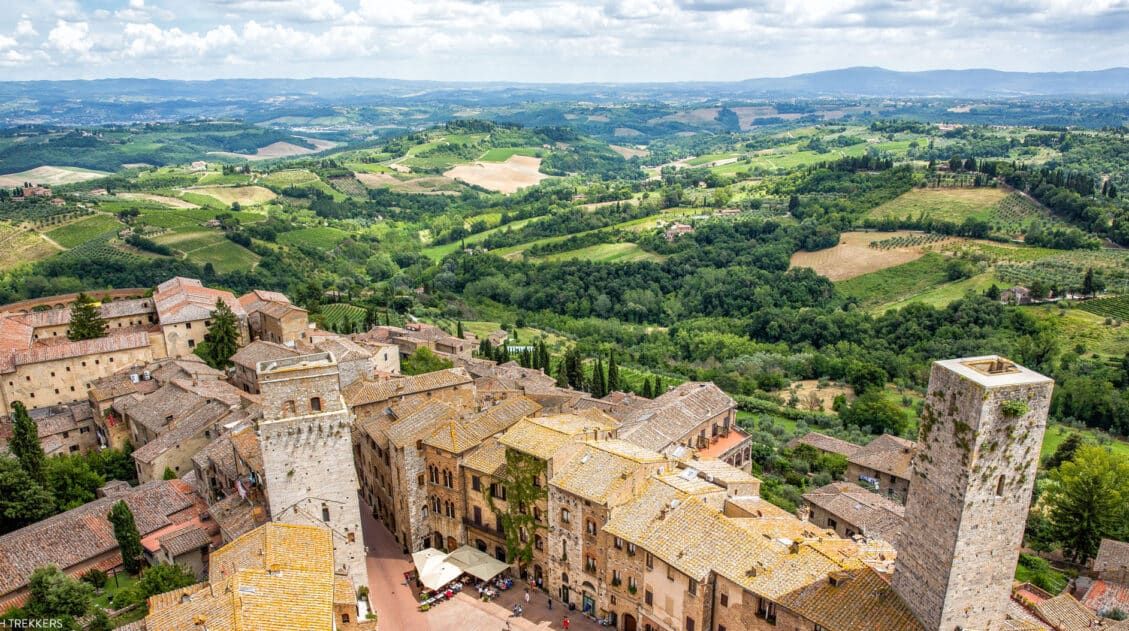
20 Gorgeous Views of Italy and Where to Photograph Them
Italy is one of the most photogenic countries in the world, and after six trips here, we’ve stood at a lot of viewpoints, from clifftop villages in Tuscany to the jagged peaks of the Dolomites to the canals of Venice at twilight. The views never get old. In this guide, we share 20 of our […]
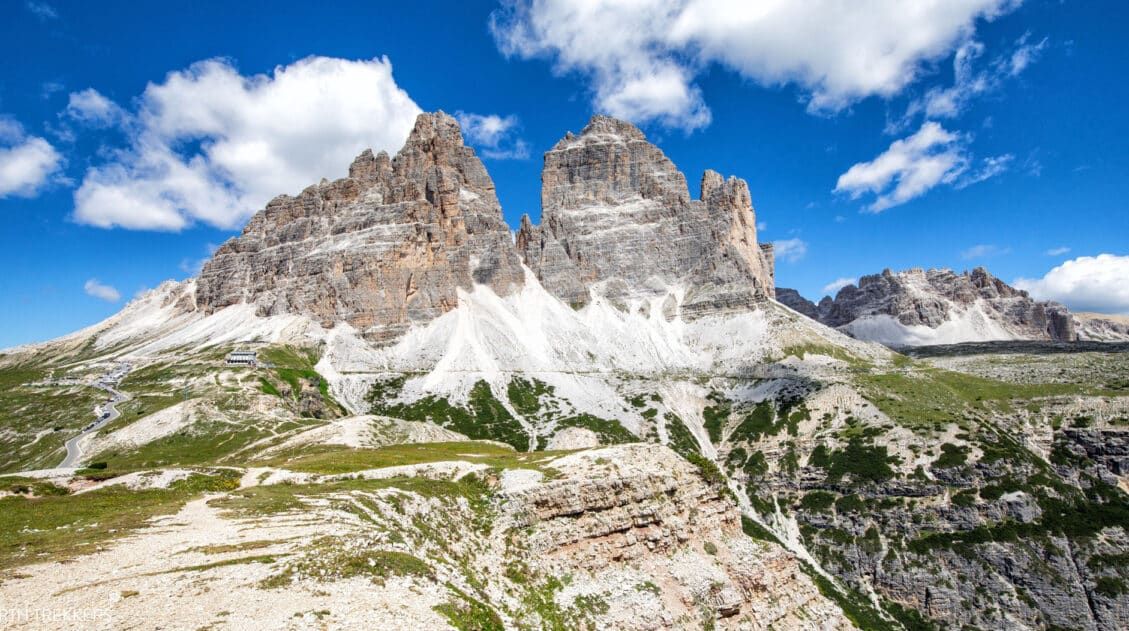
15 Best Hikes in the Dolomites (Easy to Challenging)
Jagged limestone peaks rise above green valleys, cable cars make it easy to reach the high mountains, and many trails lead to rifugios where you can stop for lunch with an incredible view. The Dolomites are one of the best hiking destinations in Europe, and this guide ranks the 15 best hikes in the Dolomites, […]

Comments 6