
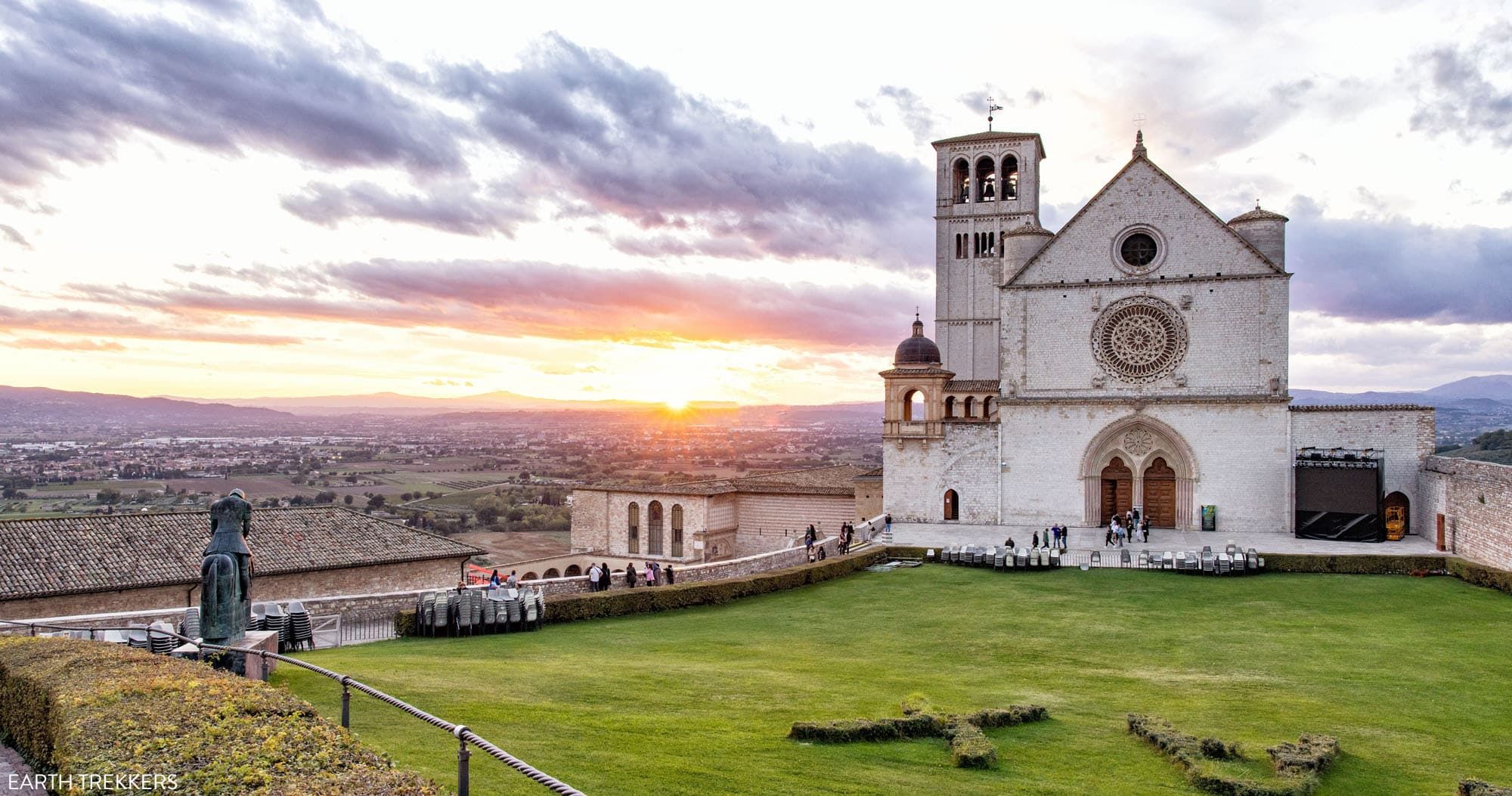
Discover the best things to do in Assisi, from the breathtaking Basilica di San Francesco to a hilltop medieval fortress and some of the most photogenic side streets in all of Umbria.
Located in Umbria on the slopes of Monte Subasio, Assisi is one of Italy’s most beautiful and undervisited cities. This is the birthplace of St. Francis, a UNESCO World Heritage Site, and one of Christianity’s most important pilgrimage destinations, yet somehow, it still feels like a secret. Visitors who make the trip here are often surprised by how calm and unhurried Assisi feels compared to Tuscany’s more famous hill towns.
If you’re visiting in 2026, there’s an added reason to make the trip: this year marks the 800th anniversary of St. Francis’s death, and Assisi has been designated an official Franciscan Jubilee Year through January 10, 2027, making it an especially meaningful time to visit.
We spent two days here, and it was exactly the right amount of time to explore it well. Assisi won us over immediately, with its stone streets, the jaw-dropping basilicas, and the sweeping views over the Spoleto Valley. But our favorite moments came at twilight, when the streetlamps lit up the pale limestone buildings and the whole city seemed to glow. We were lucky enough to dine one evening on an outdoor terrace and watch the sun set over the valley below. It’s the kind of place that surprises you.
Whether you’re here as a pilgrim, an art lover, or simply a traveler who appreciates a beautiful Italian hill town, Assisi delivers. Here’s everything you need to know to plan your visit.
At a Glance: Visiting Assisi
LOCATION | Umbria, Italy
BEST FOR | History lovers, art lovers, pilgrims, fans of Italian hill towns
HOW MUCH TIME | 1 day to see the highlights; 2 days to explore at a relaxed pace
GETTING THERE | By train to Santa Maria degli Angeli station, then bus up to the city; or by car
GETTING AROUND | On foot — Assisi is walkable but hilly
BEST TIME TO VISIT | Spring and fall for mild weather and smaller crowds; evenings year-round for the magical twilight atmosphere
DON’T MISS | Basilica di San Francesco, Rocca Maggiore, the side streets at twilight
ONE DAY IN ASSISI | See our One Day in Assisi Walking Tour for a full itinerary
Assisi Highlights: 5 Things Not to Miss
Short on time or just want to know the best of the best? These are the five things we’d prioritize in Assisi.
- Basilica di San Francesco — The crown jewel of Assisi. Two churches stacked on top of each other, with Giotto frescoes covering the walls of the upper church and the crypt of St. Francis below. One of the most stunning interiors we’ve seen in all of Italy.
- Basilica di Santa Chiara — A beautiful Gothic basilica with flying buttresses, the relics of St. Clare, and a piazza with breathtaking views over the countryside.
- Rocca Maggiore — The medieval fortress above the city rewards the steep climb with panoramic views over Assisi’s rooftops and the surrounding valley.
- Piazza del Comune & Temple of Minerva — The heart of the city, anchored by a remarkably intact Roman temple from the 1st century BC. Pull up a chair at a terrace café and take it all in.
- The Side Streets — Don’t rush through Assisi on a checklist. The narrow, cobblestoned alleyways lined with flower boxes and pale stone buildings are as photogenic as anything on the official sightseeing list — and at twilight, they’re magical.
A Brief History of Assisi
Before we jump into the best things to do in Assisi, it is important to get a little background information on this city. Many of the top sights in Assisi are linked to St. Francis and the rich history of the city.
Early Beginnings
Three thousand years ago, Assisi was inhabited by the Umbrians, an Indo-European civilization. The first foundations for Assisi were laid out during this time, as the city streets follow the terraces constructed by the first people here.
Control of Assisi changed hands several times, from the Romans to the Lombards and Franks. In the 11th century, Assisi became an independent city, but it would still war with nearby cities, such as Perugia.
Ties to St. Francis and St. Clare
Assisi’s most defining chapter began in late 1181 or early 1182, when St. Francis was born here to a wealthy merchant family. As a young man, he fought in the war against Perugia and was taken prisoner, an experience that set him on a path of spiritual transformation. He eventually renounced his family’s wealth, embraced a life of radical poverty, and founded the Franciscan Order, one of the most influential religious movements in Christian history.
St. Francis traveled throughout Italy, Egypt, and Spain spreading the gospel. Later in life, while fasting and meditating, he received the stigmata, the five wounds of Christ, a moment that is considered one of the most significant mystical events in Catholic history. He died on October 3, 1226, and was canonized just two years later. The very next day after his canonization, construction began on the Basilica di San Francesco, built to house his tomb.
St. Clare, a contemporary and close follower of St. Francis, founded the Order of Poor Ladies, the female counterpart to the Franciscan Order, and spent most of her life in Assisi. She was canonized in 1255, and the Basilica di Santa Chiara was built in her honor shortly after her death.
Together, Francis and Clare shaped the spiritual identity of this city in ways that are still visible on every street corner.
Assisi Today
Assisi draws pilgrims and travelers from around the world, yet it retains a quieter, more contemplative atmosphere than many of Italy’s more heavily touristed cities. In 1997, two major earthquakes caused significant damage to buildings throughout the region, and the Basilica di San Francesco was closed for two years for repairs.
In 2000, UNESCO designated the Franciscan sites of Assisi as a World Heritage Site, recognition of a place that has been shaping history for nearly a thousand years.
All of this history comes alive as you explore the city. Here’s what to see and do.
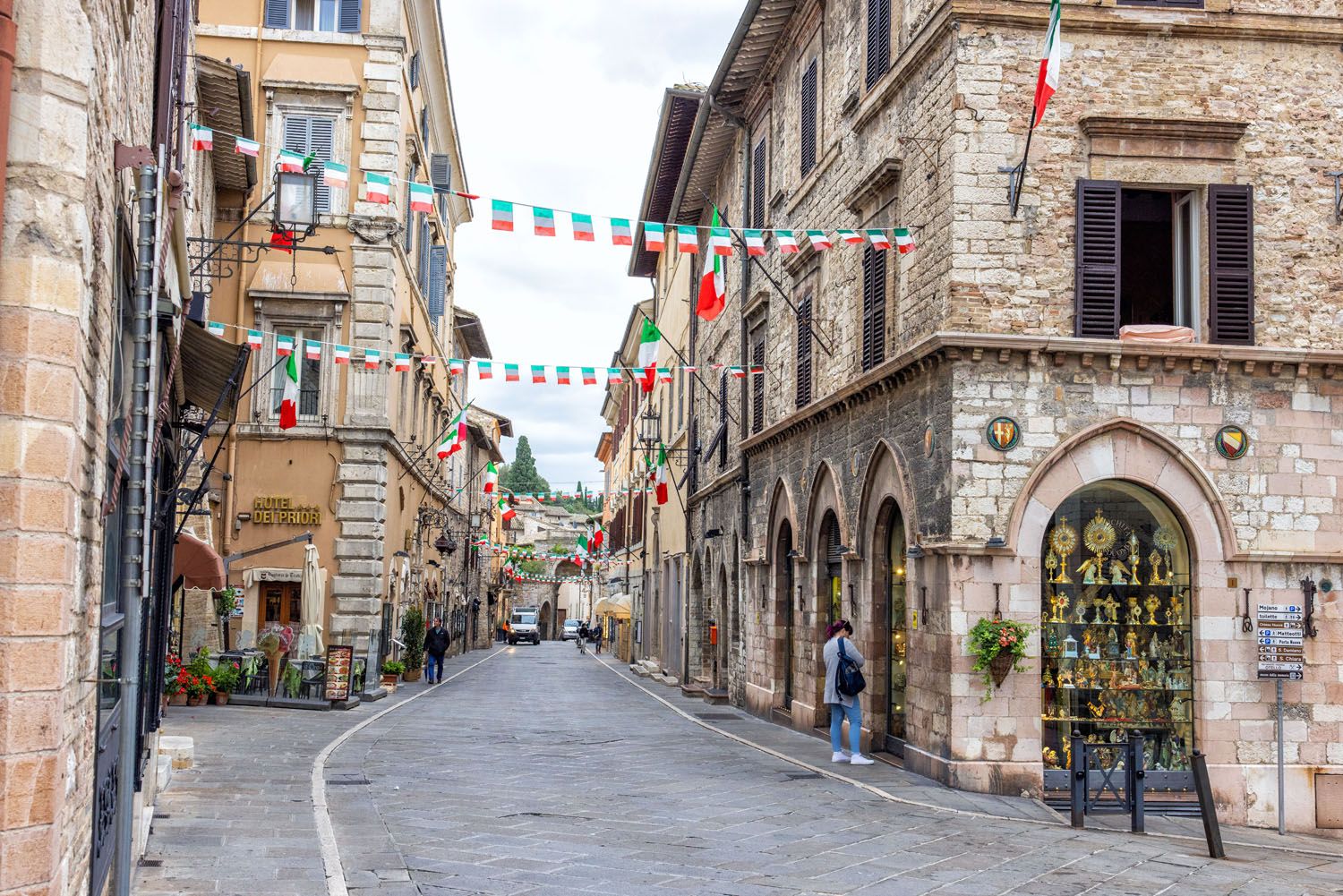
Corso Giuseppe Mazzini
Best Things to Do in Assisi
Below is a list of the best things to do in Assisi, within the city center. The best way to get around these places is to explore the city on foot. The city is hilly, so you will walk up and down some steep hills to get to some places, but it’s the best way to get around town.
1. Visit the Basilica di San Francesco d’Assisi (St. Francis Basilica)
Without a doubt, visiting the Basilica di San Francesco is one of the best things to do in Assisi.
This basilica was built in 1228 and construction began just two days after St. Francis was canonized as a saint.
Two churches are built at this site, one on top of the other. On top sits an enormous Gothic cathedral and below it is a much smaller Romanesque church. The lower church preserves the remains of St. Francis.
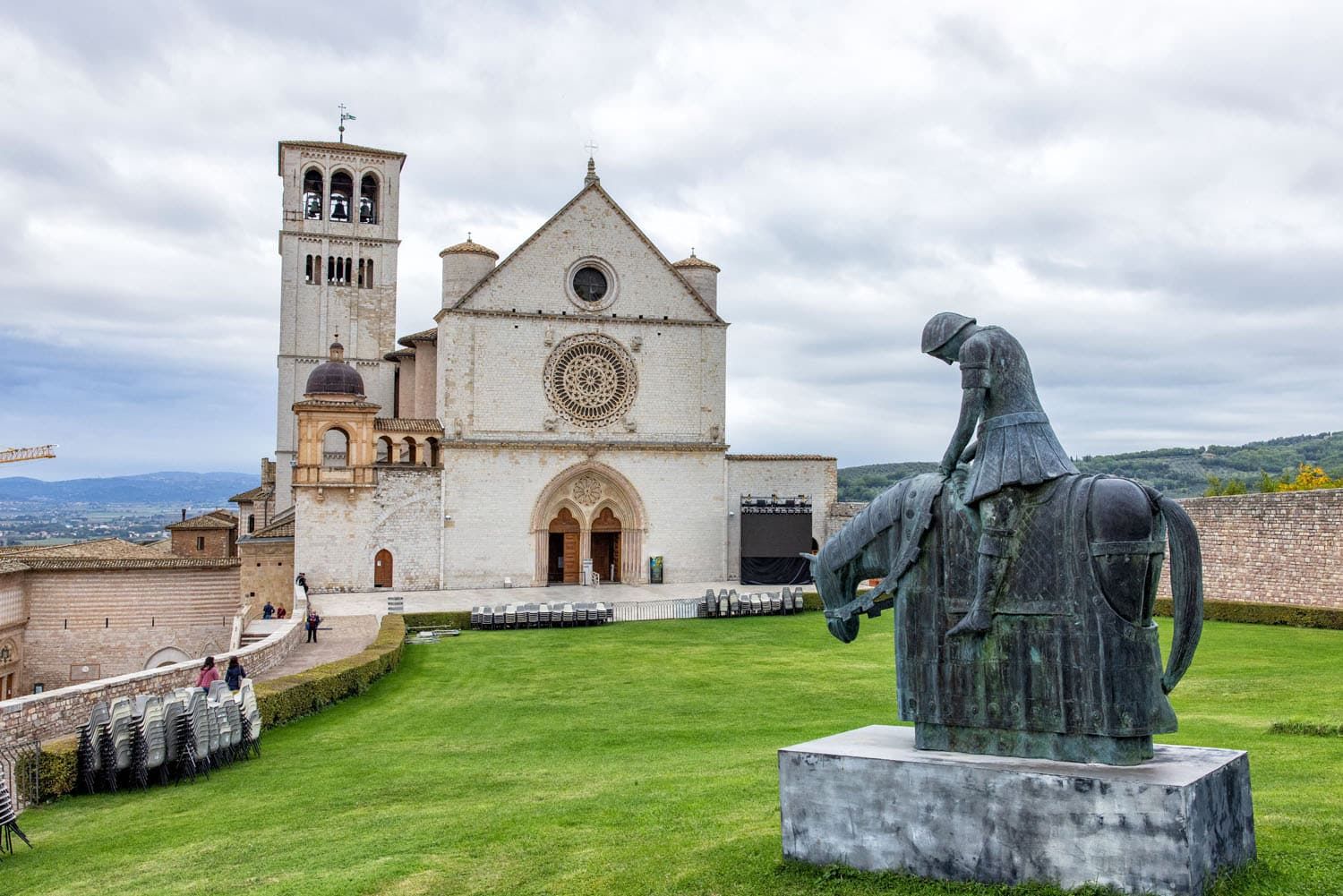
Basilica di San Francesco
From Via San Francesco, take a moment to enjoy the view of this basilica. Then walk the wide walkway to the upper church. Step inside and be prepared to be amazed. This is one of the most beautiful churches we have visited.
The walls and ceiling are covered with brightly colored frescoes and stained-glass windows. Along the nave, the frescoes on the lower walls tell the Stories from the Life of Saint Francis (painted by Giotto) and the frescoes on the upper walls tell the Stories from the Old and New Testament.
Exit the upper church and take the stairs down to the lower church. This church is much smaller and more solemn than the upper church. It is here that you can enter the crypt of St. Francis. The frescoes on the walls of the lower church were painted by artists Cimabue, Giotto, Lorenzetti, and Martini.
How to Visit the Basilica of San Francesco
Dress Code: Shoulders and knees must be covered to enter the basilica.
Cost: The basilica is free to enter.
Photography: Photography inside of both churches is not permitted.
Hours: Get updated hours on the official website.
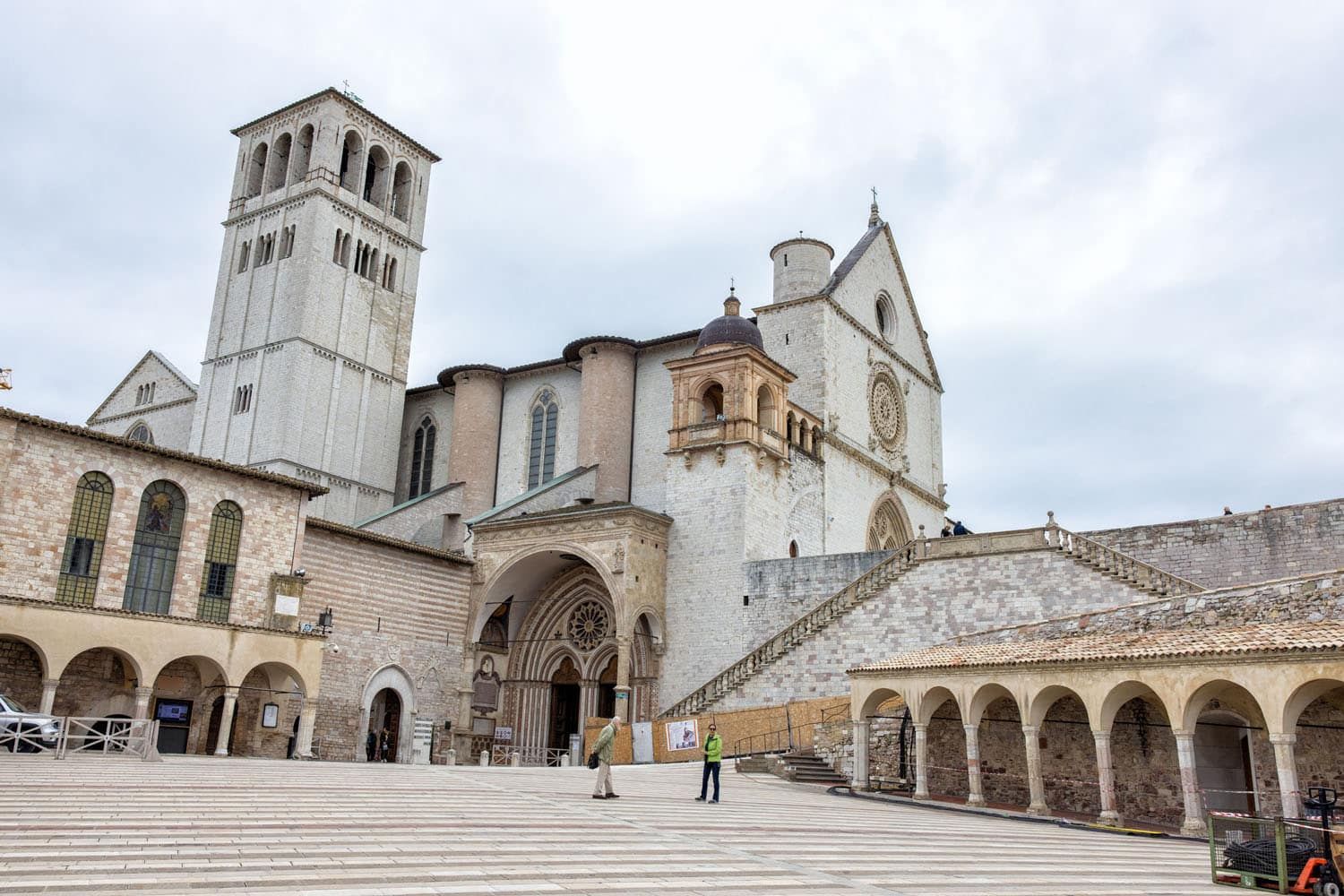
Basilica di San Francesco
2. Take a Stroll along Via San Francesco
Via San Francesco is the road that connects Piazza Del Comune with the St. Francis Basilica. It is lined with small stone buildings, housing boutique shops that sell food, souvenirs, and religious artifacts.
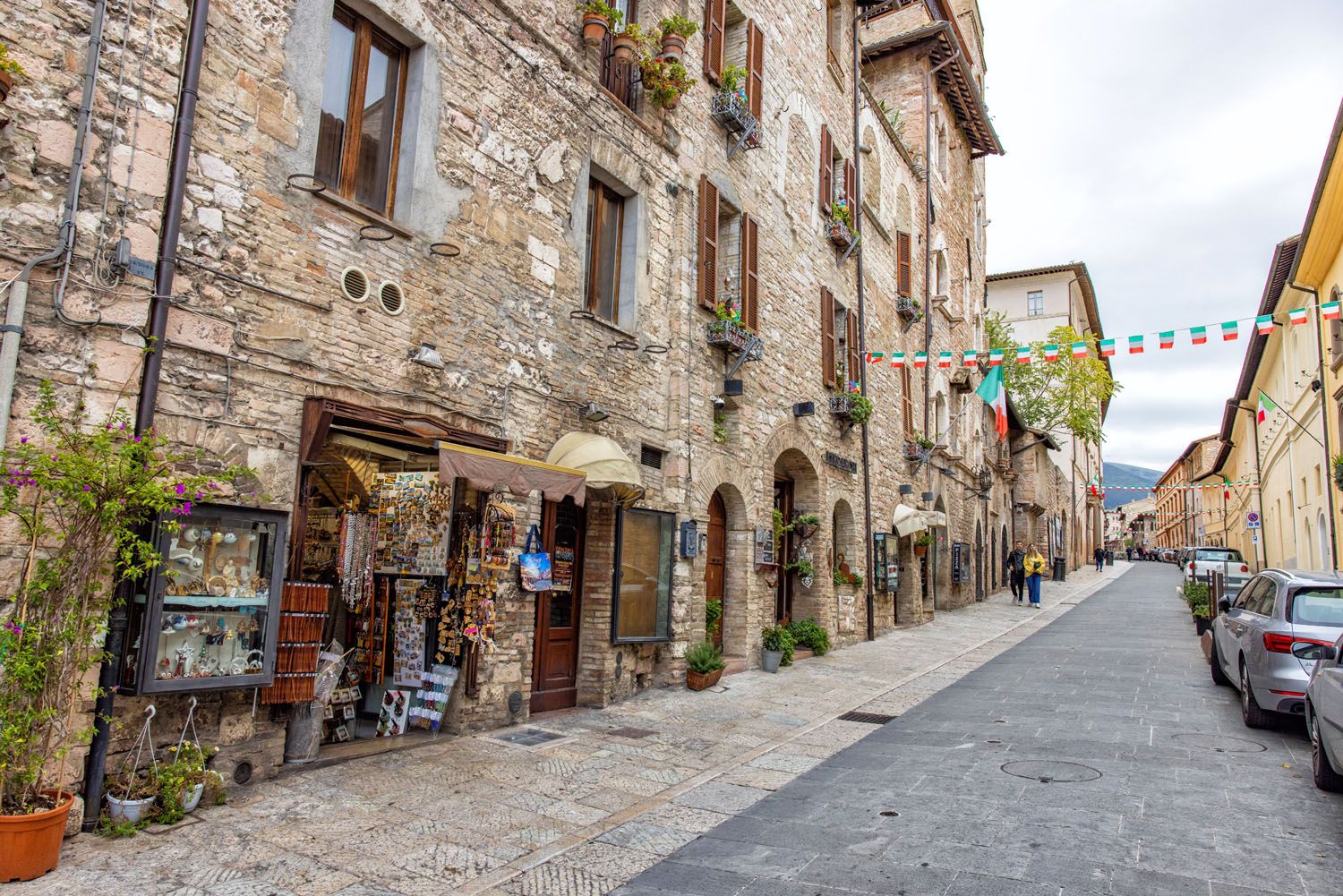
Via San Francesco
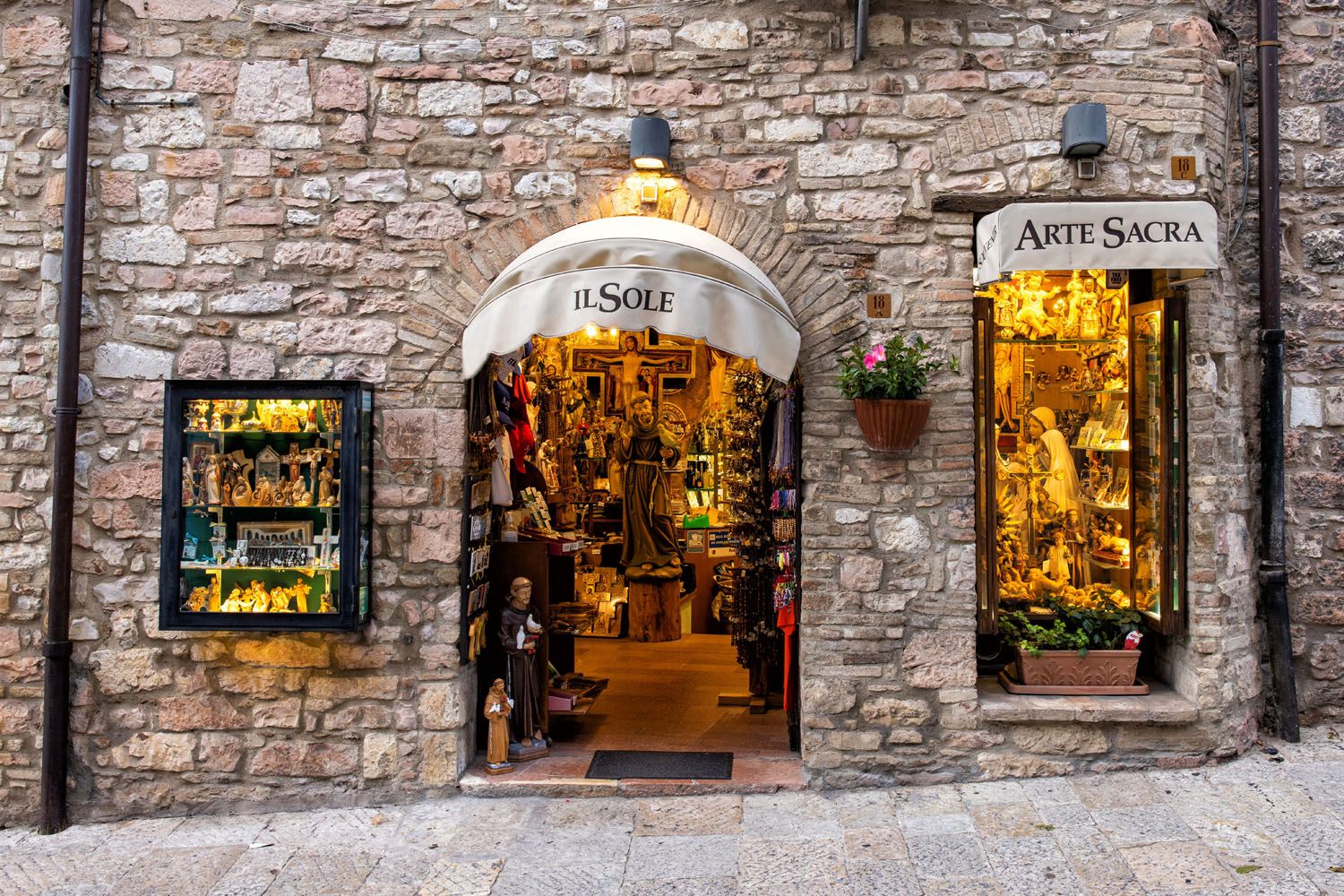
Shops along Via San Francesco
At the western end of Via San Francesco, within view of the St. Francis Basilica, is Ristorante Bar San Francesco. We had breakfast here, dining on pastries and coffee, after our visit to the basilica.
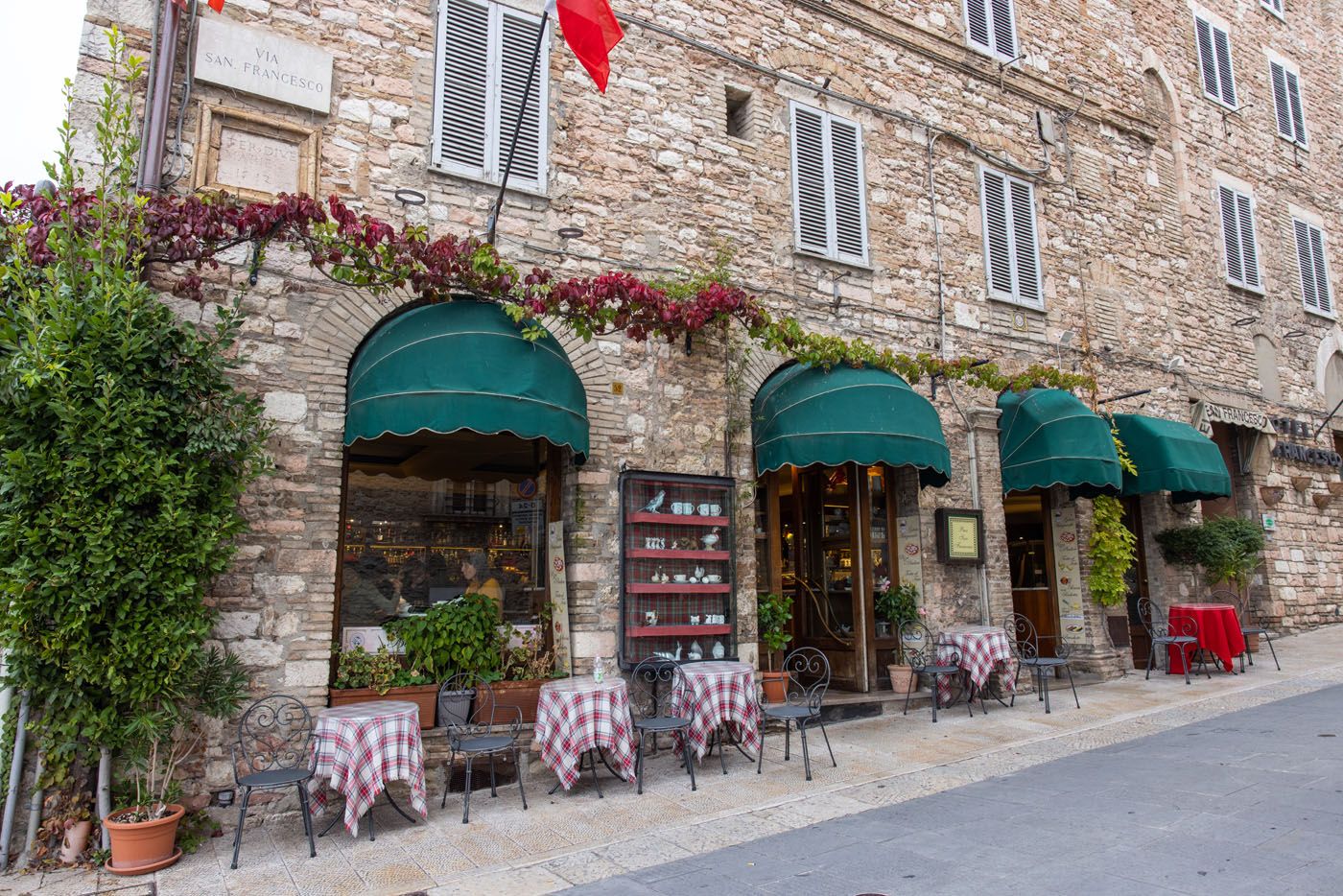
Ristorante Bar San Francesco
3. Visit Piazza del Comune
Piazza del Comune is the main square of Assisi. This large, open area is bordered by some of the oldest and most important buildings in Assisi.
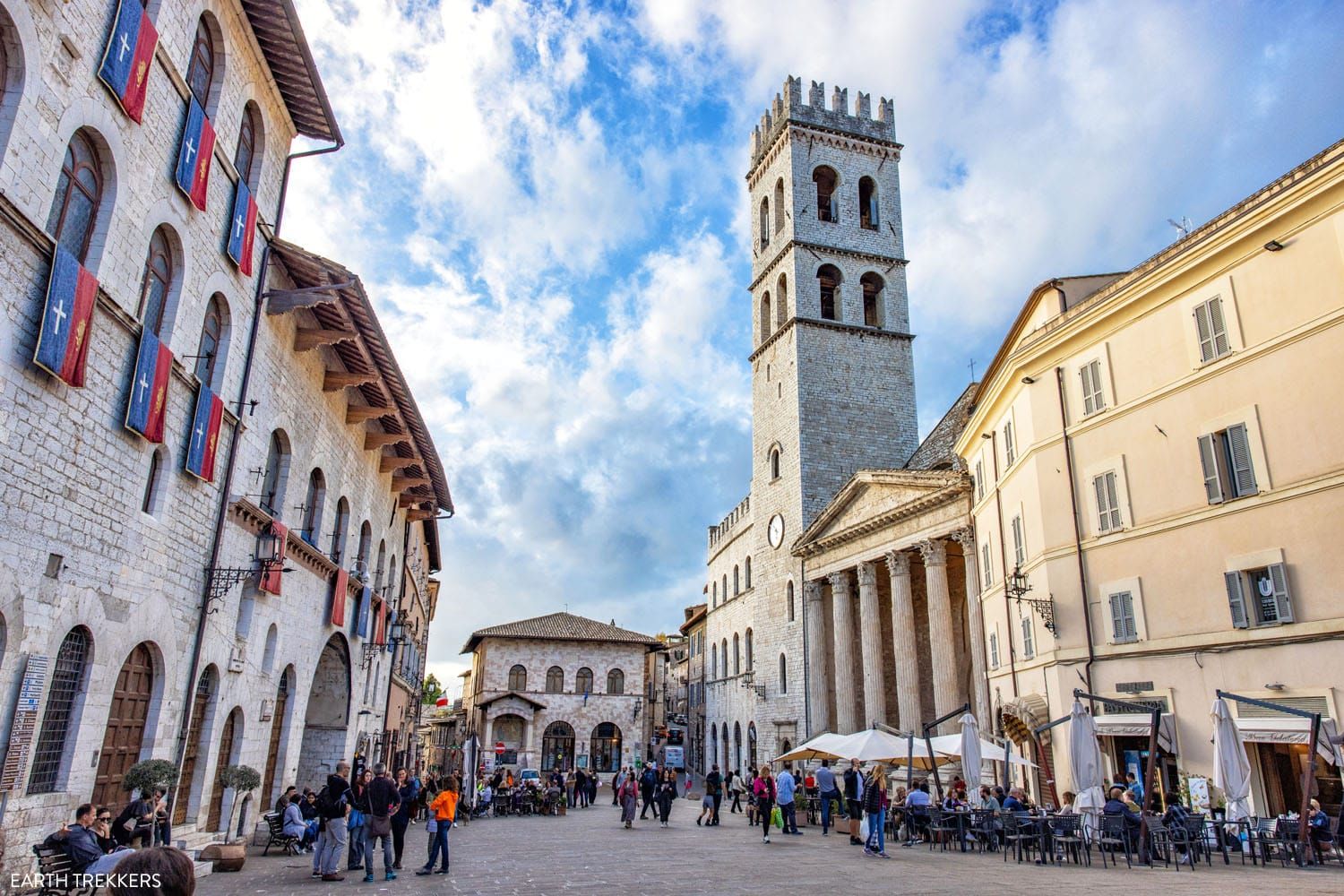
Piazza del Comune
The Temple of Minerva, which dates back to the first century BC, is the oldest building on the square. Sitting next to the Temple of Minerva is Torre del Popolo, which was built in the 13th century. Also lining the square is the town hall and the tourist information point.
In addition to the historic buildings, there are a few restaurants lining the square, plus a fountain that sits on the east end of the square.
If you are here during lunch or dinner, we had a great lunch at Taverna dei Consoli, which has seating on an outdoor terrace overlooking the square.
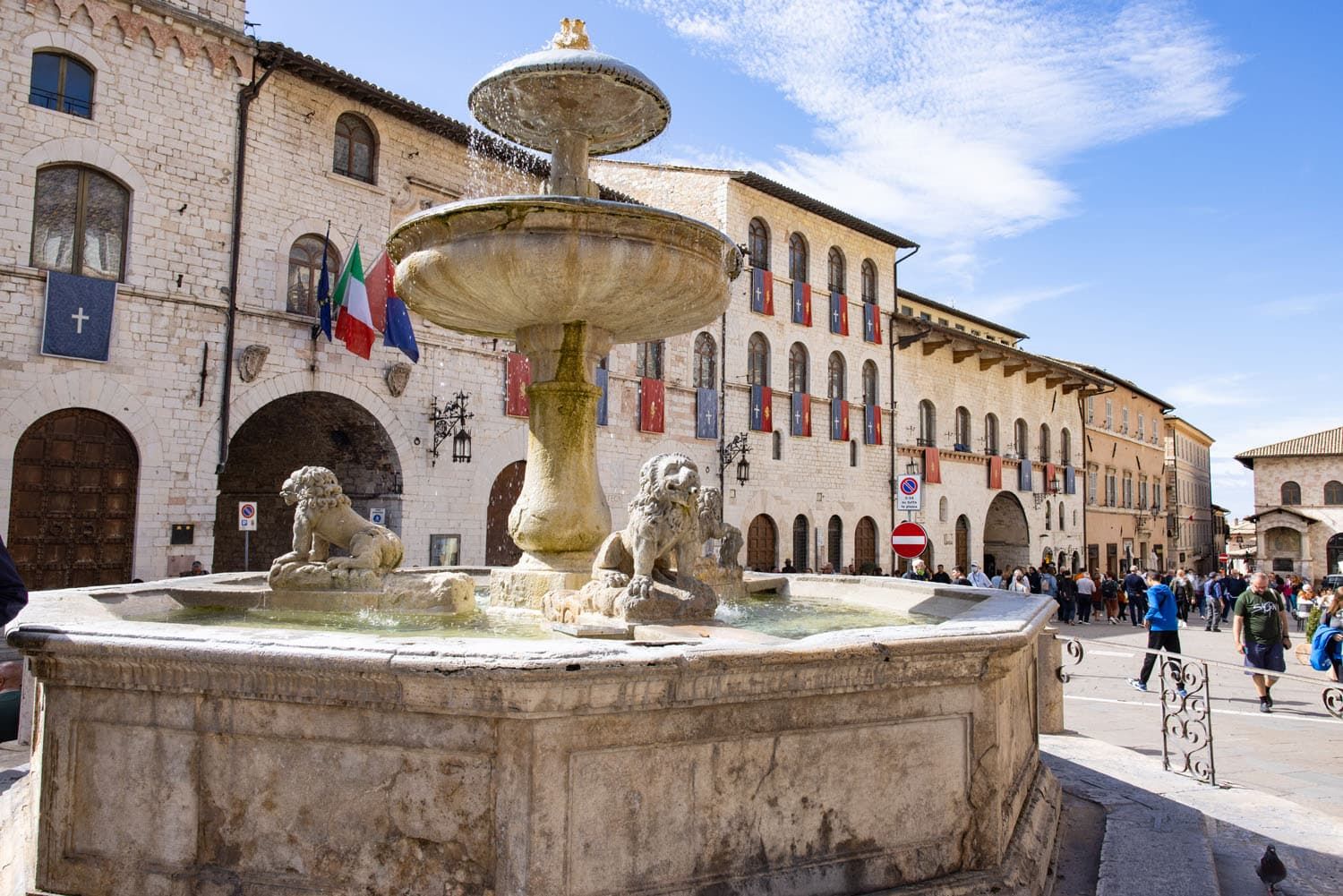
Fountain on Piazza del Comune
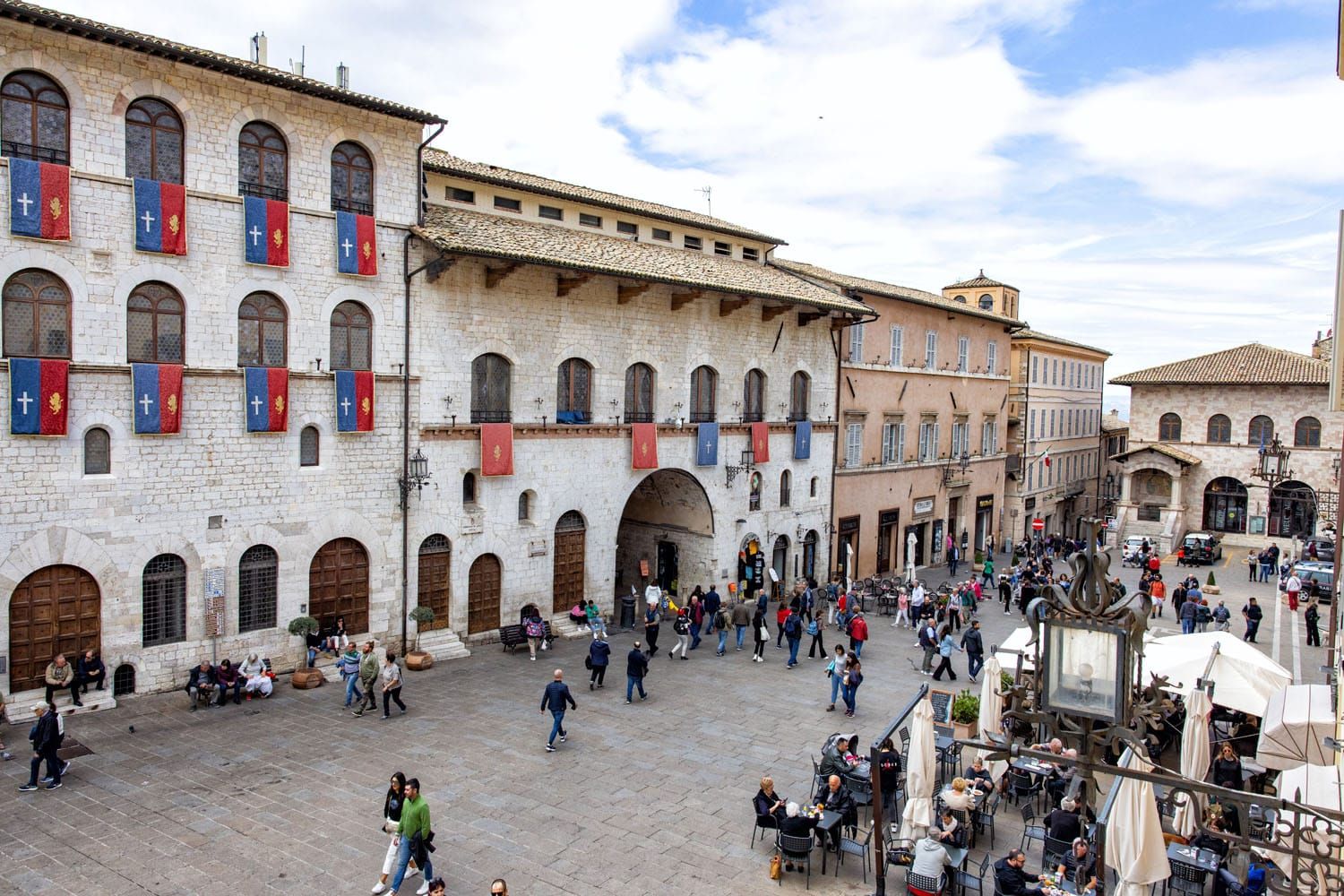
View of the piazza from Taverna dei Consoli
4. Torre del Popolo
Torre del Popolo is the tower that looms over Piazza del Comune.
It is possible to climb this tower if you make a reservation in advance. We had no idea that a reservation was necessary during our visit, and tickets were sold out until the afternoon of the following day. If you like the idea of climbing the tower (I bet the view is awesome!), learn from our mistake and book your ticket in advance. We were told that only 20 people per hour are permitted to climb the tower.
5. Step Inside the Temple of Minerva
Dating back to the 1st century BC, this temple was dedicated to the goddess Minerva and is one of the best-preserved Roman temples in all of Italy.
What makes it especially striking is the contrast you discover inside. Behind those ancient Corinthian columns is the Santa Maria sopra Minerva church, built in 1539, with an ornate Baroque altar that feels worlds away from the Roman exterior. It’s a small but memorable stop right on Piazza del Comune.
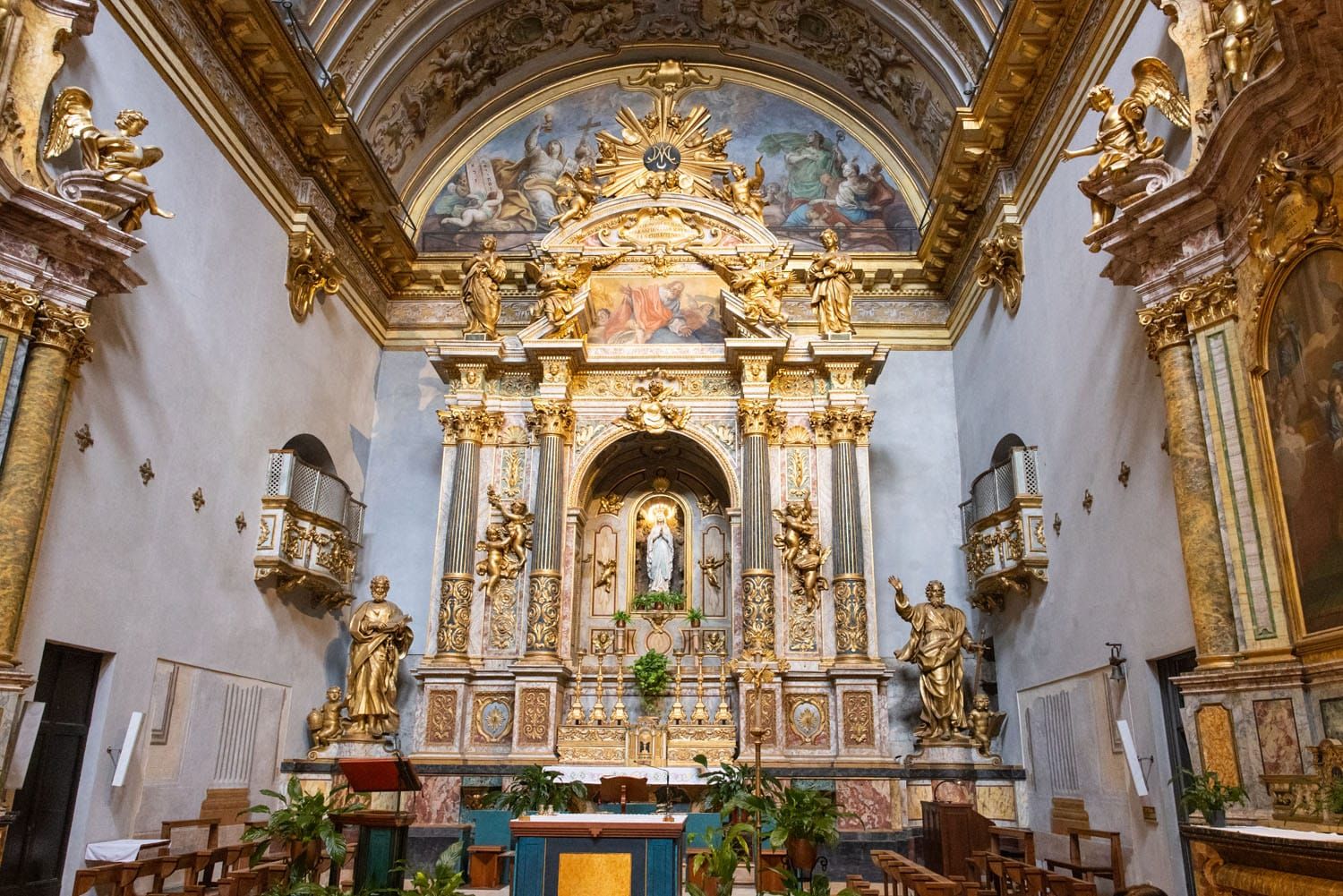
Santa Maria sopra Minerva church
6. Visit Chiesa di Santo Stefano
This very small church dates back to the 12th and 13th centuries and is considered one of the best examples of rustic Umbrian Romanesque architecture in Assisi. Remarkably, it has remained almost entirely unchanged since it was built in 1166.
Legend has it that the bells kept tolling, on their own, after the death of St. Francis. The simple single-nave interior has a wooden ceiling, Gothic arches, and fragments of medieval frescoes still visible on the walls.
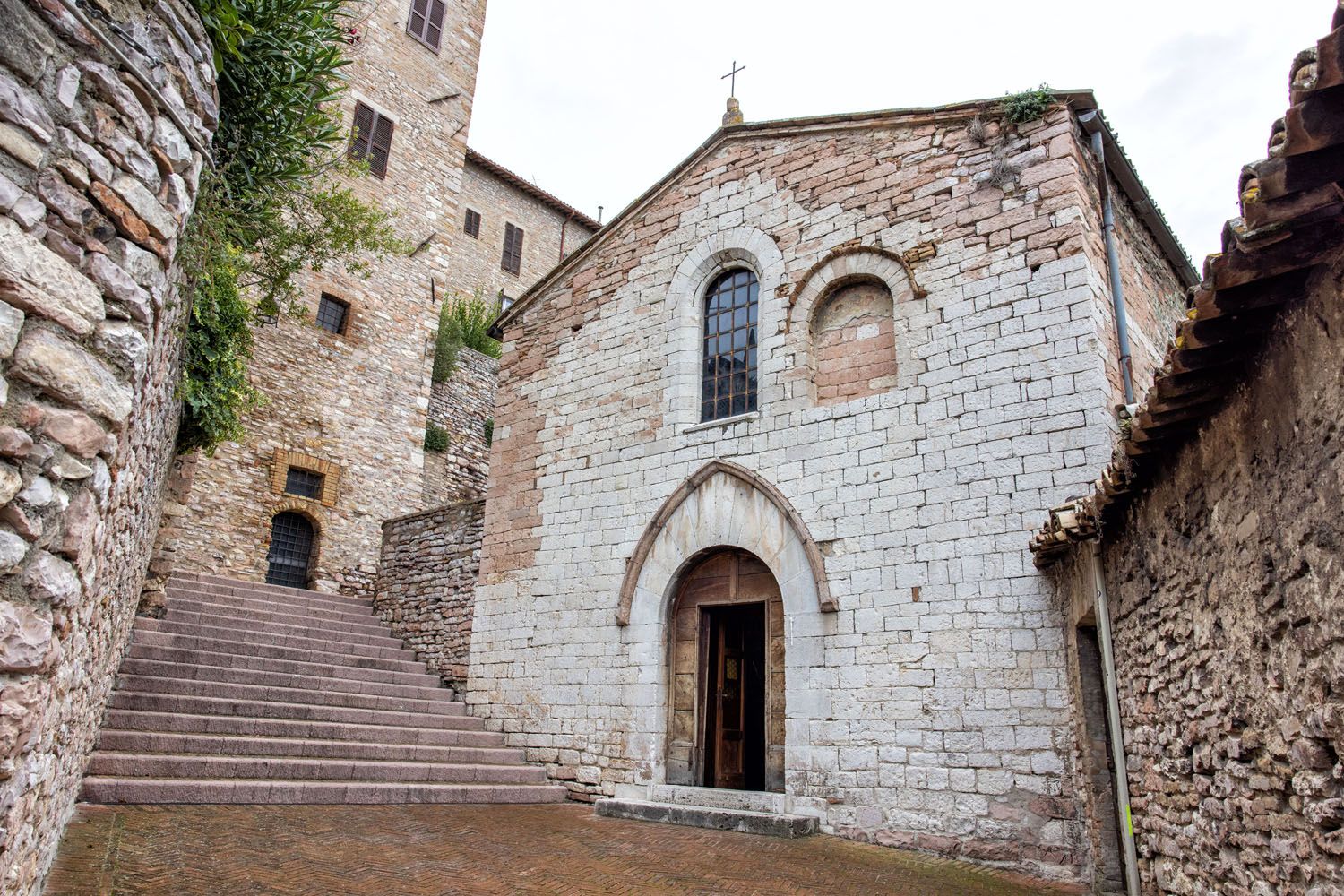
Chiesa di Santo Stefano
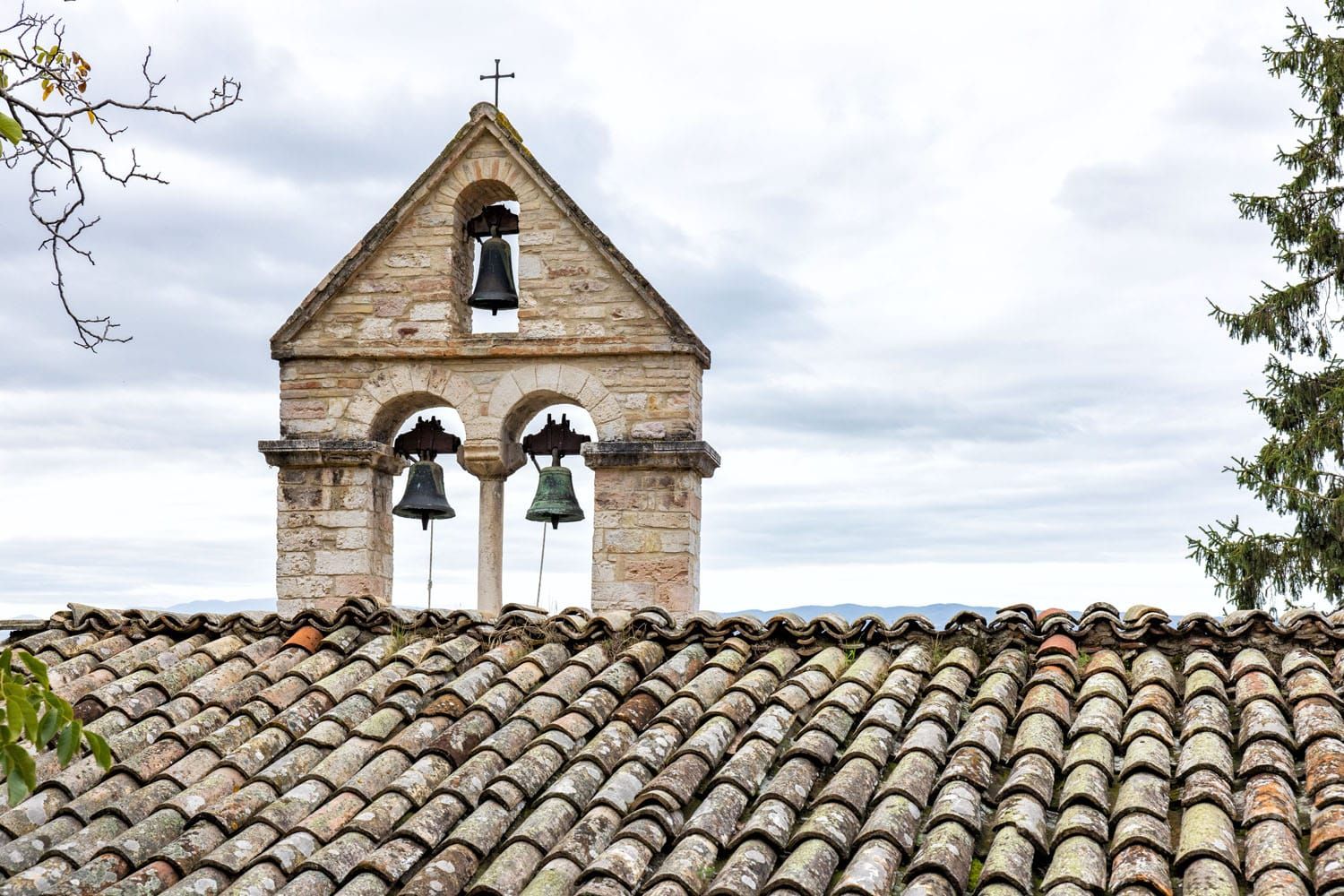
The bells of Chiesa di Santo Stefano
To get here, it is a very pretty walk along Vicolo S. Stefano. In this part of town, we loved exploring the hilly but scenic city streets. It is a much quieter area than Via San Francesco and Piazza del Comune, so if you are looking to escape the crowds, go for a scenic stroll through this part of Assisi.
7. Cathedral of San Rufino
The cathedral as we see it today was built in the 12th century in Umbrian Romanesque style and is considered one of the finest examples of Romanesque architecture in all of Umbria.
Its façade, with three rose windows, decorative friezes, and lions and griffins guarding the doorways, is worth pausing to admire before you step inside.
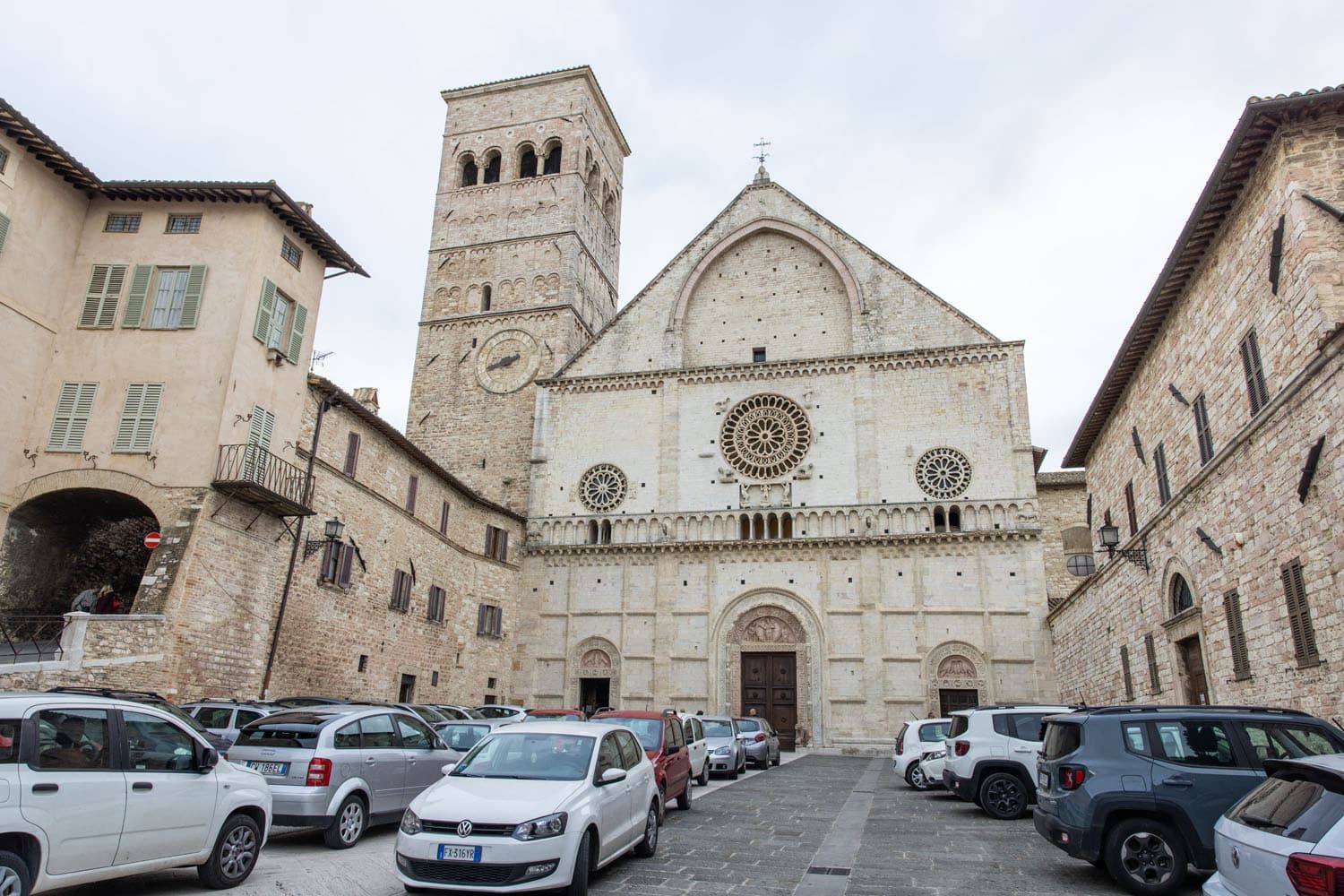
Cathedral of San Rufino
This cathedral is particularly important in that this is where both St. Francis and St. Clare were baptized, and where Clare is said to have heard Francis preach and realized her own calling. The original baptismal font where both saints were baptized is still on display just inside the entrance to the right nave.
Below the church, the crypt dates back to the year 1000 and contains a 3rd-century Roman sarcophagus believed to have once held the remains of St. Rufino, Assisi’s patron saint.
8. Basilica di Santa Chiara
The Basilica di Santa Chiara, also called the Basilica of St. Clare, was built in the 13th century in a Gothic style, just a few years after the death of St. Clare.
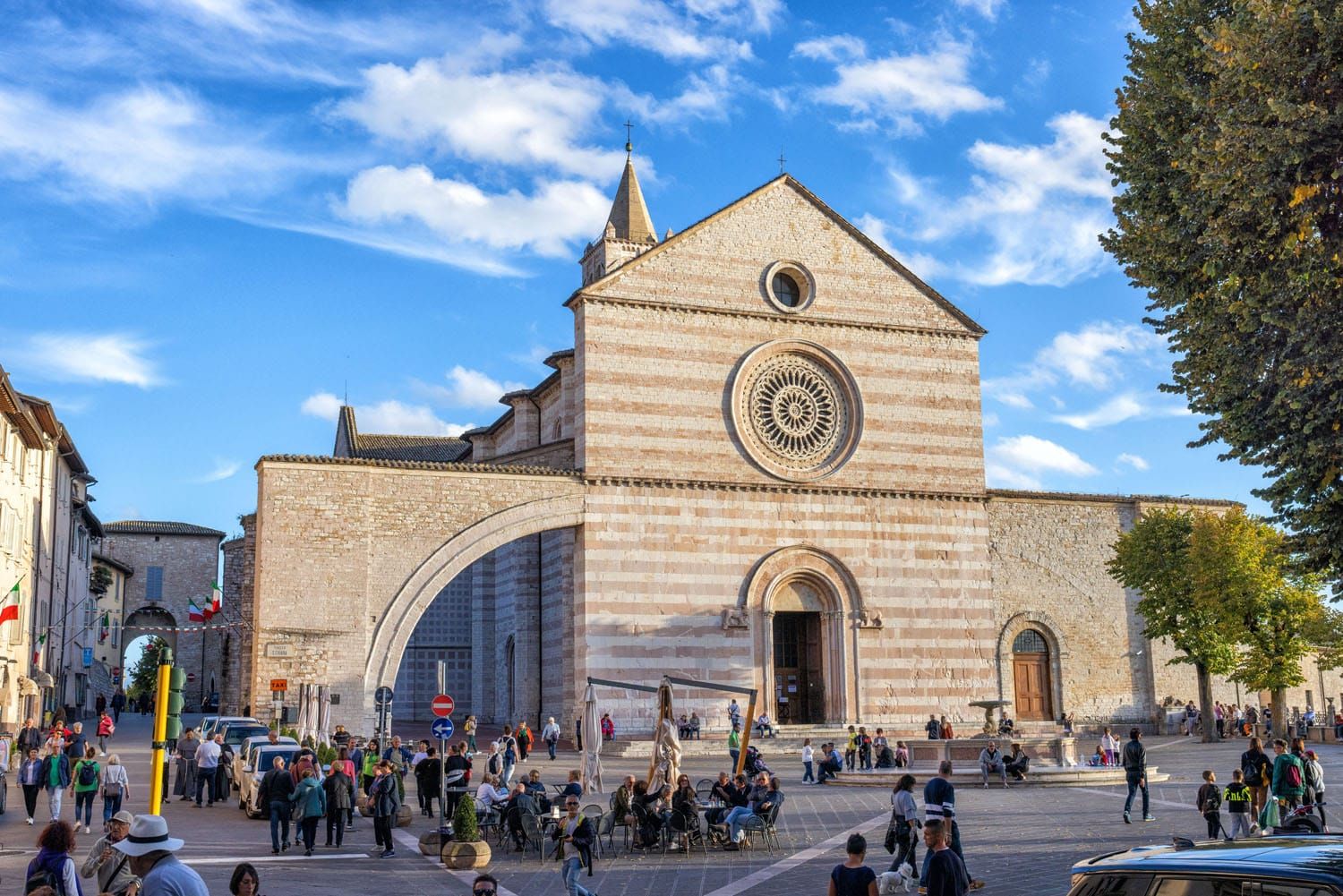
Basilica di Santa Chiara
St. Clare was one of the first followers of St. Francis. She founded the Order of Poor Ladies, which was a religious order for women in the Franciscan tradition.
The remains of St. Clare are preserved in the crypt within the basilica.
Inside the Chapel of San Giorgio is the Crucifix that is said to have spoken to St. Francis.
This is a beautiful cathedral, with its three flying buttresses that run along one side of the church. The basilica sits on Piazza Santa Chiara. From the south side of the piazza, you get a beautiful view of the countryside and a small part of Assisi.
The basilica is free to visit. Photography is not allowed inside of the basilica.
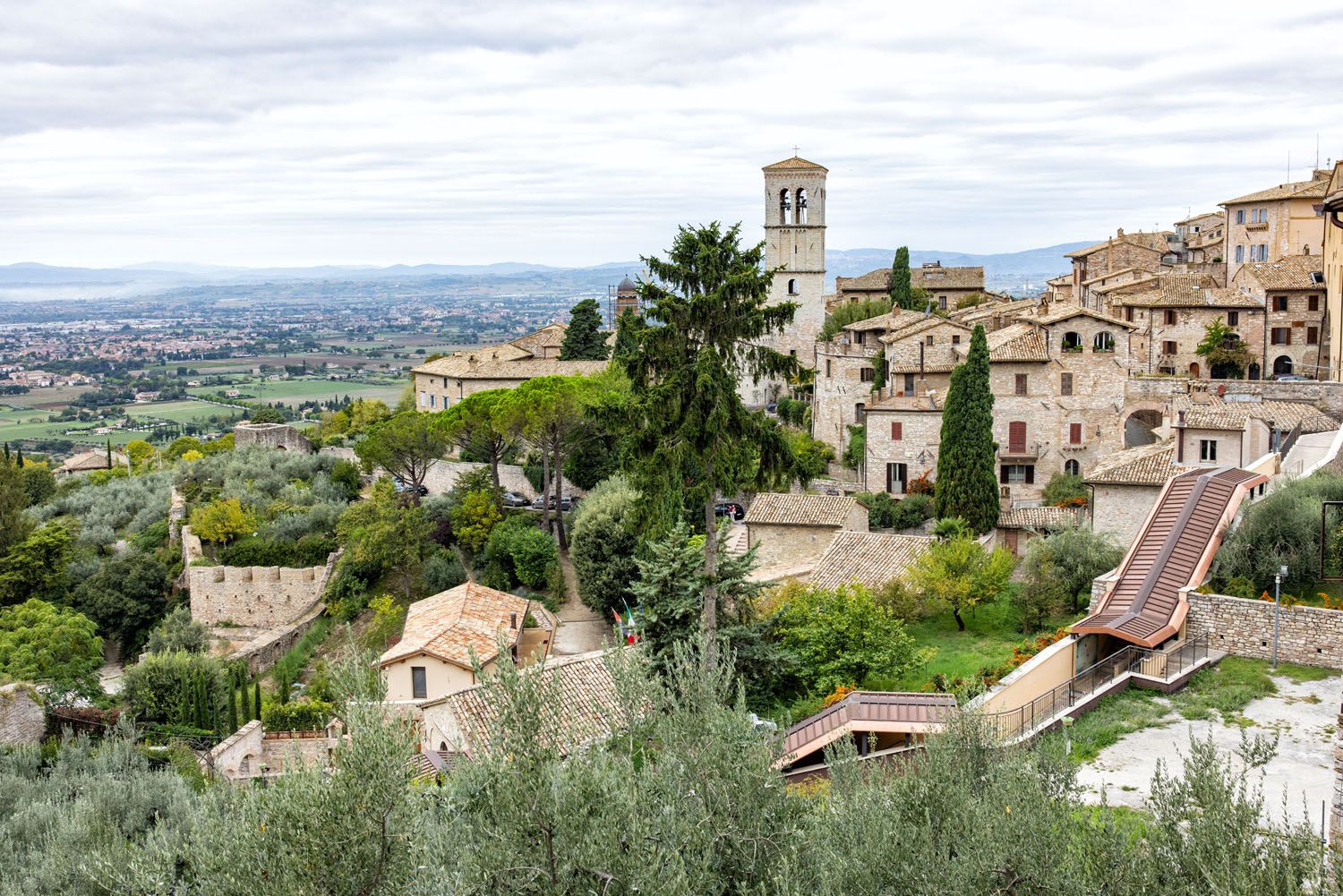
The view from Piazza Santa Chiara
9. Oratory of San Francesco Piccolino
The oratory is the location of the birthplace of St. Francis. It was once the location of a stable, where St. Francis’ mother gave birth to him. Later, it was turned into an oratory.
This place can be hard to find, but as you walk up Via Santa Chiara, from the Basilica di Santa Chiara towards Piazza del Comune, look for an entranceway on the left. It’s next to Bar Sensi. Here’s what to look for.
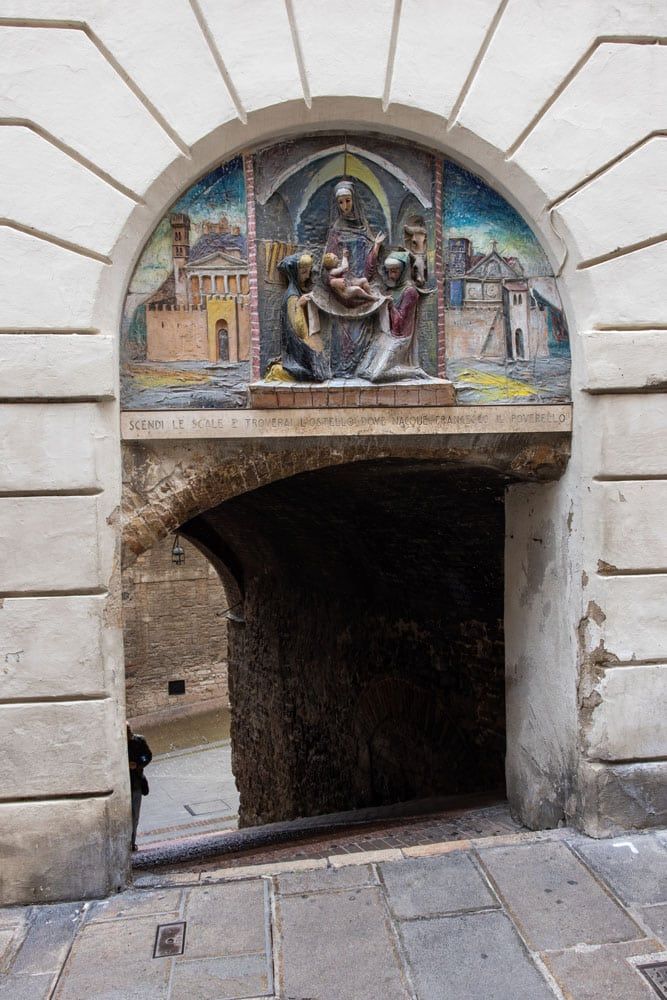
Descend the small stone staircase and the sanctuary will be on your left.
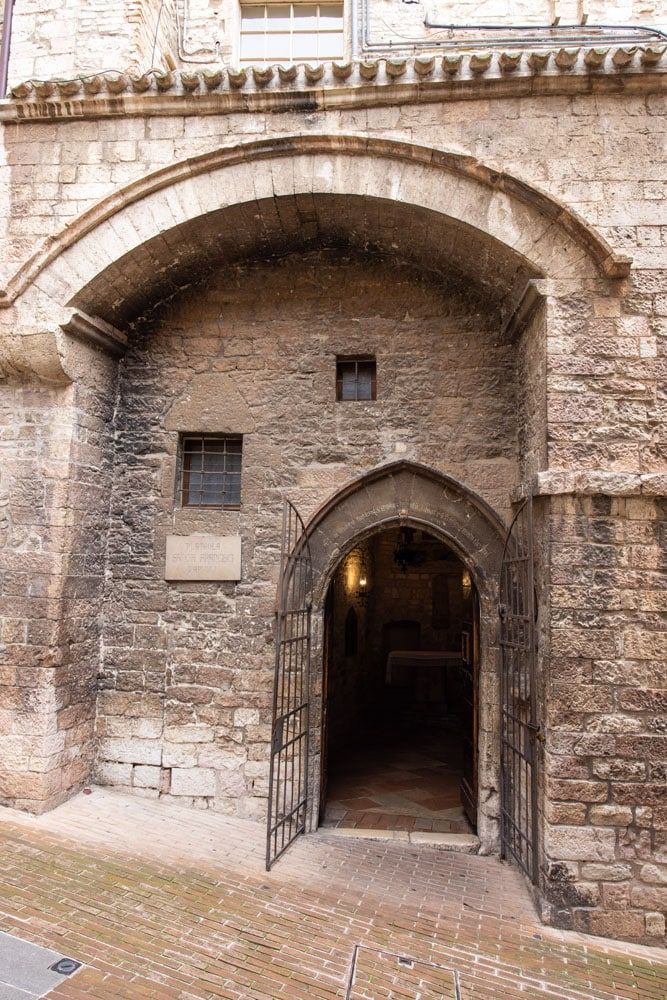
Entrance into the Oratory of San Francesco Piccolino
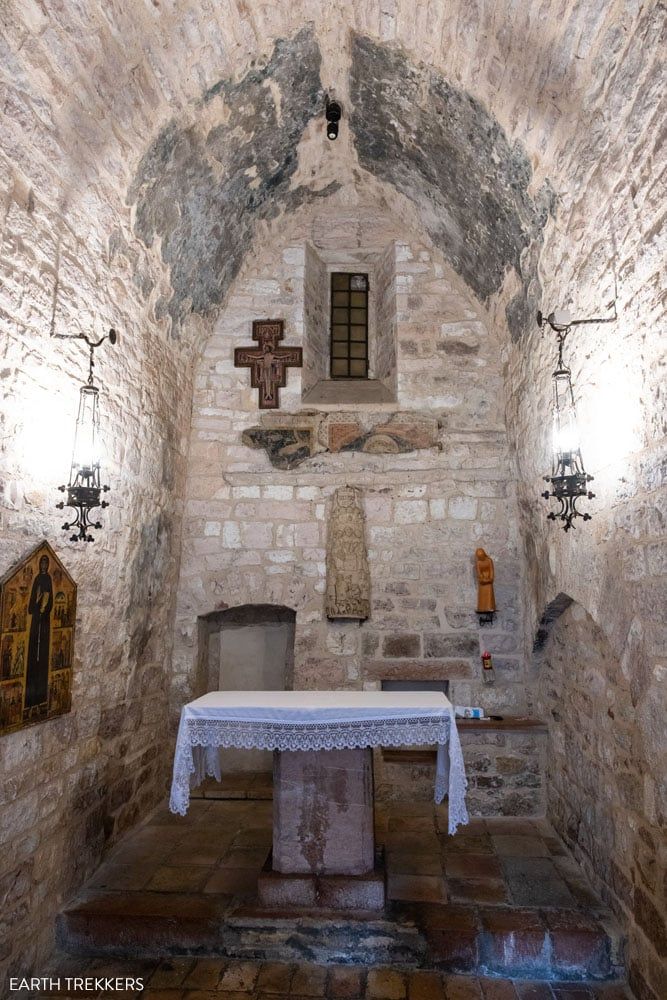
Oratory of San Francesco Piccolino
10. Chiesa Nuova
This church was built in 1615, by order of King Philip III of Spain, over the site where St. Francis’ home once stood. Even today, you can still see the doorway into the house and the small cell where St. Francis was imprisoned by his father after giving away the family’s wealth.
Outside the church, a pair of bronze statues portrays Francis’s parents: his mother Monna Pica and his merchant father Pietro di Bernardone. The Baroque interior is covered in 17th-century frescoes depicting scenes from the life of St. Francis, a striking contrast to the austere Romanesque churches found elsewhere in Assisi.
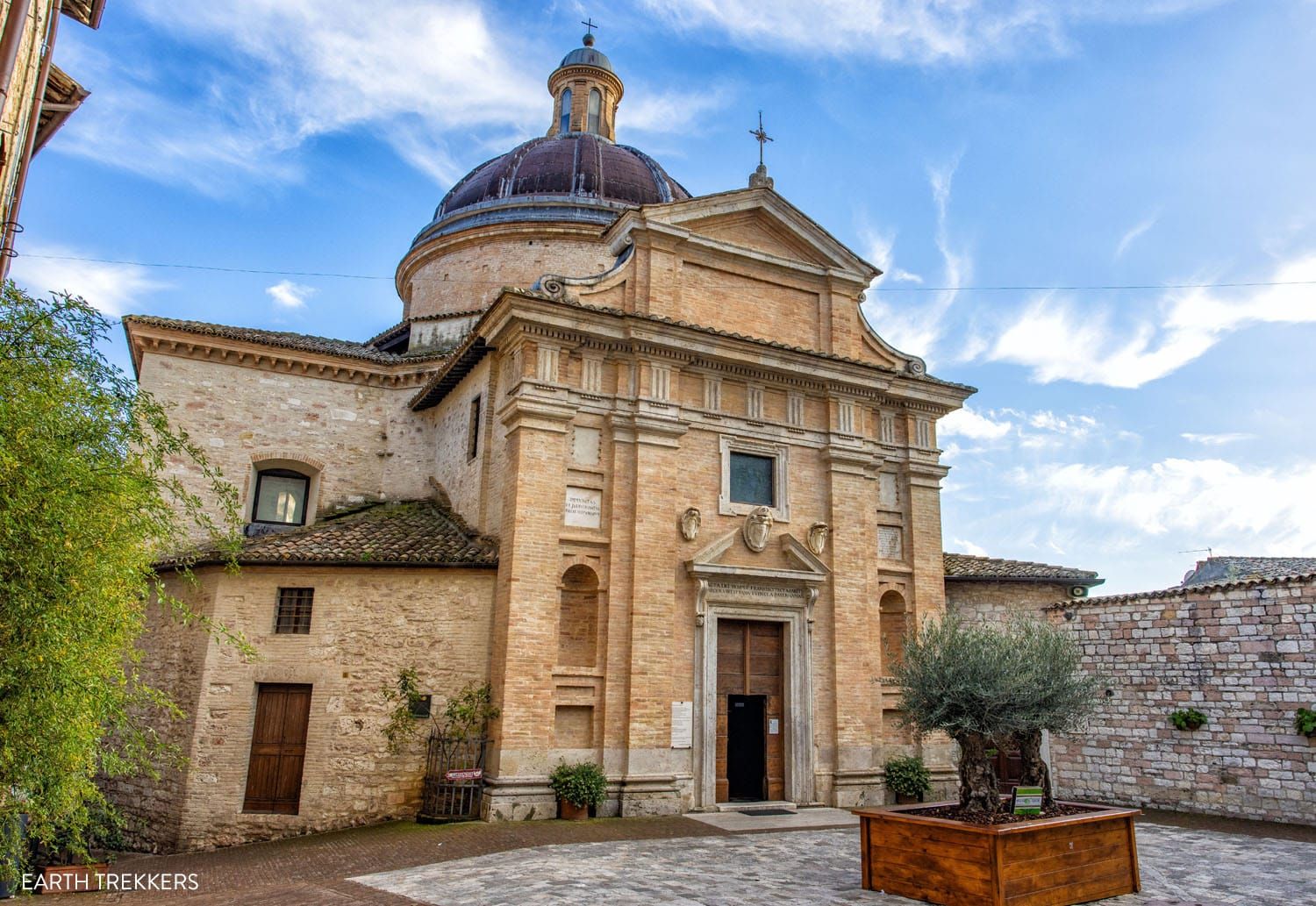
Chiesa Nuova
11. Enjoy the View from Rocca Maggiore
Sitting above Assisi is Rocca Maggiore, the medieval fortress that has guarded the city since the 12th century. During our visit, the fortress was closed for a major renovation project but has since reopened.
The steep walk up from the city center is well worth it. From the ramparts, you get sweeping 360-degree views over Assisi’s rooftops, the Basilica di San Francesco, and the entire Umbrian Valley stretching from Perugia to Spoleto.
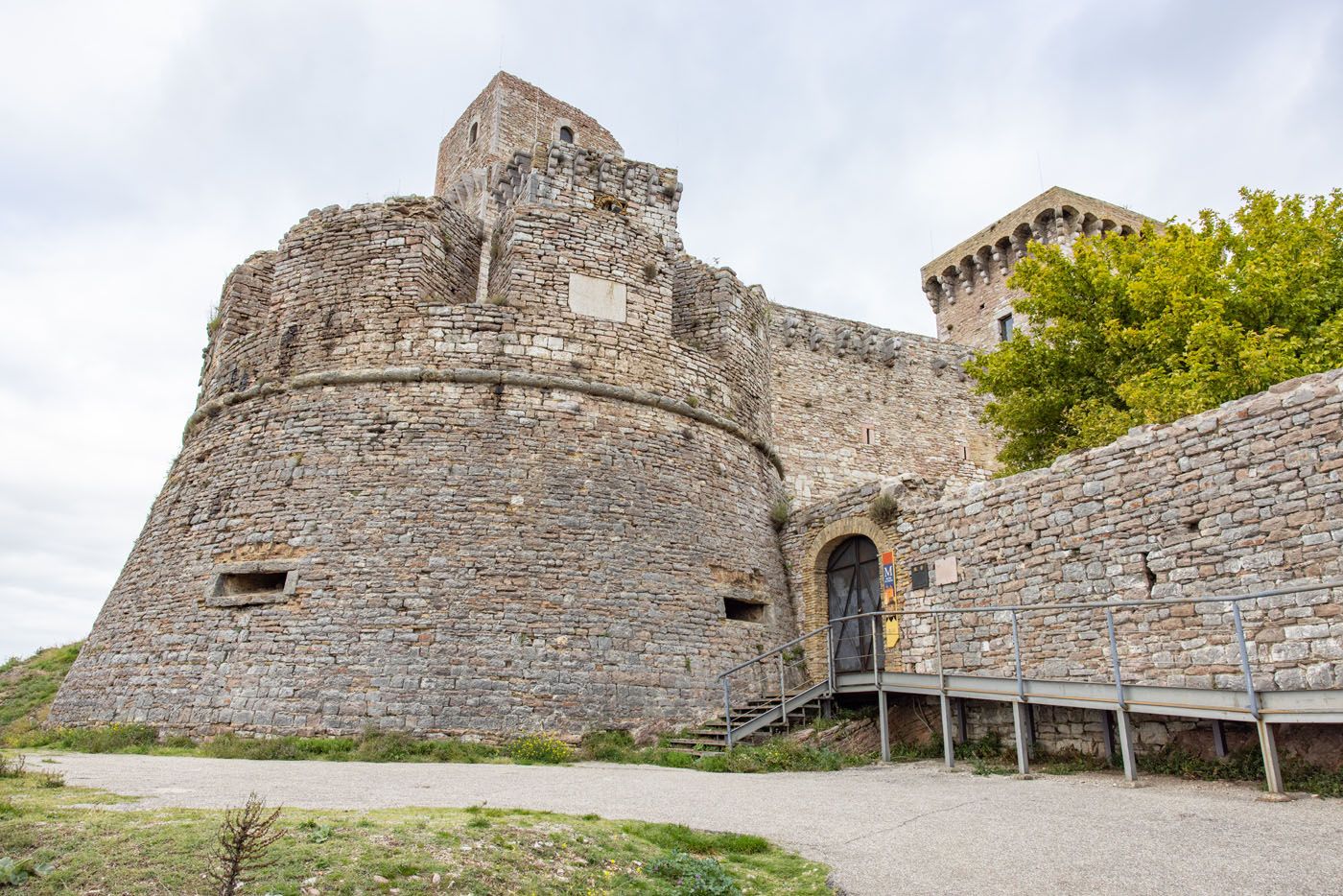
Rocca Maggiore
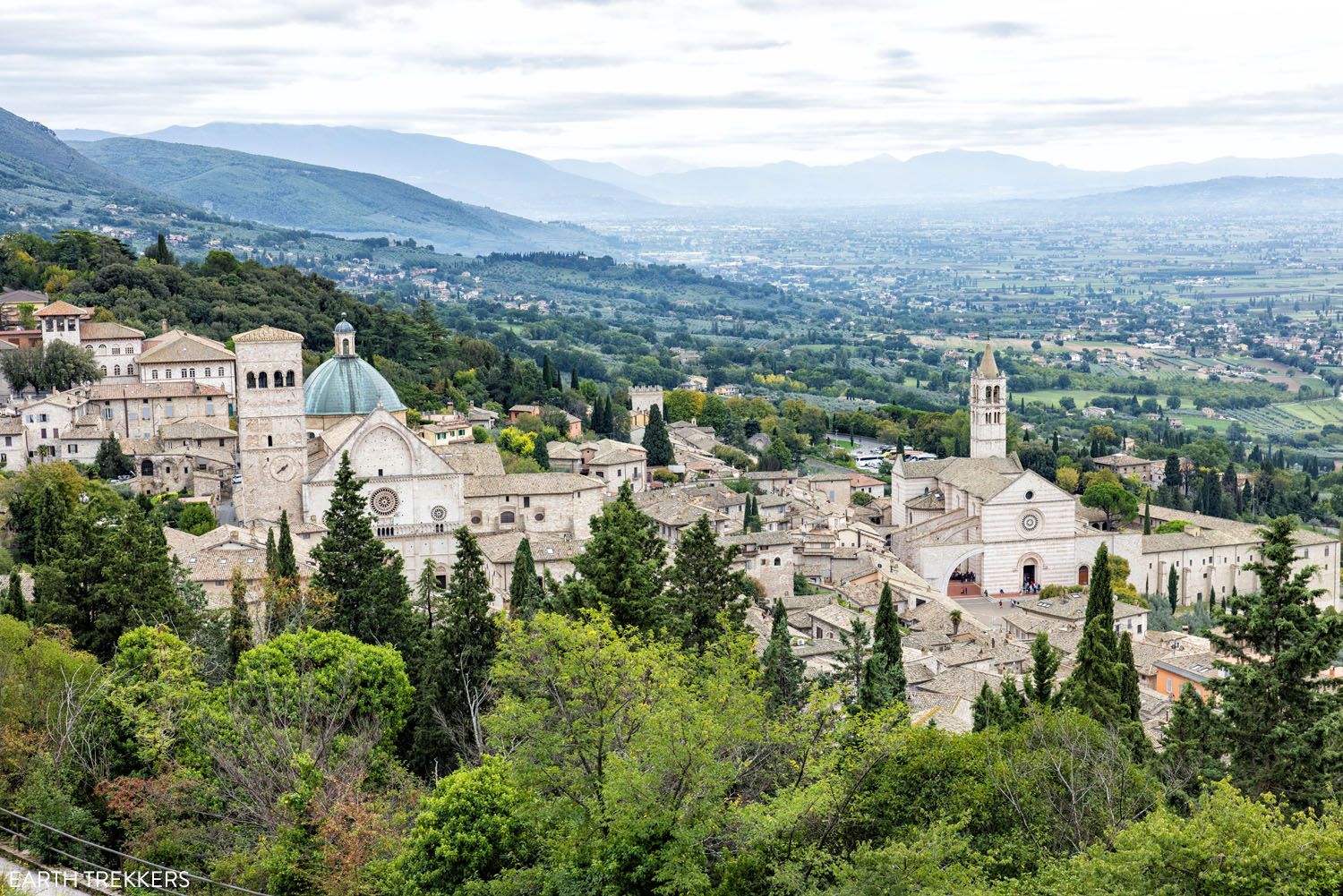
The view from the terrace next to Rocca Maggiore
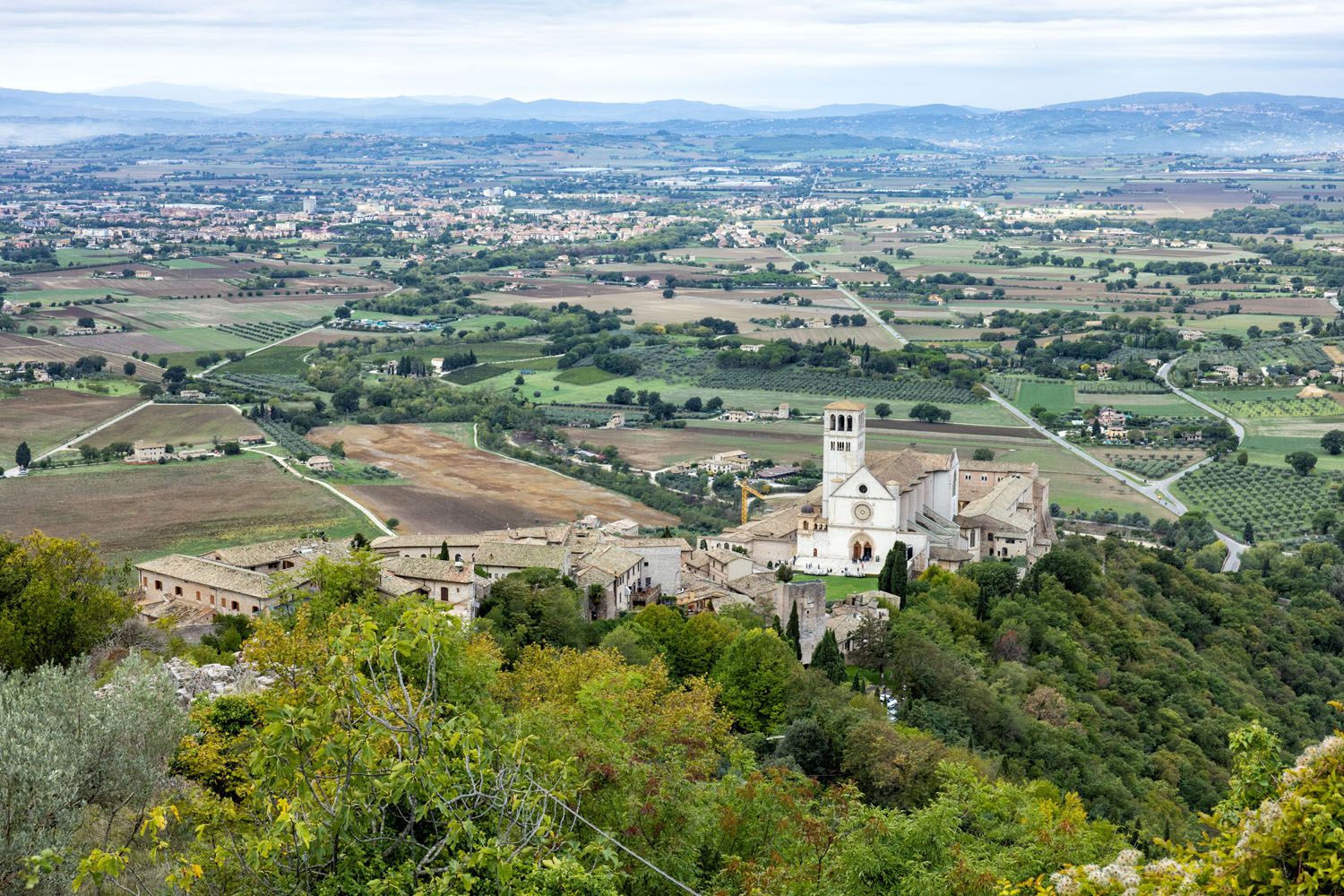
View of Basilica di San Francesco from the terrace near Rocca Maggiore
Inside, you can explore the 14th-century fortress itself: narrow passageways, spiral staircases, rooms decorated with medieval coats of arms, and arrow slits that once defended the city against invaders. Entrance costs around €8 and a combined ticket also includes the Roman Forum and Torre del Popolo.
For more information, visit the official website.
PRO TRAVEL TIP: As you walk downhill into Assisi, keep an eye out for Bar Giardino San Lorenzo. This lovely café has a garden-like setting and beautiful views of Assisi.
12. Explore the Side Streets of Assisi
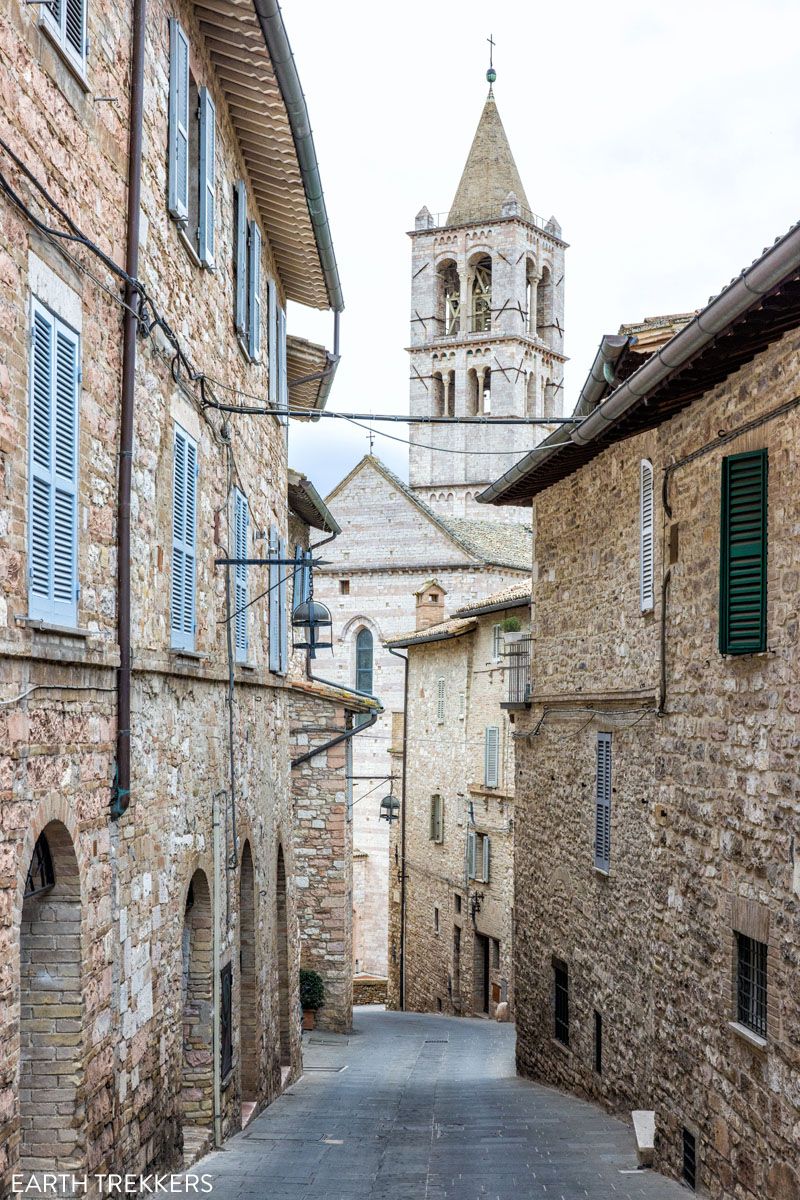
As you can see, there is a long list of historical and religious sites to visit in Assisi. But one of the best things to do in Assisi is to simply put away the checklist and wander. The narrow, cobblestoned side streets lead to picturesque alleyways, unexpected viewpoints, and quiet corners far from the main tourist flow.
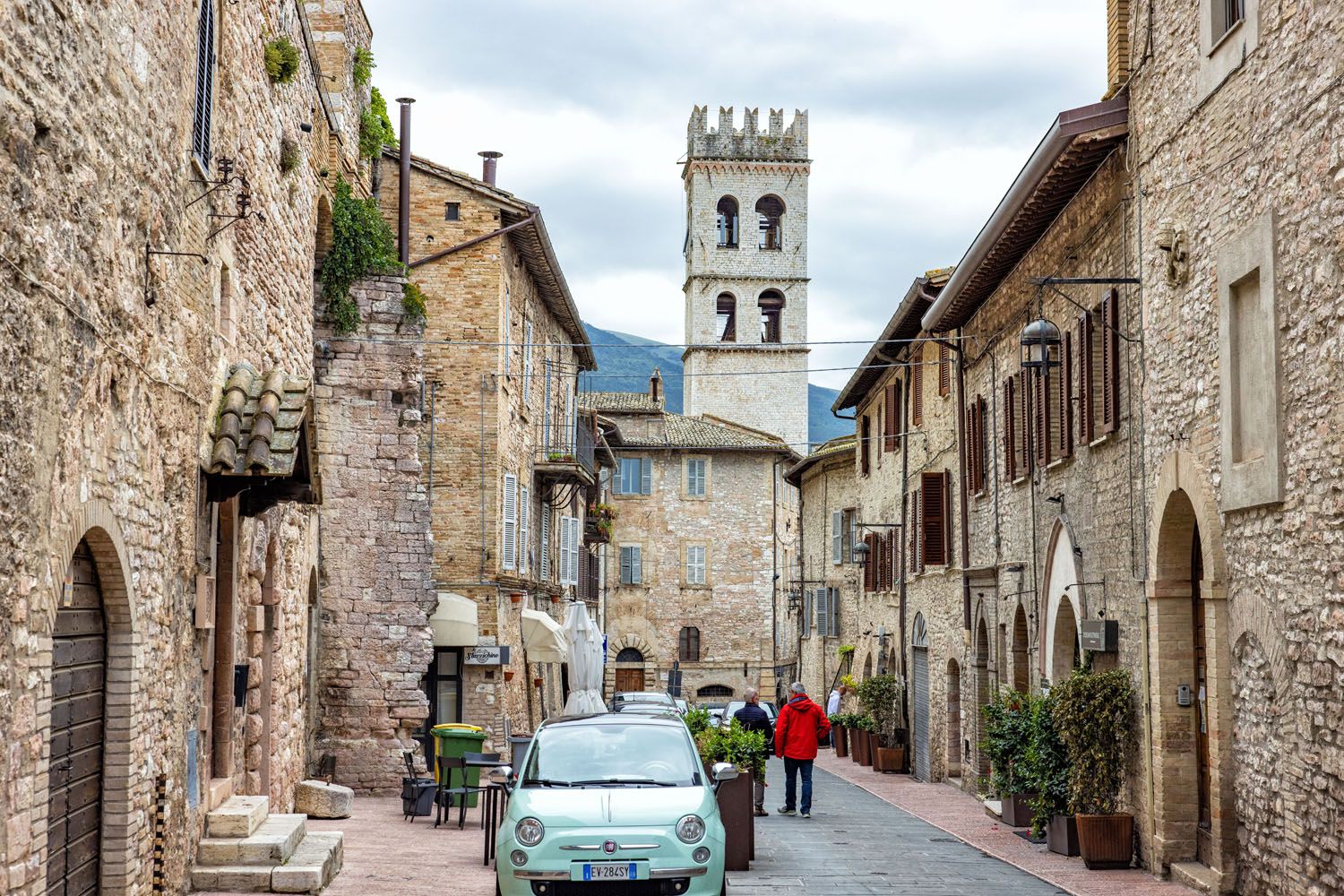
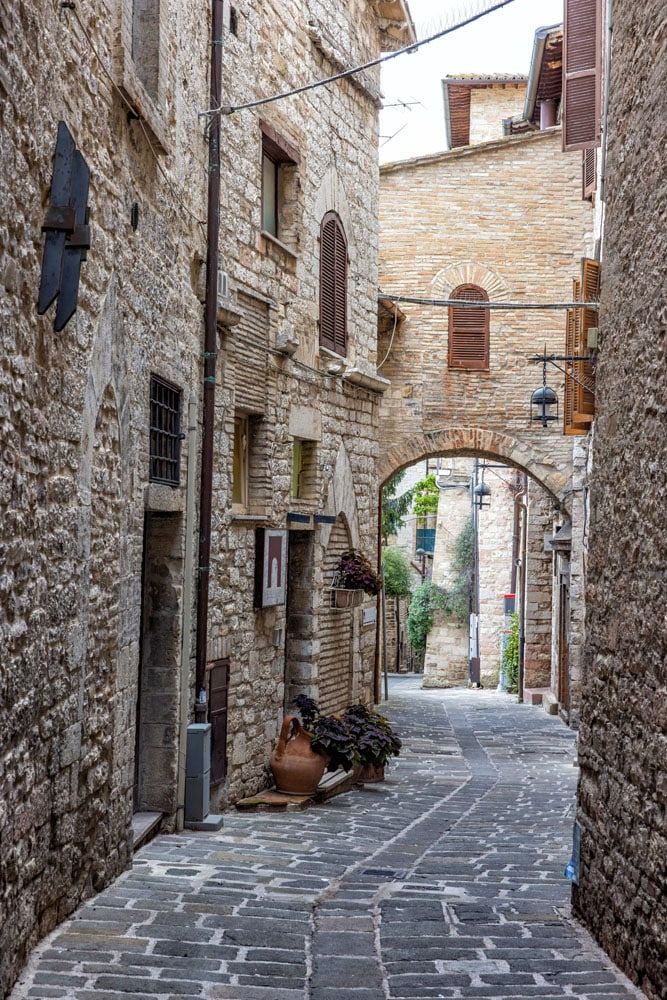
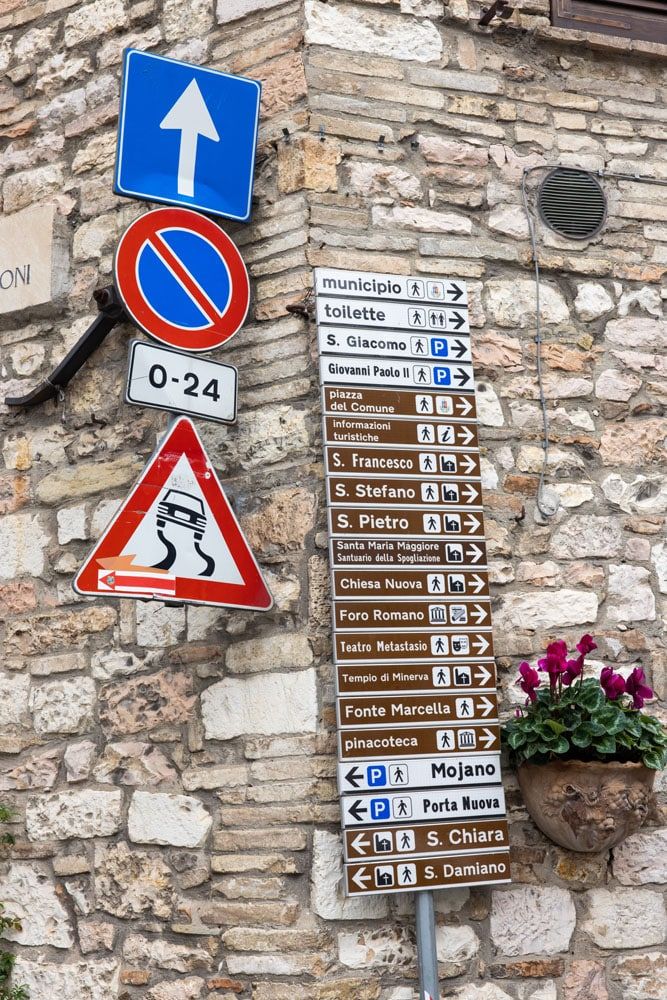
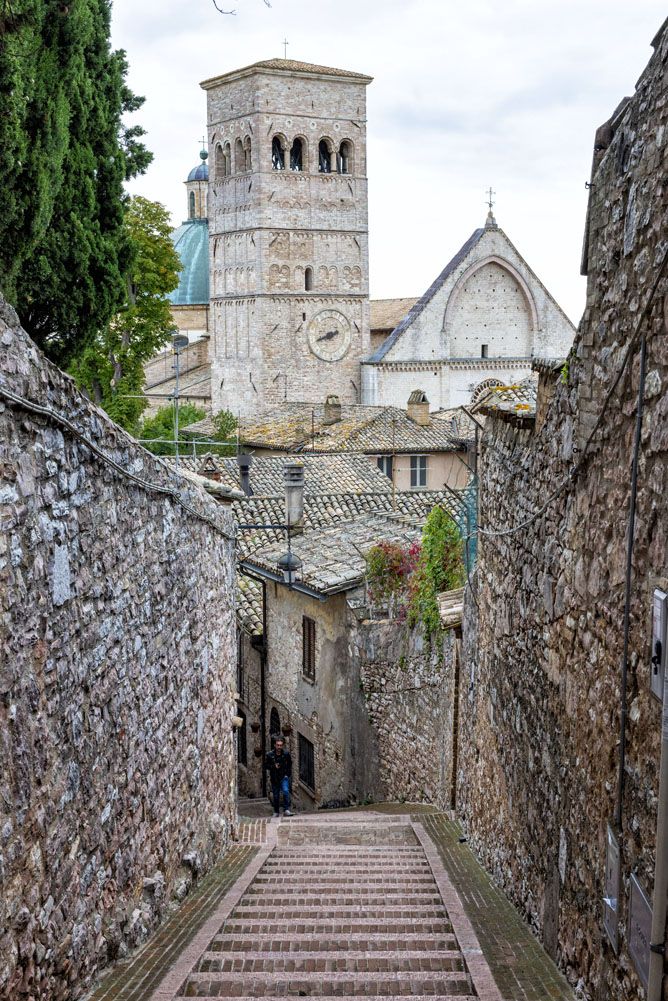
Some of our favorites: Via Aluigi and Vicolo Santo Stefano are lovely to walk in sequence. Vicolo Santo Stefano in particular is lined with flowers and potted plants spilling out from the pale stone buildings on either side. Vicolo San Lorenzo offers nice views up toward the Cathedral of San Rufino. And honestly, some of the best streets are the ones you stumble onto without a plan.
Assisi is a beautiful city at any hour, but the side streets are especially magical at twilight. As the sun drops behind the valley and the street lamps flicker on, the light reflects off the pale limestone buildings and the whole city seems to sparkle.
Things to Do in Assisi, Outside of the City Center
1. The Carceri Hermitage
The Carceri Hermitage, also called Santuario Eremo delle Carceri, is a retreat high in the mountains above Assisi. This is where St. Francis would go to meditate.
Tucked away in the forest, this small collection of stone buildings houses a few small chapels, a cloister, and the grotto of St. Francis. It is a beautiful setting, away from the hustle and bustle of city life, tucked away in the natural environment, which St. Francis loved.
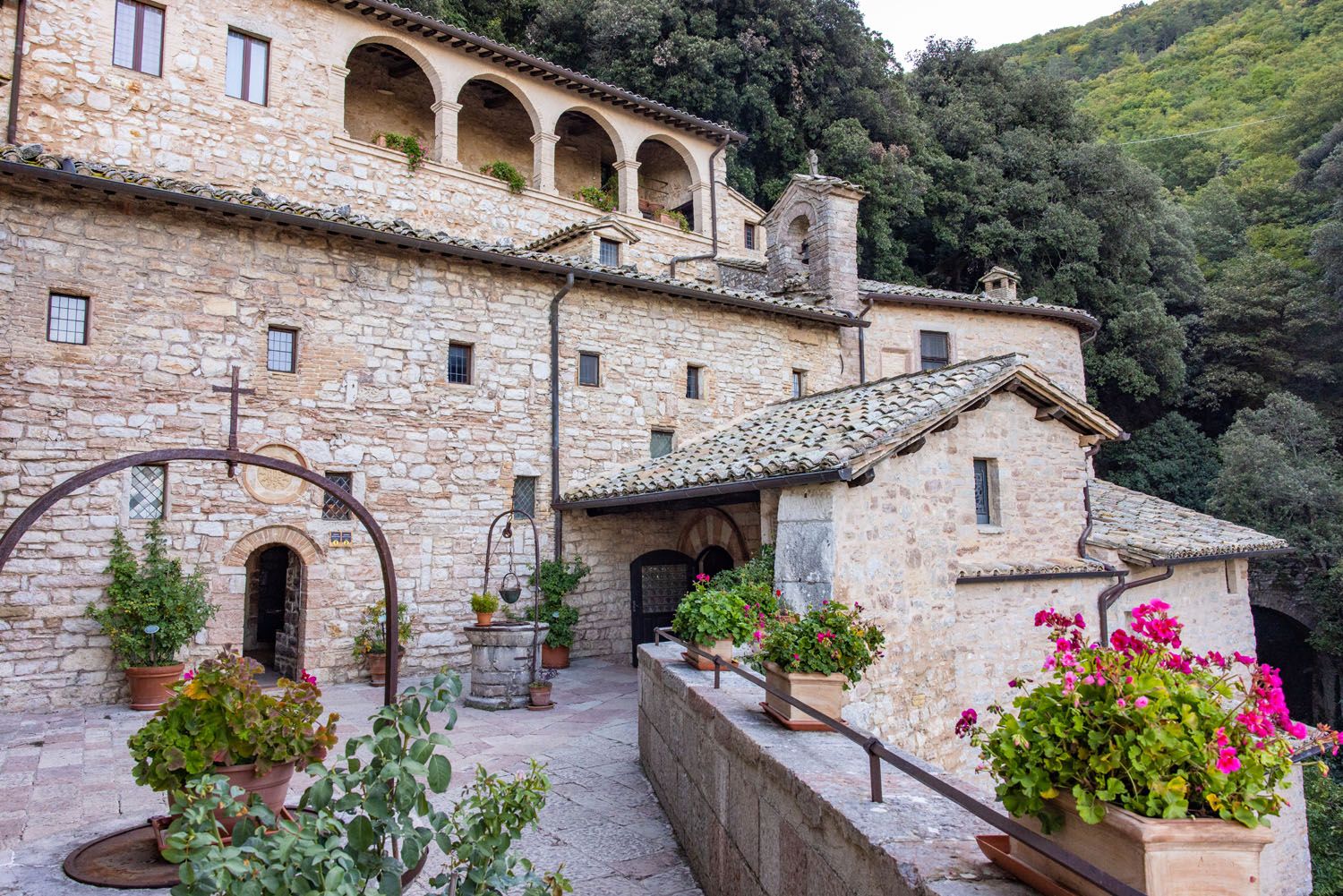
Carceri Hermitage
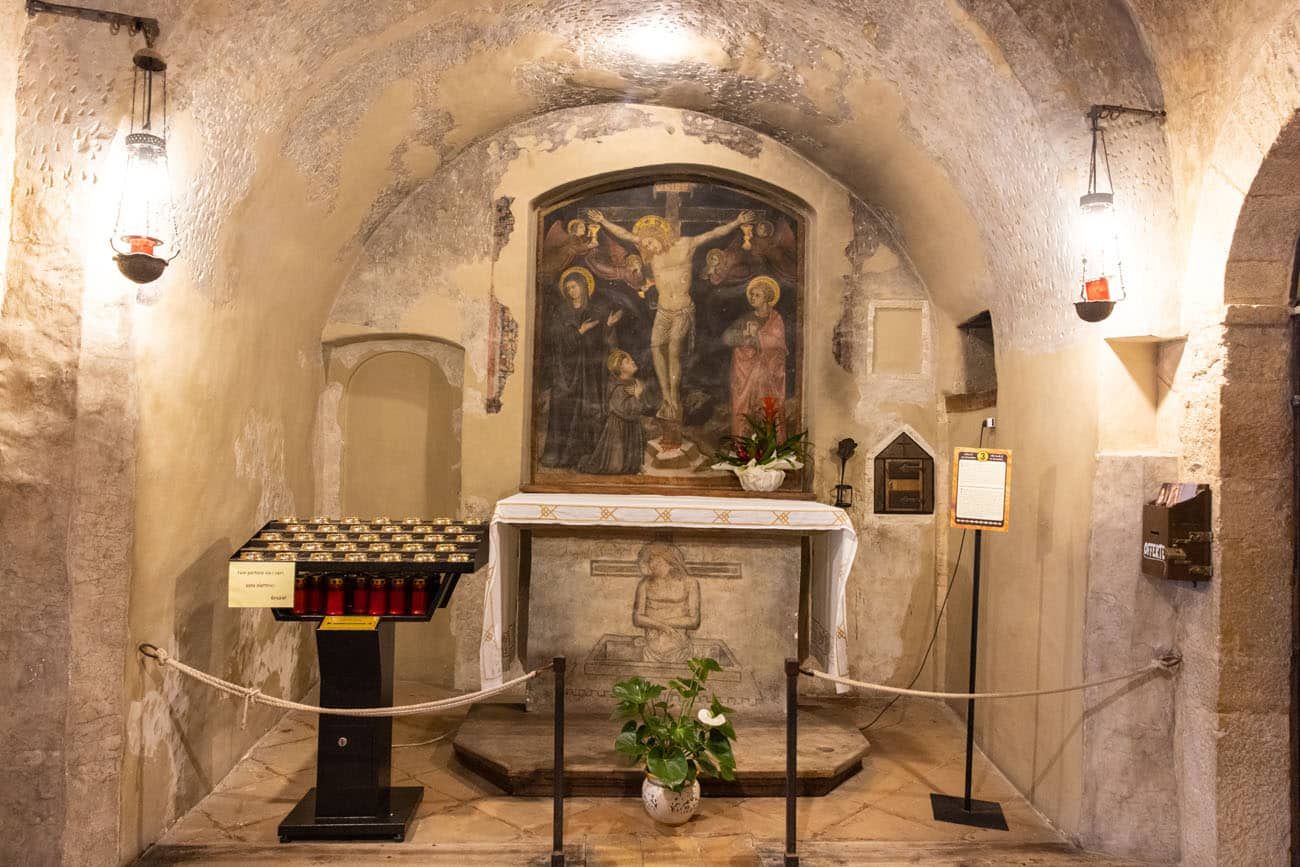
Inside the Church of San Bernardino
A visit here lasts about 30 to 45 minutes. It’s free to visit and you will follow signs that lead you to the notable places within the sanctuary.
To get here, it is a 15-minute drive from Assisi on a narrow winding road. It’s quite a distance from town, and if you plan to do this on foot, it could take several hours and will be quite strenuous.
We loved this experience. We were here at 9 am and it was still very quiet, with just a handful of visitors. Since there were so few people, we were able to experience the tranquility of which this site was intended. If your timing works out, try to visit early or late in the day, when there are fewer people.
2. Basilica of Santa Maria degli Angeli
This basilica was built between the 16th and 17th centuries.
It houses the Portiuncula (also called the Porziuncola), which is the chapel where St. Francis founded his Order of Friars Minor and gave Clare the habit of the poor.
The Chapel of the Transitus is an infirmary. It is here that St. Francis died on October 3, 1226.
Also within the basilica you can see the Courtyard of the Roses, the Rose Garden, and the Chapel of the Roses.
Inside of the Porziuncola Museum is a Crucifix by Giunta Pisano and a portrait of St. Francis. Upstairs is the Ancient Friary, a collection of small, austere rooms that were the living quarters for the first friars living near the Portiuncula.
The basilica is free to visit but there is a small fee to enter the museum. Photos are not allowed within the basilica or the museum.
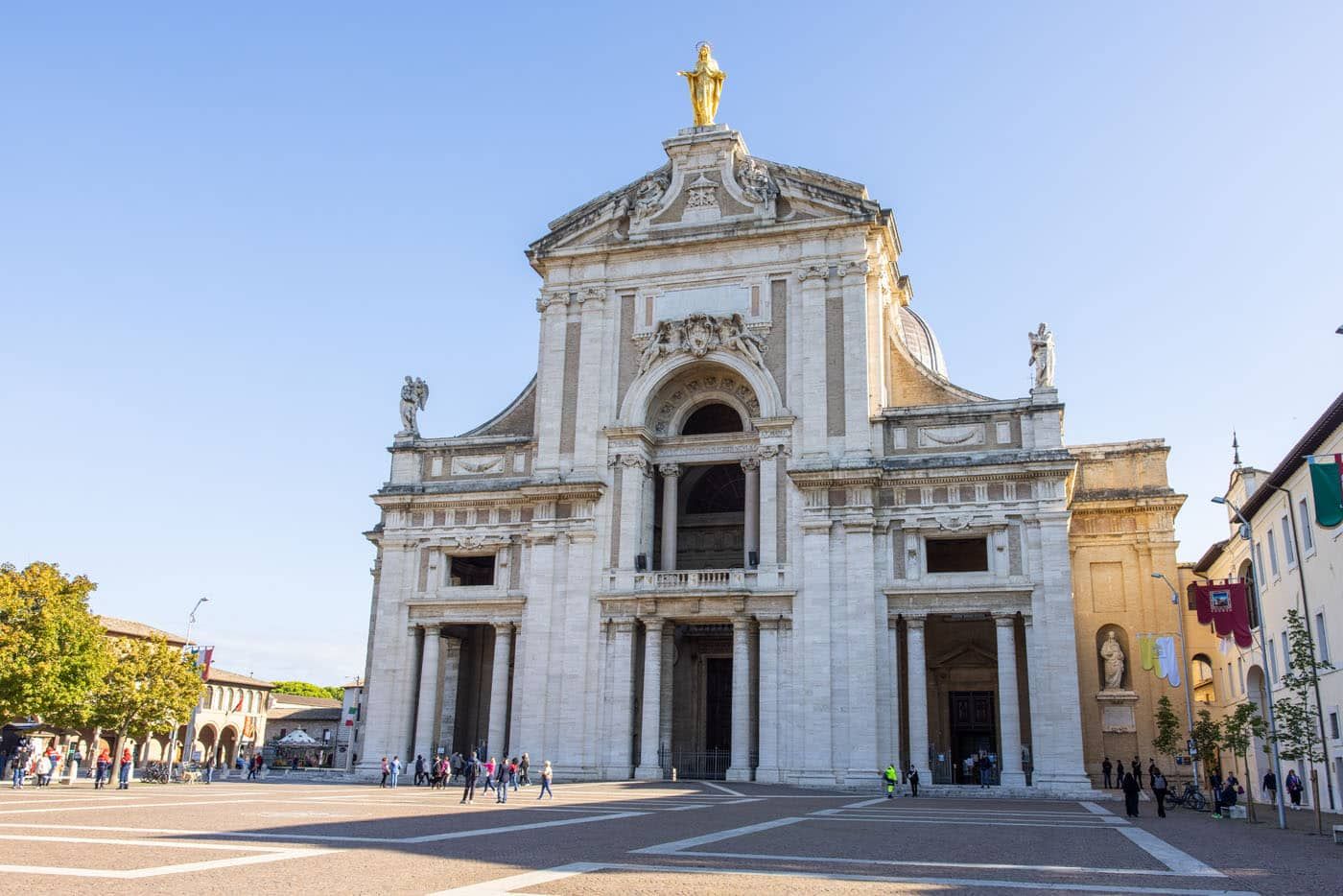
Basilica of Santa Maria degli Angeli
3. The Church of St. Damian
The Church of St. Damian (also called the Convento di San Damiano) is a very old church that dates back to the 8th century. During the time of St. Francis, it was in disrepair. While praying at this church, God spoke from the crucifix, telling St. Francis to repair his house. St. Francis took that to mean the Church of St. Damian, so he set about renovating the church with his own hands.
St. Clare would go on to form the Order of Poor Clares here and St. Francis would write Canticle of the Creatures just before his death.
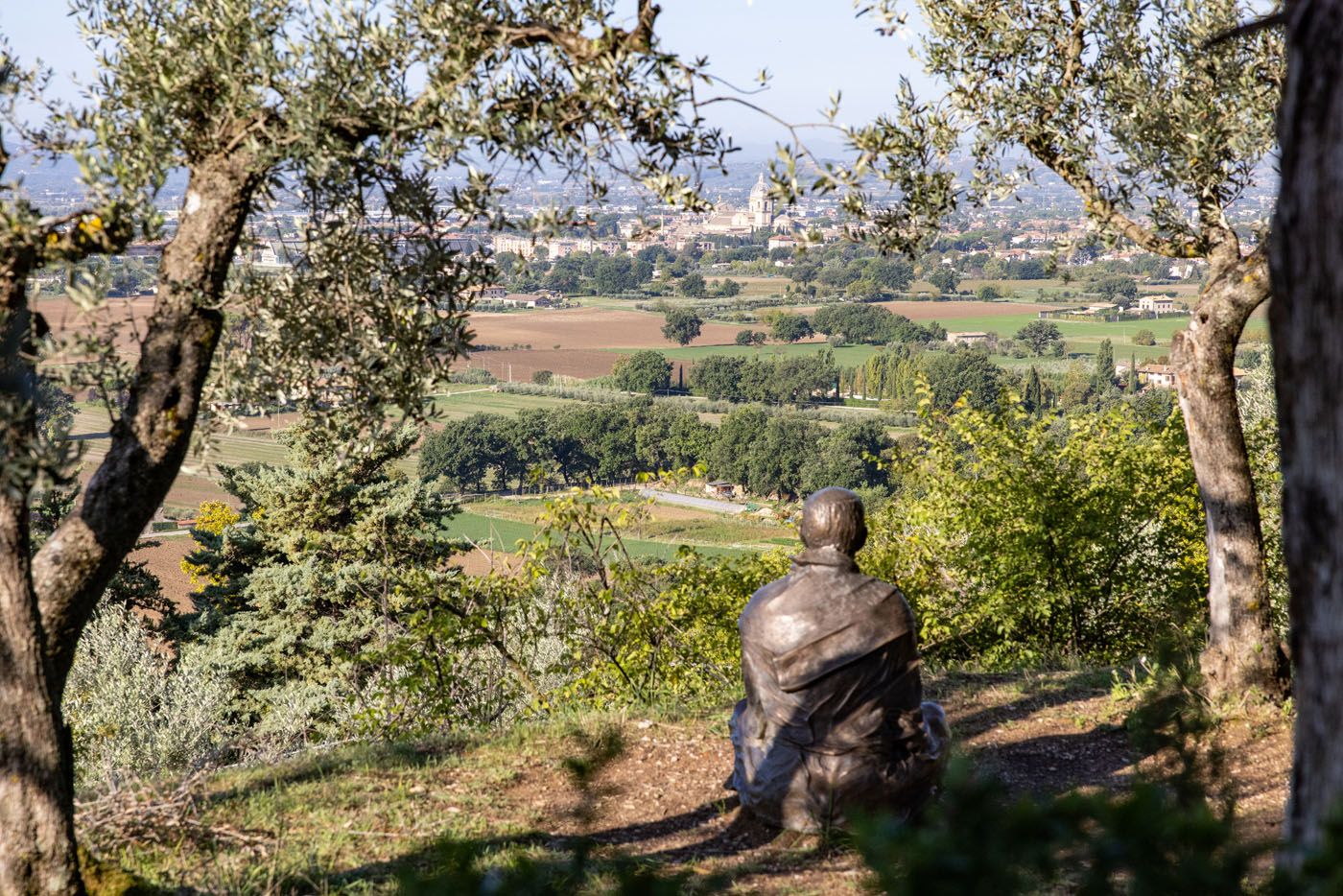
View from the Church of St. Damian
4. Visit the Sanctuary di Rivotorto
The Sanctuary di Rivotorto is where St. Francis and his first followers lived and prayed. This small stone sanctuary sits inside of the Neo-Gothic church in the photo below. It is free to visit and photography is allowed.
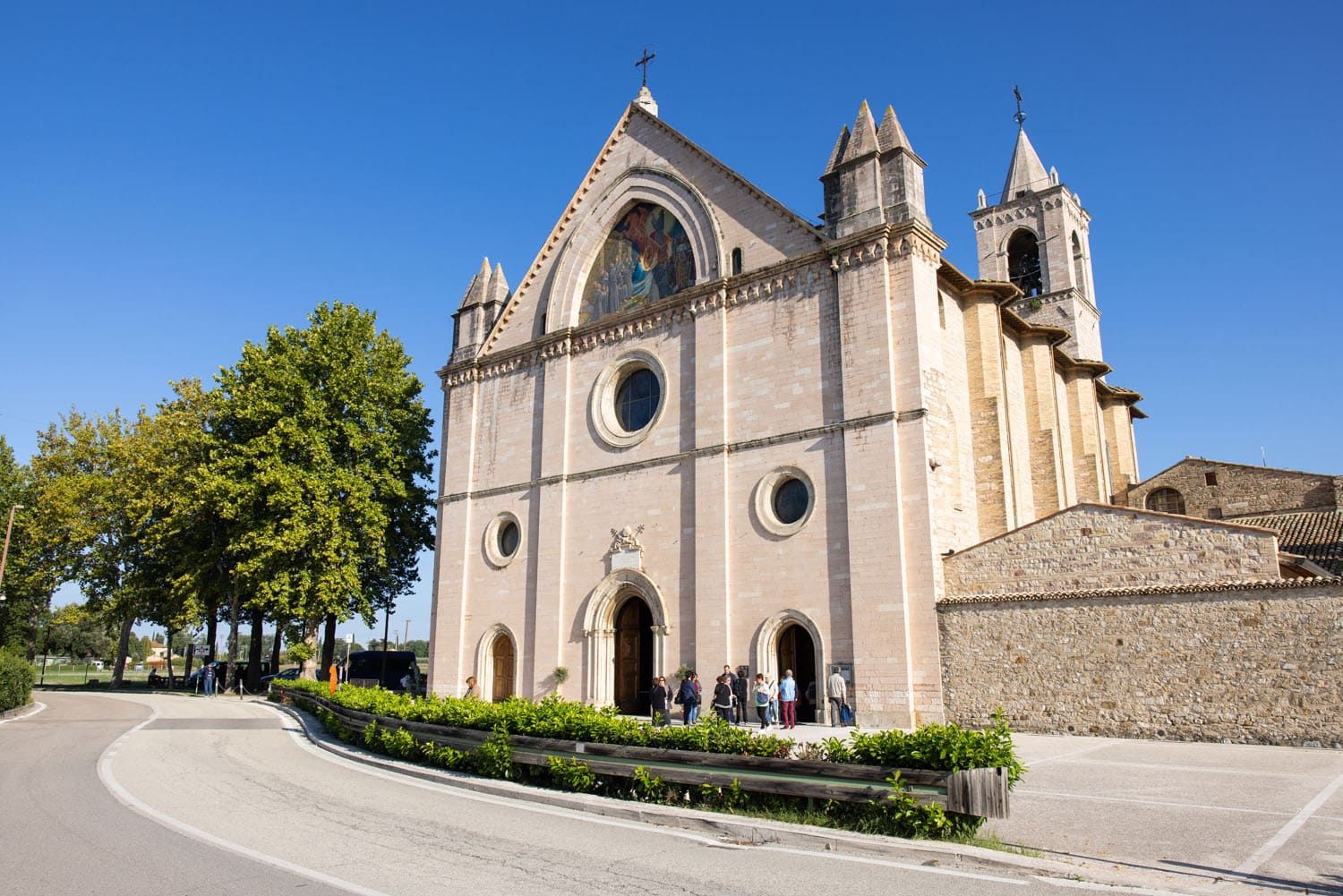
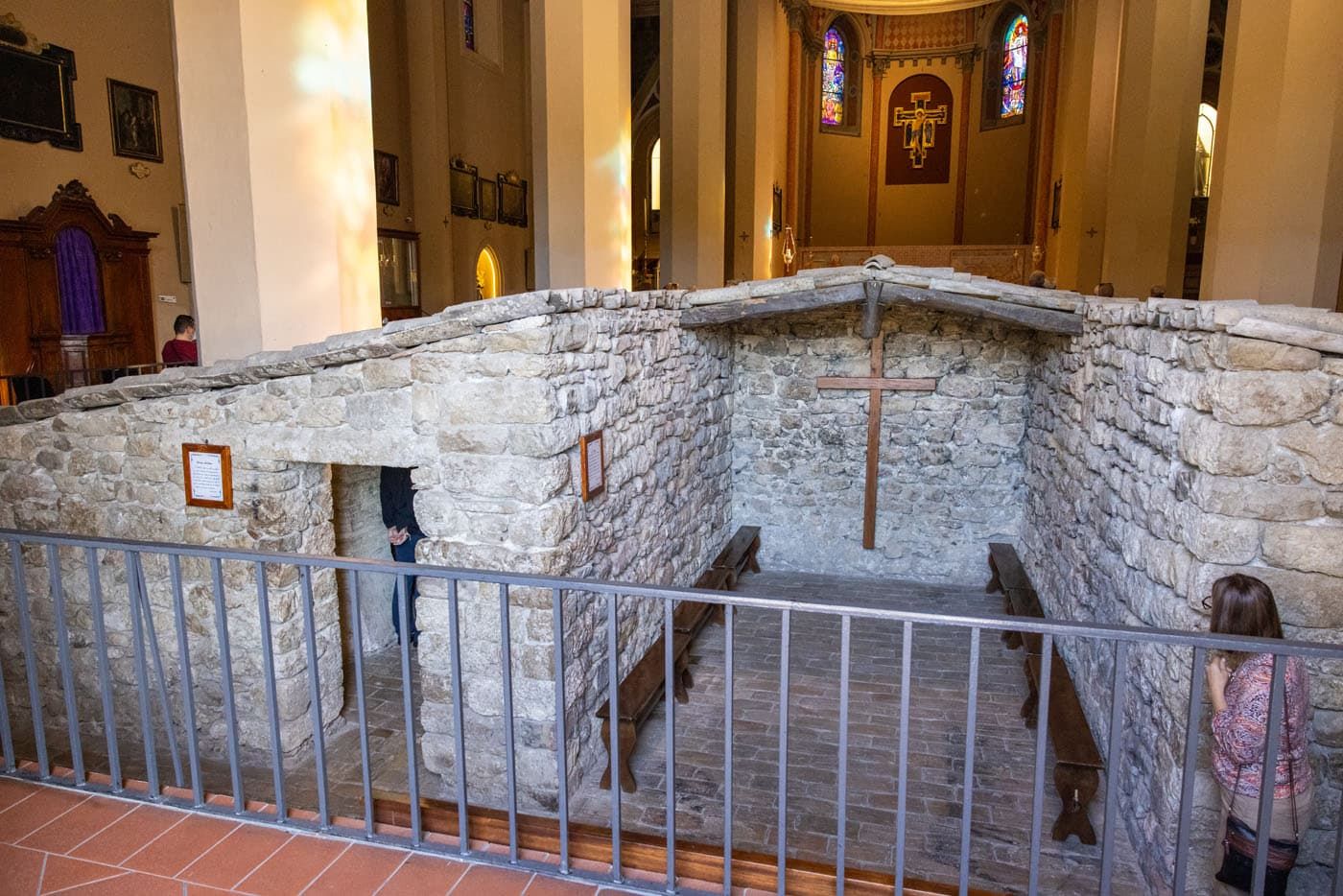
Santuario di Rivotorto
With More Time
Below is a list of more things to do in Assisi. These are only worth it, in our opinion, if you have a lot of time in town and have an interest in the history behind these additional sites.
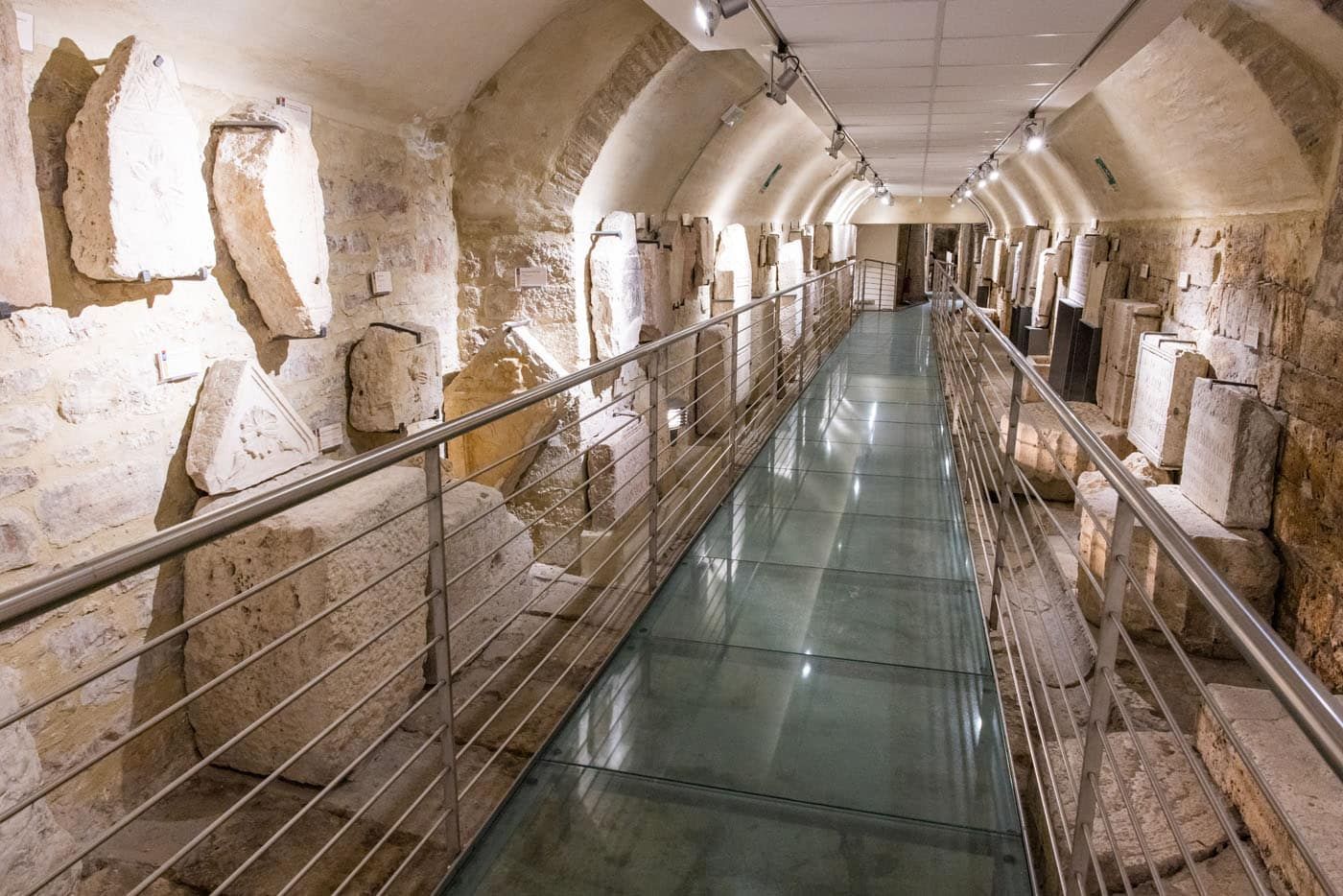
Visit the Roman Forum and Archaeological Museum
Located just a few steps from Piazza del Comune, descend below the city streets to the excavations of the ancient Roman Forum. A walkway leads to the remains of a temple, a cistern, and podium.
Roman Forum
A visit here is relatively quick, taking anywhere from 15 to 30 minutes, depending on how much interest you have in archaeological sites. It is open from 10 am to 6 pm and tickets cost €5.
SAIO Winery
This winery gets great reviews but we did not have a very good experience here. The tasting room is small and very loud, even with just a few people in the room. The service is also very slow and the hours for tastings are extremely limited throughout the day. However, it is a nice drive to get here with beautiful views of Assisi.
Things to Do in Assisi: On a Map
How to Use This Map: Click the tab in the top left corner of the map to see a list of the points of interest and to turn layers on/off. Click the icons on the map to get more information about each point of interest.
To take this map with you, click the star next to the title of the map which adds it to your Google account. Next, within your Google Maps app, select ‘Saved’ and then select ‘Maps’. This map title will now appear in your list.
How Much Time Do You Need in Assisi?
For the best experience, plan on spending one day in Assisi. This gives you enough time to visit all of the sights in the historic city center, stroll the streets, and have lunch and maybe even dinner. Those with an interest in St. Francis can spend the second half of the day visiting the religious sites that sit just outside of the city center.
For more information, check out our walking tour and one day Assisi itinerary ↓
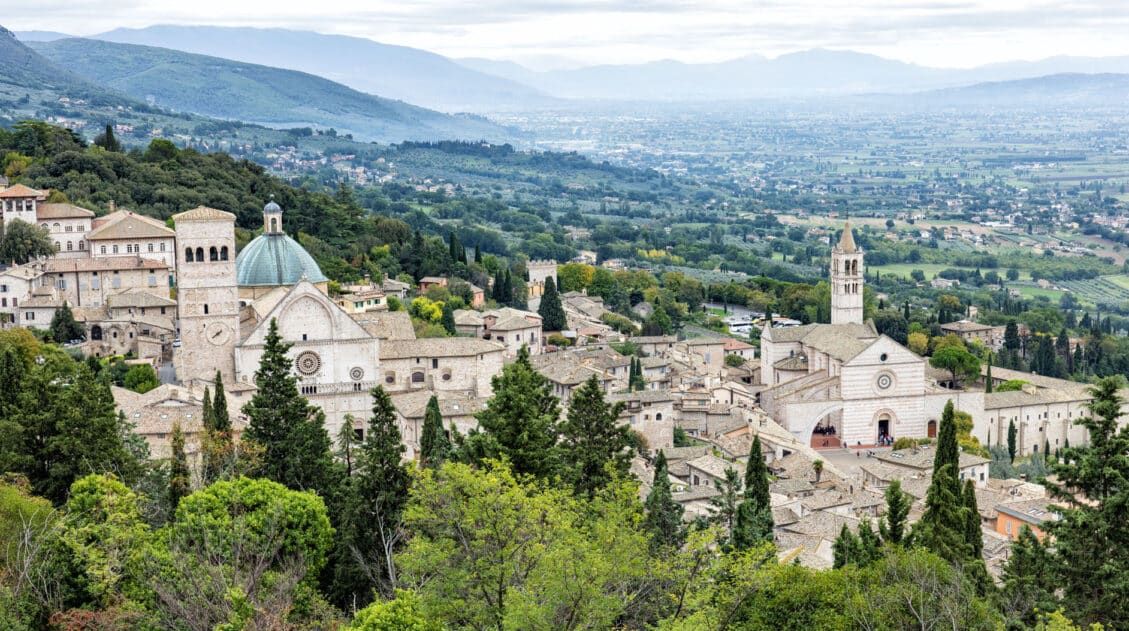
One Day in Assisi, Italy: Walking Tour & Itinerary
How to spend one day in Assisi with a walking tour to see the main sights quickly and efficiently.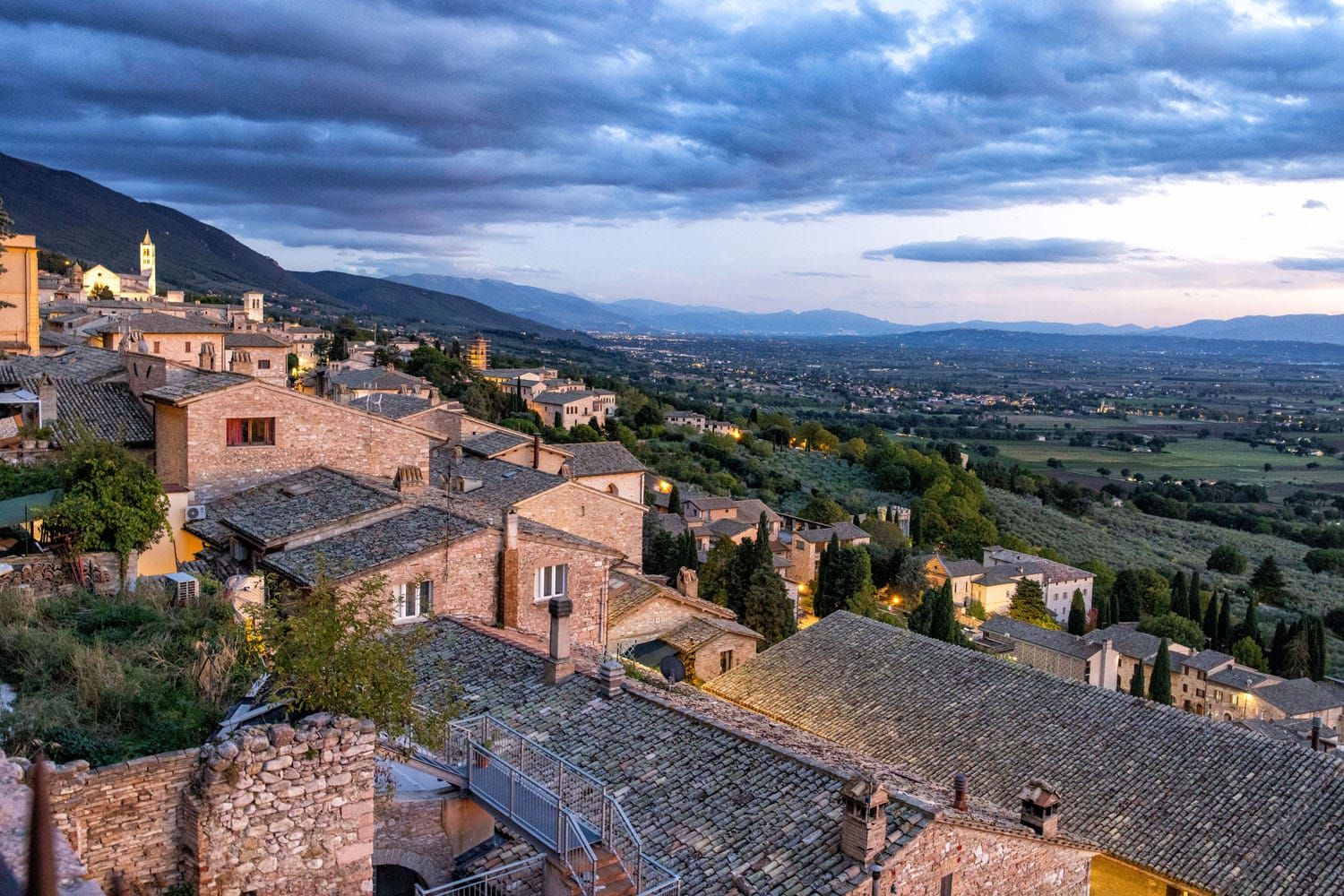
Assisi in the evening
Helpful Tips for Visiting Assisi
To check the weather forecast, we used Meteo Italy and the forecast was relatively accurate. There is also an app that you can download onto your phone.
If you plan to have dinner in Assisi, make your reservation in advance. In our experience in Italy, you will need to have a reservation for dinner at the highly rated restaurants.
From October 2 through October 4, there are festivities in Assisi celebrating the Feast of St. Francis. Festivities start on October 2. On the nights of October 3 and 4, oil lanterns are lit throughout town. We were in town October 1 through the morning of October 3, so we just missed seeing the lanterns. Expect bigger crowds than normal during this time.
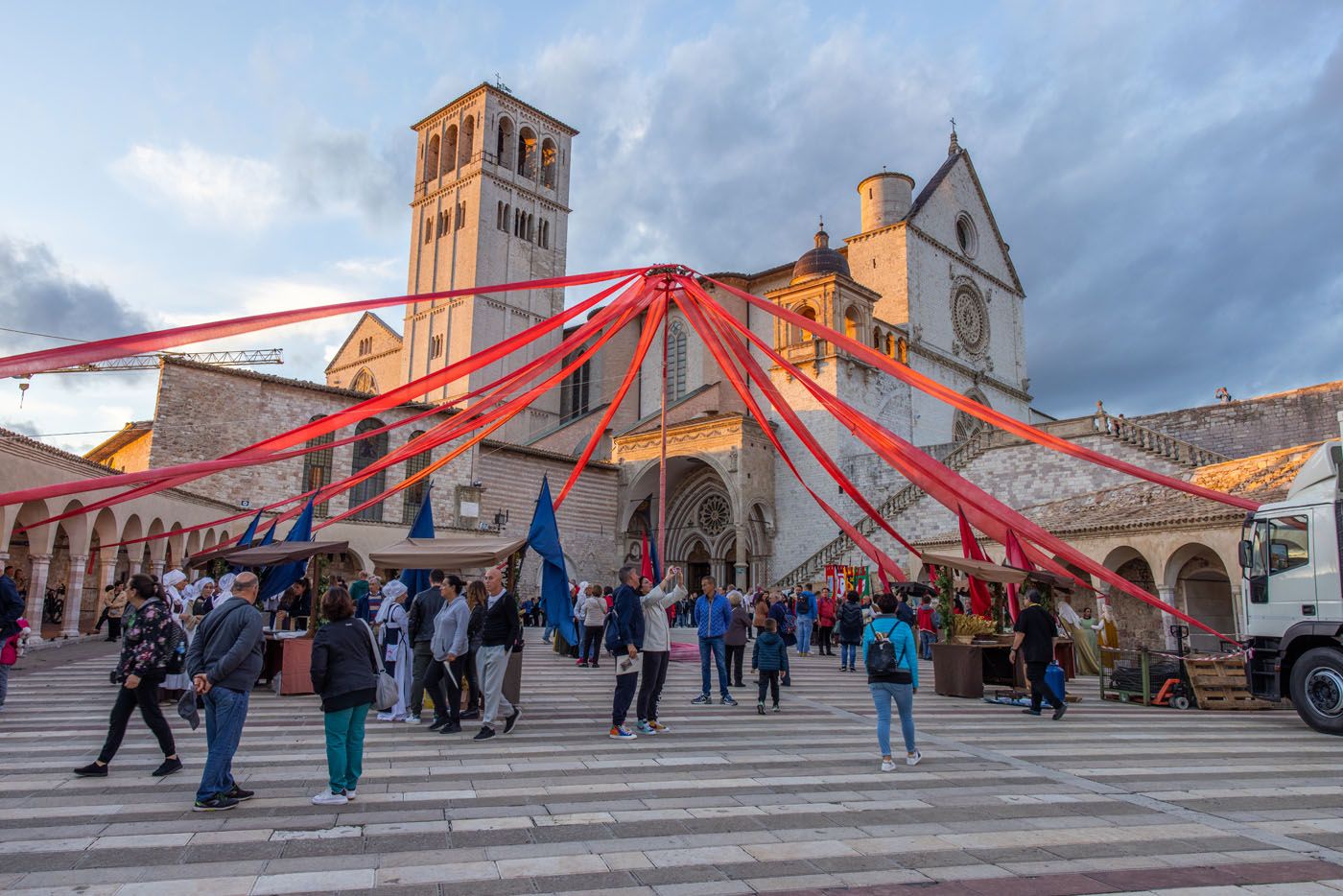
Festivities next to the Basilica di San Francesco
Where to Eat in Assisi
Bibenda Assisi gets wonderful reviews and is located just one minute away from Piazza del Comune. This was #1 on our list, both for lunch and a wine tasting, but unfortunately, they were closed during our visit.
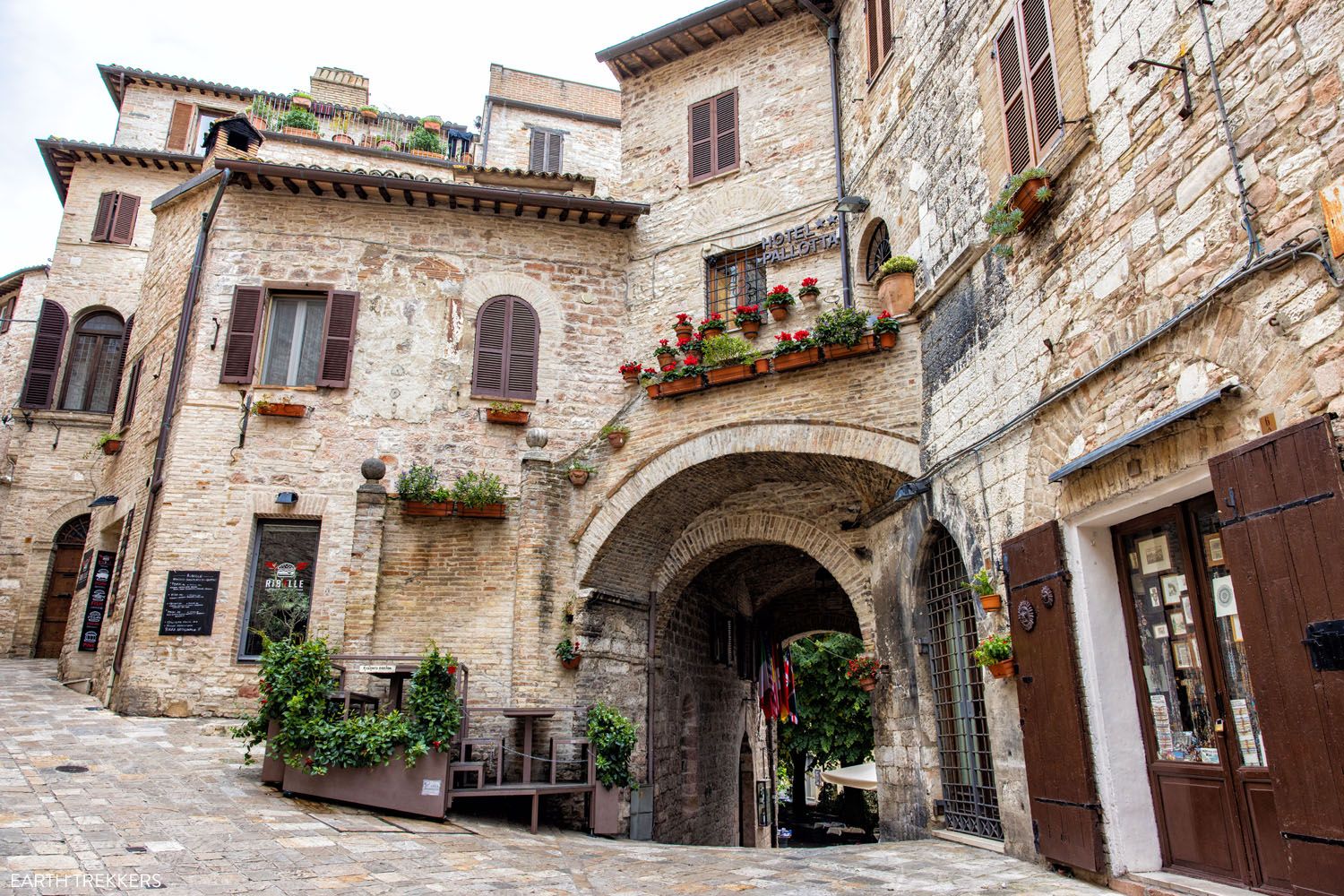
The two tables on this street are for Bibenda Assisi.
Osteria Piazzetta dell’Erba also gets very good reviews and sits right next to Bibenda Assisi.
Taverna dei Consoli is located on Piazza del Comune. We ate on their upper terrace. The views over the square are beautiful and the food is even better. We highly recommend the Cacio e Pepe (pasta with cheese and pepper).
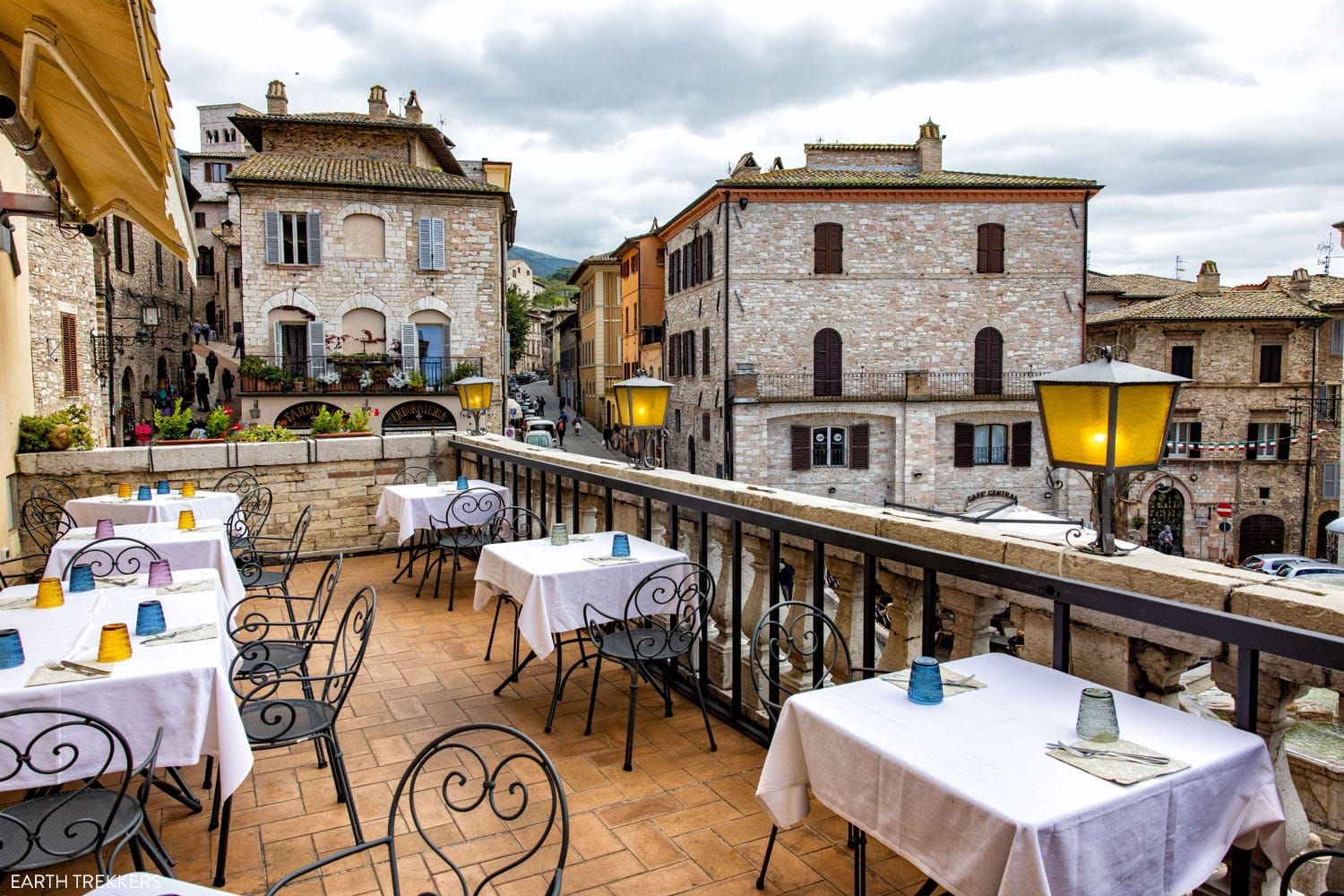
Taverna dei Consoli
Le Terrazze de Properzio. This restaurant is located high in Assisi, about a 5 to 7-minute walk from the St. Francis Basilica. It’s an uphill walk to get here, but what you get is great food and a view over the town from their outdoor terrace.
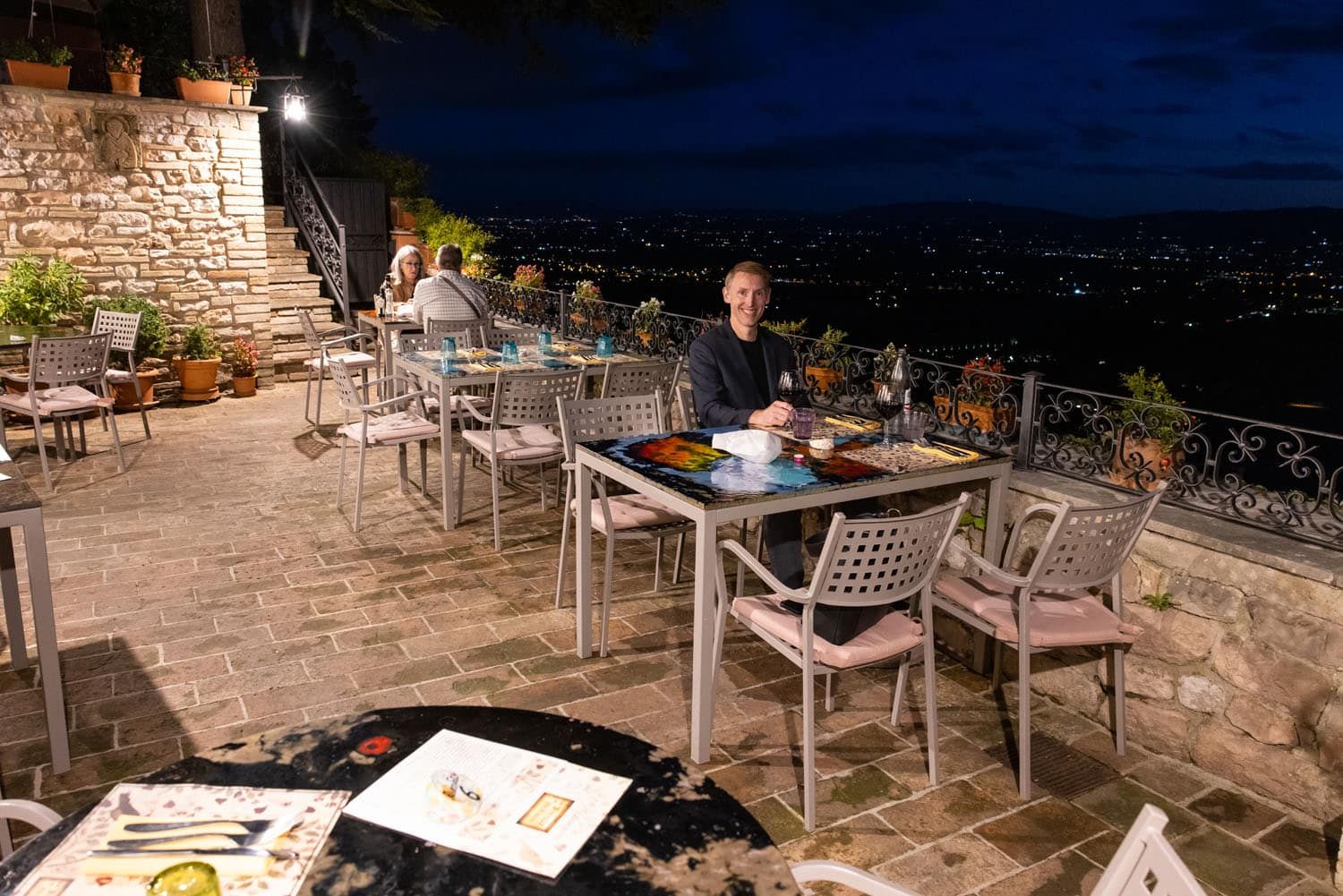
Le Terrazze de Properzio
We also loved breakfast at Ristorante Bar San Francesco and a snack at Bar Giardino San Lorenzo.
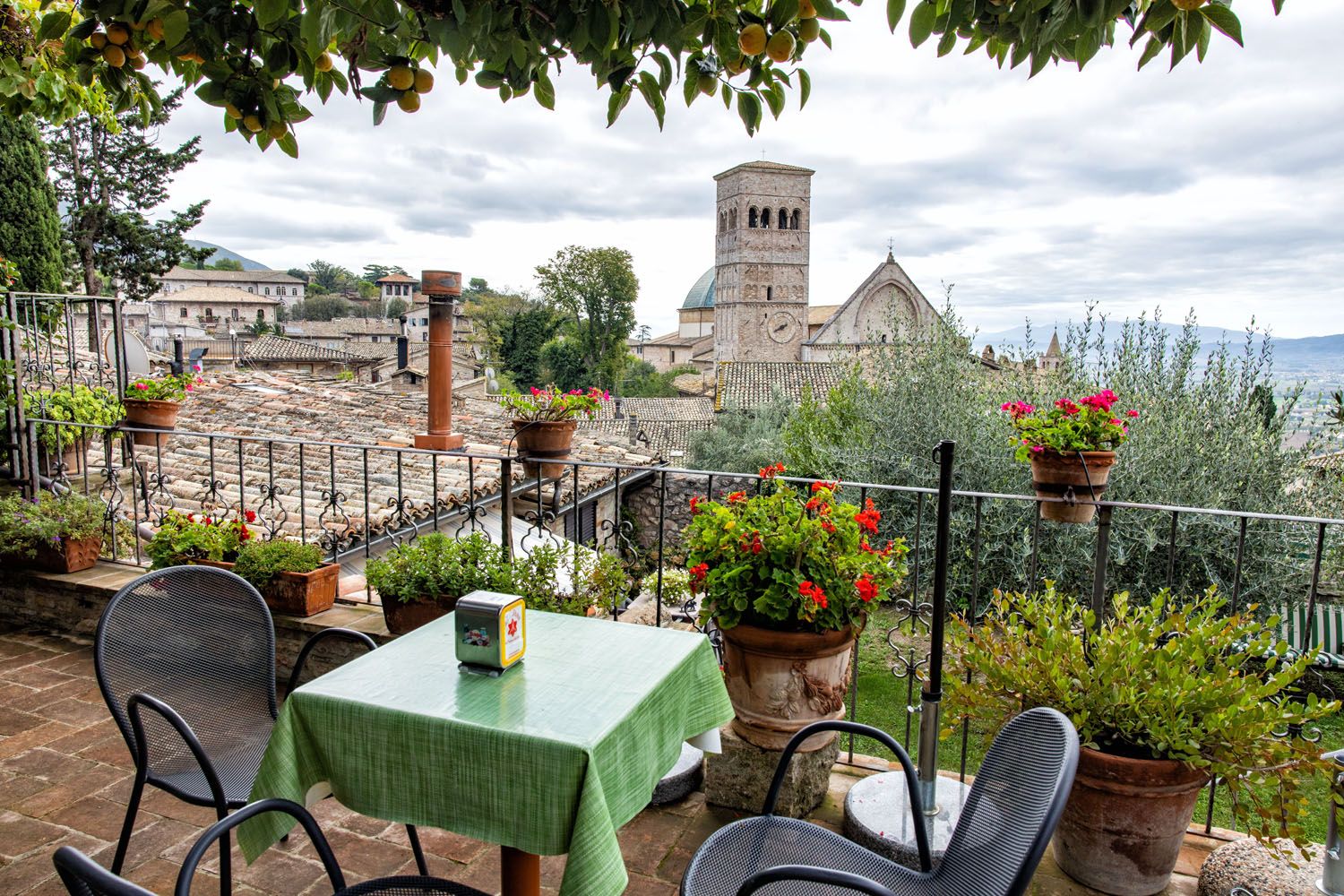
Bar Giardino San Lorenzo
How to Get to Assisi
By Public Transportation
A train station and bus station are located in the town of Santa Maria degli Angeli, which sits southwest of the historic city center, near the Basilica Santa Maria degli Angeli.
To get from Santa Maria degli Angeli to Assisi, you can take a taxi or the public bus.
By Car
Assisi also makes a great place to visit if you will be on a road trip through Italy. You will have to park your car outside of the city center and then explore the town on foot. Only local traffic is permitted to drive in Assisi.
Here are driving distances and times from nearby destinations:
- Perugia: 25 km, 35 minutes
- Cortona: 72 km, 1.25 hours
- Orvieto: 91 km, 1.5 hours
- Rome: 190 km, 2.5 hours
- Florence: 175 km, 2 hours
- Ancona: 145 km, 1.75 hours
Tours of Assisi
There are numerous tour options for visiting Assisi. This full day tour from Florence includes a visit to Assisi and the lovely Tuscan town of Orvieto.
There are also several great walking tours in Assisi, which is a good option if you want to learn more about the city and the life of St. Francis from an experienced guide. This private tour gets fantastic reviews and this 3-hour small group tour is better for those on a budget.
Don’t feel like walking the hilly streets, check out this tuk-tuk tour of Assisi.
Tours of Assisi
Best Time to Visit Assisi
We visited Assisi in early October and it was close to ideal. The weather was cool with a mix of clouds and sun, perfect for walking the hilly streets all day without overheating. Crowds were light, the city felt relaxed, and we nearly overlapped with the Feast of St. Francis on October 3 and 4, one of Assisi’s most atmospheric events, when oil lanterns are lit along the streets throughout the city. If your timing allows, it’s worth planning around.
One of Assisi’s advantages over better-known Italian destinations is that it never seems to get overwhelmed the way Florence or Siena can. Even in summer, when temperatures climb, the crowds remain manageable by comparison. That said, spring and fall are the sweet spots for comfortable sightseeing.
- Spring (April–June): Mild temperatures, flowers in bloom, and relatively light crowds. One of the best times to visit.
- Summer (July–August): Warm to hot, but more manageable than Tuscany’s busiest destinations. Book accommodation in advance.
- Fall (September–October): Our top pick. Comfortable weather, thin crowds, and the Feast of St. Francis in early October adds a special atmosphere.
- Winter (November–March): Quiet and contemplative. Some sites may have reduced hours, but you’ll have the city largely to yourself.
Where to Stay in Assisi
Alter Ego B&B gets great reviews and is located just steps away from Piazza del Comune. If you want a room with a view, check out Assisi Panoramic Rooms (a 5-minute walk to the St. Francis Basilica) and The View Assisi (overlooks the St. Francis Basilica).
We stayed at Cheri Home Assisi Apartment, which is no longer available. One of the things we loved about it was its fantastic location in Assisi, less than a 5-minute walk from Piazza del Comune. We parked in a small, private lot and from here, it was about a 5-minute walk to the apartment, not too bad for carrying luggage into town. Canto XI is a 2 bedroom vacation home, just a few doors down from where we stayed on Via Bernardo da Quintavalle, and it gets excellent reviews.
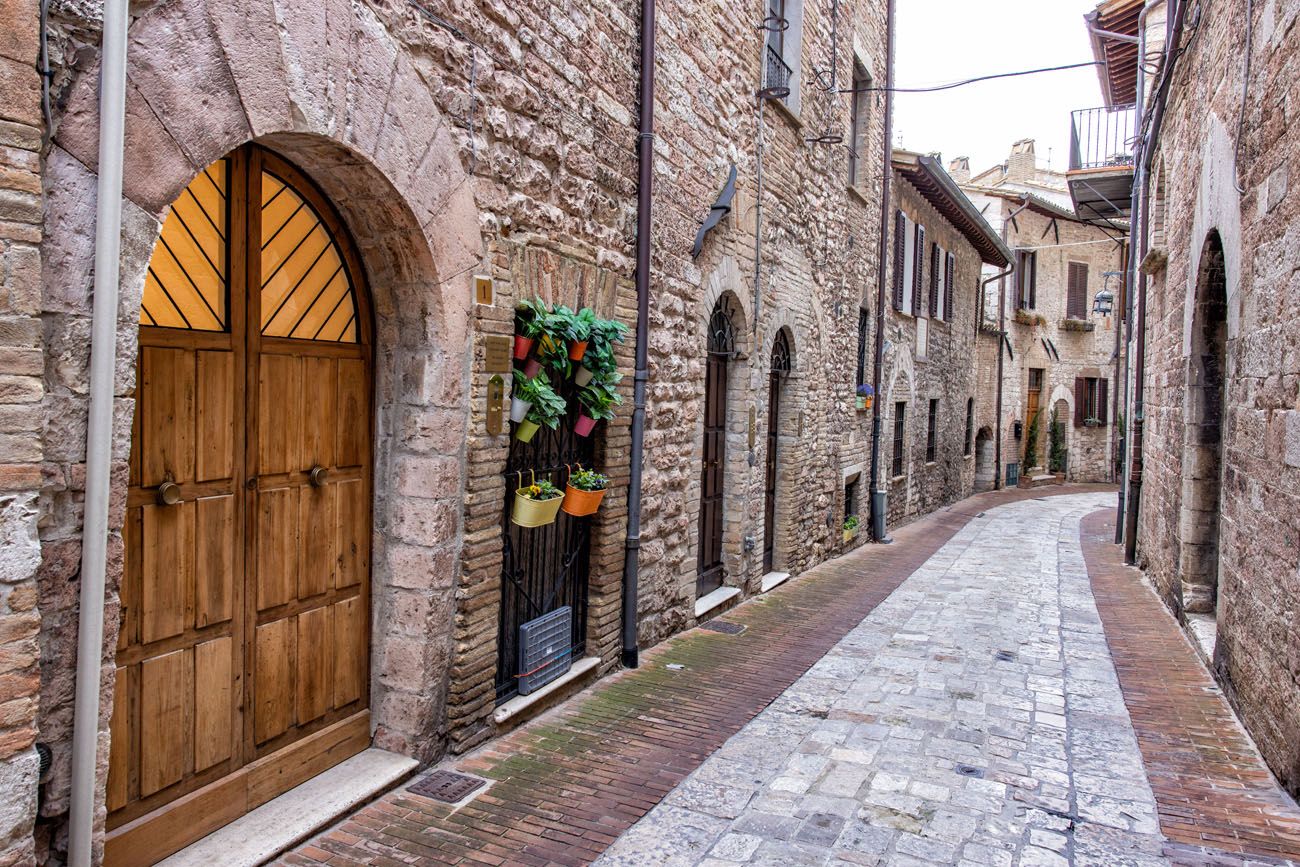
Via Bernardo da Quintavalle.
Frequently Asked Questions
Is Assisi worth visiting?
Absolutely. With its ties to St. Francis, its UNESCO World Heritage status, and its remarkable collection of medieval churches and basilicas, Assisi is one of the most rewarding cities in Italy. You don’t have to be religious to love it here. This is simply one of the most beautiful and atmospheric hill towns in the country, with a stunning setting on the slopes of Monte Subasio and sweeping views over the Spoleto Valley. What surprised us most was how unhurried it feels compared to better-known Tuscan cities. The streets are picturesque, the food is excellent, and the evenings, when the limestone buildings glow under the street lamps, are truly magical. There is something here for everyone.
How much time do I need in Assisi?
We recommend spending at least two days in Assisi. One day gives you enough time to visit the Basilica di San Francesco and a handful of other highlights, but Assisi rewards a slower pace. With more time, you can visit the sites outside the city center, the Carceri Hermitage, the Church of St. Damian, the Basilica of Santa Maria degli Angeli, and explore the side streets at your leisure. If you only have one day, see our One Day in Assisi Walking Tour for how to make the most of it.
What is Assisi known for?
Assisi is best known as the birthplace of St. Francis, one of the most venerated figures in Christianity and the founder of the Franciscan Order. The city’s Franciscan heritage, including the Basilica di San Francesco, built over St. Francis’s tomb, and numerous churches tied to his life and that of St. Clare, earned it UNESCO World Heritage status in 2000. Beyond its religious significance, Assisi is also celebrated for its extraordinary medieval architecture, its Giotto frescoes (considered among the most important works of art in Italy), and its remarkably well-preserved historic center.
Is Assisi easy to get around on foot?
Yes, Assisi is best explored on foot, and the historic center is compact enough to walk comfortably. That said, the city is built on a hillside, so be prepared for some steep climbs, particularly if you’re heading up to Rocca Maggiore or the Cathedral of San Rufino. Comfortable walking shoes are a must.
Is Assisi worth visiting as a day trip from Florence or Rome?
It’s possible, but the travel times, roughly two to two and a half hours each way from both cities, mean you’ll have limited time in Assisi itself, perhaps four to five hours at most. That’s enough to see the Basilica di San Francesco and a few highlights, but you’ll miss a lot. In our opinion, Assisi is worth spending a night. The quiet mornings and the magical twilight atmosphere are two of the best things about this city, and both are lost on a day trip. That said, if Assisi is on your list and a day trip is your only option, it’s still worth it. Just go in with realistic expectations about how much you can cover.
More to Explore in Umbria and Beyond
If you’re planning more time in Assisi, our One Day in Assisi Walking Tour maps out the best route through the city, with timing and tips to help you make the most of a full day.
Assisi pairs naturally with Orvieto, Umbria’s other essential hilltop town, known for its dramatic clifftop setting and stunning Gothic cathedral. Together, the two make a rewarding Umbria itinerary.
Many travelers visit Assisi as part of a broader Italy trip. If you’re continuing south, our guide to the best places to visit in Puglia covers one of Italy’s most underrated and beautiful regions, a natural next stop after Umbria.
For the bigger picture, our Italy Travel Guide covers destinations across the country and is the best place to start planning your trip.
If you have any questions about the best things to do in Assisi, let us know in the comment section below.
More Places to Visit in Italy
Best Things to Do in Orvieto, Italy: A Guide to Umbria’s Hilltop Gem
Pinterest Facebook Flipboard Visiting Orvieto, Italy? Here are the best things to do, including St. Patrick’s Well, the Orvieto Cathedral, Albornoz Fortress, and the famous Orvieto Classico wine. Perched dramatically on a volcanic tufa cliff, Orvieto is one of those Italian hilltop towns that stops you in your tracks before you’ve even set foot inside. […]
24 Best Things to Do in Tuscany, Italy: Cities, Hill Towns & Hidden Gems
From world-famous cities like Florence and Siena to quiet hill towns and scenic drives through vineyard-covered hills, Tuscany offers a wide range of experiences, but deciding what to do (and what to skip) can be overwhelming. We’ve explored Tuscany on two very different trips: a one-week highlights tour with our kids and a longer 10-day […]
Best Things to Do in San Gimignano (Tips from Two Visits)
San Gimignano is famous for its medieval towers, and yes, you should climb one. But a great visit here goes beyond the main piazzas and the gelato line at Dondoli. On our first trip, we arrived by bus from Siena on a busy morning with our kids, climbed to the top of Torre Grossa, ate […]
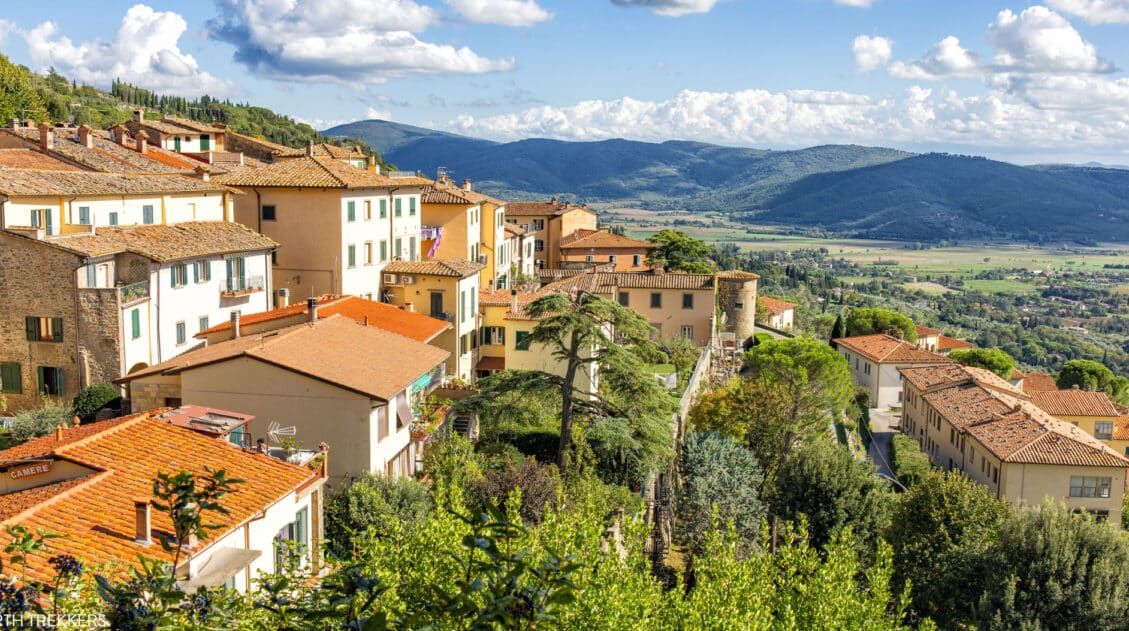
Cortona, Italy: Things to Do in This Underrated Hill Town
There’s a moment when you round a corner on one of Cortona’s side streets and the whole Val di Chiana valley opens up below you, and you think: how is this town not more famous? Tim and I had that moment during what was supposed to be a quick afternoon stopover between Arezzo and Assisi. […]
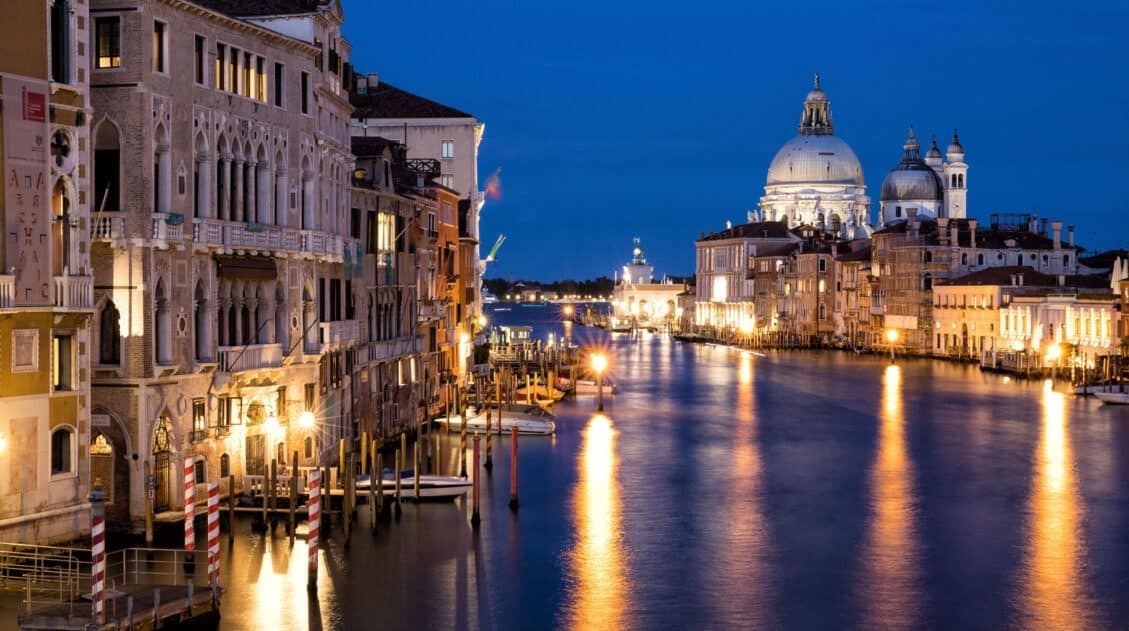
Italy Travel Guide: How to Plan a Trip to Italy
Italy Travel Guide From the ruins of ancient Rome to the hiking trails of the Dolomites, the trulli of Puglia to the hilltop villages of Tuscany, Italy is a country that rewards every kind of traveler, and keeps pulling you back. We’ve traveled to Italy six times, exploring the country from the lakes and mountains […]
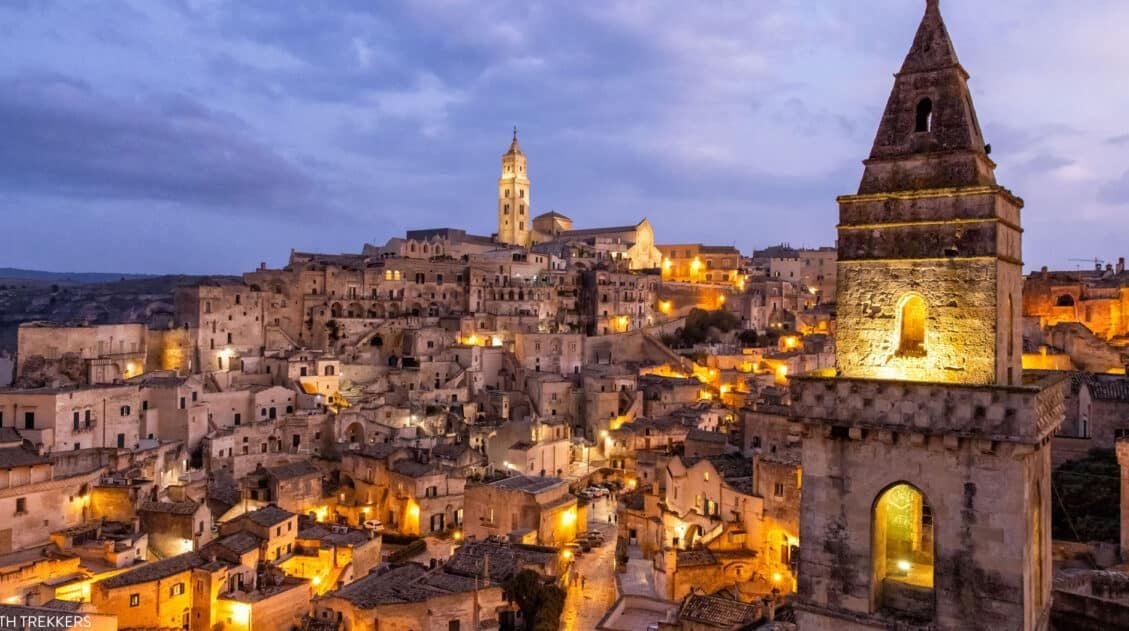
Matera Bucket List: 25 Best Things to Do in Matera
Matera is a city with a long and fascinating history. A complex of cave dwellings, stone buildings, and churches sit on the rolling hillsides, creating one of the most photogenic cities in Italy. Matera has recently been featured in numerous films, increasing its popularity. Strolling the picturesque streets, sleeping in a cave hotel, trying traditional […]
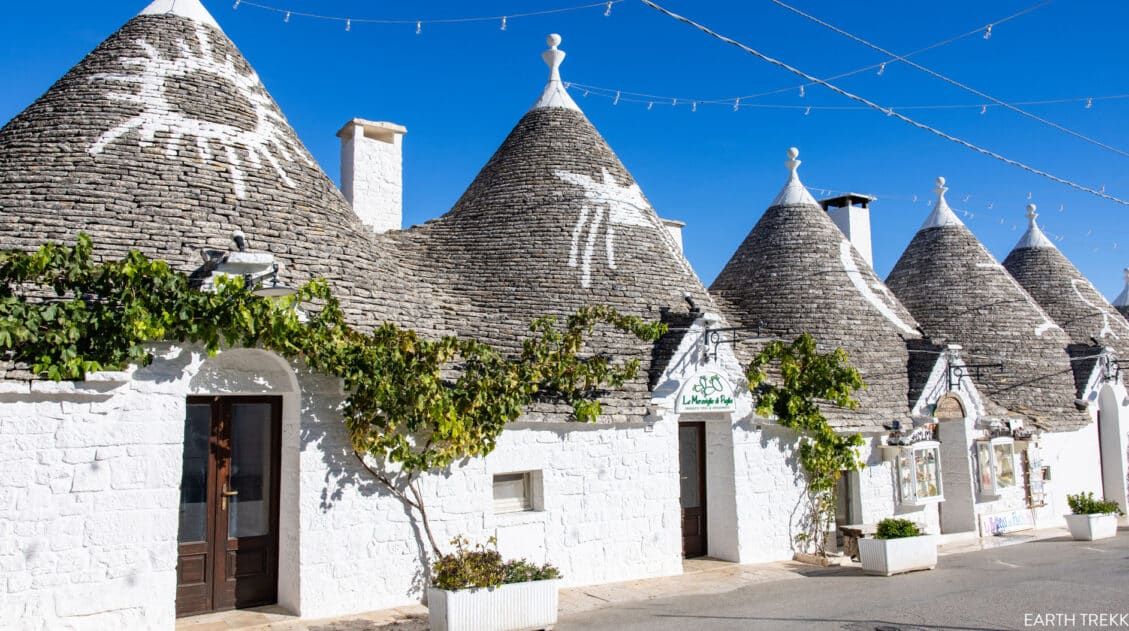
15 Amazing Things to Do in Alberobello (With Photos & Helpful Tips)
Have you ever seen photos of a place and think “that can’t be real.” Well, that’s what we thought when we first saw photos of Alberobello. This tiny town looks like it has been plucked from the pages of a fairytale. Alberobello is famous for its trulli, small round buildings with conical roofs made of […]
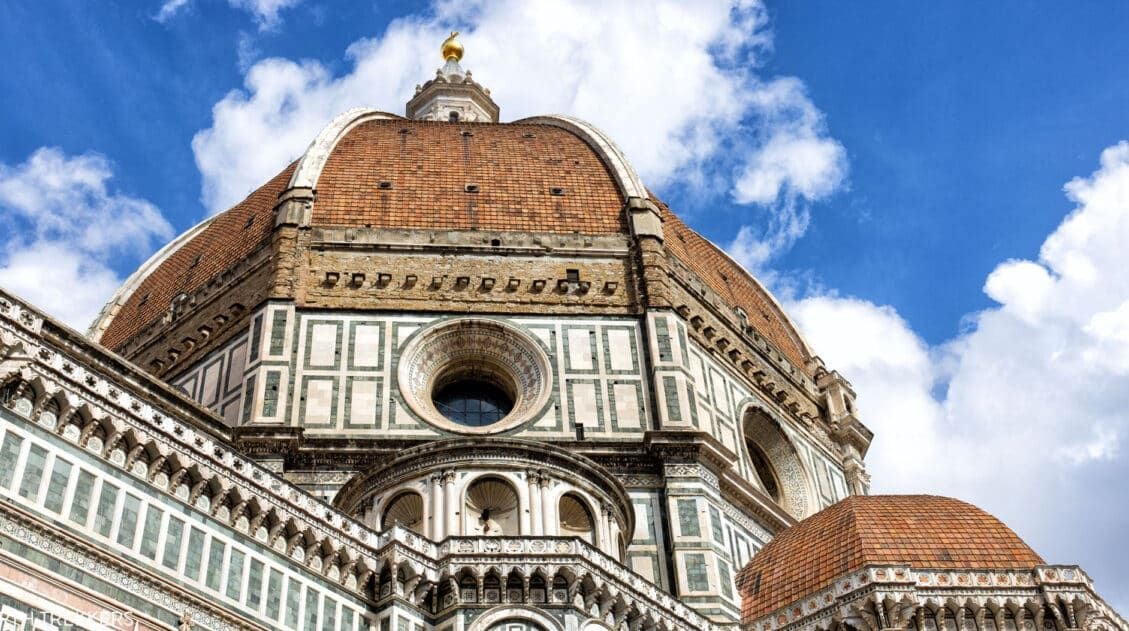
30 Best Things to Do in Florence, Italy (2026 Guide)
Florence is one of the most rewarding cities in Europe, and the best things to do in Florence range from climbing Brunelleschi’s iconic dome to watching the sunset from Piazzale Michelangelo. We know this firsthand, having visited Florence twice. Our first trip was a quick day and a half visit in July with our kids. […]
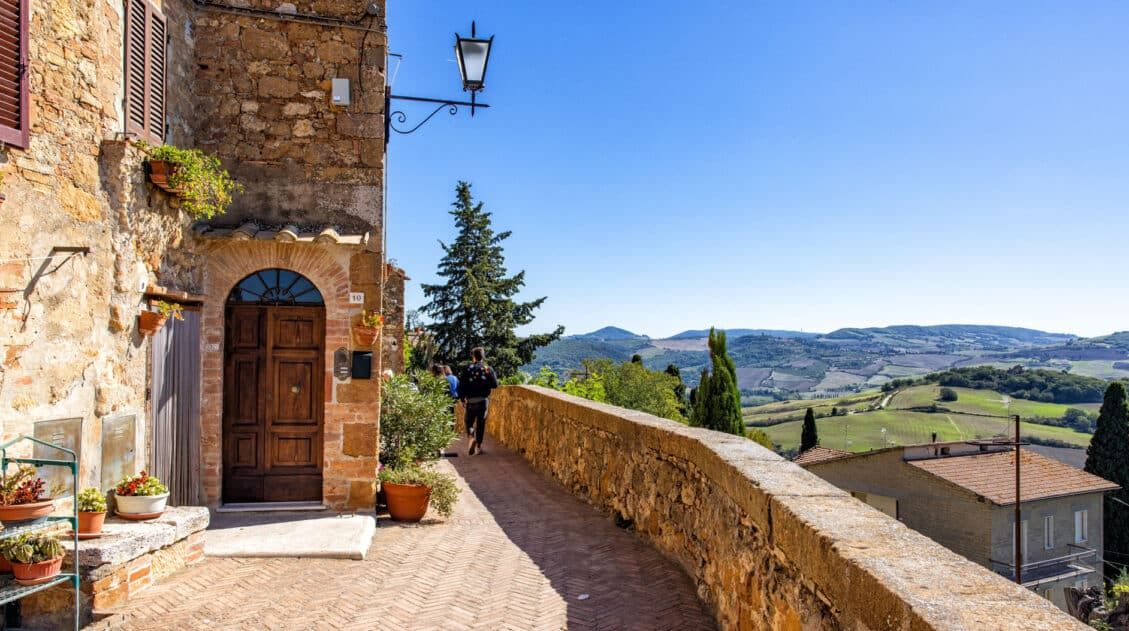
Visiting Pienza, Italy: Best Things to Do, Tips & Travel Guide
Pienza is one of those Tuscan towns that earns its reputation. Perched above the Val d’Orcia, this tiny UNESCO World Heritage Site was redesigned in the 15th century by Pope Pius II as his vision of the ideal Renaissance city. Walking its perfectly proportioned streets, it’s hard to argue with his ambition. We’ve visited Pienza […]
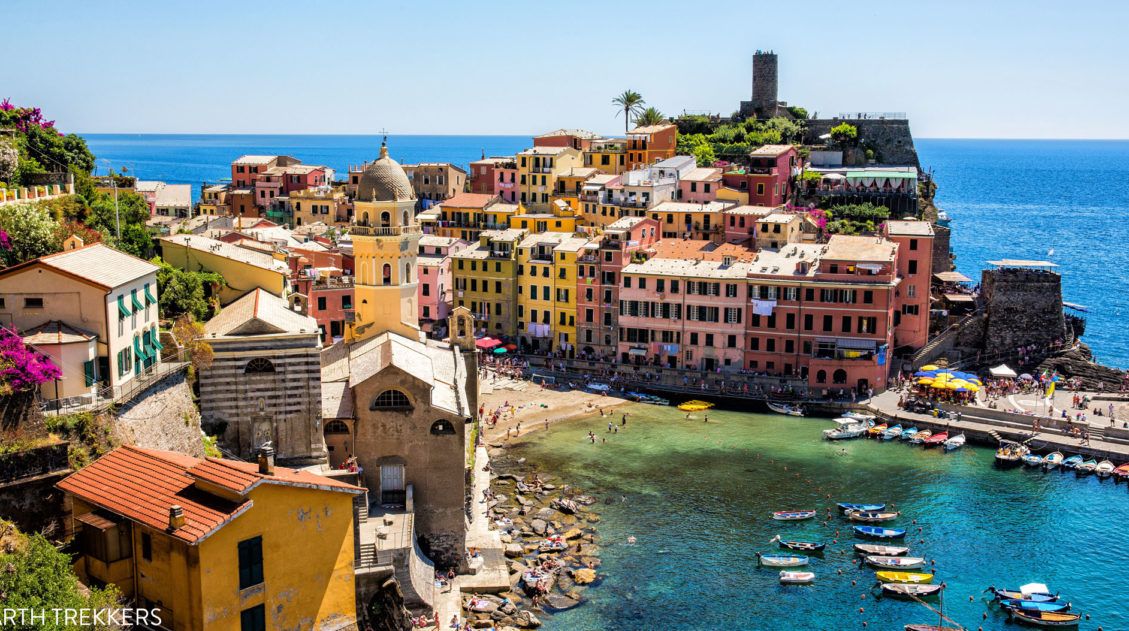
25 Best Places to Visit in Italy
After six trips to Italy, these are the 25 places to visit in Italy we keep recommending — the ones that reward first-timers and repeat visitors alike, from the iconic cities of Rome and Florence to lesser-known gems like Matera and Puglia. We’ve been to Italy six times over the past ten years, and we’re […]
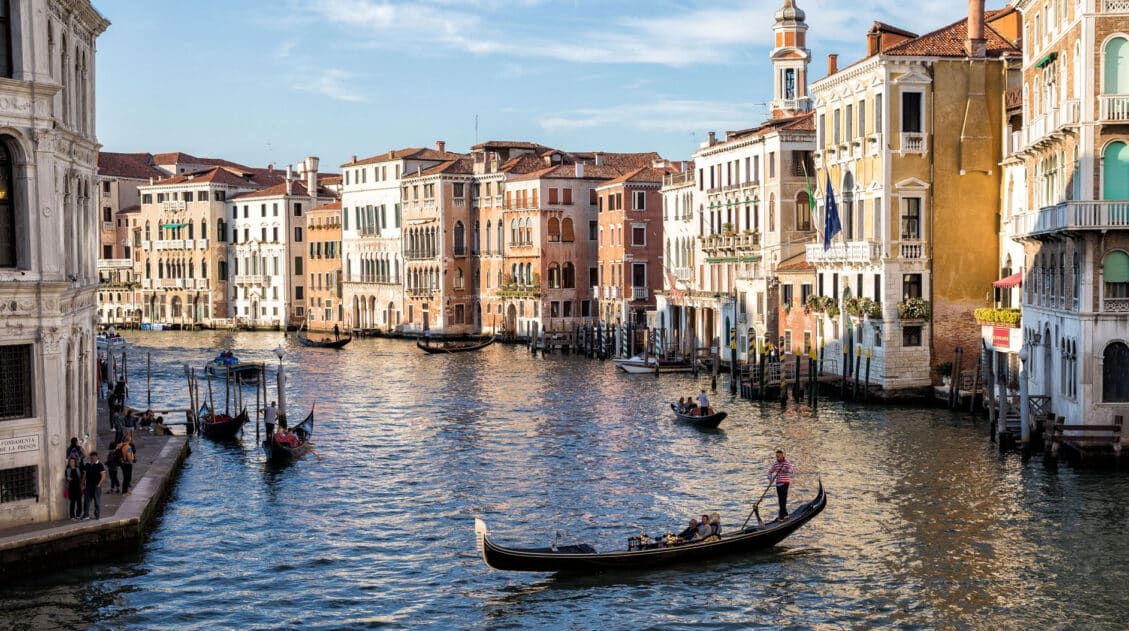
10 Days in Italy: 5 Itineraries for Every Type of Traveler
With 10 days in Italy, you have enough time for an incredible trip, but not enough time to see everything. That’s the good news and the hard news at once. Italy is enormous, wildly varied, and deeply worth savoring. The biggest mistake most people make when planning a 10-day Italy itinerary is trying to fit […]
4 Days in Rome Itinerary: Best of Rome for First Time Visitors
4 days in Rome is a wonderful amount of time to spend in this city. Not only will you be able to visit the main highlights, but you will also have time to explore a few hidden gems and add in something like a cooking class, more leisurely time, or a food tour. The list […]


Comments 14