
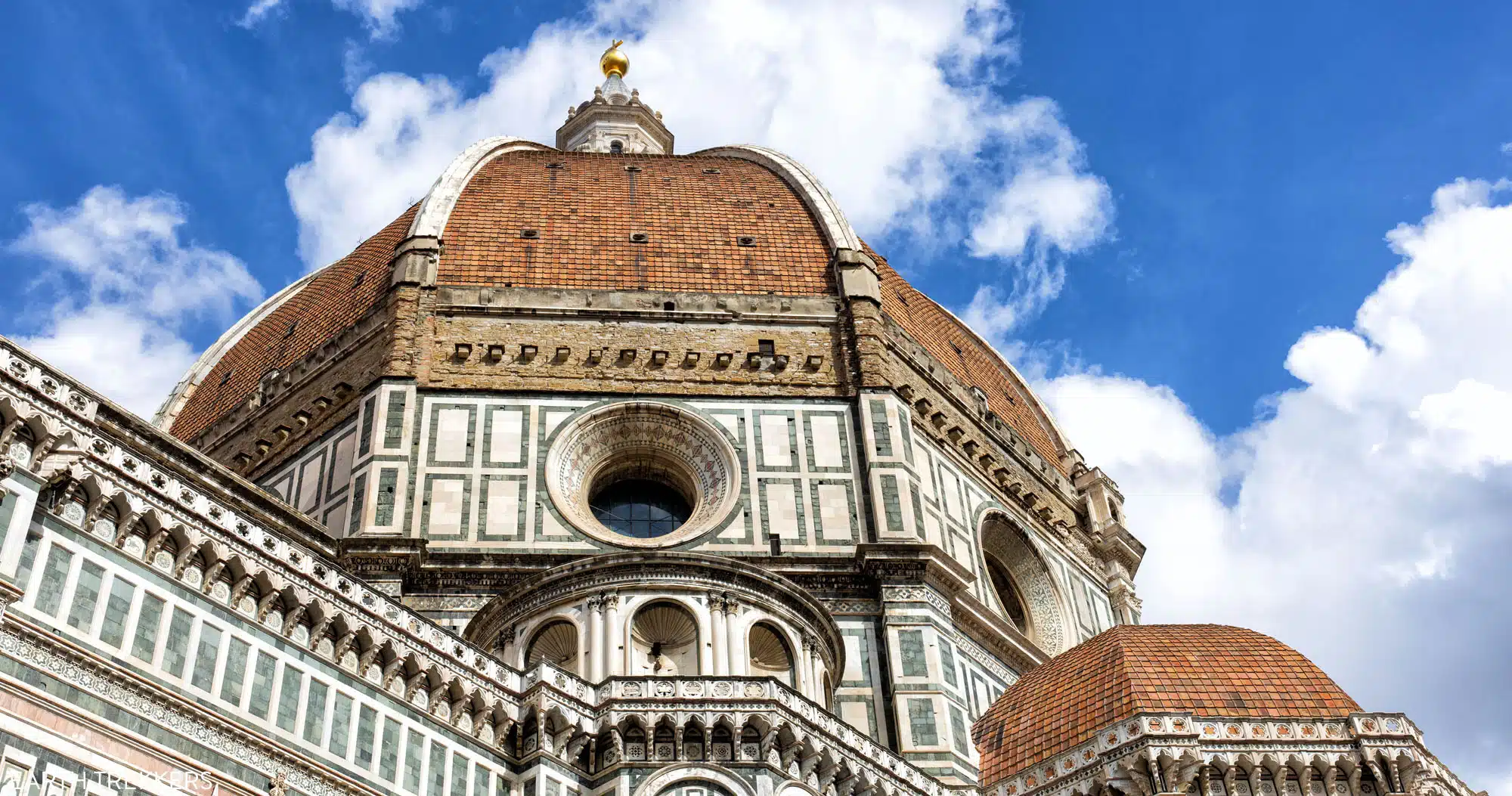
Florence is one of the most rewarding cities in Europe, and the best things to do in Florence range from climbing Brunelleschi’s iconic dome to watching the sunset from Piazzale Michelangelo.
We know this firsthand, having visited Florence twice. Our first trip was a quick day and a half visit in July with our kids. We hit the highlights and loved every minute, but with a packed Italy itinerary, we had to move on before we were ready. Tim and I returned several years later, this time in September, with a lot more time to explore the city. We revisited our favorite spots, explored hidden-gem gardens and quieter churches, discovered some great rooftop bars, and took a few day trips into Tuscany.
The result is this guide: a complete list of the best things to do in Florence, built from both trips and every conversation we’ve had with travelers since. Whether you’re trying to figure out where to spend your one afternoon or you’re planning a full week in the city, this list covers it all: the absolute must-sees, the free experiences worth your time, the viewpoints that took our breath away, and a few lesser-known spots that most visitors never find.
Best Things to Do in Florence
- Climb Brunelleschi’s Dome for 360° views over the city
- See Michelangelo’s David at the Galleria dell’Accademia
- Explore the Uffizi Gallery, one of the world’s greatest art museums
- Stroll across Ponte Vecchio
- Climb the Arnolfo Tower for the best view of the Duomo
- Watch the sunset from Piazzale Michelangelo
- Wander through Boboli Gardens or the quieter Bardini Gardens
- Tour the Baptistery of San Giovanni and see the Gates of Paradise
- Browse San Lorenzo Market and graze through Mercato Centrale
- Visit Santa Croce, the burial place of Michelangelo, Galileo, and Machiavelli
June 2026 Update: Updated all pricing and hours. Added cooking classes and food tours. Expanded the tips and FAQ section.
Best Things to Do in Florence
We’ve organized this list into six sections to make it easier to plan your time: the Duomo Complex, Piazzas and Landmarks, Art Museums, Gardens and Viewpoints, Churches, and Local Experiences. At the end of the list, you’ll find a map with everything marked.
The Duomo Complex
1. Marvel at the Florence Cathedral
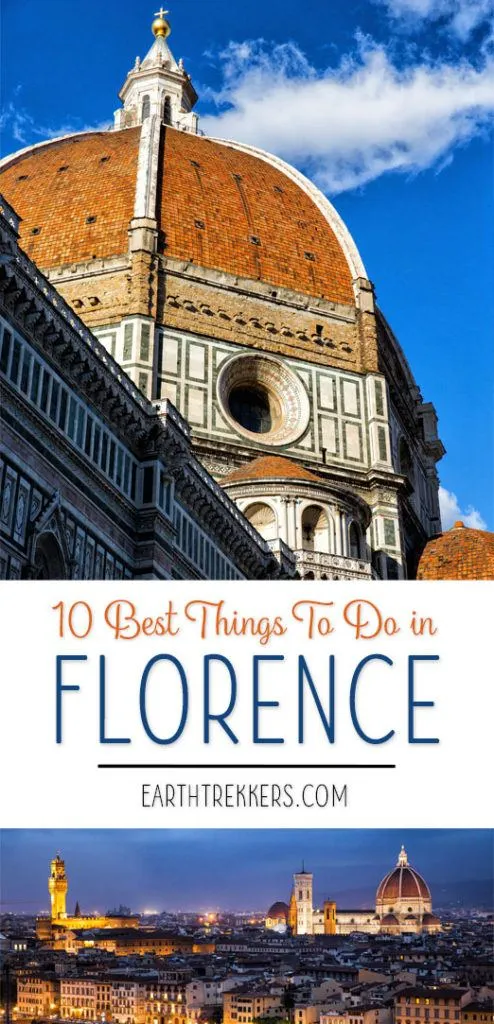
The Florence Cathedral, also called the Duomo di Firenze and Cattedrale di Santa Maria del Fiore, is one of the most recognizable cathedrals in the world.
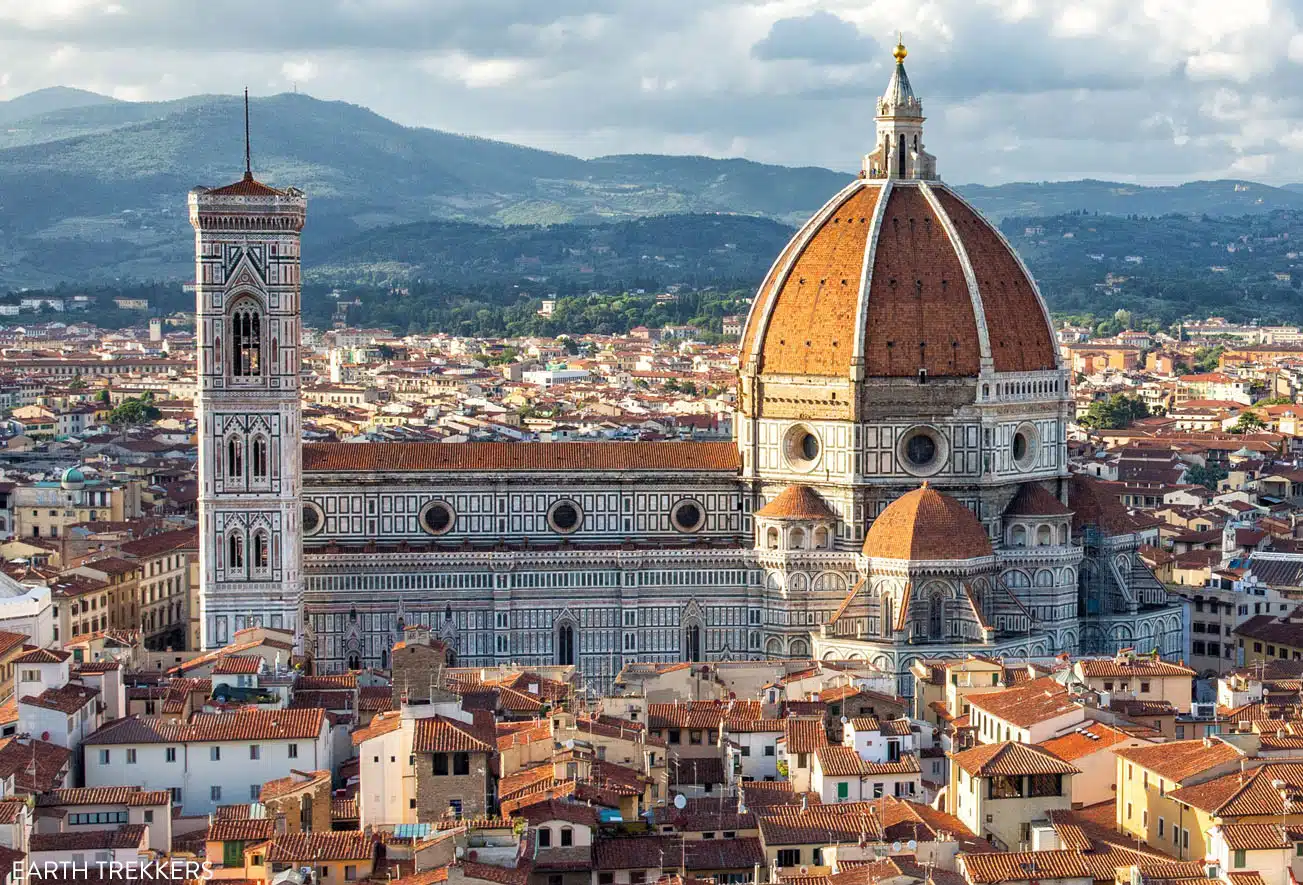
Florence Cathedral
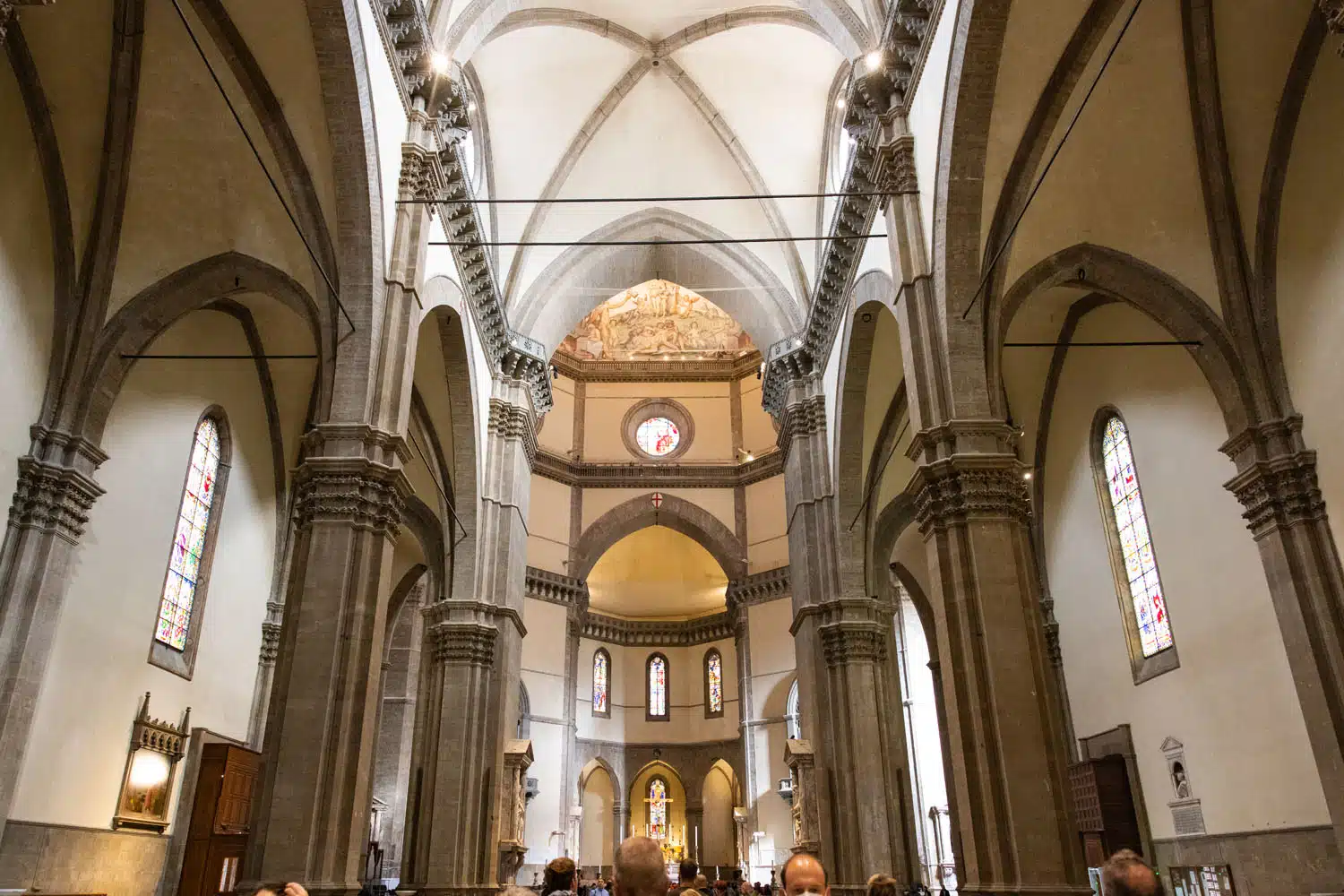
Inside the Florence Cathedral
Construction began in 1296 but it took until 1436 for most of the structure to be completed.
Brunelleschi built the dome, taking inspiration from the dome of the Pantheon in Rome, with construction lasting from 1420 to 1436. This dome is considered to be one of the most important Renaissance projects and seeing this dome, both inside and out, is one of the best things to do in Florence.
The Duomo is just one part of what is called the monumental complex of Santa Maria del Fiore. This “complex” includes not only the cathedral, but also a museum, the bell tower, the dome, the baptistery, and Santa Reparata. Some of these will show up later in this guide because they are also essential things to do in Florence.
How to Visit the Florence Cathedral
It is free to enter the cathedral. You do not need a ticket.
The entrance is at the front of the cathedral and the line wraps around the left side of the building. There tends to be a line all day, with the longest lines from mid-morning through early afternoon.
However, this line tends to move fast, so don’t be discouraged. I got in line midday, getting in line near Porta della Mandorla (which is the entrance for the dome climb) and waited about 15 minutes to enter the cathedral.
Once inside, the cathedral looks rather barren, at least compared to places like St. Mark’s Basilica and St. Peter’s Basilica. Some stained-glass windows were designed by Lorenzo Ghiberti, as well as paintings and frescoes within the cathedral. And while you are here, make sure you gaze up at the dome.
How to Visit the Florence Cathedral
Everything you need to know to visit the Florence Cathedral: places to visit, ticket types, and how to climb the dome.2. Climb Brunelleschi’s Dome for 360° Views Over Florence
Climbing the steps to the top of Brunelleschi’s dome, which sits atop the Duomo, is one of the most popular things to do in Florence.
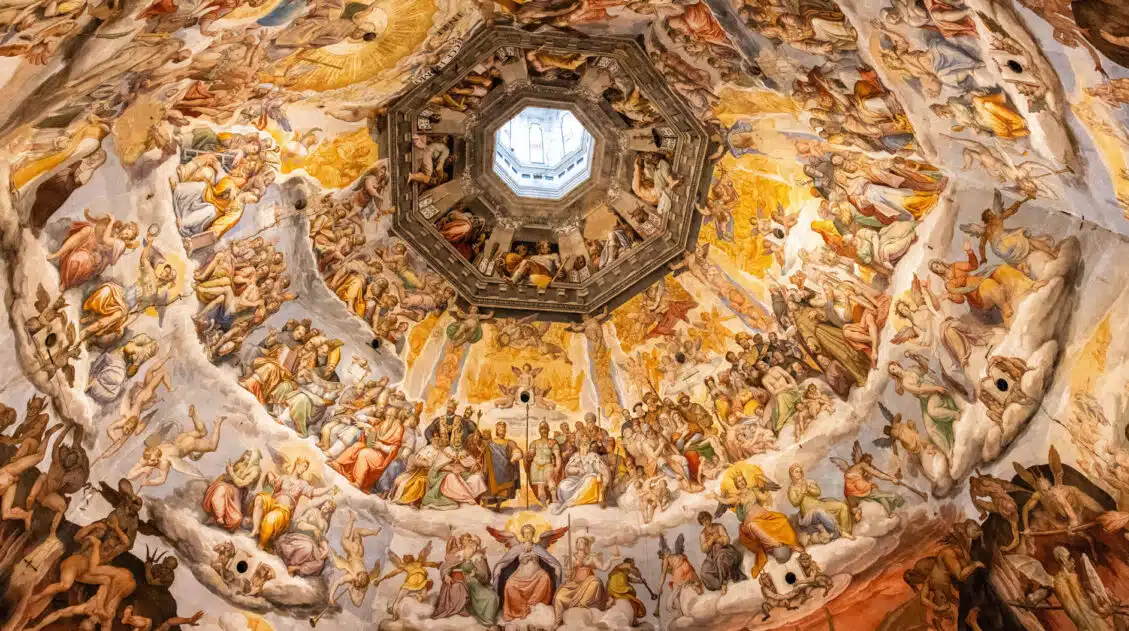
Brunelleschi constructed the dome between 1420 and 1436. The ceiling of the dome was painted with scenes from The Last Judgement from 1572 to 1579, mainly by Giorgio Vasari. Vasari died during this time and the dome paintings were completed by Frederico Zuccari, Bartolomeo Carducci, Domenico Passignano, and Stefano Pieri.
The Duomo and the dome are considered to be one of the most important projects during the Renaissance.
To climb to the top of the dome, you will walk up 463 steps. These can be steep, narrow, and winding at times and there is no elevator.
On the way up, you will walk on a walkway around the base of the dome, which gives you a great view of the frescoes of The Last Judgement. They are very graphic and our kids were mesmerized by these, in particular, the creepy portrayal of hell.
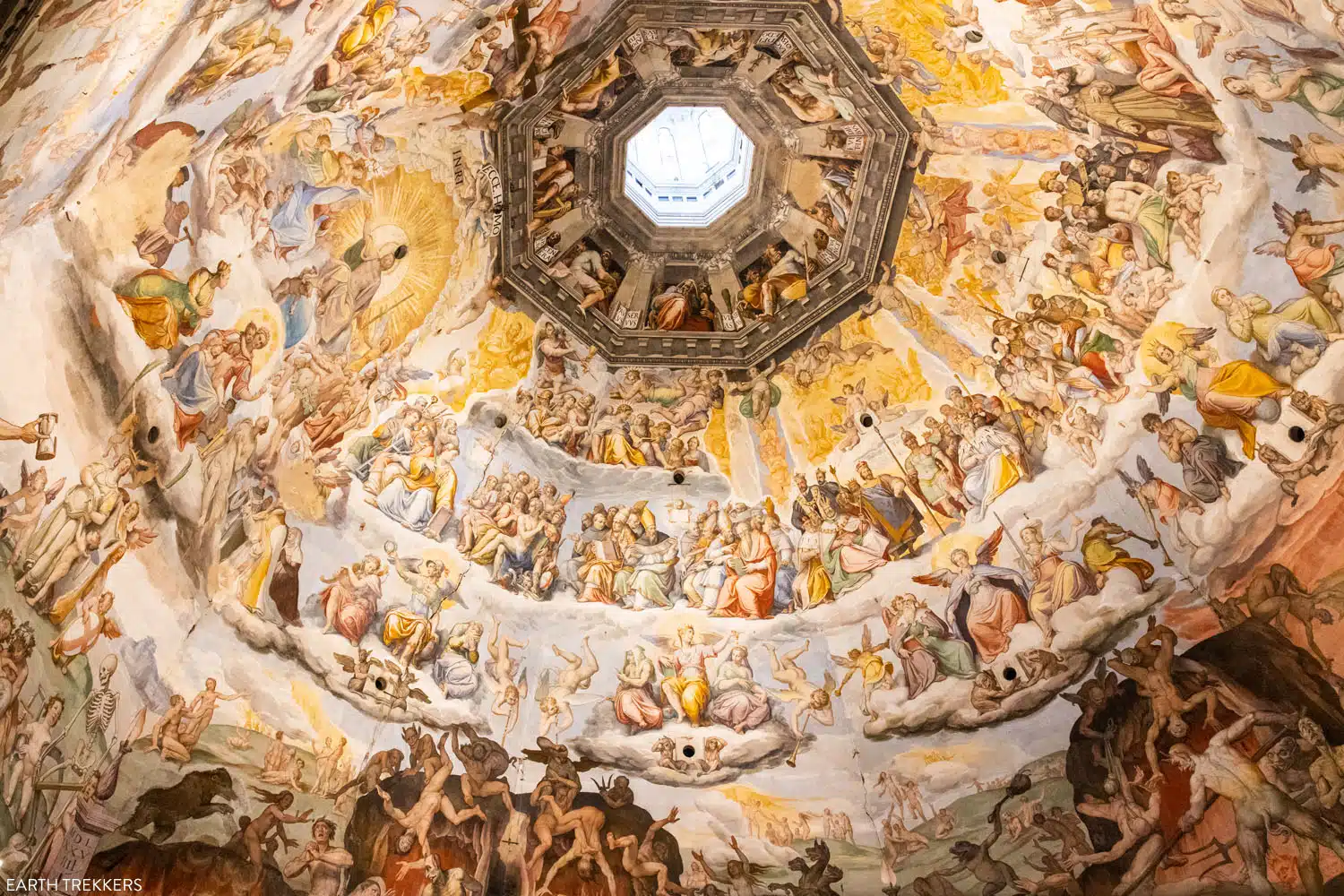
The Last Judgement frescoes
After you see the frescoes, it is still quite a few staircases to the very top, and these can be very narrow.
Once on top of the dome, you get 360° views of Florence, making this one of the best viewpoints of this city.
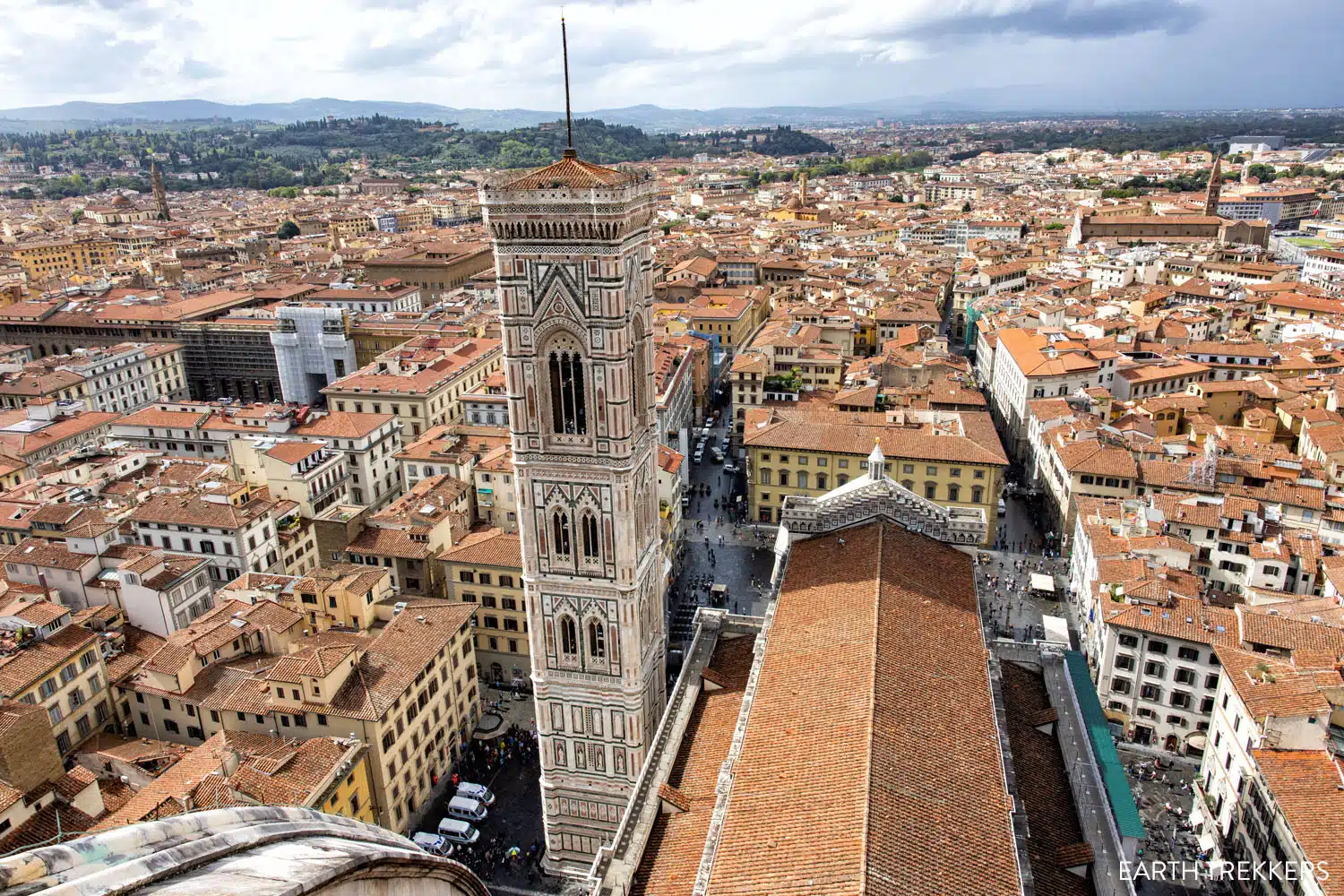
The view from the dome
How to Visit Brunelleschi’s Dome
You must make a reservation in advance. You cannot just walk up and get in line for the dome. In order to do the dome climb, purchase the Brunelleschi Ticket online and you will be prompted to reserve a time slot.
The Brunelleschi Ticket also covers the other sites of the monumental complex of Santa Maria del Fiore and you have 3 days to visit everything. Learn more about the ticket types on our guide How to Visit the Florence Cathedral.
In September, we had no problems booking our dome climb two days in advance. In the summer, when Florence is a little busier, I recommend booking your dome climb earlier than this, maybe 5 to 7 days in advance. Keep an eye on the weather because the dome will close during thunderstorms.
If time slots are sold out for your visit, you can join a tour of the Duomo that includes the dome climb.
3. Step Inside the Baptistery of San Giovanni
This is also included as part of the Duomo complex. If you purchase the Brunelleschi Pass to climb the dome, your entrance into the Baptistery is included. The Baptistery is the octagonal building that sits in front of the Duomo.
The Baptistery is older than the cathedral. Built between 1059 and 1128, it was constructed in a Florentine Romanesque style.
The Baptistery is famous for its three sets of bronze doors. Ghiberti created the north doors and the east doors (the Gates of Paradise) and Andrea Pisano created the south doors.
The original Gates of Paradise doors are located in the Opera del Duomo Museum. What you see at the Baptistery is a replica.
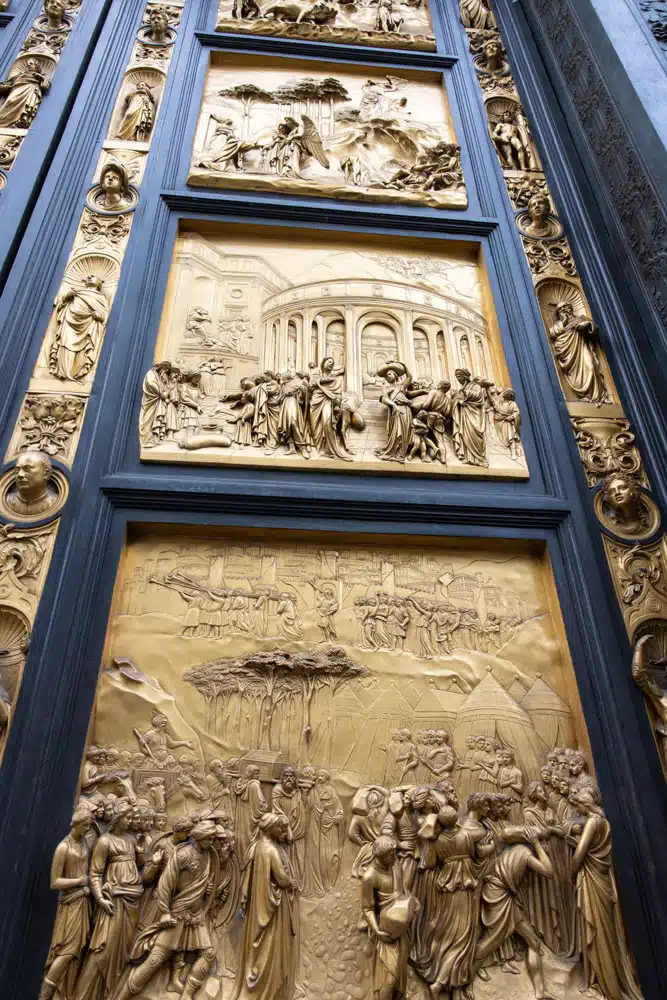
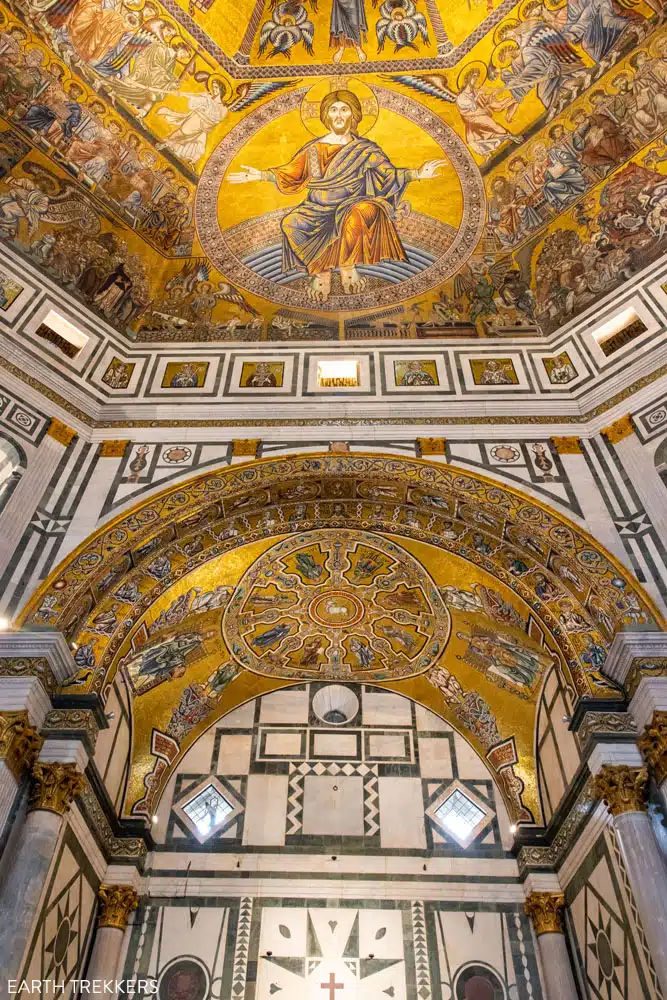
A visit inside of the Baptistery is relatively quick (10 to 15 minutes) and it is absolutely worth it to see the golden mosaic ceiling. Note: The Baptistery is currently undergoing a restoration project and the mosaics are not visible.
4. Discover the Opera del Duomo Museum
This museum displays a lot of the artwork that once adorned the Baptistery, the Bell Tower, and the cathedral.
On display are Ghiberti’s Gates of Paradise doors created for the Baptistery, an exhibit on the construction of the dome, and a replica of cathedral façade.
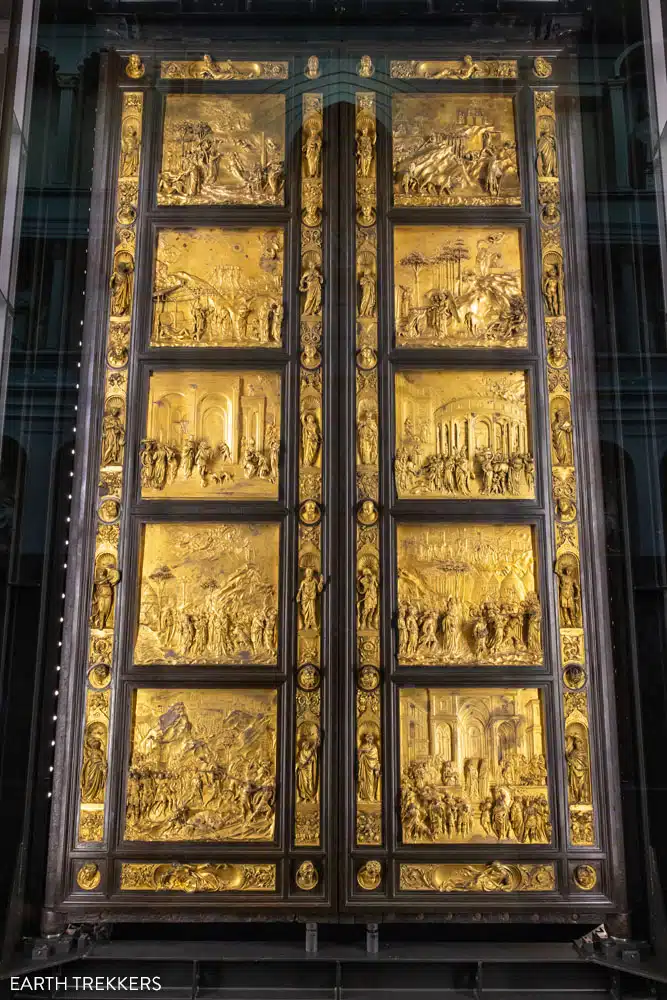
The original Gates of Paradise doors
This museum is part of the Duomo complex and is included on the Brunelleschi Pass. It is located behind the Florence Cathedral.
5. Climb Giotto’s Bell Tower for a Unique View of the Dome
For another breathtaking view of Florence, climb the 414 steps to the top of Giotto’s Bell Tower. This tower sits next to the front of the cathedral. To get to the top, you will climb a long series of staircases and along the way, can stop at several terraces for a break and a view of Florence.
There is no elevator…it’s just one long stair climb to the top.
This was once one of our favorite views in Florence. On our first visit here, we had an unobstructed view and could take magnificent photos (the photo below). However, a black mesh fencing has been added around the top of the bell tower, so you can no longer take photos from here without also photographing this mesh barrier if you have a DSLR camera. However, a phone with a small camera should be able to take photos without capturing the mesh barrier.
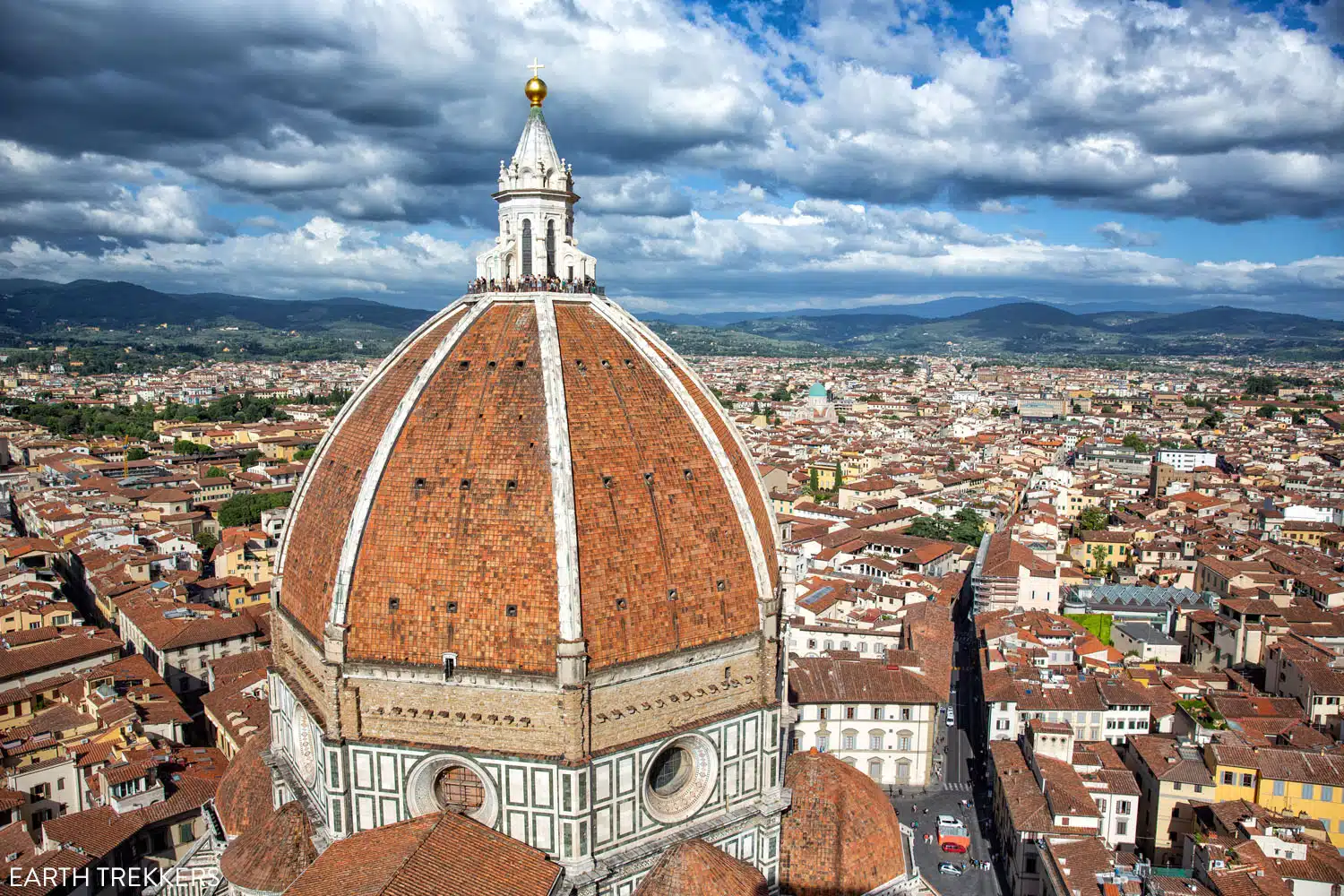
The view of the dome from Giotto’s Bell Tower
I still think it’s worth it for the view, especially since you have a great view of the dome from this spot. A visit here typically lasts 45 minutes and it is included on the Brunelleschi Pass.
6. Soak Up the Atmosphere in Piazza del Duomo
Piazza del Duomo is the piazza that sits in front of the Duomo. This is a busy place from 9 am through sunset, as thousands of visitors are touring the Duomo, museum, Baptistery, and bell tower.
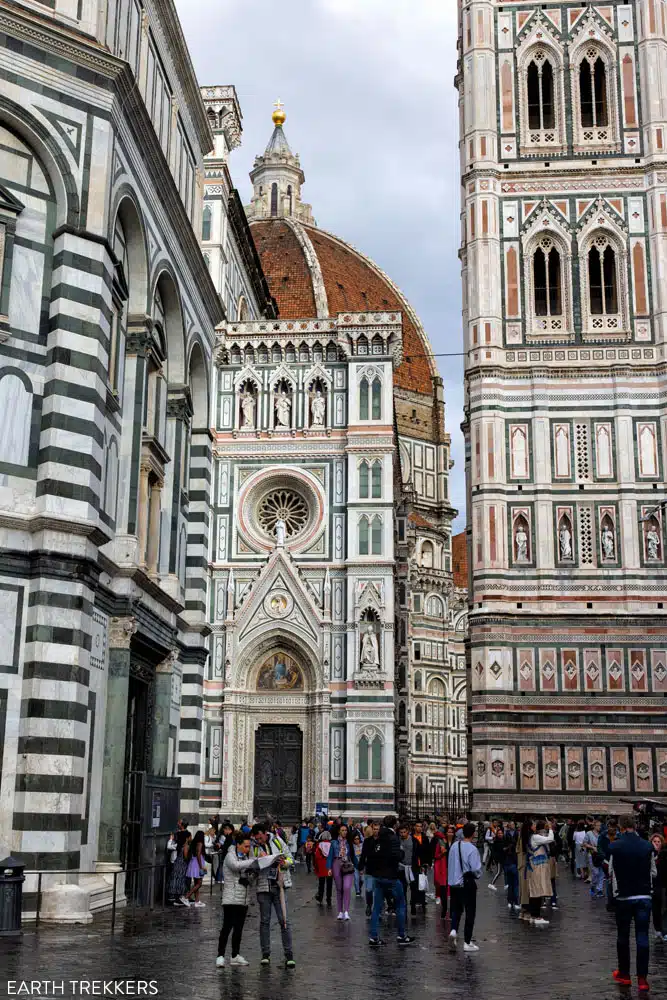
Piazza del Duomo
While you are here, it is well worth your time to walk around the Cathedral, gaze up at the dome, and take lots of photos. You also get a gorgeous view of the duomo from near the Baptistery.
For the lowest crowds, get here by 8 am. Evenings around 9 pm and later also tend to be less busy.
Piazzas, Palaces & Landmarks
7. Explore Piazza della Signoria, Florence’s Outdoor Sculpture Gallery
Piazza della Signoria is Florence’s main civic square and one of its most atmospheric spaces. It sits in front of Palazzo Vecchio and is worth lingering in, because there is genuine art to see here for free.
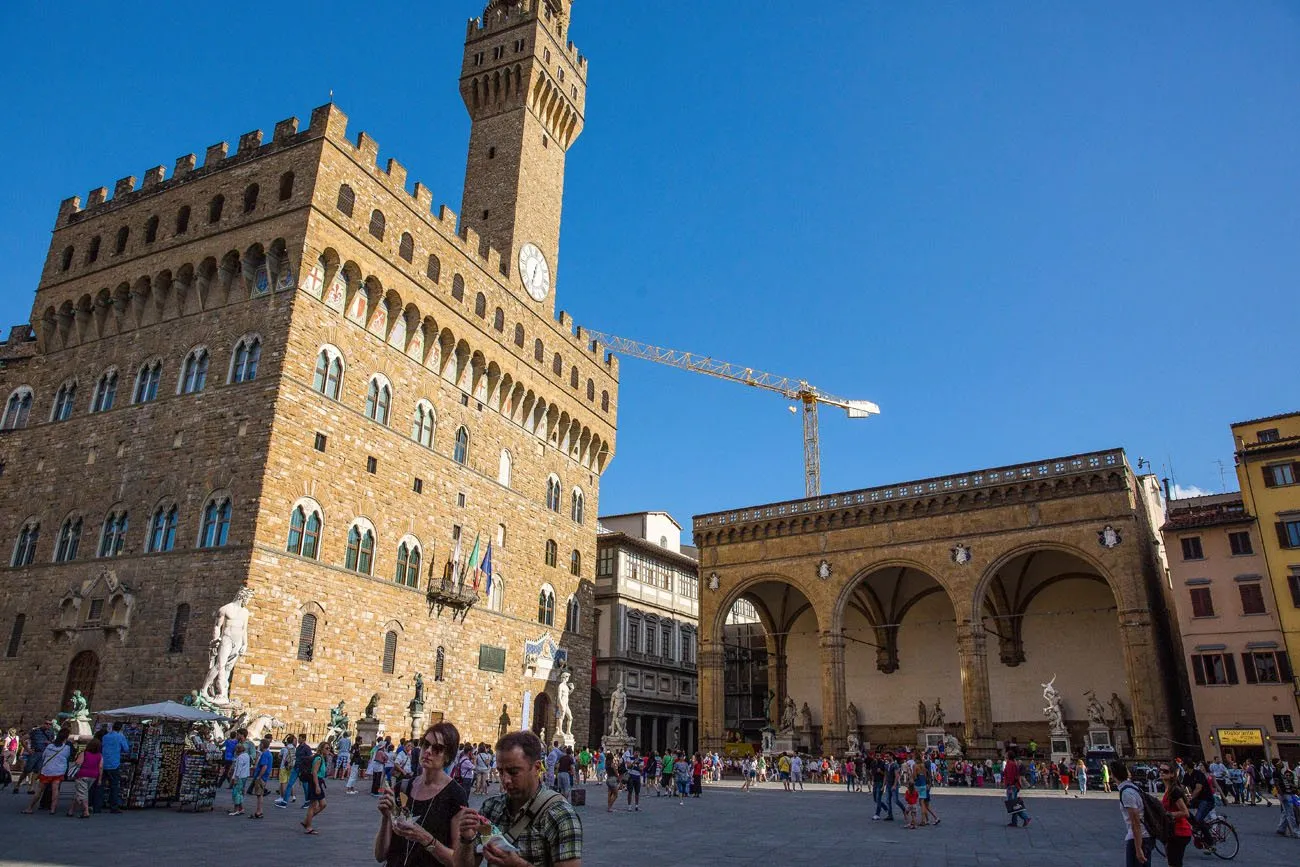
Piazza della Signoria
The Loggia dei Lanzi is an open-air sculpture gallery packed with Renaissance works, including Cellini’s Perseus with the Head of Medusa and Giambologna’s Rape of the Sabine Women.
A replica of Michelangelo’s David also stands near the entrance to Palazzo Vecchio, marking the spot where the original stood for centuries before being moved to the Accademia for protection.
The Neptune Fountain was commissioned by the Medici family and was completed in 1574.
8. Climb the Arnolfo Tower for the Best View of the Duomo
The Palazzo Vecchio is the town hall of Florence and it sits on Piazza della Signoria. Things to do here include touring the museum, taking a tour of the Roman Ruins, or, you can do our favorite activity, climb the Arnolfo Tower for one of the best views of Florence.
This is one of our favorite views of Florence, since this is one of the best spots to get a great photo of the Florence Cathedral.
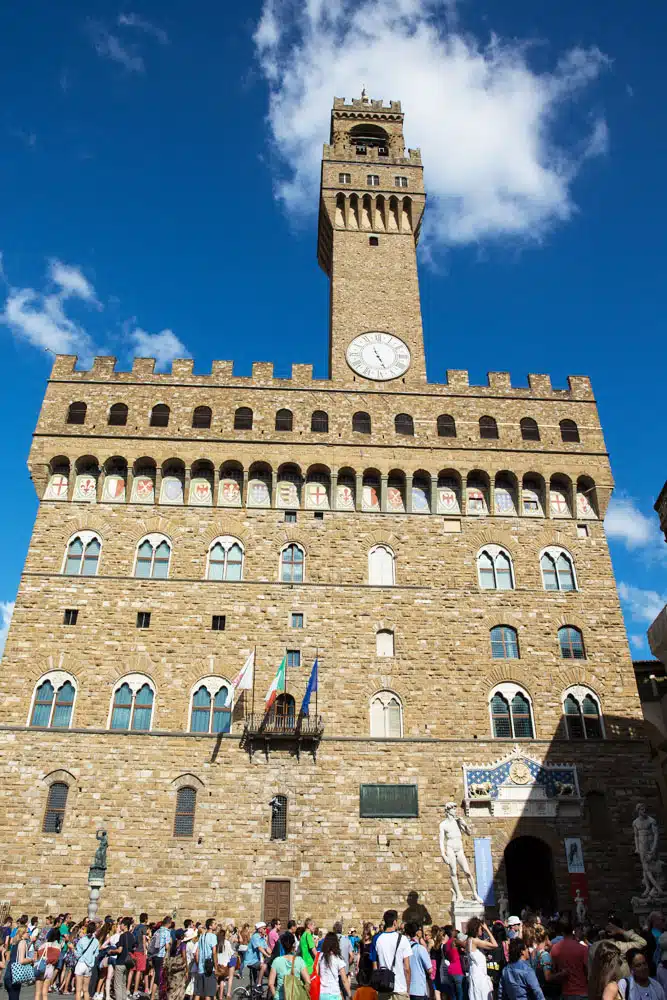
Palazzo Vecchio
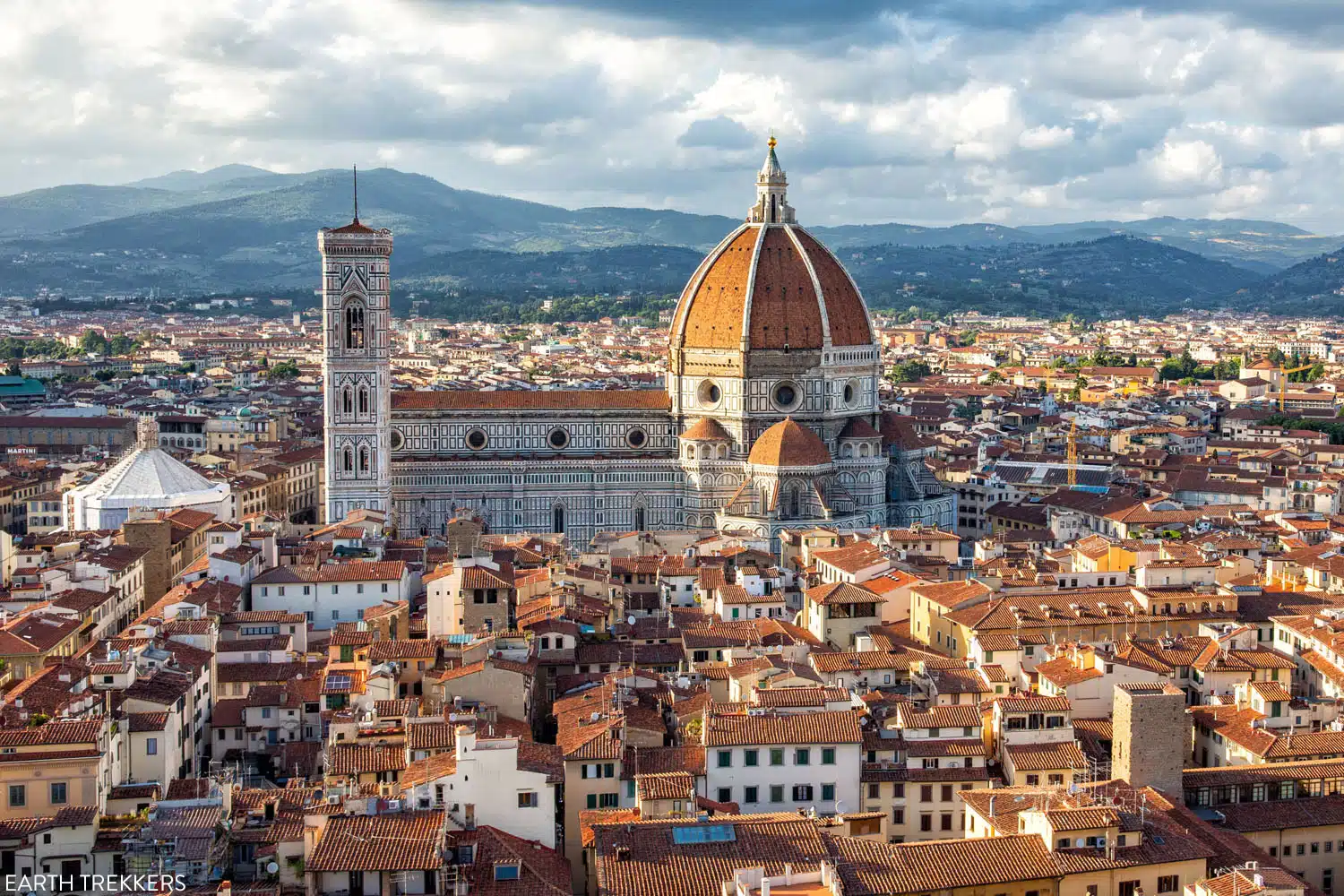
The view from the Arnolfo Tower
How to Visit Palazzo Vecchio
Cost: Museum €18, Tower €20; included on the Firenze Card
More Information: Visit the official website for full details on hours, tours, and here is the link to purchase your tickets.
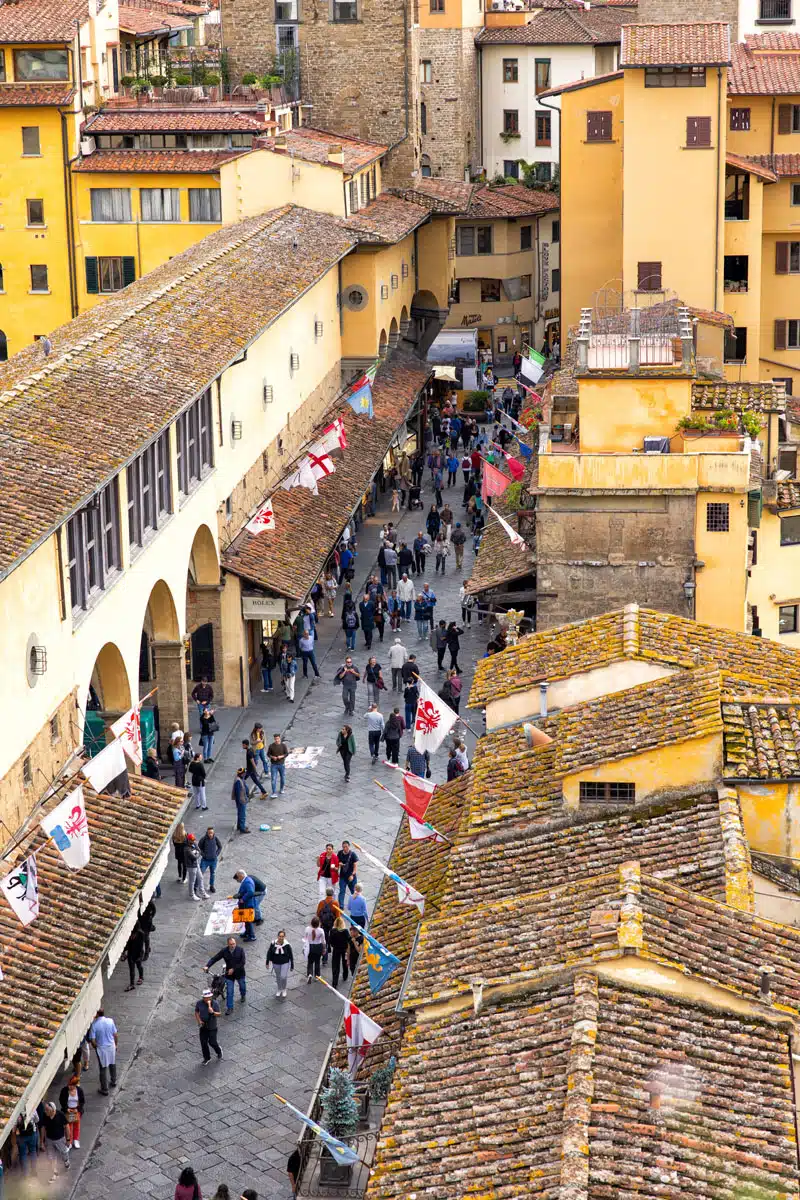
9. Stroll across Ponte Vecchio
Ponte Vecchio — “old bridge” in Italian — is a medieval stone bridge spanning the Arno River, and one of those sights that looks exactly like the photos and somehow still manages to surprise you. Shops have lined its sides for centuries, and today they mostly sell jewelry.
Walk across it, pause at the center for views up and down the Arno, and if possible, come back at sunset when the light on the water is beautiful. It’s free, open 24 hours, and worth visiting more than once.
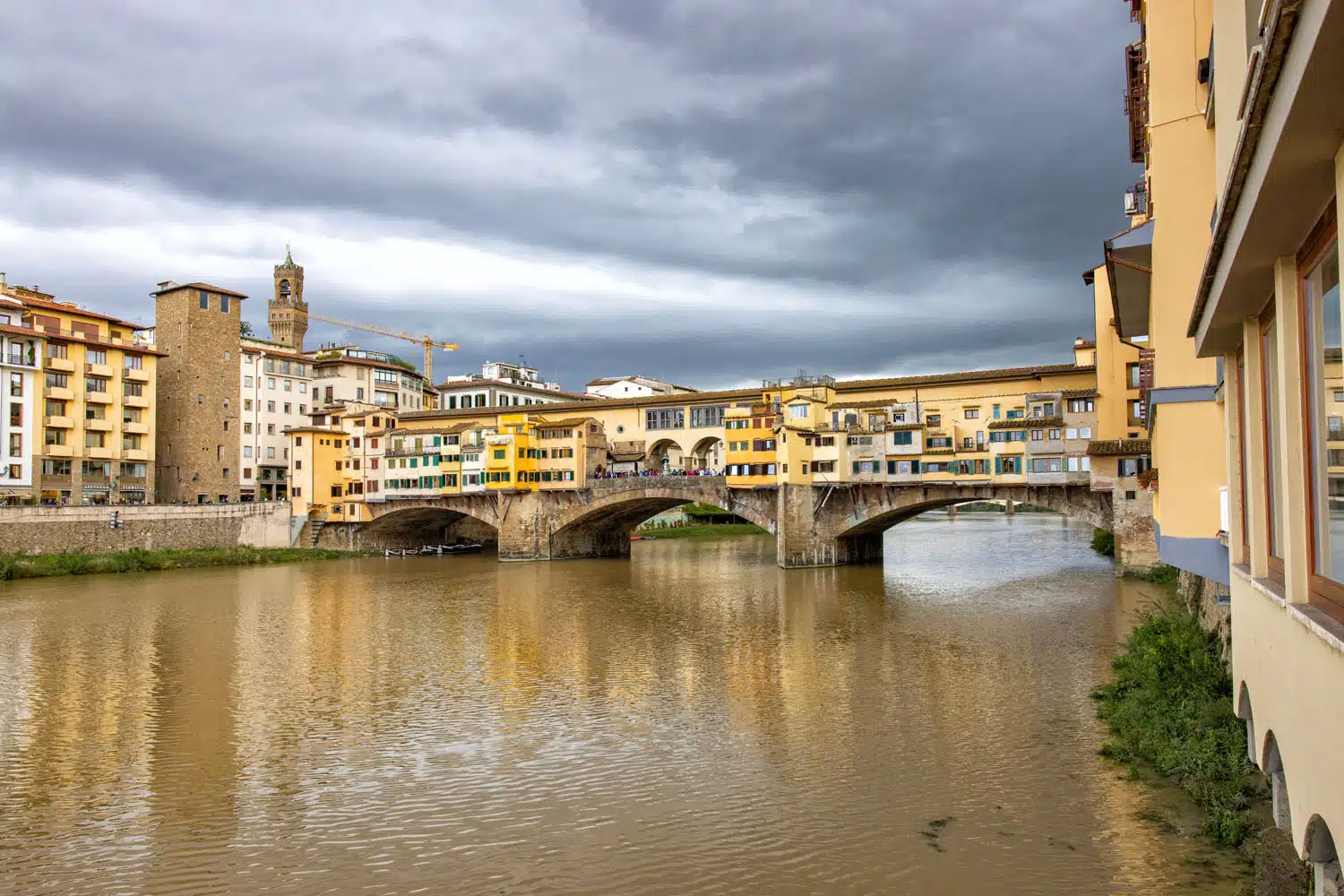
Ponte Vecchio
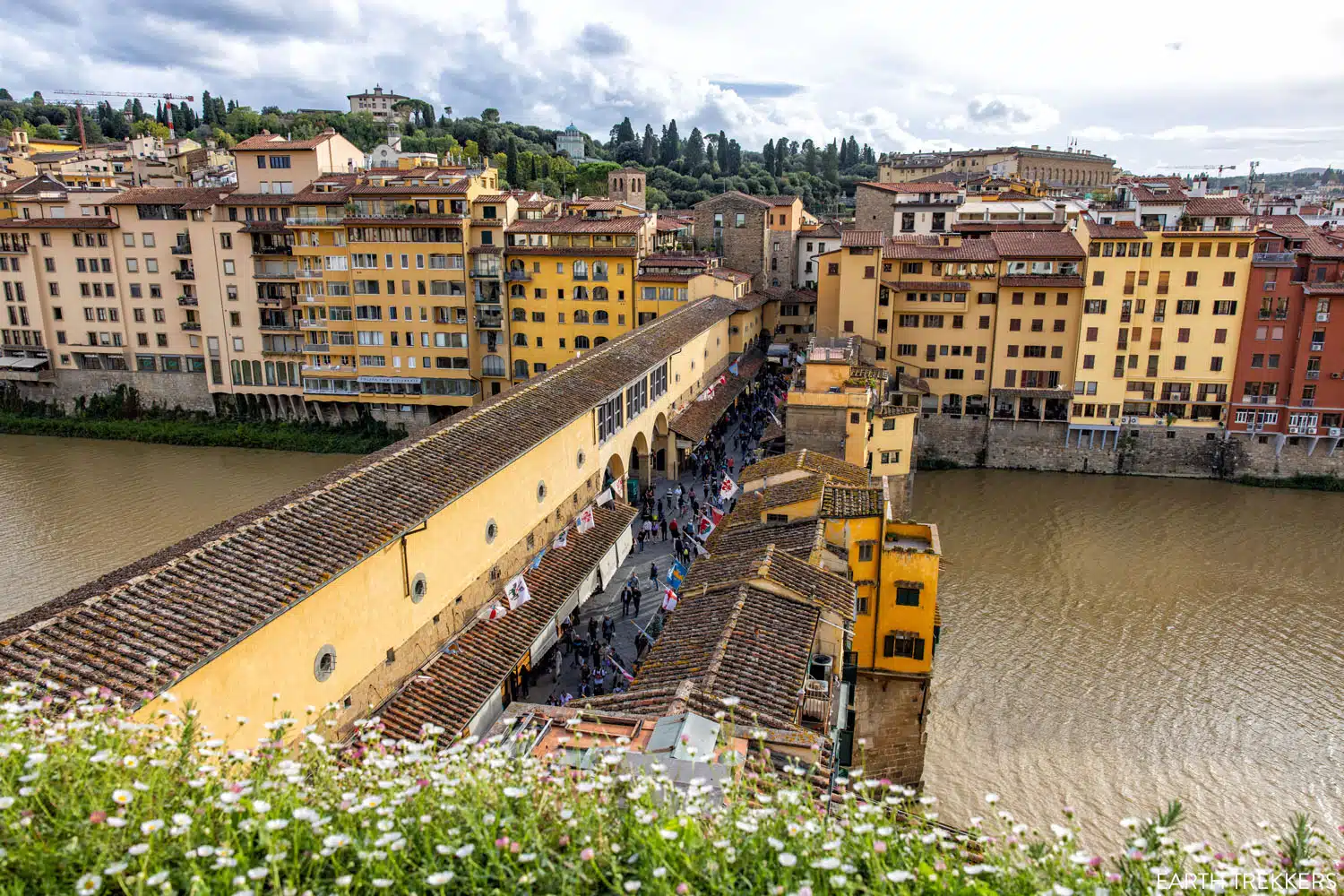
Overlooking Ponte Vecchio from La Terrazza rooftop bar (now closed)
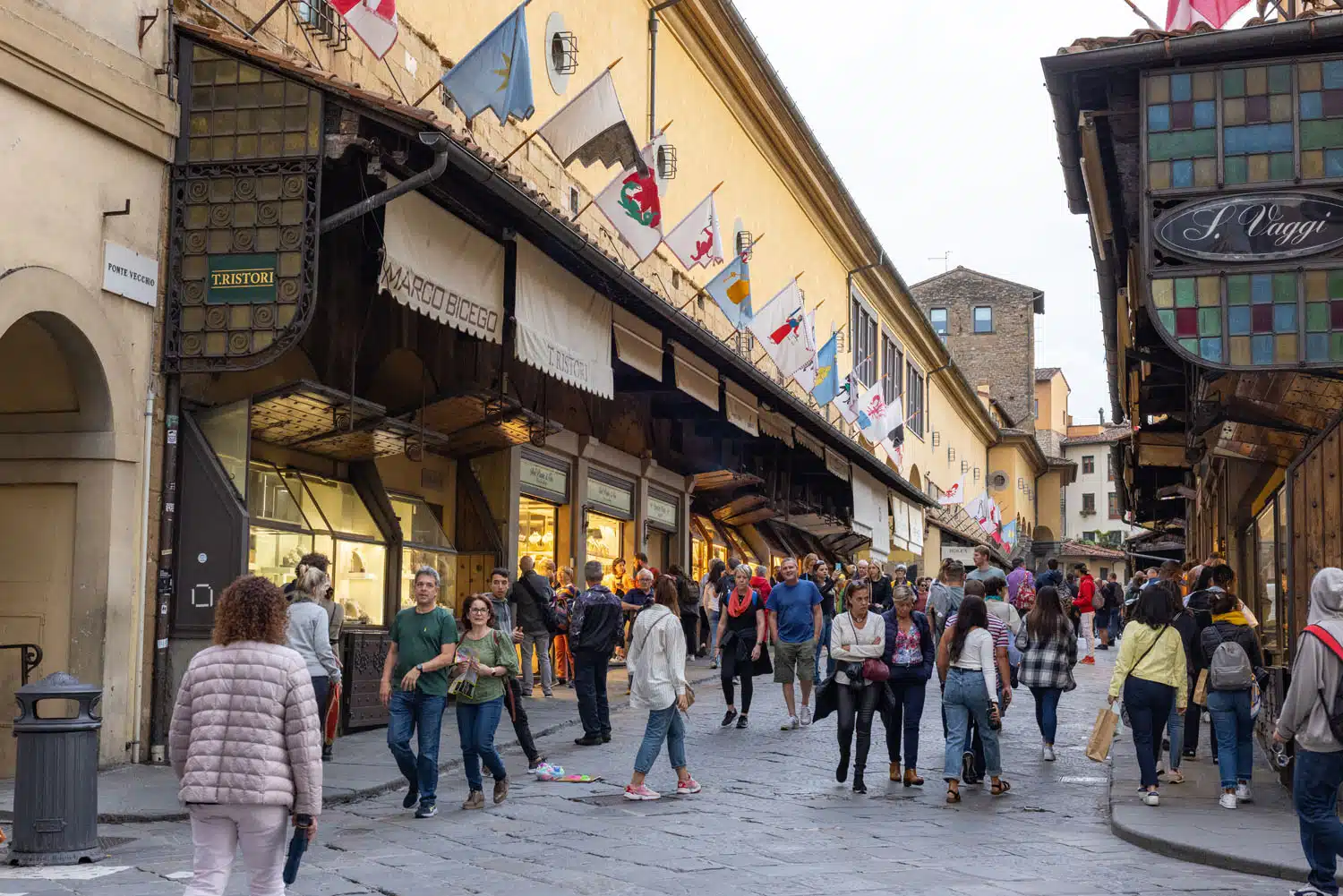
Ponte Vecchio
10. Walk the Vasari Corridor Above the Rooftops of Florence
The Vasari Corridor is an elevated, enclosed passageway built in 1565 to allow the Grand Duke to walk between Palazzo Vecchio and Palazzo Pitti without descending to street level. It runs through the Uffizi, over Ponte Vecchio, and past the church of Santa Felicita, a remarkable piece of Renaissance engineering.
Access is limited to guided tours and availability is genuinely scarce. It’s worth attempting to book well in advance, but don’t build your itinerary around it.
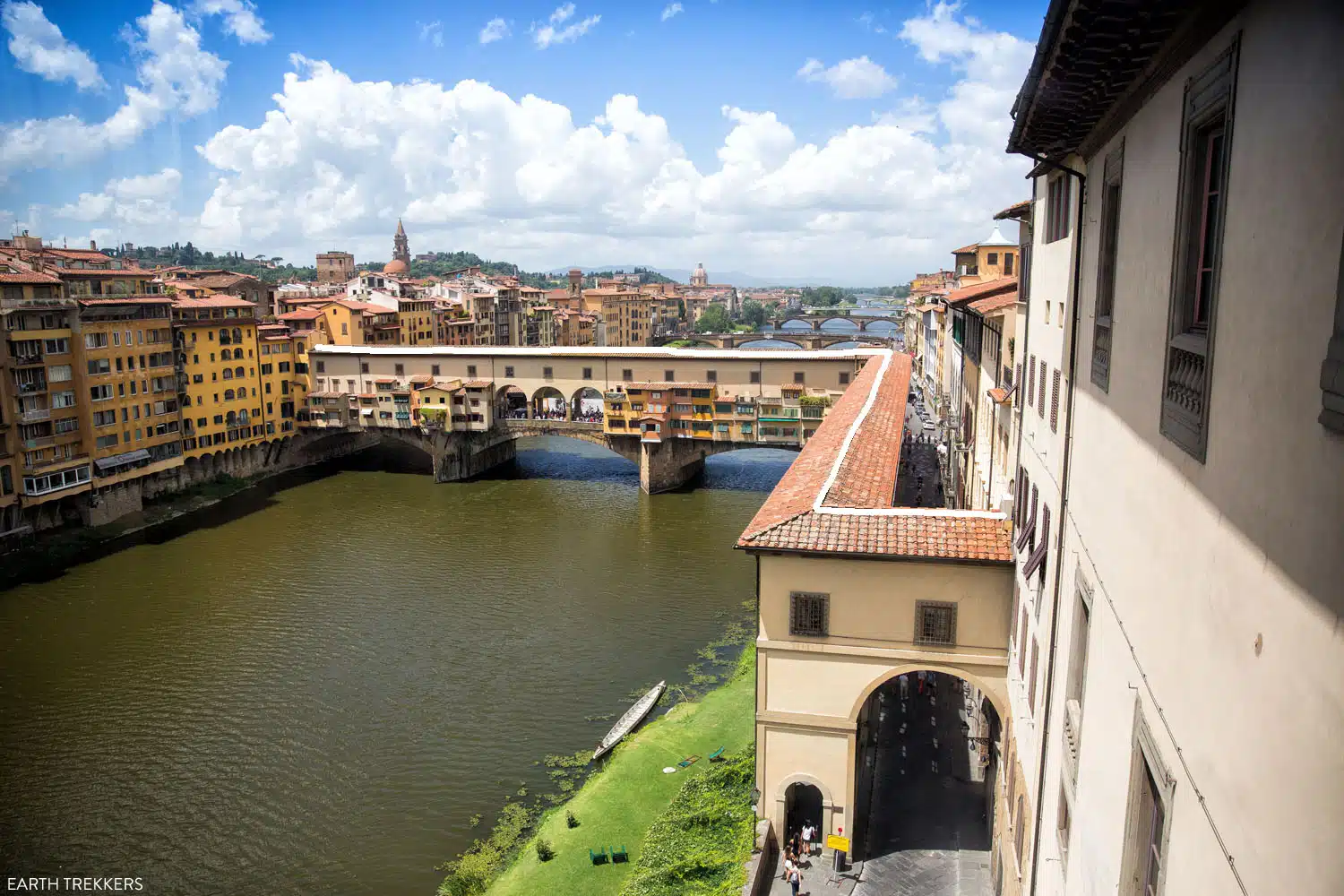
The path of the Vasari Corridor is marked with the white line.
11. Stop for Coffee in Piazza della Repubblica
Piazza della Repubblica is a large, lively square in the heart of Florence, built in the late 19th century on the site of the old Roman forum and medieval market. It’s not Florence’s most historically rich piazza, but we’ve walked through it on every visit. It’s a natural hub, ringed with cafes and always full of energy. Kids will love the carousel that sits in the center of the piazza.
Stop for a coffee at one of the historic bars on the square, or just pass through on your way between sights.
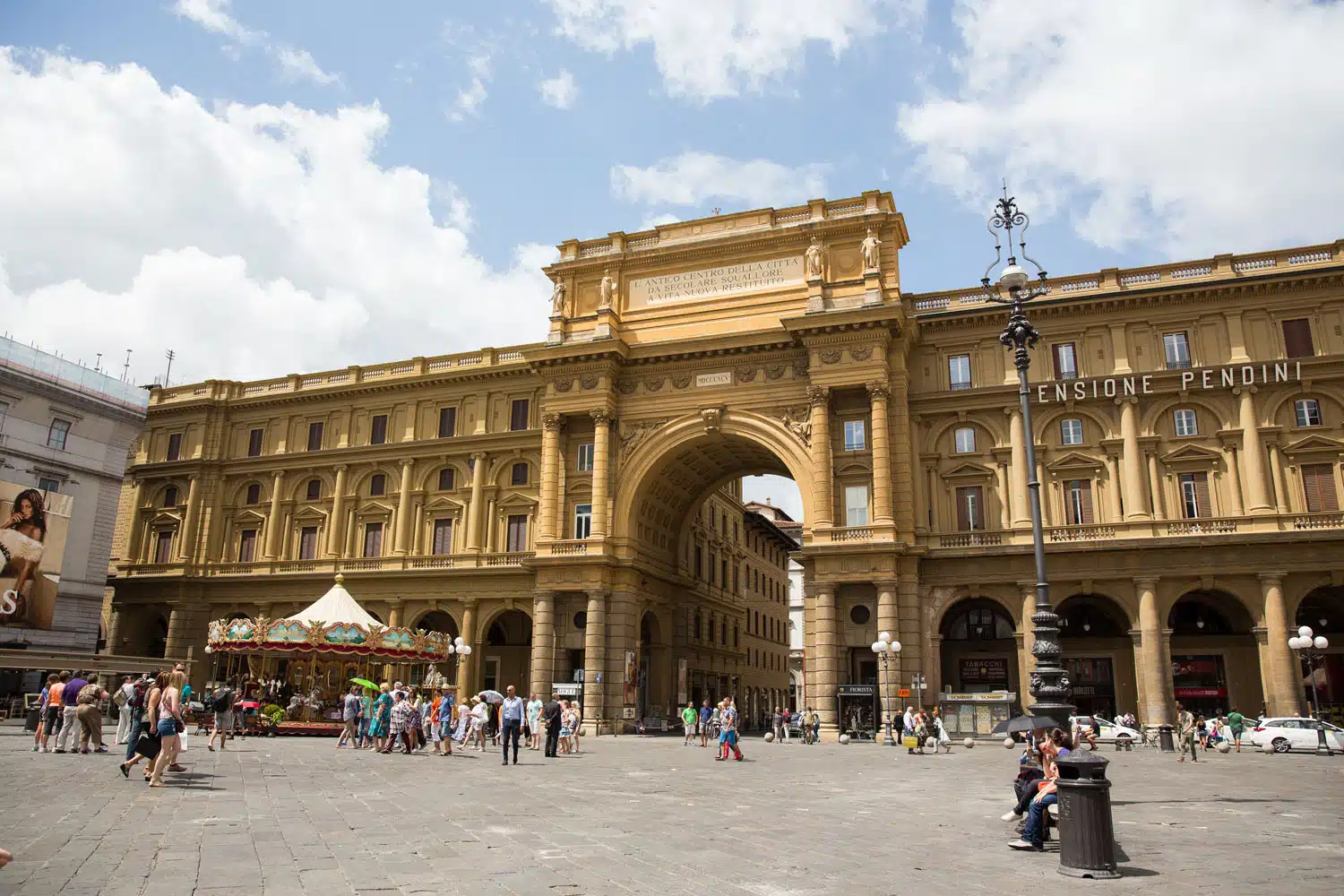
Piazza della Repubblica
For a unique view from this area, go inside the Rinascente department store, ride the elevator to the top floor, and visit Tosca & Nino, a rooftop bar with a view of the Duomo.
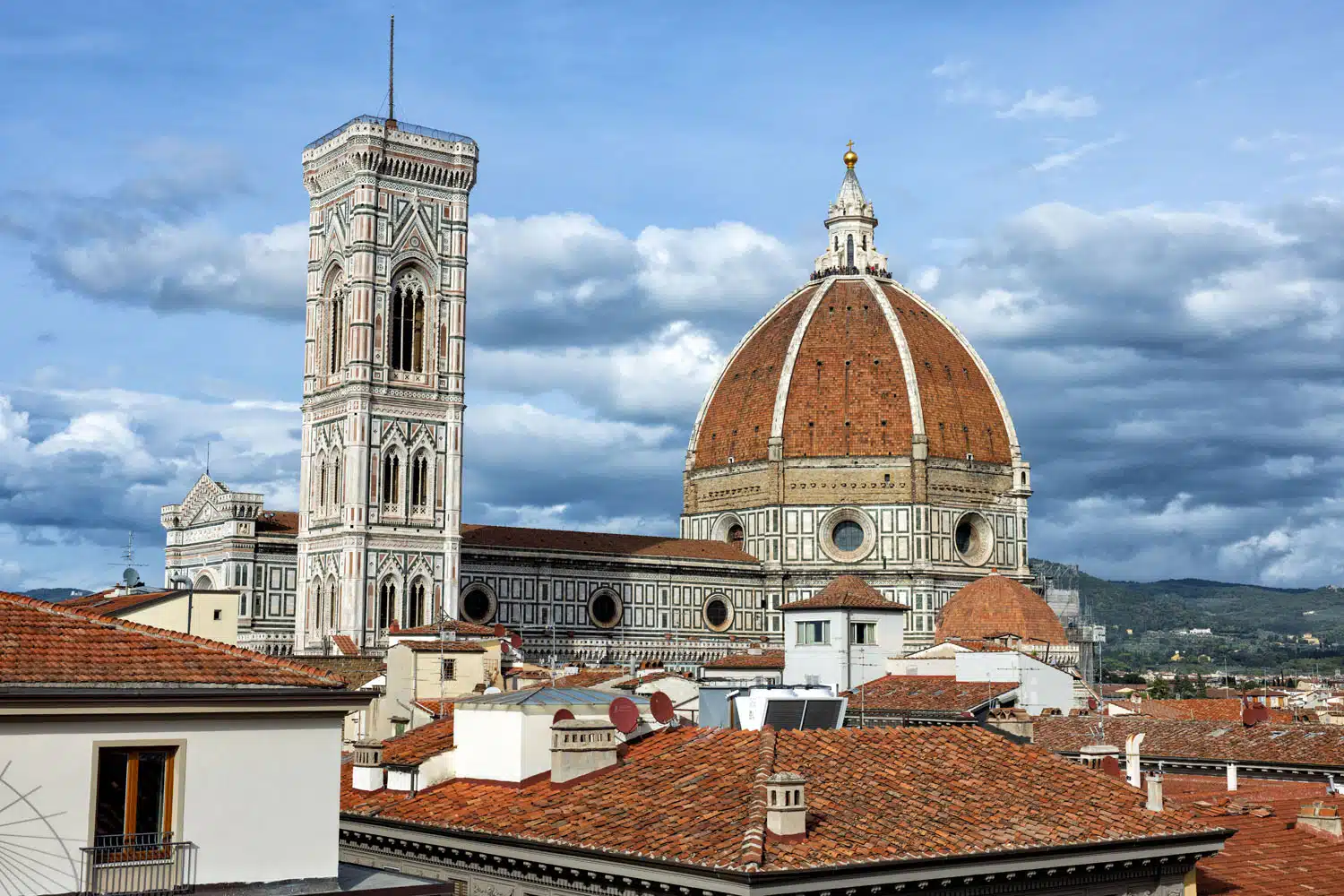
The view from Tosca & Nino
Art Museums in Florence
12. Visit the Uffizi Gallery, One of the World’s Greatest Art Museums
The Uffizi Gallery is not just the best art museum in Florence, it’s one of the most important art museums in the world.
Built in the 16th century as offices for the Medici family (uffizi means “offices”), it opened as a public museum in 1865 and now draws over four million visitors a year. The collection spans thousands of works from the Renaissance and beyond, including Botticelli’s Birth of Venus and Primavera, Leonardo da Vinci, Michelangelo, Raphael, Caravaggio, and Titian.
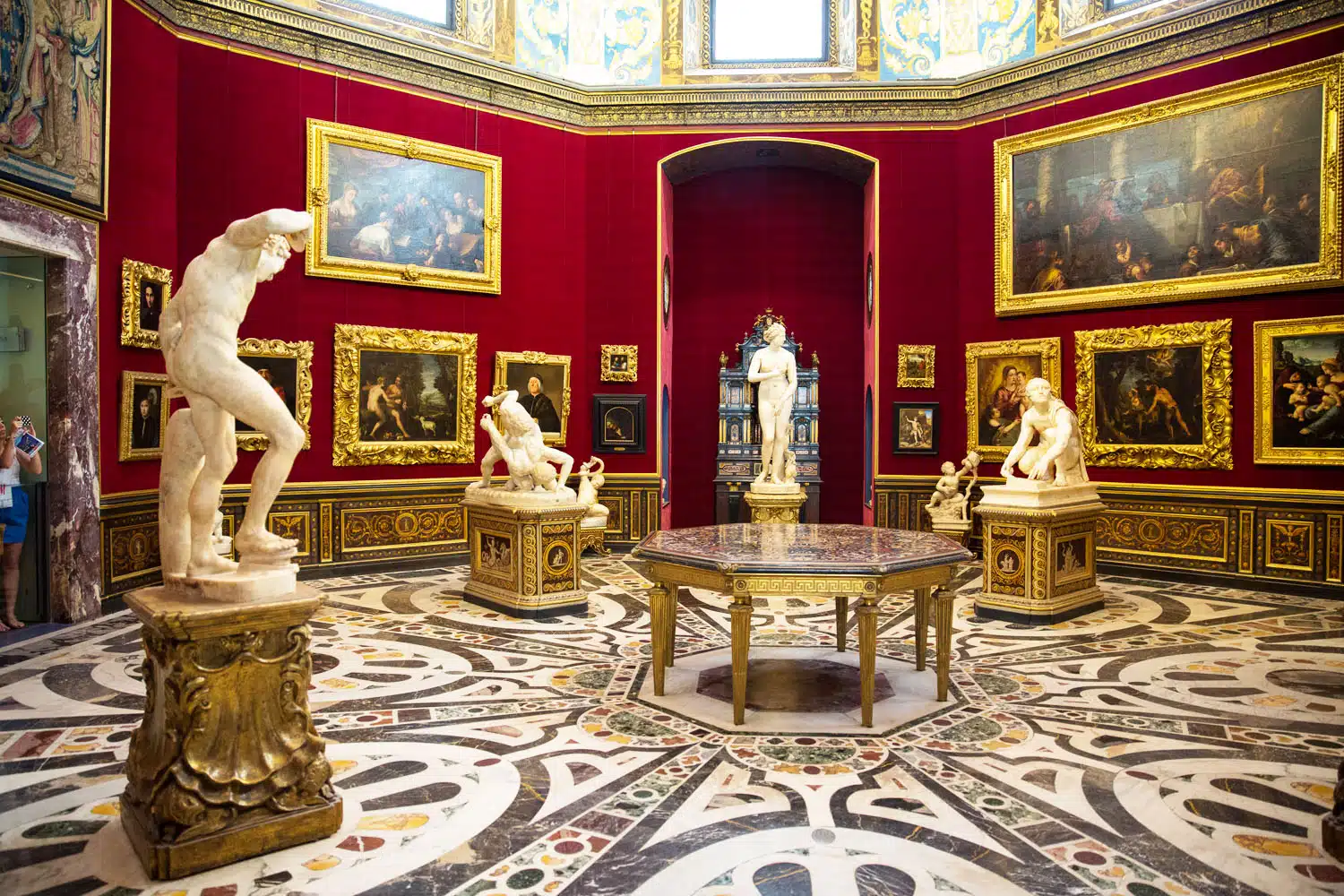
Uffizi Gallery
A guided tour is worth considering here. The sheer scale of the museum can be overwhelming without context, and a good guide brings the paintings to life in a way that an audio guide alone doesn’t quite match. Plan for at least two to three hours, more if you want to linger.
How to Visit the Uffizi Gallery
Cost: €29 online, €25 at the ticket office, €20 after 4 pm; included on the Firenze Card (advance reservation required)
Hours: 8:15 am – 6:30 pm Wednesday through Sunday; 8:15 am – 9:30 pm Tuesday; closed Monday
Website: Make your reservation online in advance on the official website or through GetYourGuide. Through GetYourGuide, you can cancel your reservation up to 24 hours in advance and get a full refund.
13. See David at Galleria dell’Accademia
Galleria dell’Accademia (also called the Accademia Gallery) is best known for Michelangelo’s statue of David. This statue once stood outside on Piazza della Signoria, but was moved here in 1873.
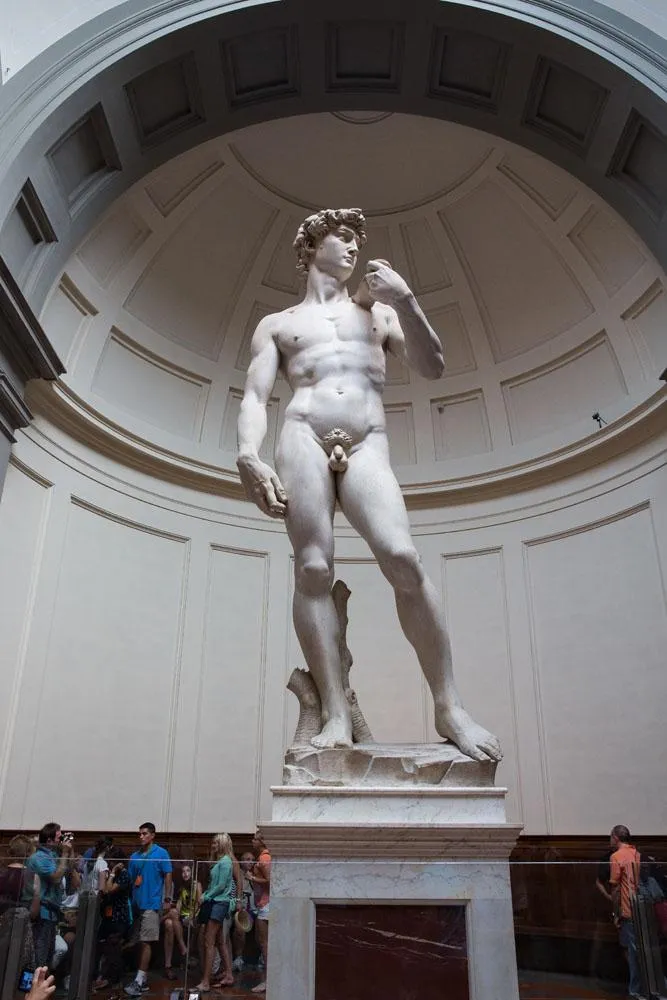
Seeing Michelangelo’s David in person is one of those experiences that genuinely lives up to the hype. We knew it was going to be impressive, but it exceeded our expectations. Standing over five meters tall, the level of detail is extraordinary: the veins on his hands, the tension in his expression, the definition of every muscle. Michelangelo carved it when he was just 26 years old, which makes it all the more astonishing.
If you can tear yourself away from David, there are more things to see inside of this art museum, including his unfinished Prisoners series, as well as paintings by Florentine artists. But let’s be honest. David is the reason everyone comes, and he’s worth every minute of the visit.
How to Visit Galleria dell’Accademia
Cost: €16 at the door (subject to availability); €20 online (€16 + €4 reservation fee); under 18 free. Combined tickets available from March 2026: 48-hour Accademia + Bargello pass €26 (+ €4 booking fee); 72-hour pass covering Accademia + all six Bargello museums €38
Hours: Tuesday–Sunday 8:15 am–6:50 pm (last entry 6:20 pm); extended Tuesday evening hours late June–early August until 10 pm; closed Mondays, January 1, May 1, December 25
Website: Book in advance on the official website or through GetYourGuide. The official government booking platform is b-ticket.com.
14. Explore the Bargello, Florence’s Most Overlooked Museum
If the Uffizi and Accademia are Florence’s headline acts, the Bargello is the hidden gem that rewards those who seek it out.
Housed in a medieval fortress that was once Florence’s main prison, the museum contains one of the finest collections of Renaissance sculpture in the world, including Donatello’s David (the first freestanding nude male sculpture since antiquity), works by Michelangelo, Ghiberti, Cellini, and Verrocchio, and an extraordinary collection of decorative arts. Michelangelo’s statue of Bacchus is located on the ground floor of the museum.
We found this museum significantly less crowded than the major museums, making it a pleasure to visit. If you have any interest in sculpture, don’t skip this one.
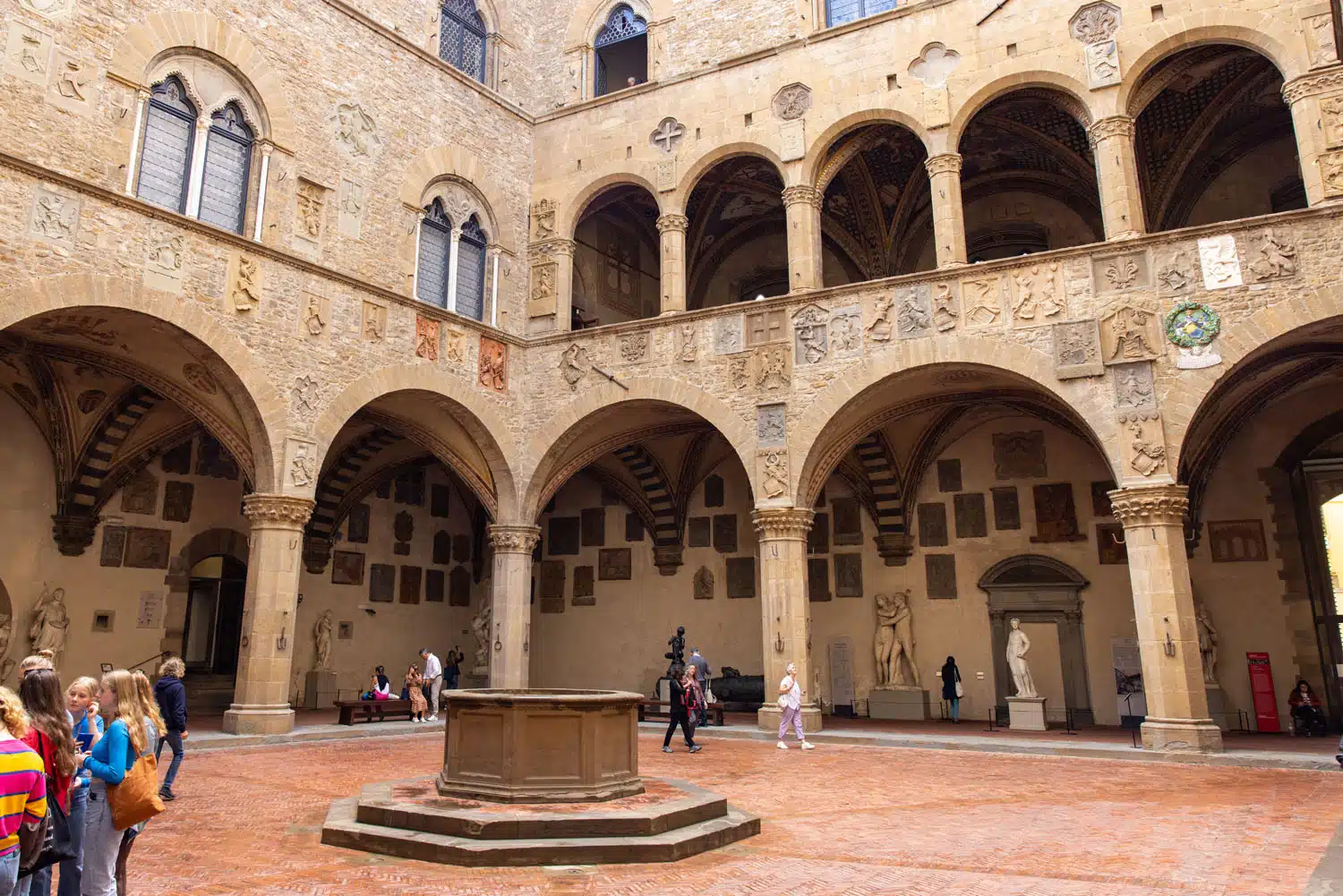
Bargello Museum
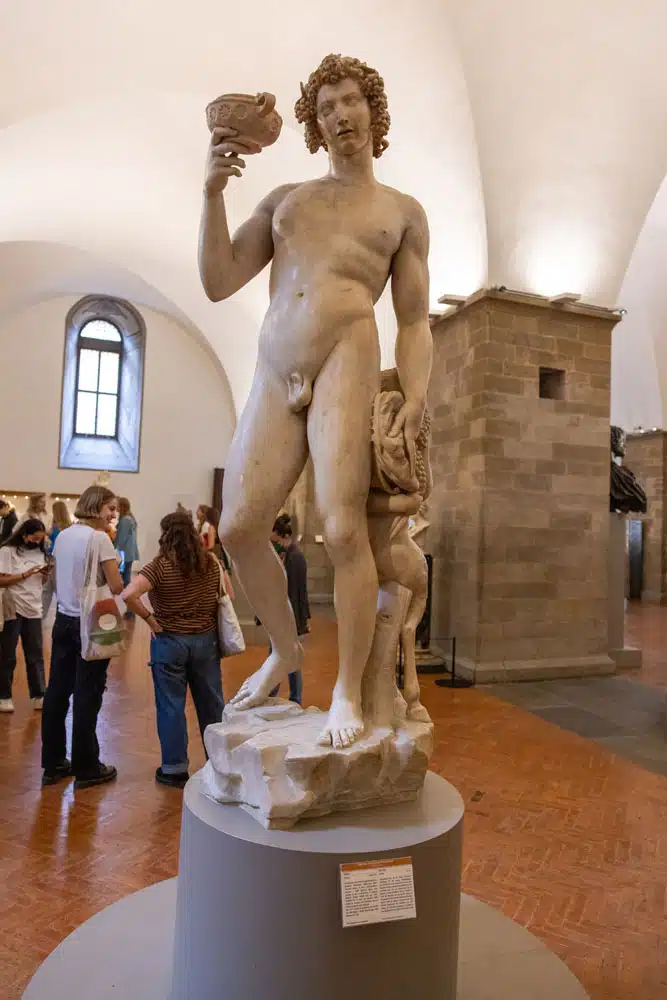
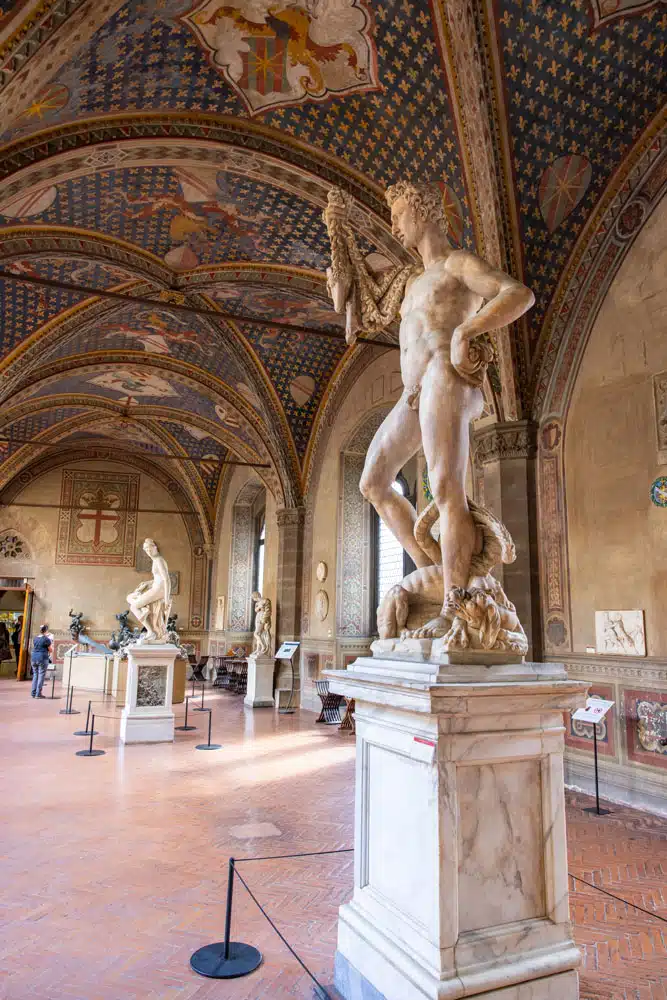
Michelangelo’s Bacchus and more statues in the Bargello
How to Visit the Bargello Museum
Cost: Standard admission €10; combined 48-hour Accademia + Bargello pass €26 (+ €4 booking fee); 72-hour pass covering both institutions €38. Book via the official government platform at b-ticket.com
Hours: Check the official website for current hours as these vary seasonally
Website: Official website
15. Visit the Galileo Museum for a Different Kind of Renaissance
This is a great museum for kids. We visited Florence with Tyler and Kara when they were 11 and 9, this was one of their favorite experiences in the city.
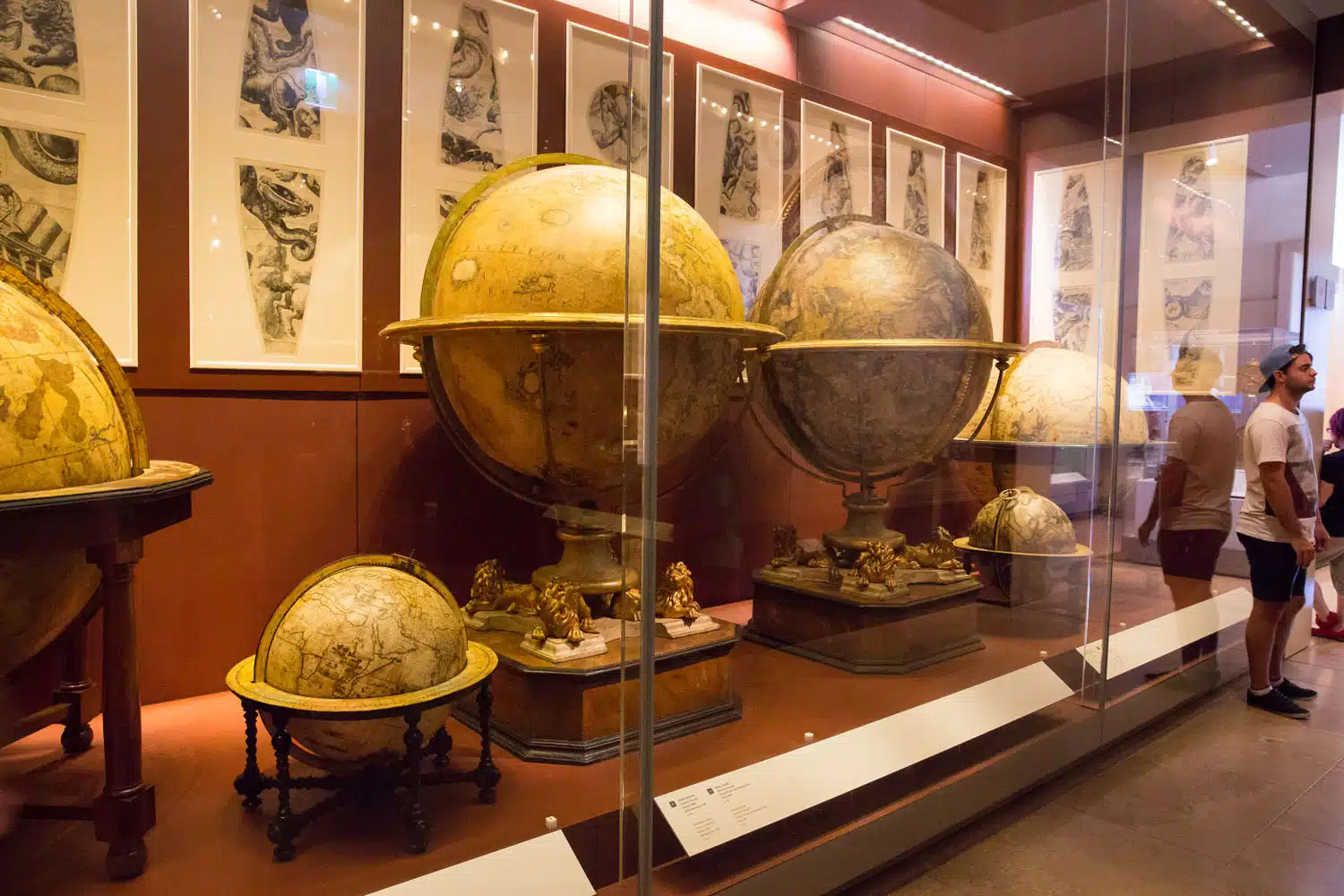
Galileo Museum
Museo Galileo contains telescopes used by Galileo, a huge collection of terrestrial and celestrial globes and armillary spheres, and even the middle finger of Gallileo’s right hand.
This museum is worth it for those with an interest in science or Galileo, or those traveling with kids.
How to Visit the Galileo Museum: This museum sits on the Arno River next to the Uffizi Gallery. Get updated hours and purchase your ticket in advance on the official website.
Gardens and Viewpoints
16. Wander Through Boboli Gardens and the Pitti Palace
The Pitti Palace and Boboli Gardens sit on the south side of the Arno River.
The Pitti Palace is a palace built in 1457 by Brunelleschi for the Pitti family. In 1550, it was purchased by Cosimo I de’ Medici as the new Grand Ducal residence. Now, the palace contains five museums: the Museum of Russian Icons, the Treasury of the Grand Dukes, the Imperial and Royal Apartments, the Museum of Costume and Fashion, and the Gallery of Modern Art.
Boboli Gardens sits behind the Pitti Palace. The gardens contain numerous Renaissance statues and fountains. From these gardens, you also get a very nice view of Florence.
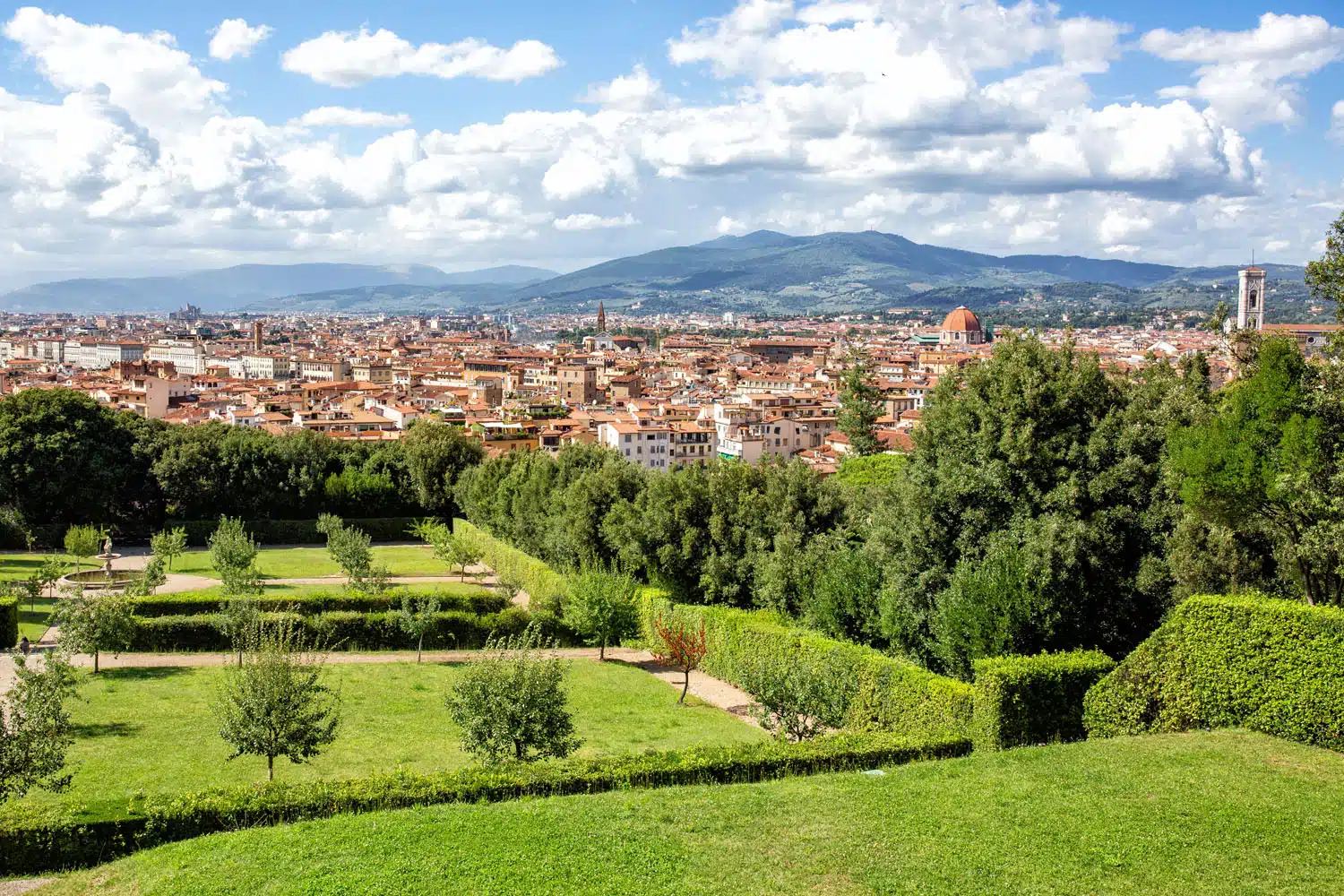
Boboli Gardens
How to Visit the Pitti Palace and Boboli Gardens
Cost: €10 for Boboli Gardens (€13 for tickets reserved online in advance); €16 for Pitti Palace (€19 for tickets reserved online in advance); €22 for a combined ticket (€25 for combined ticket reserved in advance); included on the Firenze Card
Hours: Boboli Gardens opens at 8:15 am; closing time varies depending upon the season; Pitti Palace is open Tuesday through Sunday from 8:15 am to 6:30 pm
Website: Visit the official website for updated hours and pricing for Boboli Gardens and the Pitti Palace.
17. Discover the Bardini Gardens, a Quieter Alternative to Boboli
The Bardini Gardens (also called Giardino Bardini) is the Renaissance garden of Villa Bardini. It makes a nice alternative to the busier Boboli Gardens.
This garden is located on the same hill as Boboli Gardens. The Bardini Gardens are much smaller, but because of their location, offer a better view of Florence.
On a visit here, there are two things to do: stroll through the gardens and visit the villa.
Inside of the villa there are art exhibits in the various rooms. Our favorite part was the terrace on the top of the villa with its stunning panoramic views of Florence.
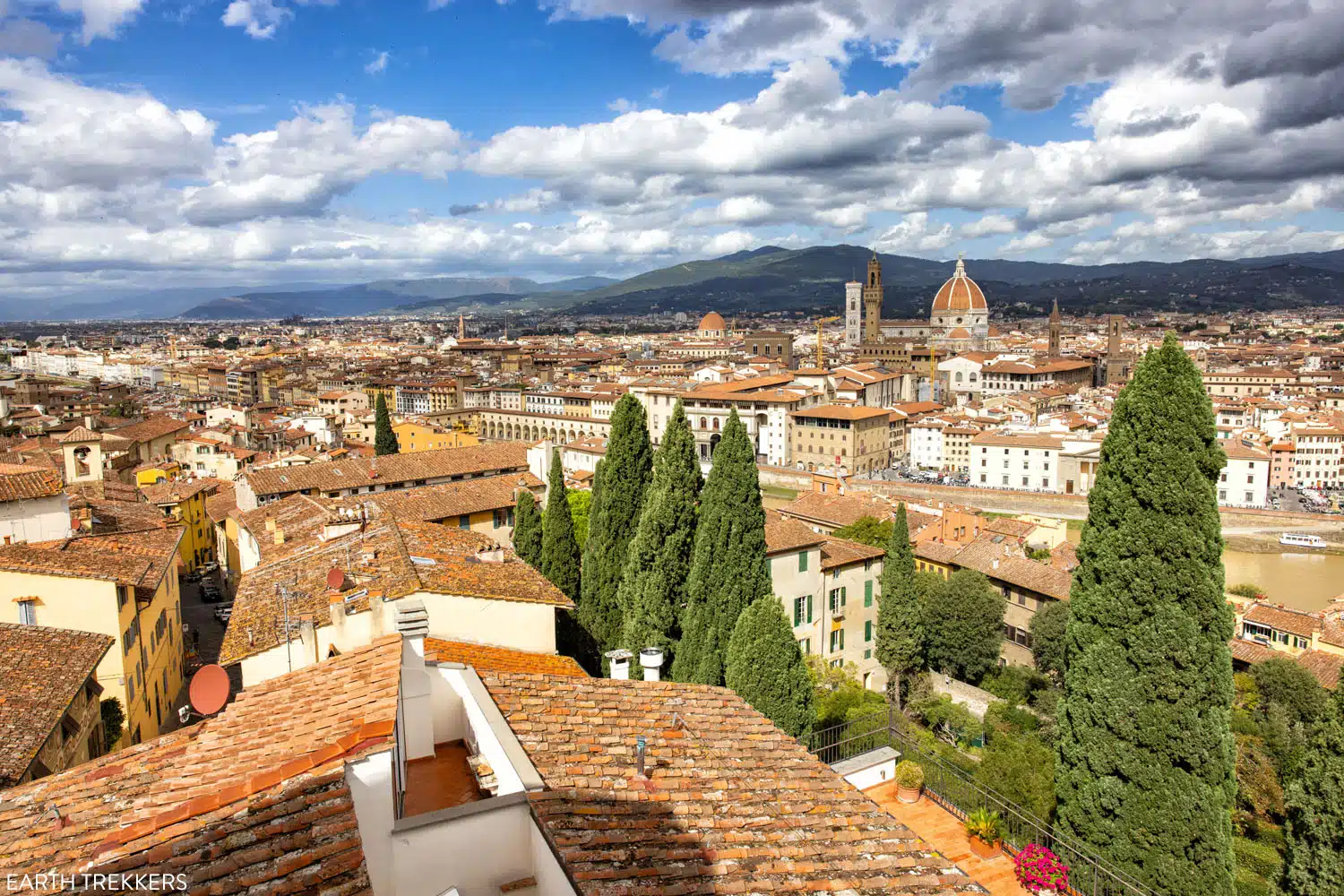
The view from Villa Bardini
In Bardini Gardens, make sure you see the Wisteria pergola. The wisteria was brought here from China by Marco Polo. It blooms in April and May but is pretty all year round (our photo was taken in September).
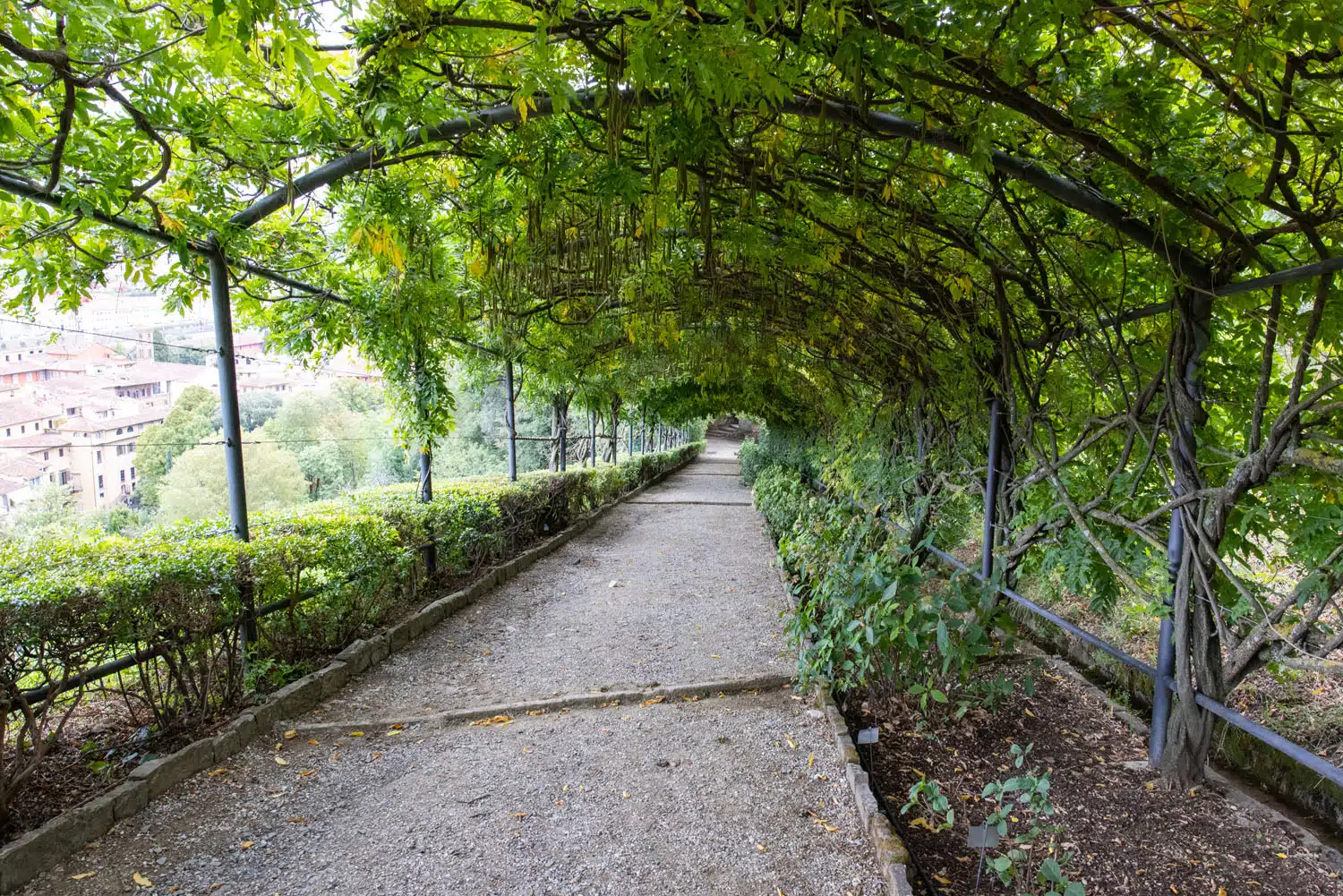
The Wisteria Pergola in September
At the top of the pergola is a wide terrace with another view of Florence (although the view from the top of the villa is much better) and a small restaurant.
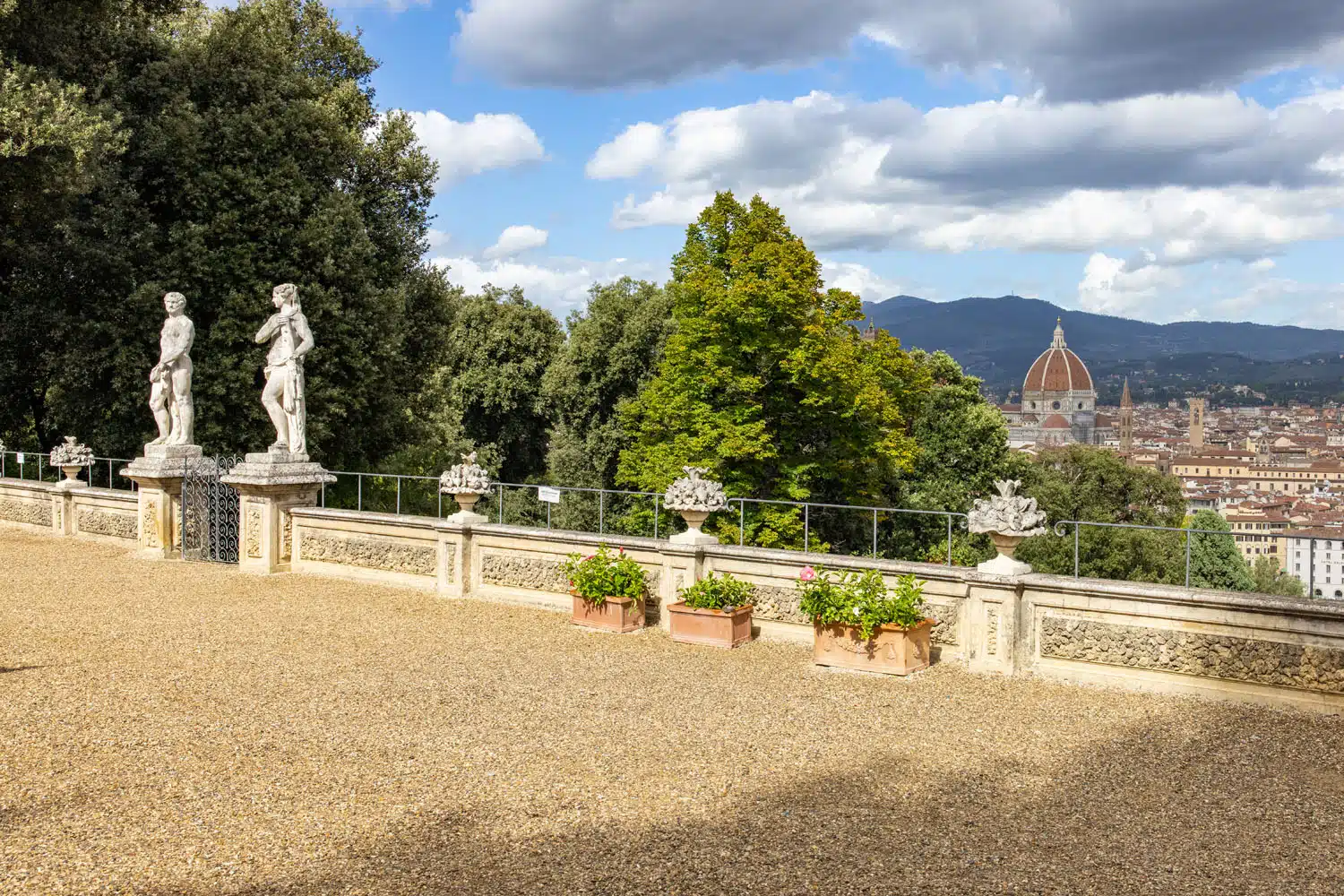
View from the terrace at Bardini Gardens
How to Visit the Bardini Gardens: Enter through Villa Bardini. To get here, it is an uphill walk on Costa San Giorgio from near Ponte Vecchio (you will pass the house of Galileo Galilei on this walk). Tickets cost €10 for the gardens and €10 for the villa, €15 for a combined ticket. The Bardini Gardens are included in the ticket for Boboli Gardens and included on the Firenze Card. Get updates on the official website.
18. Climb Porta San Niccolò for Views Over the Arno
Porta San Niccolo, also called the Tower of San Niccolo, is one of the remains of the defensive walls of Florence. It is located on the south side of Arno River, within walking distance of Piazzale Michelangelo and the Rose Garden (both of which are mentioned next).
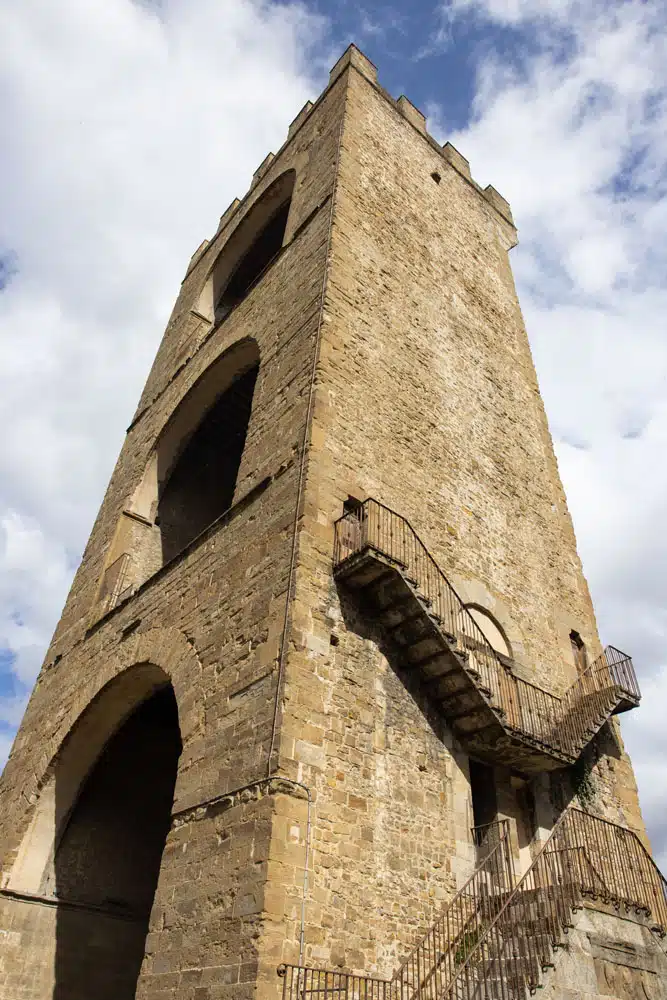
This was closed during our visit, but it is possible to go to top of the tower on a guided tour. I imagine that the view would be awesome, from its position on the Arno River.
It is only open for tours in the summer months. According to the sign at the base of the tower, tours run from the end of June through the end of September, between the hours of 4 pm and 8 pm. An advance reservation is necessary.
19. Stroll Through the Rose Garden
The Rose Garden, Giardino delle Rose, sits on the hillside below Piazzale Michelangelo and is one of those spots that feels like a secret even though it’s right in the middle of the city. It’s not our favorite viewpoint in Florence, but it’s free, peaceful, and worth a wander, especially in May and June when the roses are in bloom. We have some nice photos from here and it makes a pleasant stop on the walk up to Piazzale Michelangelo.
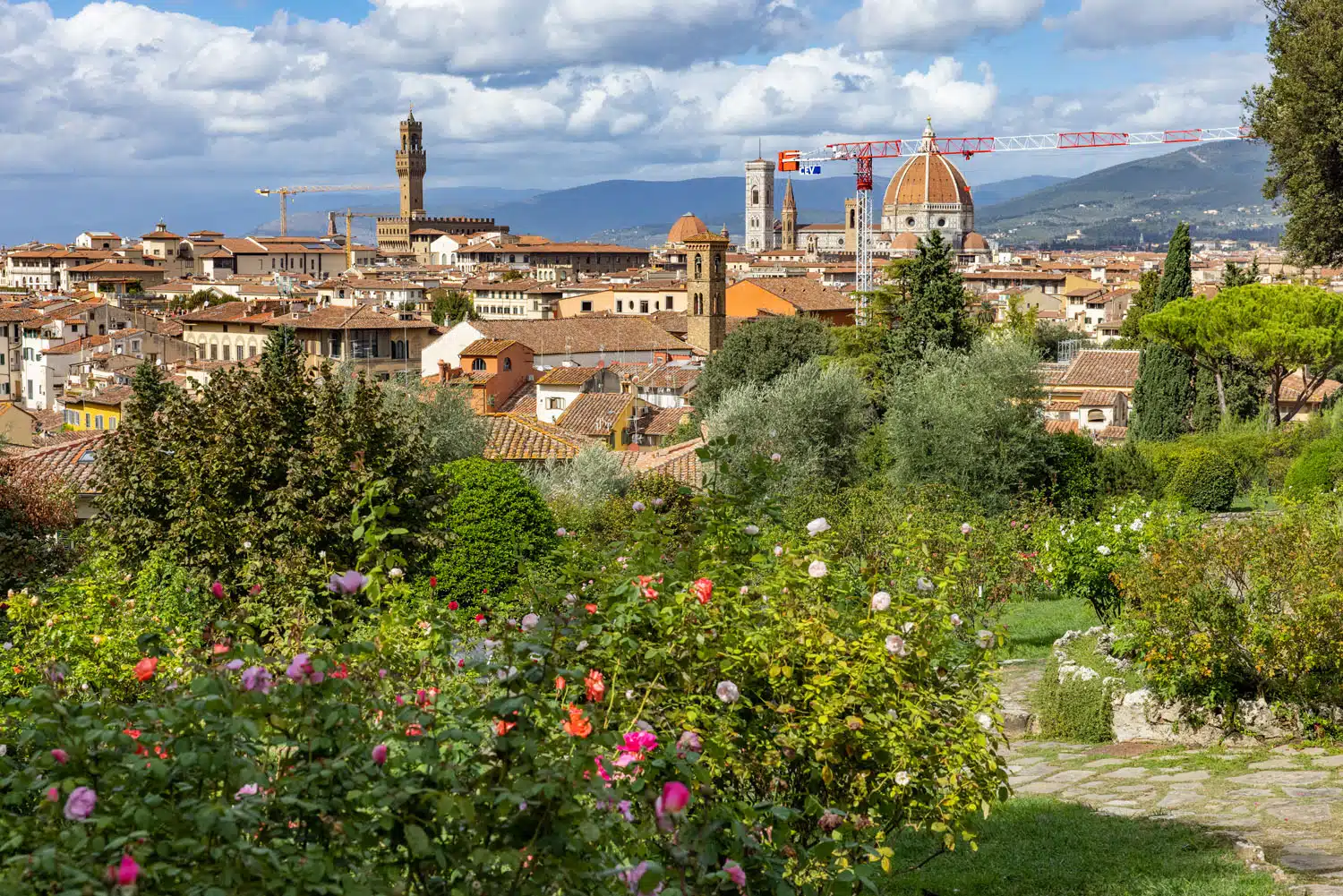
View from the Florence Rose Garden
We entered at Autorita Di Ambito Ato Toscana Centro, on Viale Giuseppe Poggi. It only takes a few minutes to walk through the gardens. Once you are finished, there is a path that leads up the hillside to Piazzale Michelangelo.
20. Watch the Sunset from Piazzale Michelangelo
If you only make it to one viewpoint in Florence, make it Piazzale Michelangelo at sunset. We visited on our first trip to Florence, in July, with our kids, and the photos we took that evening are among our favorites from an entire three-week trip through Italy. The panoramic view over the city, the Arno, and the Duomo as the light fades and Florence’s landmarks begin to glow is genuinely unforgettable. Even our kids, who had been dragged through museums all day, were captivated.
It’s a beautiful spot all day and our favorite place in Florence to watch the sunset. Here is the view during the day:
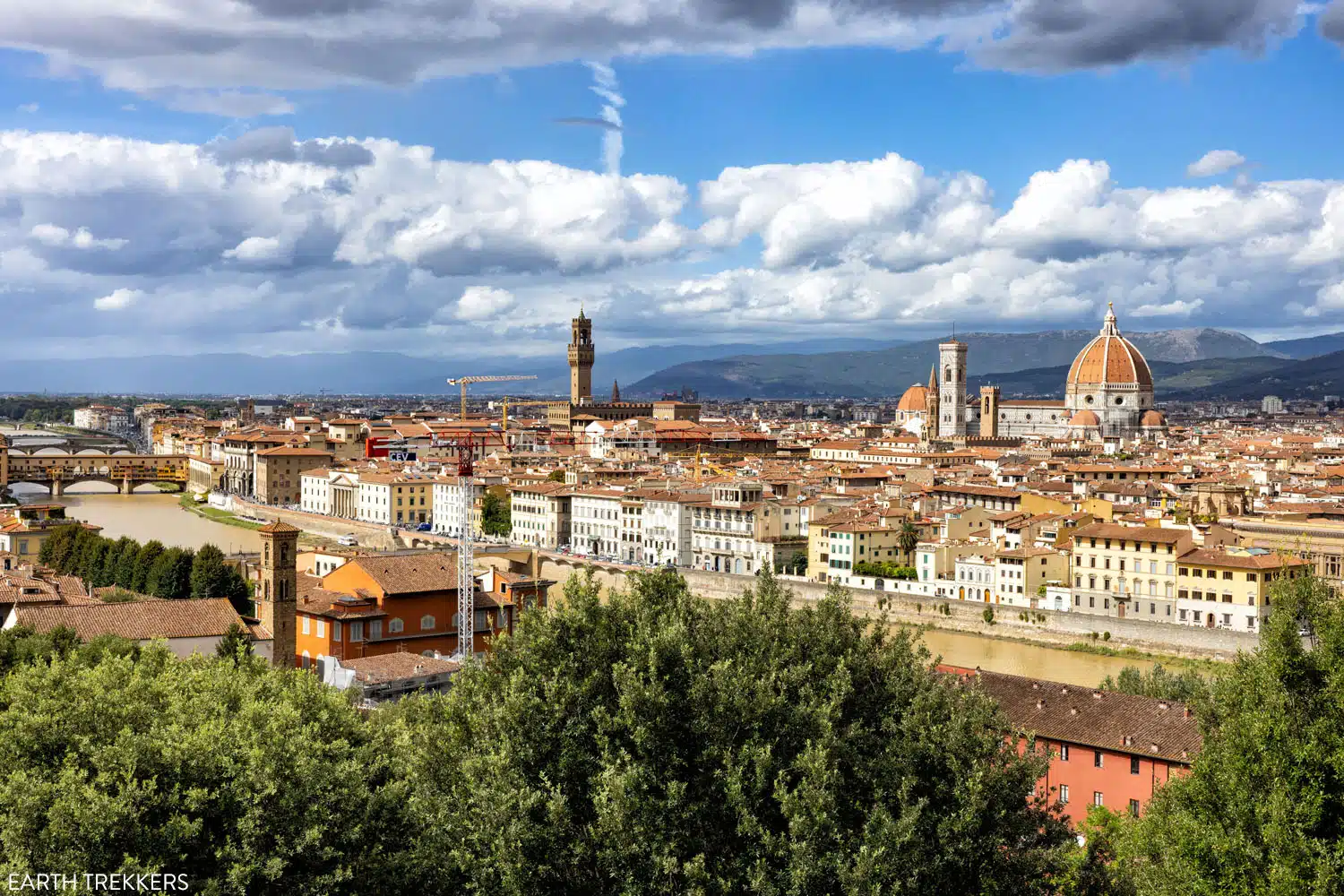
Piazzale Michelangelo during the day
And here is the view at sunset:
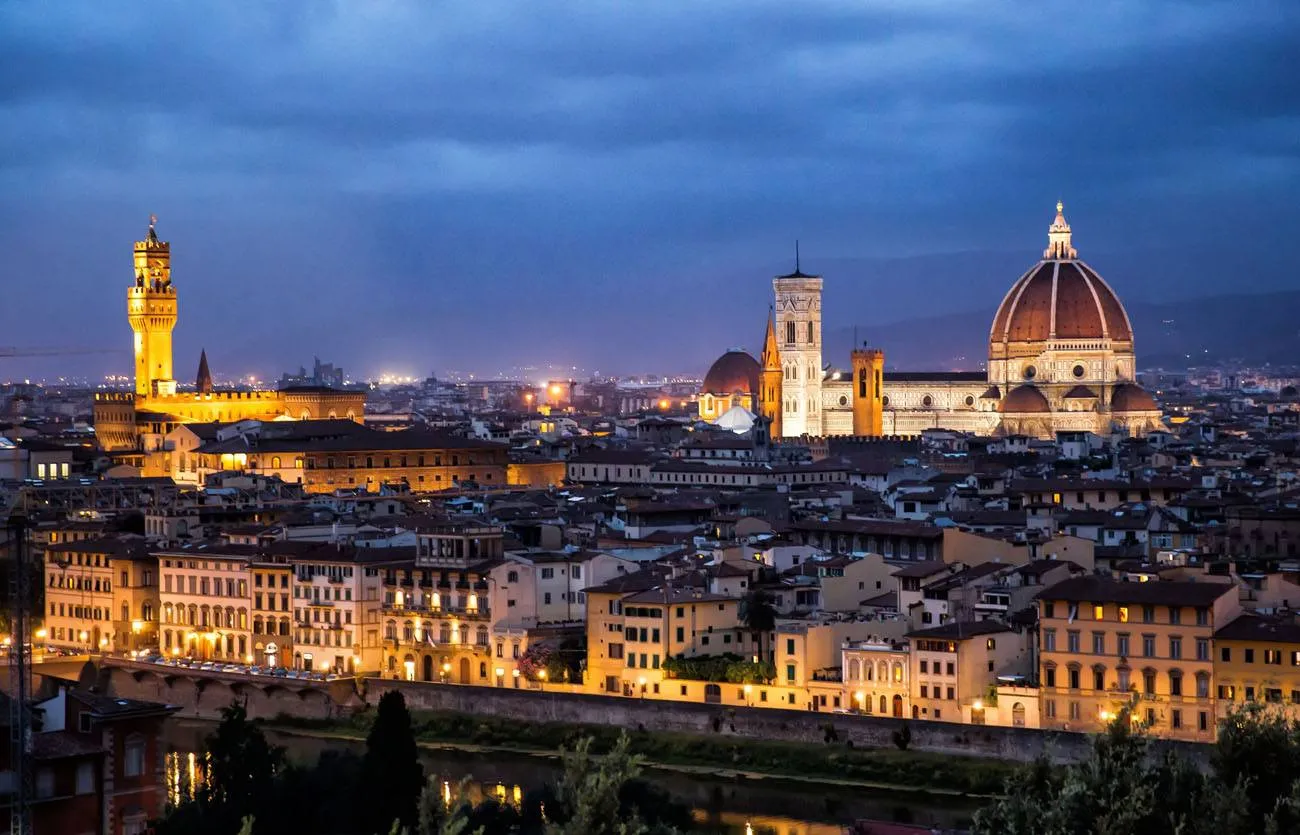
The view just after sunset
At Piazzale Michelangelo, there is also a small restaurant. Standing in the upper parking lot is another replica of Michelangelo’s statue of David.
21. Visit San Miniato al Monte for Another View of Florence
San Miniato al Monte is a beautiful Romanesque church perched on a hill above Piazzale Michelangelo, and it takes about 10 minutes to walk here. The view from San Miniato is stunning, with panoramic views of Florence. The view is beautiful but we think that the view from Piazzale Michelangelo is better, so if you only have the time and energy for one viewpoint out this way, we recommend Piazzale Michelangelo.
The church itself is one of the finest examples of Florentine Romanesque architecture in the city, with a striking green and white marble façade.
What surprised us most was the cemetery that wraps around the church. It’s peaceful, beautiful, and unlike anything else in Florence, with elaborate marble tombs and monuments set against cypress trees and views of the city below. Well worth a slow wander.
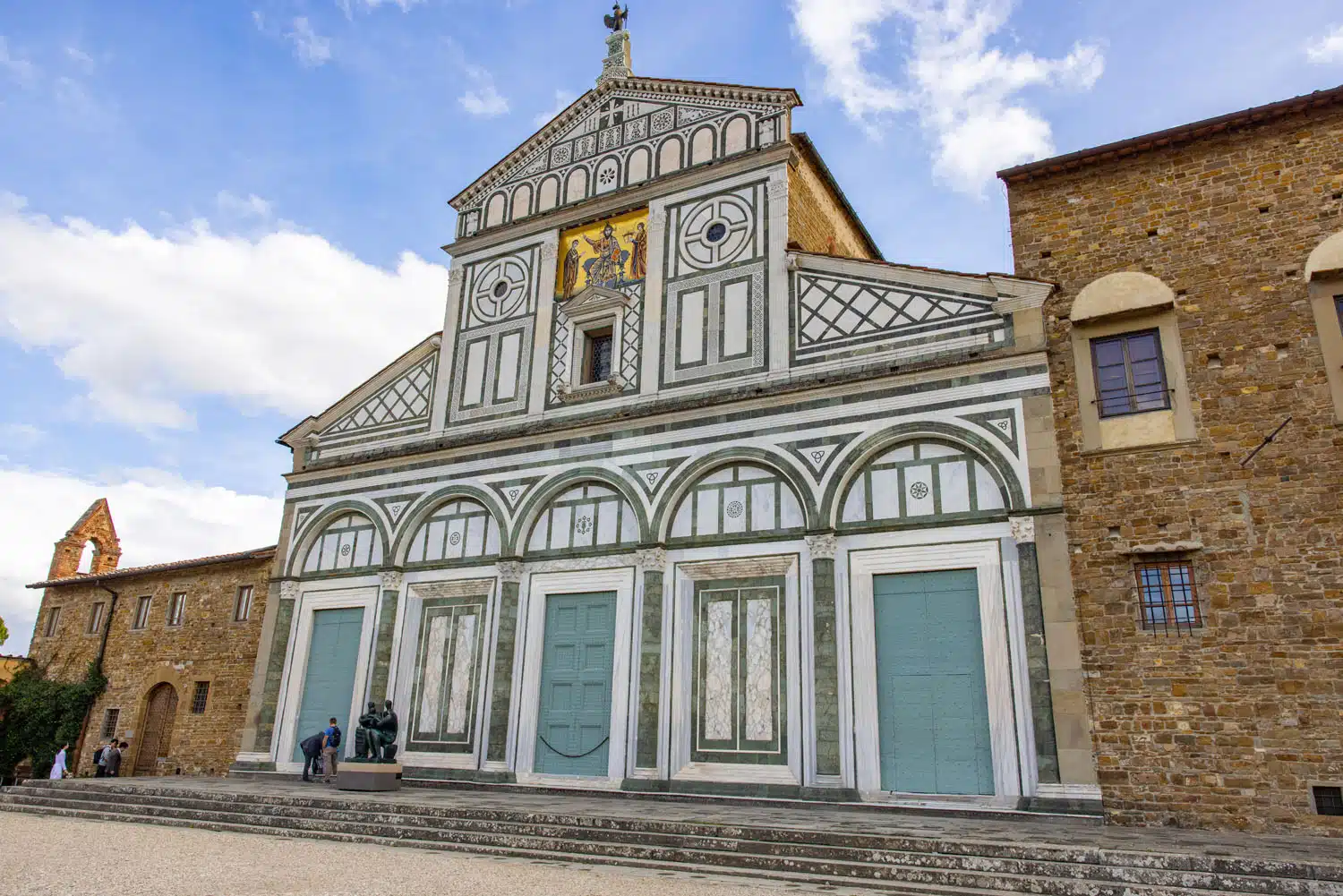
San Miniato al Monte
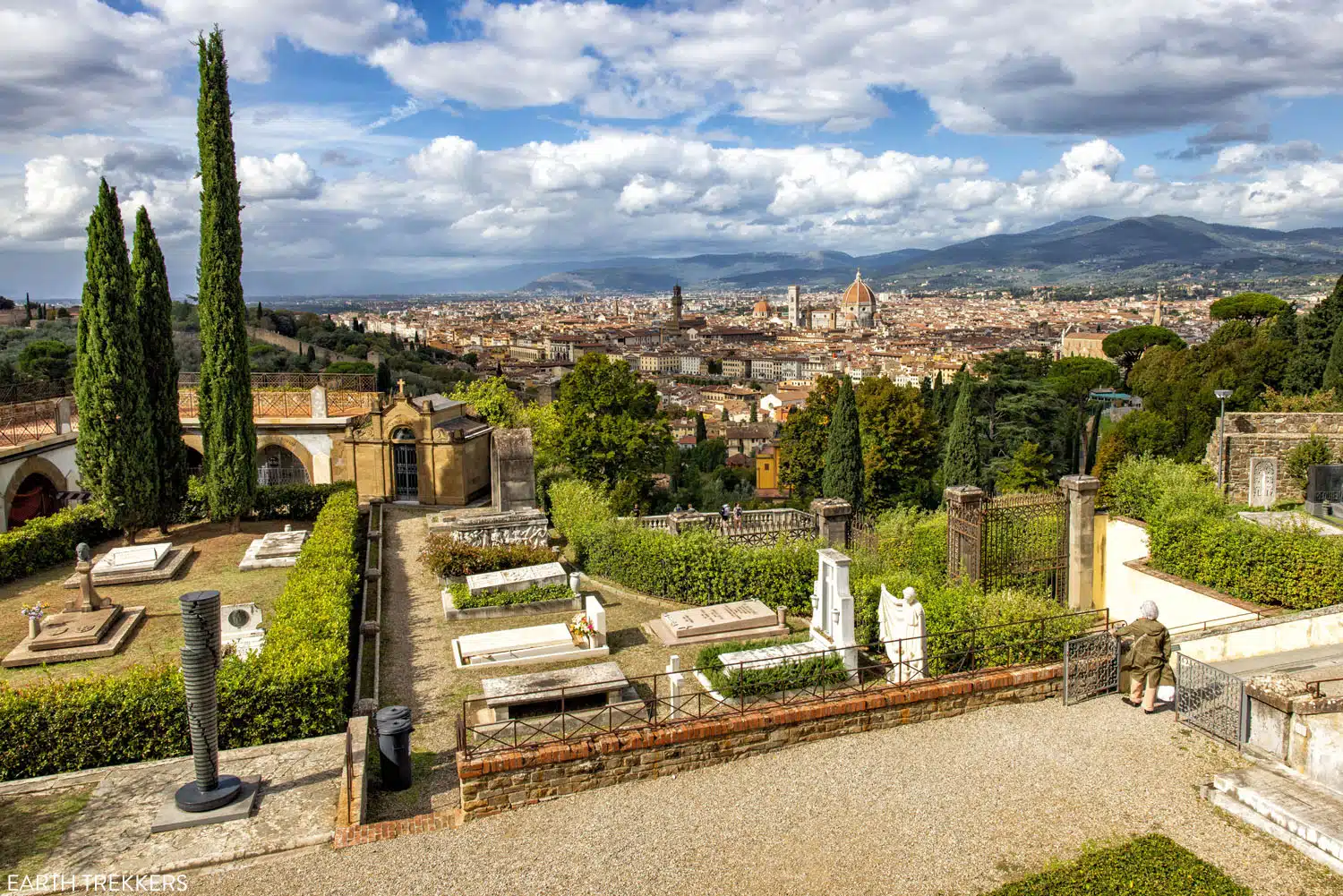
The view from San Miniato al Monte
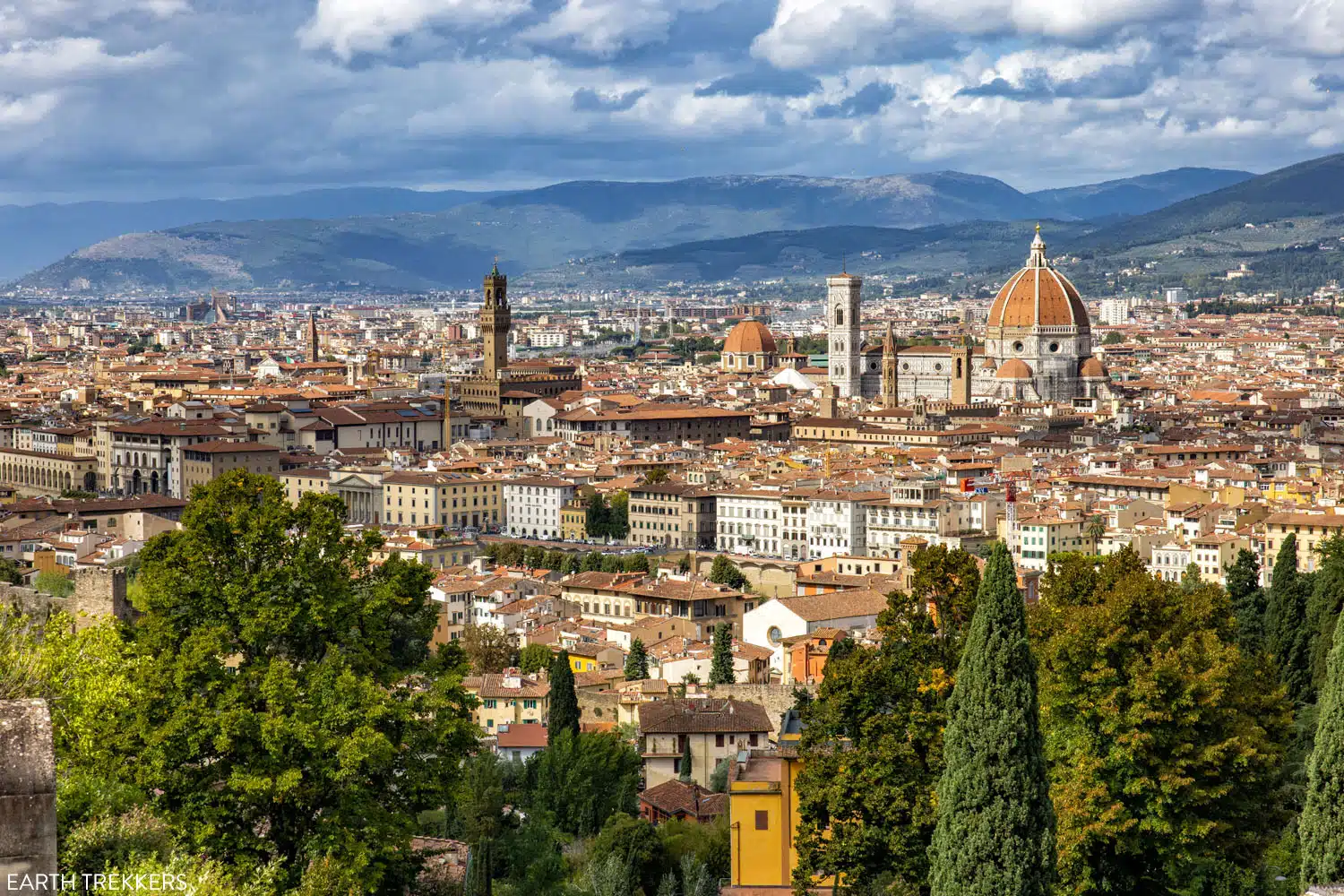
Another view from San Miniato al Monte
PRO TRAVEL TIP: From here, it is a long walk to get back to the historic heart of Florence (about a 30-minute walk but mostly downhill or flat). You can walk back to Piazzale Michelangelo and try to hire a taxi.
Churches in Florence
22. Pay Your Respects at the Basilica di Santa Croce
The Basilica di Santa Croce is one of the most visited churches in Florence, and for good reason. This is the burial place of some of the greatest figures of the Renaissance and beyond. Michelangelo, Galileo, Machiavelli, and Ghiberti are all interred here, along with a monument to Dante.
Walking through and finding each tomb is a genuinely moving experience, and the church itself is beautiful, with a stunning Gothic interior with frescoes by Giotto in the Bardi and Peruzzi chapels. There’s also a small museum attached that’s worth a look.
It’s an easy walk from Piazza della Signoria and one of the most rewarding hours you can spend in Florence.
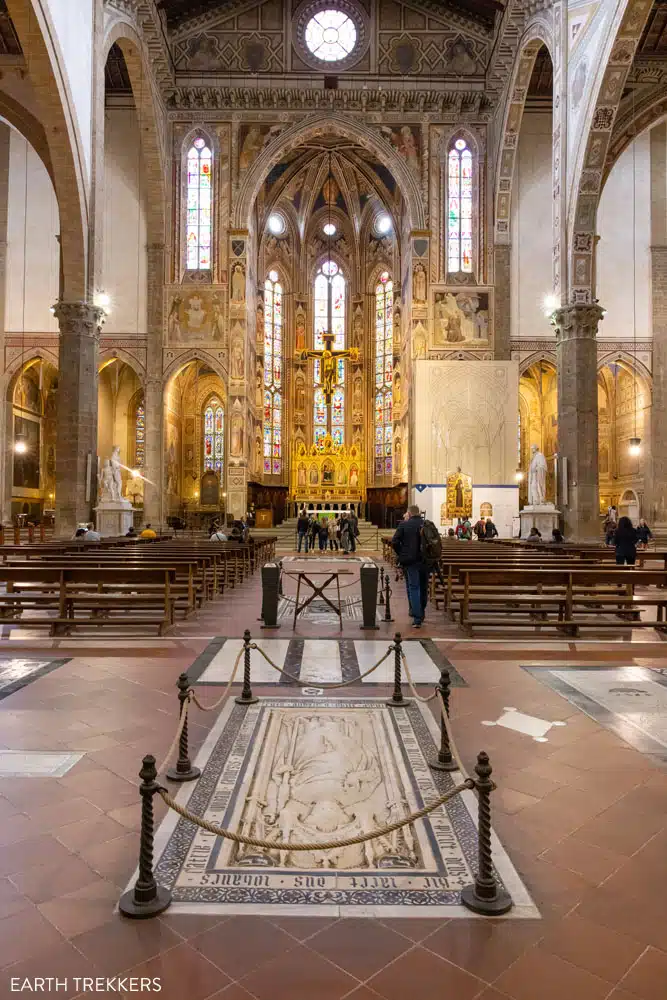
Basilica di Santa Croce
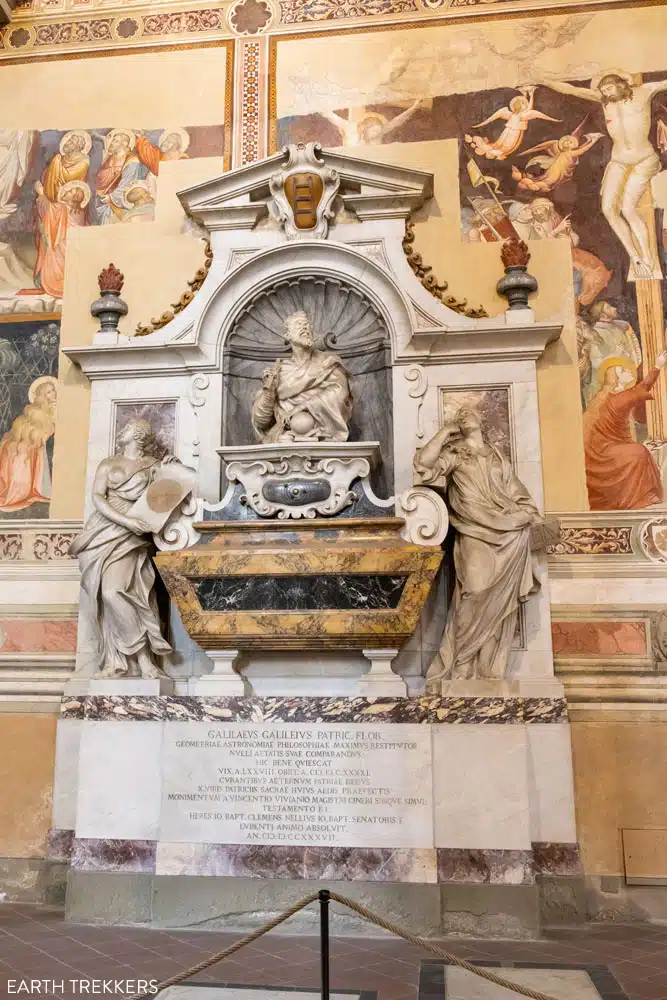
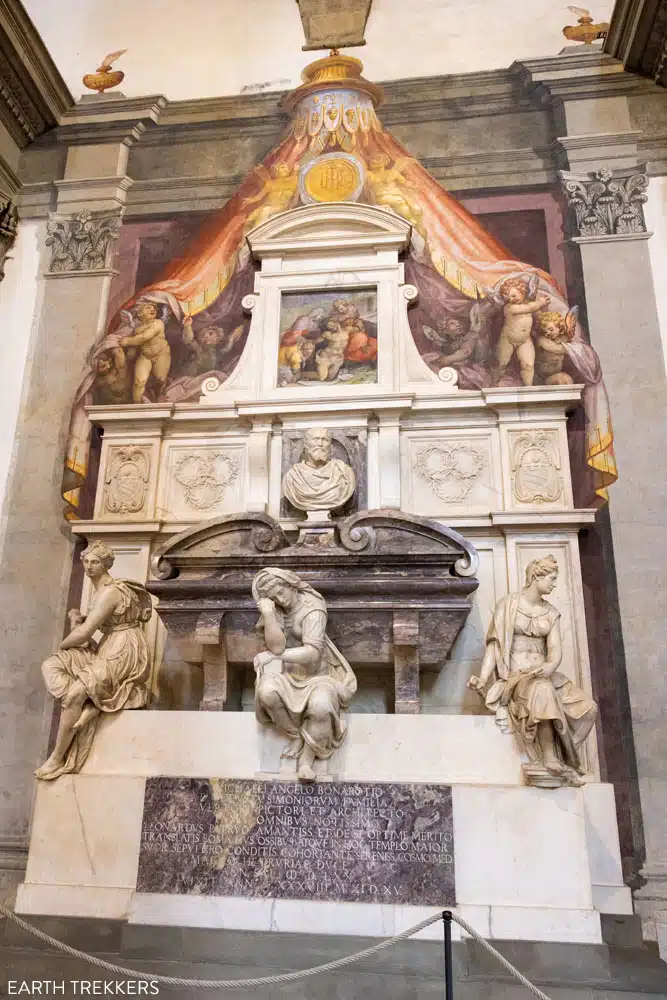
Galileo’s Tomb and Michelangelo’s tomb
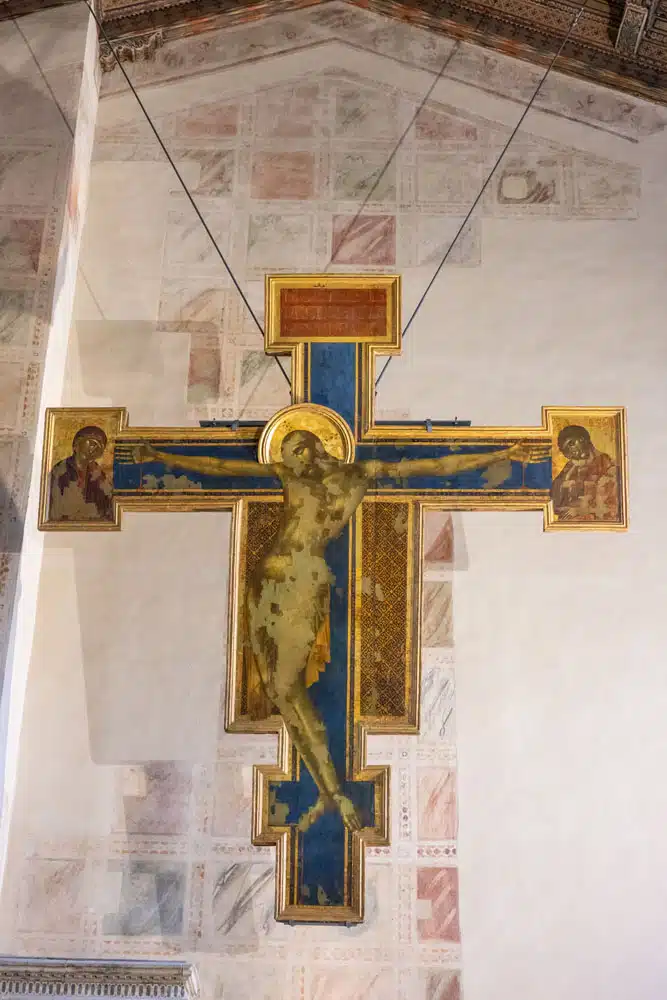
The Crucifixion by Cimabue
How to Visit the Basilica di Santa Croce: It is open every day of the week although hours vary by day and on holidays. Get updated information on the official website.
23. See the Frescoes at the Brancacci Chapel
The Brancacci Chapel, located inside the Church of Santa Maria del Carmine in the Oltrarno neighborhood, contains a cycle of frescoes that changed the course of Western art. Painted primarily by Masaccio and Masolino in the 1420s, with later additions by Filippino Lippi, these frescoes were revolutionary for their use of perspective and naturalism. Michelangelo came here to study them as a young artist.
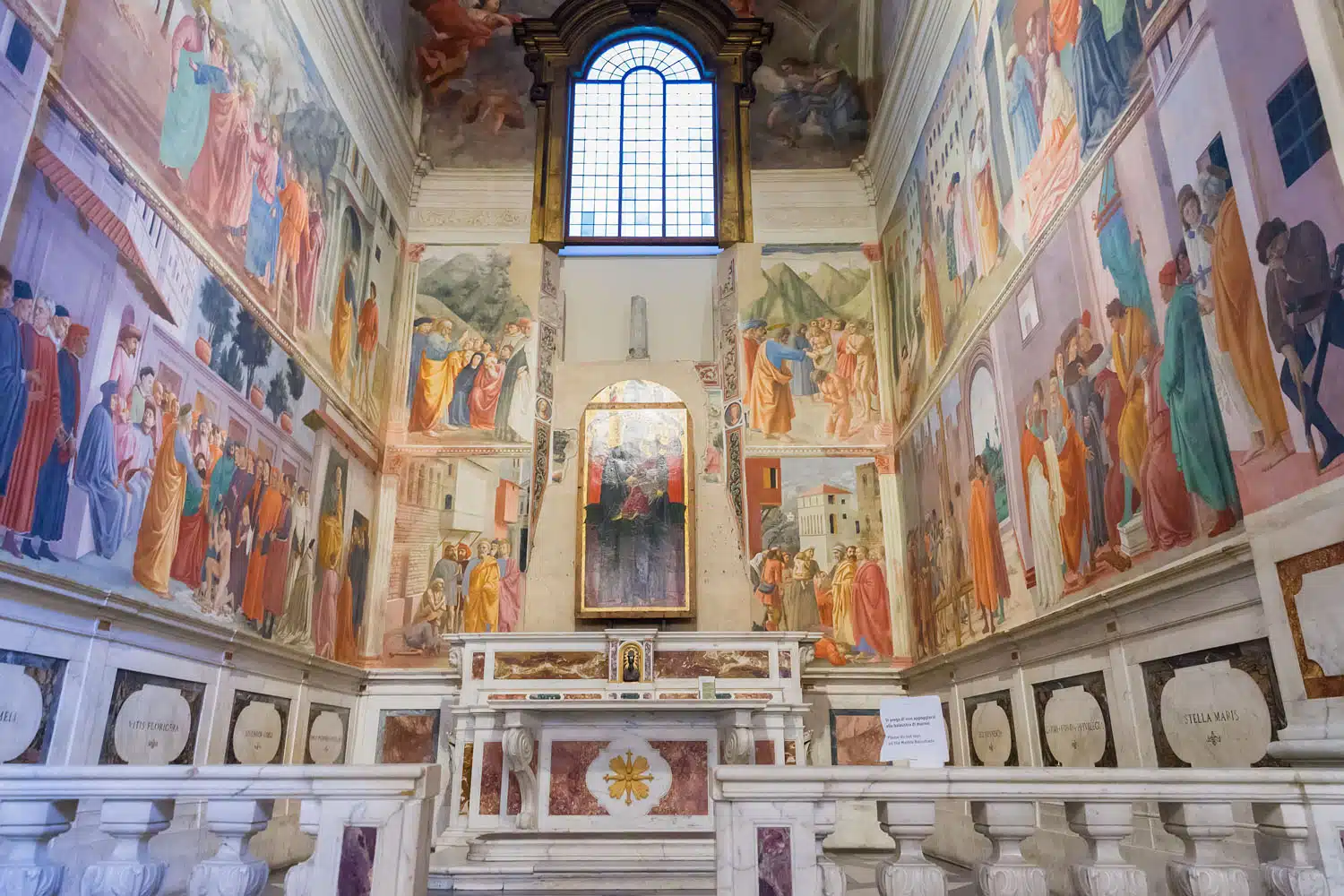
Brancacci Chapel | Anna Pakutina/shutterstock.com
The chapel is located inside of Santa Maria del Carmine Church. An advance reservation is required and it is only open 4 days a week. Learn more on the official website.
24. Admire the Facade of the Basilica di Santa Maria Novella
Santa Maria Novella sits just steps from the train station, which means most visitors walk past it on arrival without stopping. Don’t make that mistake. The green and white marble facade is one of the most beautiful in Florence. Leon Battista Alberti designed the upper portion in the 15th century and it’s considered a masterpiece of Renaissance architecture.
For us, the exterior is the real highlight here, though the interior is also worth visiting. The pulpit was designed by Brunelleschi and created by his adopted son Andrea Cavalcanti. Masaccio painted The Holy Trinity, a masterpiece that displays the importance of mathematics and perspective in Renaissance art. There are also numerous chapels with frescoes, a sacristy that contains Crucifix with the Madonna and John the Evangelist by Giotto, and the beautifully painted Spanish Chapel.
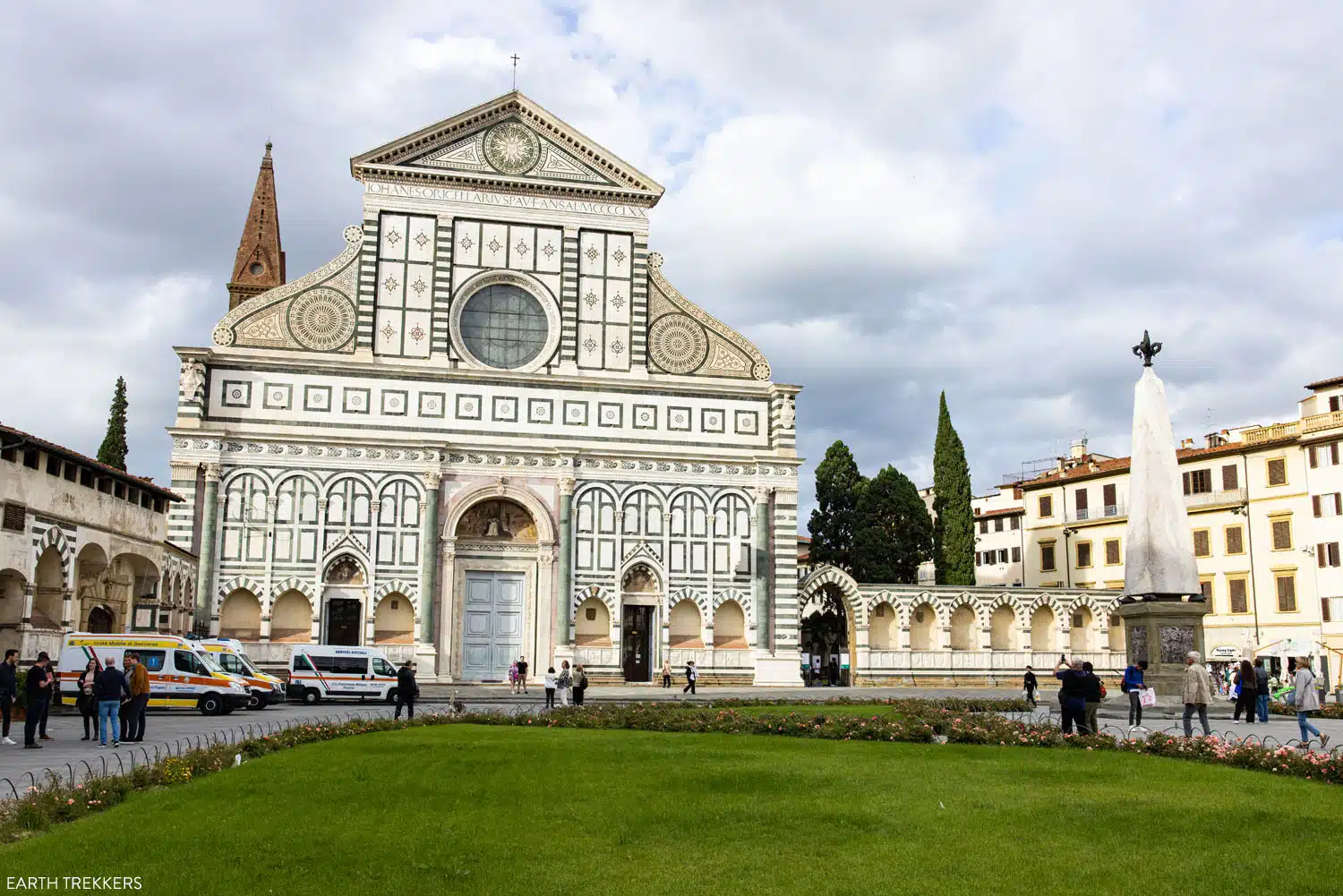
Basilica of Santa Maria Novella
How to Visit the Basilica of Santa Maria Novella: Hours vary by season and day of the week. Get updated hours and pricing here.
25. Seek Out These Smaller Churches
Florence has more remarkable churches than most cities have landmarks. Here are four worth adding to your list:
Ognissanti. Also called Chiesa di San Salvatore di Ognissanti, this Franciscan church is the burial place of Botticelli and 15th century frescoes by Botticelli and Ghirlandaio can be seen in the nave.
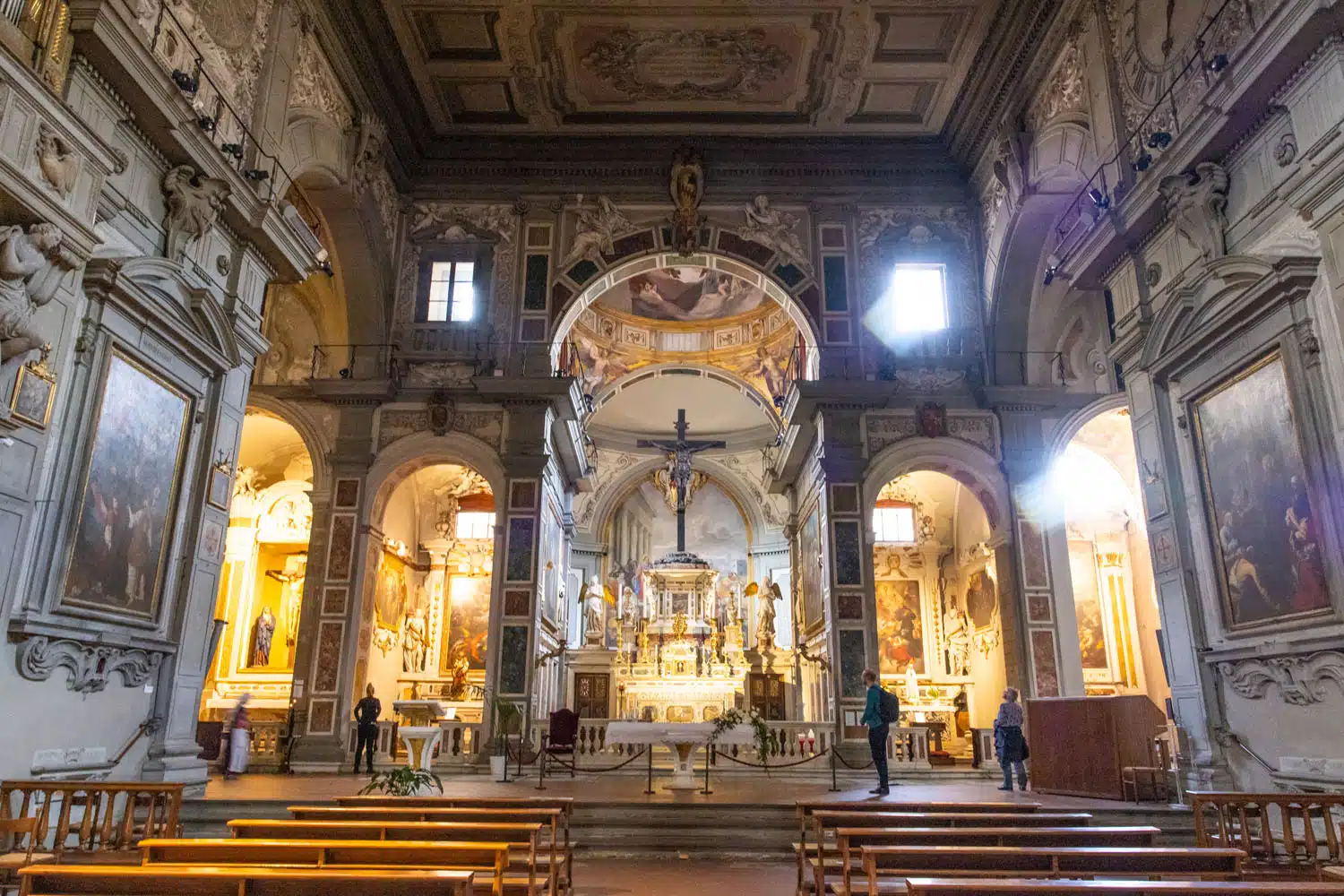
Ognissanti
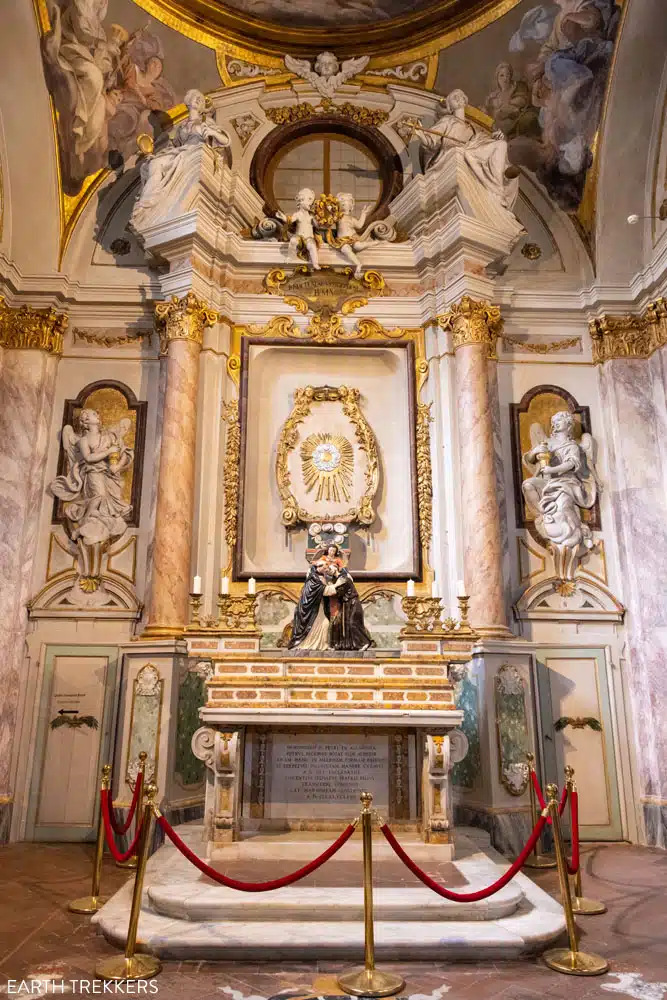
Tomb of Botticelli
Basilica di Santa Trinita. The Roman Catholic church is famous for its Sassetti Chapel, which contains frescoes by Domenico Ghirlandaio.
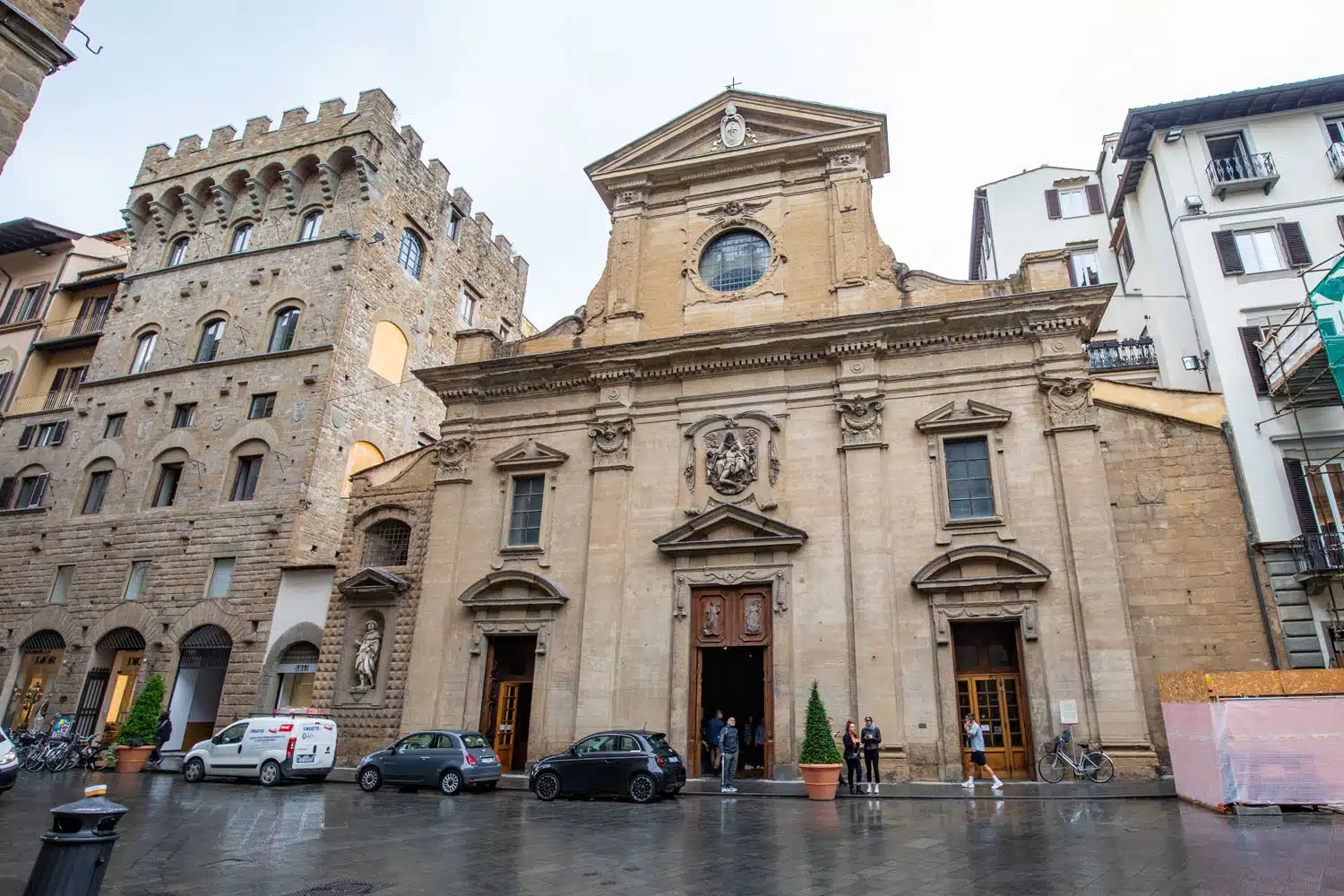
Basilica di Santa Trinita
Basilica di San Lorenzo. Some sources state that this is the oldest church in Florence. In 1419, the Medici family financed a new church to be built at this site and Brunelleschi was the principal architect. It became the parish church of the Medici family and many members of the Medici family are buried here. There are numerous works of art inside of the basilica created by Donatello, Michelangelo, and Fiorentino.
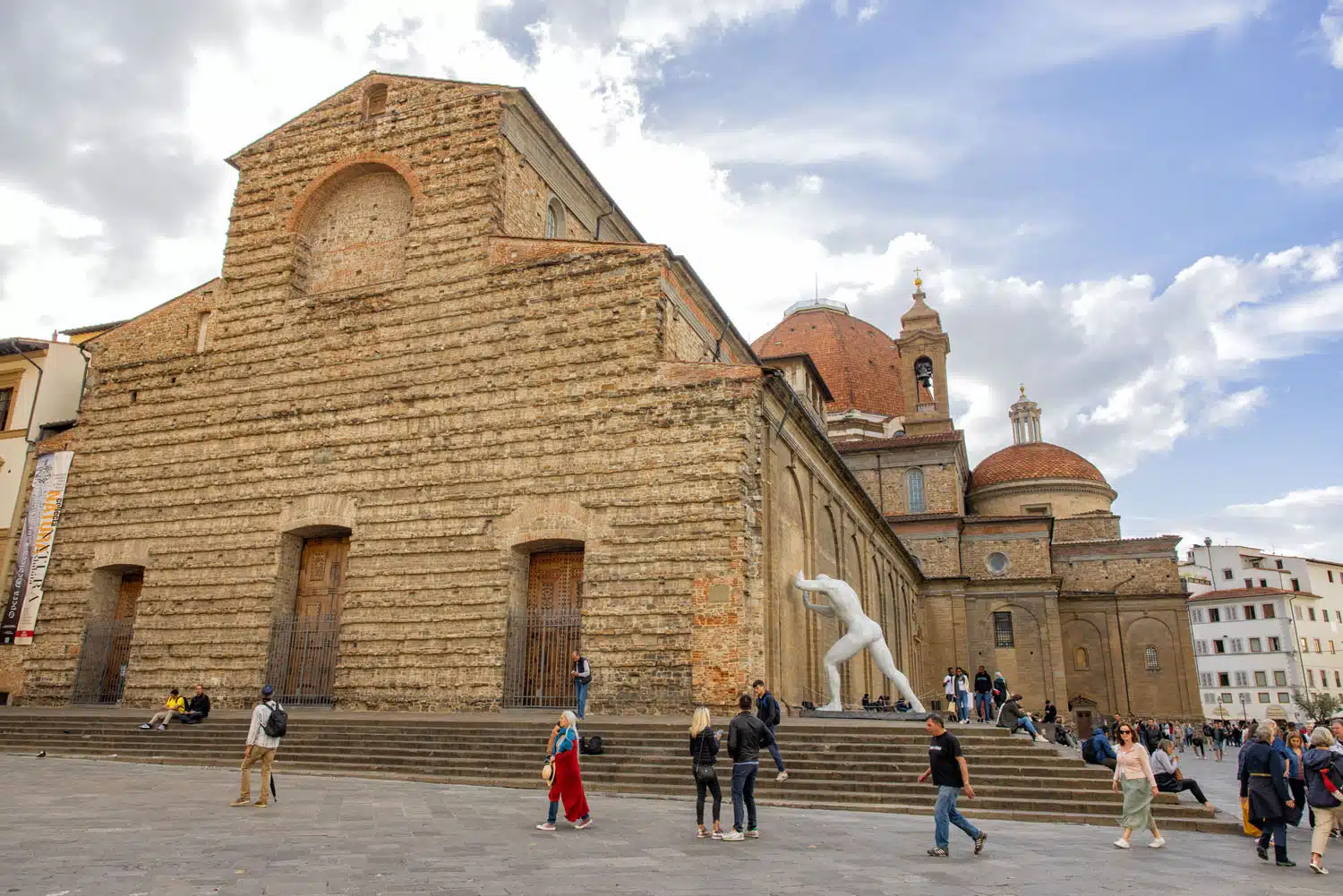
Basilica di San Lorenzo
Santissima Annunziata is one of Florence’s most revered churches, home to a miraculous image of the Virgin Mary that has drawn pilgrims for centuries. The forecourt loggia is beautiful and the interior is lavishly decorated. It tends to be quieter than the major sites, which makes it a peaceful stop.
Local Experiences
26. Go Shopping in San Lorenzo Market & Mercato Centrale
The San Lorenzo Market spills out across the streets around the Basilica di San Lorenzo and is one of the liveliest spots in Florence. Leather goods, souvenirs, scarves, and street food stalls compete for your attention in every direction. Inside the historic building, Mercato Centrale is Florence’s great covered food market, two floors of vendors selling fresh pasta, cheese, meat, wine, bread, and some of the best street food in the city.
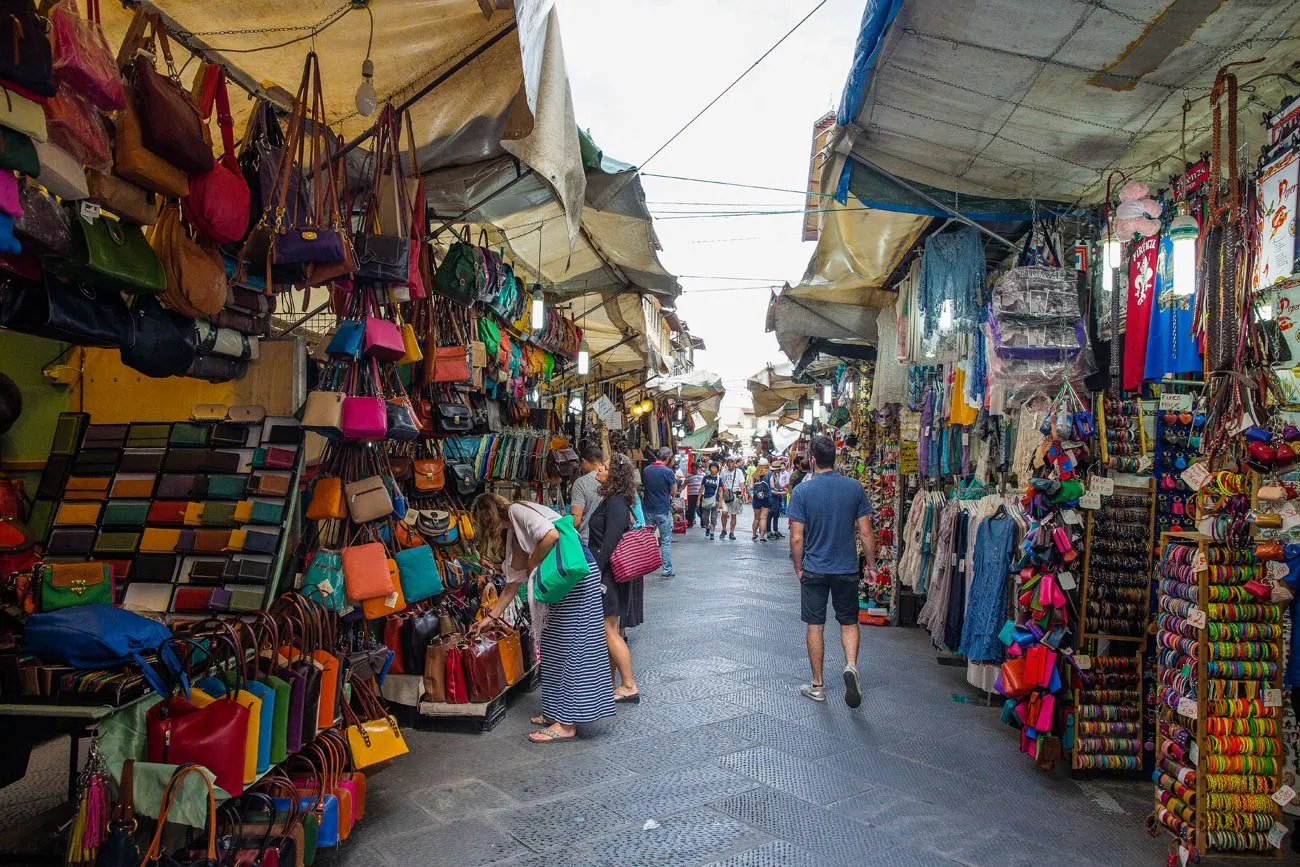
San Lorenzo Market
On our first visit to Florence with our kids, we assembled a picnic lunch here and ate it in the piazza near San Lorenzo. It’s one of those simple travel memories that sticks. If you’re looking for a casual, affordable, and genuinely local lunch option, this is it.
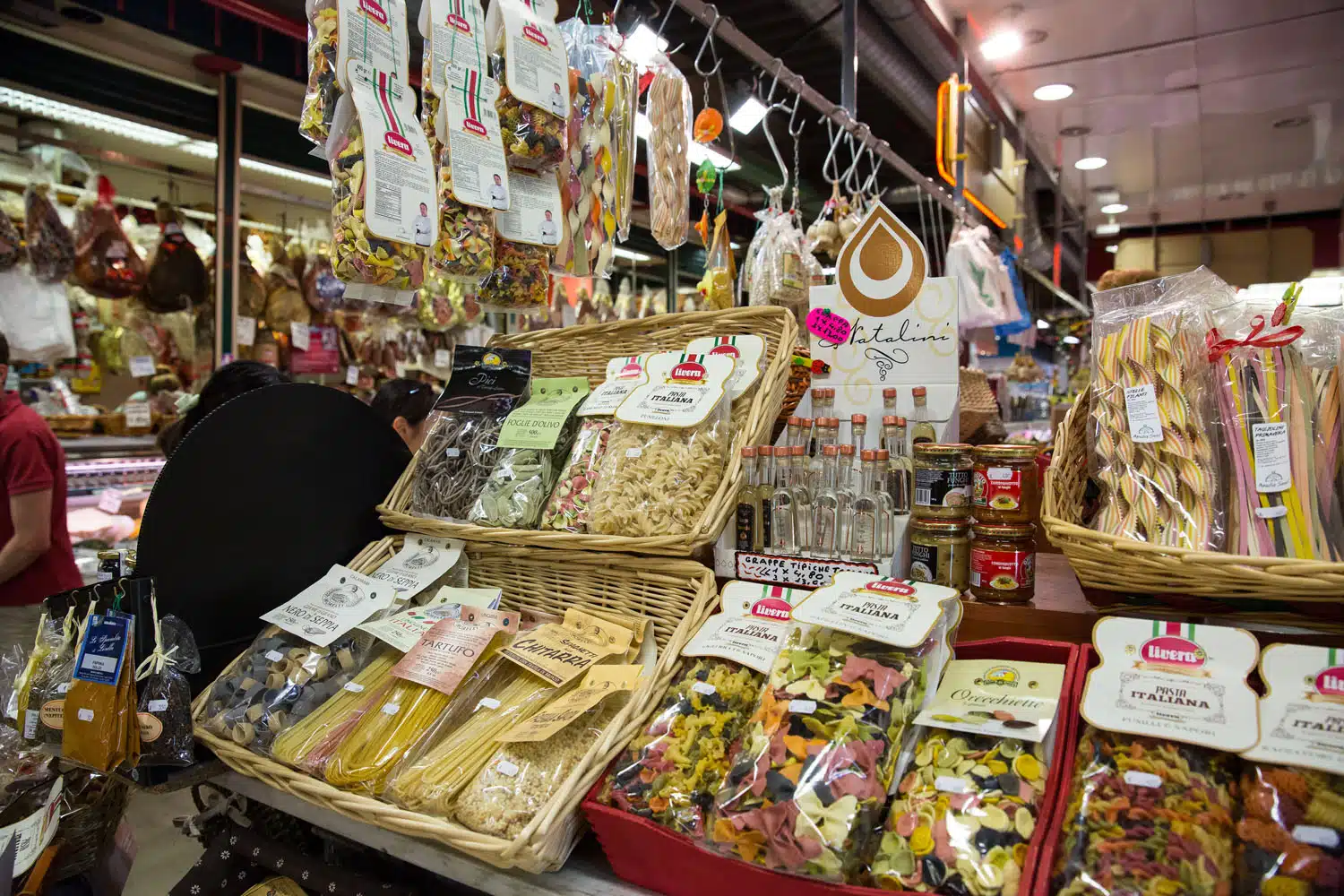
Mercato Centrale
27. Step Inside the Officina Profumo-Farmaceutica di Santa Maria Novella
Even if you have no intention of buying anything, the Officina Profumo-Farmaceutica di Santa Maria Novella is worth stepping inside.
Founded by Dominican friars in 1612, it’s one of the oldest pharmacies in the world, and the interior, with its frescoed ceilings, dark wood cabinets, terracotta floors, is as beautiful as any church in the city. The perfumes, soaps, and herbal preparations on display fill the air with something extraordinary.
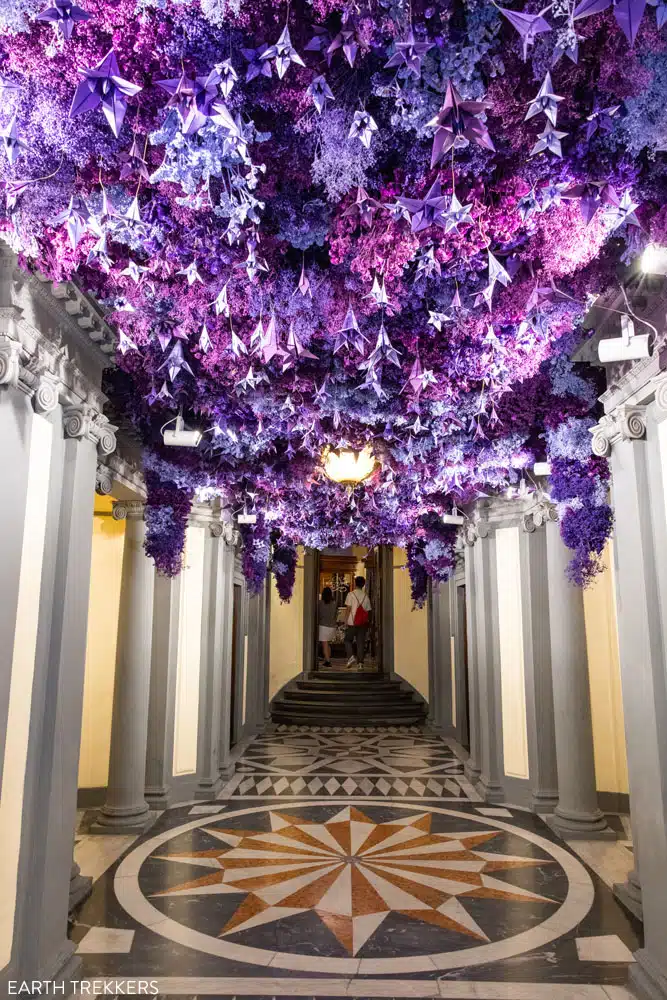
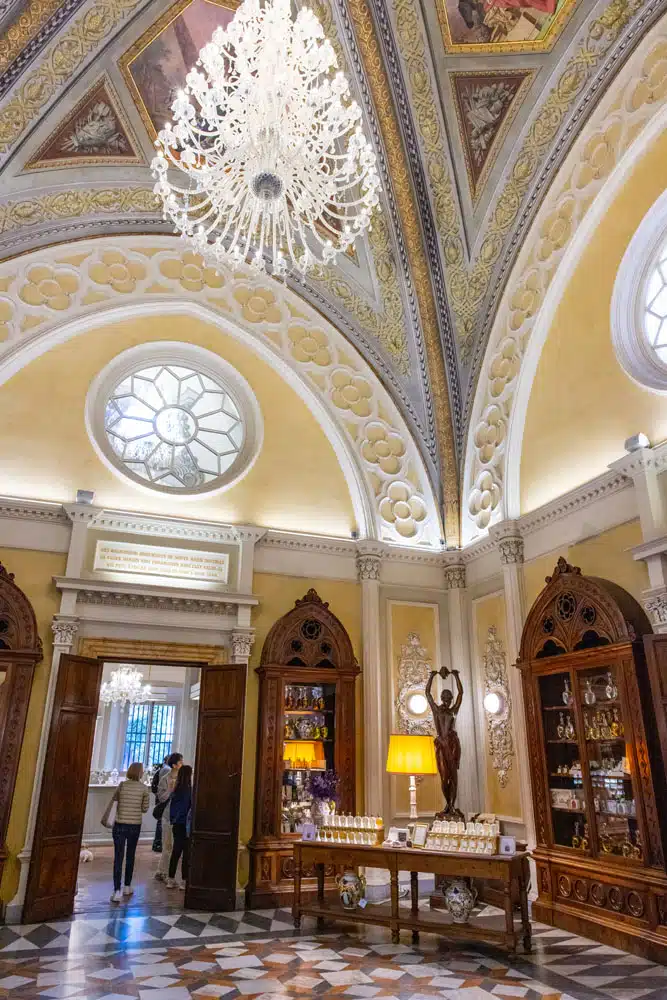
We didn’t buy anything, but we lingered far longer than we expected to. It’s a five-minute detour from Santa Maria Novella and one of those only-in-Florence experiences that surprises you.
28. Rub the Nose of the Fontana del Porcellino for Good Luck
Il Porcellino, which means piglet in Italian, is the nickname for this statue. This small boar sits next to Mercato del Porcellino (also called Mercato Nuovo), a small outdoor market in Florence.
There are several legends about this boar. If you put a coin into the mouth of the boar and it falls into the grate, you will have good luck.
If you rub the boar’s nose, then you will be ensured a return visit to Florence. We’ve done it, our kids did it enthusiastically, and it’s one of those charming, low-key moments that breaks up a day of museums and churches. Takes thirty seconds, costs nothing, and the boar’s nose is genuinely very shiny from centuries of hands.
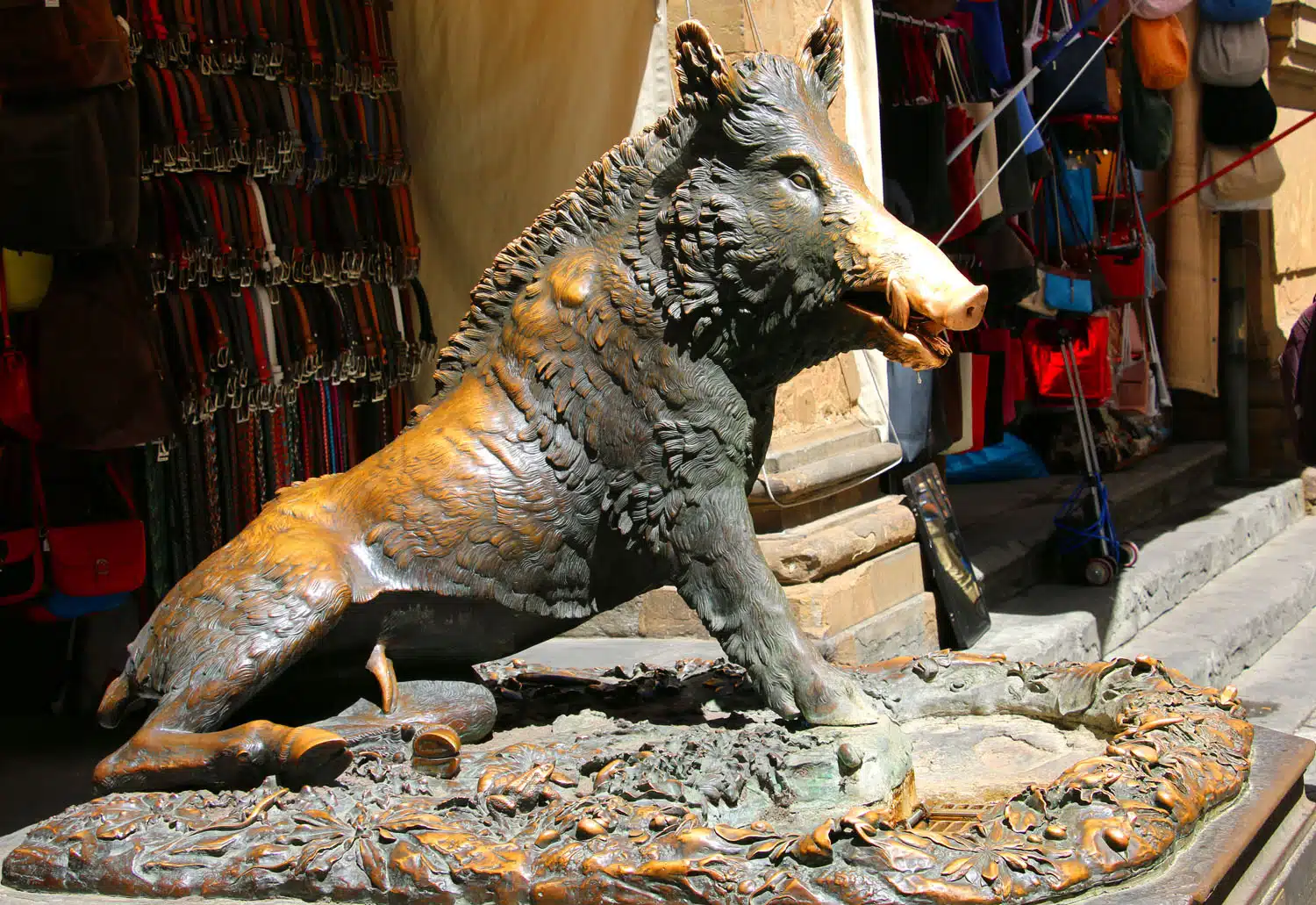
Il Porcellino
29. Drink in the Views from a Florence Rooftop Bar
Visiting a rooftop bar or two is one of the best things to do in Florence. If you want drinks with a view of the Duomo, you have quite a few rooftop bars in Florence to choose from.
We have a guide to the Best Rooftop Bars in Florence, but a few of our favorites are View on Art, Divina Terrazza Rooftop Bar, Tosca & Nino, and Cosimo.
After a day of sightseeing, this is the perfect way to unwind but still gaze across the beautiful city of Florence.
Cocktails can be pricey, but what you are also getting is an amazing view of the city. It’s best to make your reservations in advance because some of these are quite popular.
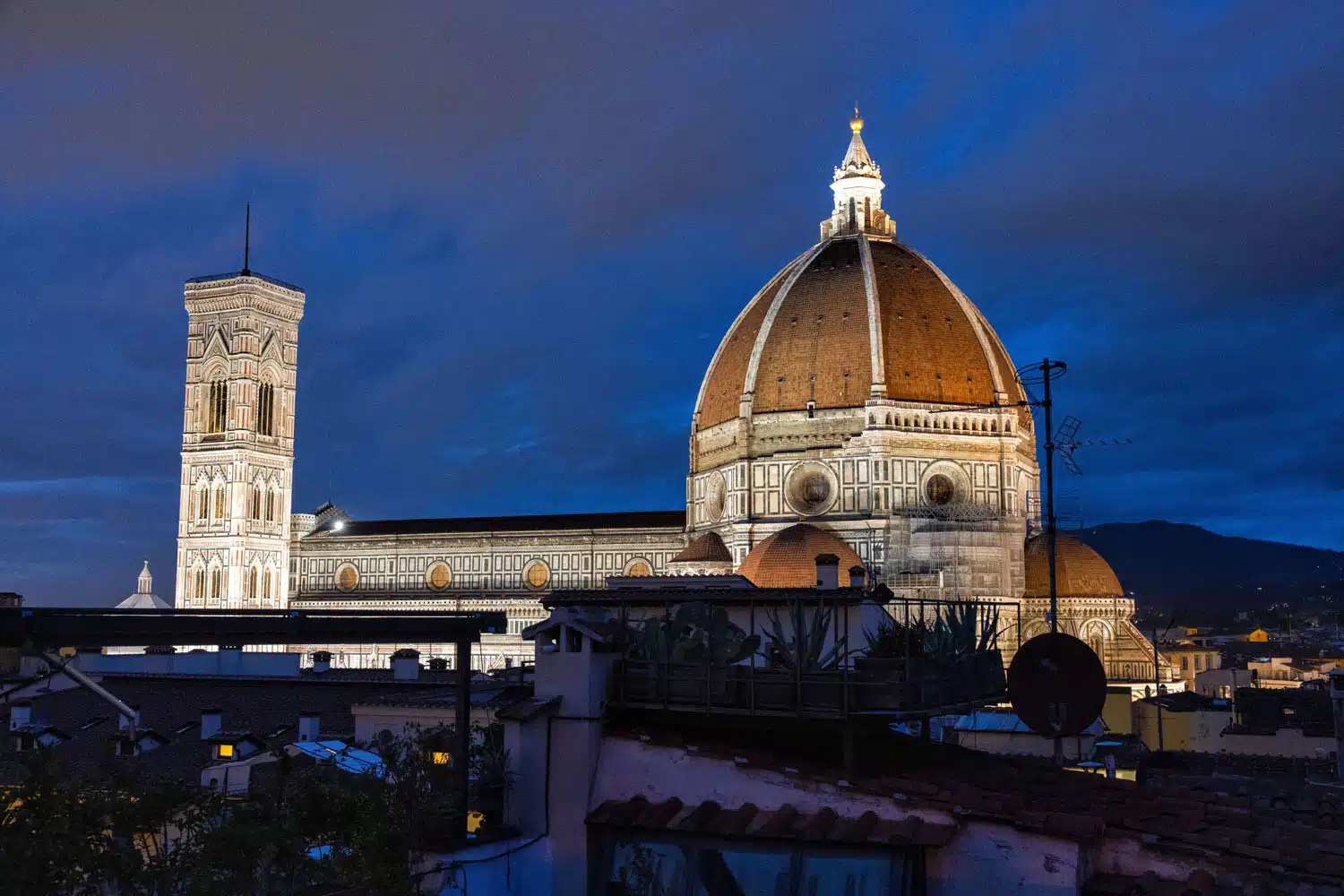
Divina Terrazza
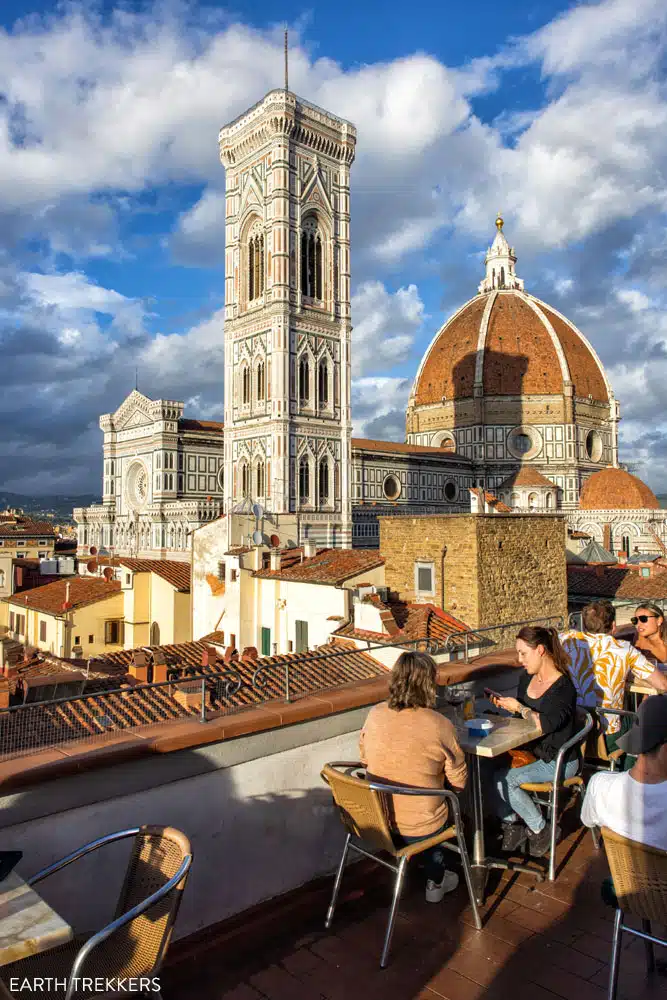
View on Art
30. Join a Food Tour or Take a Cooking Class
Florence is one of the best cities in Italy to learn about food, and that’s saying something.
A food tour through the city’s markets and street food stalls is a great way to understand what makes Florentine cuisine distinct: the lampredotto sandwiches, the schiacciata, the ribollita, the Chianti.
A cooking class goes deeper, with hands-on instruction in fresh pasta, bistecca Fiorentina, and the sauces that define Tuscan cooking. Learn how to make fresh pasta in this pasta cooking class (plus unlimited wine!) or learn how to cook both pasta and tiramisu in this cooking class.
We’ve done food tours and cooking classes in other parts of Italy and always found them worthwhile, plus they change how you eat for the rest of the trip.
Food Tours & Cooking Classes
Map of Things to Do in Florence
How to Use This Map: Click the icons on the map to get more information about each point of interest. To take this map with you, click the star next to the title of the map which adds it to your Google account. Next, within your Google Maps app, select ‘Saved’ and then select ‘Maps’. This map title will now appear in your list.
Our Recommendations
10 Best Free Things to Do in Florence
- Admire the Duomo from all sides in Piazza del Duomo
- Step inside the Florence Cathedral and gaze up at the dome ceiling
- See the Gates of Paradise doors on the Baptistery of San Giovanni
- Stroll across Ponte Vecchio and watch the Arno at sunset
- Explore the open-air sculpture gallery in Piazza della Signoria
- Visit the Rose Garden on the hillside below Piazzale Michelangelo
- Walk up to San Miniato al Monte for the view and the cemetery
- Rub the nose of the Fontana del Porcellino for good luck
- Wander through Piazza della Repubblica and stop for a coffee
- Watch the sunset from Piazzale Michelangelo
10 Best Things to Do in Florence with Kids
- Climb Brunelleschi’s Dome: best for older kids who can manage 463 steps
- See the inside of the Florence Cathedral and the ceiling frescoes
- Come face to face with Michelangelo’s David at the Accademia; even kids are impressed
- Wander through Boboli Gardens or Bardini Gardens
- Climb the Arnolfo Tower at Palazzo Vecchio for the best view of the Duomo
- Visit the Galileo Museum: telescopes, scientific instruments, and yes, Galileo’s preserved finger
- Rub the nose of the Fontana del Porcellino for good luck
- Assemble a picnic lunch at Mercato Centrale and eat it near San Lorenzo
- Watch the sunset from Piazzale Michelangelo; our kids were captivated
- Visit the Uffizi Gallery; keep the visit short and focused on a handful of masterpieces rather than trying to see everything
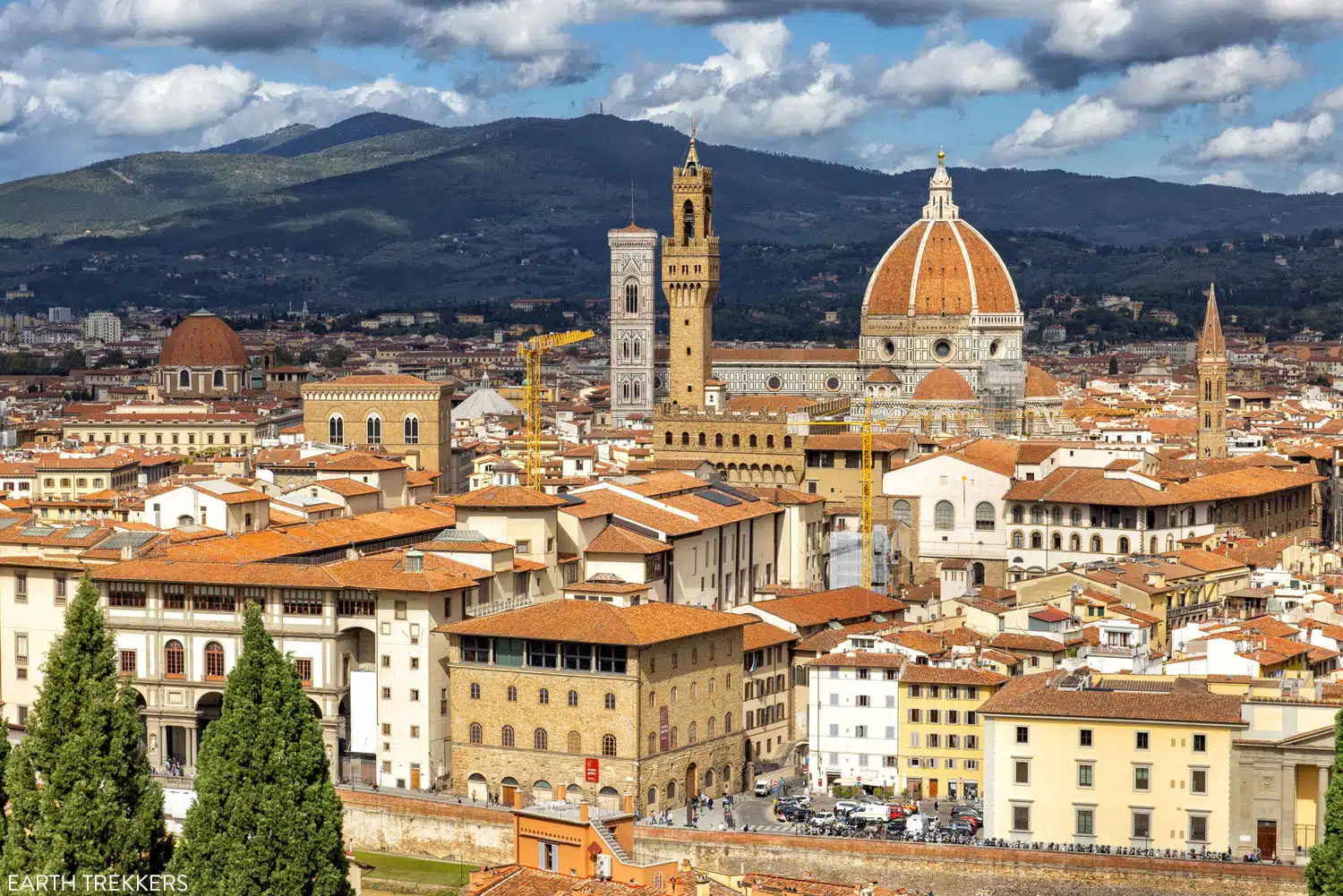
The view from Bardini Gardens
Explore Tuscany from Florence
While in Florence, one of the best things to do is to take a day trip. And you have a lot of choices. For the full list, read our article Best Day Trips from Florence ↓
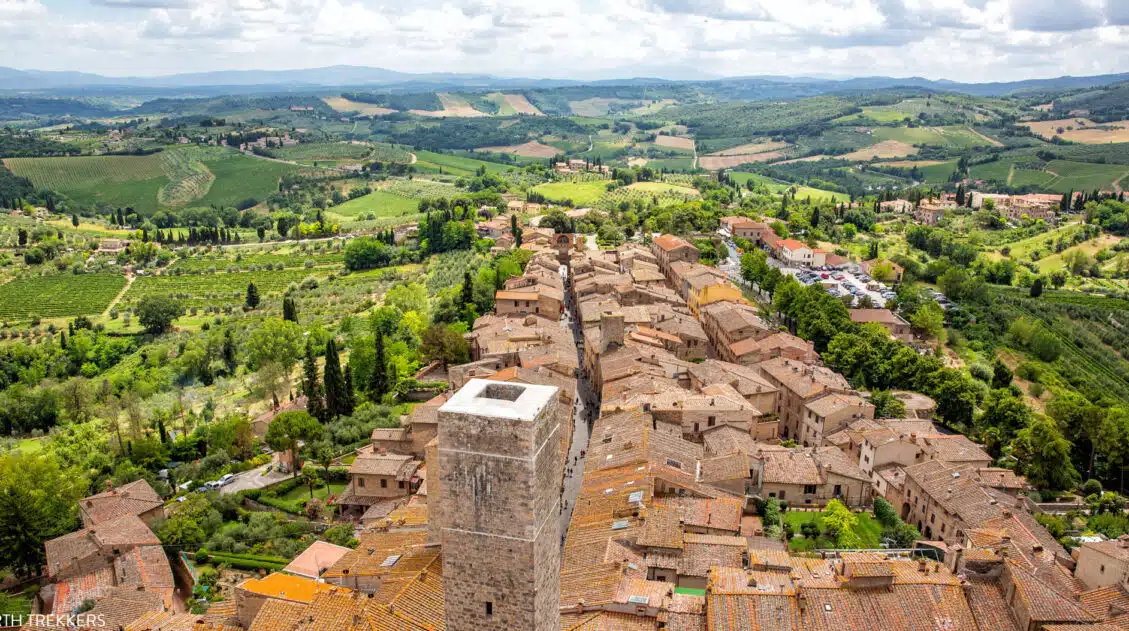
Best Day Trips from Florence: 15 Picks for Every Type of Traveler
Visit Tuscan hill towns, Milan, Bologna, the Cinque Terre, and more.Florence is located within Tuscany, so from here, you can day trip to many Tuscan hill towns.
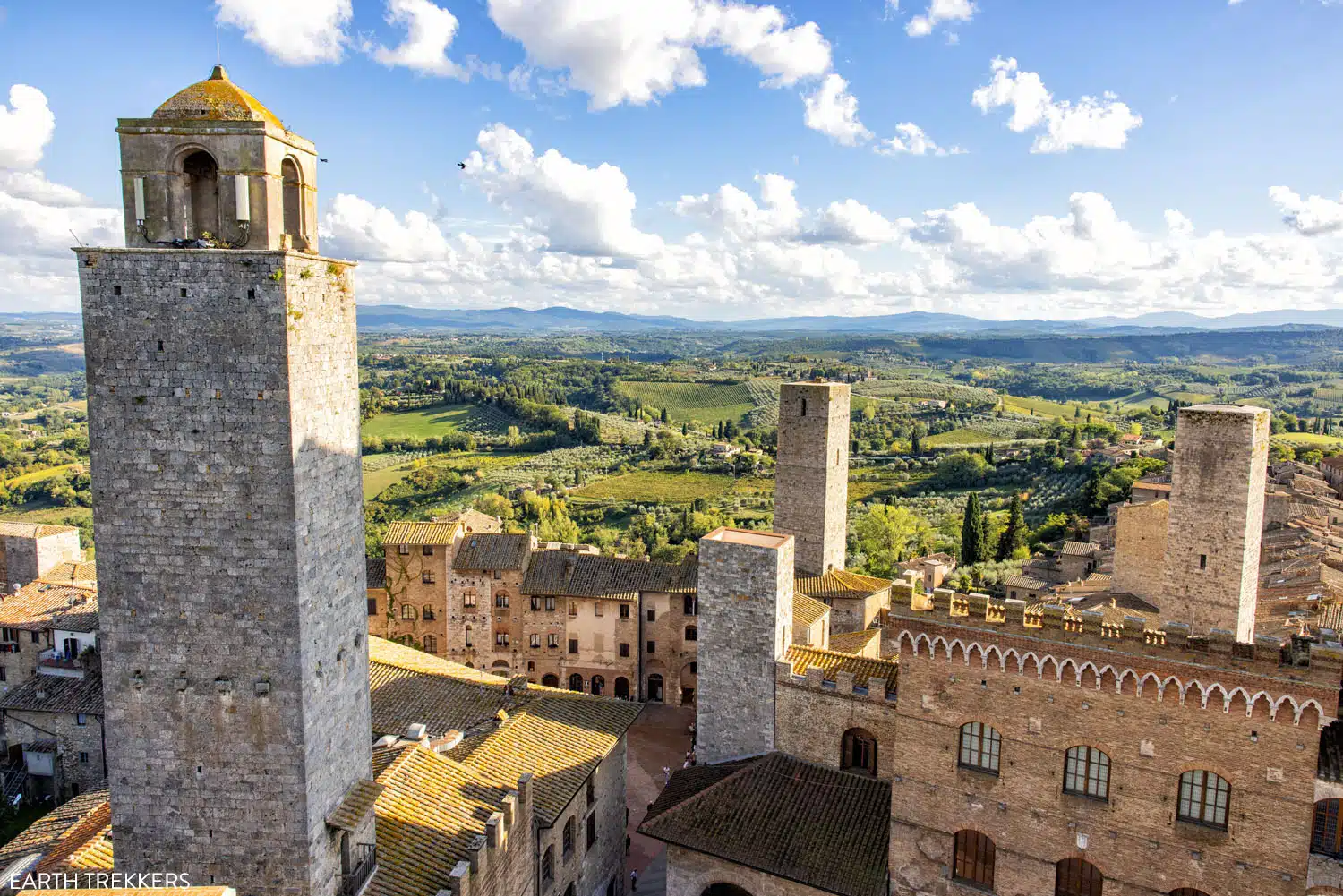
San Gimignano
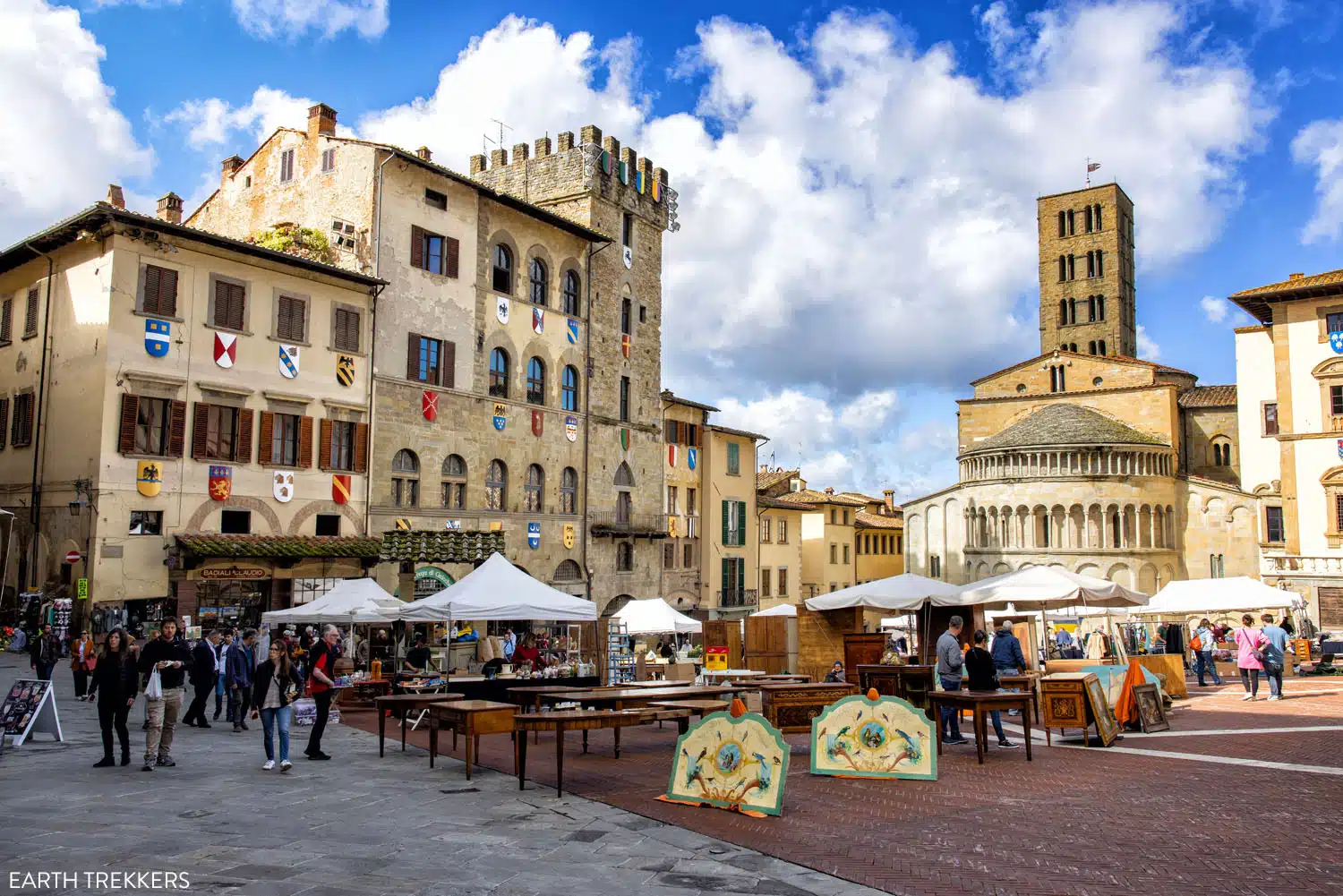
Arezzo
Planning Your Time in Florence
For the best experience, we recommend spending two or more days in Florence. With two days, you can visit the main sites in Florence, plus have time to dine in a few restaurants and visit some of the best viewpoints of the city. With more time, you can explore more of Florence or take day trips into Tuscany. Learn how to plan your time with our 2 Day Florence Itinerary.
But if you only have one day in Florence, with some advance planning, you can visit many of the top sights, including the Duomo, Accademia Gallery, the Uffizi Gallery, Ponte Vecchio, and the sunset view from Piazzale Michelangelo. Get the full details in our article How to Spend One Day in Florence.
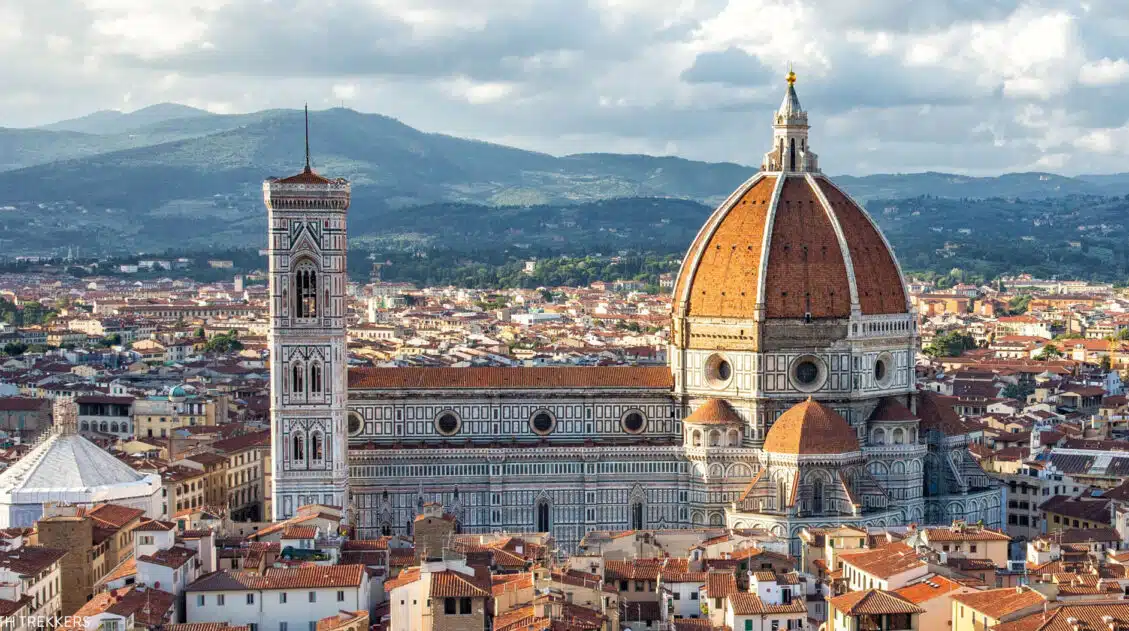
One Perfect Day in Florence: Must-See Sights & Sunset Views
Pinterest Facebook Flipboard One day in Florence is enough to see the best of this city, if you plan it right. With a well-planned day, you can visit Florence’s top sights, including the Duomo, Michelangelo’s David, the Uffizi Gallery, and Ponte Vecchio. Watch the sunset over the rooftops, stroll through Florence’s scenic streets, and end […]
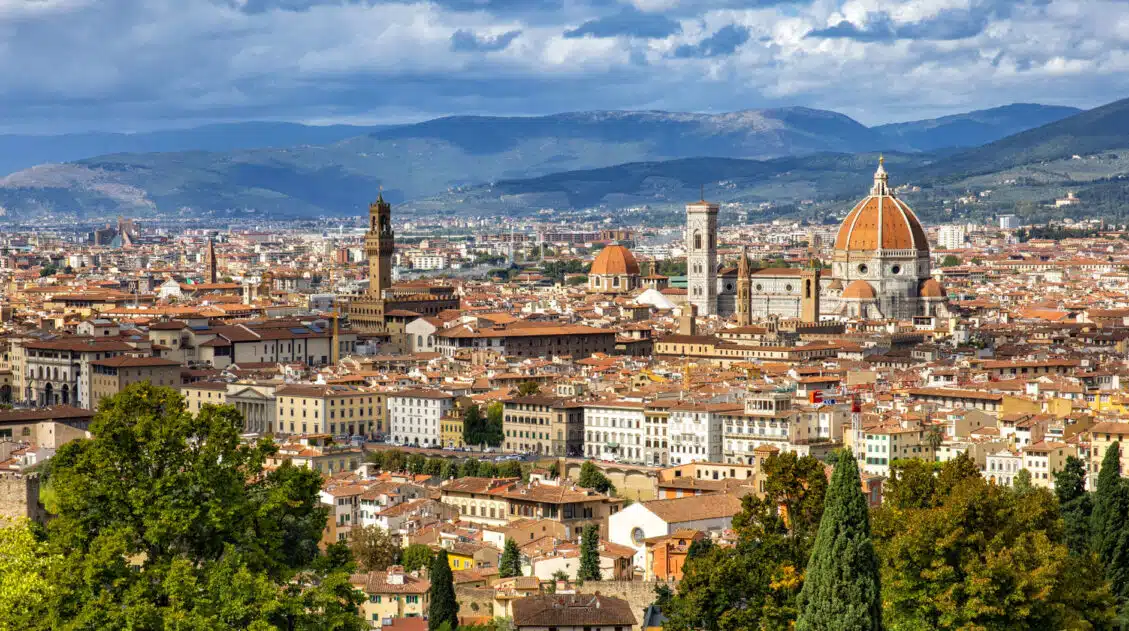
2 Days in Florence: Detailed Day-by-Day Itinerary
Two days in Florence is the sweet spot for a first visit. It’s enough time to see everything that matters, without the feeling that you’re sprinting from one landmark to the next. With two days, you can climb the dome of the Florence Cathedral, stand in front of Michelangelo’s David, spend a proper morning in […]
Best Time to Visit Florence
We’ve visited Florence twice: once in July with our kids and again in September, with more time to explore. July felt busy everywhere, but not unmanageably so. Having tickets booked in advance made a real difference. We moved through the Duomo complex and the major museums without significant waits, even in peak summer. The heat was warm rather than oppressive on our visit, though that can vary considerably from year to year, and midday in summer can be brutal in a city with so much pavement and so little shade.
September felt quieter. Florence was still busy by most cities’ standards, but noticeably more relaxed than July. The tradeoff was the weather. We had clouds and rain for roughly half our visit, which is something to factor in if you’re planning to spend time at outdoor viewpoints or do Tuscan day trips.
If we were planning a first trip and could choose any month, we’d lean toward May. The weather tends to be warm and pleasant without the full heat of summer, the Tuscan countryside is lush and green, and the crowds haven’t yet hit their July peak. It’s also an ideal time for the Bardini Gardens and the Rose Garden, both of which are at their best in spring.
- Spring (April–May): Our top recommendation. Pleasant weather, green countryside, fewer crowds than summer, flowers in bloom.
- Summer (June–August): Peak season with peak crowds, but very manageable with advance bookings. Heat varies — come early, rest at midday.
- Fall (September–October): Quieter feel, beautiful light on good days, but an increased chance of rain especially in September.
- Winter (November–March): Fewest crowds and lowest prices. Cold and grey, but the museums are as good as ever and the city has a different, more local feel.
Tips for Visiting Florence
Book everything in advance. I’ll say it plainly: Florence rewards those who plan ahead and punishes those who don’t. The dome climb, Michelangelo’s David, and the Uffizi can all sell out days or weeks ahead in peak season. Book as soon as your dates are confirmed and work through the official websites where possible.
Check the official websites before you go, and before you choose your dates. Florence has a lot of moving parts. Museums close for maintenance, sections go offline without much warning, and the dome itself closes for a few days each fall for annual maintenance. A quick check of the Duomo Opera website and the Uffizi Galleries site before you finalize your travel dates can save real disappointment on the ground.
Skip the Firenze Card. We used it on our first visit and it made sense at the time, but it now covers fewer sites than it used to, and many attractions still require advance time-slot reservations through the official website even if you have the card. Our recommendation: book individual tickets directly through each official website. It takes a little more planning but gives you more flexibility and control.
If you only climb one tower, I recommend the Arnolfo Tower at Palazzo Vecchio over Giotto’s Bell Tower. You get one of the best views of the Florence Cathedral from the top. It’s unobstructed and stunning. Giotto’s Bell Tower has a mesh grate around the viewing platform that takes away from the experience. Save the Bell Tower for if you have extra time.
If you’re traveling with kids, go easy on the art museums. When our kids were young, they’d glaze over within about thirty minutes of entering an art museum and we learned to work with that rather than against it. Pick one or two, keep visits short, and balance them with outdoor spaces, gelato, and the kind of sights that don’t require standing still and being quiet.
Watch for Monday closures. Many of Florence’s major museums, including the Uffizi, Accademia, and Boboli Gardens, are closed on Mondays, or in Boboli’s case, the first and last Monday of each month. Plan your itinerary around this or you’ll arrive at a locked door.
Eat as much gelato as possible. The more towers you climb, the more you can eat. Ciao!
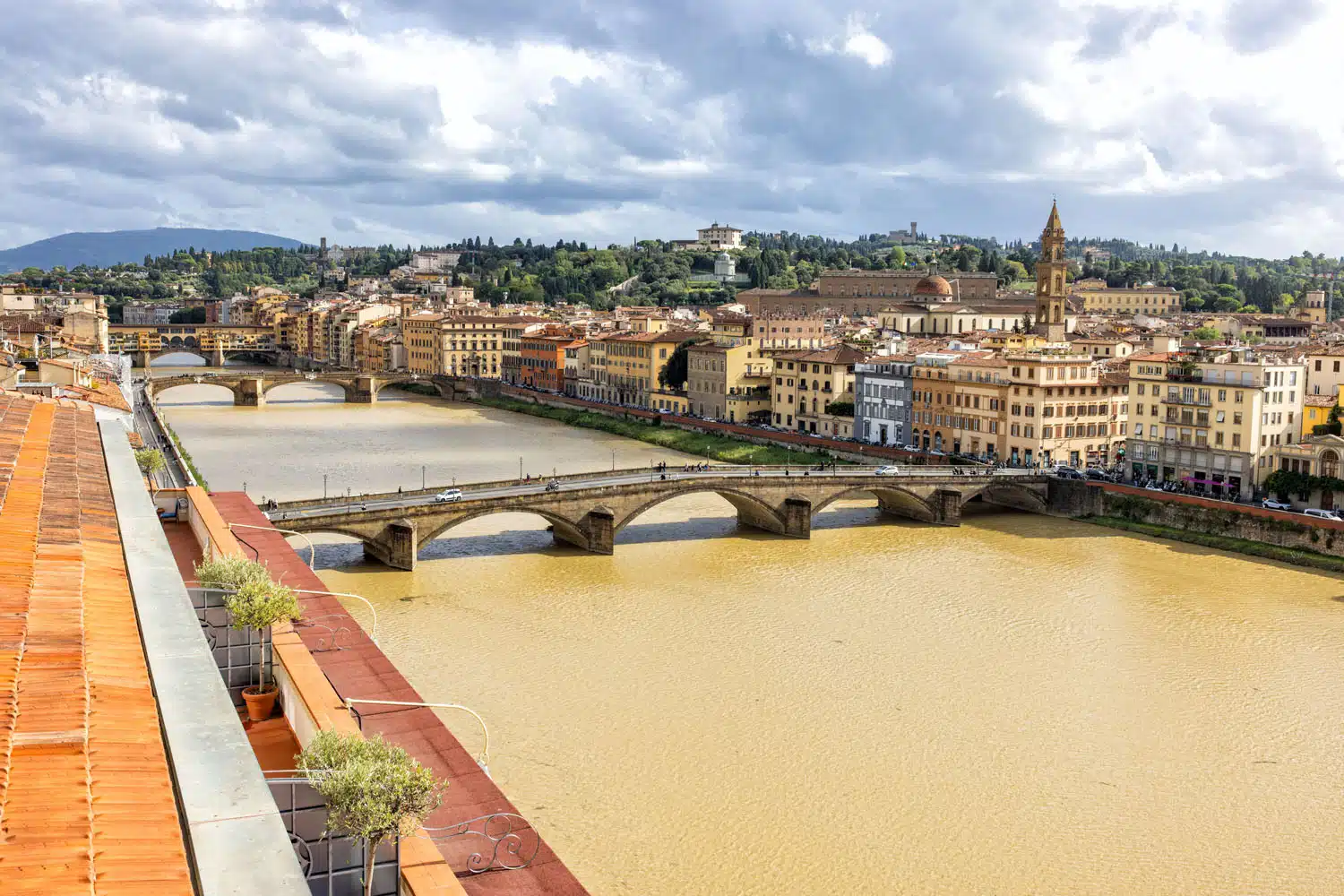
Arno River
Frequently Asked Questions About Florence
Is the Firenze Card worth it?
The Firenze Card was once a fantastic money-saving card that let you skip the line at Florence’s top sites, but that has changed. It’s expensive, covers fewer sites than it used to, and many attractions still require a separate advance time-slot reservation even if you have it. Our recommendation is to book individual tickets directly through each attraction’s official website. The only exception is if you’re spending four or more days in Florence and plan to visit a large number of museums, including lesser-known ones like the Strozzi Palace, Medici Chapels, and Brancacci Chapel.
How many days do you need in Florence?
We’d recommend a minimum of two days, and ideally three to five. Two days gives you enough time to see the highlights without feeling like you’re racing. Three to five days opens up the hidden gems: the Bargello, Bardini Gardens, San Miniato al Monte, rooftop bars, and day trips into Tuscany. We visited for a day and a half on our first trip and loved it, but our four to five day return visit showed us a completely different side of the city.
Is it possible to visit Florence in one day?
Yes, with the right planning. Florence is a compact city and the major sights are clustered within the historic center, which makes it easy to move between them on foot. In one day you can visit the Duomo, climb the dome, see Michelangelo’s David at the Accademia, tour the Uffizi Gallery, stroll across Ponte Vecchio, and watch the sunset from Piazzale Michelangelo. You’ll need to book tickets well in advance and keep a tight schedule, but it’s very doable. We have a full one day in Florence itinerary that walks you through exactly how to do it.
What is the best time to visit Florence?
Our top pick is May. The weather is warm and pleasant, the Tuscan countryside is lush and green for day trips, and the summer crowds haven’t fully arrived yet. September is also popular and feels quieter than July, but be prepared for a higher chance of rain. We had clouds and rain for roughly half of our September visit. July is busy but very manageable if you book all your tickets in advance. For the fewest crowds and lowest prices, visit in winter, because the museums are as good as ever and the city has a more local feel.
Do you need to book Florence attractions in advance?
Yes, for the major sites, advance booking is essential. The dome climb has the most limited availability and should be booked first, ideally weeks ahead in summer. The Accademia (David) and Uffizi Gallery also sell out regularly in peak season. Ponte Vecchio, Piazzale Michelangelo, the Rose Garden, and most churches are free and require no booking. A good rule of thumb: if it’s on the top ten list and costs money, book it before you arrive.
More Help Planning Your Trip to Florence
If you’re still working out how to structure your time in Florence, our one day in Florence itinerary and two days in Florence itinerary walk you through exactly how to sequence the highlights depending on how long you have.
For a deeper look at the Duomo complex specifically, our Florence Duomo guide covers everything you need to know about climbing the dome, visiting the Baptistery, and making the most of your time there.
If viewpoints are a priority, our best views in Florence post covers every rooftop, hilltop, and tower worth climbing, and our best rooftop bars in Florence guide pairs the best views with the best cocktails.
If you’re planning a bigger Italy trip with Florence as one stop, our Italy Travel Guide is the best place to start, with links to our 10-day Italy itinerary and 14-day Italy itinerary to help you build out the full trip.
If you have any questions about the best things to do in Florence or how to plan your visit, let us know in the comment section below.
More Places to Visit in Italy
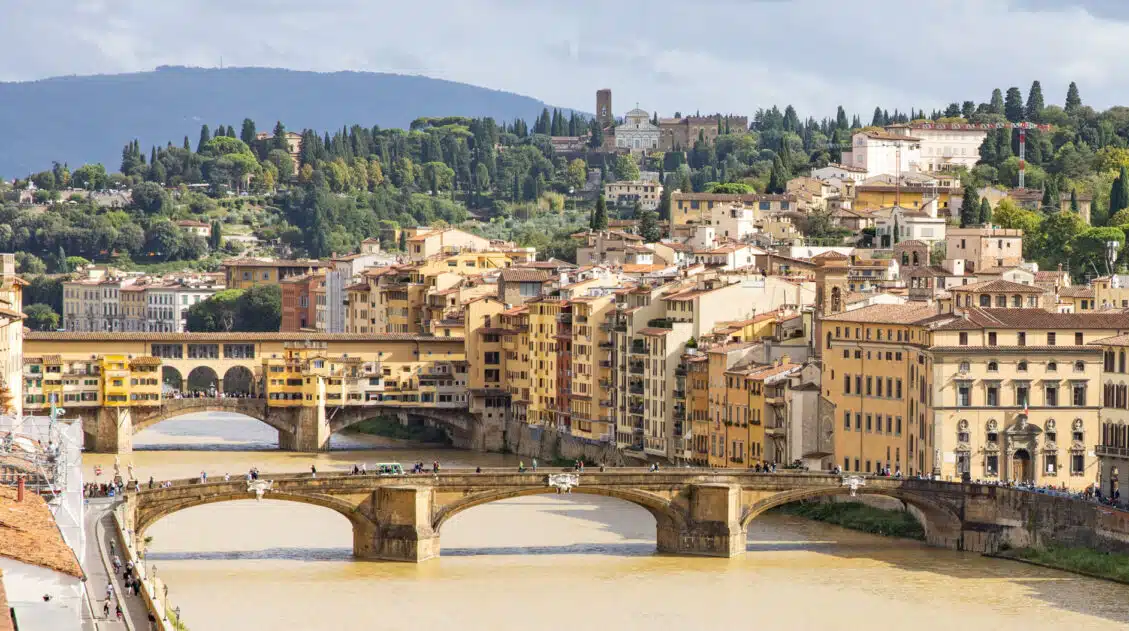
Where to Stay in Florence: Best Hotels & Neighborhoods
If you’re planning your first visit to Florence, where you stay will shape the entire experience. Florence is compact and walkable, which means a well-chosen hotel puts the Duomo, the Uffizi, and the Ponte Vecchio at your doorstep. A poorly chosen one means commuting to the magic instead of living inside it. We’ve visited Florence […]
Best Day Trips from Florence: 15 Picks for Every Type of Traveler
Florence is one of the best home bases for exploring Tuscany and nearby cities. The most popular day trips from Florence are conveniently accessible by train, with destinations like Pisa, Lucca, Bologna, Arezzo, and Siena just one to two hours away. Renting a car or joining a guided tour provides access to Tuscan hill towns, […]
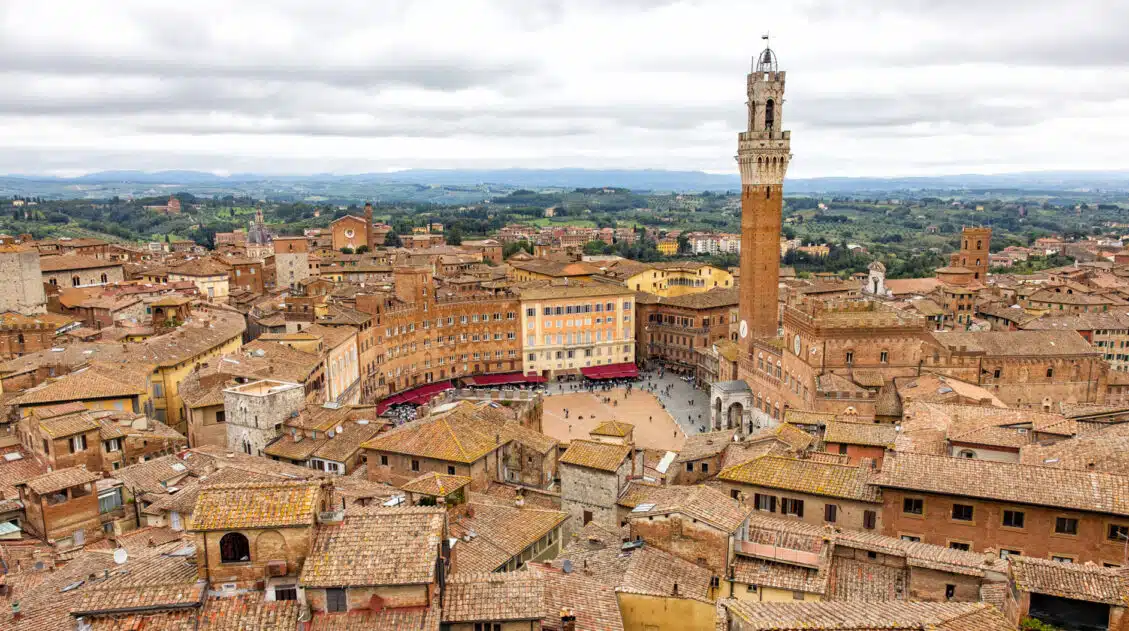
The Best Things to Do in Siena, Italy
Some cities in Italy overwhelm you with options. Siena does the opposite, and that’s exactly what we loved about it. The historic center is compact and entirely walkable, the main sights are clustered within easy reach of each other, and the city has a pace that makes it easy to slow down. The things to […]
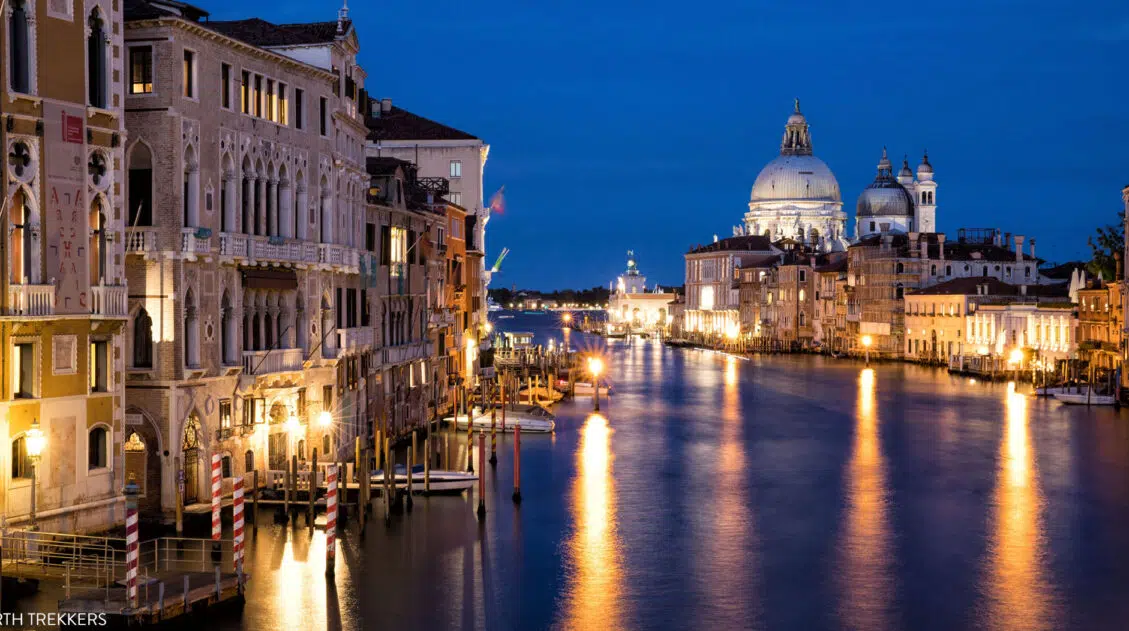
10 Day Italy Itinerary: Rome, Florence, Cinque Terre & Venice
There’s a moment on the train from Rome to Florence, about an hour in, where the landscape shifts from the flat Roman countryside to something greener and hillier, and you realize you’re already in a different Italy. We’ve made that journey more than once over six trips to Italy, and it never gets old. This […]
1 to 2 Days in Bologna: The Best Itinerary for First Timers
Bologna didn’t make it onto our Italy itinerary until our sixth trip. We’d visited Rome, Florence, Venice, the Amalfi Coast, Tuscany, and the Dolomites, and somehow kept skipping over this city in northern Italy. Once we finally arrived, Tim and I were instantly captivated: the busy, bustling Quadrilatero with its wine bars and shops overflowing […]
Italy Travel Guide: How to Plan a Trip to Italy
Italy Travel Guide From the ruins of ancient Rome to the hiking trails of the Dolomites, the trulli of Puglia to the hilltop villages of Tuscany, Italy is a country that rewards every kind of traveler, and keeps pulling you back. We’ve traveled to Italy six times, exploring the country from the lakes and mountains […]
Best Things to Do in Arezzo, Tuscany (+ Map, Tips & Itinerary)
After two trips through Tuscany, we’ve visited a lot of hill towns, including Siena, Cortona, Montepulciano, Pienza, and a handful of smaller villages tucked into the countryside. Arezzo was one of the last ones we visited, and arriving on a Sunday in early October, we weren’t sure what to expect. What we found was one […]
Pisa Day Trip: How to Visit the Leaning Tower from Florence
Traveling from Florence to the Cinque Terre? Here’s how to stop in Pisa to see and climb the Leaning Tower in just a couple of hours, without derailing your travel day. If you’re traveling between Florence and the Cinque Terre, Pisa is one of the easiest and most worthwhile stops you can add to your […]
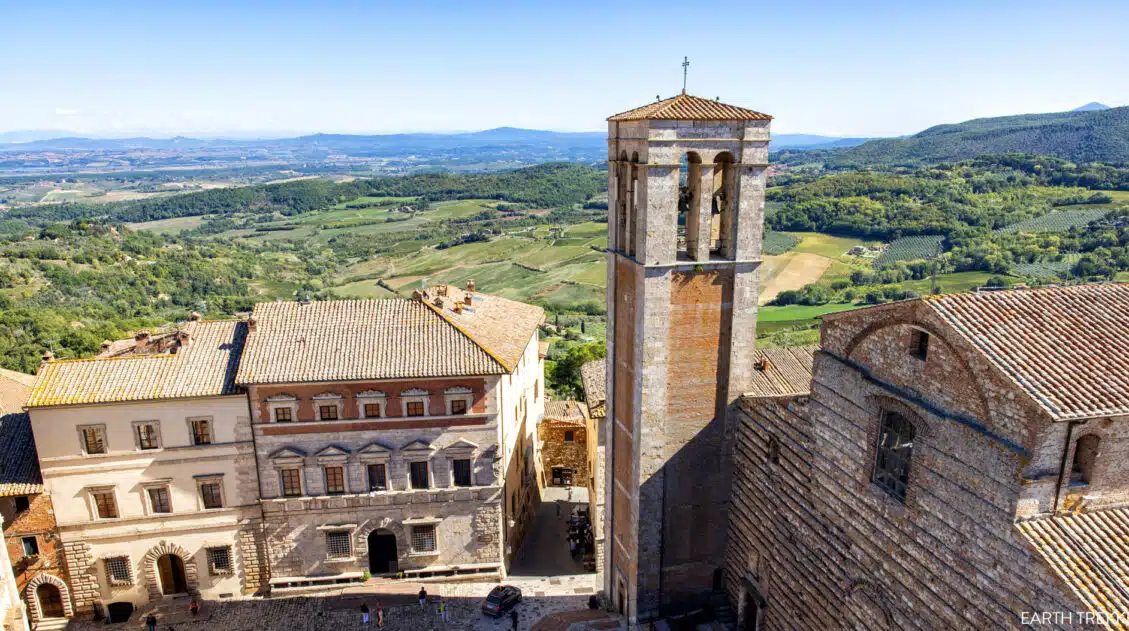
Best Things to Do in Montepulciano: Wine Cellars & Beyond
Planning your list of things to do in Montepulciano? This hilltop town in southern Tuscany is one of the most atmospheric places in the region, known for its Renaissance architecture, sweeping views over the Val d’Orcia, and its famous Vino Nobile wine. Perched on a hilltop in Val d’Orcia, Montepulciano is compact but packed with […]
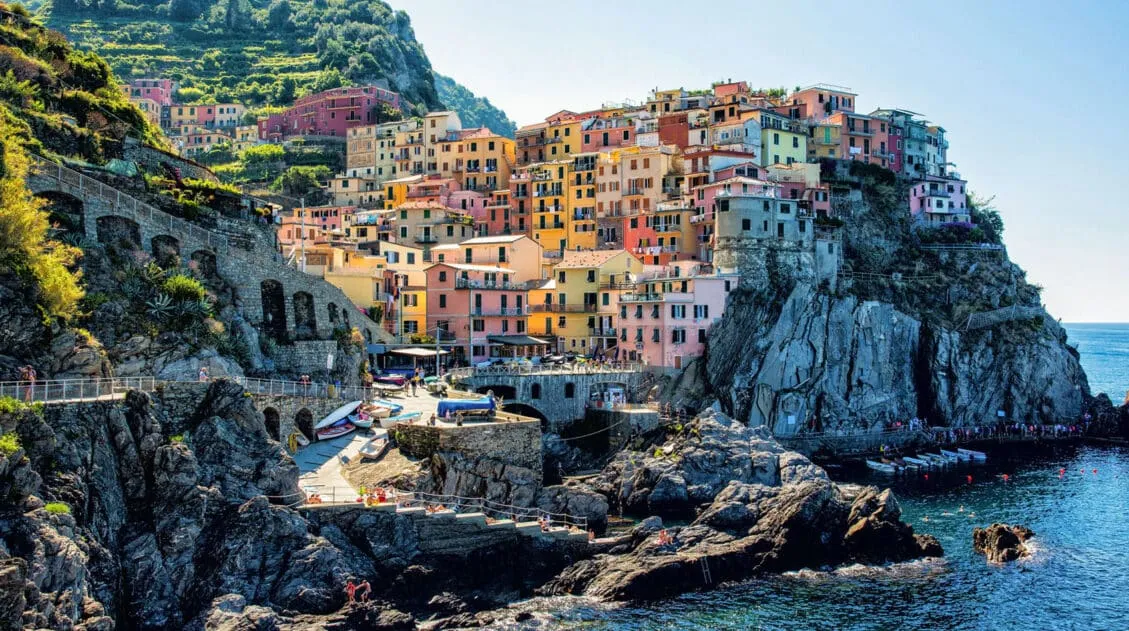
Planning to Hike the Cinque Terre? Here’s What to Know for 2026
The Cinque Terre is one of Italy’s most iconic coastal hikes, connecting five colorful villages by cliffside trails overlooking the Mediterranean. Here’s exactly how to hike the Cinque Terre from Riomaggiore to Monterosso, including trail closures, ticket costs, one-way rules, and what to expect in 2026. We hiked the entire route as a family. Our […]
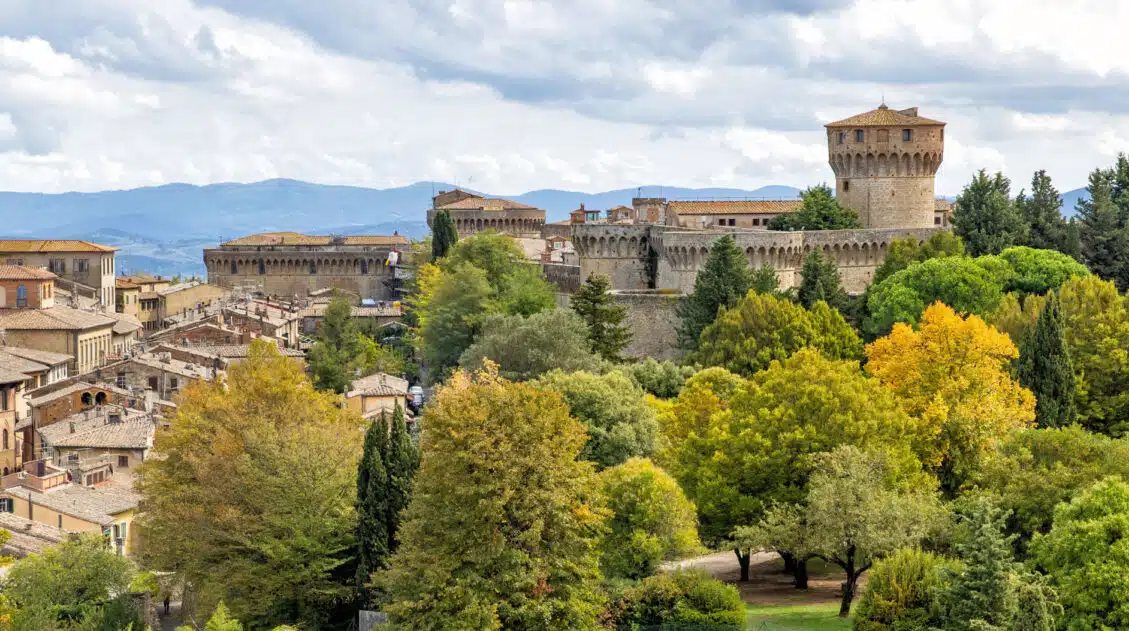
The Perfect Tuscany Itinerary for 3 Days, 5 Days & One Week
Planning a trip to Tuscany? This guide covers everything you need to build the perfect itinerary, whether you have 3 days, 5 days, or a full week. How long should you spend here? Where should you stay? Should you rent a car? What towns are worth visiting? These are all questions that may be running […]
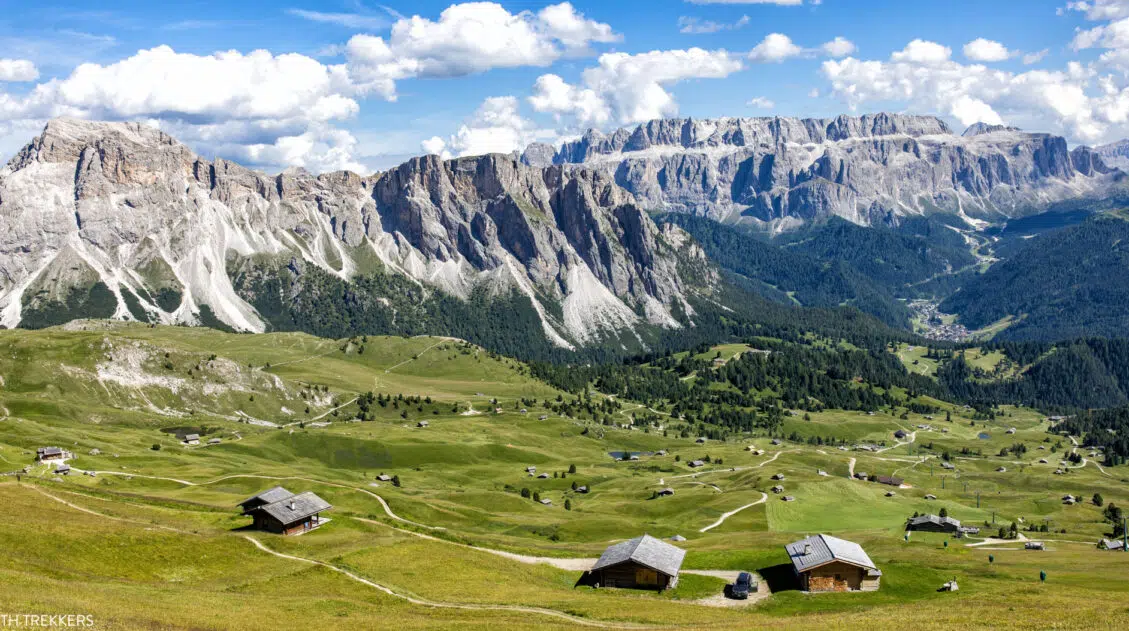
15 Surprising Things to Do in the Dolomites That Aren’t Hiking
We have traveled to the Dolomites twice, spending 12 days exploring alpine lakes, mountain passes, and hiking trails. This guide features the very best things to do in the Dolomites that require minimal or no hiking, based on our personal experiences. It’s no secret that the Dolomites are a great place to go hiking. But […]
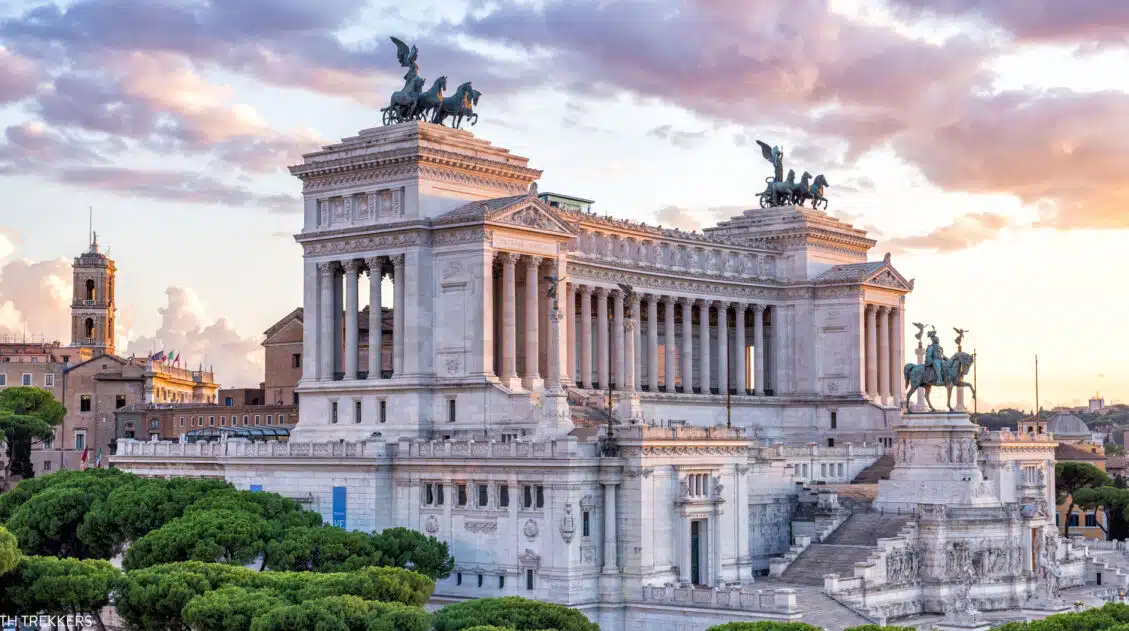
30 Things to Do in Rome | The Ultimate Rome Bucket List
Rome is the capital city of Italy and one of the largest cities in Europe. With its long, rich history, famous landmarks, museums and archaeological sites, the to-do list for visitors is enormous. 30 things to do in Rome sounds like a lot, and it is, but there are many more places we could have […]


Comments 10