
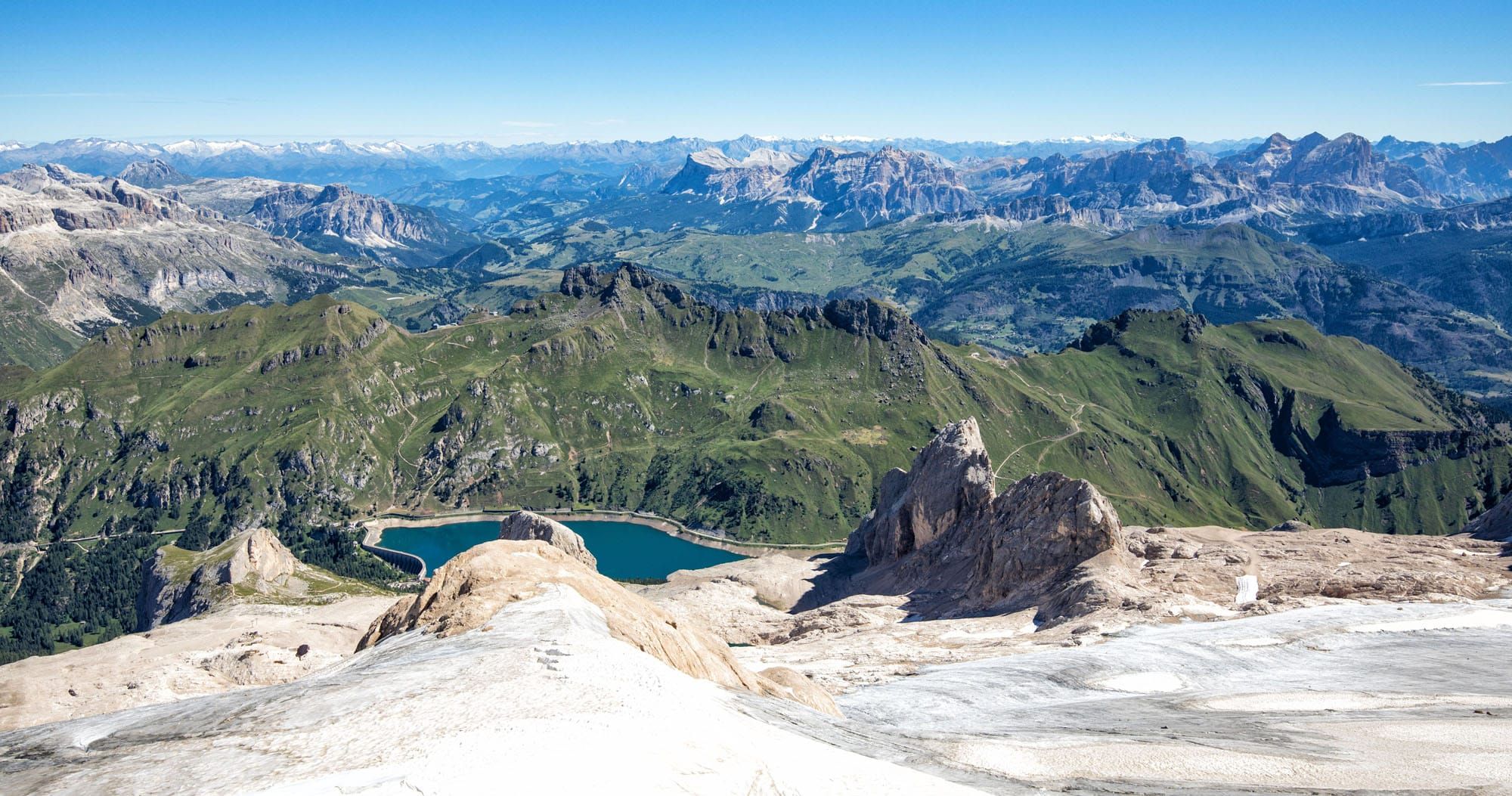
We visited Marmolada while road tripping through the Dolomites, driving from Cortina d’Ampezzo to Val Gardena. Since it is the highest peak in the Dolomites, it had long been on our list of places to visit, and adding it as a stop along this scenic drive made perfect sense.
After hiking many of the region’s most famous trails and viewpoints, from Seceda to Tre Cime di Lavaredo, we were curious how Marmolada would compare. What we found was a very different kind of experience: part high-alpine adventure, part World War I history lesson, and part panoramic viewpoint over some of the most dramatic mountain scenery in northern Italy.
Riding the cable car to the summit is one of the easiest ways to stand on top of the Dolomites without committing to a long hike. From the upper station, you’re treated to sweeping views of jagged limestone peaks, alpine valleys, and, on a clear day, distant ridgelines stretching for miles. This is one of the most unique experiences in the region and easily earns a spot on our list of the Best Things to Do in the Dolomites.
In this guide, we’ll explain exactly how to visit Marmolada, what to expect at each cable car station, how much time you need, and whether it’s worth adding to your Dolomites road trip.
The Essentials
LOCATION | Near Passo Fedaia, between Cortina d’Ampezzo and Val Gardena
ELEVATION | 3,343 meters (10,968 feet) — highest peak in the Dolomites
BEST FOR | Glacier views, standing on the highest summit, easy-access alpine panorama
TIME NEEDED | 2 to 3 hours
COST | Cable car ticket required (check current pricing before your visit)
CAN YOU HIKE? | Limited hiking; more of a summit viewpoint experience
Why Visit Marmolada?
As the highest peak in the Dolomites, Marmolada offers something the others don’t: glacier views, massive vertical scale, and the feeling of standing on top of the entire mountain range.
Add in the World War I museum carved into the mountain and the rare chance to stand beside one of the Dolomites’ last remaining glaciers, and Marmolada becomes more than just a viewpoint, it becomes one of the most unique experiences in the region.
Is Marmolada Worth It?
If you want to say that you stood on the highest mountain in the Dolomites, then a trip to Marmolada is worth it. It also doesn’t take much time to visit Marmolada. To ride the series of cable cars and enjoy views, you are looking at investing about 2 hours into this experience. It can easily be added to a road trip, if you plan to drive through this part of the Dolomites.
However, a visit to Marmolada is expensive and it’s a bit out of the way from the other places to visit in the Dolomites.
At Marmolada, our favorite experiences were the views from Punta Rocca and exploring the WWI caves and trails at Punta Serauta.
We enjoyed this visit, but I can list a lot of other activities that I think are more worth your time on a trip to the Dolomites. Keep reading ↓
Marmolada vs Seceda vs Freccia nel Cielo vs Lagazuoi
If you’re planning a trip to the Dolomites, it can be hard to choose between the region’s famous cable car summits. We’ve visited five of the most popular: Marmolada, Seceda, Freccia nel Cielo (Tofana di Mezzo), Lagazuoi, and Sass Pordoi. Each delivers a very different experience.
Here’s how they compare.
| Experience | Best For | Crowds | Effort |
| Marmolada | Standing on the highest peak in the Dolomites, glacier views, WWI museum | Moderate | Very Easy (cable car only) |
| Seceda | The classic Dolomites postcard photo | High | Easy (cable car) or Moderate (short hike to the iconic viewpoint) |
| Freccia nel Cielo (Cima Tofana) | Big alpine drama with fewer people and expansive 360° summit views | Low to moderate | Easy + optional short summit climb |
| Lagazuoi | Scenic hiking, WWI history and tunnels | Moderate | Easy, moderate if you choose to hike down |
| Sass Pordoi | Panoramic views over Passo Pordoi, plus you get a view of Marmolada | Moderate | Easy, with option to do a strenuous hike to the summit of Piz Boè |
How to Choose Which is Best?
- Choose Marmolada if you want the highest viewpoint in the Dolomites and glacier scenery.
- Choose Seceda if you want the most iconic ridgeline photo and don’t mind larger crowds.
- Choose Freccia nel Cielo (Cima Tofana & Tofana di Mezzo) if you want huge views with fewer crowds and a short, thrilling hike to a mountain peak.
- Choose Lagazuoi if you want to combine panoramic views with a memorable hike. This was the very first hike we did in the Dolomites, and we loved it for its views, plus it’s a downhill hike the entire distance.
- Choose Sass Pordoi for more high alpine views, plus a view of Marmolada. If you like hiking, Piz Boè is one of the easiest 3,000+ meter summit hikes in the Dolomites.
How to Visit Marmolada
Where is Marmolada?
Marmolada is located in the Dolomites, straddling the border between the Italian regions of Veneto and Trentino-Alto Adige.
This mountain is so tall (3,343 meters/10,968 feet) that on a clear day, it can be seen from Venice.
Most people visit Marmolada when touring the Italian Dolomites. The easiest way to get here is by car since public transportation is limited. Here are the driving distances and times from nearby destinations:
- Selva di Val Gardena: 40 km, 1 hour
- Cortina d’Ampezzo: 40 km, 1 hour
- Selva di Cadore: 15 km, 20 minutes
- Venice: 195 km, 3 hours and 15 minutes
How Much Does It Cost to Visit Marmolada?
During the summer season, which runs from mid-June through mid-September, it costs €38 for a round-trip ticket from Malga Ciapela to Punta Rocca. This price is accurate as of February 2026, but could change closer to the start of the summer season.
For updated pricing, and to purchase your tickets in advance, visit the official website.
When is Marmolada Open?
There are two seasons that Marmolada is open, the summer season and the winter season.
In the summer (early-June through mid-September), the cable cars run from 9:00 am to 4:30 pm. The winter season runs from the end of December through early April, depending on snow conditions. During this time, the cable car operates from 8:40 am to 4:00 pm. Get the exact dates and times here.
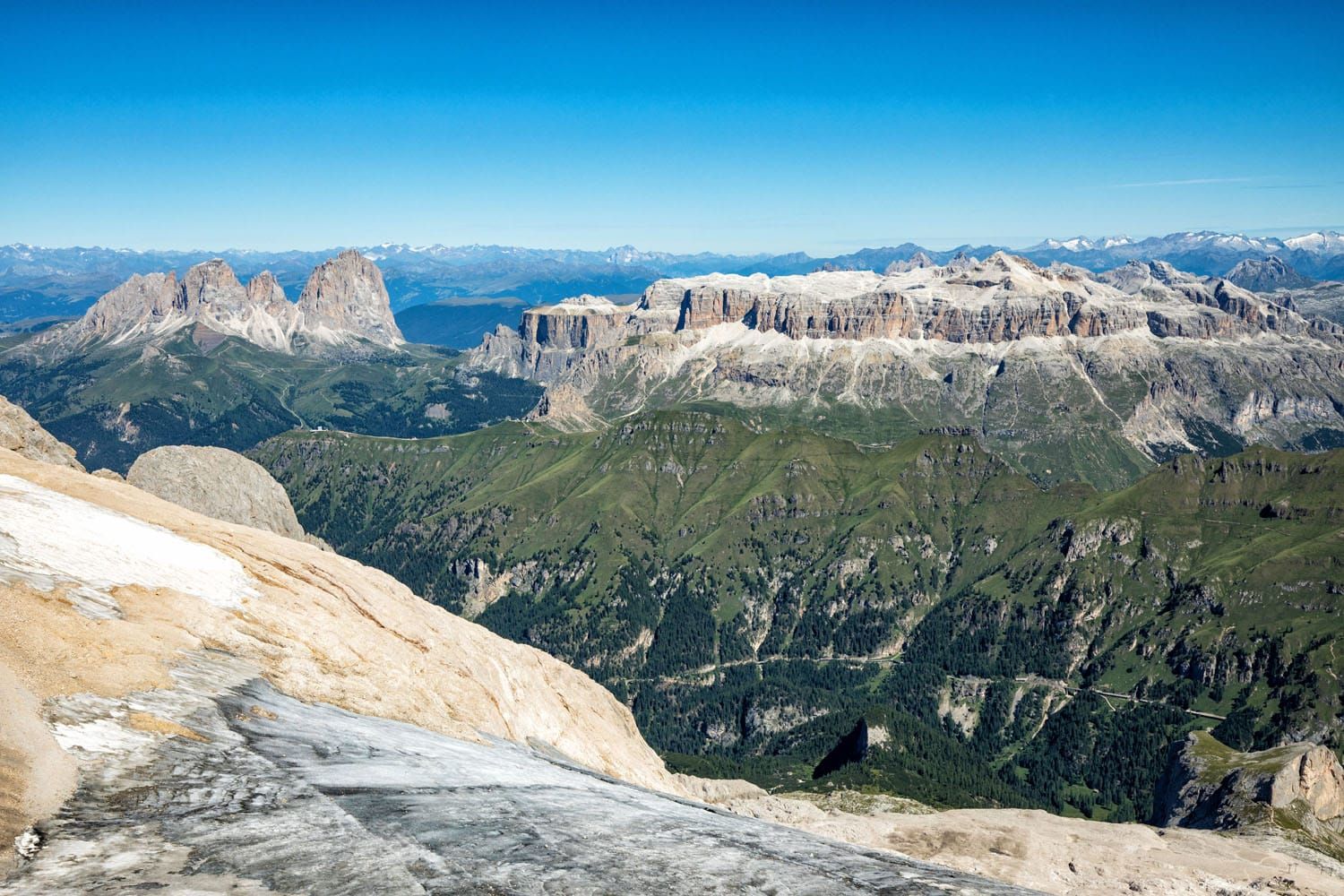
The view of the Sella Group and Sassolungo from Marmolada
Riding the Marmolada Cable Car: What to Expect
In order to get to the top of Marmolada, you will ride a series of three cable cars to the top. Here is a description of the route and what you can do and see along the way.
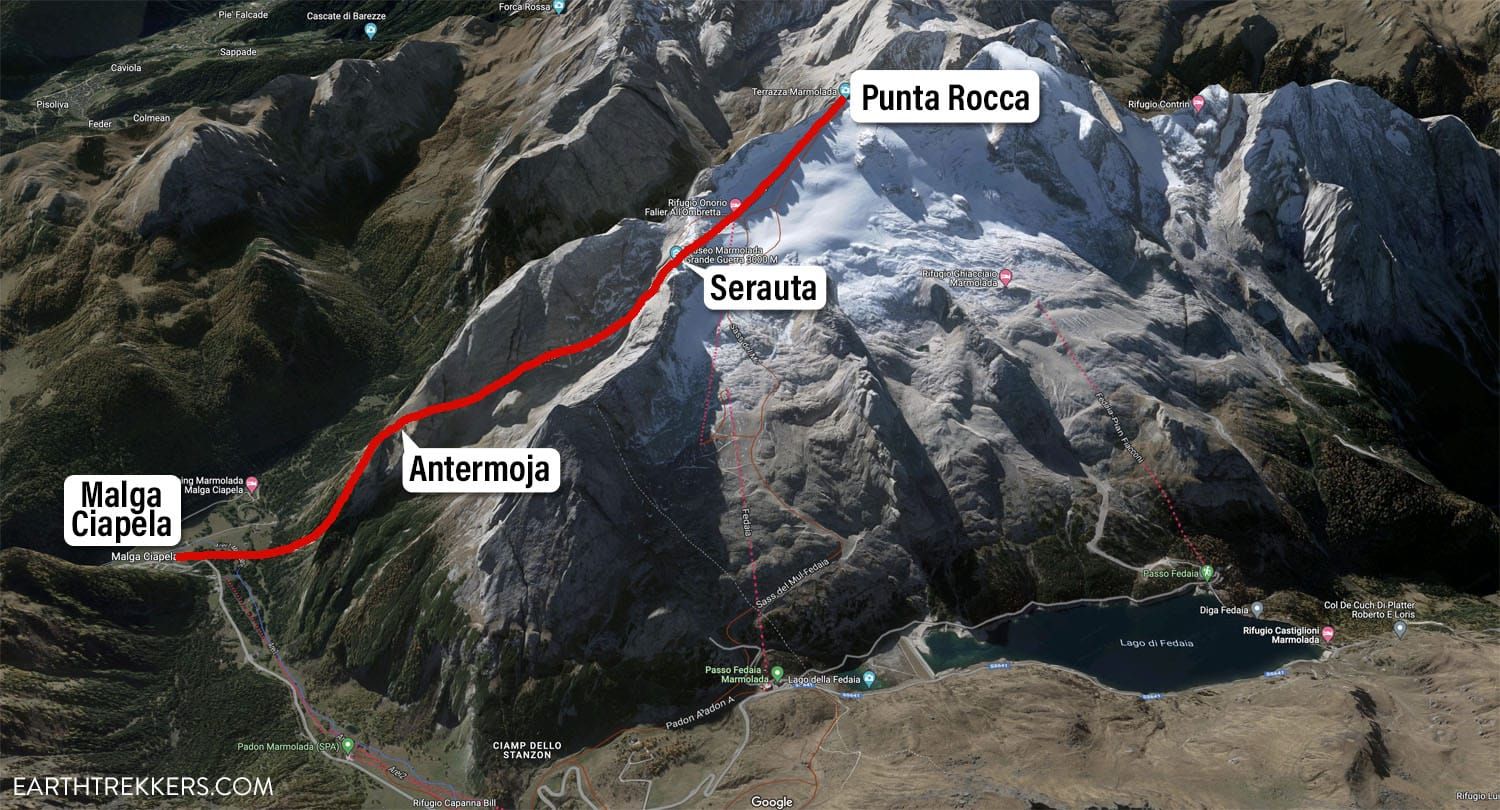
Marmolada Map: cable car route
Malga Ciapèla (1,450 meters) to Antermoja (2,350 meters)
The bottom station is called Malga Ciapèla. There is a large parking lot here as well as a restaurant. You can either purchase your tickets in advance or purchase them at the bottom station. We did this on a busy July day and did not have to wait in line at the ticket booth.
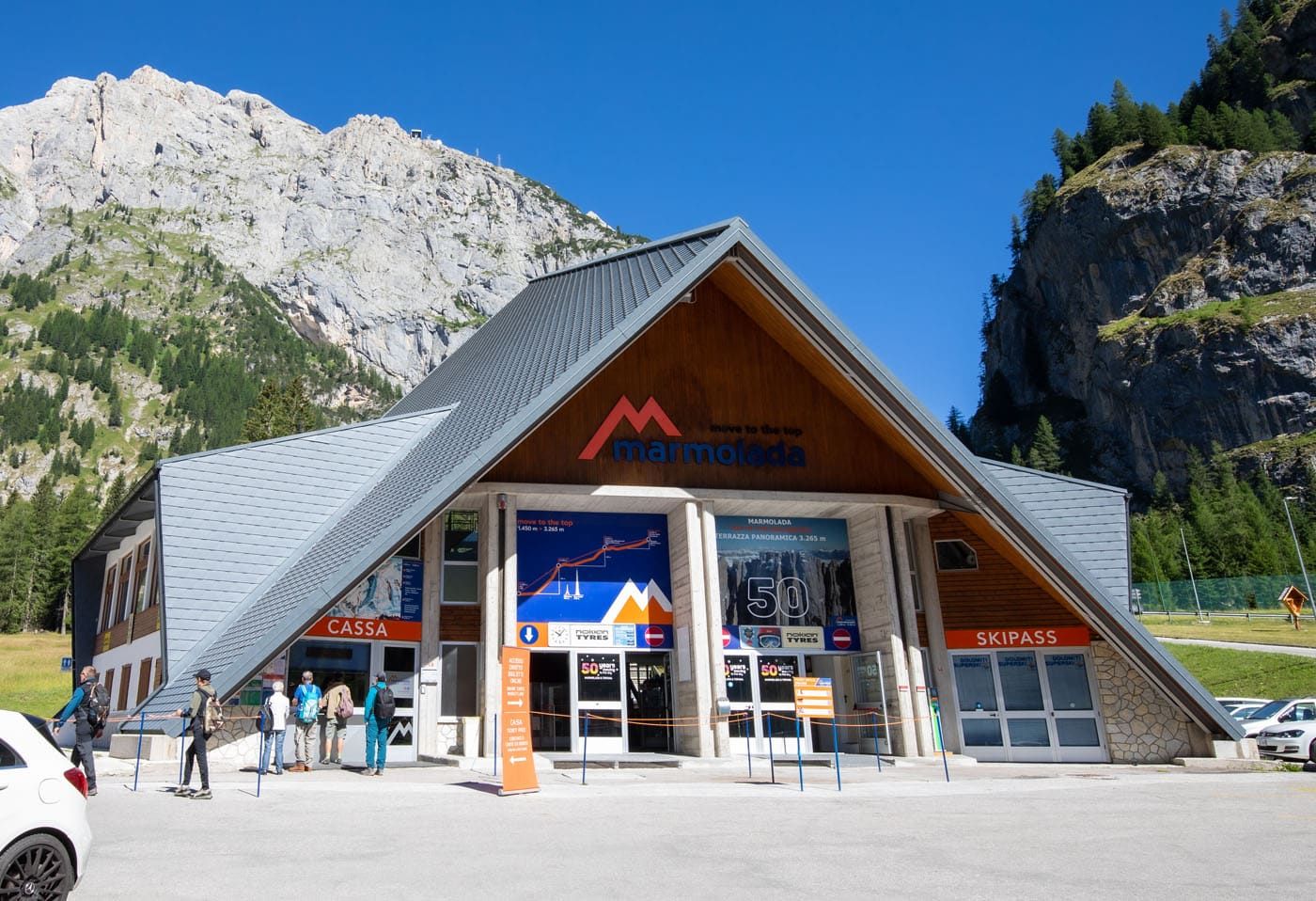
Marmolada bottom station
From Malga Ciapèla, you will ride a cable car to Antermoja. Antermoja is a transfer station, so from here, you will board the cable car to the next station (there is nothing to do here…no restrooms and no viewpoints).
Antermoja (2,350 meters) to Serauta (2,950 meters)
From Antermoja, ride the second cable car to Serauta.
Things to Do at Serauta
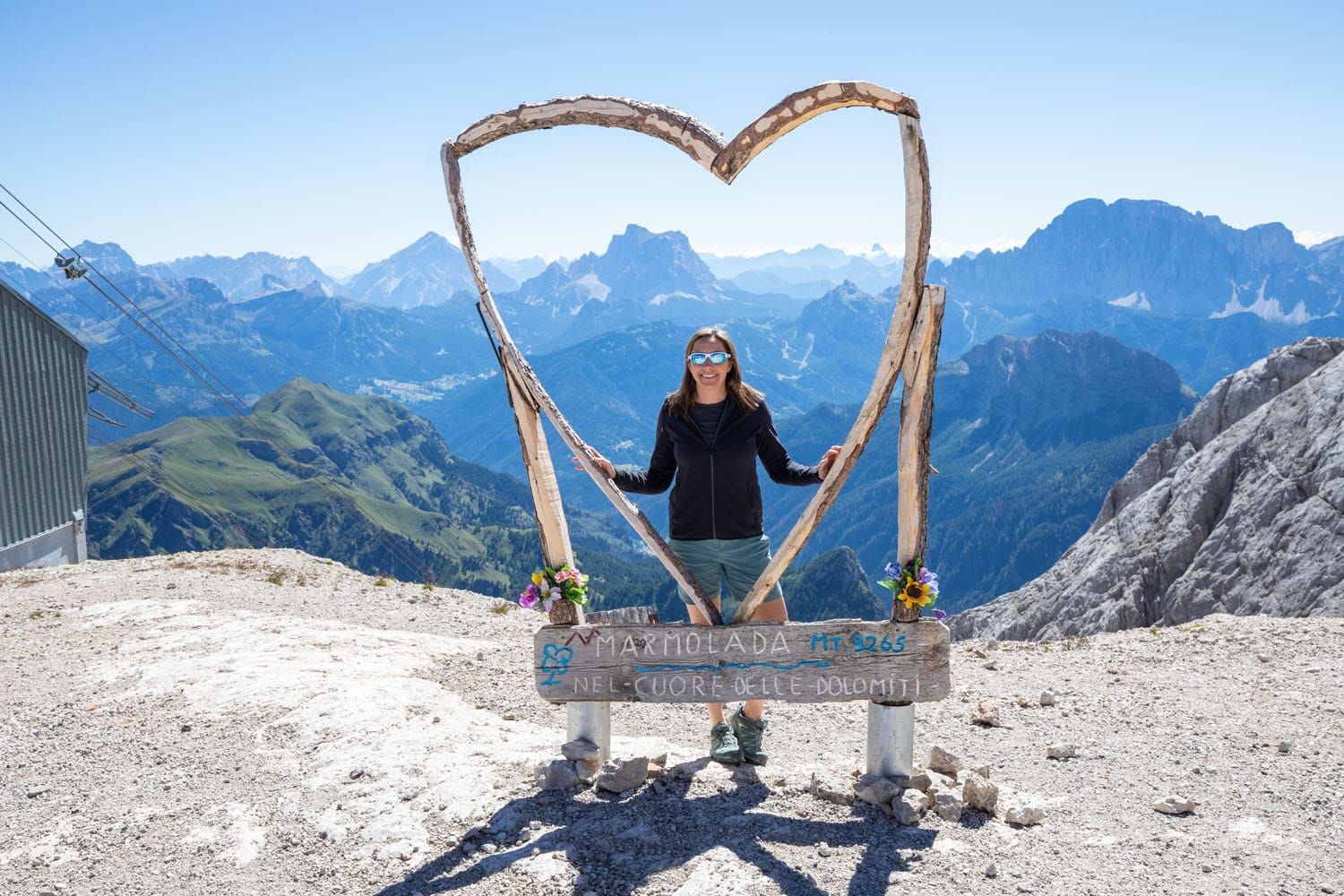
Photo Op by the Heart Sculpture
Walk outside for views from this point on Marmolada. Not far from the station is a heart sculpture which makes a nice photo spot on the mountain.
Outdoor Viewing Terrace
From the large viewing terrace, you get a great view looking north across the Dolomites. It’s not quite as impressive as the view you get from Punta Rocca, since you are not as high, but from here, you can see the Marmolada Glacier and the Punta Rocca station.
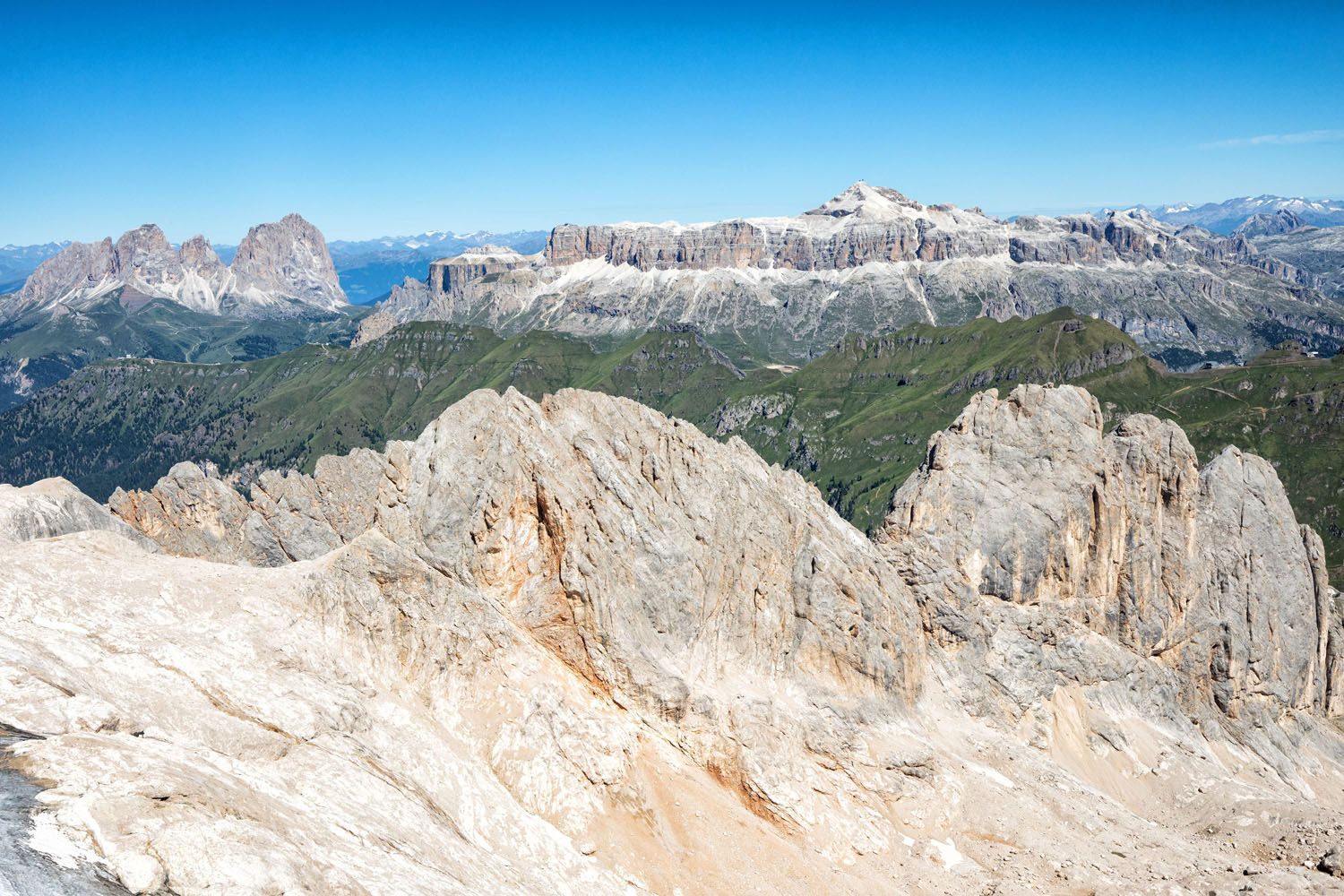
The view of Sassolungo and the Sella Group from Serauta
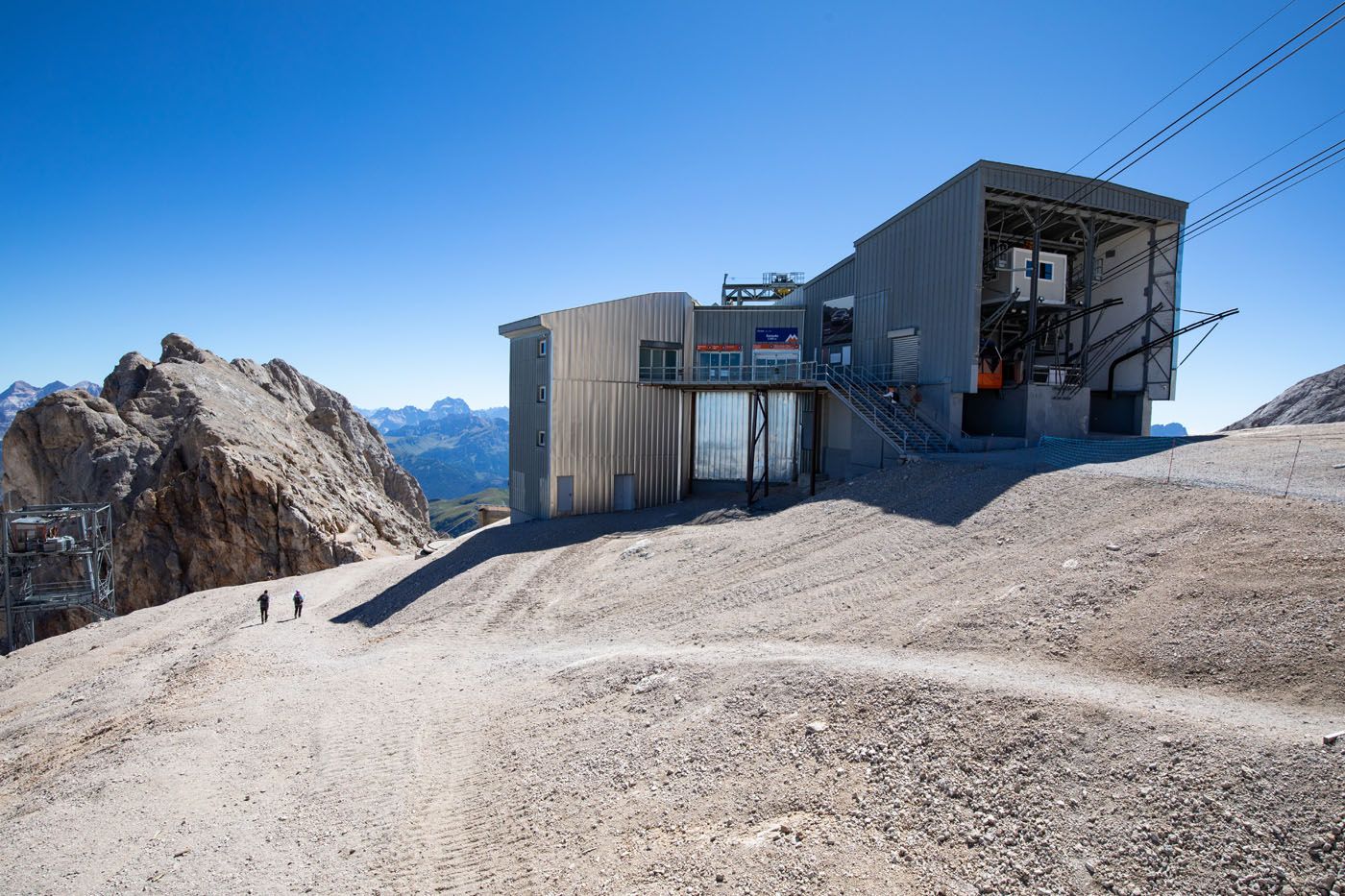
Serauta Station
Sacred Monumental Area of Punta Serauta
A short, easy downhill walk takes you to the WWI sites on Punta Serauta. In this area are bunkers and observation posts built during WWI.
Before hiking onto the trails, you will pass a sign warning visitors of the steep drops and exposed cliff edges. The final portion of this trail is a via ferrata, but you can hike the lower section without any via ferrata equipment. The trails here are very wide but if you have a fear of heights, you will find this to be very challenging.
We hiked up and around the lower part of the WWI sites. Once the trails narrowed, we stopped climbing higher, since we did not have the proper equipment.
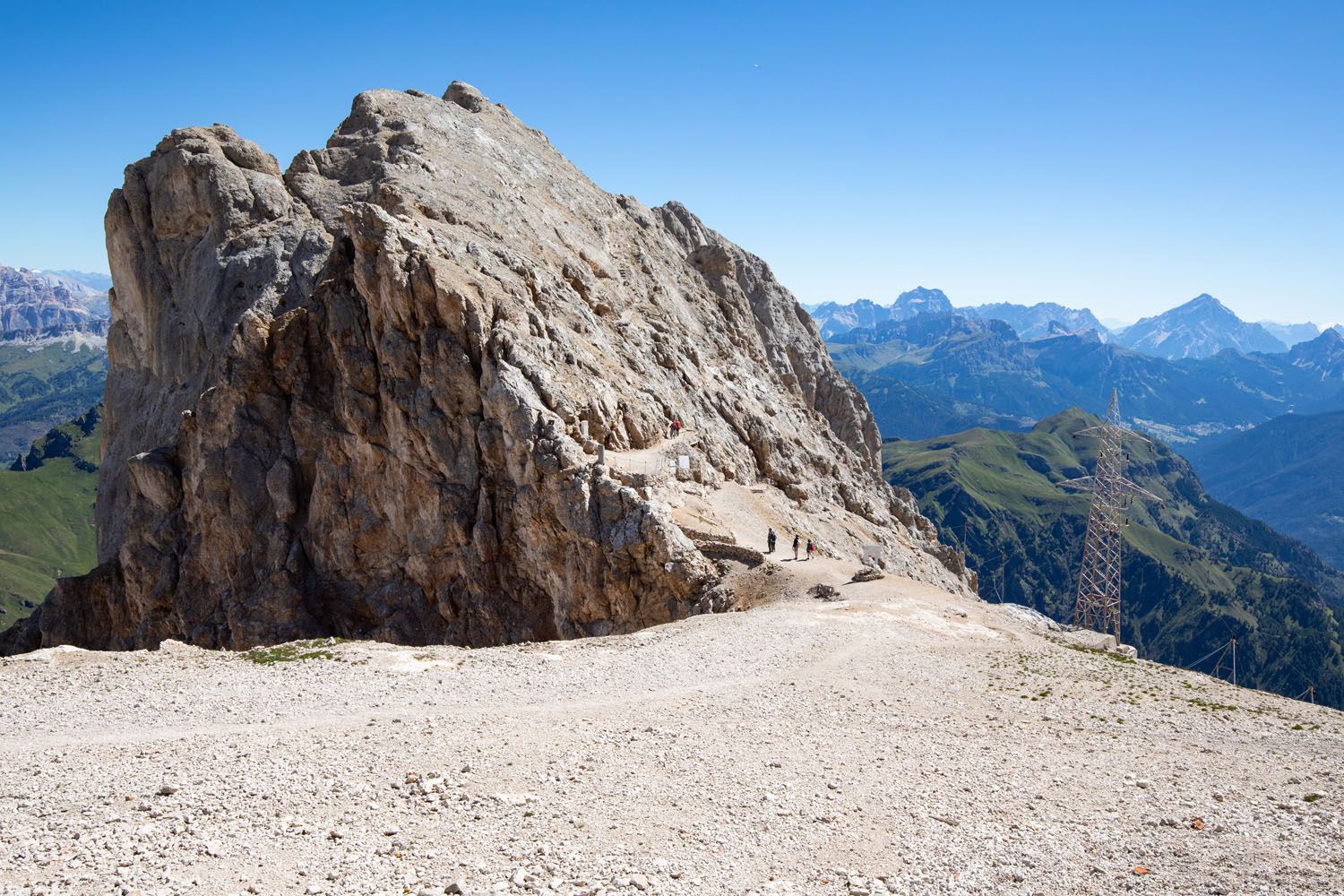
Sacred Monumental Area of Punta Serauta
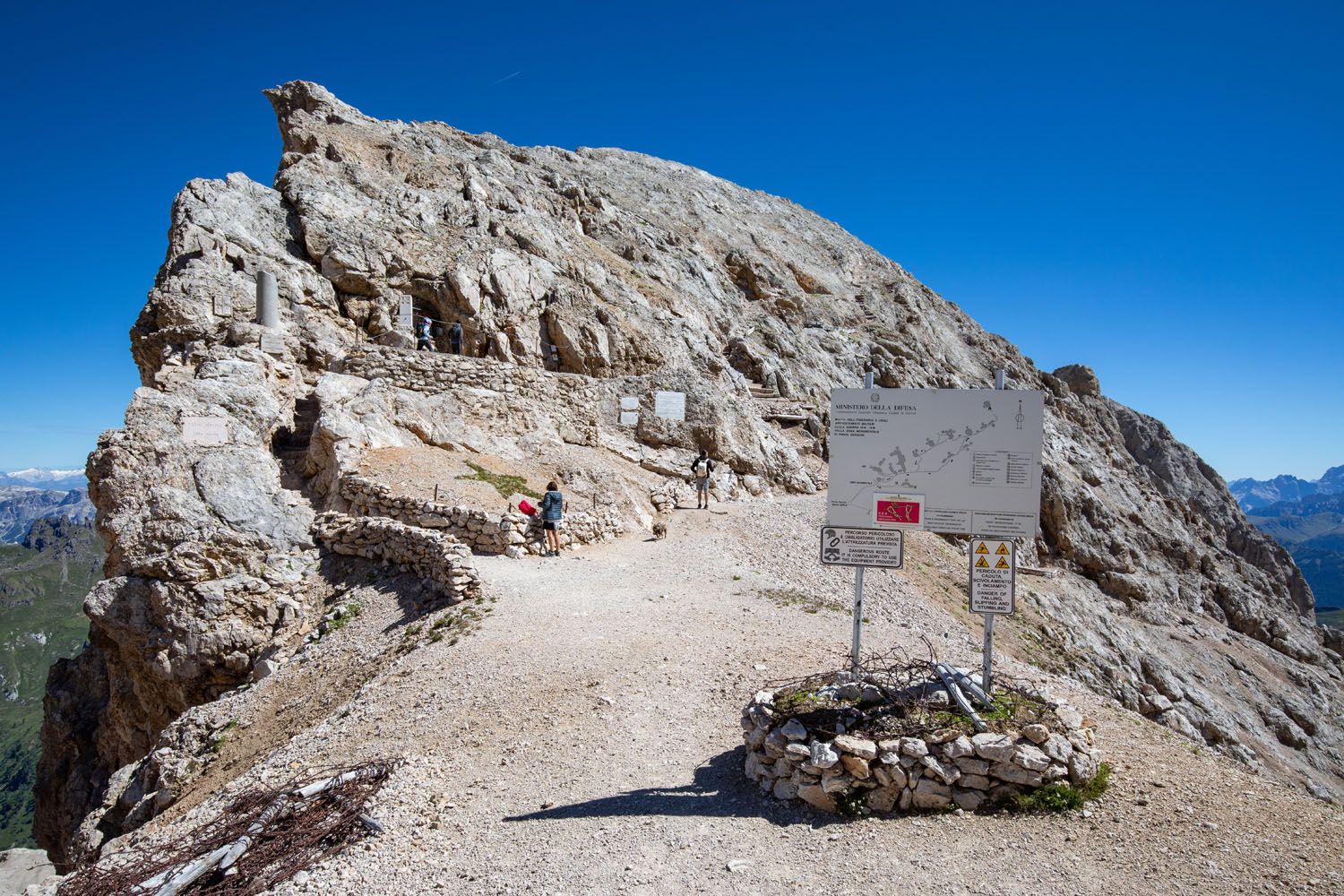
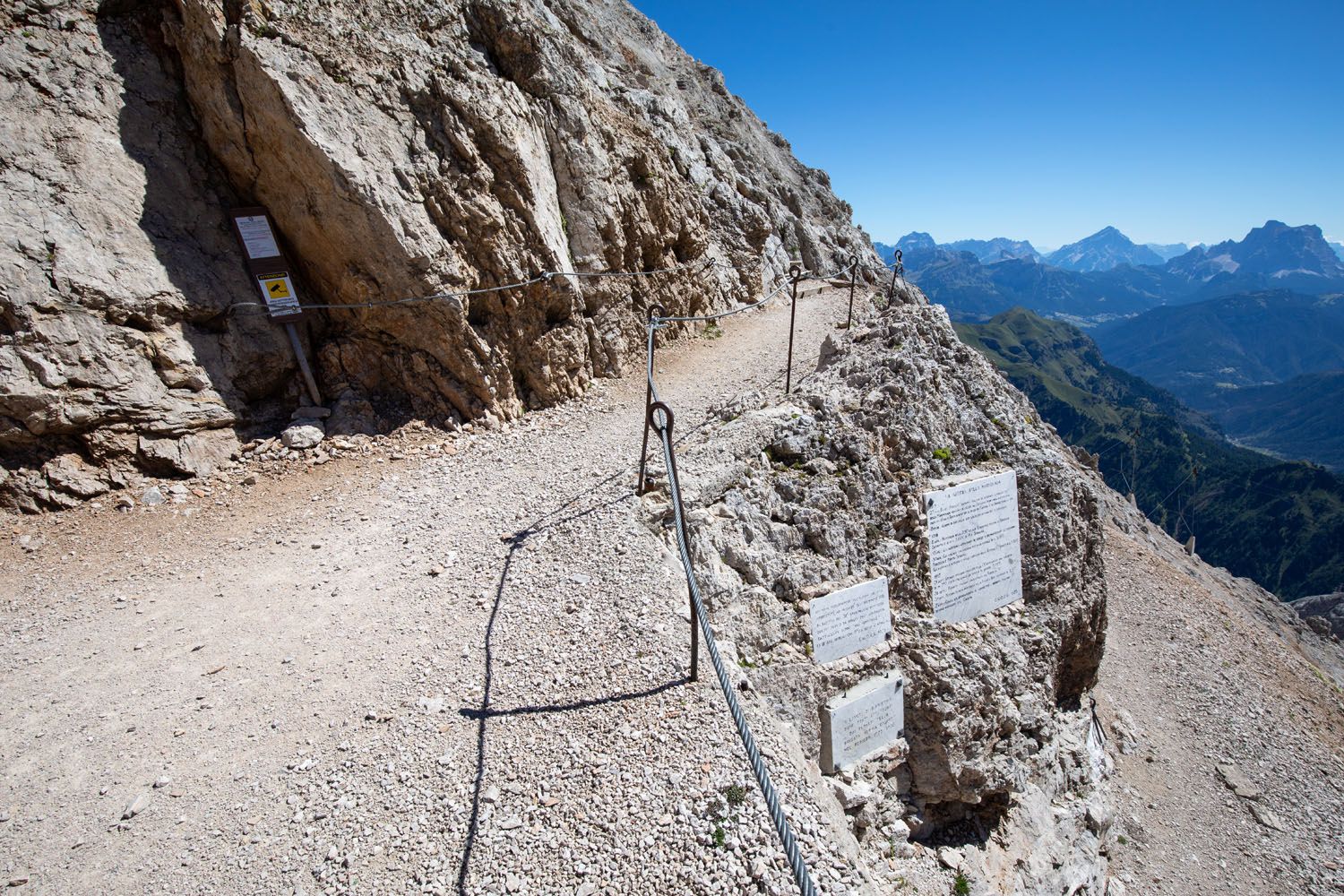
The first part of the trails are wide like the one above.
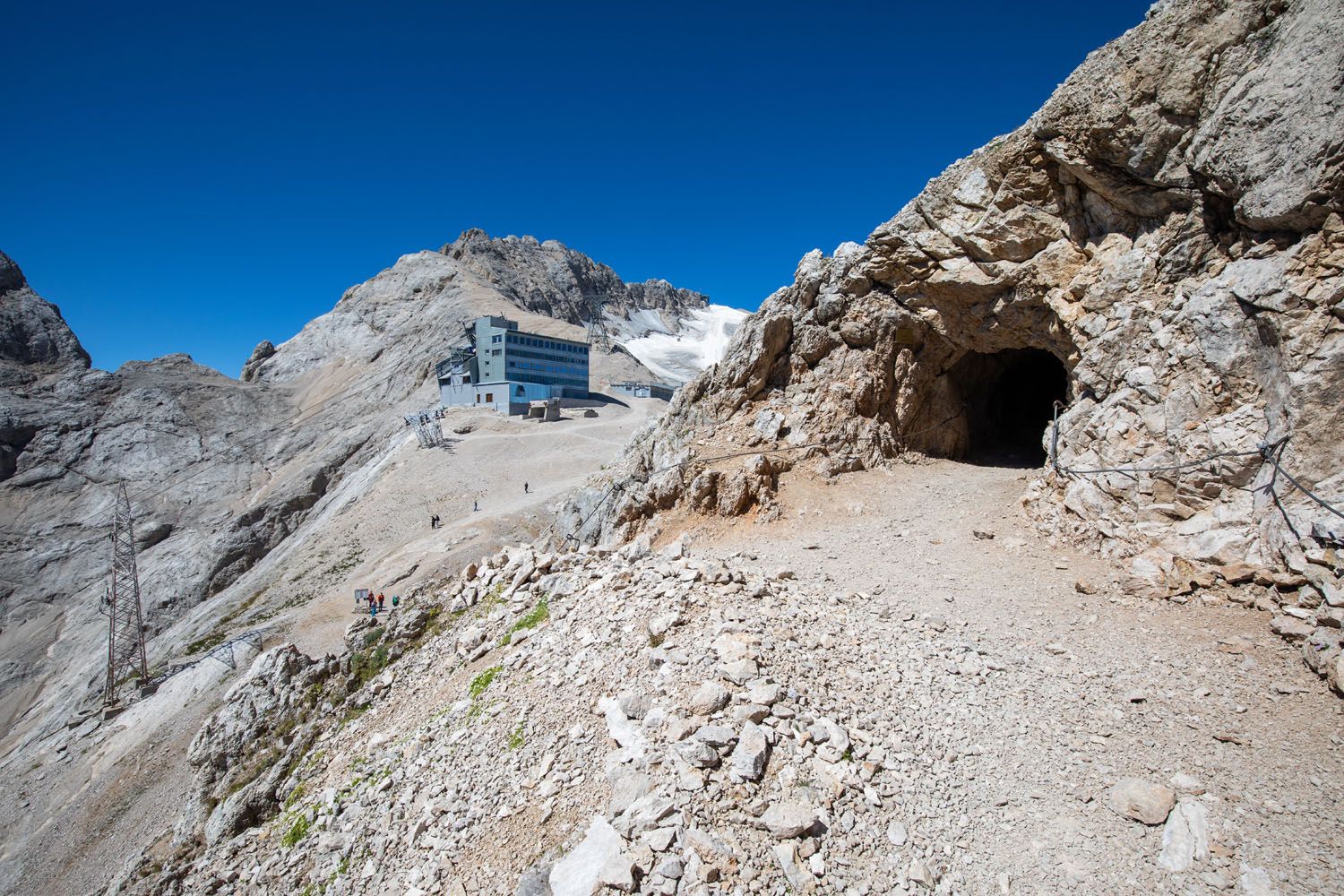
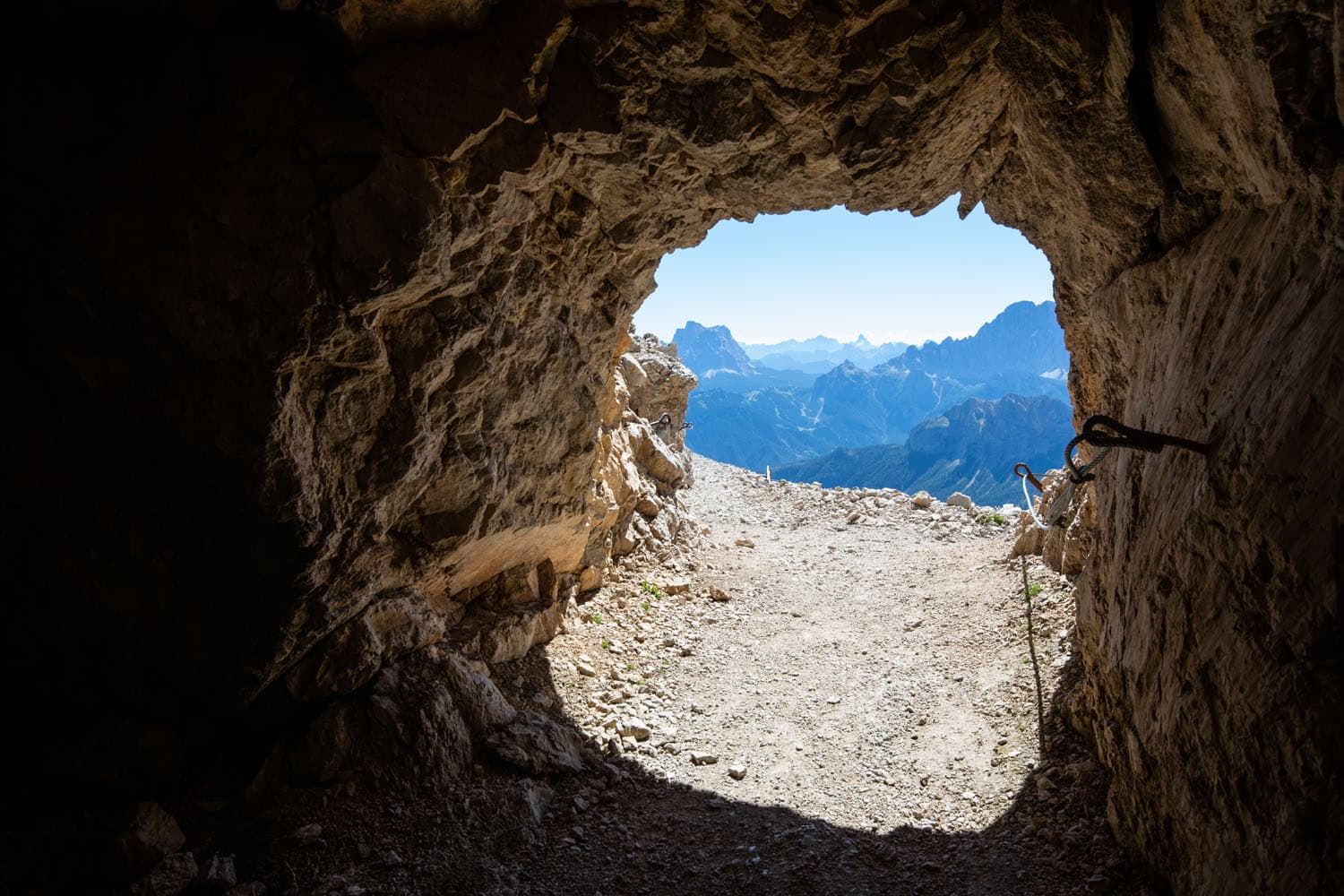
In my opinion, if you are interested in WWI historical sites, or just like the idea of exploring caves, bunkers, and having a great view of Marmolada, hiking the bottom section of the Monumental Area is worth it.
PRO TRAVEL TIP: The Monumental Area is typically open from June through September. The remainder of the year you cannot hike in this area because it is covered with snow.
Museum of the Great War
This museum includes information on what it was like for soldiers living and working on Marmolada during WWI. It is filled with artifacts, such as clothing, guns, artillery from this time period. Entrance into the museum is included with your cable car ticket.
Note: Photographs are not allowed inside of the museum
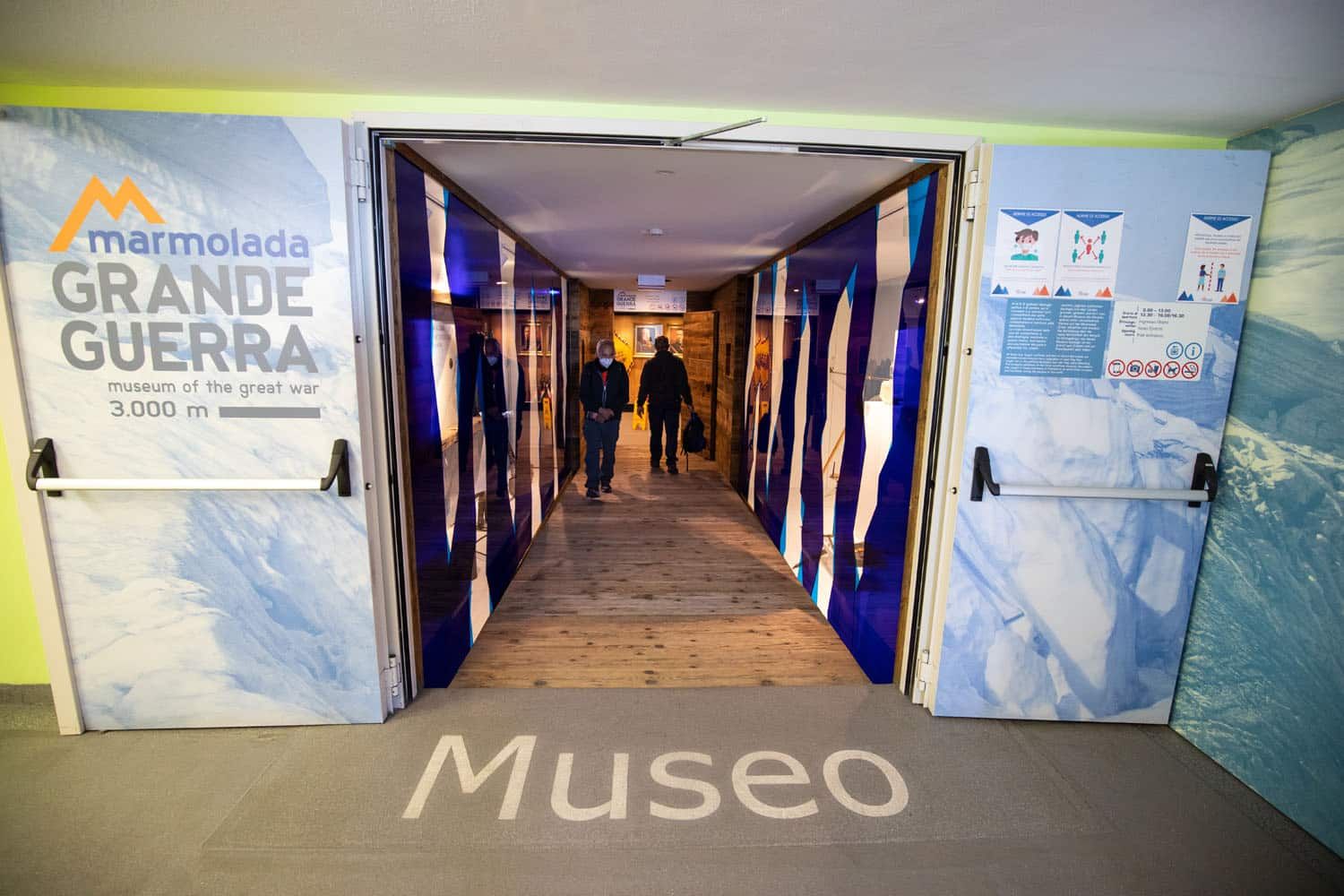
Museum of the Great War
PRO TRAVEL TIP: There are no bathrooms at Punta Rocca (the highest level yoy will visit at Marmolada). If you need to use a restroom, do so now before boarding the cable car to Punta Rocca.
Serauta (2,950 meters) to Punta Rocca (3,265 meters/10,700 feet)
Once at Punta Rocca, you are standing on one of the highest points in the Dolomites.
Marmolada is a mountain with multiple peaks. Punta Rocca, which is the location of the final cable car station, is pretty high, but it is not the tallest peak. That would be Punta Penia, which sits just a little bit higher than Punta Rocca (3,343 meters/10,968 feet). You can easily see Punta Penia from the observation deck.
Things to Do at Punta Rocca
Observation Deck
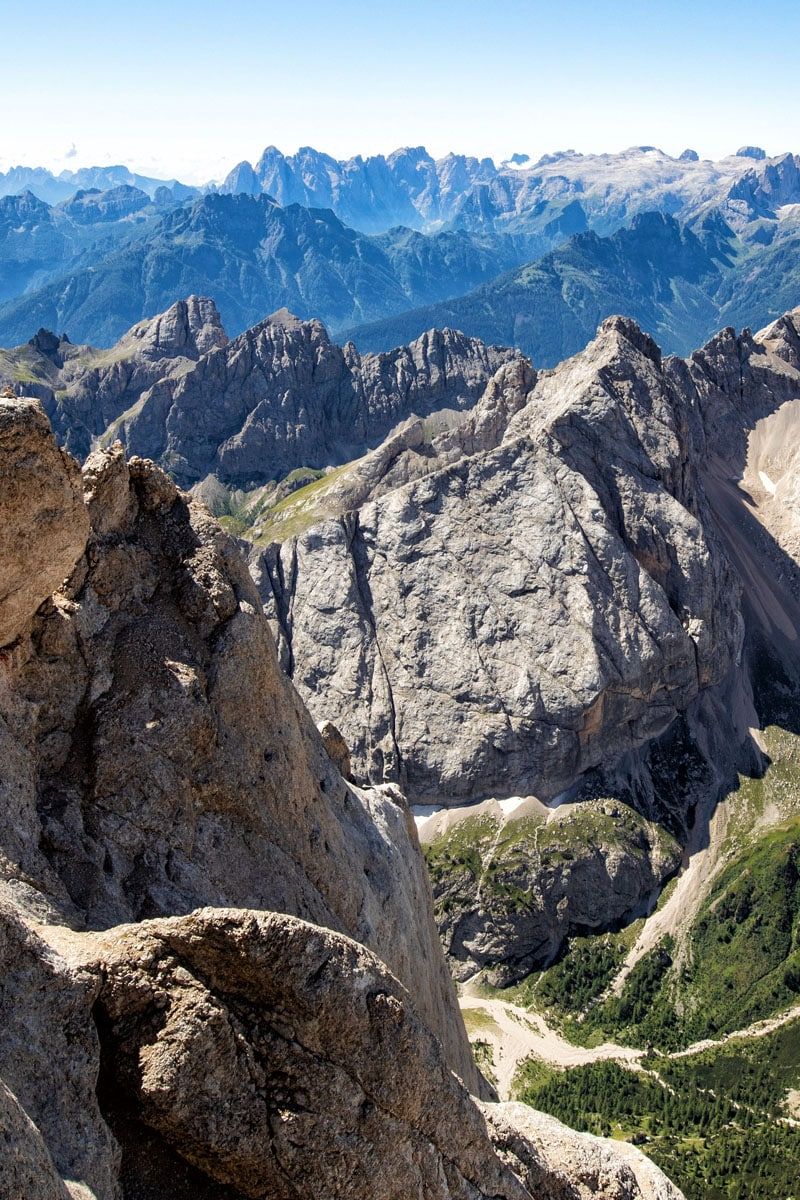
Once off the cable car, walk upstairs to the observation deck. From here, you get 360° views of the Dolomites. From here, you can see Punta Penia (the highest peak of Marmolada), Sassolungo, the Sella group, and Monte Cristallo, just to name a few.
A popular thing to do on the observation deck is to have your photo taken with the Marmolada sign on the floor. We did not do this, since it was busy (we were here late-morning in July), but it is a cool photo op, if you don’t mind waiting your turn.
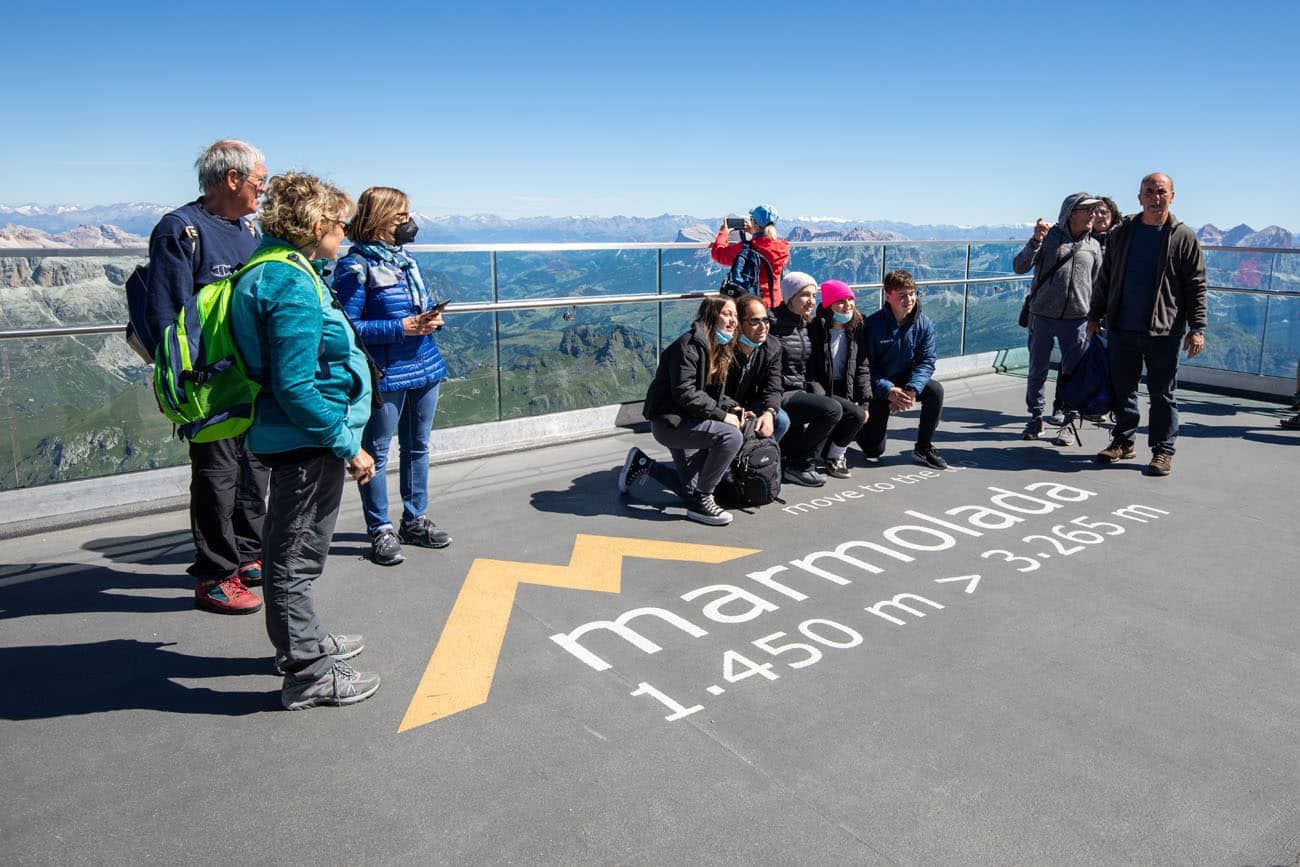
Punta Rocca observation deck
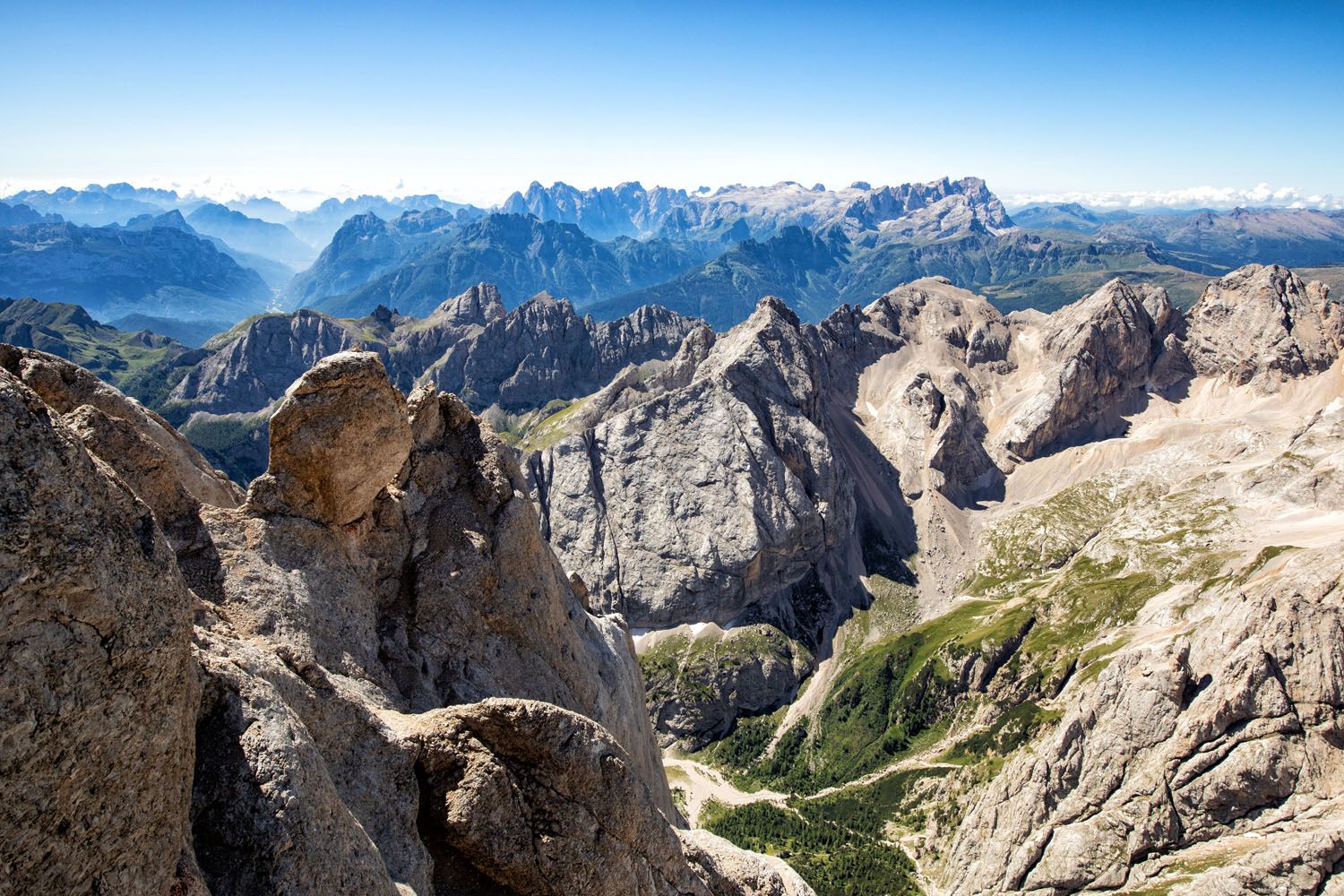
The view from the Punta Rocca observation deck
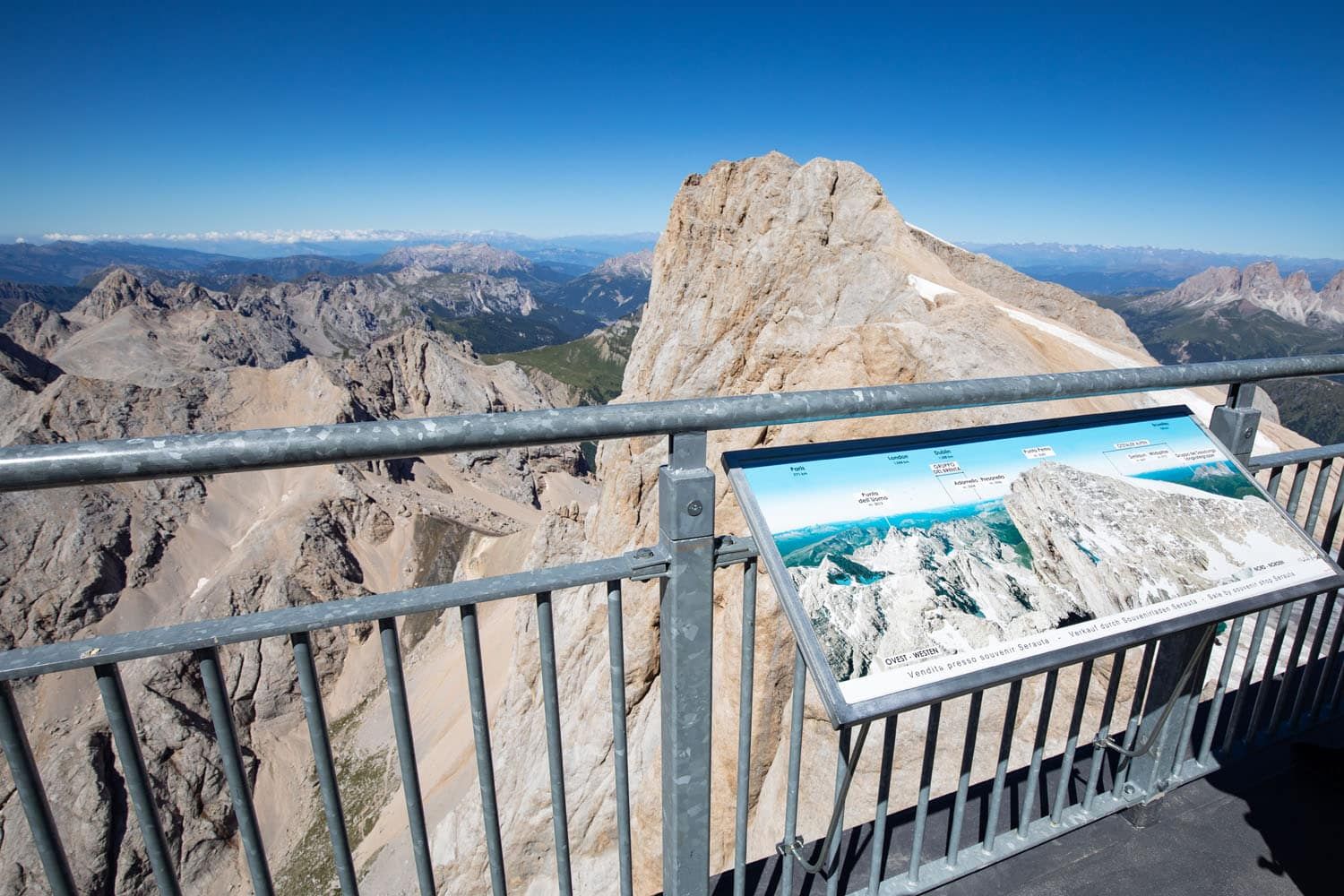
There are signs labeling the mountain peaks
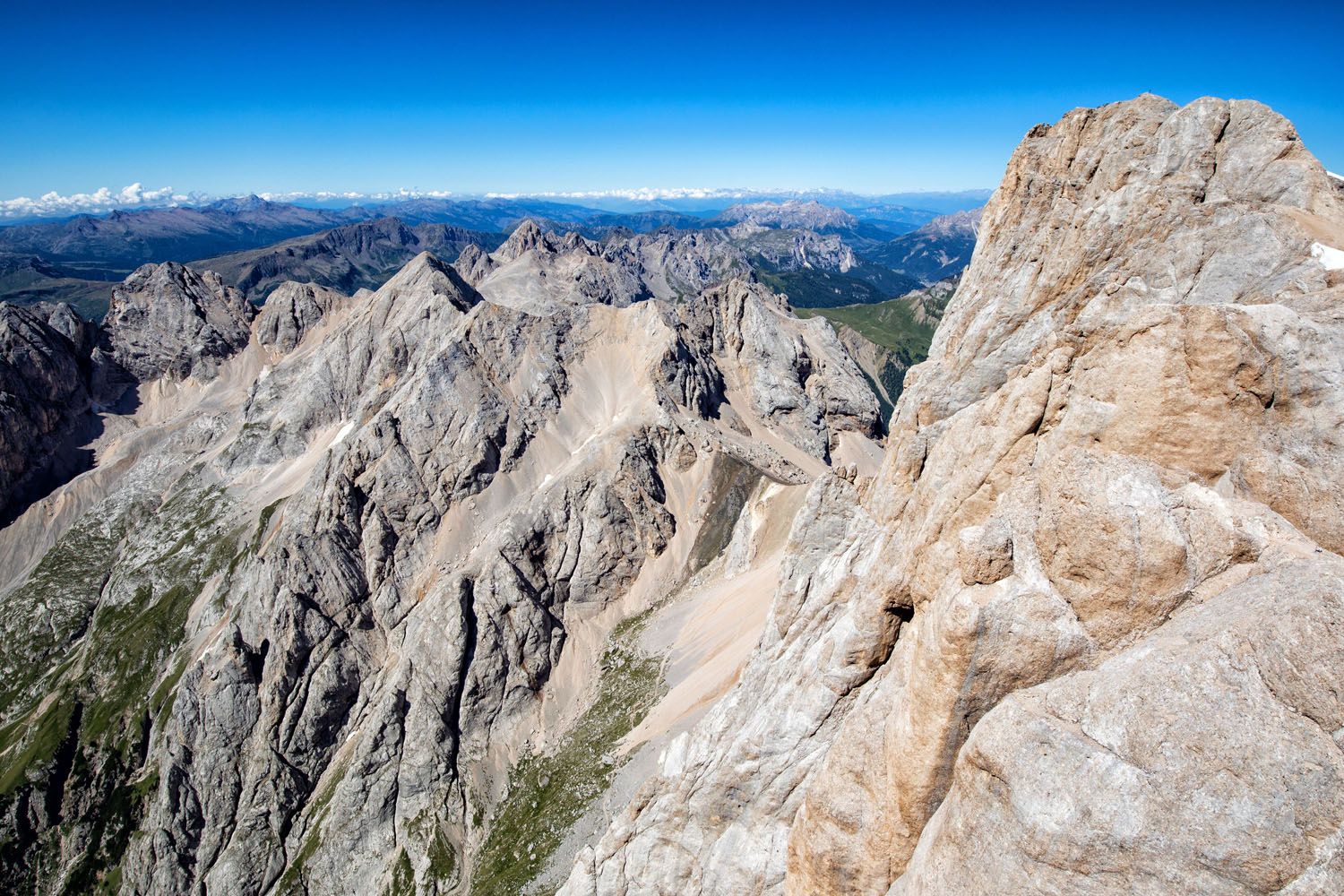
Punta Penia is the peak on the right side of this photo
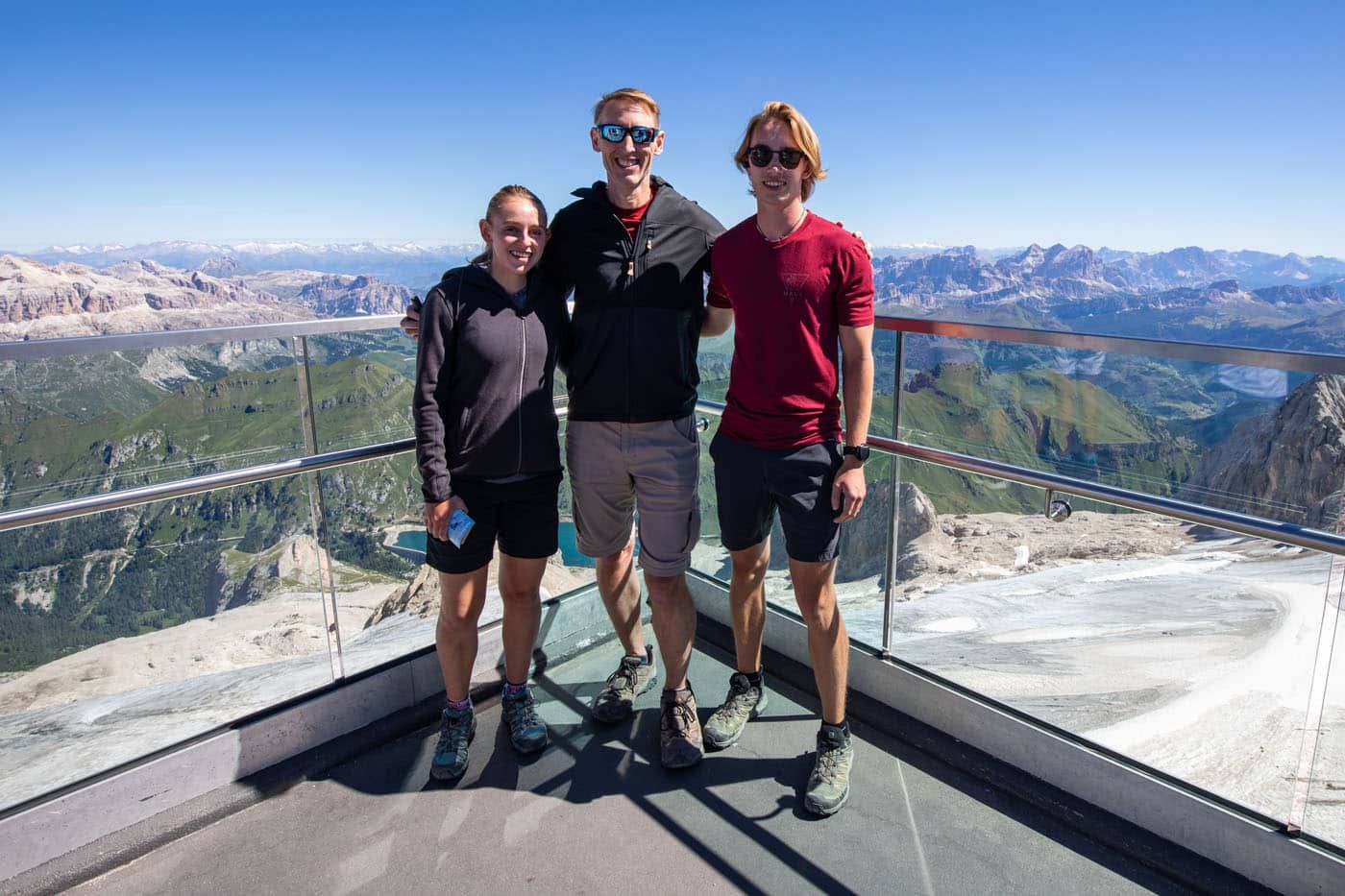
See/Walk/Ski on the Glacier
From the Punta Rocca station, you can ride the elevator down to the glacier. In the summer, walking on this glacier is a very popular thing to do on a visit to Marmolada (in the winter, it is possible to go skiing here).
We visited Marmolada in July 2022, about 10 days after the Marmolada avalanche that killed several people. The glacier was closed off and covered with a white tarp. Looking at photos from previous years, the glacier was a lot smaller on our visit, which makes me wonder if this is an activity that will be offered in future years. In 2025, I read that the glacier could be completely melted by 2040.
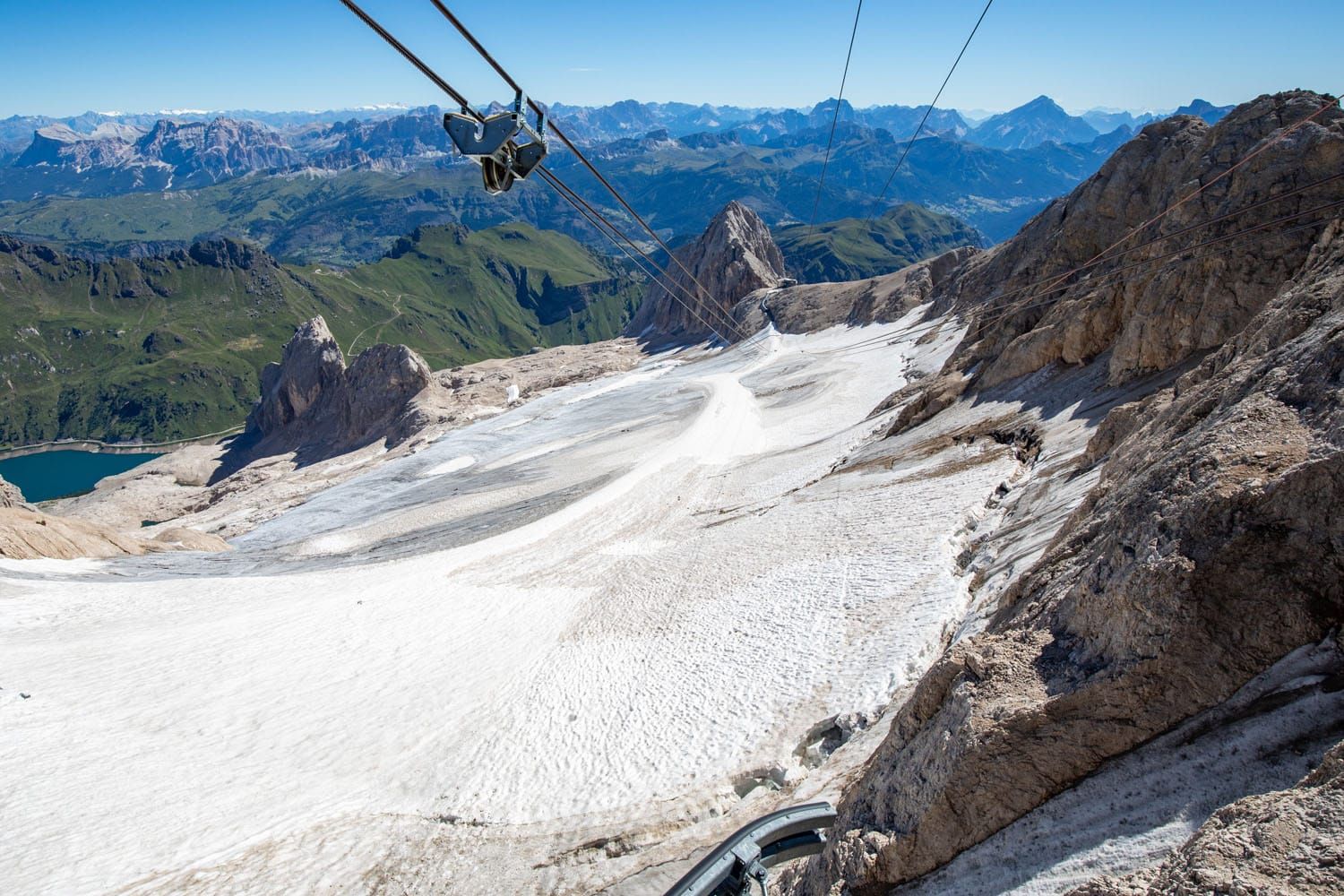
The Marmolada Glacier
Grotto of the Madonna
In this cave, there is a statue of the Madonna that was consecrated by Pope John Paul II in 1979. With a reservation, it is possible to attend mass here.
La Bellunese Ski Slope
This ski slope is 12 km long, the longest of Dolomiti Superski, with a change in altitude of 1,800 meters (5,900 feet). It’s only available in winter.
Before You Go: Have Lunch or a Snack at Bar Funivia
If you need a bite to eat, we recommend the restaurant that sits next to the parking lot of Marmolada (Bar Funivia). We got paninis and apple strudel here and everything we ate was delicious. The service is super fast, too, so if you have a busy day planned, and want good food for lunch or a snack without spending a lot of time, make sure you grab a bite to eat here before traveling on to your next destination.
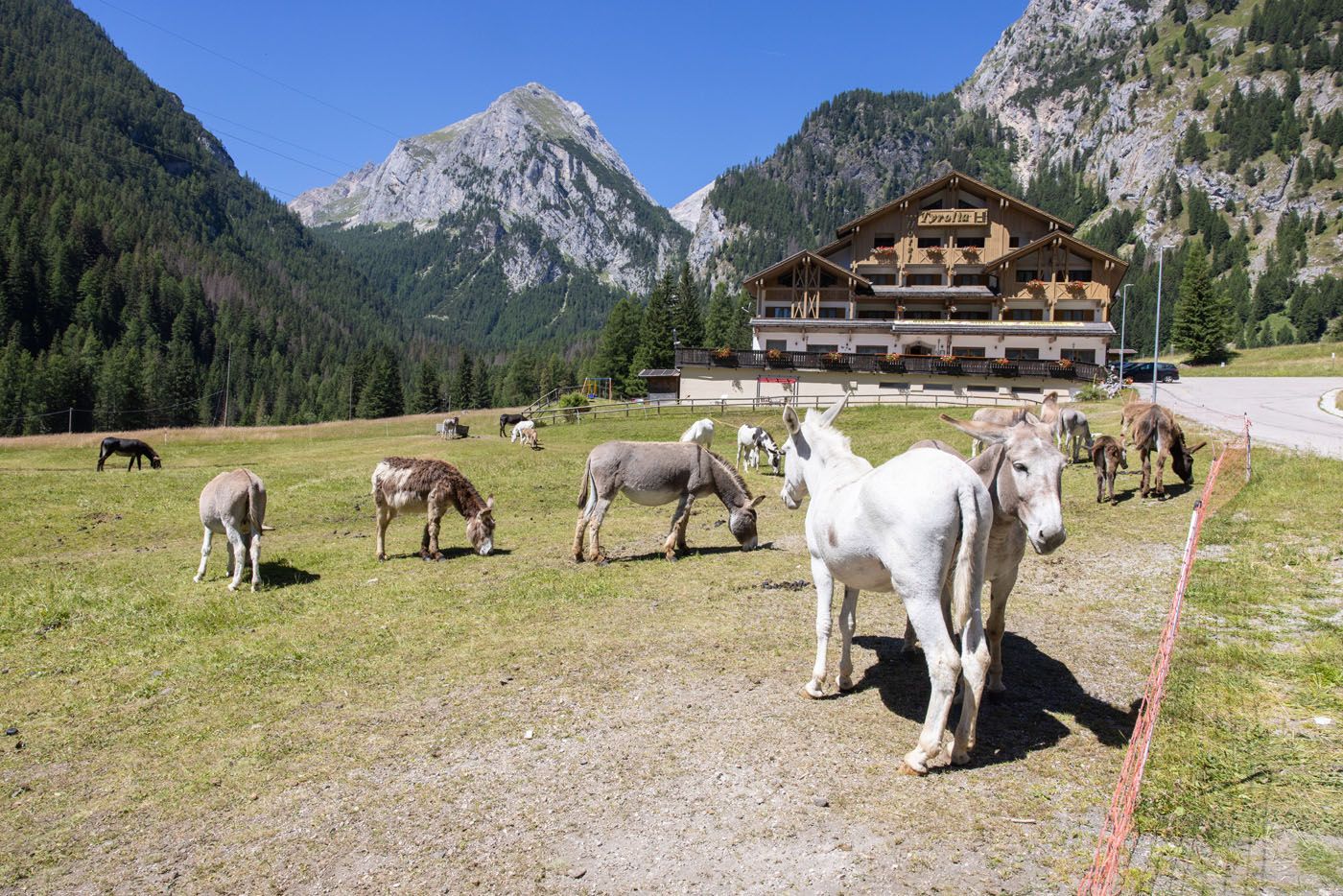
And before or after your lunch, just around the corner are donkeys, which are fun to watch or take your kids to see.
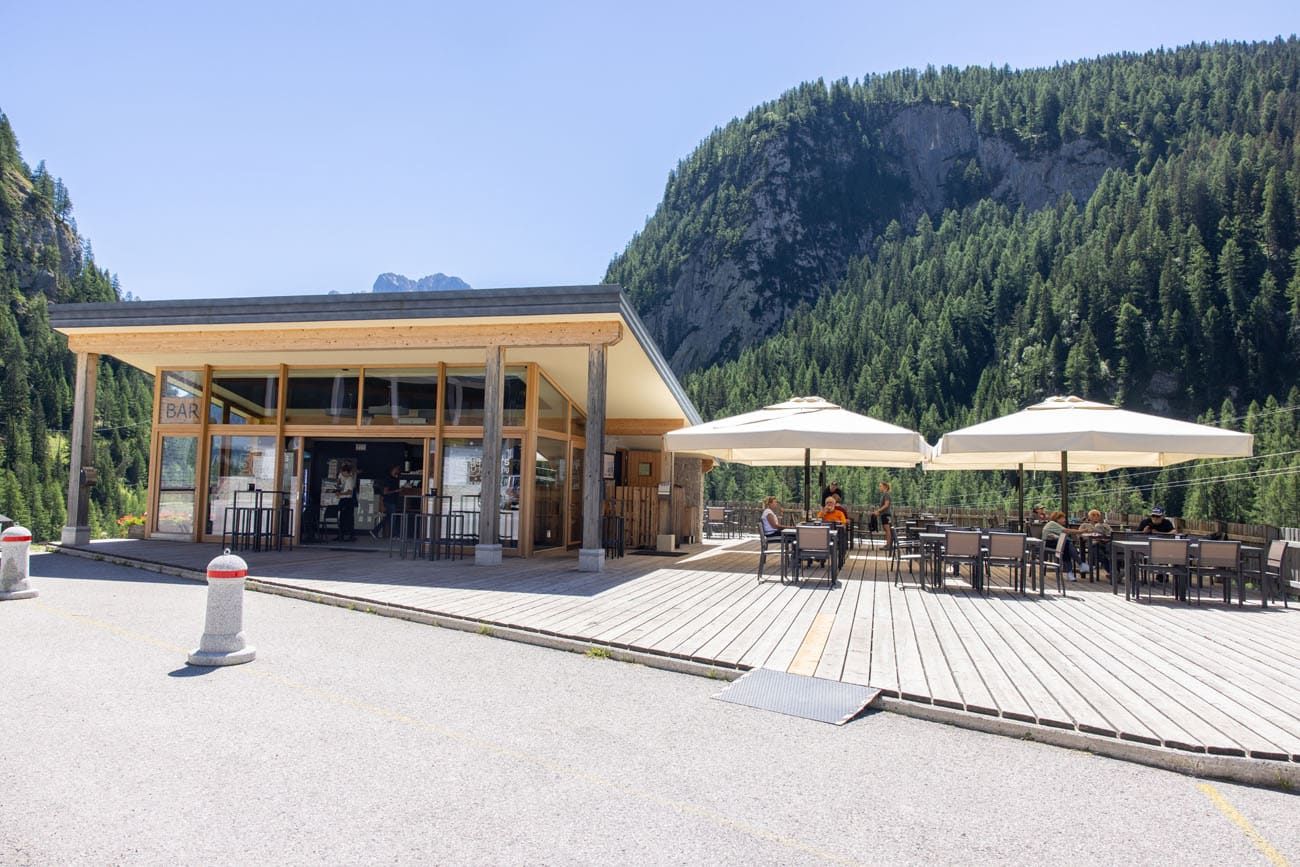
Bar Funivia
Frequently Asked Questions
How long does it take to visit Marmolada?
Plan on spending 2 hours at Marmolada. This gives you enough time to ride the series of cable cars, visit the museum, enjoy the views from the observation platforms, and hike the WWI trails at Punta Serauta.
What should I wear on Marmolada?
Since you will be at a high altitude, it will be colder on top of Marmolada then at the bottom station. Bring one or two additional layers, since it will be cooler at the top.
Can I bring my dog?
Yes, you can bring a dog on the cable cars, but they must be muzzled and on a leash.
What time of year can I visit Marmolada?
Marmolada can be visited in the summer and winter. In the summer, you can hike around the Sacred Monumental Area of Punta Serauta. In the winter, Marmolada becomes a skiing destination.
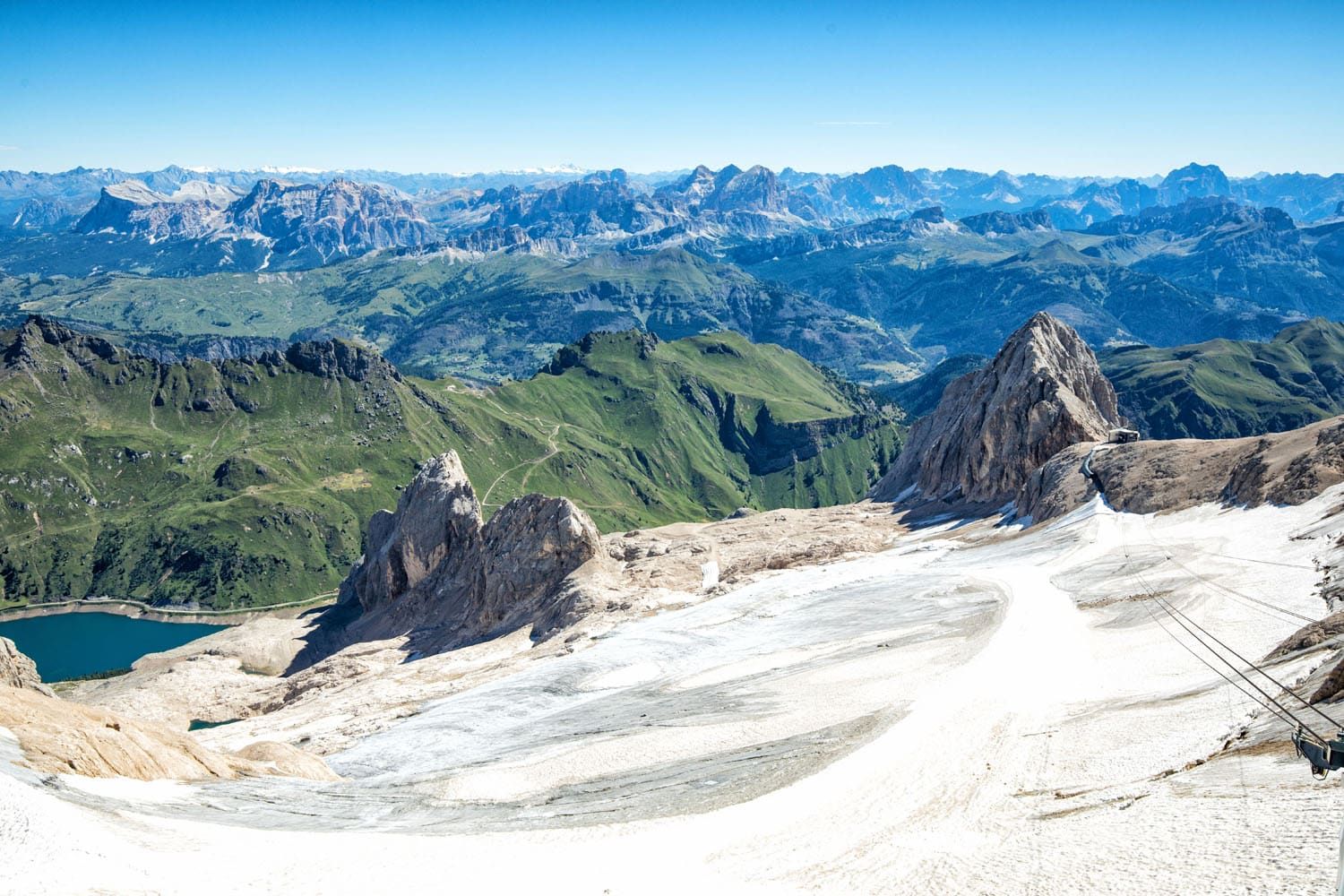
Another view from Punta Rocca
Add This to Your Dolomites Itinerary
Marmolada is easy to combine with several other highlights in the Dolomites, especially if you’re road tripping between Cortina d’Ampezzo and Val Gardena. Because the cable car does most of the elevation gain for you, it works well as a half-day stop, leaving time to explore nearby mountain passes, scenic drives, or short hikes.
If you’re building out your trip, Marmolada pairs especially well with:
- Seceda in Val Gardena
- Lagazuoi and the WWI tunnels near Passo Falzarego
- Ride the cable car to Sass Pordoi and hike to Piz Boè
- A scenic drive on Passo Fedaia, Passo Pordoi, and the Sella Pass
For a broader overview of what to include in your trip, see our guide to the Best Things to Do in the Dolomites, which lots of great experiences requiring little to no hiking. And if you’re still in the planning phase, our complete Dolomites Travel Guide covers where to stay, how long to go, transportation tips, and how to connect these destinations into a seamless itinerary.
If you have any questions about how to visit Marmolada, let us know in the comment section below.
Plan Your Trip to Italy
We have TONS more information about Italy in our Italy Travel Guide, including Rome, Florence, Venice, Tuscany, the Dolomites, the Amalfi Coast, the Cinque Terre, and Puglia.
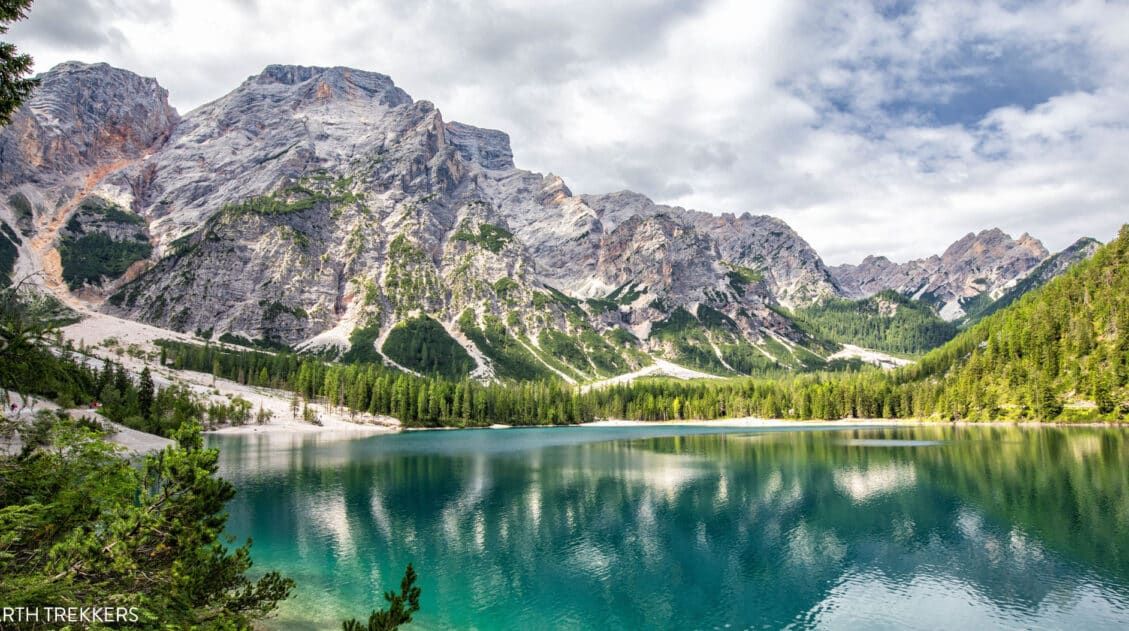
Exactly How to Visit Lago di Braies in 2026 (Photos & Helpful Tips)
Lago di Braies (Pragser Wildsee) is one of the most beautiful lakes in the Dolomites, but visiting it requires planning. In this guide, you’ll learn the best time to go, how parking and access restrictions work in 2026, how to avoid the worst crowds, and whether Lago di Braies is actually worth visiting. This crystal-clear […]
15 Best Hikes in the Dolomites (Easy to Challenging)
The Dolomites are one of the best hiking destinations in Europe. In this guide, we rank the 15 best hikes in the Dolomites, from easy scenic trails to challenging alpine adventures, based on views, difficulty, and our firsthand experience hiking the region. Jagged limestone peaks, knife-edge ridgelines, and turquoise alpine lakes make the Dolomites one […]
Tre Cime di Lavaredo Hike: Step-By-Step Trail Guide, Parking & Map
The Tre Cime di Lavaredo trail is one of the most iconic hikes in the Italian Dolomites, featuring a scenic loop trail that circles three dramatic limestone peaks. We’ve hiked Tre Cime on multiple trips to the Dolomites, including peak summer season when parking restrictions were in place. The first time we did this hike, […]
Exactly How to Hike to the Cadini di Misurina Viewpoint
The hike to the Cadini di Misurina viewpoint is one of our favorite short hikes in the Dolomites. This is a gorgeous hike every step of the way, with panoramic views of the surrounding mountains, a unique view of the “backside” of Tre Cime di Lavaredo, and of course, an awesome view of the Cadini […]
Alpe di Siusi (Seiser Alm) in Summer: Things to Do, Photos & Tips
Alpe di Siusi (Seiser Alm in German) is the highest alpine meadow in Europe. This lush, green meadow is located in the Dolomites of Italy. Cabins, rifugios, and hotels dot the landscape. Hiking trails and biking trails run along the hillsides, connecting the small villages. And Sassolungo, with its jagged, rocky peaks, looms over the […]
How to Hike the Adolf Munkel Weg to Geisler Alm
The Adolf Munkel Weg is a point-to-point hiking trail that runs along the Odle/Geisler mountain group in Val di Funes. This hike is on the longer side (13 km) and since it is point-to-point, you will have to use public transportation or do some extra hiking to get back to the starting point. We didn’t […]
Hiking the Amazing Puez-Odle Altopiano in the Dolomites
The Puez-Odle Altopiano trail is a 17 km (10.6 mile) hike along some of the highest mountain peaks in the Dolomites. We hiked this lesser-known trail on our first trip to the Dolomites and it is a spectacular hike from start to finish. With jaw-dropping views of the Dolomites, fields of wildflowers, and endless alpine […]
How to Hike Rifugios Averau & Nuvolau for Stunning Dolomites Views
Although we hadn’t intended to hike to Rifugio Averau or Rifugio Nuvolau, seeing them in the distance while hiking the Cinque Torri changed everything. The views from both huts were spectacular, turning a spontaneous decision into one of our most unforgettable experiences in the Dolomites. Rifugios Averau and Nuvolau are two of the most scenic, […]
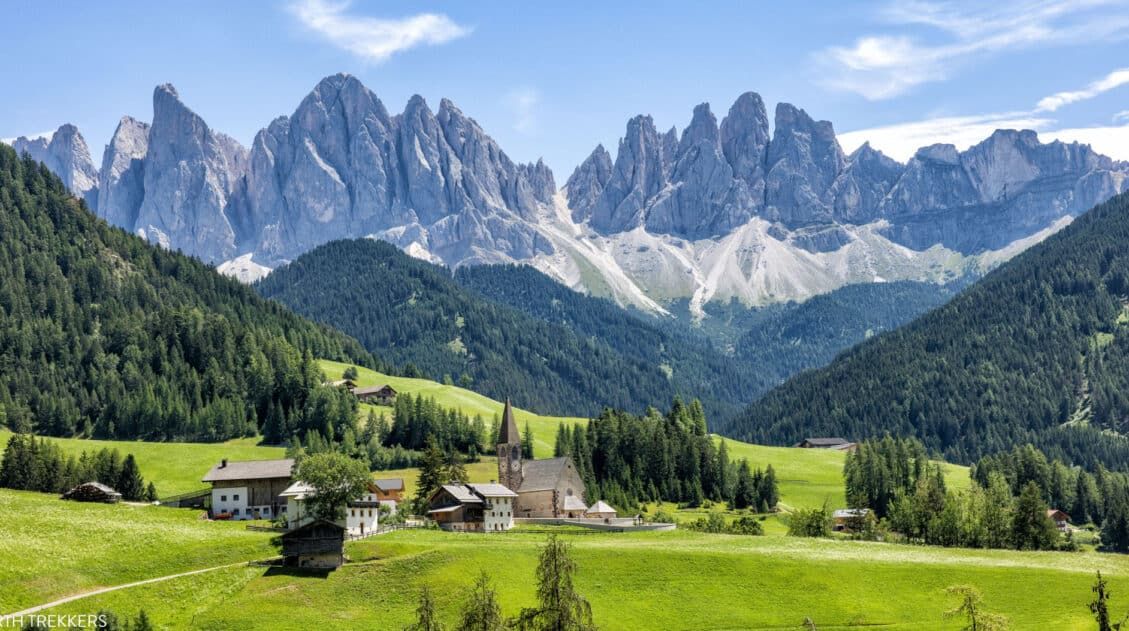
Dolomites Itinerary: Mix-and-Match Daily Plans for 3 to 10 Days
Planning a Dolomites itinerary can feel overwhelming. With its towering peaks, storybook alpine villages, epic hikes, and scenic drives around every corner, how do you decide what’s worth your time? In this guide, we make it simple. We break the Dolomites into easy, day-by-day itineraries that you can mix and match to build your perfect […]
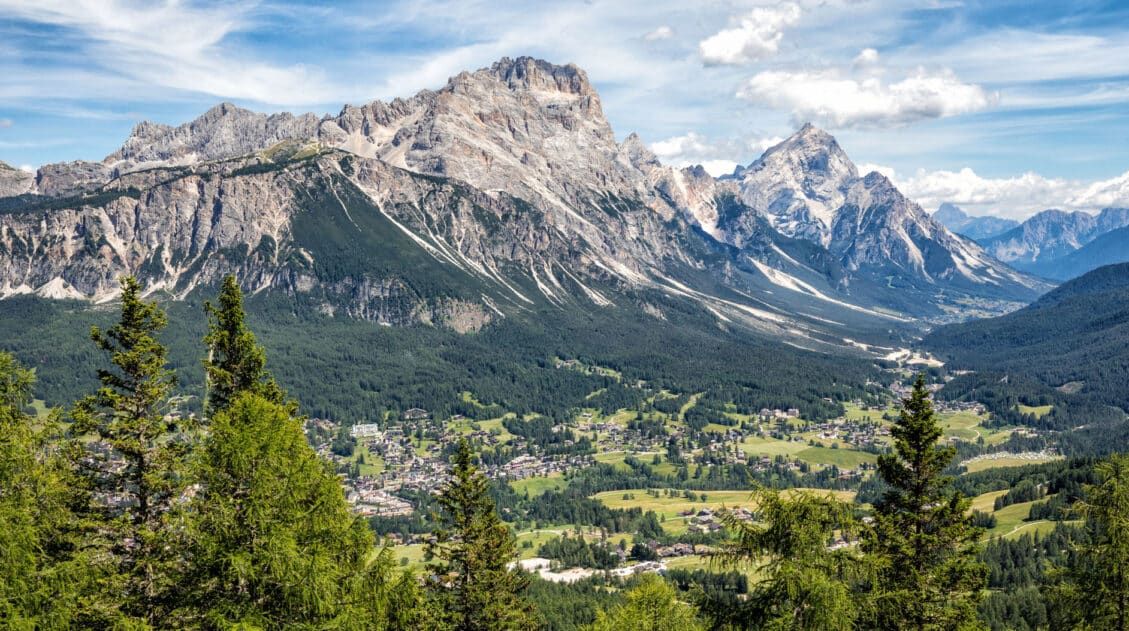
Where to Stay in the Dolomites (2026 Guide to the Best Towns & Hotels)
Wondering where to stay in the Dolomites? It’s one of the most important decisions you’ll make when planning your trip. This region may look small on a map, but winding alpine roads and high mountain passes mean travel times are longer than expected. Stay in the wrong town and you could spend hours driving instead […]
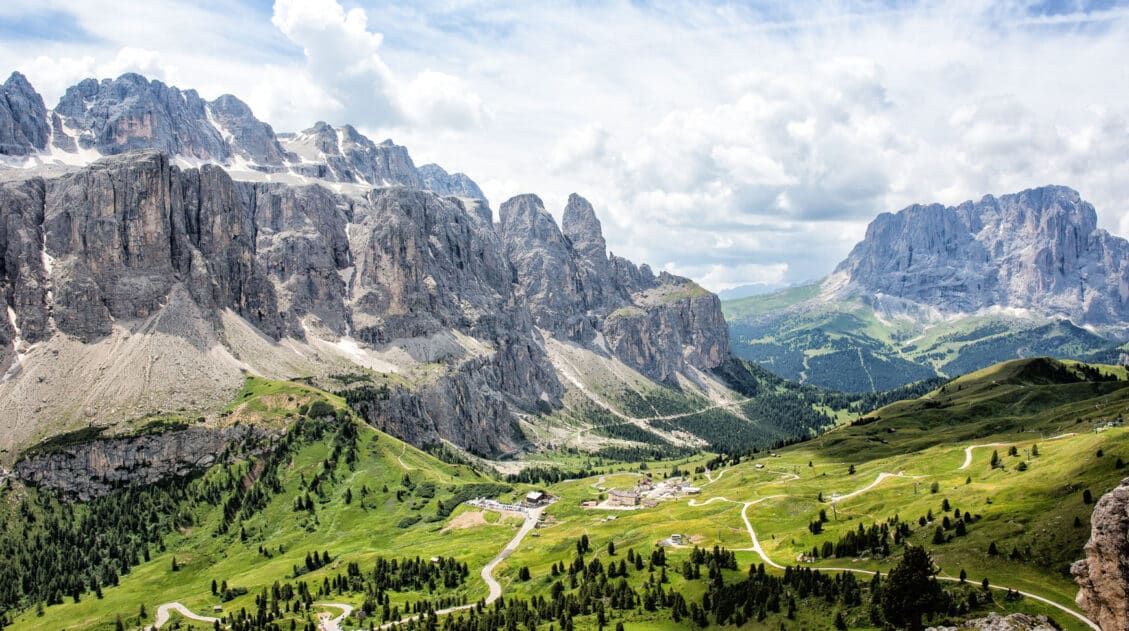
Dolomites Travel Guide: How to Plan a Trip to the Dolomites
Dolomites Travel Guide The Dolomites are one of the most breathtaking mountain destinations in Europe. Jagged pinnacles of rock soar into the sky, mountain huts and cabins dot the green, rolling hills, cable cars whisk hikers and skiers to the highest mountain peaks, and hiking trails connect small hamlets and towns. We’ve spent 12 days […]
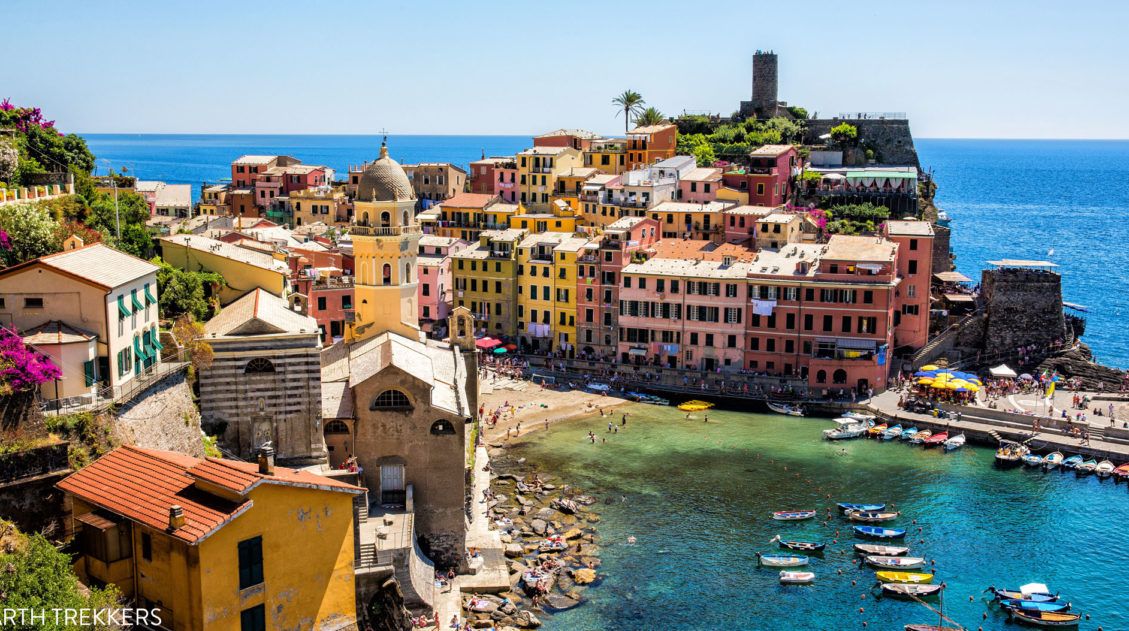
25 BEST Places to Visit in Italy
In this guide, you’ll discover 25 beautiful places to visit in Italy, from Rome’s ancient wonders to the Cinque Terre’s coastal charm. See the highlights in 7 to 14 days or spend 3+ weeks to dive deeper into Italy’s extraordinary sights. If you are planning your first trip to Italy, be prepared to fall in […]
The Perfect 10 Day Northern Italy Itinerary (Dolomites, Venice & Lake Como)
This 10-day itinerary through Northern Italy features Venice, the Dolomites, Verona, Milan, and Lake Como, with hiking suggestions, hotel recommendations, and practical planning advice based on our numerous trips to Italy. We’ve visited Italy numerous times, exploring these destinations on separate trips over the years, hiking in the Dolomites, wandering the canals of Venice, strolling […]
Italy Travel Guide: How to Plan a Trip to Italy
Italy Travel Guide Italy is home to some of the world’s best food, wine, and art. Add in gorgeous coastlines, beautiful beaches, world-class fashion, phenomenal hiking trails, villas in Tuscany, and gelato, and you have the ingredients for an epic vacation. Italy is a favorite destination for many travelers for a very good reason. Come […]


Comments 8