
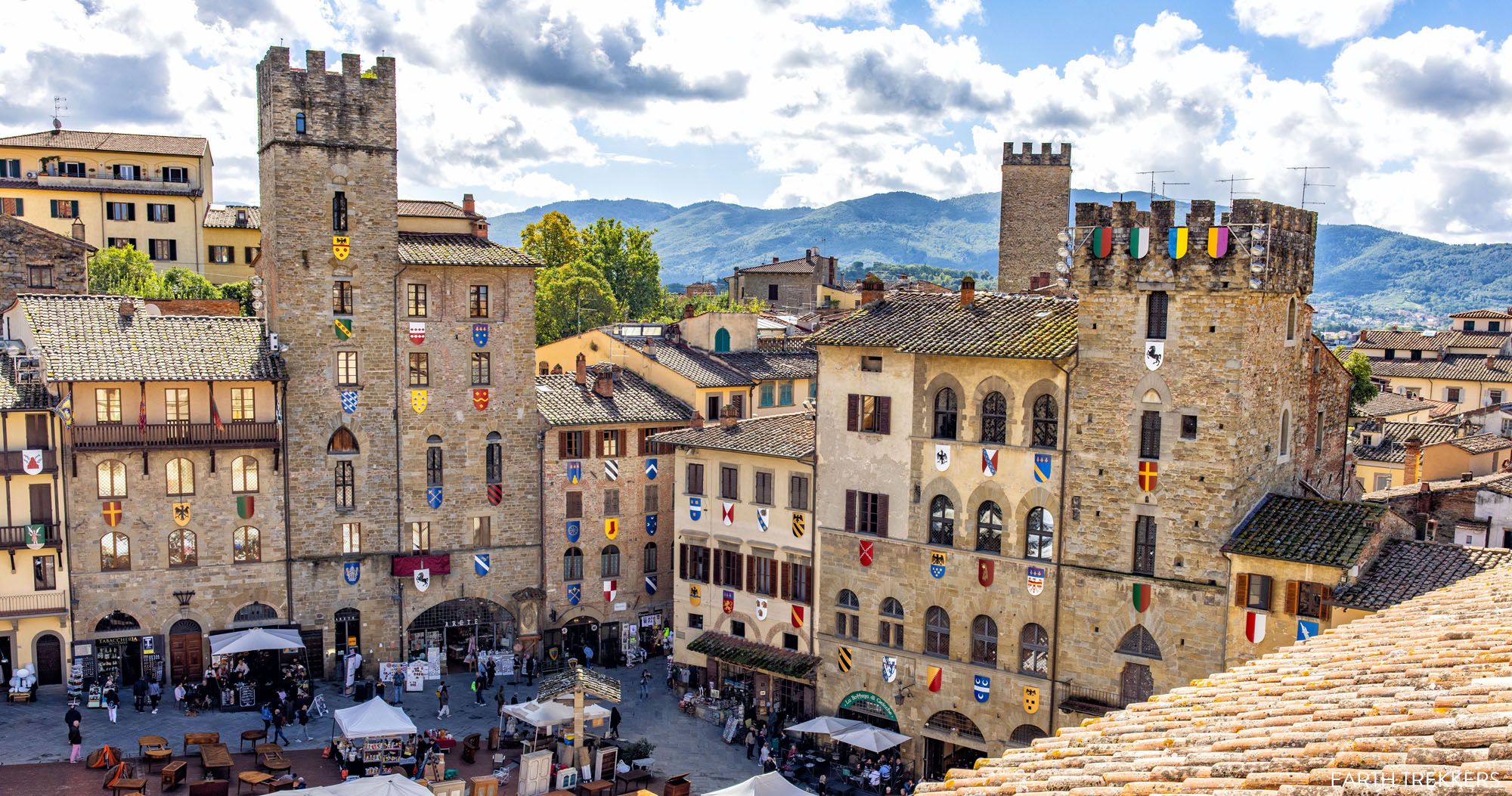
After two trips through Tuscany, we’ve visited a lot of hill towns, including Siena, Cortona, Montepulciano, Pienza, and a handful of smaller villages tucked into the countryside. Arezzo was one of the last ones we visited, and arriving on a Sunday in early October, we weren’t sure what to expect. What we found was one of the most distinctive main squares in all of Italy. Piazza Grande is ringed with colorful medieval shields, each one representing a different house of the city. It’s bold and vivid in a way that sets Arezzo apart from every other town we visited in Tuscany.
We also loved how easy it is to explore Arezzo. It’s a small, walkable town, and you can cover the highlights comfortably on foot in a day, making it an ideal stop on a Tuscany road trip or a very rewarding day trip from Florence or Siena.
And if you haven’t been before, prepare to be a little surprised: this is one of those places that quietly exceeds expectations, with world-class Renaissance art, a gorgeous medieval streetscape, and a laid-back atmosphere that feels genuinely local.
In this guide, we share the best things to do in Arezzo, where to eat, how to get here, and everything you need to plan your visit. For more help planning your broader trip, check out our Tuscany Itinerary, our guide to the Best Things to Do in Tuscany, and our complete Italy Travel Guide.
The Essentials
NEAREST MAJOR CITY | Florence (1 hour by train or car)
DON’T MISS | Piazza Grande, Corso Italia, Basilica of San Francesco, Fortezza Medicea
HOW MUCH TIME | Half a day for the highlights; a full day is ideal
BEST TIME TO VISIT | Spring (April–May) and fall (September–October) for mild weather and smaller crowds.
HOW TO GET THERE | Direct trains run frequently from Florence (1–1.5 hrs) and Siena (1–1.5 hrs by bus/train). Easily reached by car via the A1 motorway.
April 2026 Update: Significantly updated to improve depth and usefulness. Added a one-day itinerary, plus new information about Casa di Petrarca and the Basilica of San Francesco. Verified all links and pricing.
Best Things to Do in Arezzo
1. Spend Some Time in Piazza Grande
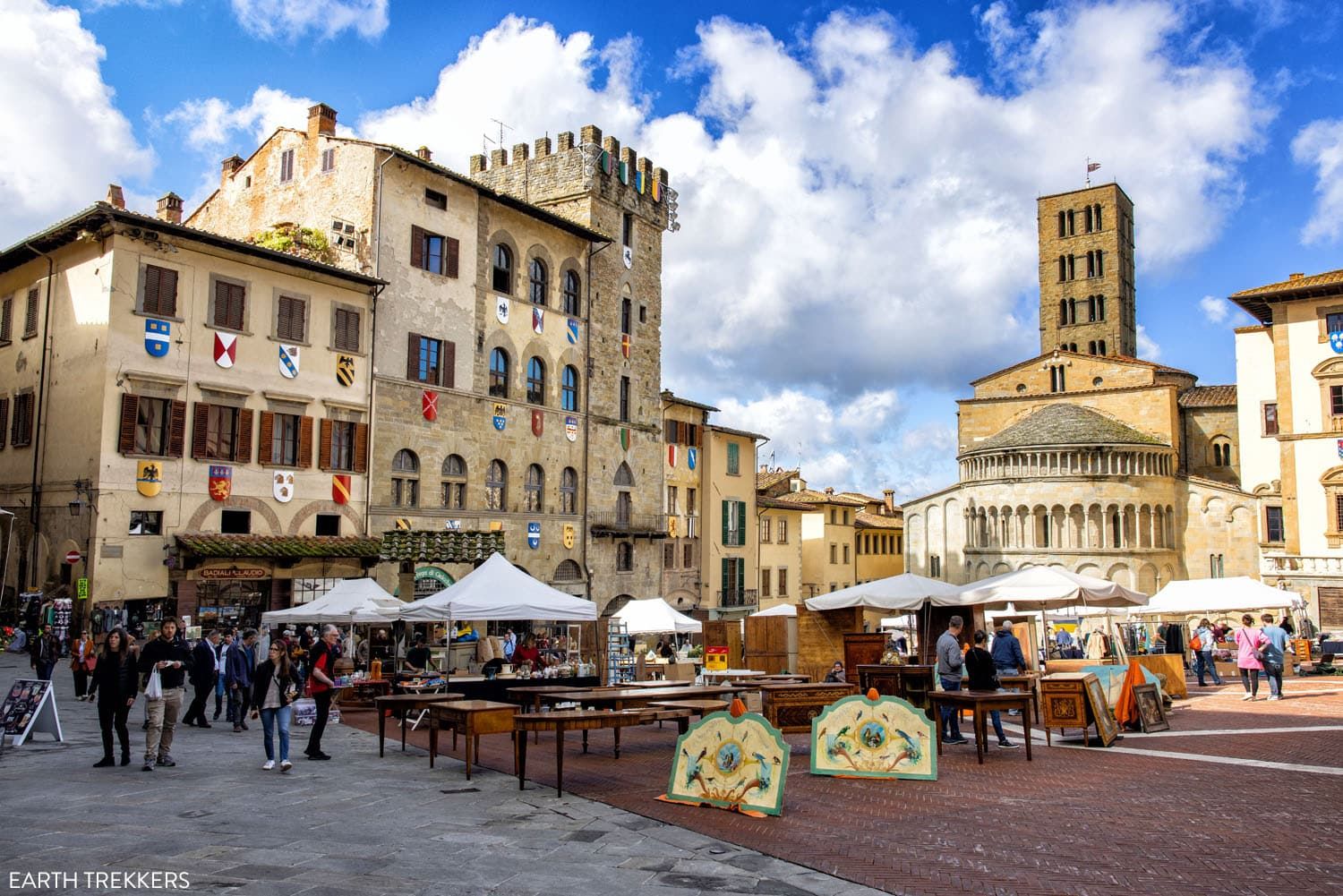
Piazza Grande is the main square in Arezzo and often considered to be one of the most beautiful squares in Italy. This is also the location of the Saracen Joust reenactments held twice a year.
Arezzo may also look familiar if you’ve seen Roberto Benigni’s Life is Beautiful. Much of the film was shot here, and Piazza Grande featured prominently in several scenes.
Piazza Grande
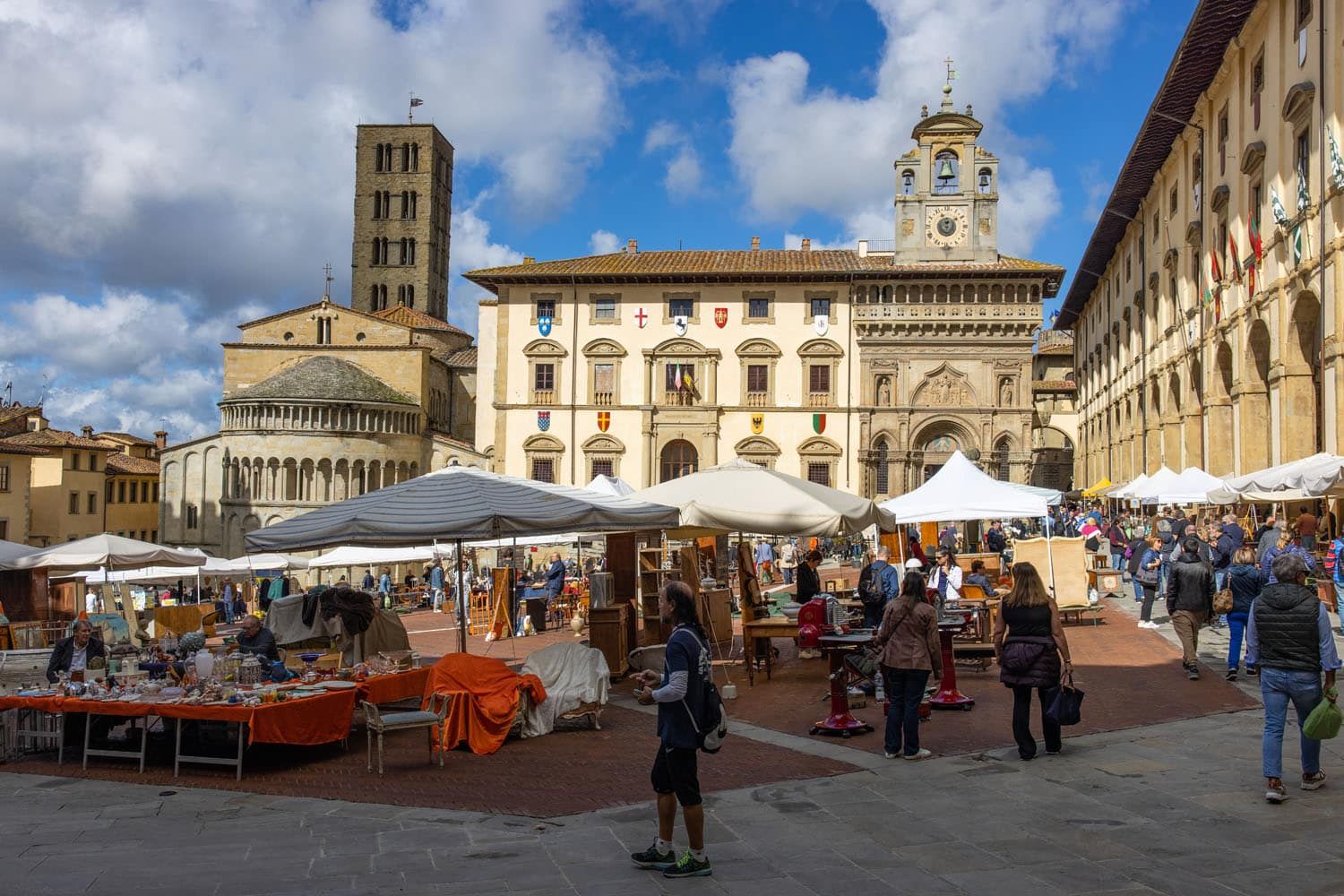
Piazza Grande and the monthly antique market
This large square is surrounded by some of the most important buildings in the town.
Logge del Vasari (Vasari Loggia) is the colonnaded building that sits on the north side of Piazza Grande.
Medieval houses run along the eastern side of the square. If you are in town near the time when the jousting festivals take place, these buildings are adorned with the banners of the houses.
The back of Santa Maria della Pieve is a prominent feature on the square, as is the Museum of Fraternita and its clock tower.
During the monthly antique market, this square is filled with stalls selling antiques.
We had a great lunch in Piazza Grande, and a great view, at Osteria Grande, dining on grilled octopus and pasta.
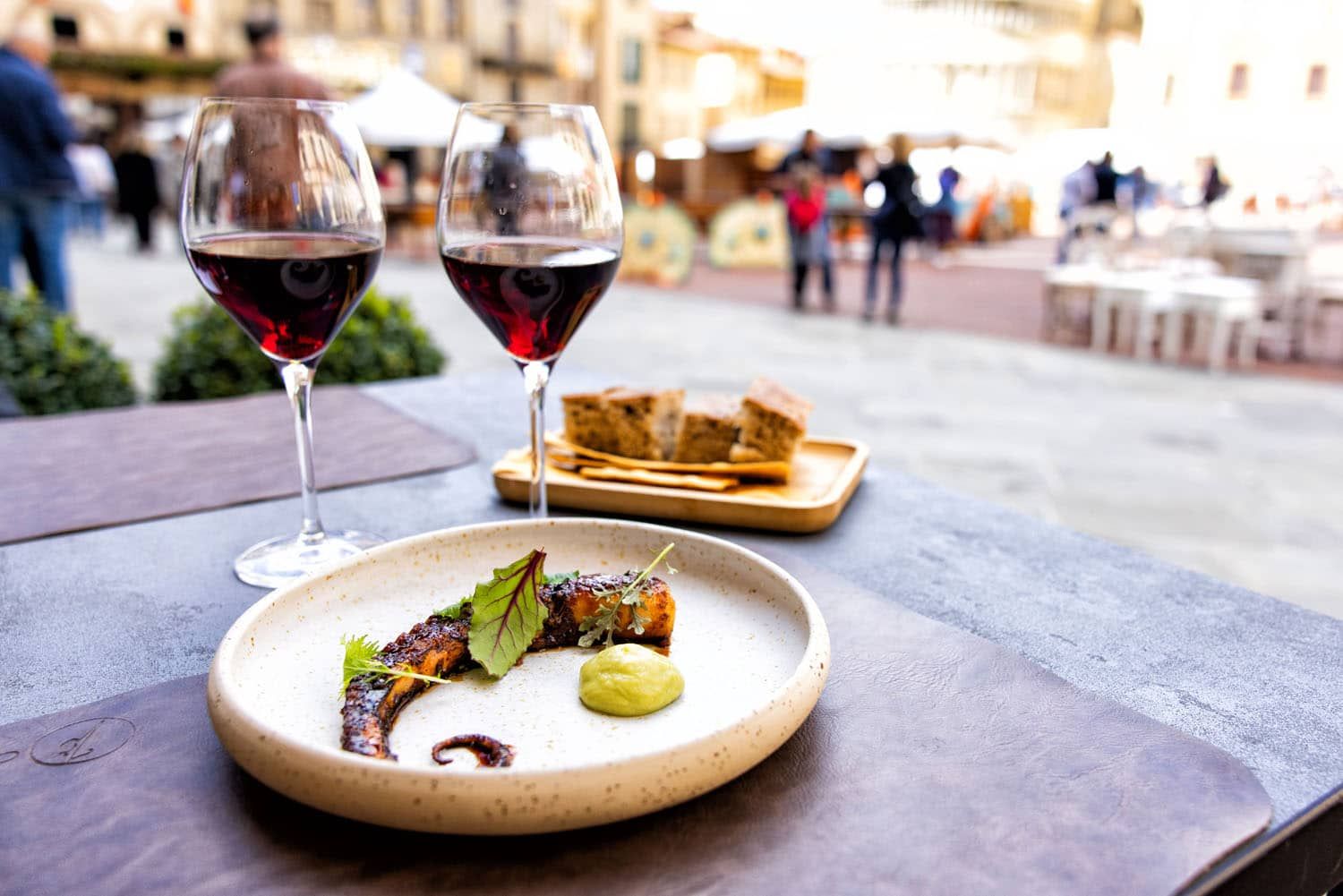
Osteria Grande
2. See the Frescoes in the Basilica of San Francesco
If there is one thing you absolutely must not miss in Arezzo, and one thing you need to plan ahead for, it is the Basilica of San Francesco.
The church itself is beautiful, but the real reason people come here from all over the world is the Bacci Chapel: Piero della Francesca’s fresco cycle, the Legend of the True Cross, is widely considered one of his finest works and an early Renaissance masterpiece.
The cycle, painted between 1452 and 1466, tells the story of the wood on which Jesus Christ was crucified across fifteen scenes arranged on three levels of the chapel walls. What makes it so extraordinary is not just the storytelling, it’s the technical achievement. Piero’s mastery of perspective, color, and geometric composition feels startlingly modern for the 15th century. Art historians often compare this chapel to the Sistine Chapel, just without the crowds.
We didn’t make it inside on our visit because tickets were already sold out for the day by the time we arrived, and this is exactly the mistake we don’t want you to make. Learn from us on this one.
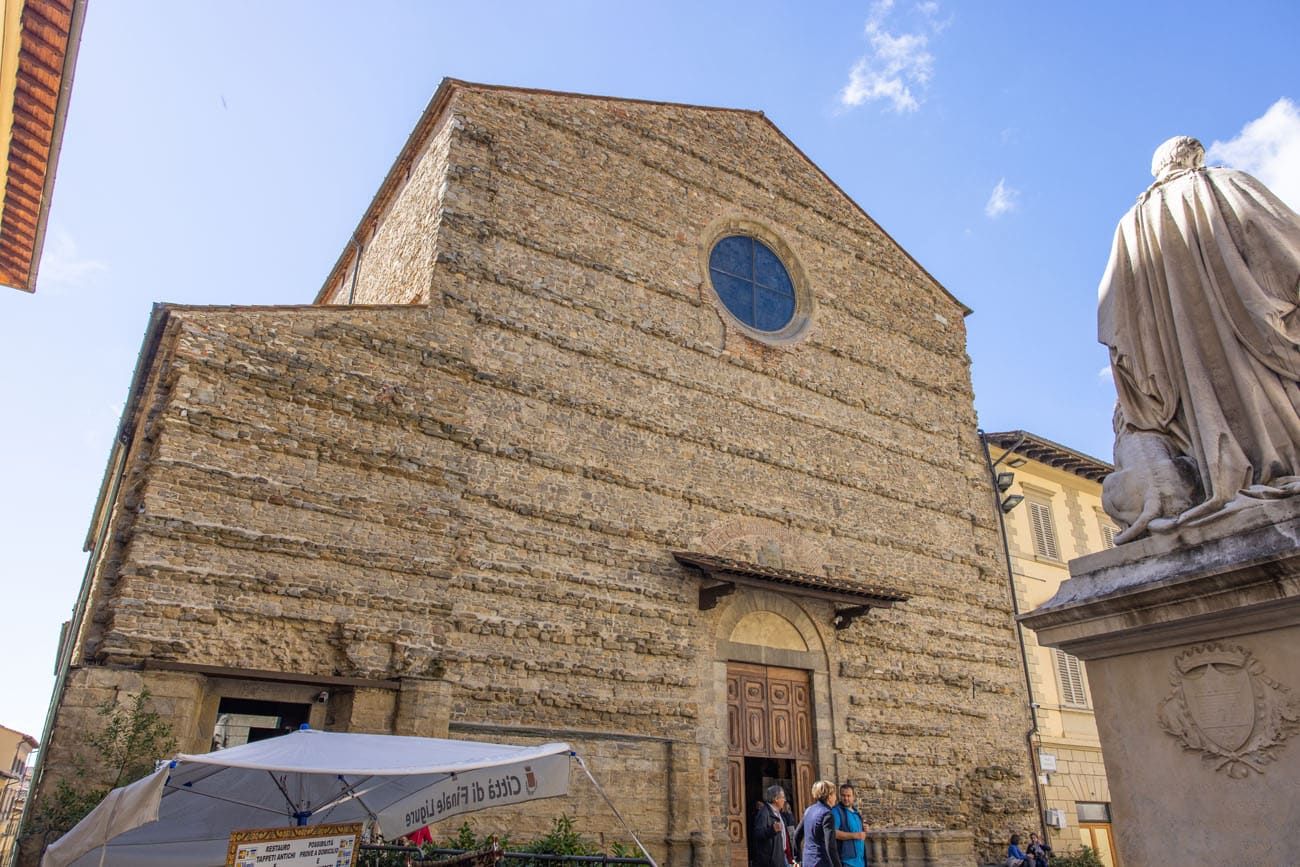
Basilica of San Francesco Arezzo
PRO TRAVEL TIP: Visits to the Bacci Chapel are by reservation only, with a maximum of 30 people per session lasting 30 minutes. Book your tickets in advance at museiarezzo.it before you arrive in Arezzo, ideally at least a week ahead in spring and fall, and further out in summer. Walk-up availability is very limited and often gone by mid-morning (when we visited, tickets were not available for walk-ups). The good news: a ticket to the Basilica of San Francesco also gives you access to the Museum of Medieval and Modern Art, the Archaeological Museum, and the Vasari House Museum for 72 hours, making it excellent value if you’re spending a full day in Arezzo.
3. The Church of Santa Maria della Pieve
Santa Maria della Pieve is a church that dates back to 1008. Most of what we see today was constructed in the 12th and 13th centuries and the bell tower was added in 1330. The frescoes on the interior of the church were added in the 14th and 15th centuries. In the 16th century, Giorgio Vasari created the altar and choir stalls.
Notable things to see inside of Santa Maria delle Pieve are the Polyptych by Pietro Lorenzetti and the Reliquary bust of Saint Donatus by Pietro Vanni and Paolo Ghiselli.
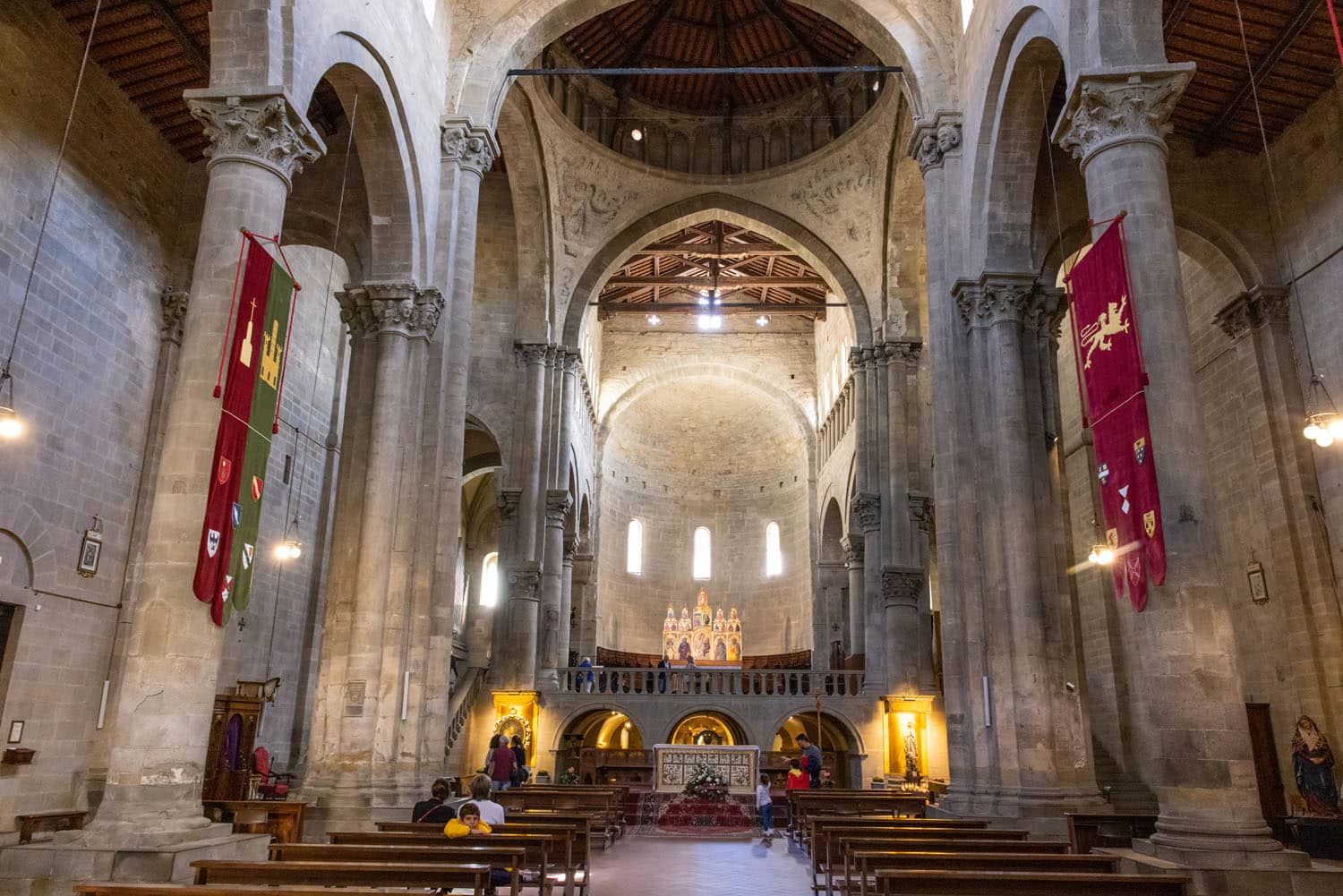
Inside the Church of Santa Maria della Pieve
4. The Arezzo Cathedral
The Arezzo Cathedral, also called the Duomo and the Cathedral of San Donato, dates back to the 13th century. The grand interior contains beautiful stained-glass windows created in the 1500’s, a bas-relief of The Baptism of Jesus by Donatello, the Chapel of the Madonna del Conforto, and colorful frescoes that cover the ceiling of the nave.
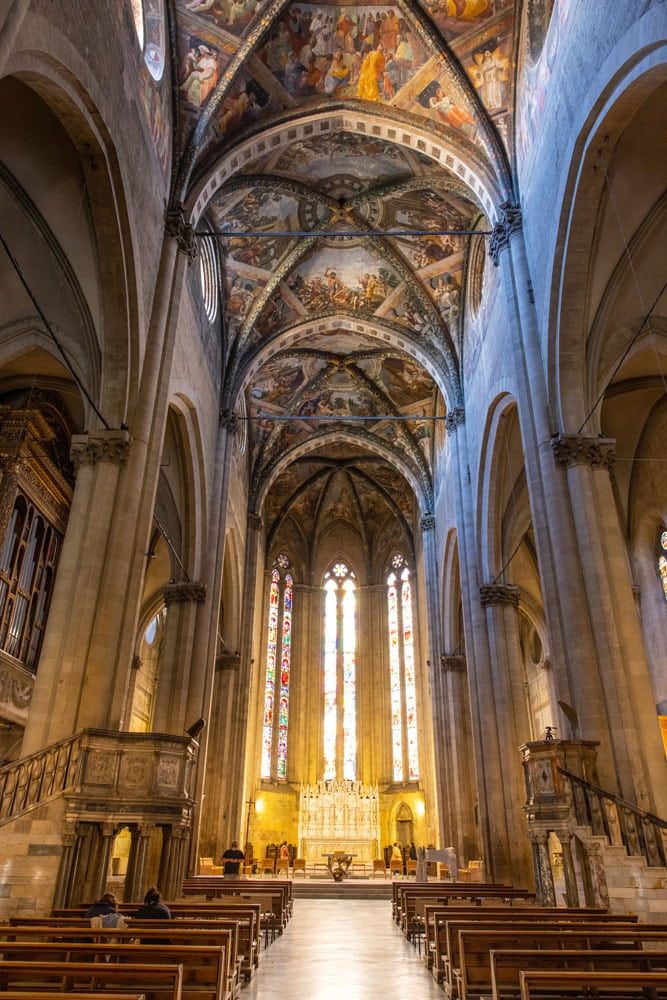
Inside the Arezzo Cathedral
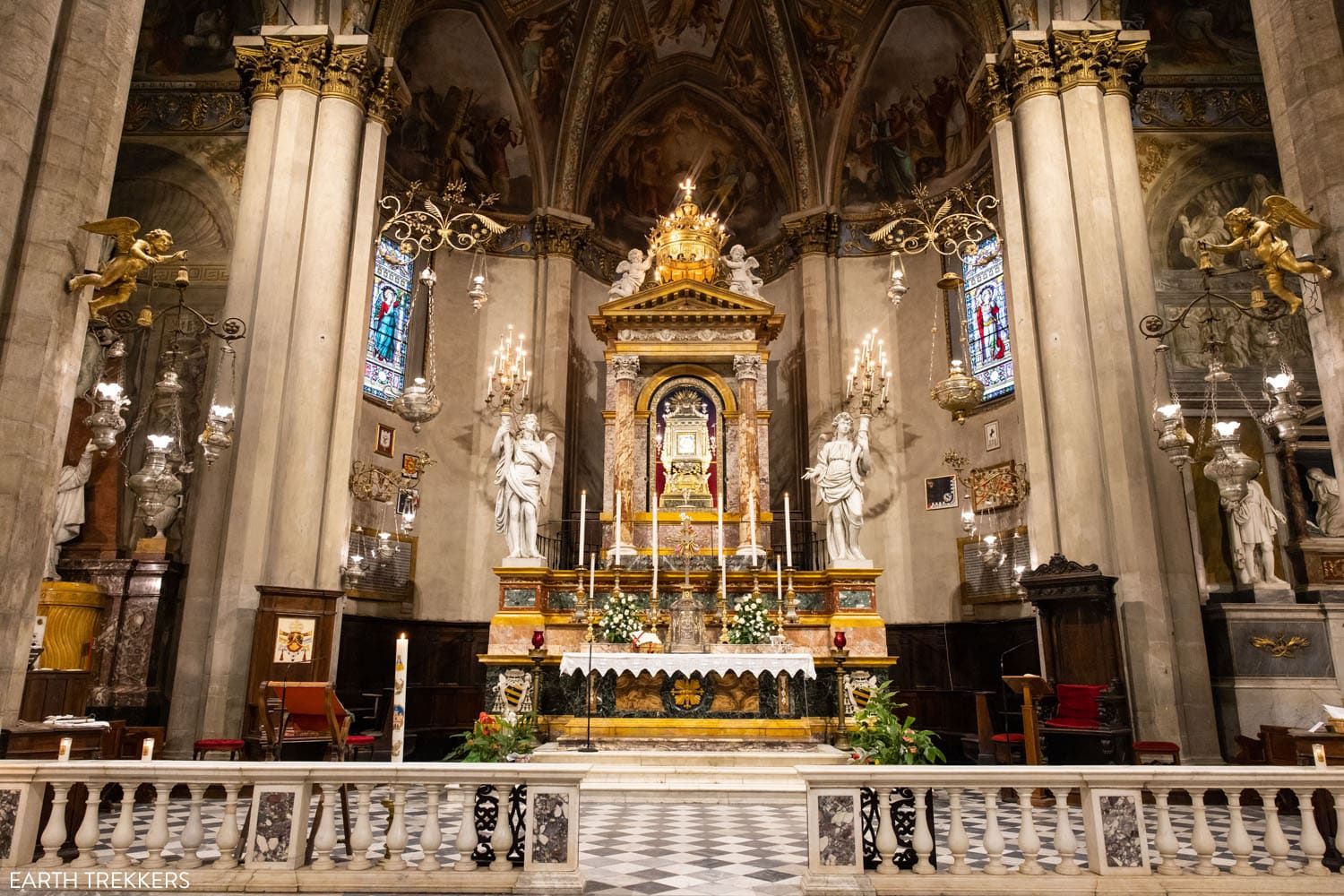
Chapel of the Madonna del Conforto
5. Enjoy the Views from Fortezza Medicea and Il Prato Park
For some of the best views in Arezzo, head to the hilltop Fortezza Medicea and the park that surrounds it.
The Medici Fortress was built in the 1500s by Cosimo I to reinforce Florentine dominance over the city, and interestingly, much of the stone used to build it was quarried from Arezzo’s own Roman amphitheater.
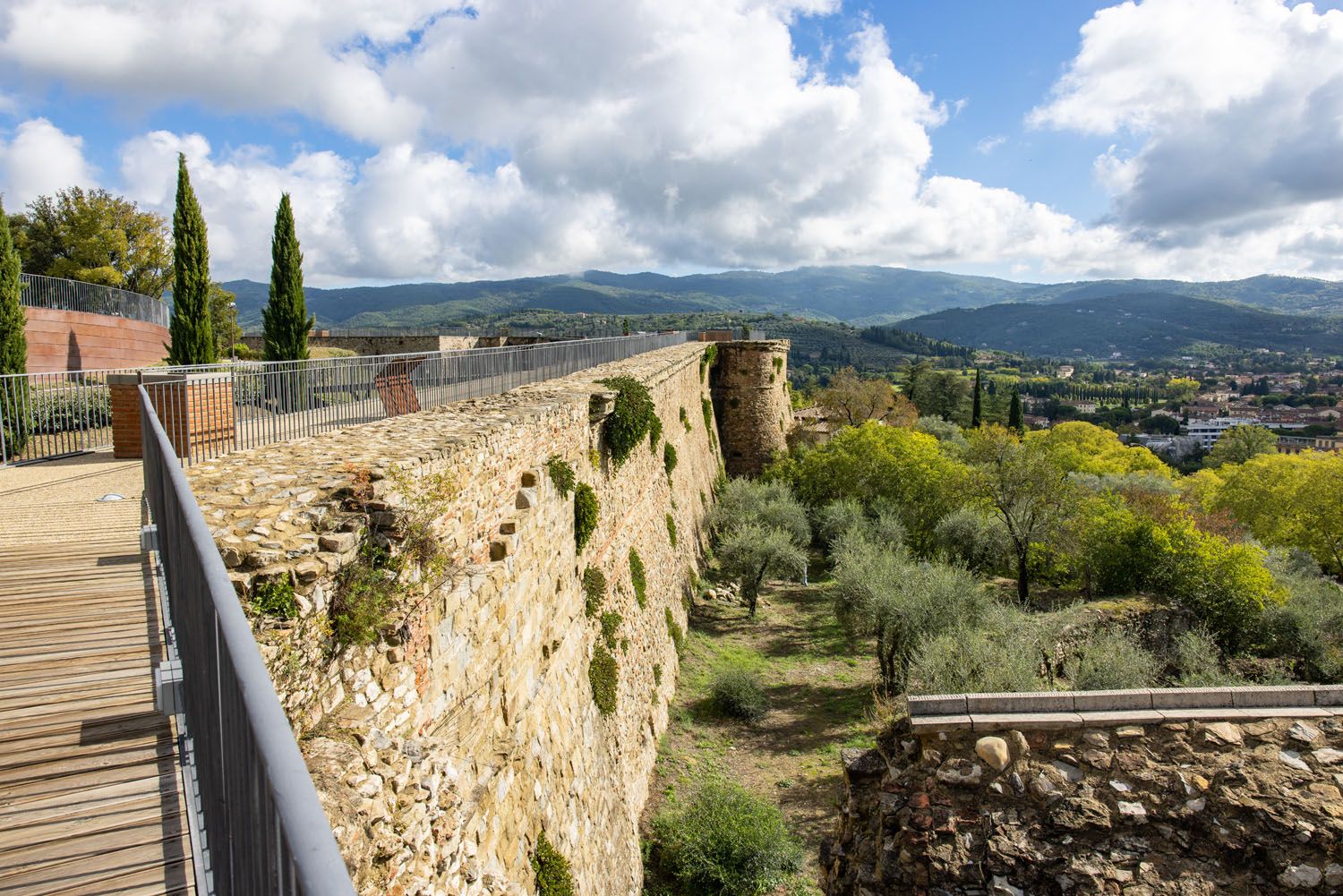
Fortezza Medicea
Today you can walk the fortress walls for sweeping views over the rooftops of Arezzo and the rolling Tuscan countryside beyond. One of the more unexpected viewpoints is of the Arezzo cemetery, which is oddly beautiful from above.
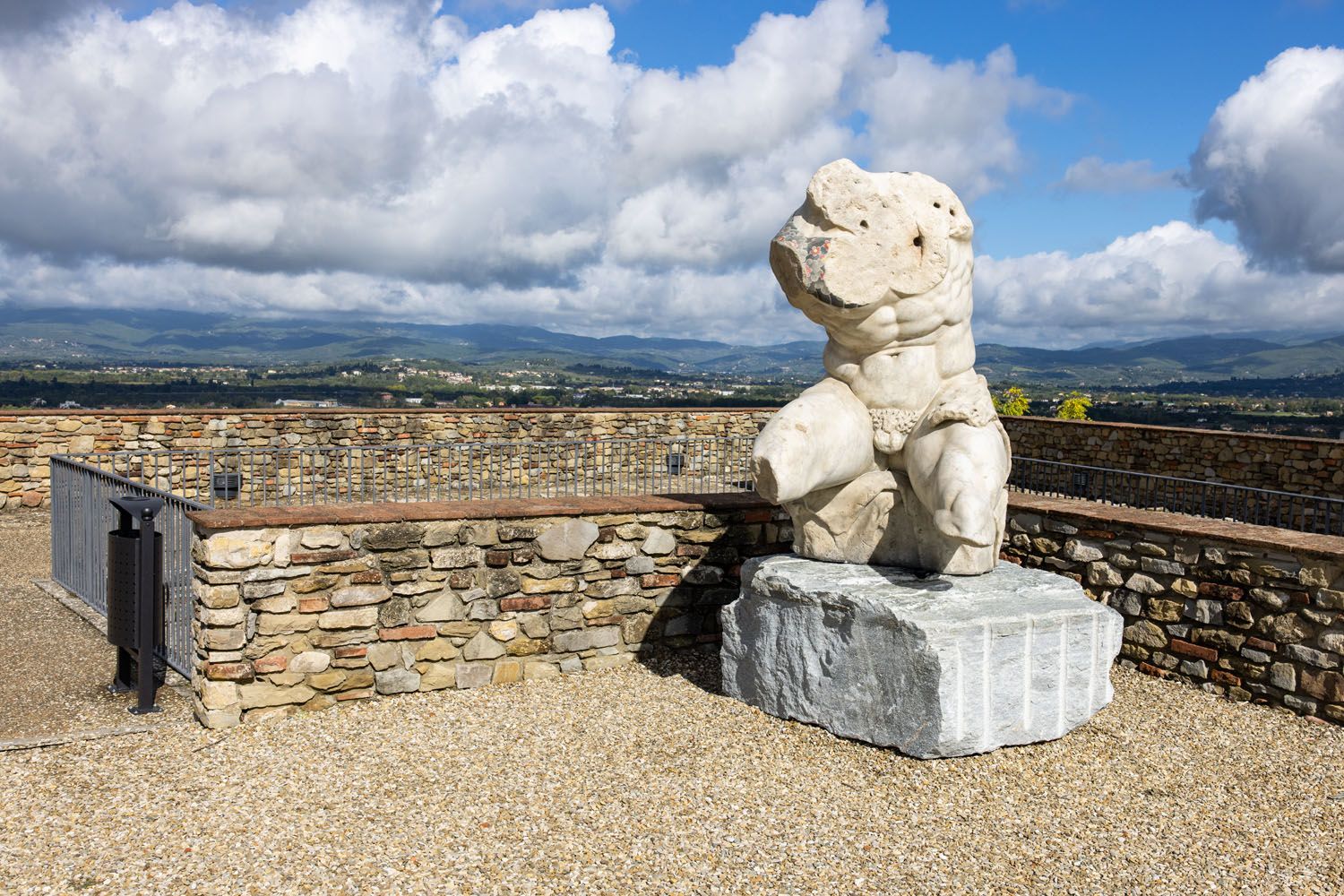
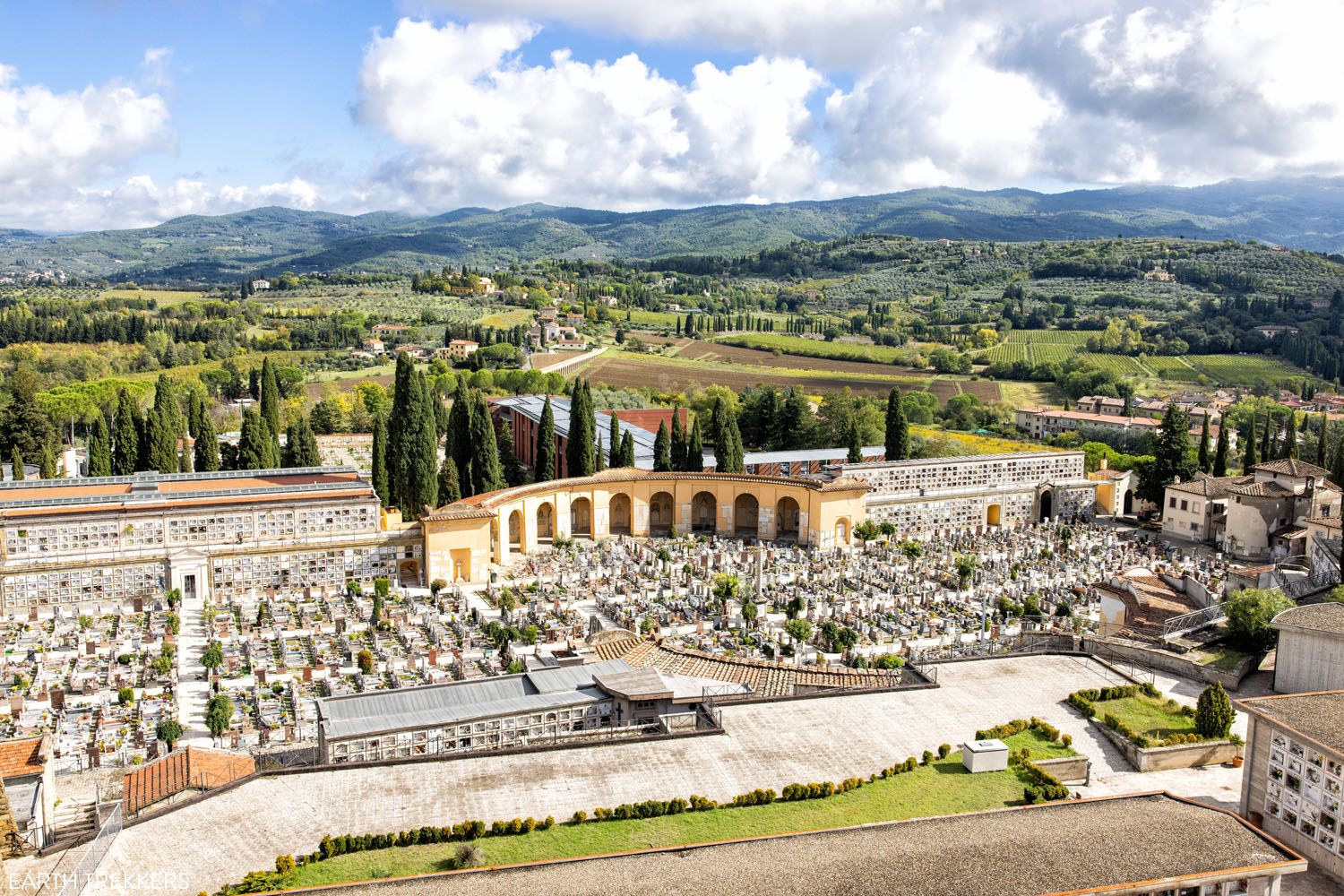
Arezzo Cemetery
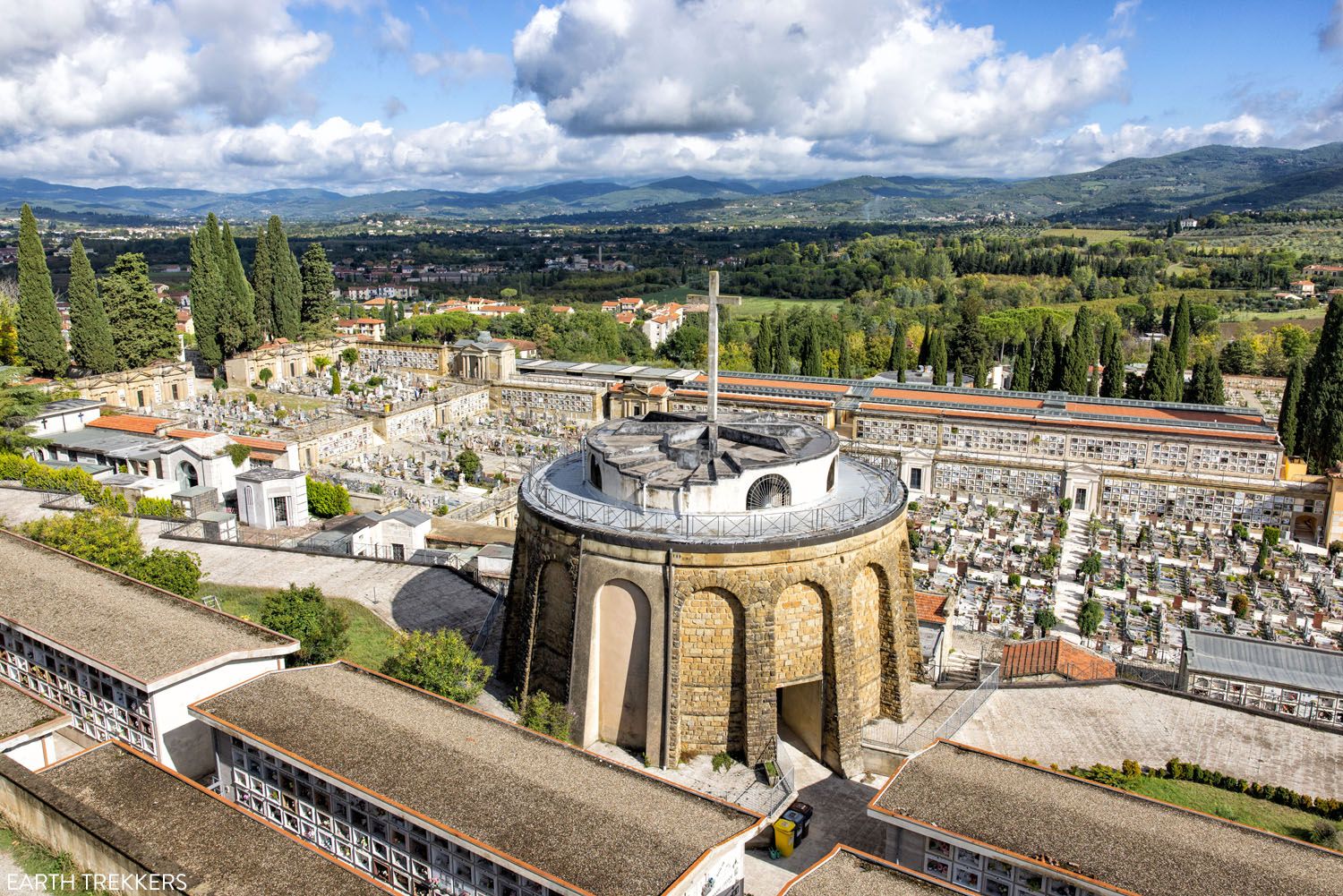
Arezzo Cemetery
Attached to the fortress is Il Prato, a quiet, shaded park that’s a favorite with locals. From the northern end, you get an open view toward the Casentino Valley and the surrounding hills, a nice contrast to the medieval streets you’ve been walking all day.
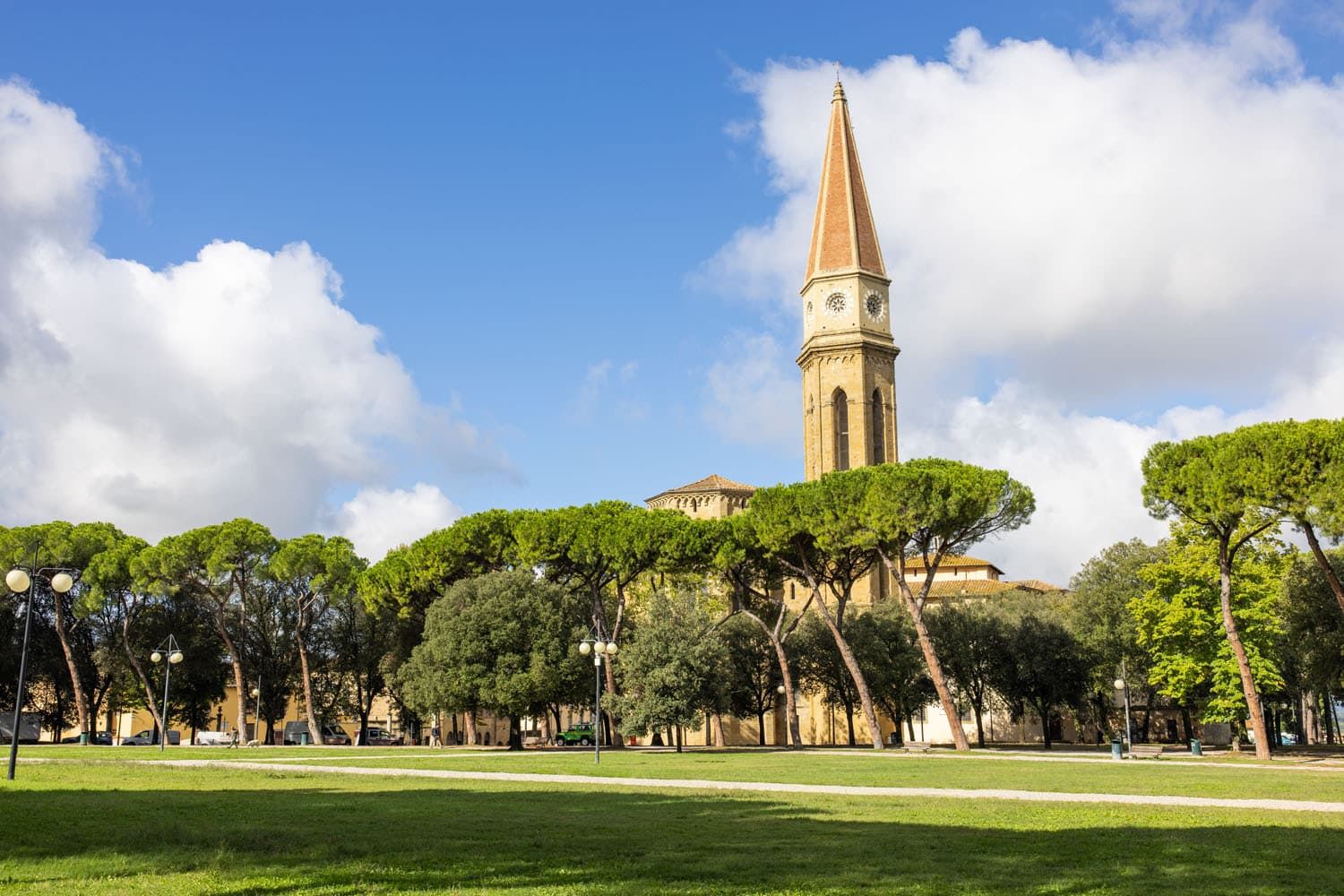
Il Prato Park
From the northern end of the park, you get a view over the rolling hills of Tuscany:
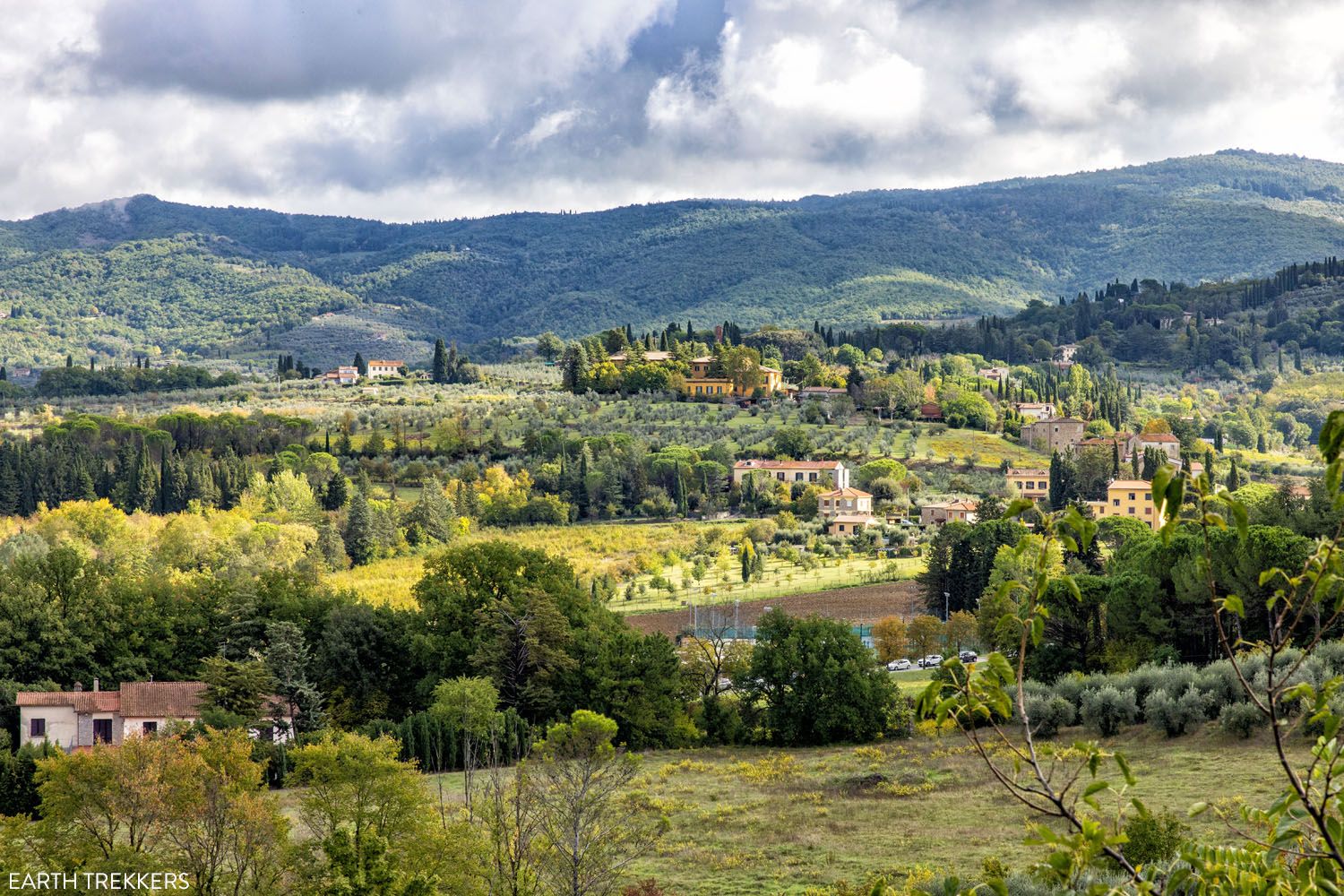
The view from the northern end of the park
At the center of the park stands a large and elaborate marble monument to Petrarch, the poet born in Arezzo in 1304, which is worth a look as you pass through.
On the south side of the park, near Tempietto alla Vittoria, there’s a lovely viewpoint looking back down Corso Italia toward the clock tower of the town hall, one of the best photo spots in the city. We’ve marked it on our map as “viewpoint of Corso Italia.”
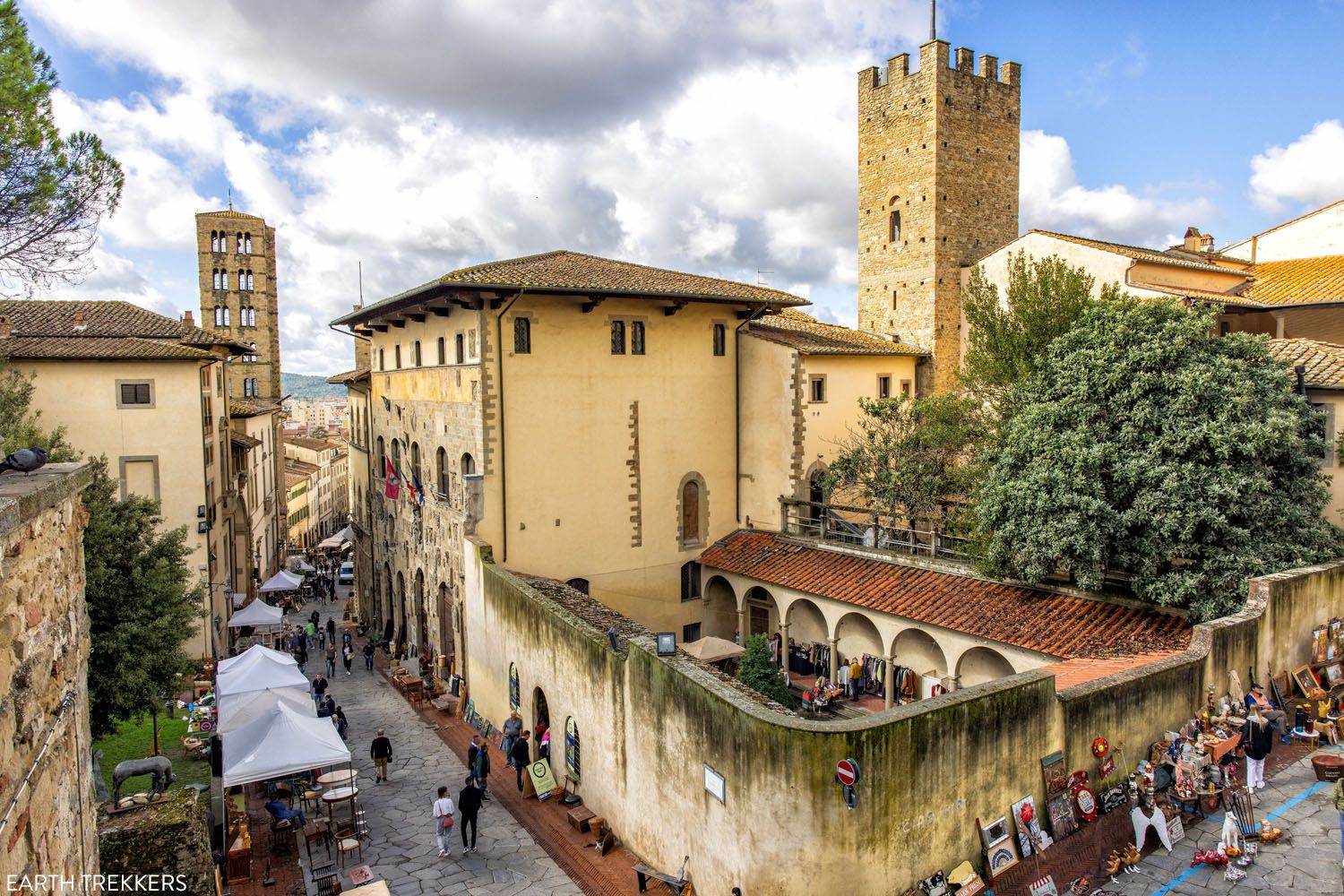
The view of Corso Italia
Plan about 30 to 45 minutes for both together. Get hours and pricing of the fortress on the official website.
6. Vasari’s House (Casa Vasari)
Giorgio Vasari was born in Arezzo in 1511 and went on to become one of the most influential figures of the Renaissance, He was a painter, architect, and writer whose contributions can be found across Tuscany. He painted the Last Judgement frescoes on the dome of the Florence Cathedral, designed the Vasari Corridor in Florence, and wrote The Lives of the Most Excellent Painters, Sculptors, and Architects, which is essentially the western world’s first art history encyclopedia. He also designed the loggia you admired in Piazza Grande.
His home in Arezzo is now a museum, and it’s a delight to walk through. Vasari decorated the ceilings and walls of each room himself, creating an immersive experience that feels like stepping inside one of his paintings. It’s a more intimate experience than many of Arezzo’s other museums and easy to combine with a visit to nearby San Domenico.
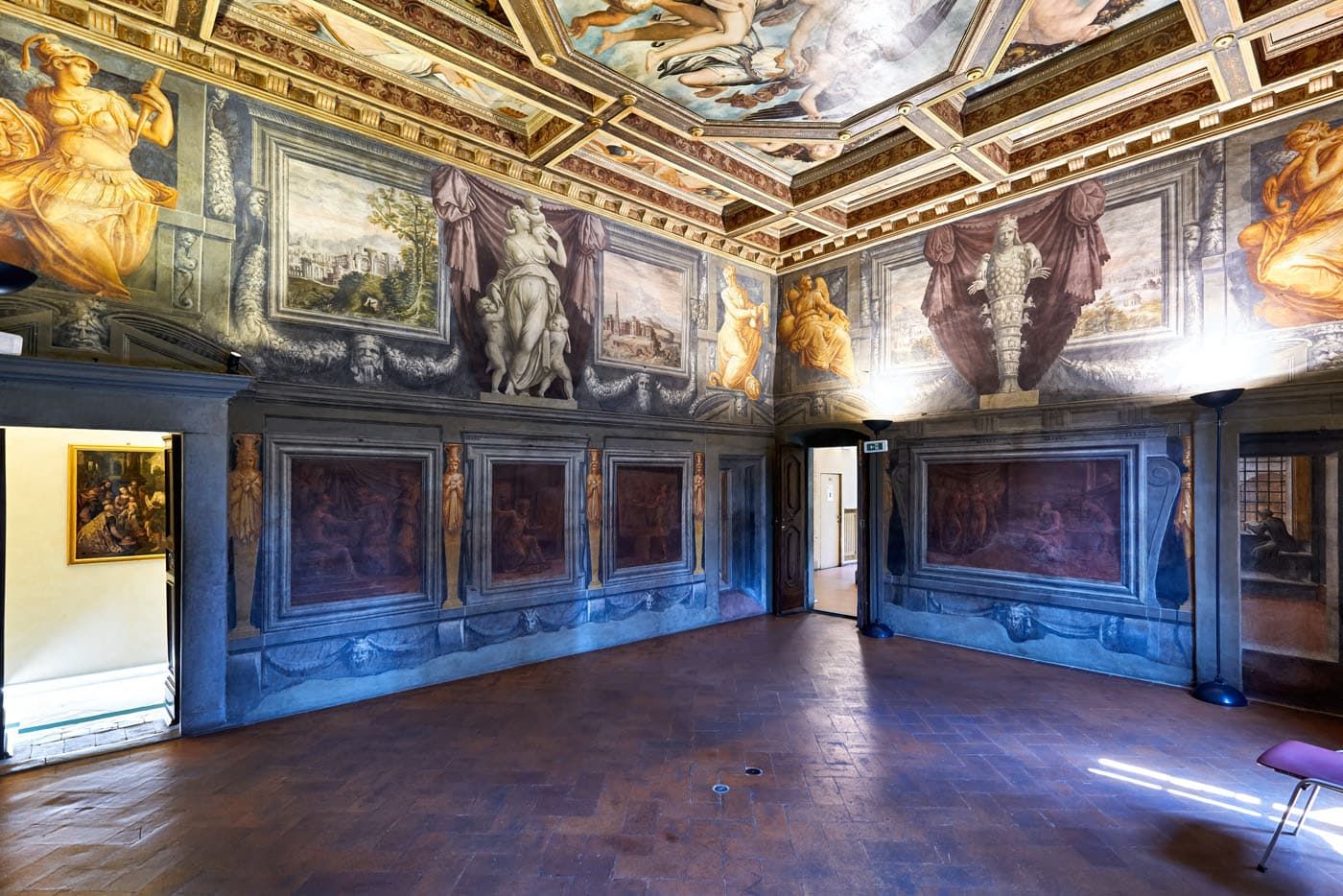
Casa Vasari | marcobrivio.photography/shutterstock.com
PRO TRAVEL TIP: During our visit, the house didn’t open until mid-afternoon, which was well outside the hours listed on the official website. This happened frequently throughout Tuscany, so we’d recommend calling ahead or checking locally before building your day around it. Get current hours and pricing at the official website.
7. Visit Casa di Petrarca (Petrarch’s Birthplace)
Most visitors to Arezzo know it as the city of Vasari, but Arezzo has a second famous son who is arguably even more celebrated in Italy. The poet Francesco Petrarch was born here on July 20, 1304, and his birthplace on Via dell’Orto is now a museum and home to the Petrarca Academy of Letters, Arts and Sciences.
Inside, the museum houses Renaissance paintings by Tuscan artists, Petrarchan relics and materials, a collection of 250 ancient coins, and a library rich in volumes related to Petrarchism. There’s also a short film about Petrarch’s life available in English, French, German, and Italian, a good orientation if you’re not already familiar with his work.
Even if you skip the interior, the building itself is worth a glance as you walk between the Cathedral and Il Prato park. It sits right along the natural route through the upper part of town. And just a short walk away in Il Prato, you’ll find the large marble monument to Petrarch that dominates the park, which is worth a stop on its own.
PRO TRAVEL TIP: Get hours on the official website before you go. During winter, the museum is only open on weekends. From late spring through early fall, it is open Thursday through Tuesday (closed Wednesdays).
8. The Palace of Fraternita dei Laici
This beautiful building sits on Piazza Grande, next to Santa Maria della Pieve.
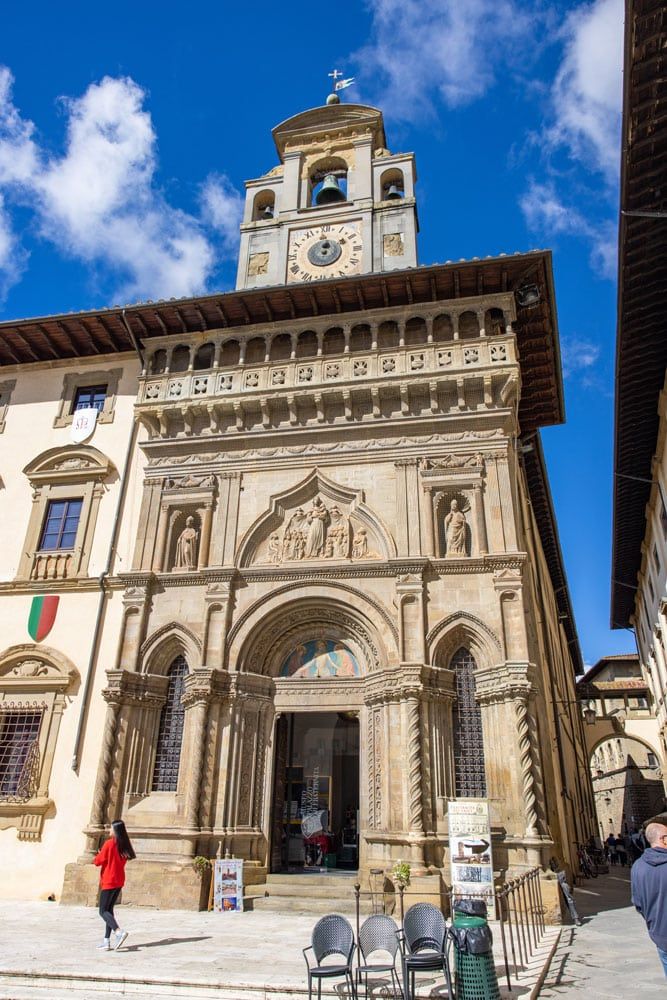
Palace of Fraternita dei Laici
The outside of the building is adorned with sculptures created by Bernardo Rossellino: the Madonna della Misericordia and statues of Pope Blessed Gregory X and St. Donald.
On top of the palace is one of the oldest functioning clocks in Italy. This is such a notable place to visit that it gets its own entry next.
You can simply admire this building from Piazza Grande or you can go inside to visit the Museum of Fraternita, which contains more than 6000 paintings, sculptures, and antique furnishings.
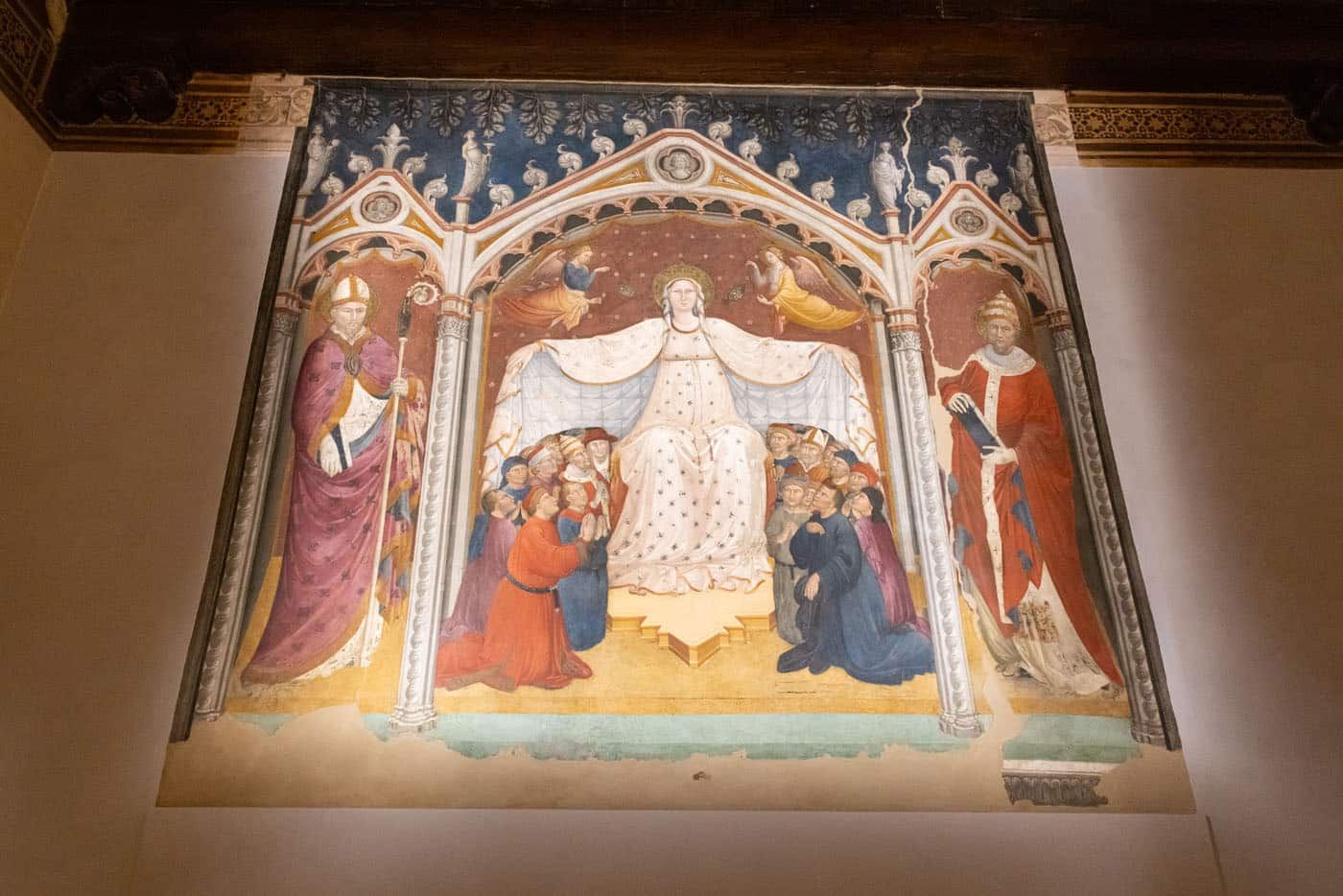
Mural painting of Madonna della Misericordia
9. Enjoy the View from the Clock Tower
The clock that sits on top of Palace of Fraternita dei Laici is one of the oldest functioning clocks in Italy. It was completed in 1552 by Felice di Salvatore da Fossato and it continues working today.
The main reason to visit the clock tower is for the view over Piazza Grande. This was our favorite view of Arezzo, with views of Piazza Grande, the antique market, and the colorful shields.
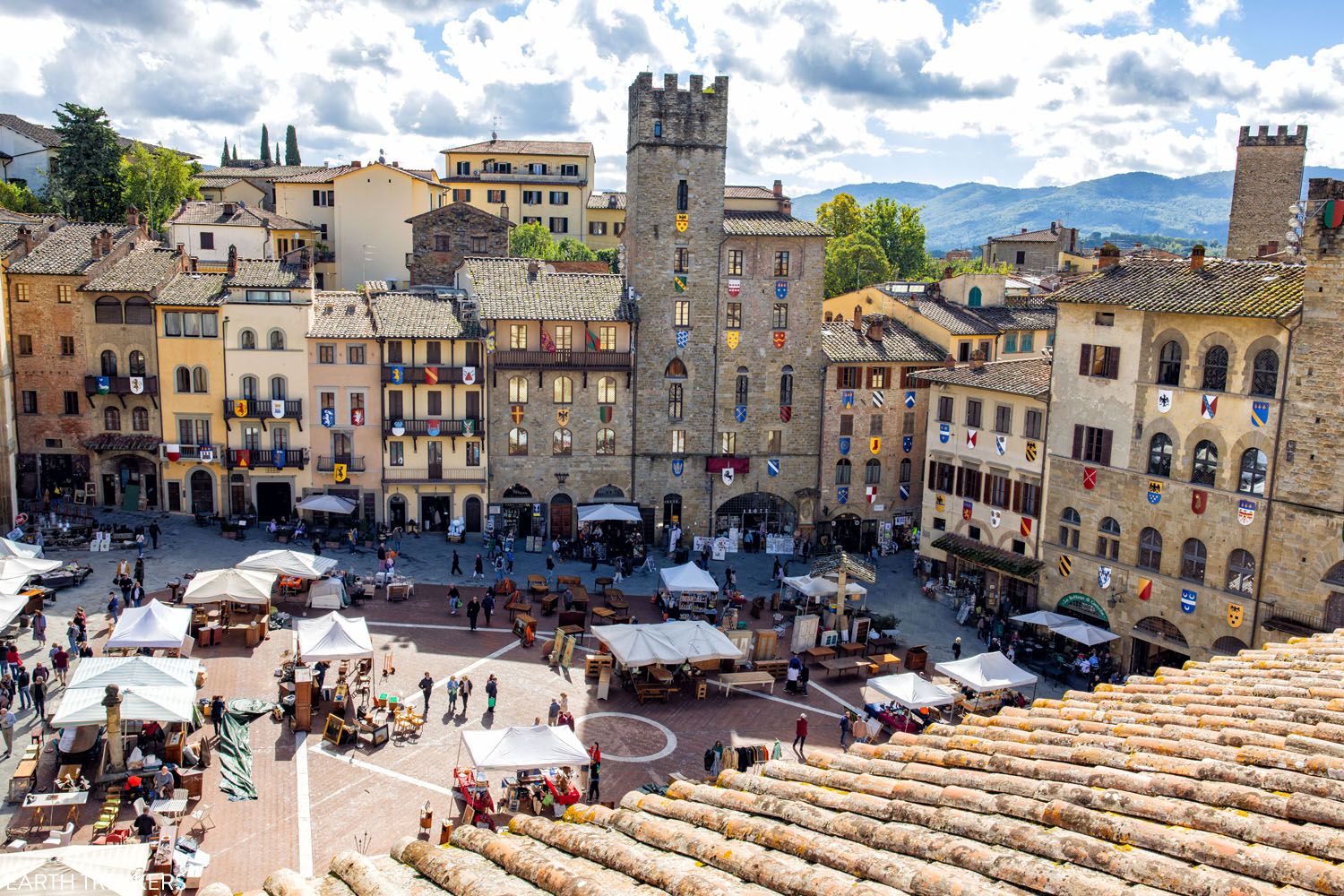
Piazza Grande
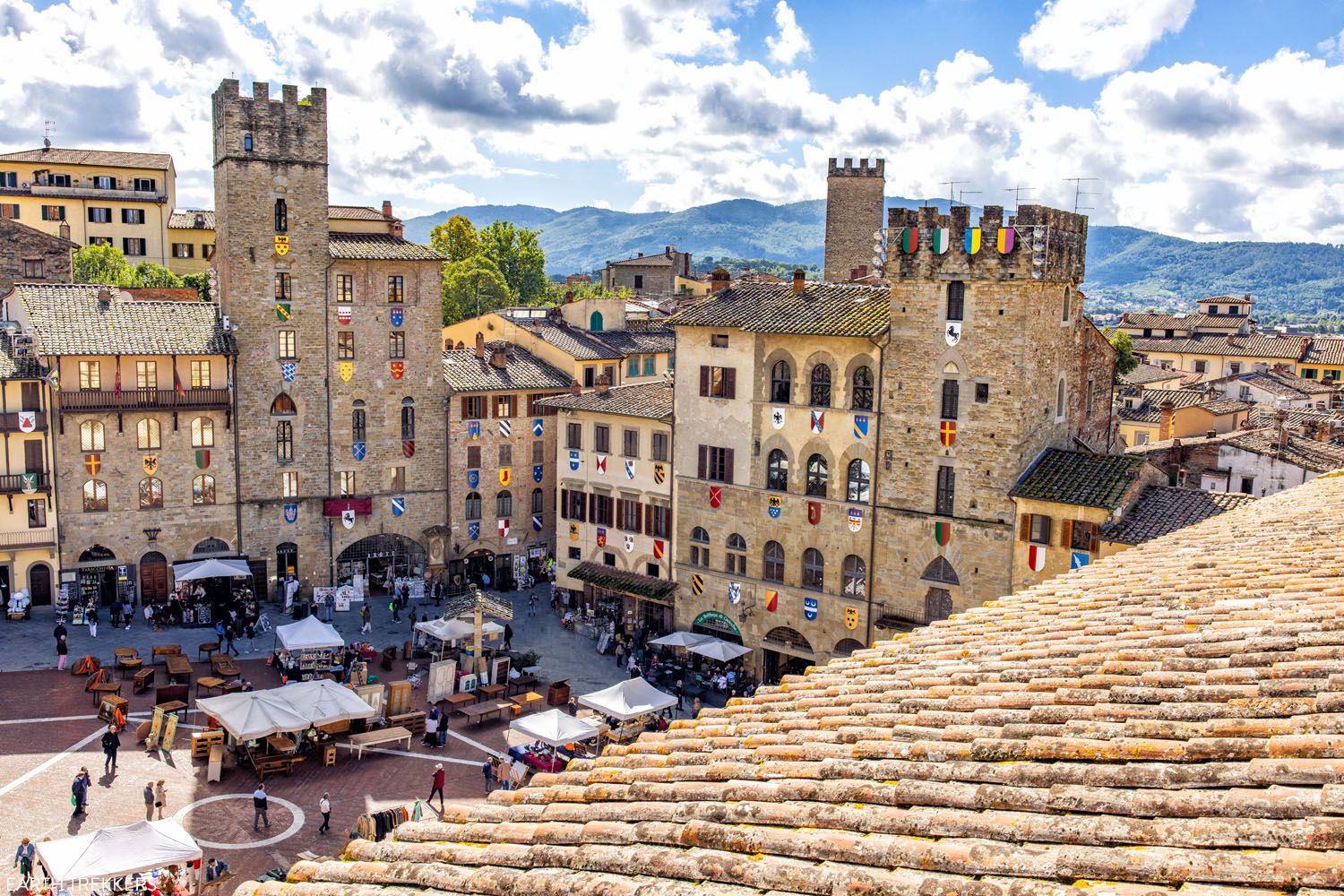
Another view of Piazza Grande
To visit the clock tower, you enter through the Palace of Fraternita dei Laici. There is a small entrance fee to visit the museum.
10. Stroll along Corso Italia
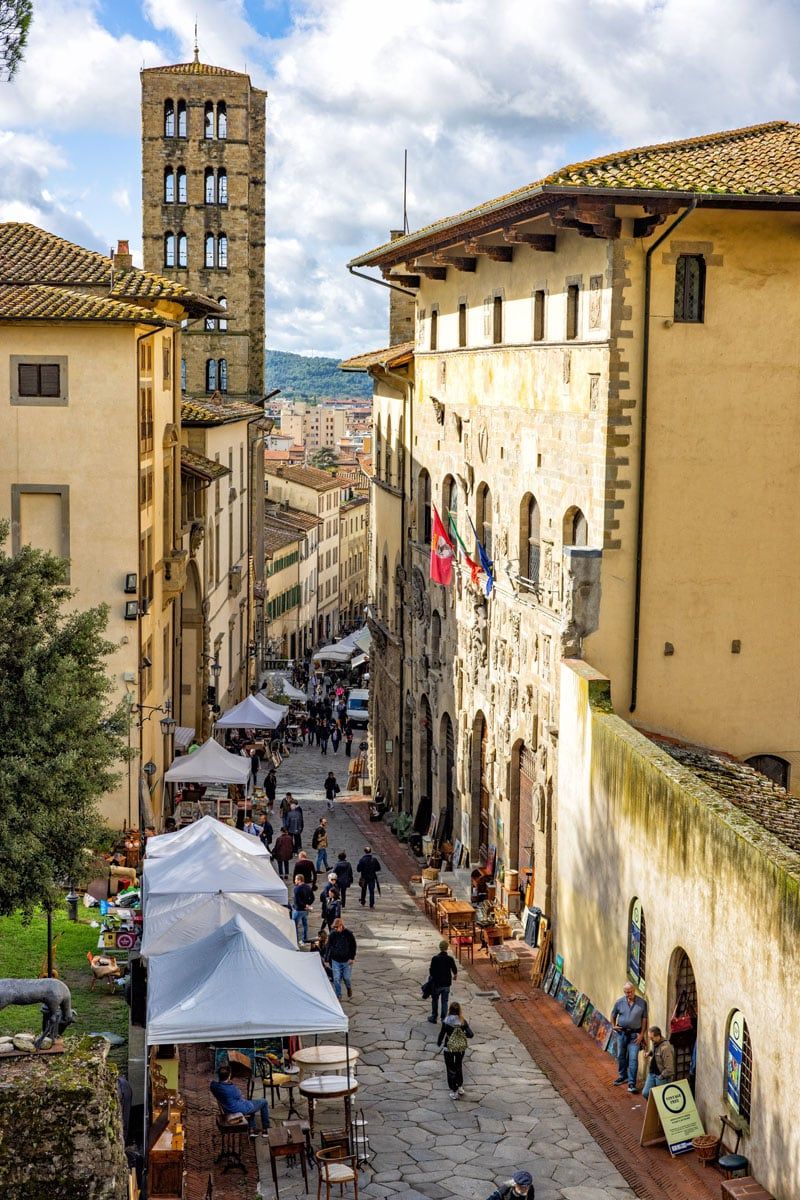
Corso Italia is the main thoroughfare through Arezzo. It starts near Santa Maria della Pieve and runs downhill towards the train station. This busy pedestrian street is lined with shops, cafes, and during the antique fair, many stalls selling antiques and artwork.
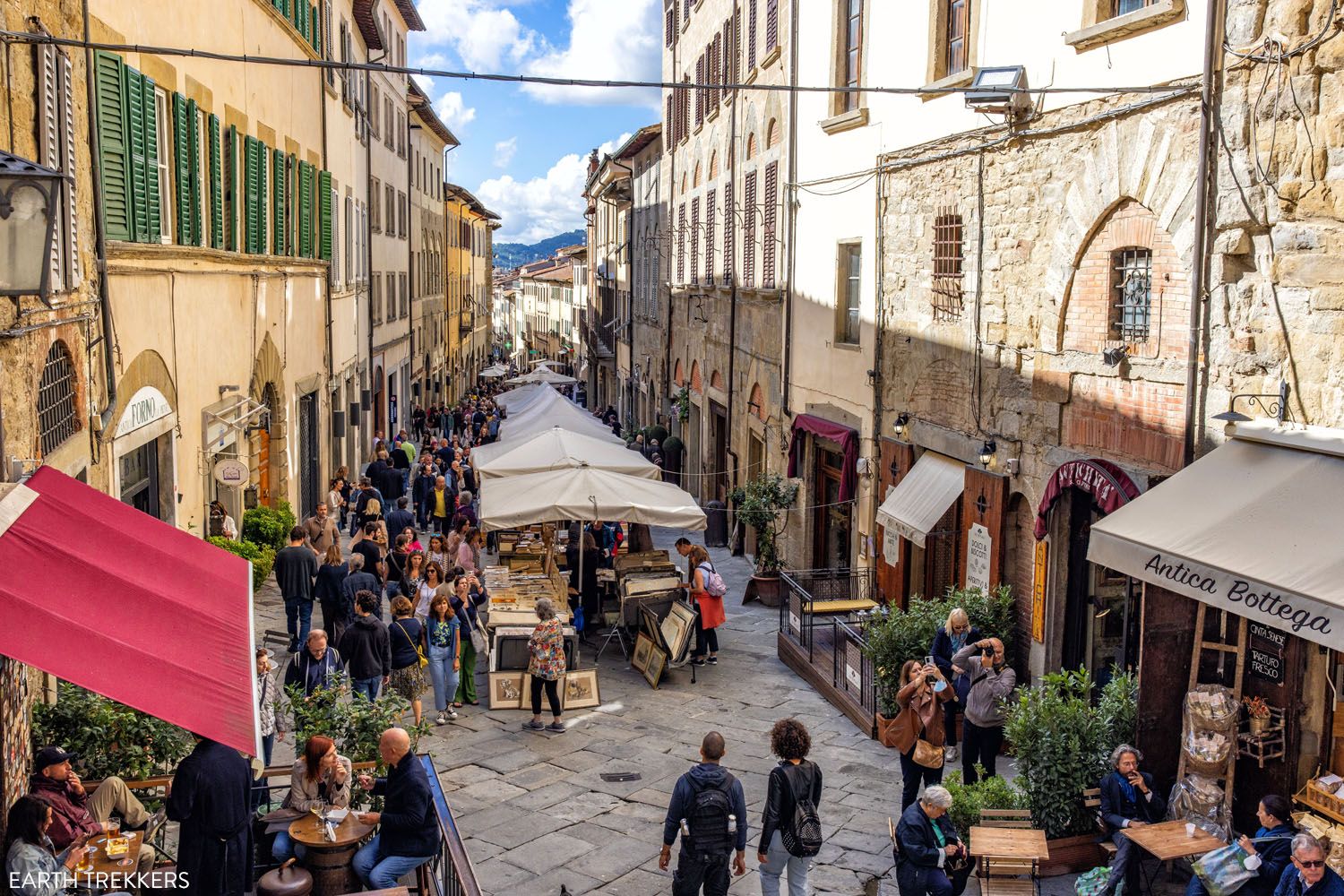
Corso Italia
11. Go Shopping at the Antique Market
On the first Sunday of every month, Piazza Grande and the side streets are filled with vendors selling antiques. Approximately 400 stalls are set up throughout the city, selling jewelry, artwork, furniture, toys, home goods, and clothing.
We just happened to be in Arezzo on the first Sunday of October. The city center had a very festive vibe and was quite busy, both with visitors and those shopping for antiques.
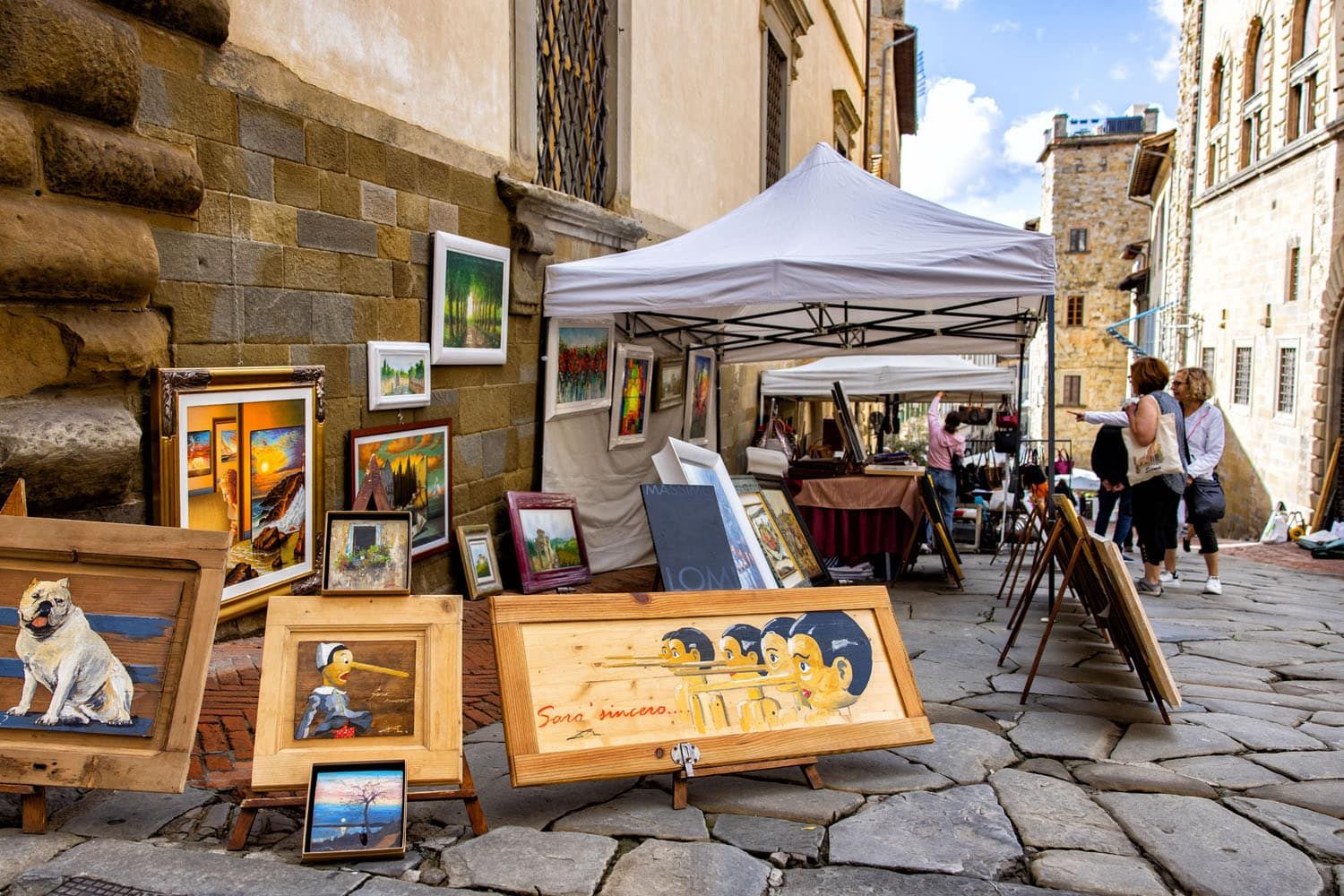
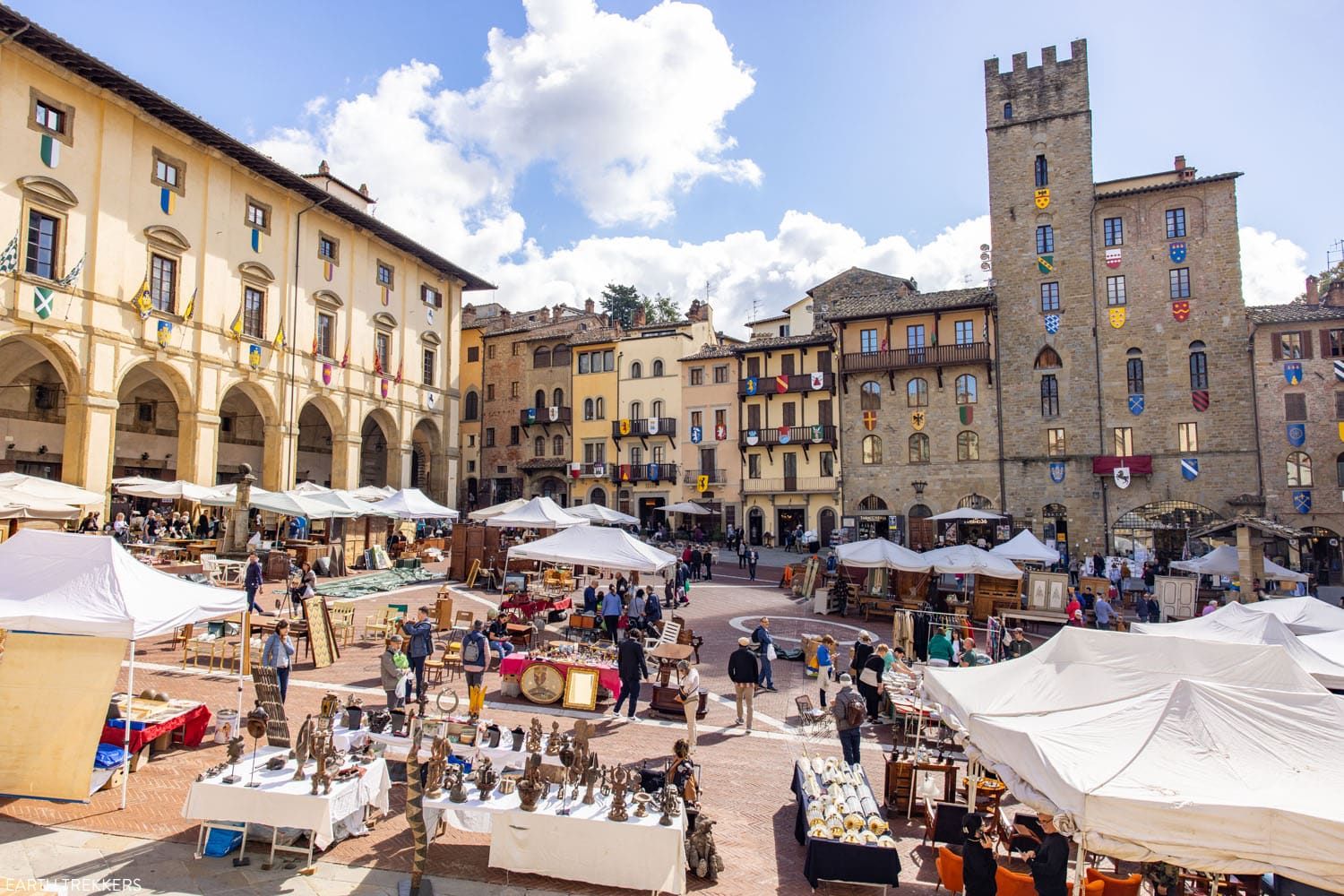
Arezzo antique market
12. Piazza della Libertà
Piazza della Libertà is another large square in Arezzo. Sitting around this square are the town hall (Palazzo dei Priori) and its clock tower, the Arezzo Cathedral, the Saracen Jousting Museum, and the Mudas Museum.
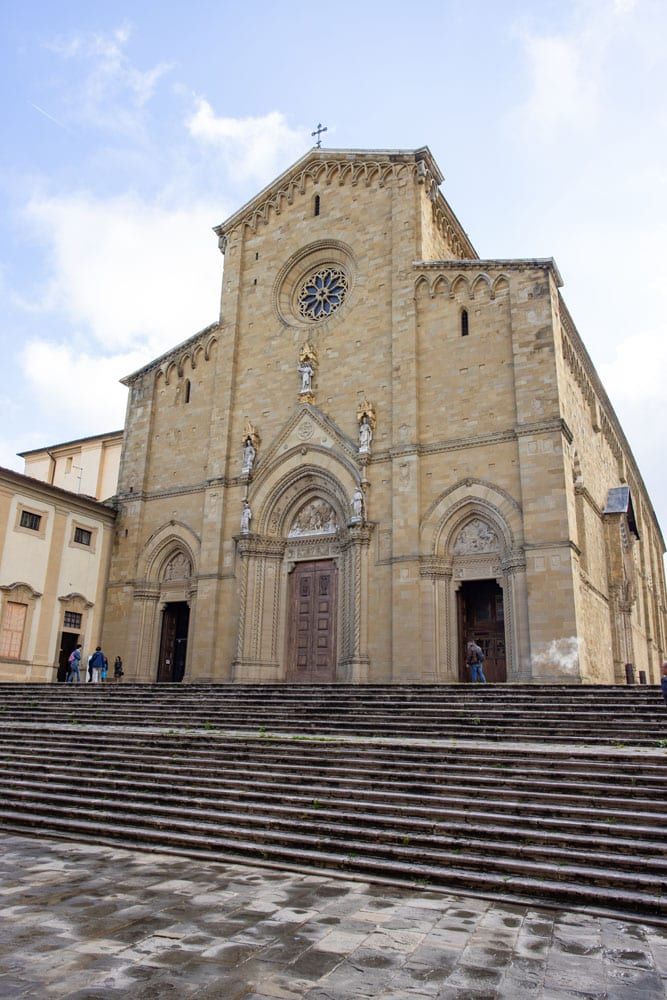
Arezzo Cathedral
13. The Saracen Jousting Museum
The Saracen Jousting Museum, also called the I Colori della Giostra museum, has exhibits and artifacts of the jousting reenactments that are held in Arezzo. It is a quick, entertaining museum to visit, with videos and the garments worn by the jousters.
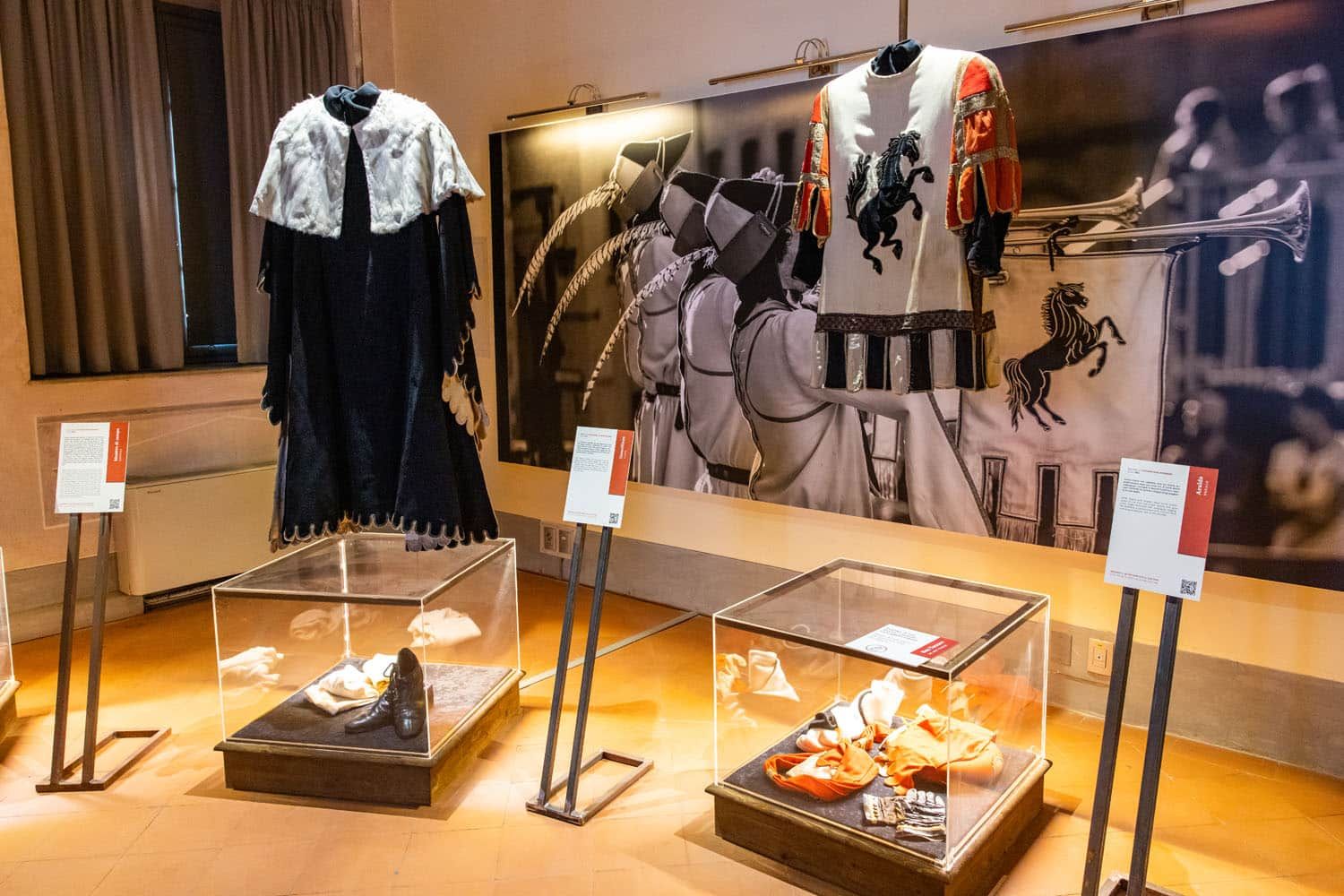
Saracen Jousting Museum
It is located on Piazza della Libertà. Get hours and pricing here.
14. Basilica of San Domenico
This small basilica is a short walk from the city center of Arezzo but it is worth the visit to see the Crucifix by Cimabue and the frescoes that cover the walls of the church, including the Crucifixion by Parri di Spinello.
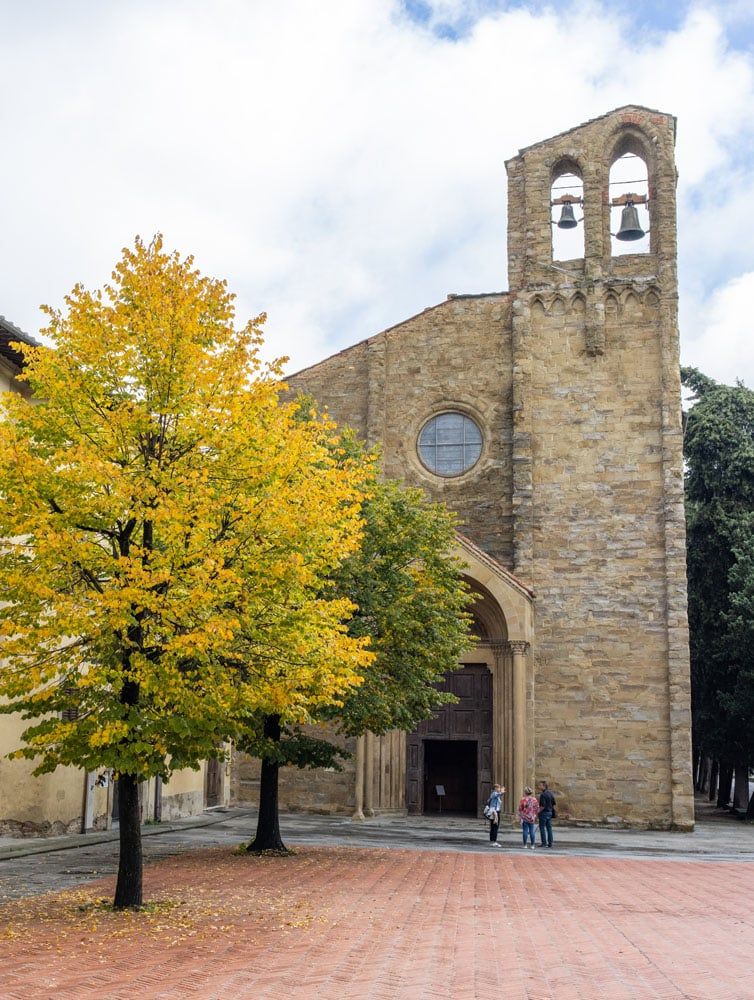
Basilica of San Domenico
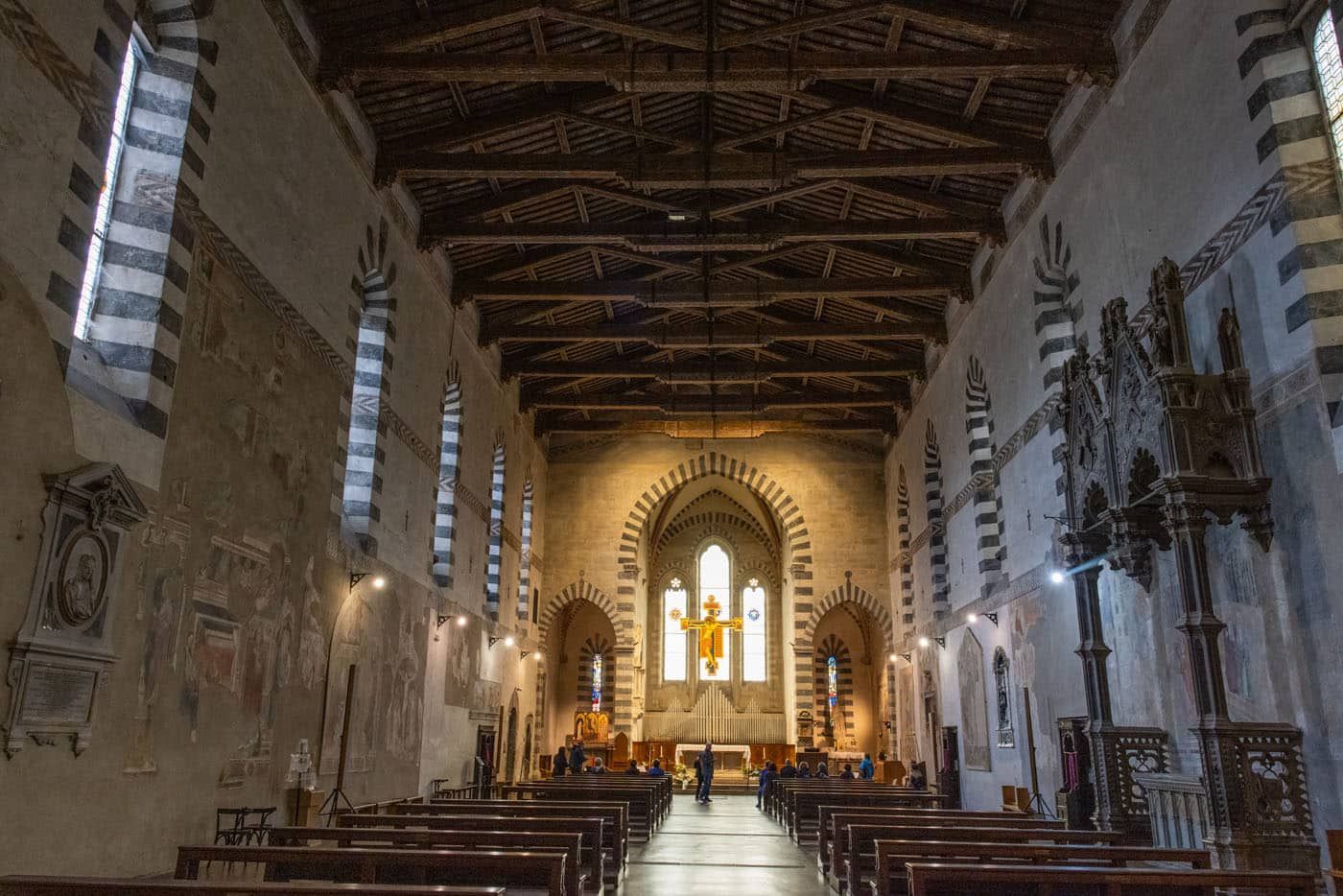
Inside the Basilica of San Domenico
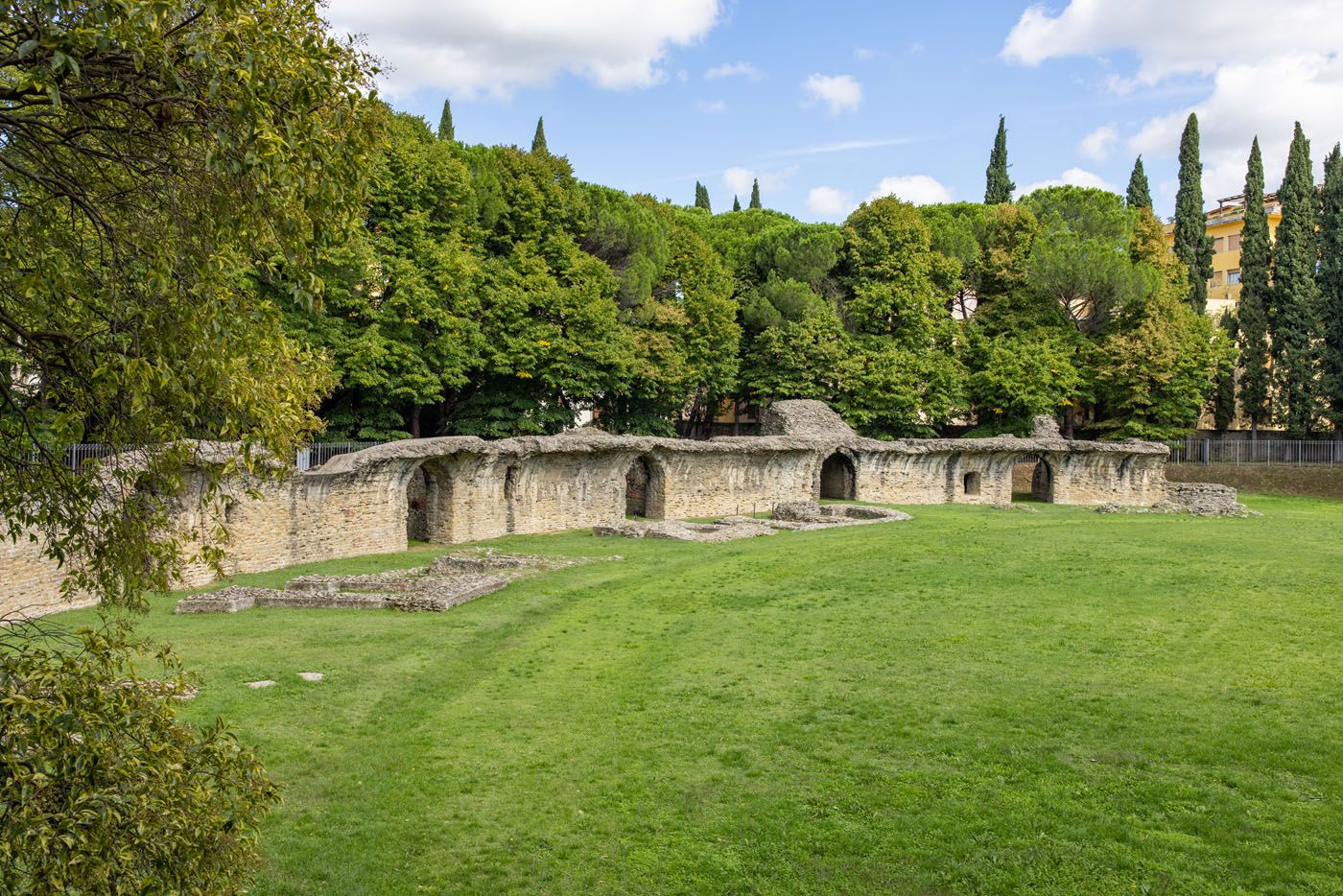
15. The Archaeological Museum & Roman Amphitheater
Most people know Arezzo for its Renaissance art, but the city has a much older story to tell. The Gaio Cilnio Mecenate National Archaeological Museum traces Arezzo’s history back through Roman and Etruscan times across 26 galleries on two floors.
The standout exhibits are the examples of Arretine ware, which is the distinctive red-glazed pottery that was produced in Arezzo and exported across the entire Roman Empire, making the city one of the ancient world’s most important centers of ceramic production.
The building sits alongside the remains of the Roman Amphitheater, which once held around 10,000 spectators. Much of it was dismantled over the centuries, and some of its stone was even used to build the Fortezza Medicea, but what remains is still evocative, and the museum does a good job of contextualizing what the site once looked like.
This one is best suited to history enthusiasts rather than a must-do for every visitor. But if you have a full day in Arezzo and an interest in the ancient world, it’s a worthwhile stop. It’s conveniently located near the train station, making it a natural first or last stop of the day.
16. Mudas Museum
The Mudas Museum (Museo Diocesano di Arte Sacra) is located on Piazza della Libertà. It contains frescoes by Giorgio Vasari and Luca Signorelli and sacred jewelry, the most important being the “Pace di Siena.”
Get hours and pricing here.
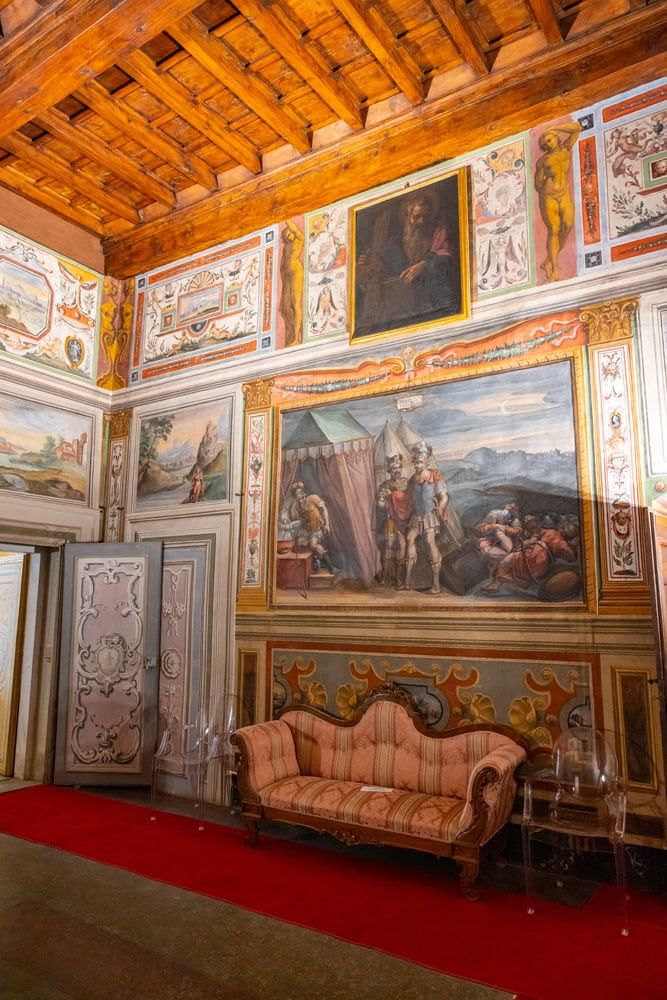
Mudas Museum
Things to Do in Arezzo: On a Map
All of the sights listed above are packed into Arezzo’s compact historic center, which makes the town remarkably easy to explore on foot. Use the map below to plan your route. We found it easiest to start at the top of the hill near the Cathedral and work our way down toward the train station.
How to Use This Map: Click the icons on the map to get more information about each point of interest. To take this map with you, click the star next to the title of the map which adds it to your Google account. Next, within your Google Maps app, select ‘Saved’ and then select ‘Maps’. This map title will now appear in your list.
How Much Time Do You Need in Arezzo?
A half day gives you enough time to see the highlights if you move quickly: Piazza Grande, a church or two, and a stroll along Corso Italia. But a full day is what we’d recommend. Arezzo is the kind of town that rewards a slower pace, and with world-class Renaissance art, a hilltop fortress, and some of the best lunch spots in Tuscany, there’s no reason to rush through it.
If you’re day-tripping from Florence or Siena, a full day is very doable. Both cities are about an hour away by train or car. If you’re on a Tuscany road trip, Arezzo also makes a great overnight base for exploring the surrounding hill towns and the Casentino Valley.
One Day in Arezzo: A Suggested Itinerary
Arezzo is compact and walkable, which makes it easy to cover the highlights in a single day. Here’s how we’d structure it:
Morning
Start at the top of the hill. Begin with the Arezzo Cathedral. Arrive early and take your time with the stained-glass windows and Donatello’s baptismal font relief. This is the best time to visit the Jousting Museum or the Mudas Museum, if you have interest in those (they are interesting but skippable).
From there, stroll through Il Prato park for panoramic views over the Casentino Valley and a look at the Petrarch monument. Walk the walls of the adjacent Fortezza Medicea for sweeping views over the rooftops and rolling Tuscan countryside.
Then head downhill to Piazza Grande. This is the heart of Arezzo and deserves a slow, unhurried look.
Afternoon
Have lunch on or near Piazza Grande before your pre-booked time slot at the Basilica of San Francesco. Piero della Francesca’s Legend of the True Cross is the highlight of any visit to Arezzo so don’t rush it.
Afterward, visit the Church of Santa Maria della Pieve and Vasari’s House if it’s open (call ahead to confirm hours). If time allows, the Archaeological Museum and Roman Amphitheater are a short walk from the train station and make a natural endpoint to the day.
Evening
Arezzo has a lovely, unhurried atmosphere after the day-trippers leave. Stroll back up Corso Italia for the passeggiata, do a little shopping or antique browsing, and consider staying for dinner if your schedule allows. You’ll have the town largely to yourself.
Where to Eat in Arezzo
We had a great lunch at Osteria Grande, which sits on Piazza Grande. Typically, restaurants on the main squares in Italy get mediocre reviews for their food, but this restaurant is different. Everything we had was delicious and the setting is unbeatable. However, it is a bit pricey.
Other recommended restaurants include Trattoria Cavour 42 (a highly rated restaurant serving traditional Italian dishes), Ristorante La Pieve (on Corso Italia across from Santa Maria della Pieve), La Chiavi D’Oro (a Michelin-starred restaurant), and Teorema del Gusto (a restaurant in a cave like setting).
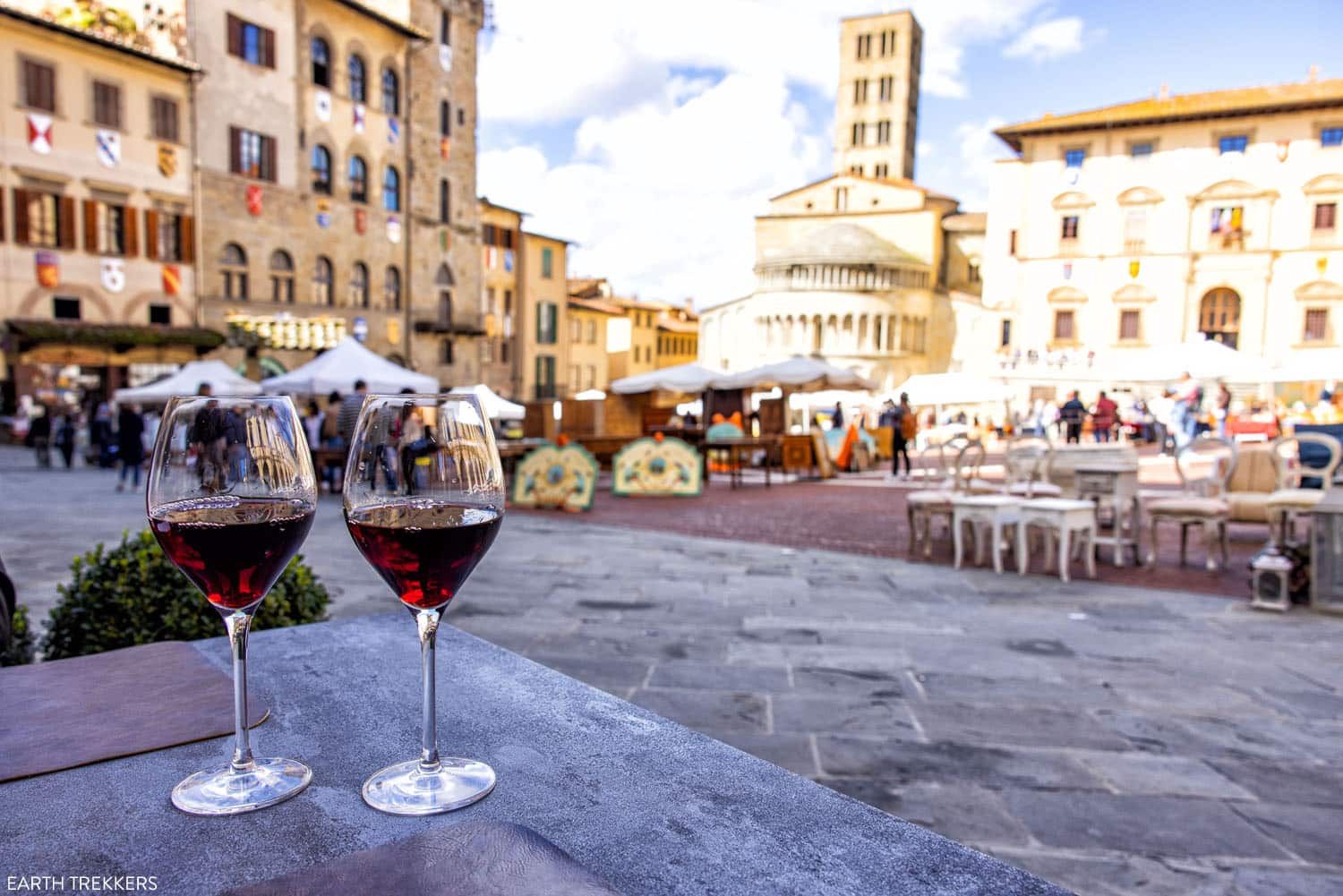
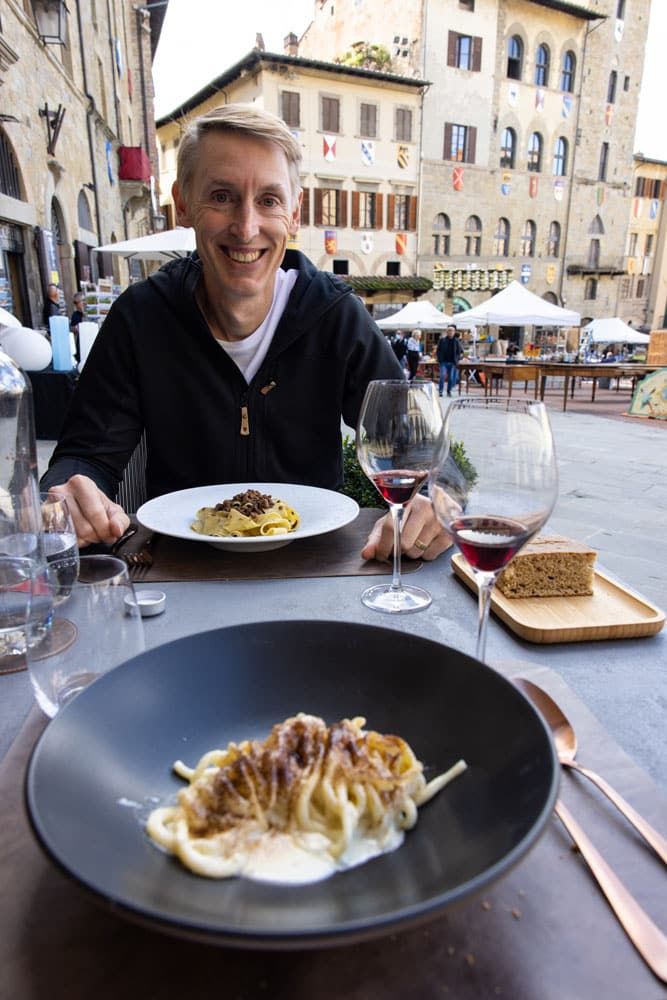
Dining at Osteria Grande
How to Get to Arezzo
Arezzo is located in the southeast corner of Tuscany. You can get here by bus, train, car, and on a tour.
By Train
There are three train stations in Arezzo. The main station is located on Piazza della Repubblica, on the southwest side of town. From here, it is a quick walk up Corso Italia or Via Guido Monaco to get to the main sites in town.
From Florence, there are frequent trains to Arezzo and the journey takes 1 hour to one and a half hours, depending on the speed of the train.
By Bus
The bus station is located next to the main Arezzo train station. If you are traveling by bus, there are frequent buses from Siena to Arezzo.
By Car
Arezzo is also easy to get to by car. Here are the driving distances and times from nearby destinations:
- Cortona: 30 km, 45 minutes
- Florence: 77 km, 1 hour 15 minutes
- Siena: 70 km, 1 hour 15 minutes
- Montepulciano: 55 km, 1 hour
- Perugia: 95 km, 1 hour 15 minutes
- Assisi: 115 km, 1.5 hours
- San Marino: 130 km, 2.25 hours
There are several parking lots located outside of the city center. We parked at Parcheggio Eden ATAM, which is very close to the Archaeological Museum. Another convenient parking lots is Parcheggio Cardorna. There will be a small hourly fee for each of these lots.
Things to Do Near Arezzo
One of Arezzo’s greatest strengths as a base is its location. You’re within easy reach of some of the best hill towns and landscapes in Tuscany.
Cortona — 45 minutes by car. One of the most beautifully situated hill towns in Tuscany, with sweeping views over Lake Trasimeno. Easy to combine with Arezzo as a two-stop day.
Montepulciano — 1 hour by car. A classic Tuscan hill town famous for its Vino Nobile wine and stunning main square. Worth at least a half day.
Siena — 1 hour 15 minutes by car. One of the great medieval cities of Italy, with the magnificent Piazza del Campo and the famous Palio horse race.
Florence — 1 hour 15 minutes by car or 1 hour by train. The anchor of any Tuscany trip and easily done as a day trip from Arezzo.
Sansepolcro — 45 minutes by car. The birthplace of Piero della Francesca, whose Resurrection fresco here has been called one of the greatest paintings in the world. A must for anyone who loved the frescoes in Arezzo.
Anghiari — 30 minutes by car. A small, beautifully preserved walled town that sees far fewer tourists than its neighbors. Worth a short stop if you’re heading toward Sansepolcro.
The Casentino Valley — 30 to 45 minutes by car. A quieter, wilder side of Tuscany. The Foreste Casentinesi National Park offers excellent hiking, while the Sanctuary of La Verna and the Hermitage of Camaldoli are two of the most atmospheric religious sites in all of Italy.
Where to Stay in Arezzo
Casa Mirko is a very highly rated bed and breakfast that sits just outside of Arezzo.
Cuprena is a beautiful villa 8 km (5 miles) from Arezzo. Surrounded by gardens and featuring spacious rooms and suites, this is a lovely place to stay for a few days to explore Arezzo and the nearby Tuscan towns.
Casa Torre has several small apartments with a kitchen and washing machine, so it makes a great pick for those traveling long term and or want to stay in the city center of Arezzo. The top terrace of this property has awesome views of Arezzo.
Frequently Asked Questions
Is Arezzo worth visiting?
Absolutely. Arezzo is one of the most rewarding towns in Tuscany. It has world-class Renaissance art, one of the most distinctive main squares in Italy, and a laid-back atmosphere that feels genuinely local. It gets a fraction of the tourists that Florence and Siena receive, which makes the experience all the more enjoyable. We’d put it on any Tuscany itinerary without hesitation.
Is Arezzo worth a day trip from Florence?
Yes, we enjoyed our visit to Arezzo. It’s easy to visit, since the train from Florence takes about an hour and runs frequently, and a full day gives you plenty of time to see the highlights. There were a few towns we liked more – Montepulciano, Siena, and Pienza are on this list – but they are more popular and draw bigger crowds. If you want to tour a medieval hill town with lower crowds, Arezzo is a great one to put on your list.
What is Arezzo famous for?
Arezzo is famous for its monthly antique market, the oldest and largest in Italy, its twice-yearly Saracen Joust reenactments in Piazza Grande, and for being the birthplace of Renaissance artist Giorgio Vasari. It is also home to Piero della Francesca’s Legend of the True Cross frescoes in the Basilica of San Francesco, considered one of the great masterpieces of Italian Renaissance art.
When is the Arezzo antique market?
The antique market takes place on the first Sunday of every month, with stalls also set up on the Saturday before. Around 400 vendors fill Piazza Grande and the surrounding streets. It’s a fun time to visit but expect the town to be busier than usual.
Do I need to book tickets for the Basilica of San Francesco in advance?
Yes, and we can’t stress this enough. Visits to the Bacci Chapel are by reservation only, limited to 30 people per session. Tickets sell out quickly, especially in spring and fall. Book ahead at museiarezzo.it to avoid missing out. We made the mistake of not booking in advance and the tickets were sold out by the time we arrived.
More Help Planning Your Trip to Tuscany
Arezzo is just one piece of what makes Tuscany such a remarkable region to explore. If you’re still in the planning stages, our Tuscany Itinerary will help you figure out how to fit Arezzo into a broader trip, and our guide to the Best Things to Do in Tuscany covers the region’s highlights from top to bottom.
We also have in-depth guides to many of the Tuscan hill towns closest to Arezzo — including San Gimignano, Pienza, Siena, and Volterra — so you can plan each stop with the same level of detail. And if you’re planning a broader trip through Italy, our Italy Travel Guide has everything you need.
If you have any questions about the best things to do in Arezzo or how to plan your visit, let us know in the comment section below.
More Information for Your Trip to Italy
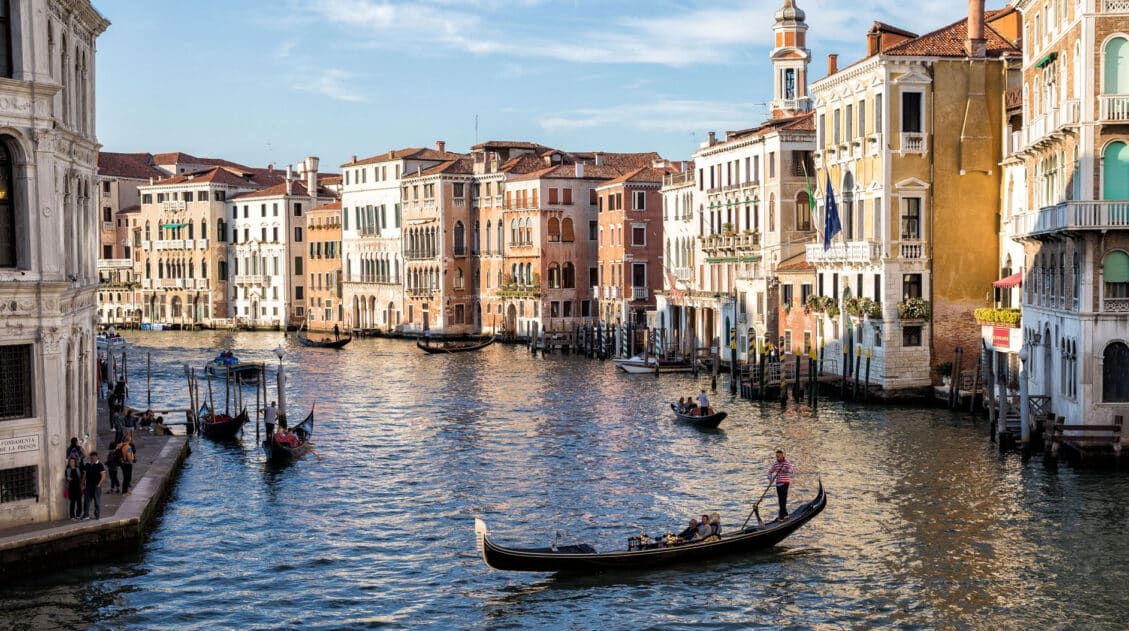
10 Days in Italy: 5 Itineraries for Every Type of Traveler
Pinterest Facebook Flipboard With 10 days in Italy, you have enough time for an incredible trip, but not enough time to see everything. That’s the good news and the hard news at once. Italy is enormous, wildly varied, and deeply worth savoring. The biggest mistake most people make when planning a 10-day Italy itinerary is […]
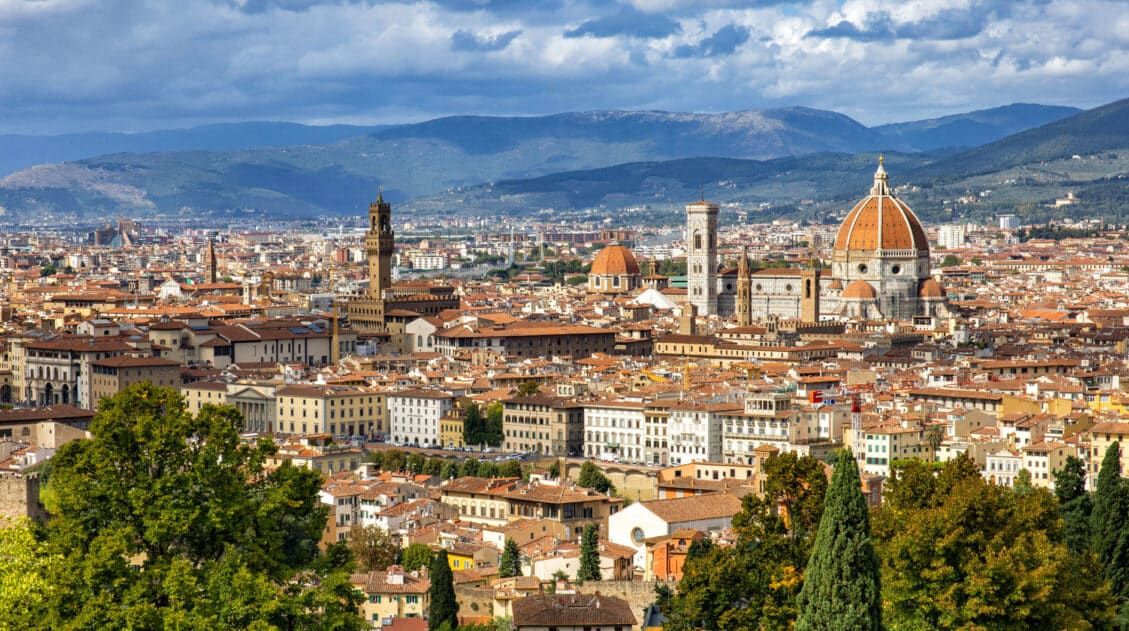
2 Days in Florence: Detailed Day-by-Day Itinerary
Two days in Florence is the sweet spot for a first visit. It’s enough time to see everything that matters, without the feeling that you’re sprinting from one landmark to the next. With two days, you can climb the dome of the Florence Cathedral, stand in front of Michelangelo’s David, spend a proper morning in […]
20 Best Things to Do in Bologna, Italy
Bologna doesn’t get the attention it deserves. The best things to do in Bologna revolve around food, from rolling fresh pasta in a cooking class, wandering the Quadrilatero while cheese wheels and cured meats hang in every doorway, and sitting at a wine bar long enough to understand why locals call this city La Grassa, […]
15 Amazing Things to Do in Alberobello (With Photos & Helpful Tips)
Have you ever seen photos of a place and think “that can’t be real.” Well, that’s what we thought when we first saw photos of Alberobello. This tiny town looks like it has been plucked from the pages of a fairytale. Alberobello is famous for its trulli, small round buildings with conical roofs made of […]
25 Best Places to Visit in Italy
After six trips to Italy, these are the 25 places to visit in Italy we keep recommending — the ones that reward first-timers and repeat visitors alike, from the iconic cities of Rome and Florence to lesser-known gems like Matera and Puglia. We’ve been to Italy six times over the past ten years, and we’re […]
One Day in Assisi, Italy: Walking Tour & Itinerary
Discover the best of Assisi’s historic city center on this self-guided walking tour, covering the Basilica di San Francesco, Rocca Maggiore, and more in just five hours. Assisi is one of Italy’s most beautiful and undervisited cities. This UNESCO World Heritage Site is perched on the slopes of Monte Subasio, with a spiritual atmosphere, extraordinary […]
Best Things to Do in Montepulciano: Wine Cellars & Beyond
Planning your list of things to do in Montepulciano? This hilltop town in southern Tuscany is one of the most atmospheric places in the region, known for its Renaissance architecture, sweeping views over the Val d’Orcia, and its famous Vino Nobile wine. Perched on a hilltop in Val d’Orcia, Montepulciano is compact but packed with […]
Things to Do in Lucca, Italy: Best Sights, Tips & More
Lucca is one of Tuscany’s most rewarding cities to visit. While Florence gets the crowds and Pisa gets the selfies, Lucca has a charm that’s entirely its own: Renaissance city walls you can walk or bike, medieval towers rising above the rooftops, and a piazza built inside a Roman amphitheater. What we loved most was […]
12 Best Views of Florence, Italy (A Photographer’s Guide)
Discover the best views of Florence, from the dome of the Duomo to Piazzale Michelangelo at sunset, with photos from every viewpoint, photography tips, and a map. Florence is one of the most photogenic cities in the world, and after several trips here, we can say with confidence that getting up high is one of […]
One Day in Venice: 3 Different Ways to Plan Your Itinerary
One day in Venice itinerary: 3 different ways to plan your time, whether you want the top sights, the quiet canals, or a mix of both. If you are planning to spend one day in Venice, there are several ways to do it. Do you want to spend the day visiting the top sights in […]
Travel Photography Gear Guide: What’s In Our Camera Bag
Do you want to know how we capture the images that you see on our website? Here is our photography gear guide, with links and explanations of our photography gear and accessories. At the end of this post, we offer tips and tricks on how to take better photographs while traveling. October 2025 Update: We […]
Italy Travel Guide: How to Plan a Trip to Italy
Italy Travel Guide From the ruins of ancient Rome to the hiking trails of the Dolomites, the trulli of Puglia to the hilltop villages of Tuscany, Italy is a country that rewards every kind of traveler, and keeps pulling you back. We’ve traveled to Italy six times, exploring the country from the lakes and mountains […]


Comments 8